Waltey
Zgodba o grbavcu, kristjanu, oskrbniku, Judu in krojaču
Tisoč in ena noč · arabska pripovedna tradicijaO besedilu
Zgodba o grbavcu, kristjanu, oskrbniku, Judu in krojaču
- Vir
- Tisoč in ena noč
- Avtor
- arabska pripovedna tradicija
- Jezik branja
- English
- Jezik izvirnika
- Arabic
- Čas branja
- 12 min branja
- Obseg
- 9 strani
- Naslov izvirnika
- حكاية الأحدب والنصراني والمباشر واليهودي والخياط - الليالي ٢٤ إلى ٢٥
O izvirniku
Tisoč in ena noč
Zgodbe v zgodbah, polne trgovcev, dvorov, preoblek in nočnih zapletov. Bralni jezik je English, izvirnik pa prihaja iz vira Tisoč in ena noč v jeziku Arabic.
Besedilo
Zgodba o grbavcu, kristjanu, oskrbniku, Judu in krojaču
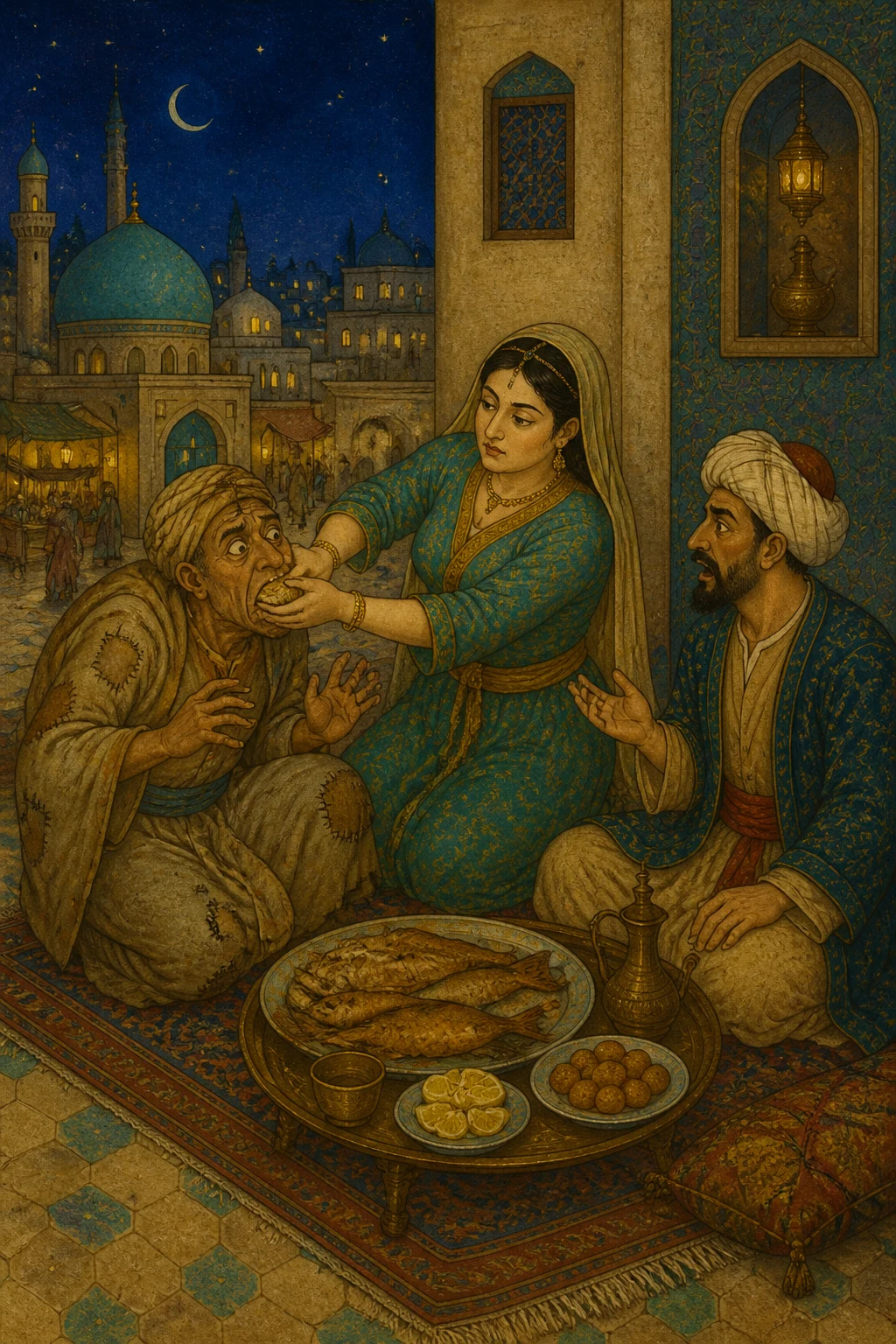
She said: It has reached me, O fortunate king, that long ago, in ages past, there lived in a city of China a tailor who was comfortably off and fond of merriment and music. From time to time he and his wife would go out to admire the wonders of the pleasure gardens. One day they went out early in the morning and were returning home toward evening when they met a hunchback whose very appearance could make an angry man laugh and banish sorrow and care. The tailor and his wife drew near to enjoy the sight of him, then invited him home to keep them company that night. He accepted and went with them. The tailor went out to the market, and, as night had fallen, bought fried fish, bread, lemons, and sweets for dessert. He returned, set the fish before the hunchback, and they sat down to eat. The tailor’s wife took a large piece of fish and thrust it into the hunchback’s mouth, clapping her hand over it. “By God,” she said, “you shall swallow it all at once, in a single gulp! I will not give you time to chew it.” He swallowed, but there was a stout bone in the fish, and, his appointed hour having come, it lodged in his throat and he died. Then dawn overtook Shahrazad, and she fell silent, leaving her tale untold.
When it was the twenty-fifth night
She said: It has reached me, O fortunate king, that when the tailor’s wife fed the hunchback the piece of fish, he died, for his appointed hour had come. The tailor said, “There is no power and no strength save in God, the Most High, the Almighty! Was this poor fellow destined to meet his death at our hands?” His wife said, “Why stand there doing nothing? Have you not heard the poet’s words:
Why soothe my soul with vain hopes over a thing that brings only grief and sorrow? Why sit upon a fire that has not gone out? To sit upon the flames is surely ruin.” Her husband said, “What am I to do?” She replied, “Get up, take him in your arms, and spread a silk cloth over him. I will go out ahead of you tonight, and you will follow me. Say, ‘This is my son and this is his mother. We are taking him to the physician to be treated.’” When the tailor heard this, he rose and took the hunchback in his arms, while his wife cried, “Get well, my son! Where does it hurt? Where has the smallpox broken out?” Everyone who saw them said, “They have a child with smallpox.” They went on, asking where a physician lived, until they were directed to the house of a Jewish physician. They knocked, and a black maidservant came down and opened the door. Seeing a man carrying a little one, with its mother beside him, she asked, “What is the matter?” The tailor’s wife said, “We have a little one whom we want the physician to examine. Take this quarter-dinar and give it to your master, and ask him to come down and see my son, for he has been taken ill.” The maid went upstairs, and the tailor’s wife stepped across the threshold and said to her husband, “Leave the hunchback here, and let us save ourselves.” The tailor stood him up, propped him against the wall, and went away with his wife. Meanwhile, the maid went in to the Jewish physician and said, “There is a sick person downstairs with a woman and a man. They have given me a quarter-dinar for you to prescribe a suitable remedy.”
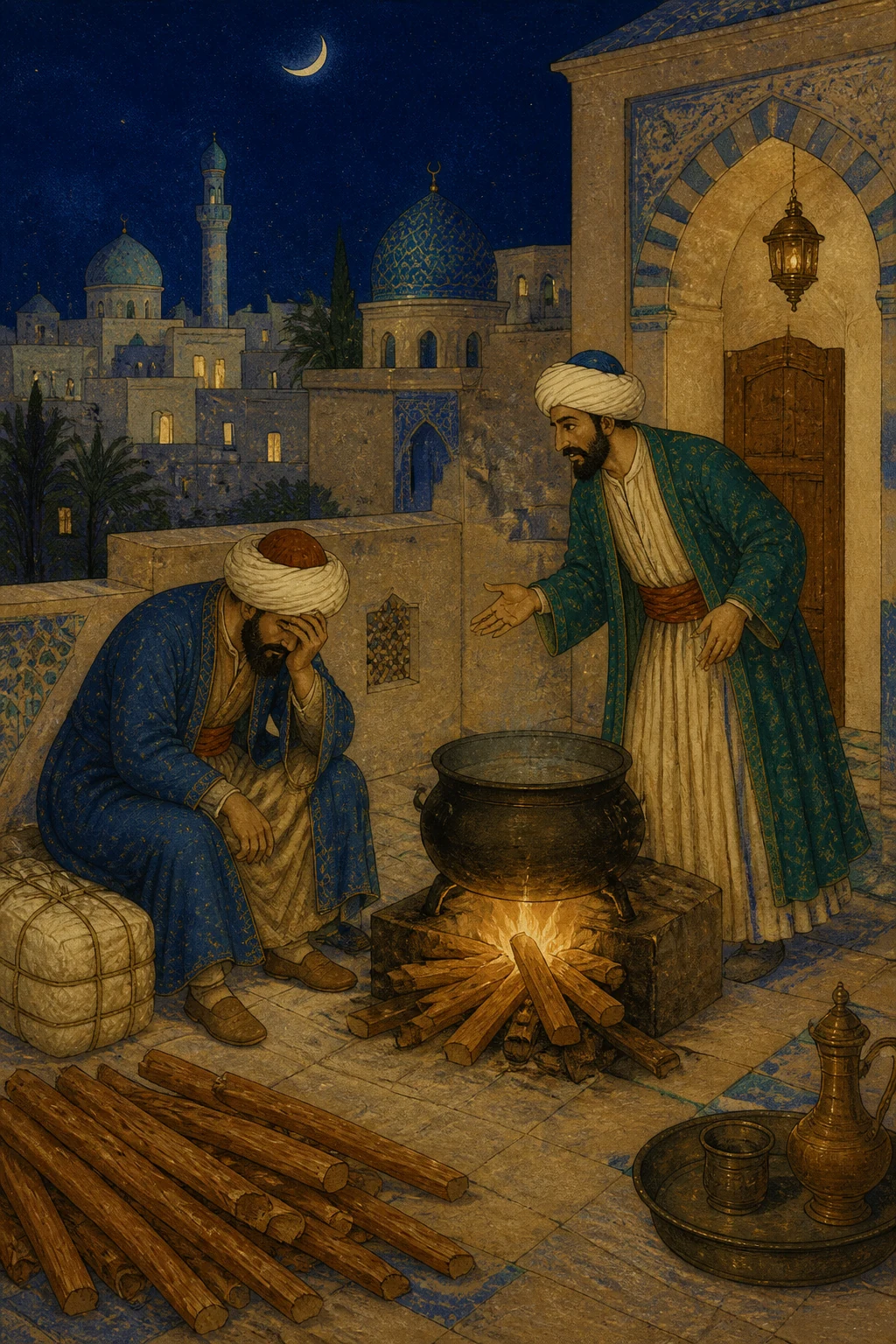
When the Jewish physician saw the quarter-dinar, he was delighted. He rose at once and went downstairs in the dark, but at his very first step his foot caught against the dead hunchback. “O Almighty! O Lord! By the Ten Commandments! By Aaron and Joshua son of Nun!” he cried. “I must have stumbled over this sick man and sent him tumbling down to his death! How am I to get the man I have killed out of my house?” He picked him up and carried him from the courtyard up to his wife, telling her what had happened. “Why are you sitting here?” she said. “If you stay here until daybreak, our lives will be forfeit! You and I must carry him up to the roof and throw him into our Muslim neighbor’s house. He is a steward in the sultan’s kitchen. Cats are always coming into his house and eating the food and the mice there, and if the body stays there a night, dogs will come down from the rooftops and eat it all.” The Jewish physician and his wife carried the hunchback up to the roof, lowered him to the ground by his hands and feet, and set him against the wall. Then they went back down and away. Scarcely had the hunchback been set down when the steward came home, opened the door, and went upstairs with a lighted candle. Finding a man standing in the corner beside the kitchen, he said, “What is this? By God, it is a human being who steals our provisions! He takes whatever meat or fat he finds, even if I hide it from the cats and dogs. It would do no good to kill every cat and dog in the neighborhood, for he comes down from the rooftops!” He seized a great mallet and jabbed the hunchback with it, then struck him in the chest, knocking him down. Finding him dead, he was distressed and said, “There is no power and no strength save in God!” Fearing for his own life, he cried, “God curse the fat and the meat, and this night as well! How did this man come to meet his death at my hands?” Then he looked closely and saw that the man was a hunchback. “Is it not enough that you are a hunchback,” he said, “without being a thief as well, stealing meat and fat? O God, who veils our faults, shelter me beneath Your gracious veil!”
Then he hoisted him onto his shoulders and carried him out of the house late that night. He went on until he reached the entrance to the market, where he stood him beside a shop at the mouth of a lane, left him, and went away. Now a Christian, who was the sultan’s broker, came along drunk, having set out for the bathhouse. His drunken fancy told him that the bathing pool was close by. He staggered on until he came near the hunchback and began to relieve himself in front of him. Turning his head, he caught sight of someone standing there. Earlier that night his turban had been snatched, and when he saw the hunchback, he imagined that the fellow meant to snatch his turban. He clenched his fist and struck the hunchback on the neck, knocking him to the ground, then shouted for the market watchman. In his drunken fury, he fell upon the hunchback, beating and throttling him. The watchman arrived and found the Christian kneeling over the Muslim and striking him. “Get off him!” he said. The Christian rose, and the watchman went up to the fallen man and found him dead. “What! A Christian kills a Muslim?” he cried. He seized the Christian, bound his arms behind his back, and took him to the governor’s house. “O Christ! O Virgin!” the Christian said to himself. “How could I have killed him? How quickly he died from a single blow!” His drunkenness had fled, and sober reflection had taken its place.
The hunchback and the Christian spent the night at the governor’s house. The governor ordered the executioner to be summoned, had a gallows erected for the Christian, and placed him beneath it. The executioner came, slipped the rope around the Christian’s neck, and was about to hang him when the steward forced his way through the crowd. Seeing the Christian beneath the gallows, he pushed the people aside and said to the executioner, “Do not do it! I am the one who killed him.” The governor asked, “Why did you kill him?” He replied, “Last night I entered my house and found that he had come down from the roof and stolen my provisions. I struck him in the chest with a mallet, and he died. Then I carried him to the market and left him at such-and-such a place, in such-and-such a lane.” The steward went on, “Is it not enough that I killed a Muslim, without a Christian being put to death on my account? Hang no one but me.” When the governor heard the steward’s words, he released the Christian broker and told the executioner, “Hang this man, since he has confessed.” The executioner took the rope from the Christian’s neck, put it around the steward’s, and placed him beneath the gallows. He was about to hang him when the Jewish physician forced his way through the crowd and cried out, “Do not do it! It was I alone who killed him. He came to my house for treatment, and when I went downstairs to him, I stumbled over him, and he died. Do not kill the steward. Kill me instead!”
The governor ordered the Jewish physician to be put to death, and the executioner took the rope from the steward’s neck and placed it around the physician’s. Just then the tailor came pushing through the crowd and said to the executioner, “Do not do it! It was I alone who killed him. Yesterday I went out to enjoy myself, and when I was coming home at suppertime, I met this hunchback, drunk, with a tambourine in his hand, singing merrily. I stopped to watch him, then brought him home with me. I bought some fish, and we sat down to eat. My wife took a piece of fish and a morsel of bread and thrust them into his mouth. He choked and died on the spot. My wife and I carried him to the Jewish physician’s house. The maid came down and opened the door, and I said to her, ‘Tell your master that a woman and a man are at the door with a sick person. Ask him to come and examine him and prescribe some medicine.’ I gave her a quarter-dinar, and she went upstairs to her master. I propped the hunchback beside the stairs and went away with my wife. The physician came down, stumbled over him, and thought he had killed him.” Then the tailor asked the Jewish physician, “Is that not true?” “Yes,” he replied. The tailor turned to the governor and said, “Release the physician and hang me.” Hearing this, the governor marveled at the hunchback’s affair and said, “This is a tale to be recorded in books!” Then he told the executioner, “Release the Jew and hang the tailor, since he has confessed.” The executioner brought the tailor forward and said, “Are we to keep bringing one forward and sending another back, without hanging anyone?” Then he put the rope around the tailor’s neck.
Such was their plight. As for the hunchback, he was, it is said, the sultan’s jester, and the sultan could not bear to be parted from him. Having got drunk, the hunchback had stayed away all that night and until noon the following day. The sultan asked some of those present about him, and they said, “Our lord, the governor has brought him out dead and ordered his killer to be hanged. The governor went down to hang the murderer, but a second man appeared, and then a third, each saying, ‘It was I alone who killed him,’ and each explaining to the governor how he had done it.” When the king heard this, he called out to the chamberlain, “Go down to the governor and bring them all before me.” The chamberlain went down and found the executioner on the point of putting the tailor to death. “Do not do it!” he shouted. “Tell the governor that the matter has reached the king.” Then he took the governor, the hunchback’s body, the tailor, the Jewish physician, the Christian, and the steward, and brought them all before the king. When the governor stood before him, he kissed the ground and related everything that had happened to them all; there is no profit in repeating it. When the king heard the story, he was filled with wonder and delight, and ordered it to be written in letters of gold. “Have you ever heard anything like the story of this hunchback?” he asked those present. At this the Christian came forward and said, “O king of the age, if you grant me leave, I will tell you something that happened to me, stranger, more marvelous, and more entertaining than the story of the hunchback.” The king replied, “Tell us what you have to tell.”
Izvirnik
حكاية الأحدب والنصراني والمباشر واليهودي والخياط - الليالي ٢٤ إلى ٢٥
Naslednje strani prikazujejo izvirno besedilo za primerjavo.
فلما كانت الليلة ٢٤
قالت: بلغني أيها الملك السعيد أنه كان في قديم الزمان وسالف العصر والأوان في مدينة الصين رجل خياط مبسوط الرزق، يحب اللهو والطرب، وكان يخرج هو وزوجته في بعض الأحيان يتفرجان على غرائب المنتزهات، فخرجَا يومًا من أول النهار، ورجعا آخِرَه إلى منزلهما عند المساء، فوجدَا في طريقهما رجلًا أحدبَ رؤيتُه تُضحِك الغضبان، وتُزِيل الهمَّ والأحزان، فعند ذلك تقدَّمَ الخياطُ هو وزوجته يتفرجان عليه، ثم إنهما عزمَا عليه أن يروح معهما إلى بيتهما لينادمهما تلك الليلة، فأجابهما إلى ذلك ومشى معهما إلى البيت، فخرج الخياط إلى السوق، وكان الليل قد أقبل فاشترى سمكًا مقليًّا وخبزًا وليمونًا، وحلاوةً يتحلُّون بها، ثم رجع وحطَّ السمك قدام الأحدب وجلسوا يأكلون، فأخذت امرأة الخياط جزلة سمك كبيرة ولقمتها للأحدب، وسدت فمه بكفها، وقالت: والله ما تأكلها إلا دفعةً واحدة في نفَسٍ واحد، ولا أمهلك حتى تمضغها. فابتلعها وكان فيها شوكة قوية فتصلَّبَتْ في حلْقِه لأجل انقضاء أجله، فمات. وأدرك شهرزاد الصباح فسكتَتْ عن الكلام المباح.
فلما كانت الليلة ٢٥
قالت: بلغني أيها الملك السعيد أن امرأة الخياط لما لقمتِ الأحدبَ جزلة السمك فمات لانقضاء أجله في وقته، فقال الخياط: لا حول ولا قوة إلا بالله العلي العظيم، هذا المسكين ما كان موته إلا هكذا على أيدينا! فقالت المرأة: وما هذا التواني، أَمَا سمعتَ قول الشاعر:
مَا لِي أُعَلِّلُ نَفْسِي بِالْمُحَالِ عَلَى أَمْرٍ يَكُونُ بِهِ هَمٌّ وَأَحْزَانُ
مَاذَا الْقُعُودُ عَلَى نَارٍ وَمَا خَمَدَتْ إِنَّ الْقُعُودَ عَلَى النِّيرَانِ خُسْرَانُ
فقال لها زوجها: وما أفعله؟ قالت: قُمْ واحمله في حضنك، وانشر عليه فوطة حرير، وأخرج أنا قدامك وأنت ورائي في هذه الليلة، وقُلْ: هذا ولدي وهذه أمه، ومرادنا أن نؤديه إلى الطبيب ليداويه. فلما سمع الخياط هذا الكلامَ، قام وحمل الأحدب في حضنه، وزوجته تقول: يا ولدي، سلامتك، أين محل وجعك؟ وهذا الجدري كان لك في أي مكان؟ فكلُّ مَن رآهما يقول: معهما طفل مصاب بالجدري. ولم يزالَا سائرين وهما يسألان عن منزل الطبيب حتى دلُّوهما على بيت طبيب يهودي، فقرعَا الباب فنزلَتْ لهما جاريةٌ سوداء، وفتحتِ البابَ ونظرَتْ، وإذا بإنسان حاملٍ صغيرًا وأمه معه، فقالت الجارية: ما خبركم؟ فقالت امرأة الخياط: معنا صغير مرادنا أن ينظره الطبيب، فخذي هذا الربع دينار، وأعطيه لسيدك ودعيه ينزل ليرى ولدي، فقد لحقه ضعف. فطلعت الجارية، ودخلت زوجة الخياط داخل العتبة وقالت لزوجها: دَعِ الأحدب هنا ونفوز بأنفسنا. فأوقفه الخياط، وأسنده إلى الحائط، وخرج هو وزوجته، وأما الجارية فإنها دخلت على اليهودي وقالت له: في أسفل البيت ضعيف مع امرأة ورجل، وقد أعطياني ربع دينار لك، وتصف لهما ما يوافقه.
فلما رأى اليهودي الربعَ دينار فرح، وقام عاجلًا، ونزل في الظلام، فأول ما نزل عثرت رجله في الأحدب وهو ميت، فقال: يا للعزيز، يا للمولى، والعشر كلمات! يا لهارون ويوشع بن نون! كأني عثرتُ في هذا المريض، فوقع إلى أسفل فمات، فكيف أخرج بقتيلي من بيتي؟ فحمله وطلع به من حوش البيت إلى زوجته، وأعلمها بذلك، فقالت له: وما قعودك ها هنا؟! فإنْ قعدتَ هنا إلى طلوع النهار راحت أرواحنا، فأنا وأنت نطلع به السطح ونرميه في بيت جارنا المسلم؛ فإنه رجل مباشر على مطبخ السلطان، وكثيرًا ما تأتي القطط في بيته وتأكل ممَّا فيه من الأطعمة والفئران، وإنِ استمر فيه ليلة تنزل عليه الكلاب من السطوح وتأكله جميعه. فطلع اليهودي وزوجته وهما حاملان الأحدب، وأنزلاه بيدَيْه ورجلَيْه إلى الأرض، وجعلاه ملاصقًا للحائط، ثم نزلَا وانصرفَا، ولم يستقر نزول الأحدب إلا والمباشِر قد جاء إلى البيت وفتحه وطلع البيت ومعه شمعة مضيئة، فوجد ابن آدم واقفًا في الزاوية في جانب المطبخ، فقال ذلك المباشر: ما هذا؟ والله إن الذي يسرق حوائجنا، ما هو إلا ابن آدم فيأخذ ما وجده من لحم أو دهن، ولو خبأته من القطط والكلاب؛ وإنْ قتلتُ قطط الحارة وكلابها جميعًا لا يفيد؛ لأنه ينزل من السطوح. ثم أخذ مطرقة عظيمة ووكزه بها فصار عنده، ثم ضربه بها على صدره فوقع، فوجده ميتًا، فحزن وقال: لا حول ولا قوة إلا بالله، وخاف على نفسه وقال: لعن الله الدهن واللحم وهذه الليلة، كيف فرغَتْ منية ذلك الرجل على يدي؟ ثم نظر إليه فإذا هو أحدب، فقال: أَمَا يكفي أنك أحدب حتى تكون حراميًّا، وتسرق اللحم والدهن؟! يا ستَّار، استرني بسترك الجميل.
ثم حمله على أكتافه، ونزل به من بيته في آخر الليل، وما زال سائرًا به إلى أول السوق، فأوقفه بجانب دكان في رأس عطفة وتركه وانصرف، وإذا بنصراني وهو سمسار السلطان، وكان سكرانَ، فخرج يريد الحمام فقال له سكره: إن المسبح قريب. فما زال يمشي ويتمايل حتى قرب من الأحدب، وجعل يريق الماء قباله، فلاحت منه التفاته فوجد واحدًا واقفًا، وكان النصراني قد خطفوا عمامته في أول الليل، فلما رأى الأحدب واقفًا اعتقد أنه يريد خطف عمامته، فطبق كفه ولكم الأحدب على رقبته، فوقع في الأرض، وصاح النصراني على حارس السوق، ثم نزل على الأحدب من شدة سكره ضربًا، وصار يخنقه خنقًا، فجاء الحارس فوجد النصراني باركًا على المسلم وهو يضربه، فقال الحارس: قُمْ عنه. فقام فتقدَّمَ إليه الحارس فوجده ميتًا، فقال: كيف يقتل النصراني مسلمًا؟ ثم قبض على النصراني وكتَّفَه، وجاء به إلى بيت الوالي، والنصراني يقول في نفسه: يا مسيح، يا عذراء، كيف قتلتُ هذا؟ وما أسرع ما مات في لكمة، قد راحت السكرة وجاءت الفكرة.
ثم إن الأحدب والنصراني باتا في بيت الوالي، وأمر الوالي أن يُنادَى على السياف، ونصب للنصراني خشبة وأوقفه تحتها، وجاء السياف ورمى في رقبة النصراني الحبل، وأراد أن يعلقه، وإذا بالمباشر قد شَقَّ الناس، فرأى النصراني وهو واقف تحت المشنقة، ففسح الناس وقال للسياف: لا تفعل، أنا الذي قتلتُه. فقال له الوالي: لأي شيء قتلتَه؟ قال: إني دخلتُ الليلةَ بيتي فرأيته نزل من السطح، وسرق مصالحي فضربته بمطرقة على صدره فمات، فحملته وجئتُ به إلى السوق، وأوقفته في موضع كذا في عطفة كذا. ثم قال المباشِر: ما كفاني أني قتلتُ مسلمًا حتى يُقتَل بسببي نصراني! فلا تشنق غيري. فلما سمع الوالي كلامَ المباشِر أطلق النصراني السمسار، وقال للسياف: اشنق هذا باعترافه. فأخذ الحبل من رقبة النصراني، ووضعه في رقبة المباشِر، وأوقفه تحت الخشبة، وأراد أن يعلِّقه، وإذا باليهودي الطبيب قد شقَّ الناس، وصاح على السياف وقال له: لا تفعل، فما قتله إلا أنا؛ وذلك أنه جاءني في بيتي ليتداوى، فنزلتُ إليه فعثرتُ فيه برجلي فمات، فلا تقتل المباشِرَ، واقتلني.
فأمر الوالي بقتل اليهودي الطبيب، فأخذ السيافُ الحبلَ من رقبة المباشِر، ووضعه في رقبة اليهودي الطبيب، وإذا بالخياط جاء وشقَّ الناس، وقال للسياف: لا تفعل، فما قتله إلا أنا، وذلك أني كنت بالنهار أتفرج، وجئت وقت العشاء فلقيتُ هذا الأحدب سكران ومعه دف وهو يغني بفرحة، فوقفت أتفرج عليه، وجئت به إلى بيتي واشتريت سمكًا وقعدنا نأكل، فأخذَتْ زوجتي قطعةَ سمك ولقمةً ودستهما في فمه، فزور فمات لوقته، فأخذته أنا وزوجتي وجئنا به لبيت اليهودي، فنزلت الجارية وفتحت لنا الباب، فقلت لها: قولي لسيدك إن بالباب امرأة ورجلًا ومعهما ضعيف تعال انظره وصِفْ له دواءً. وأعطيتها ربع دينار، فطلعتْ لسيدها، وأسندتُ الأحدبَ إلى جهة السلم، ومضيت أنا وزوجتي، فنزل اليهودي فعثر فيه فظن أنه قتله. ثم قال الخياط لليهودي: أصحيح هذا؟ قال: نعم. والتفت الخياط للوالي، وقال له: أطلق اليهودي واشنقني. فلما سمع الوالي كلامه تعجَّبَ من أمر الأحدب، وقال: إن هذا أمر يُؤرَّخ في الكتب. ثم قال للسياف: أطلق اليهودي، واشنق الخياط باعترافه. فقدَّمَه السياف وقال: هل نقدِّم هذا ونؤخِّر هذا، ولا نشنق واحدًا؟ ثم وضع الحبل في رقبة الخياط.
فهذا ما كان من أمر هؤلاء، وأما ما كان من أمر الأحدب، فقيل إنه كان مسخرة للسلطان، وكان السلطان لا يقدر أن يفارقه، فلما سكر الأحدب غاب عنه تلك الليلة، وثاني يوم إلى نصف النهار، فسأل عنه بعض الحاضرين فقالوا له: يا مولانا، طلع به الوالي وهو ميت، وأمر بشنق قاتله، فنزل الوالي ليشنق القاتل، فحضر له ثانٍ وثالث، وكلٌّ يقول: ما قتله إلا أنا، وكل واحد يذكر للوالي سببَ قتله له. فلما سمع الملك هذا الكلامَ صرخ على الحاجب وقال له: انزل إلى الوالي، وَأْتِني بهم جميعًا. فنزل الحاجب فوجد السياف كاد أن يقتل الخياط، فصرخ عليه الحاجب وقال: لا تفعل، وأَعْلِمِ الواليَ أن القضية بلغت الملك. ثم أخذه وأخذ الأحدب معه محمولًا، والخياط واليهودي والنصراني والمباشِر، وطلع بالجميع إلى الملك، فلما تمثَّلَ الوالي بين يديه قبَّلَ الأرض، وحكى له جميع ما جرى من الجميع، وليس في الإعادة إفادة، فلما سمع الملك هذه الحكاية تعجَّبَ وأخذه الطرب، وأمر أن يُكتَب ذلك بماء الذهب، وقال للحاضرين: هل سمعتم مثل قصة هذا الأحدب؟ فعند ذلك تقدَّمَ النصراني، وقال: يا ملك الزمان، إن أذنتَ لي حدَّثْتُكَ بشيء جرى لي، وهو أعجب وأغرب وأطرب من قصة الأحدب. فقال الملك: حدِّثنا بما عندك.
Nadaljuj z branjem