Prevod
She said: It has reached me, O fortunate king, that long ago, in ages past, there lived in a city of China a tailor who was comfortably off and fond of merriment and music. From time to time he and his wife would go out to admire the wonders of the pleasure gardens. One day they went out early in the morning and were returning home toward evening when they met a hunchback whose very appearance could make an angry man laugh and banish sorrow and care. The tailor and his wife drew near to enjoy the sight of him, then invited him home to keep them company that night. He accepted and went with them. The tailor went out to the market, and, as night had fallen, bought fried fish, bread, lemons, and sweets for dessert. He returned, set the fish before the hunchback, and they sat down to eat. The tailor’s wife took a large piece of fish and thrust it into the hunchback’s mouth, clapping her hand over it. “By God,” she said, “you shall swallow it all at once, in a single gulp! I will not give you time to chew it.” He swallowed, but there was a stout bone in the fish, and, his appointed hour having come, it lodged in his throat and he died. Then dawn overtook Shahrazad, and she fell silent, leaving her tale untold.
When it was the twenty-fifth night
She said: It has reached me, O fortunate king, that when the tailor’s wife fed the hunchback the piece of fish, he died, for his appointed hour had come. The tailor said, “There is no power and no strength save in God, the Most High, the Almighty! Was this poor fellow destined to meet his death at our hands?” His wife said, “Why stand there doing nothing? Have you not heard the poet’s words:
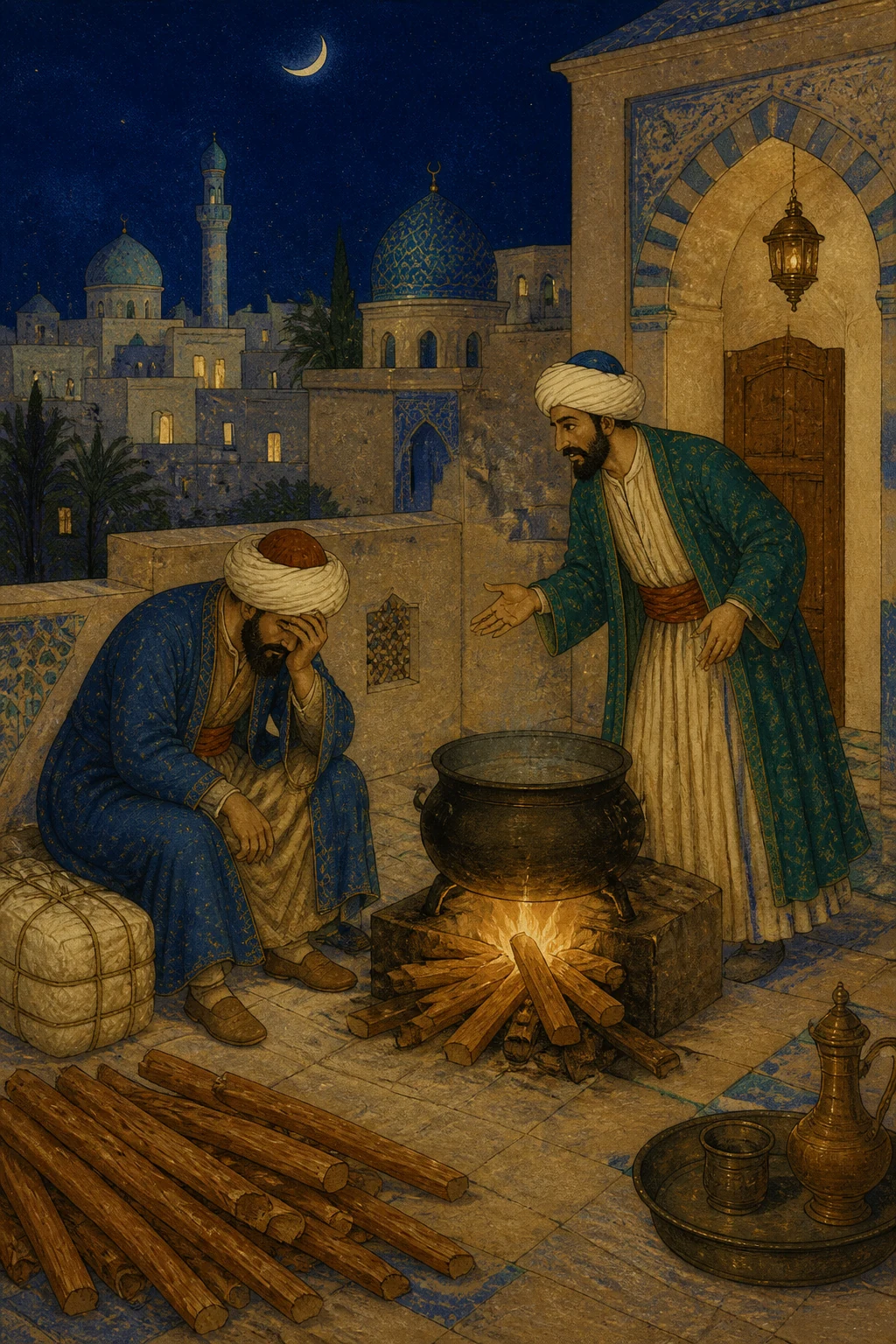
Why soothe my soul with vain hopes over a thing that brings only grief and sorrow? Why sit upon a fire that has not gone out? To sit upon the flames is surely ruin.” Her husband said, “What am I to do?” She replied, “Get up, take him in your arms, and spread a silk cloth over him. I will go out ahead of you tonight, and you will follow me. Say, ‘This is my son and this is his mother. We are taking him to the physician to be treated.’” When the tailor heard this, he rose and took the hunchback in his arms, while his wife cried, “Get well, my son! Where does it hurt? Where has the smallpox broken out?” Everyone who saw them said, “They have a child with smallpox.” They went on, asking where a physician lived, until they were directed to the house of a Jewish physician. They knocked, and a black maidservant came down and opened the door. Seeing a man carrying a little one, with its mother beside him, she asked, “What is the matter?” The tailor’s wife said, “We have a little one whom we want the physician to examine. Take this quarter-dinar and give it to your master, and ask him to come down and see my son, for he has been taken ill.” The maid went upstairs, and the tailor’s wife stepped across the threshold and said to her husband, “Leave the hunchback here, and let us save ourselves.” The tailor stood him up, propped him against the wall, and went away with his wife. Meanwhile, the maid went in to the Jewish physician and said, “There is a sick person downstairs with a woman and a man. They have given me a quarter-dinar for you to prescribe a suitable remedy.”
When the Jewish physician saw the quarter-dinar, he was delighted. He rose at once and went downstairs in the dark, but at his very first step his foot caught against the dead hunchback. “O Almighty! O Lord! By the Ten Commandments! By Aaron and Joshua son of Nun!” he cried. “I must have stumbled over this sick man and sent him tumbling down to his death! How am I to get the man I have killed out of my house?” He picked him up and carried him from the courtyard up to his wife, telling her what had happened. “Why are you sitting here?” she said. “If you stay here until daybreak, our lives will be forfeit! You and I must carry him up to the roof and throw him into our Muslim neighbor’s house. He is a steward in the sultan’s kitchen. Cats are always coming into his house and eating the food and the mice there, and if the body stays there a night, dogs will come down from the rooftops and eat it all.” The Jewish physician and his wife carried the hunchback up to the roof, lowered him to the ground by his hands and feet, and set him against the wall. Then they went back down and away. Scarcely had the hunchback been set down when the steward came home, opened the door, and went upstairs with a lighted candle. Finding a man standing in the corner beside the kitchen, he said, “What is this? By God, it is a human being who steals our provisions! He takes whatever meat or fat he finds, even if I hide it from the cats and dogs. It would do no good to kill every cat and dog in the neighborhood, for he comes down from the rooftops!” He seized a great mallet and jabbed the hunchback with it, then struck him in the chest, knocking him down. Finding him dead, he was distressed and said, “There is no power and no strength save in God!” Fearing for his own life, he cried, “God curse the fat and the meat, and this night as well! How did this man come to meet his death at my hands?” Then he looked closely and saw that the man was a hunchback. “Is it not enough that you are a hunchback,” he said, “without being a thief as well, stealing meat and fat? O God, who veils our faults, shelter me beneath Your gracious veil!”
Then he hoisted him onto his shoulders and carried him out of the house late that night. He went on until he reached the entrance to the market, where he stood him beside a shop at the mouth of a lane, left him, and went away. Now a Christian, who was the sultan’s broker, came along drunk, having set out for the bathhouse. His drunken fancy told him that the bathing pool was close by. He staggered on until he came near the hunchback and began to relieve himself in front of him. Turning his head, he caught sight of someone standing there. Earlier that night his turban had been snatched, and when he saw the hunchback, he imagined that the fellow meant to snatch his turban. He clenched his fist and struck the hunchback on the neck, knocking him to the ground, then shouted for the market watchman. In his drunken fury, he fell upon the hunchback, beating and throttling him. The watchman arrived and found the Christian kneeling over the Muslim and striking him. “Get off him!” he said. The Christian rose, and the watchman went up to the fallen man and found him dead. “What! A Christian kills a Muslim?” he cried. He seized the Christian, bound his arms behind his back, and took him to the governor’s house. “O Christ! O Virgin!” the Christian said to himself. “How could I have killed him? How quickly he died from a single blow!” His drunkenness had fled, and sober reflection had taken its place.
The hunchback and the Christian spent the night at the governor’s house. The governor ordered the executioner to be summoned, had a gallows erected for the Christian, and placed him beneath it. The executioner came, slipped the rope around the Christian’s neck, and was about to hang him when the steward forced his way through the crowd. Seeing the Christian beneath the gallows, he pushed the people aside and said to the executioner, “Do not do it! I am the one who killed him.” The governor asked, “Why did you kill him?” He replied, “Last night I entered my house and found that he had come down from the roof and stolen my provisions. I struck him in the chest with a mallet, and he died. Then I carried him to the market and left him at such-and-such a place, in such-and-such a lane.” The steward went on, “Is it not enough that I killed a Muslim, without a Christian being put to death on my account? Hang no one but me.” When the governor heard the steward’s words, he released the Christian broker and told the executioner, “Hang this man, since he has confessed.” The executioner took the rope from the Christian’s neck, put it around the steward’s, and placed him beneath the gallows. He was about to hang him when the Jewish physician forced his way through the crowd and cried out, “Do not do it! It was I alone who killed him. He came to my house for treatment, and when I went downstairs to him, I stumbled over him, and he died. Do not kill the steward. Kill me instead!”
The governor ordered the Jewish physician to be put to death, and the executioner took the rope from the steward’s neck and placed it around the physician’s. Just then the tailor came pushing through the crowd and said to the executioner, “Do not do it! It was I alone who killed him. Yesterday I went out to enjoy myself, and when I was coming home at suppertime, I met this hunchback, drunk, with a tambourine in his hand, singing merrily. I stopped to watch him, then brought him home with me. I bought some fish, and we sat down to eat. My wife took a piece of fish and a morsel of bread and thrust them into his mouth. He choked and died on the spot. My wife and I carried him to the Jewish physician’s house. The maid came down and opened the door, and I said to her, ‘Tell your master that a woman and a man are at the door with a sick person. Ask him to come and examine him and prescribe some medicine.’ I gave her a quarter-dinar, and she went upstairs to her master. I propped the hunchback beside the stairs and went away with my wife. The physician came down, stumbled over him, and thought he had killed him.” Then the tailor asked the Jewish physician, “Is that not true?” “Yes,” he replied. The tailor turned to the governor and said, “Release the physician and hang me.” Hearing this, the governor marveled at the hunchback’s affair and said, “This is a tale to be recorded in books!” Then he told the executioner, “Release the Jew and hang the tailor, since he has confessed.” The executioner brought the tailor forward and said, “Are we to keep bringing one forward and sending another back, without hanging anyone?” Then he put the rope around the tailor’s neck.
Such was their plight. As for the hunchback, he was, it is said, the sultan’s jester, and the sultan could not bear to be parted from him. Having got drunk, the hunchback had stayed away all that night and until noon the following day. The sultan asked some of those present about him, and they said, “Our lord, the governor has brought him out dead and ordered his killer to be hanged. The governor went down to hang the murderer, but a second man appeared, and then a third, each saying, ‘It was I alone who killed him,’ and each explaining to the governor how he had done it.” When the king heard this, he called out to the chamberlain, “Go down to the governor and bring them all before me.” The chamberlain went down and found the executioner on the point of putting the tailor to death. “Do not do it!” he shouted. “Tell the governor that the matter has reached the king.” Then he took the governor, the hunchback’s body, the tailor, the Jewish physician, the Christian, and the steward, and brought them all before the king. When the governor stood before him, he kissed the ground and related everything that had happened to them all; there is no profit in repeating it. When the king heard the story, he was filled with wonder and delight, and ordered it to be written in letters of gold. “Have you ever heard anything like the story of this hunchback?” he asked those present. At this the Christian came forward and said, “O king of the age, if you grant me leave, I will tell you something that happened to me, stranger, more marvelous, and more entertaining than the story of the hunchback.” The king replied, “Tell us what you have to tell.”