Waltey
Vrabčevka in nespametna opica
Pančatantra · indijska zbirka pripovediO besedilu
Vrabčevka in nespametna opica
- Vir
- Pančatantra
- Avtor
- indijska zbirka pripovedi
- Jezik branja
- English
- Jezik izvirnika
- Sanskrit
- Čas branja
- 16 min branja
- Obseg
- 13 strani
- Naslov izvirnika
- Tantra 01 mitra-bheda chunk 11
O izvirniku
Pančatantra
Indijske zgodbe o zvijači, prijateljstvu in modrosti v svetu živali in vladarjev. Bralni jezik je English, izvirnik pa prihaja iz vira Pančatantra v jeziku Sanskrit.
Besedilo
Vrabčevka in nespametna opica
He who tries to engage such a person in conversation comes to grief.
But the bird disregarded him and went on addressing the monkeys without pause: “Friends! Why all this useless trouble?” When he still would not stop chattering, one of the monkeys, enraged by their fruitless efforts, seized him by the wings and dashed him against a rock, killing him. That is why I say, “Wood that will not bend cannot be bent,” and so forth. As it is also said:
Advice given to fools provokes anger, not peace;
Milk drunk by serpents only increases their venom.
And again:
Advice should not be given to just anyone.
See how a foolish monkey left the well-housed bird homeless.
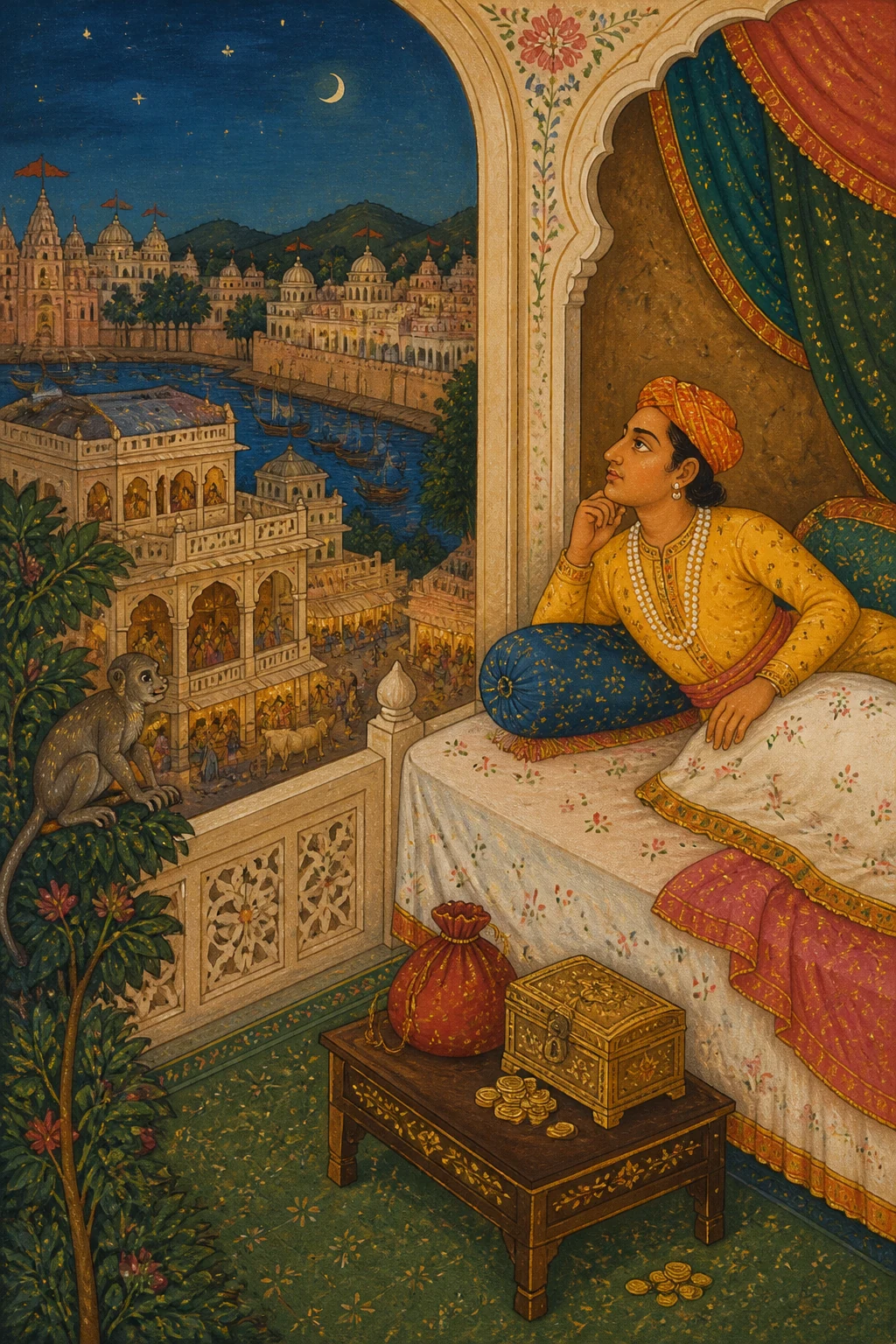
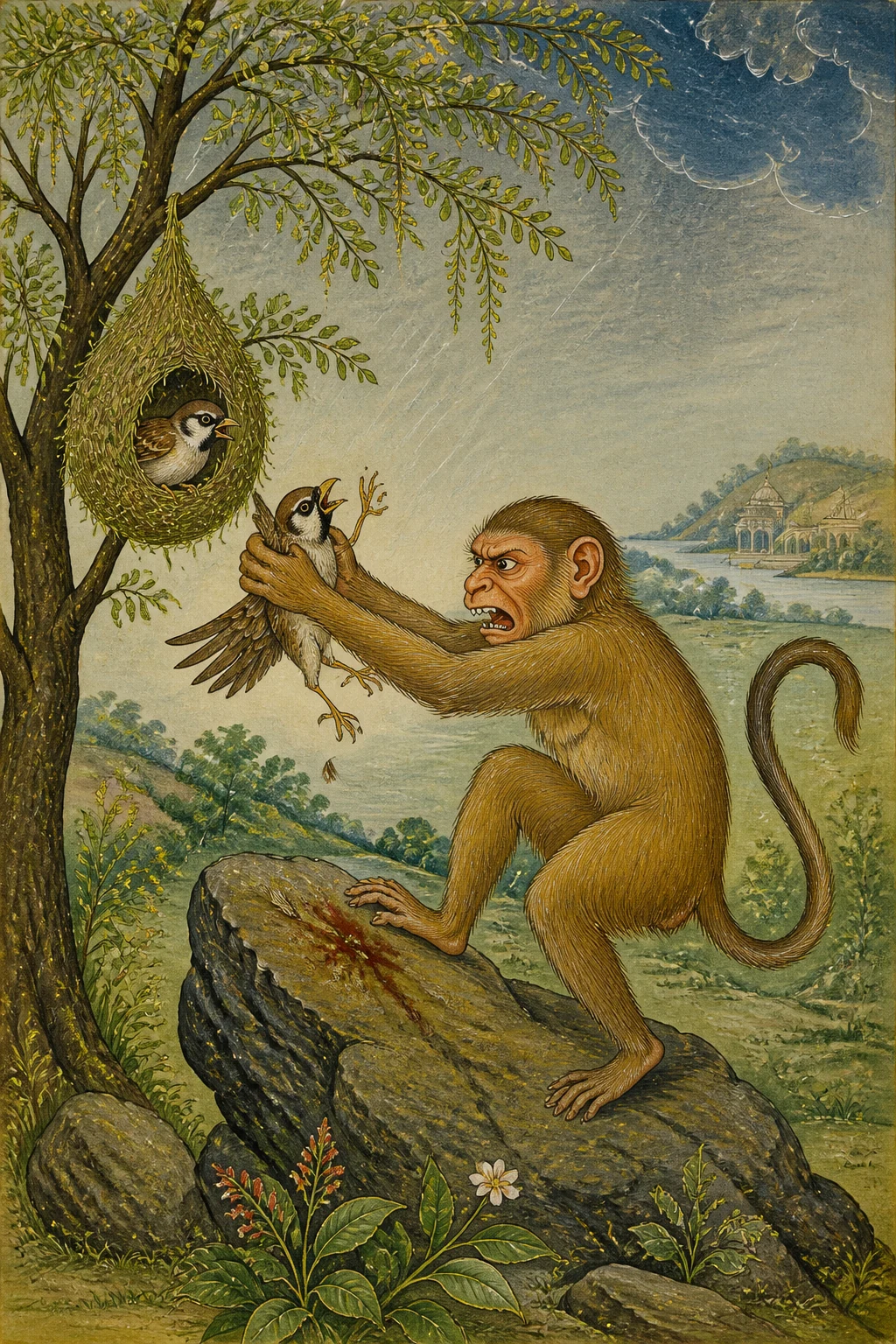
Damanaka asked, “How did that happen?” The other replied: Story 18. In a certain forest, a pair of sparrows lived in a nest they had built hanging from the branch of a shami tree. One day, as they rested comfortably, a winter cloud began to drizzle. Just then a monkey, battered by wind and rain, his fur bristling, his teeth chattering like a lute, came shivering to the foot of that shami tree and sat down. Seeing him in this condition, the female sparrow said, “My good fellow!
You have hands and feet and look like a man. Fool, if the cold cuts you so, why do you not build yourself a house?”
Hearing this, the monkey said angrily, “You wretched creature! Why will you not take a vow of silence? What insolence! She dares mock me now!
This needle-faced, ill-mannered slut, who talks as though she were a scholar,
Chatters on without a trace of fear. Why should I not kill her?”
After this outburst he said to her, “Foolish bird! What business have you troubling yourself about me? For it is said:
Give counsel to one who listens with faith, especially when he asks for it.
Words spoken to one without faith are like cries in the wilderness.”
But why say more? The sparrow, sitting in her nest, spoke to him again. At once he climbed the shami tree and tore her nest into a hundred pieces. That is why I say, “Advice should not be given,” and so forth.
“And so, you fool, though you have been taught, you have learned nothing. Or perhaps the fault is not yours: instruction brings virtue to a good man, but not to a wicked one. As it is said:
What use is learning bestowed where it does not belong?
It is like a lamp placed inside a dark, concealing pot.
“Relying on your useless learning and refusing to heed my words, you are bringing about your own ruin. Surely you are a son who disgraces his birth. For it is said:
Those versed in the scriptures recognize four kinds of sons in this world:
The mother’s equal, the father’s equal, the son who surpasses his father, and the son who falls beneath him.
A son whose virtues match his mother’s is the first; his father’s equal is the second.
The third surpasses his father; the fourth is the lowest of the low.
A scoundrel, delighted by another’s misfortune, takes no account even of his own destruction.
A headless trunk will often dance on the battlefield though its head is lost.
“Ah, how well it is said:
Dharmabuddhi and Kubuddhi—I know them both.
Through the son’s misguided cleverness, his father was killed by smoke.”
Damanaka asked, “How did that happen?” The other replied: Story 20. The Tale of the Black Snake. In a certain country lived two friends, Dharmabuddhi and Papabuddhi. One day Papabuddhi thought, “I am a fool, and poor besides. I shall take Dharmabuddhi with me to another country, earn money with his help, and then cheat him out of his share as well. That will make me happy.” So, on another day, Papabuddhi said to Dharmabuddhi, “My friend! When you are old, what deeds of your own will you have to remember? If you never see other countries, what tales will you have to tell in cultivated company? For it is said:
He who has not traveled over the earth and learned the many languages, customs, and ways of dress of other lands
Has wasted the fruit of his birth.
And again:
A man does not fully acquire learning, wealth, or skill
Until he travels gladly over the earth, from country to country.”
Delighted by these words, Dharmabuddhi obtained his elders’ permission and set off with him for foreign lands on an auspicious day. As they traveled, Papabuddhi acquired a great deal of wealth through Dharmabuddhi’s abilities. At last, having both amassed considerable fortunes, they joyfully set out for home, eager to return. For it is said:
To those who have lived abroad and gained learning, wealth, and skill,
Even a single krosha of the homeward road seems a hundred yojanas long.
As they drew near their home, Papabuddhi said to Dharmabuddhi, “My friend! We ought not to take all this money home. Our families and relatives will be asking for it. Let us bury it somewhere here in the depths of the forest and enter the town with only a little. Whenever we need more, we can come back together and take just what we require. For it is said:
A wise man should not display his wealth to anyone, however little it may be.
The sight of it can unsettle even a sage’s mind.
And again:
Just as flesh is devoured by fish in water, by beasts on land,
And by birds in the sky, so is the wealthy man preyed upon everywhere.”
Hearing this, Dharmabuddhi said, “Very well, my friend. Let us do so.” Having carried out their plan, they both went home and lived comfortably. Then one night Papabuddhi went into the forest at midnight, took all the money, filled in the hole, and returned to his house.
On another day he went to Dharmabuddhi and said, “My friend, I have a large family, and we are suffering for want of money. Let us go to that place and bring back a little.”
“Very well, my friend,” he replied. “Let us do so.”
They both went there and dug up the spot, only to find the vessel empty. At once Papabuddhi began beating his head and cried, “Dharmabuddhi! You have taken this money, and no one else! The hole has been filled in again. Give me my half, or I shall report you to the king’s court.” Dharmabuddhi replied, “You wicked man! Do not say such a thing! I am Dharmabuddhi, whose mind is set on righteousness. I would never commit such a theft. For it is said:
The righteous regard other men’s wives as their mothers, other men’s wealth as clods of earth,
And all living beings as themselves.”
So the two went before the magistrate, arguing and accusing each other. The officers presiding over the court were about to order them to undergo an ordeal when Papabuddhi said, “Ah! The proper course of justice has not been observed. For it is said:
In a dispute, seek a document; failing that, seek witnesses.
Only when witnesses are lacking do the wise prescribe an ordeal.
“In this matter, the tree deities are my witnesses. They will declare which of us is the thief and which is honest.” All the officers replied, “Sir, you have spoken rightly. For it is said:
When even an outcaste is available as a witness in a dispute,
An ordeal is not warranted—how much less when forest deities are witnesses!
“We too are most curious about this matter. At daybreak, both of you must accompany us to that part of the forest.” Meanwhile, Papabuddhi went home and said to his father, “Father, I have stolen a great deal of money from Dharmabuddhi. A word from you will secure it for us; otherwise, we shall lose it and our lives as well.”
His father replied, “Quickly tell me, my son, what I must say to make the money safely ours.”
Papabuddhi said, “Father, there is a great shami tree in that place, with a large hollow in its trunk. Go inside it at once. Tomorrow morning, when I call for the truth to be proclaimed, you must say that Dharmabuddhi is the thief.”
This was done. At daybreak Papabuddhi bathed and went to the shami tree with the court officers, Dharmabuddhi leading the way. Then he proclaimed in a loud voice:
“The sun and moon, the wind and fire, heaven, earth, water, the heart, and Yama, day and night, and both twilights—
And Dharma himself—know the deeds of men.
“Revered goddess of the forest! Tell us which of us is the thief.”
Then Papabuddhi’s father, hidden in the hollow of the shami tree, said, “Listen! Dharmabuddhi stole the money.”
Hearing this, all the king’s officers stared wide-eyed in amazement. While they were consulting the law books to determine the proper punishment for Dharmabuddhi’s theft, Dharmabuddhi heaped combustible material around the hollow of the shami tree and set it alight. As the hollow blazed, Papabuddhi’s father stumbled out, his body half burned and his eyes bursting, crying out in agony. They all asked, “What is this?”
He told them that the whole wicked scheme had been contrived by Papabuddhi, and then he died. The king’s officers hanged Papabuddhi from a branch of the shami tree and, praising Dharmabuddhi, said, “Ah, how well it is said:
A wise man should consider not only his plan, but also its dangers.
Before the foolish heron’s very eyes, his young were devoured by mongooses.”
Dharmabuddhi asked, “How did that happen?” They replied: Story 21. The Tale of the Merchant’s Son Named Jirnadhana. In a certain forest stood a banyan tree inhabited by many herons. In a hollow of its trunk lived a black snake, who passed his days eating the herons’ chicks before their feathers had even grown. One heron, seeing that his young had been devoured, was overcome with grief. He went to the shore of a lake and stood there with bowed head and eyes full of tears. Seeing him in this state, a crab said, “Uncle, why are you weeping like this today?”
The heron replied, “My friend, what can I do? Unlucky creature that I am, my young have been eaten by the snake that lives in the hollow. I weep because I am stricken with grief. Tell me, is there any way to destroy him?”
Hearing this, the crab thought, “He is our natural enemy. I shall give him advice, mixing truth with falsehood, that will bring destruction upon all the other herons as well. For it is said:
With words as soft as butter, but a heart devoid of pity,
Guide your enemy in such a way that he perishes with all his kin.”
Then he said, “Uncle, if that is how matters stand, scatter pieces of fish from the entrance of a mongoose’s burrow all the way to the snake’s hollow. The mongoose will follow the trail and destroy that wicked snake.”
The heron did so. Following the pieces of fish, the mongoose killed the black snake, and then, little by little, devoured all the herons living in that tree as well. That is why we say, “A wise man should consider not only his plan,” and so forth.
“In just this way, you fool, you have devised a disaster rather than a remedy, like Papabuddhi. You are no good man; your mind is set only on evil. I have recognized you for what you are, since you brought our master’s life into danger. You yourself have exposed your wickedness and deceit. Or, as it is well said:
Who, however hard he tried, could see the passage through which a peacock’s food comes out,
If those fools did not dance in their delight at the thunder of the clouds?
“If you can bring our master to such a state, what account would you take of someone like me? You must therefore keep away from me. For it is said:
Where mice eat a balance made of a thousand measures of iron,
There, O king, a hawk may carry off a boy—of that there is no doubt.”
Damanaka asked, “How did that happen?” The other replied: Story 22. The Tale of the Merchant’s Son Named Jirnadhana. In a certain town lived a merchant’s son named Jirnadhana. Having lost his fortune, he thought of traveling to another country, reflecting:
“A man who remains destitute in the country or place
Where once he enjoyed pleasures earned by his own efforts is the lowest of men.
And again:
He who begs others for help in the very place
Where he once lived long in pride and splendor earns contempt.”
Now in his house there was a balance made of a thousand measures of iron, an heirloom acquired by his ancestors. He left it for safekeeping in the house of a certain wealthy merchant and set off for another country. After wandering abroad at his pleasure for a long time, he returned to his own town and said to the merchant, “Sir, please return the balance I left in your keeping.”
The merchant replied, “My friend, your balance is no longer here. Mice ate it.”
Jirnadhana said, “Sir, if mice ate it, the fault is not yours. Such is this world: nothing in it lasts forever. But I am going to the river to bathe. Please send your boy Dhanadeva with me, carrying my bathing things.” Troubled by his theft and suspicious of the other man, the merchant said to his son, “My boy, this uncle of yours is going to the river to bathe. Take his bathing things and go with him.” Ah, how well it is said:
No man does another a kindness out of affection alone,
Without fear, hope of gain, or some practical purpose.
And again:
Where excessive courtesy is shown without any apparent reason,
One should be suspicious, for it may end in sorrow.
The merchant’s son happily took the bathing things and set off with the visitor. After bathing, Jirnadhana shut the boy in a cave beside the river, blocked its entrance with a large stone, and quickly returned to the house. The merchant asked him, “My guest, tell me: where is my boy, who went to the river with you?”
He replied, “A hawk carried him off from the riverbank.”
The merchant said, “You liar! How could a hawk ever carry off a boy? Give me back my son, or I shall report you to the king’s court!”
Jirnadhana replied, “You paragon of truth! Just as a hawk cannot carry off a boy, neither can mice eat a balance made of iron. So return my balance if you want your son.” Arguing in this way, they both went to the king’s court.
There the merchant cried out at the top of his voice, “Outrage! Outrage! This thief has stolen my son!”
The magistrates said to Jirnadhana, “Sir, return the merchant’s son.”
He replied, “What can I do? A hawk carried the boy off from the riverbank before my very eyes.”
Hearing this, they said, “Sir, you are not telling the truth. Can a hawk possibly carry off a boy?”
He replied, “Gentlemen, please hear me:
Where mice eat a balance made of a thousand measures of iron,
There, O king, a hawk may carry off a boy—of that there is no doubt.”
They asked, “How is that?”
Then the merchant related the whole affair before the members of the court. They laughed, brought the two men to an understanding, and satisfied them both by arranging the return of the balance and the boy.
***********************************************************************
“That is why I say, ‘Where mice eat a balance made of a thousand measures of iron,’ and so forth.
“You fool! You did this because you could not bear the favor shown to Sanjivaka. Ah, how well it is said: Men of low birth commonly revile the well-born, the unfortunate revile fortune’s favorites,
Misers revile the generous, the crooked revile the upright, and the penniless revile the wealthy;
Those afflicted with ugliness revile the handsome, and sinners revile the righteous;
And fools forever revile the man versed in many branches of learning.
And again:
Fools hate the learned; the poor hate the very rich;
The wicked hate those faithful to their vows, and unchaste women hate virtuous wives.
“You fool, even in trying to help, you have done harm. For it is said:
Better a wise enemy than a foolish friend:
A king was killed by a monkey, while Brahmins were saved by a thief.”
Damanaka asked, “How did that happen?” The other replied: Story 23. A certain king had a monkey as his personal attendant. The monkey was utterly devoted to him, enjoyed his complete confidence, and was allowed to roam freely even through the inner apartments. One day, while the king slept and the monkey fanned him, a fly settled on the king’s chest. Though the monkey repeatedly drove it off with the fan, it kept returning to the same spot. At last the foolish monkey, naturally impulsive and now enraged, seized a sharp sword and struck at it. The fly flew away, but the keen-edged blade split the king’s chest in two, killing him. Therefore a king who wishes to live long should never keep a foolish attendant.
Izvirnik
Tantra 01 mitra-bheda chunk 11
Naslednje strani prikazujejo izvirno besedilo za primerjavo.
Source ID: panchatantra_gretil_tantra_01_chunk_11 Source URL: https://gretil.sub.uni-goettingen.de/gretil/1_sanskr/5_poetry/4_narr/vispancu.htm samālāpena yo yuṅkte sa gacchati parābhavam so 'pi tam anādṛtya bhūyo 'pi vānarān anavaratam āha-bhoḥ ! kiṃ vṛthā kleśena ? atha yāvad asau na kathañcit pralapan viramati tāvad ekena vānareṇa vyartha-śramatvāt kupitena pakṣābhyāṃ gṛhītvā śilāyām āsphālita uparataś ca | ato 'haṃ bravīmi-nānamyaṃ namate dāru ity ādi | tathā ca- upadeśo hi mūrkhāṇāṃ prakopāya na śāntaye | payaḥ-pānaṃ bhujaṅgānāṃ kevalaṃ viṣa-vardhanam anyac ca- upadeśo na dātavyo yādṛśe tādṛśe nare | paśya vānaramūrkheṇa sugṛhī nirgṛhīkṛtā damanaka āha-katham etat ?
so 'bravīt- kathā 18 kasmiṃścid vane śamī-vṛkṣa-śākhālambita-vasathaṃ kṛtvāraṇya-caṭaka-dampatī prativasataḥ sma | atha kadācit tayoḥ sukha-saṃsthayor hemanta-megho mandaṃ mandaṃ varṣitum ārabdhaḥ | atrāntare kaścic chākhā-mṛgo vātāsāra-samāhataḥ proddhūṣita-śarīro dantavīṇāṃ vādayan vepamānas tasyāḥ śamyā mūlam āsādyopaviṣṭaḥ | atha taṃ tādṛṣam avalokya caṭakā prāha-bho bhadra !
hasta-pāda-samopeto dṛśyase puruṣākṛtiḥ | śītena bhidyase mūḍha kathaṃ na kuruṣe gṛham etac chrutvā tāṃ vānaraḥ sakopam āha-adhame kasmān na tvaṃ mauna-vratā bhavasi ? aho dhārṣṭyam asyāḥ | adya mām upahasati- sūcī-mukhi durācārā raṇḍā paṇḍita-vādinī | nāśaṅkate prajalpantī tat kim enāṃ na hanmy aham evaṃ pralapya tām āha-mugdhe ! kiṃ mama cintayā tava prayojanam ? uktaṃ ca- vācyaṃ śraddhā-sametasya pṛcchateś ca viśeṣataḥ | proktaṃ śraddhā-vihīnasya araṇya-ruditopamam tat kiṃ bahunā tāvat | kulāya-sthitayā tayā punar apy abhihitaḥ | sa tāvat tāṃ śamīm āruhya tasyāḥ kulāyaṃ śatadhā khaṇḍaśo 'karot | ato 'haṃ bravīmi-upadeśo na dātavyaḥ iti | tan mūrkha ! śikṣāpito 'pi na śikṣitas tvam | athavā na te doṣo 'sti, yataḥ sādhoḥ śikṣā guṇāya sampadyate, nāsādhoḥ | uktaṃ ca-
kiṃ karoty eva pāṇḍityam asthāne viniyojitam | andhakāra-praticchanne ghaṭe dīpa ivāhitaḥ tad-vyartha-pāṇḍityam āśritya mama vacanam aśṛṇvann ātmanaḥ śāntim api vetsi | tan nūnam apajātas tvam | uktaṃ ca- jātaḥ putro 'nujātaś ca atijātas tathaiva ca | apajātaś ca loke'smin mantavyāḥ śāstra-vedibhiḥ mātṛ-tulya-guṇo jātas tv anujātaḥ pituḥ samaḥ | atijāto 'dhikas tasmād apajāto 'dhamādhamaḥ apy ātmano vināśaṃ gaṇayati na khalaḥ para-vyasana-hṛṣṭaḥ | prāyo mastaka-nāśe samara-mukhe nṛtyati kabandhaḥ aho, sādhv idam ucyate- dharma-buddhiḥ kubuddhiś ca dvāv etau viditau mama | putreṇa vyartha-pāṇḍityāt pitā dhūmena ghātitaḥ
damanaka āha--katham etat ? so 'bravīt- kathā 20 kṛṣṇa-sarpa-kathā kasmiṃścid deśe dharmabuddhiḥ pāpabuddhiś ca dve mitre prativasataḥ | atha kadācit pāpabuddhinā cintitaṃ yad-ahaṃ tāvan mūrkho dāridryopetaś ca | tad enaṃ dharmabuddhim ādāya deśāntaraṃ gatvā asyāśrayeṇārthopārjanāṃ kṛtvainam api vañcayitvā sukhībhavāmi | athānyasminn ahani pāpabuddhir dharmabuddhiṃ prāha-bho mitra ! vārdhaka-bhāve kiṃ tv ātma-viceṣṭitaṃ smarasi | deśāntaram adṛṣṭvā kāṃ śiṣṭa-janasya vārttāṃ kathayiṣyasi ? uktaṃ ca- deśāntareṣu bahu-vidha-bhāṣā-veṣādi yena na jñātam | bhramatā dharaṇī-pīṭhe tasya phalaṃ janmano vyartham tathā ca- vidyāṃ vittaṃ śilpaṃ tāvan nāpnoti mānavaḥ samyak | yāvad vrajati na bhūmau deśād deśāntaraṃ hṛṣṭaḥ atha tasya tad-vacanam ākarṇya prahṛṣṭa-manās tenaiva saha guru-janānujñātaḥ śubhe'hani deśāntaraṃ prasthitaḥ | tatra ca dharmabuddhi-prabhāveṇa bhramatā pāpabuddhinā prabhūtataraṃ vittam āsāditam | tataś ca tau dvāv api prabhūtopārjita-dravyau prahṛṣṭau sva-gṛhaṃ praty autsukyena prasthitau | uktaṃ ca-
prāpta-vidyārtha-śilpānāṃ deśāntara-nivāsinām | krośa-mātro 'pi bhū-bhāgaḥ śata-yojanavad bhavet atha sva-sthāna-samīpa-vartinā pāpabuddhinā dharmabuddhir abhihitaḥ-bhadra ! na sarvam etad dhanaṃ gṛhaṃ prati netuṃ yujyate | yataḥ kuṭumbino bāndhavāś ca prārthayiṣyante | tad atraiva vana-gahane kvāpi bhūmau nikṣipya kiñcin mātram ādāya gṛhaṃ praviśāvaḥ | bhūyo 'pi prayojane sañjāte tan-mātraṃ sametyāsmāt sthānān neṣyāvaḥ | uktaṃ ca- na vittaṃ darśayet prājñaḥ kasyacit svalpam apy aho | muner api yatas tasya darśanāc calate manaḥ tathā ca- yathāmiṣaṃ jale matsyair bhakṣyate śvāpadair bhuvi | ākāśe pakṣibhiś caiva tathā sarvatra vittavān tad ākarṇya dharmabuddhir āha-bhadra evaṃ kriyatām | tathānuṣṭhite dvāv api tau sva-gṛhaṃ gatvā sukhena saṃsthitavantau | athānyasminn ahani pāpabuddhir niśīthe'ṭavyāṃ gatvā tat sarvaṃ vittaṃ samādāya gartaṃ pūrayitvā sva-bhavanaṃ jagāma |
athānyedyur dharmabuddhiṃ sametya provāca-sakhe bahu-kuṭumbā vayaṃ vittābhāvāt sīdāmaḥ | tad gatvā tatra sthāne kiṃcin mātraṃ dhanam ānayāvaḥ | so 'bravīt-bhadra, evaṃ kriyatām | atha dvāv api gatvā tat sthānaṃ yāvat khanatas tāvad riktaṃ bhāṇḍaṃ dṛṣṭavantau | atrāntare pāpabuddhiḥ śiras tāḍayan provāca-bho dharmabuddhe ! tvayā hṛtam etad dhanaṃ, nānyena | yato bhūyo 'pi gartāpūraṇaṃ kṛtam | tat prayaccha me tasyārdham | anyathāhaṃ rāja-kule nivedayiṣyāmi | sa āha-bho durātman ! mā maivaṃ vada | dharmabuddhiḥ khalv aham | naitac caura-karma karomi | uktaṃ ca- mātṛvat para-dārāṇi para-dravyāṇi loṣṭavat | ātmavat sarva-bhūtāni vīkṣante dharma-buddhayaḥ evaṃ dvāv api vivadamānau dharmādhikāriṇaṃ gatau ? procatuś ca parasparaṃ dūṣayantau | atha dharmādhikaraṇādhiṣṭhita-puruṣair divyārthaṃ yāvan niyojitau tāvat pāpabuddhir āha-
aho na samyag-dṛṣṭo nyāyaḥ | uktaṃ ca- vivāde anviṣyate patraṃ tad-abhāve'pi sākṣiṇaḥ | sākṣy abhāvāt tato divyaṃ pravadanti manīṣiṇaḥ tad atra viṣaye mama vṛkṣa-devatāḥ sākṣi-bhūtās tiṣṭhanti | tā apy āvayor ekataraṃ cauraṃ sādhuṃ vā kariṣyanti | atha taiḥ sarvair abhihitam-bho yuktam uktaṃ bhavatā | uktaṃ ca- antyajo 'pi yadā sākṣī vivāde samprajāyate | na tatra yujyate divyaṃ kiṃ punar vana-devatāḥ tad asmākam apy atra viṣaye mahat kautūhalam vartate | pratyūṣa-samaye yuvābhyām apy asmābhiḥ saha tatra vanoddeśe gantavyam iti | etasminn antare pāpabuddhiḥ sva-gṛhaṃ gatvā sva-janakam uvāca-tāta, prabhūto 'yaṃ mayārtho dharmabuddheś coritaḥ | sa ca tava vacanena pariṇatiṃ gacchati | anyathāsmākaṃ prāṇaiḥ saha yāsyati |
sa āha-vatsa, drutaṃ vada yena procya tad dravyaṃ sthiratāṃ nayāmi | pāpabuddhir āha-tāta, asti tat-pradeśe mahā-śamī | tasyāṃ mahat koṭaram asti | tatra tvaṃ sāṃpratam eva praviśa | tataḥ prabhāte yadāhaṃ satya-śrāvaṇaṃ karomi, tadā tvayā vācyaṃ yad dharmabuddhiś caura iti | tathānuṣṭhite pratyūṣe snātvā pāpabuddhiḥ dharmabuddhi-puraḥ-saro dharmādhikaraṇakaiḥ saha tāṃ śamīm abhyetya tāra-svareṇa provāca | ādityacandrāv anilo 'nalaś ca dyaur bhūmir āpo hṛdayaṃ yamaś ca | ahaś ca rātriś ca ubhe ca sandhye dharmo hi jānāti narasya vṛttam bhagavati vana-devate ! āvayor madhye yaś caura tat kathayata | atha pāpabuddhi-pitā śamī-koṭara-sthaḥ provāca-bho, dharmabuddhinā hṛtam etad dhanam | tad ākarṇya sarve te rāja-puruṣā vismayotphulla-locanā yāvad dharmabuddher vitta-haraṇocitaṃ nigrahaṃ śāstra-dṛṣṭyāvalokayanti tāvad dharmabuddhinā tac chamī-koṭaraṃ vahni-bhojya-dravyaiḥ pariveṣṭya vahninā sandīpitam | atha jvalati tasmin śamī-koṭare'rdha-dagdha-śarīraḥ sphuṭitekṣaṇaḥ karuṇaṃ paridevayan pāpabuddhi-pitā niścakrāma | tataś ca taiḥ sarvaiḥ pṛṣṭaḥ-bho kim idam ?
ity ukte idaṃ sarvaṃ kukṛtyaṃ pāpabuddheḥ kāraṇāj jātam ity uktvā mṛtaḥ | tatas te rāja-puruṣāḥ pāpabuddhiṃ śamī-śākhāyāṃ pratilambya dharmabuddhiṃ praśaṃsyedam ūcuḥ- aho sādhv idam ucyate- upāyaṃ cintayet prājñas tathāpāyam api cintayet | paśyato baka-mūrkhasya nakulair bhakṣitāḥ sutāḥ dharma-buddhiḥ prāha-katham etat ? te procuḥ- kathā 21 jīrṇadhana-nāma-vaṇik-putra-kathā asti kasmiṃścid vanoddeśe bahu-baka-sanātho vaṭa-pādapaḥ | tasya koṭare kṛṣṇa-sarpaḥ prativasati sma | sa ca baka-bālakān ajāta-pakṣān api sadaiva bhakṣayan kālaṃ nayati | athaiko bakas tena bhakṣitāny apatyāni dṛṣṭvā śiśu-vairāgyāt saras-tīram āsādya bāṣpa-pūraita-nayano 'dho-mukhas tiṣṭhati | taṃ ca tādṛk-ceṣṭitam avalokya kulīrakaḥ provāca-māma kim evaṃ rudyate bhavatādya ?
sa āha-bhadra kiṃ karomi ? mama manda-bhāgyasya bālakāḥ koṭara-nivāsinā sarpeṇa bhakṣitāḥ | tad-duḥkha-duḥkhito 'haṃ rodimi | tat kathaya me yady asti kaścid upāyas tad-vināśāya | tad ākarṇya kulīrakaś cintayāmāsa-ayaṃ tāvad asmat-sahaja-vairī | tathopadeśaṃ prayacchāmi satyānṛtaṃ yathānye'pi bakāḥ sarve saṅkṣayam āyānti | uktaṃ ca- navanīta-samāṃ vāṇīṃ kṛtvā cittaṃ tu nirdayam | tathā prabodhyate śatruḥ sānvayo mriyate yathā āha ca-māma, yady evaṃ tan matsya-māṃsa-khaṇḍāni nakulasya bila-dvārāt sarpa-koṭaraṃ yāvat prakṣipa yathā nakulas tan-mārgeṇa gatvā taṃ duṣṭa-sarpaṃ vināśayati | atha tathānuṣṭhite matsya-māṃsānusāriṇā nakulena taṃ kṛṣṇa-sarpaṃ nihatya te'pi tad-vṛkṣāśrayāḥ sarve bakāś ca śanaiḥ śanair bhakṣitāḥ | ato vayaṃ brūmaḥ-upāyaṃ cintayed iti |
evaṃ mūḍha ! tvayāpy apāyaś cintito nopāyaḥ pāpa-buddhivat | tan na bhavasi tvaṃ sajjanaḥ | kevalaṃ pāpa-buddhir asi | jñāto mayā svāminaḥ prāṇa-sandehānayanāt | prakaṭīkṛtaṃ tvayā svayam evātmano duṣṭatvaṃ kauṭilyaṃ ca | athavā sādhv idam ucyate- yatnād api kaḥ paśyec chikhinām āhāra-niḥsaraṇa-mārgam | yadi jalada-dhvani-muditās ta eva mūḍhā na nṛtyeyuḥ yadi tvaṃ svāminam enāṃ daśāṃ nayasi tad asmad-vidhasya kā gaṇanā ? tasmān mamāsannena bhavatā na bhāvyam | uktaṃ ca- tulāṃ loha-sahasrasya yatra khādanti mūṣakāḥ | rājaṃs tatra harec chyeno bālakaṃ nātra saṃśayaḥ damanaka āha--katham etat ?
so 'bravīt- kathā 22 jīrṇadhana-nāma-vaṇik-putra-kathā asti kasmiṃścid adhiṣṭhāne jīrṇadhano nāma vaṇik-putraḥ | sa ca dravya-kṣayād deśāntara-gamana-manā vyacintayat- yatra deśe atha vā sthāne bhogān bhuktvā svavīryataḥ | tasmin vibhavahīno yo vaset sa puruṣādhamaḥ tathā ca- yenāhaṃkārayuktena ciraṃ vilasitaṃ purā | dīnaṃ vadati tatraiva yaḥ pareṣāṃ sa ninditaḥ tasya ca gṛhe sahasra-loha-bhāra-ghaṭitā pūrva-puruṣopārjitā tulāsīt | tāṃ ca kasyacid chreṣṭino gṛhe nikṣepa-bhūtāṃ kṛtvā deśāntaraṃ prasthitaḥ | tataḥ suciraṃ kālaṃ deśāntaraṃ yathecchayā bhrāntvā punaḥ sva-puram āgatya taṃ śreṣṭhinam uvāca-bhoḥ śreṣṭhin ! dīyatāṃ me sā nikṣepa-tulā | sa āha-bho ! nāsti sā tvadīyā tulā | mūṣikair bhakṣitā | jīrṇadhana āha-bhoḥ śreṣṭhin ! nāsti doṣas te yadi mūṣikair bhakṣiteti | īdṛg evāyaṃ saṃsāraḥ | na kiṃcid atra śāśvatam asti | param ahaṃ nadyāṃ snānārthaṃ gamiṣyāmi | tat tvam ātmīyaṃ śiśum enaṃ dhanadeva-nāmānaṃ mayā saha snānopakaraṇa-hastaṃ preṣayeti |
so 'pi caurya-bhayāt tasya śaṅkitaḥ sva-putram uvāca-vatsa, pitṛvyo 'yaṃ tava snānārthaṃ nadyāṃ yāsyati | tad gamyatām anena sārdhaṃ snānopakaraṇam ādāyeti | aho sādhv idam ucyate- na bhaktyā kasyacit ko 'pi priyaṃ prakurute naraḥ | muktvā bhayaṃ pralobhaṃ vā kārya-kāraṇam eva vā tathā ca- atyādaro bhaved yatra kārya-kāraṇa-varjitaḥ | tatra śaṅkā prakartavyā pariṇāme'sukhāvahā athāsau vaṇik-śiśuḥ snānopakaraṇam ādāya prahṛṣṭa-manās tenābhyāgatena saha prasthitaḥ | tathānuṣṭhite vaṇik snātvā taṃ śiśuṃ nadī-guhāyāṃ prakṣipya tad-dvāraṃ bṛhac-chilayācchādya satvaraṃ gṛham āgataḥ | pṛṣṭaś ca tena vaṇijā-bho 'bhyāgata tat kathyatāṃ kutra me śiśur yas tvayā saha nadīṃ gataḥ iti | sa āha-nadī-taṭāt sa śyenena hṛta iti | śreṣṭhy āha-mithyā-vādin ! kiṃ kvacic chyeno bālaṃ hartuṃ śaknoti ? tat samarpaya me sutam, anyathā rāja-kule nivedayiṣyāmīti |
sa āha-bhoḥ satyavādin ! yathā śyeno bālaṃ na nayati tathā mūṣikā api loha-bhāra-ghaṭitāṃ tulāṃ na bhakṣayanti | tad arpaya me tulāṃ yadi dārakeṇa prayojanam | evaṃ vivadamānau dvāv api rāja-kulaṃ gatau | tatra śreṣṭhī tāra-svareṇa provāca-bho 'brahmaṇyam abrahmaṇyam | mama śiśur anena caureṇāpahṛtaḥ | atha dharmādhikāriṇas tam ūcuḥ-bhoḥ samarpyatāṃ śreṣṭhi-sutaḥ | sa āha-kiṃ karomi ? paśyato me nadī-taṭāc chyenenāpahṛtaḥ śiśuḥ | tac chrutvā te procuḥ-bho na satyam abhihitaṃ bhavatā | kiṃ śyenaḥ śiśuṃ hartuṃ samartho bhavati ?
sa āha-bho bhoḥ śrūyatāṃ mad-vacaḥ | tulāṃ loha-sahasrasya yatra khādanti mūṣikāḥ | rājaṃs tatra harec chyeno bālakaṃ nātra saṃśayaḥ te procuḥ-katham etat ? tataḥ śreṣṭhī sabhyānām agre sarvaṃ vṛttāntaṃ nivedayāmāsa | tatas tair vihasya dvāv api tau parasparaṃ sambodhya tulā-śiśu-pradānena santoṣitau | *********************************************************************** ato 'haṃ bravīmi-tulāṃ loha-sahasrasya iti | tan mūrkha ! sañjīvaka-prasādam asahamānena tvayaitat kṛtam | aho sādhv idam ucyate- prāyeṇātra kulānvitaṃ kukulajāḥ śrī-vallabhaṃ durbhagā dātāraṃ kṛpaṇā ṛjūn anṛjavo vitte sthitaṃ nirdhanāḥ | vairūpyopahṛtāś ca kānta-vapuṣaṃ dharmāśrayaṃ pāpino nānā-śāstra-vicakṣaṇaṃ ca puruṣaṃ nindanti mūrkhāḥ sadā
tathā ca- mūrkhāṇāṃ paṇḍitā dveṣyā nirdhanānāṃ mahādhanāḥ | vratinaḥ pāpa-śīlānām asatīnāṃ kula-striyaḥ tan mūrkha tvayā hitam apy ahitaṃ kṛtam | uktaṃ ca- paṇḍito 'pi varaṃ śatrur na mūrkho hita-kārakaḥ | vānareṇa hato rājā viprāś cīreṇa rakṣitāḥ damanaka āha--katham etat ? so 'bravīt- kathā 23 kasyacid rājño nityaṃ vānaro 'tibhakti-paro 'ṅga-sevako 'ntaḥ-pure apy apratiṣiddha-prasaro 'tiviśvāsa-sthānam abhūt | ekadā rājño nidrāṃ gatasya vānare vyajanaṃ nītvā vāyuṃ vidadhati rājño vakṣaḥ-sthalopari makṣikopaviṣṭā | vyajanena muhur muhur niṣidhyamānāpi punaḥ punas tatra evopaviśati | tatas tena svabhāva-capalena mūrkheṇa vānareṇa kruddhena satā tīkṣṇaṃ khaḍgam ādāya tasyā upari prahāro vihitaḥ | tato makṣikoḍḍīya gatā, paraṃ tena śita-dhāreṇāsinā rājño vakṣo dvidhā jātaṃ rājā mṛtaś ca | tasmāc cirāyur icchatā nṛpeṇa mūrkho 'nucaro na rakṣaṇīyaḥ |
Nadaljuj z branjem