Prevod
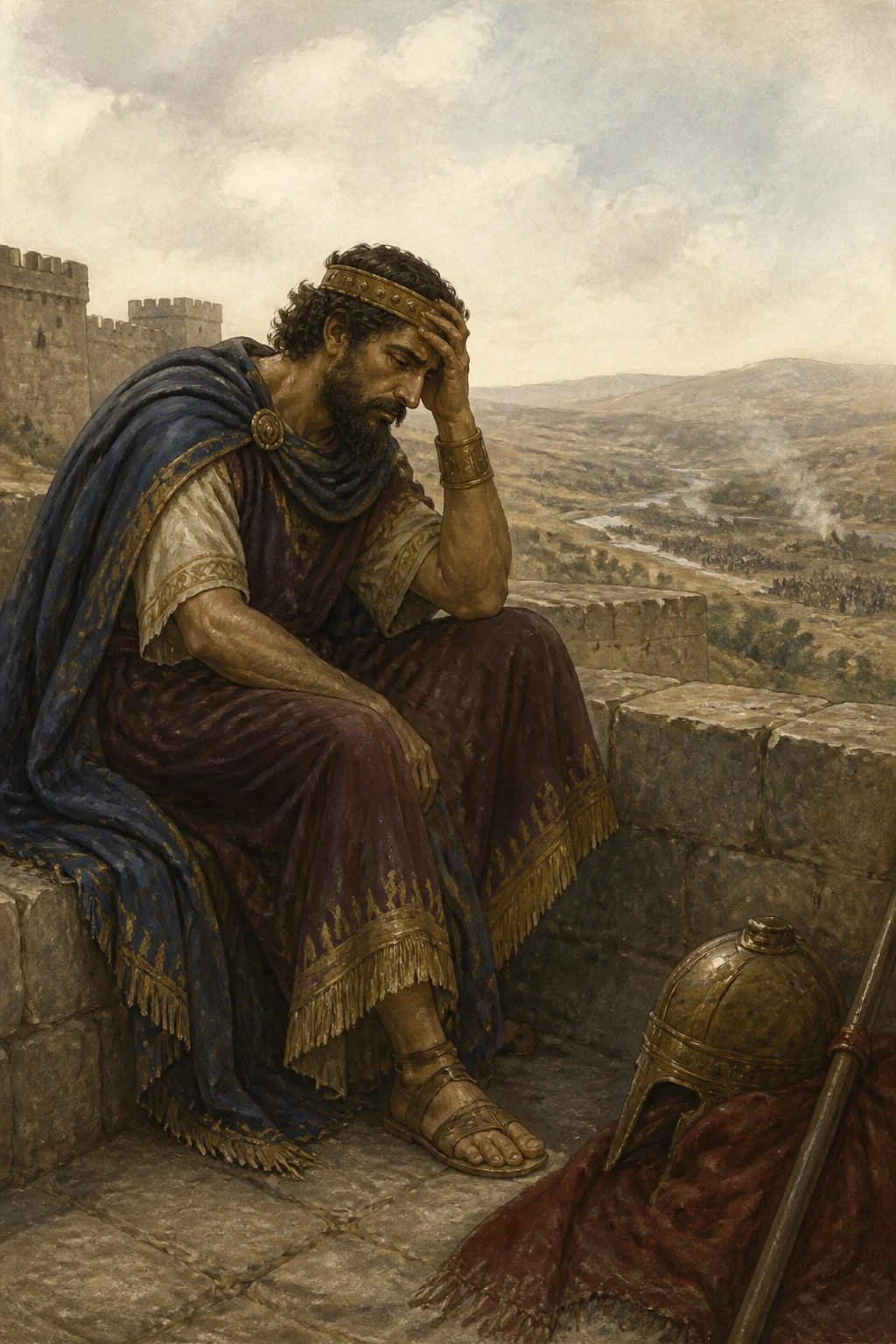
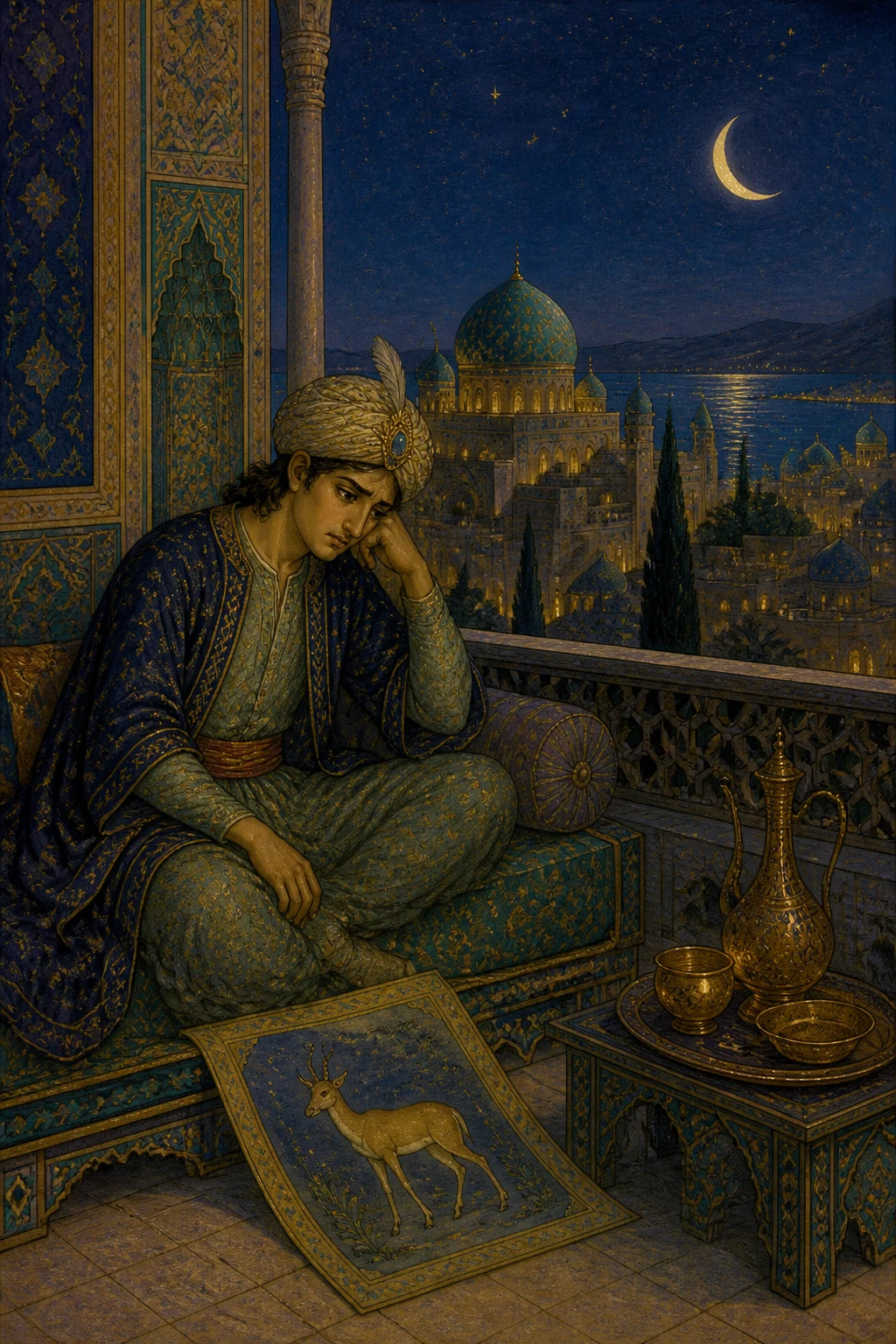
As for King Jan Shah, he remained for two months without seeing his father, refusing to admit any of the slave girls who attended him. At last he grew deeply troubled and asked some of his followers, “What news is there of my father? Why has he not come to see me?” They told him what had befallen his father at the hands of King Kafid, and he said, “Bring me my horse, so that I may go to him.” “We hear and obey,” they replied, and brought it. When his horse stood before him, he said to himself, “I am consumed by my own troubles. The best course is to take my horse and make for the City of the Jews. Once I arrive, God may grant me relief through the merchant who hired me to work for him. Perhaps he will do as he did the first time. Who knows where good fortune may lie?” Then he mounted, took a thousand horsemen with him, and set out, so that people began to say, “Jan Shah is going to his father to fight at his side.” They rode until evening, then halted in a great meadow and spent the night there. When they had fallen asleep and Jan Shah knew that all his soldiers were slumbering, he rose stealthily, girded his waist, mounted his horse, and took the road to Baghdad. For he had heard from the Jews that a caravan came to them from Baghdad every two years, and he said to himself, “When I reach Baghdad, I shall travel with the caravan until I come to the City of the Jews.” Having firmly resolved upon this, he went on his way. When the soldiers awoke and found neither Jan Shah nor his horse, they mounted and searched for him to right and left, but could discover no trace of him. So they returned to his father and told him what his son had done. The king flew into such a rage that sparks almost seemed to issue from his mouth. He flung his crown from his head and cried, “There is no power and no strength save in God! I have lost my son, and the enemy stands before me!” The kings and viziers said to him, “Have patience, King of the Age. Patience can bring nothing but good.” Meanwhile, Jan Shah, grieving for his father and parted from his beloved, went sorrowful and careworn, his heart wounded, his eyes sore with weeping, and sleep forsaking him by night and day. As for his father, when he learned that all his troops and armies were lost, he abandoned the war against his enemy and returned to his city. He entered it, shut its gates, and strengthened its walls, seeking refuge from King Kafid. Each month Kafid came to the city demanding battle, and remained before it for seven nights and eight days. Then he took his army back to their tents to tend the wounded. Whenever the enemy withdrew, the people of King Tayghamus’s city busied themselves repairing their weapons, strengthening the walls, and preparing the mangonels. King Tayghamus and King Kafid remained in this state for seven years, with war unceasing between them. And dawn overtook Shahrazad, and she ceased her permitted tale.
When it was the Five Hundred and Twenty-first Night
She said: It has reached me, O fortunate King, that King Tayghamus and King Kafid remained in this state for seven years. Such was their case. As for Jan Shah, he continued on his way across wildernesses and deserts. Whenever he reached a town, he asked about the Castle of Jawhar Takni, but no one could tell him anything of it. They would only say, “We have never heard that name at all.” Then he asked about the City of the Jews, and a merchant told him that it lay on the farthest borders of the lands of the East. “Travel with us this month,” he said, “to the city of Mazraqan, which is in India. From there we shall go to Khurasan, then journey on to the city of Shamun, and from there to Khwarazm. The City of the Jews is close to Khwarazm, for only a year and three months’ journey lies between them.” Jan Shah waited until the caravan departed and travelled with it until they reached Mazraqan. When he entered the city, he began asking about the Castle of Jawhar Takni, but no one could tell him anything of it. The caravan set out again, and he travelled with it to India. He entered the city and asked about the Castle of Jawhar Takni, but no one knew of it, and they said, “We have never heard that name at all.” On the road he endured great hardship, dreadful perils, hunger, and thirst.
Then he left India and journeyed on until he reached the lands of Khurasan and came to the city of Shamun. He entered it and asked about the City of the Jews. They told him of it and described the road, so he travelled for days and nights until he reached the place where he had escaped from the apes. Then he walked for days and nights until he came to the river beside the City of the Jews. He sat on its bank and waited until Saturday, when, by the power of God Most High, it ran dry. He crossed over and went to the house of the Jew with whom he had stayed the first time, and greeted him and his household. They rejoiced to see him and brought him food and drink, then asked, “Where have you been all this time?” “In the dominions of God Most High,” he answered. He spent that night with them, and the next day he went out to stroll about the city. There he saw a crier calling, “People! Who will take a thousand dinars and a beautiful slave girl in return for half a day’s work for us?” “I will do this work,” said Jan Shah. “Follow me,” said the crier. He followed him until they reached the house of the Jewish merchant to whom he had come the first time. The crier said to the master of the house, “This young man will do the work you require.” The merchant welcomed him, saying, “You are most welcome,” and took him into the women’s quarters. He brought him food and drink, and Jan Shah ate and drank. Then the merchant presented him with the dinars and the beautiful slave girl, and he spent that night with her. In the morning he took the dinars and the girl and entrusted them to the Jew in whose house he had first lodged. Then he returned to the merchant who had hired him, mounted, and rode with him until they reached a lofty, towering mountain.
The merchant took out a rope and a knife and said to Jan Shah, “Throw this mare to the ground.” He threw her down, bound her legs with the rope, slaughtered and skinned her, cut off her legs and head, and slit open her belly, just as the merchant commanded. Then the merchant said, “Get inside this horse’s belly, and I shall sew it up around you. Whatever you see there, tell me of it. This is the work for which you have been paid.” Jan Shah climbed into the horse’s belly, and the merchant sewed it up around him, then went some distance away and hid. An hour later a great bird swooped down from the sky, snatched up the horse, and soared with it into the heavens before alighting on the mountaintop. Once there, it made to eat the horse, but Jan Shah, feeling its approach, slit open the belly and emerged. The bird took fright and flew away. Jan Shah stood up and looked down at the merchant, who seemed no bigger than a sparrow at the foot of the mountain. “What do you want, merchant?” he called. “Throw me some of the stones lying about you,” he replied, “and I shall show you the way down.” Jan Shah said, “You are the man who did such and such to me five years ago! I suffered hunger and thirst, terrible weariness, and many misfortunes. Now you have brought me back to this place, intending my destruction. By God, I shall throw you nothing!” Then Jan Shah set off along the road that led to Sheikh Nasr, King of the Birds. And dawn overtook Shahrazad, and she ceased her permitted tale.
When it was the Five Hundred and Twenty-second Night
She said: It has reached me, O fortunate King, that Jan Shah set off along the road that led to Sheikh Nasr, King of the Birds. He travelled for days and nights, with weeping eyes and a sorrowful heart. When hungry, he ate the plants of the earth; when thirsty, he drank from its rivers. At last he reached the palace of our lord Solomon and saw Sheikh Nasr sitting at its gate. He approached and kissed his hands, and the sheikh welcomed and greeted him. Then he said, “My son, what has happened to bring you here? You left this place with Lady Shamsa, your eyes content and your heart glad.” Jan Shah wept and told him how Lady Shamsa had flown away, saying, “If you love me, come to me at the Castle of Jawhar Takni.” Sheikh Nasr marvelled at this and said, “By God, my son, and by the truth of our lord Solomon, I do not know it, nor have I heard that name in all my life.” “What am I to do?” said Jan Shah. “Love and longing have brought me to death’s door.” Sheikh Nasr replied, “Wait until the birds come, and we shall ask them about the Castle of Jawhar Takni. Perhaps one of them will know it.” Jan Shah’s heart was comforted. He entered the palace and went to the pavilion containing the lake where he had seen the three maidens, and he remained with Sheikh Nasr for some time.
One day, as he sat there as usual, Sheikh Nasr said to him, “My son, the time for the birds to come is drawing near.” Jan Shah rejoiced at this news, and only a few days later the birds arrived. The sheikh came to Jan Shah and said, “My son, learn these names and come to meet the birds.” They came, kind after kind, and greeted Sheikh Nasr. He asked them about the Castle of Jawhar Takni, but each replied, “I have never heard of that castle in all my life.” Jan Shah wept and lamented until he fell senseless. Sheikh Nasr summoned a great bird and said to it, “Carry this young man to the land of Kabul.” He described the country and the way there, and the bird replied, “I hear and obey.” Jan Shah mounted its back, and the sheikh said to him, “Take care of yourself. Do not lean to either side, lest you be torn apart in the air. Stop your ears against the wind, lest the rush of the heavenly spheres and the roar of the seas harm you.” Jan Shah did as Sheikh Nasr instructed. Then the bird took wing, rose into the sky, and carried him for a day and a night before alighting beside the King of the Beasts, whose name was Shah Badri. The bird said to Jan Shah, “We have lost our way to the land Sheikh Nasr described.” It wished to take him up and fly on, but Jan Shah said, “Go your way and leave me in this land, where I shall either die or find my way home.” So the bird left him with Shah Badri, King of the Beasts, and flew away. Shah Badri asked him, “My son, who are you? Where have you come from with this great bird, and what is your story?” He told him all that had happened, from beginning to end. The King of the Beasts marvelled at his tale and said, “By the truth of our lord Solomon, I do not know this castle. But whoever shows us where it is shall be honoured, and we shall send you there.” Jan Shah wept bitterly and waited a little while. Then Shah Badri, King of the Beasts, came to him and said, “Rise, my son. Take these tablets and commit what is written on them to memory. When the beasts arrive, we shall ask them about that castle.” And dawn overtook Shahrazad, and she ceased her permitted tale.
When it was the Five Hundred and Twenty-third Night
She said: It has reached me, O fortunate King, that Shah Badri, King of the Beasts, said to Jan Shah, “Commit what is written on these tablets to memory. When the beasts arrive, we shall ask them about that castle.” Scarcely an hour had passed before the beasts came, kind after kind, and greeted King Shah Badri. He asked them about the Castle of Jawhar Takni, but they all replied, “We do not know this castle, nor have we heard of it.” Jan Shah wept and regretted that he had not gone on with the bird that had brought him from Sheikh Nasr. The King of the Beasts said to him, “My son, do not grieve. I have an elder brother called King Shammakh, who was once held captive by our lord Solomon because he had rebelled against him. Among the jinn, none is older than he and Sheikh Nasr. Perhaps he knows this castle. He rules over the jinn in these lands.” Then the King of the Beasts mounted Jan Shah on the back of one of the beasts and sent a letter with him, commending him to his brother’s care. The beast set off at once and carried Jan Shah for days and nights until it reached King Shammakh. It halted by itself some distance from the king, and Jan Shah dismounted and walked into his presence. He kissed his hands and gave him the letter. The king read it, understood its contents, and welcomed him, saying, “By God, my son, I have never heard of this castle in all my life, nor have I seen it.” Jan Shah wept and lamented, and King Shamsakh said to him, “Tell me your story. Who are you, where have you come from, and where are you going?” He told him everything that had happened, from beginning to end. Shammakh marvelled and said, “My son, I do not believe that our lord Solomon ever heard of this castle or saw it in all his life. But I know a monk who lives on a mountain, a man of great age. All the birds, beasts, and jinn have submitted to him through the power of his incantations. He ceaselessly recited spells over the kings of the jinn until, against their will, they yielded to the force of his incantations and his magic. All the birds and beasts come to serve him. I myself rebelled against our lord Solomon, and he held me captive; yet none overcame me but this monk, through his mighty cunning, spells, and sorcery, and I remained in his service. Know that he has travelled through every land and region, and knows the roads, the directions, the places, the castles, and the cities. I doubt that any place is hidden from him. I shall send you to him, and perhaps he will show you the way to this castle. If he cannot, no one can, for the birds, beasts, and jinn obey him, and all come before him. Such is the power of his magic that he has made himself a staff in three sections. He plants it in the ground and recites an incantation over the first section, and flesh and blood come forth from it. He recites an incantation over the second, and milk comes forth. He recites an incantation over the third, and wheat and barley come forth. Then he draws the staff from the ground and returns to his monastery, which is called the Monastery of Diamonds. This monk and diviner can devise every kind of marvellous contrivance. He is a sorcerer and soothsayer, cunning, deceitful, and wicked, and his name is Yaghmus. He possesses every manner of incantation and spell. I shall certainly send you to him with a great bird that has four wings.” And dawn overtook Shahrazad, and she ceased her permitted tale.
When it was the Five Hundred and Twenty-fourth Night
She said: It has reached me, O fortunate King, that King Shammakh said to Jan Shah, “I shall certainly send you to the monk with a great bird that has four wings.” Then he mounted him on the back of a mighty bird with four wings, each thirty Hashimite cubits long. Its legs were like those of an elephant, but it flew only twice a year. King Shammakh had a servitor called Tamshun, who each day snatched up two Bactrian she-camels from the land of Iraq and tore them apart for the bird to eat. When Jan Shah had mounted its back, Shammakh commanded it to carry him to the monk Yaghmus. It bore him away and travelled with him for nights and days until it reached Mount al-Qal‘ and the Monastery of Diamonds. Jan Shah alighted beside the monastery and saw the monk Yaghmus worshipping inside the church. He approached, kissed the ground, and stood before him. When the monk saw him, he said, “Welcome, my son, stranger to these lands, far from home. Tell me what has brought you here.” Jan Shah wept and told him his story from beginning to end. When the monk heard it, he marvelled exceedingly and said, “By God, my son, I have never heard of this castle, nor have I met anyone who has heard of it or seen it, though I was alive in the days of Noah, the Prophet of God, and ruled over the beasts, birds, and jinn from Noah’s time until the days of our lord Solomon son of David. I do not believe that Solomon ever heard of this castle. But have patience, my son, until the birds, beasts, and servitors of the jinn arrive. I shall ask them, and perhaps one of them will tell us of it and bring us news, and God Most High will ease your plight.”
Jan Shah stayed with the monk for some time. One day, as he sat there, all the birds, beasts, and jinn came before the monk. He and Jan Shah asked them about the Castle of Jawhar Takni, but not one said that he had seen it or heard of it. Each replied, “I have neither seen this castle nor heard of it.” Jan Shah began to weep and lament and beseech God Most High. While he was thus occupied, a bird arrived, the last of all the birds, black in colour and immense in size. It descended from the heights of the sky, came forward, and kissed the monk’s hands. The monk asked it about the Castle of Jawhar Takni, and it replied, “Monk, we used to live beyond Qaf, on the Mountain of Crystal, in a vast wilderness. My brothers and I were little nestlings, and our father and mother went out each day to bring us food. One day they went out and were gone for seven days, and we suffered terribly from hunger. On the eighth day they returned, both weeping. We asked them, ‘Why have you been away from us?’ They replied, ‘A marid came upon us, snatched us up, and carried us to the Castle of Jawhar Takni, where he brought us before King Shahlan. When King Shahlan saw us, he wished to kill us, but we told him that we had little chicks waiting for us, and he spared our lives.’ If my father and mother were still alive, they could tell you about the castle.” When Jan Shah heard this, he wept bitterly and said to the monk, “I beg you to command this bird to carry me towards its father and mother’s nest on the Mountain of Crystal, beyond Mount Qaf.” The monk said to the bird, “Bird, I wish you to obey this young man in all he commands.” “I hear and obey your words,” it replied. Then it took Jan Shah upon its back and flew off. It carried him for days and nights until it reached the Mountain of Crystal, where it alighted and rested for a time. Then it took him on its back again and flew for two days until it reached the country where the nest stood. And dawn overtook Shahrazad, and she ceased her permitted tale.
When it was the Five Hundred and Twenty-fifth Night
She said: It has reached me, O fortunate King, that the bird flew with Jan Shah for two days until it reached the country where the nest stood. It alighted there and said, “Jan Shah, this is the nest in which we lived.” Jan Shah wept bitterly and said to the bird, “I wish you to carry me towards the place to which your father and mother used to fly to fetch food.” “I hear and obey, Jan Shah,” it replied. Then it took him up and flew for seven nights and eight days until it reached a lofty mountain. It set him down from its back and said, “I know no land beyond this place.” Sleep overcame Jan Shah, and he slept on the mountaintop. When he awoke, he saw a distant radiance whose light filled the sky. He marvelled at that gleam and brilliance, not knowing that it was the shining of the castle he sought. A journey of two months lay between him and it. The castle was built of red rubies, its houses of yellow gold, and it had a thousand towers built of precious minerals drawn from the Sea of Darkness. For this reason it was called the Castle of Jawhar Takni, since it was made of the very substance of gems and minerals. It was a mighty castle, and its king was named Shahlan, the father of the three maidens.
Such was the case with Jan Shah. As for Lady Shamsa, when she escaped from him and returned to her father, mother, and family, she told them what had happened between her and Jan Shah. She related his story, telling them how he had wandered the earth and seen its wonders, how he loved her and she loved him, and all that had passed between them. When her father and mother heard this, they said, “It is not lawful before God for you to treat him so.” Her father then told the matter to his servitors among the mighty marids of the jinn and said, “Whichever of you sees a human being must bring him to me.” Lady Shamsa had told her mother that Jan Shah was passionately in love with her, saying, “He is sure to come to us, for when I flew away from the roof of his father’s palace, I told him, ‘If you love me, come to the Castle of Jawhar Takni.’”
When Jan Shah saw that shining radiance, he set out towards it to discover what it was. Lady Shamsa had sent one of her servitors on an errand towards Mount Qarmus. As the servitor went on his way, he saw a human figure in the distance. He approached and greeted him. Jan Shah was frightened of him, but returned his greeting. “What is your name?” the servitor asked. “My name is Jan Shah,” he replied. “I once captured a jinniya called Lady Shamsa, for I had fallen under the spell of her loveliness and beauty, and loved her dearly. Then, after she had entered my father’s palace, she escaped from me.” He told him everything that had happened between them, weeping as he spoke to the marid. The sight of Jan Shah’s tears moved the servitor’s heart, and he said, “Do not weep, for you have attained your desire. Know that she loves you dearly and has told her father and mother of your love for her. Everyone in the castle loves you for her sake. Take comfort, then, and let your eyes be glad.” The marid lifted him onto his shoulders and carried him to the Castle of Jawhar Takni. Messengers hurried to King Shahlan, Lady Shamsa, and her mother with the glad news of Jan Shah’s arrival. When they heard it, they rejoiced exceedingly. King Shahlan commanded all his servitors to go out and meet Jan Shah, and he himself rode forth with all the servitors, ifrits, and marids to welcome him. And dawn overtook Shahrazad, and she ceased her permitted tale.
When it was the Five Hundred and Twenty-sixth Night
She said: It has reached me, O fortunate King, that King Shahlan rode forth with all the servitors, ifrits, and marids to meet Jan Shah. When the king, Lady Shamsa’s father, came up to him, he embraced him, and Jan Shah kissed King Shahlan’s hands. The king ordered for him a splendid robe of honour made of many-coloured silk, embroidered with gold and studded with jewels. Then he set upon his head a crown the like of which no human king had ever seen, and ordered a magnificent horse to be brought for him from the steeds of the kings of the jinn. Jan Shah mounted, and the king mounted too. With the servitors to their right and left, they rode in a splendid procession until they reached the palace gate. The king dismounted, and Jan Shah alighted with him. He found it a magnificent palace, its walls built of gems, rubies, and precious minerals, while crystal, chrysolite, and emeralds were inlaid in the floor. He marvelled at it and wept, and the king and Lady Shamsa’s mother wiped away his tears, saying, “Weep no more, and do not grieve. Know that you have attained your desire.” When he reached the heart of the palace, beautiful slave girls, slaves, and pages came to meet him. They seated him in the finest place and stood in attendance, while he gazed in wonder at the beauty of the place and its walls, built of every kind of mineral and precious jewel.
King Shahlan withdrew to his audience chamber and ordered the slave girls and pages to bring Jan Shah to sit with him. They led him into the king’s presence. The king rose to greet him and seated him beside him on his throne. Then the meal was brought, and they ate and drank and washed their hands. Afterwards Lady Shamsa’s mother came to him, greeted him, and welcomed him, saying, “After hardship you have reached your goal, and after sleeplessness your eyes may rest. Praise be to God for your safe arrival.” Then she went straight to her daughter, Lady Shamsa, and brought her to Jan Shah. Lady Shamsa greeted him, kissed his hands, and lowered her head in shame before him and before her mother and father. Her sisters, who had been with her in the palace, came too, kissed his hands, and greeted him. Then Lady Shamsa’s mother said, “Welcome, my son. My daughter Shamsa has wronged you, but for our sake do not hold against her what she has done.” When Jan Shah heard these words, he gave a cry and fell senseless, to the king’s astonishment. They sprinkled his face with rose water mixed with musk and civet, and he revived. Looking at Lady Shamsa, he said, “Praise be to God, who has granted my desire and quenched my fire, until no flame remains in my heart.” Lady Shamsa said, “May you be safe from all fire! But, Jan Shah, I wish you to tell me what befell you after we parted, and how you came to this place. Most of the jinn do not even know the Castle of Jawhar Takni. We acknowledge the rule of no king, and no one has known the way to this place or heard of it.” He told her everything that had happened to him and how he had arrived. He told them what had befallen his father at the hands of King Kafid, and described the hardships he had endured upon the road and the terrors and marvels he had seen. “All this was for your sake, my lady Shamsa,” he said. Her mother replied, “You have attained your desire, and Lady Shamsa is a maiden whom we bestow upon you.” Jan Shah rejoiced exceedingly at these words. She continued, “Next month, God Most High willing, we shall hold the festivities, celebrate the wedding, and marry her to you. Then you shall take her to your own country. We shall give you a thousand marids from among our servitors. If you gave even the least of them permission to kill King Kafid and his people, he would do it in an instant. Each year we shall send you a company of them, and if you command a single one to destroy all your enemies, he will destroy them.” And dawn overtook Shahrazad, and she ceased her permitted tale.
When it was the Five Hundred and Twenty-seventh Night
She said: It has reached me, O fortunate King, that Lady Shamsa’s mother said to him, “Each year we shall send you a company of them, and if you command a single one to destroy all your enemies, he will destroy them to the last.” Then King Shahlan seated himself upon his throne and ordered the officers of his realm to prepare a great celebration and adorn the city for seven days and nights. “We hear and obey,” they replied. They went out at once and began preparing for the festivities. Their preparations lasted two months, after which they celebrated Lady Shamsa’s wedding with such splendour that no rejoicing like it had ever been seen. Then they brought Jan Shah to his bride, and he remained with her for two years in the sweetest and happiest of lives, eating and drinking. At last he said to Lady Shamsa, “Your father promised that we might go away and spend one year there and one year here.” “I hear and obey,” Lady Shamsa replied. That evening she went in to her father and told him what Jan Shah had said. “I hear and obey,” he answered, “but wait until the beginning of the month, so that we may prepare the servitors for you.” She told Jan Shah what her father had said, and he waited for the appointed time. Then King Shahlan gave the servitors leave to attend Lady Shamsa and Jan Shah and escort them to Jan Shah’s country. He had prepared for them a magnificent litter of red gold, set with pearls and jewels. Above it stood a pavilion of green silk, patterned in every colour and studded with precious gems, whose beauty bewildered the eye. Jan Shah and Lady Shamsa climbed onto the litter, and the king chose four servitors to carry it. Each took his place at one of its sides and lifted it, with Jan Shah and Lady Shamsa seated above.
Lady Shamsa bade farewell to her mother, sisters, and kin. Her father mounted and rode beside Jan Shah, while the servitors bore the litter along. King Shahlan travelled with them until midday, when the servitors set the litter down. They alighted and took leave of one another. King Shahlan commended Lady Shamsa to Jan Shah’s care and charged the servitors to watch over them both. Then he ordered the servitors to lift the litter. Lady Shamsa bade her father farewell, and Jan Shah did likewise. They departed, and her father turned back. He had given her three hundred beautiful slave girls from among his concubines, and had given Jan Shah three hundred young male slaves from among the jinn. They all climbed onto the litter, and the four servitors lifted it and flew with it between heaven and earth. Each day they covered a distance of thirty months’ travel, and continued in this manner for ten days. Among the servitors was one who knew the land of Kabul. When he saw it, he told them to descend upon the great city of that country. This was King Tayghamus’s city, and there they alighted. And dawn overtook Shahrazad, and she ceased her permitted tale.
When it was the Five Hundred and Twenty-eighth Night
She said: It has reached me, O fortunate King, that the servitors alighted upon King Tayghamus’s city, bearing Jan Shah and Lady Shamsa. King Tayghamus had been defeated by his enemies and had taken refuge in a city, where he was closely besieged. King Kafid pressed him hard, and though he asked him for safe conduct, Kafid refused to grant it. When King Tayghamus knew that he had no means left of escaping King Kafid, he resolved to strangle himself and die, finding rest from his grief and sorrow. He rose, bade farewell to his viziers and emirs, and entered his house to take leave of the women. Throughout his kingdom the people wept, wailed, mourned, and cried aloud. While he was thus occupied, the servitors arrived above the palace within the citadel. Jan Shah ordered them to lower the litter into the middle of the audience hall. They did as he commanded, and Lady Shamsa alighted with Jan Shah, the slave girls, and the young male slaves. They found all the people of the city besieged, sorely pressed, and in great distress. Jan Shah said to Lady Shamsa, “Beloved of my heart and delight of my eyes, look at my father and see what a wretched state he is in.” When Lady Shamsa saw his father and the people of his kingdom in such a plight, she commanded the servitors to fall fiercely upon the besieging army and kill them. “Leave not one of them alive,” she said. Then Jan Shah beckoned to a mighty servitor named Qaratash and ordered him to bring King Kafid before him in bonds. The servitors set out against him, taking the litter with them. They went on until they set the litter upon the ground and erected the pavilion above it. They waited until midnight, then fell upon King Kafid and his troops and began slaughtering them. One would seize eight or ten men as they sat upon an elephant, fly up with them into the sky, and let them fall, so that they were torn apart in the air. Others struck the soldiers with iron clubs. The servitor named Qaratash went straight to King Kafid’s tent and burst in upon him as he sat on his couch. He seized him and flew up into the sky. Kafid screamed in terror at the sight of the servitor, who carried him on until he set him down on the litter before Jan Shah. Jan Shah ordered the servitors to lift the litter and hold it aloft. King Kafid came to his senses only to find himself between heaven and earth, and began slapping his face in bewilderment.
Such was the case with King Kafid. As for King Tayghamus, when he saw his son he almost died of joy. He gave a great cry and fell unconscious. They sprinkled his face with rose water, and when he revived, father and son embraced and wept bitterly. King Tayghamus knew nothing of the servitors’ attack upon King Kafid. Then Lady Shamsa rose and walked over to King Tayghamus, Jan Shah’s father. She kissed his hands and said, “My lord, go up to the palace roof and watch my father’s servitors fight.” The king went up to the roof, and he and Lady Shamsa sat watching the servitors as they struck through the army from end to end. One would take an iron club and strike an elephant, crushing both it and its riders until elephants could no longer be distinguished from men. Another would come upon a band of fugitives and shout in their faces, so that they fell down dead. Another would seize twenty horsemen, soar into the sky with them, and cast them to the ground, where they were dashed to pieces. All this while, Jan Shah, his father, and Lady Shamsa looked on and watched the battle. And dawn overtook Shahrazad, and she ceased her permitted tale.
When it was the Five Hundred and Twenty-ninth Night
She said: It has reached me, O fortunate King, that Tayghmus, his son Janshah, and his wife, Lady Shamsa, climbed to the top of the palace and watched the spirit-servants fighting King Kafid’s army. King Kafid watched them from his throne and wept. The slaughter among his troops continued for two days, until they had been slain to the last man. Then Janshah ordered the spirit-servants to bring the throne down to the ground in the midst of King Tayghmus’s citadel, and they brought it down as their master King Janshah commanded. King Tayghmus then ordered one of the spirits, named Shamwal, to take King Kafid, put him in chains and fetters, and imprison him in the Black Tower. Shamwal did as he was commanded. Then King Tayghmus ordered the cymbals to be struck and sent bearers of glad tidings to Janshah’s mother. They went and told her that her son had returned and performed these deeds. She rejoiced, mounted, and came to him. When Janshah saw her, he clasped her to his breast, and she fainted from the excess of her joy. They sprinkled her face with rose water, and when she revived, she embraced him and wept for sheer delight. When Lady Shamsa learned of her arrival, she rose and walked over to her, greeted her, and the two embraced for a long while. Then they sat talking together. King Tayghmus opened the gates of the city and sent heralds throughout all the lands to spread the glad news. Gifts and rarities poured in upon him, and emirs, soldiers, and kings from other countries came to greet him and congratulate him on his victory and his son’s safe return. Thus they continued for some time, with people bringing them gifts and splendid treasures.
Then the king held another magnificent wedding feast for Lady Shamsa and ordered the city to be adorned. She was displayed before Janshah in jewels and sumptuous robes, and Janshah went in to her and gave her a hundred beautiful slave girls to attend her. A few days later, Lady Shamsa went to King Tayghmus and interceded with him for King Kafid, saying, “Release him, so that he may return to his own country. If he should cause any harm, I shall order one of the spirit-servants to snatch him up and bring him to you.” “I hear and obey,” he replied. He sent word to Shamwal to bring King Kafid before him, and Shamwal brought him in chains and fetters. When Kafid came into his presence and kissed the ground before him, the king ordered his fetters removed, and they freed him. Then he mounted him on a lame horse and said, “Queen Shamsa has interceded for you. Go back to your own country, but if you return to your former ways, she will send one of the spirit-servants to bring you here.” So King Kafid set off for his own land in the most wretched state. And dawn overtook Shahrazad, and she fell silent, leaving her tale untold.
When it was the five hundred and thirtieth night
She said: It has reached me, O fortunate King, that King Kafid set off for his own country in the most wretched state. Janshah, his father, and Lady Shamsa lived in the sweetest ease and happiness, enjoying the fullest and most perfect delight. All this the young man seated between the two graves related to Buluqiya. Then he said, “I am that very Janshah who witnessed all these things, my brother Buluqiya.” Buluqiya marveled at his story. Then Buluqiya, who wandered for love of Muhammad, God bless him and grant him peace, said to Janshah, “My brother, what is the meaning of these two graves? Why do you sit between them, and why do you weep?” Janshah replied, “Know, Buluqiya, that we lived in the sweetest ease and happiness, enjoying the fullest and most perfect delight. We would spend one year in our own country and another in the Castle of Jawhar Takni. Whenever we traveled, we sat upon the throne, and the spirit-servants carried it, flying between heaven and earth.” Buluqiya asked, “My brother Janshah, how far was that castle from your country?” Janshah replied, “Each day we covered a distance of thirty months’ journey, and we reached the castle in ten days. We continued in this way for several years. Then, as we were traveling as usual, we came to this place and brought the throne down to look about this island. We sat on the riverbank and ate and drank. Lady Shamsa said, ‘I wish to bathe in this river.’ She took off her clothes, and the slave girls undressed as well, and they went down into the river and swam. I walked along the bank, leaving the girls to play in the water with Lady Shamsa. Suddenly a great shark, one of the creatures of the sea, struck her leg, singling her out from among the girls. She screamed and fell dead that very instant. The girls fled out of the river to the tent, escaping the shark.
“Then some of the girls carried her to the tent, dead. When I saw her lifeless, I fell unconscious. They sprinkled my face with water, and when I revived, I wept over her. I ordered the spirit-servants to take the throne to her family and tell them what had befallen her. They went and told them, and before long her family arrived here. They washed and shrouded her, buried her in this place, and held the mourning rites for her. They wished to take me back to their country with them, but I said to her father, ‘I ask you to have a pit dug beside her grave and make it a grave for me, so that when I die, I may be buried beside her.’ King Shahlan ordered one of the spirit-servants to do this, and he did as I wished. Then they went away and left me here to mourn and weep over her. Such is my story, and the reason I sit between these two graves.” Then he recited these two verses:
“Since you departed, my lords, this house is no home; nor is that kindly neighbor a neighbor any more. The familiar companion I once knew here brings no companionship, and its lights give light no more.” When Buluqiya heard these words from Janshah, he marveled. And dawn overtook Shahrazad, and she fell silent, leaving her tale untold.
When it was the five hundred and thirty-first night
She said: It has reached me, O fortunate King, that when Buluqiya heard these words from Janshah, he marveled and said, “By God, I thought I had journeyed far and wandered over the earth, but by God, what I have heard of your story has made me forget all I have seen.” Then he said to Janshah, “My brother, I beg of your kindness and generosity that you show me a safe road.” Janshah showed him the way, and Buluqiya bade him farewell and departed. All this the Queen of the Serpents related to Hasib Karim al-Din, who asked her, “How did you learn these things?” She replied, “Know, Hasib, that twenty-five years ago I sent a great serpent to Egypt with a letter of greetings to Buluqiya, charging her to have it delivered to him. The serpent went and handed it to the daughter of Shamukh, who had a daughter in Egypt. She took the letter and traveled to Egypt, where she asked people about Buluqiya, and they directed her to him. When she came into his presence, she greeted him and gave him the letter. He read it, understood its contents, and asked the serpent, ‘Have you come from the Queen of the Serpents?’ ‘Yes,’ she replied. He said, ‘I wish to go with you to the Queen of the Serpents, for I have a request to make of her.’ ‘I hear and obey,’ she answered. She took him with her to her daughter’s home, greeted her daughter, then bade her farewell and departed. She said to him, ‘Close your eyes.’ He closed them and opened them again, and found himself in the mountain where I live. She led him to the serpent who had given her the letter and greeted her. The serpent asked, ‘Did you deliver the letter to Buluqiya?’ She replied, ‘Yes, I delivered it, and he has come with me. Here he is.’ Buluqiya stepped forward, greeted that serpent, and asked her about the Queen of the Serpents. She answered, ‘She has gone to Mount Qaf with her hosts and armies. When summer comes, she returns to this land. Whenever she goes to Mount Qaf, she leaves me in her place until her return. If you need anything, I shall grant it.’ Buluqiya said, ‘I wish you to bring me the plant which, when a man pounds it and drinks its juice, keeps him from weakness, old age, and death.’ The serpent replied, ‘I shall not bring it until you tell me what befell you after you parted from her, when you and Affan went to the burial place of our lord Solomon.’ So Buluqiya told her his story from beginning to end, and related all that had befallen Janshah as well. Then he said, ‘Grant my request, so that I may return to my own country.’ The serpent answered, ‘By our lord Solomon, I do not know the way to that herb.’ Then she ordered the serpent who had brought him, ‘Take him back to his own country.’ ‘I hear and obey,’ she replied. She said to him, ‘Close your eyes.’ He closed them and opened them again, and found himself on Mount al-Muqattab. From there he walked until he reached his home.
“When the Queen of the Serpents returned from Mount Qaf, the serpent whom she had left in her place came to greet her and said, ‘Buluqiya sends you his greetings.’ She related everything Buluqiya had told her of what he had seen on his travels and of his meeting with Janshah.” Then the Queen of the Serpents said to Hasib Karim al-Din, “That is how this story came to me, Hasib.” Hasib said, “Queen of the Serpents, tell me what befell Buluqiya when he returned to Egypt.” She replied, “Know, Hasib, that after Buluqiya parted from Janshah, he traveled for nights and days until he reached a great sea. He anointed his feet with some of the liquid he carried and walked over the surface of the water until he reached an island of trees, rivers, and fruit, as lovely as Paradise. He wandered about the island and saw an enormous tree with leaves like the sails of ships. Drawing near, he found beneath it a table spread with every kind of exquisite food. On the tree he saw a great bird made of pearls and green emeralds. Its legs were silver, its beak red ruby, and its feathers precious metals. It was glorifying God Most High and invoking blessings upon Muhammad, God bless him and grant him peace.” And dawn overtook Shahrazad, and she fell silent, leaving her tale untold.
When it was the five hundred and thirty-second night
She said: It has reached me, O fortunate King, that when Buluqiya landed on the island and found it like Paradise, he wandered through it and saw its wonders. Among them was that bird of pearls and green emeralds, with feathers of precious metal, glorifying God Most High and invoking blessings upon Muhammad, God bless him and grant him peace. When Buluqiya saw this great bird, he asked, “Who are you, and what is your story?” The bird replied, “I am one of the birds of Paradise. Know, my brother, that when God Most High drove Adam out of Paradise, He sent out with him four leaves with which to cover himself. These fell upon the earth. One was eaten by worms, and from it came silk; the second was eaten by gazelles, and from it came musk; the third was eaten by bees, and from it came honey; and the fourth fell in India, and from it came spices. As for me, I wandered over all the earth until God graciously bestowed this place upon me, and here I have remained. Every Friday eve and Friday, the saints and spiritual poles of the world come to visit this place and eat of this food. It is God Most High’s hospitality to them, which He offers them every Friday eve and Friday. Afterward the table is raised to Paradise, and its food neither dwindles nor changes.” Buluqiya ate, and when he had finished and praised God Most High, al-Khidr, peace be upon him, appeared. Buluqiya rose to greet him and was about to leave, but the bird said, “Sit down, Buluqiya, in the presence of al-Khidr, peace be upon him.” Buluqiya sat down, and al-Khidr said, “Tell me about yourself and relate your story.” Buluqiya told him everything that had happened to him from beginning to end, until he had come to the place where he now sat before him. Then he asked, “My lord, how far is it from here to Egypt?” “A journey of ninety-five years,” he replied. When Buluqiya heard this, he wept, bent over al-Khidr’s hand and kissed it, saying, “Deliver me from this exile, and may God reward you. I am on the brink of destruction and have no means left to save myself.” Al-Khidr said, “Pray to God Most High to give me leave to take you to Egypt before you perish.” Buluqiya wept and implored God Most High, who accepted his prayer and inspired al-Khidr, peace be upon him, to take him to his family. Al-Khidr said, “Lift your head. God has accepted your prayer and inspired me to take you to Egypt. Cling to me, hold me firmly with both hands, and close your eyes.” Buluqiya clung to al-Khidr, peace be upon him, holding him with both hands, and closed his eyes. Al-Khidr took a single step, then said, “Open your eyes.” He opened them and found himself standing at the door of his own house. He turned to bid al-Khidr farewell, but could find no trace of him. And dawn overtook Shahrazad, and she fell silent, leaving her tale untold.
When it was the five hundred and thirty-third night
She said: It has reached me, O fortunate King, that when al-Khidr, peace be upon him, brought Buluqiya to his own door, Buluqiya opened his eyes to bid him farewell but could not find him. He entered his house, and when his mother saw him, she gave a loud cry and fainted from the excess of her joy. They sprinkled her face with water until she revived. Then she embraced him and wept bitterly, while Buluqiya wept one moment and laughed the next. His family, kinsfolk, and all his friends came to congratulate him on his safe return. The news spread throughout the land, and gifts came to him from every quarter. Drums were beaten and pipes sounded, and the people rejoiced exceedingly. Afterward Buluqiya told them his story and all that had befallen him, and how al-Khidr had brought him to the door of his own house. They marveled at this and wept until they could weep no more.
All this the Queen of the Serpents related to Hasib Karim al-Din. Hasib marveled and wept bitterly, then said to the Queen of the Serpents, “I wish to return to my own country.” She replied, “I fear, Hasib, that once you reach your country, you will break your pledge and the oath you swore, and enter a bathhouse.” He swore further solemn oaths that he would never enter a bathhouse as long as he lived. Then she summoned a serpent and said, “Take Hasib Karim al-Din up to the surface of the earth.” The serpent took him and led him from place to place until she brought him out upon the earth through the mouth of an abandoned pit. He walked until he reached the city and made his way home. It was late in the day, when the sun was turning yellow. He knocked at the door, and his mother came and opened it. When she saw her son standing there, she cried out for joy, flung herself upon him, and wept. His wife heard her weeping and came out. Seeing her husband, she greeted him and kissed his hands. They rejoiced greatly in one another and entered the house. When they had settled down and he was seated among his family, he asked about the woodcutters who used to gather wood with him and who had gone away and left him in the pit. His mother said, “They came to me and told me, ‘A wolf ate your son in the valley.’ They have become merchants, owning properties and shops, and the world has prospered with them. Every day they bring us food and drink, and they have continued to do so until now.” He said to his mother, “Tomorrow go to them and say, ‘Hasib Karim al-Din has returned from his travels. Come to meet him and greet him.’” In the morning his mother went to the woodcutters’ houses and told them what her son had instructed her to say. When they heard her words, their faces changed color, and they said, “We hear and obey.” Each gave her a suit of silk embroidered with gold, saying, “Give your son this to wear, and tell him we shall come to him tomorrow.” “I hear and obey,” she replied. Then she returned to her son, told him what had happened, and gave him what they had sent.
Such was the case with Hasib Karim al-Din and his mother. As for the woodcutters, they gathered a company of merchants, told them what they had done to Hasib Karim al-Din, and asked, “How should we deal with him now?” The merchants answered, “Each of you should give him half his wealth and his slaves.” They all agreed to this, and each took half his wealth and went with the others to Hasib. They greeted him, kissed his hands, and gave him what they had brought, saying, “This is but a little of what we owe to your kindness, and we are now at your service.” He accepted it and said, “What is past is past. This was ordained by God Most High, and destiny overcomes all precautions.” They said, “Come with us to stroll about the city and visit the bathhouse.” He replied, “I have sworn an oath never to enter a bathhouse as long as I live.” “Then come to our houses,” they said, “so that we may entertain you.” “I hear and obey,” he answered. He rose and went with them, and each entertained him for a night, until seven nights had passed. He had now become a man of wealth, properties, and shops. The merchants of the city gathered about him, and he told them all that had happened to him and all he had seen. He became one of the foremost merchants and lived in this way for some time.
One day he went out for a stroll through the city. As he passed the door of a bathhouse, a friend of his who owned it caught his eye. The man greeted and embraced him, saying, “Honor me by entering the bathhouse and having yourself scrubbed, so that I may entertain you.” Hasib replied, “I have sworn an oath never to enter a bathhouse as long as I live.” The bathhouse keeper swore, “My three wives shall each be divorced three times over if you do not come into the bathhouse with me and bathe.” Hasib Karim al-Din was troubled. The man said, “My brother, would you leave my children fatherless, ruin my household, and lay the sin upon my neck?” Then the bathhouse keeper threw himself at Hasib’s foot and kissed it, saying, “I place myself under your protection: come into the bathhouse with me, and let the sin be upon my own neck.” The bath attendants and everyone inside crowded around Hasib Karim al-Din, pressed him, stripped off his clothes, and led him into the bathhouse. No sooner had he entered, sat beside the wall, and poured water over his head than twenty men approached and said, “Get up, fellow, and come with us. You are wanted by the sultan.” They sent one of their number to the sultan’s vizier. The man went and informed him, and the vizier mounted, accompanied by sixty mamluks, and rode to the bathhouse. They came upon Hasib Karim al-Din, and the vizier greeted him warmly, gave the bathhouse keeper a hundred dinars, and ordered a horse to be brought for Hasib to ride. Then the vizier, Hasib, and the vizier’s company mounted and rode together to the sultan’s palace. The vizier and his men dismounted, as did Hasib, and they sat in the palace. A meal was brought, and they ate and drank, then washed their hands. The vizier bestowed upon Hasib two robes of honor, each worth five thousand dinars, and said, “Know that God has favored us with you and shown us mercy through your coming. The sultan is on the brink of death from leprosy, and our books have revealed that his life rests in your hands.”
Hasib marveled at their conduct. Then the vizier, Hasib, and the high officers of state passed through the palace’s seven gates until they came before the king. He was called King Karazdan, King of the Persians, and he ruled the seven climes. In his service were a hundred sultans, seated upon chairs of red gold, and ten thousand champions, each commanding a hundred deputies and a hundred executioners armed with swords and battle-axes. They found the king lying with his face wrapped in a kerchief, groaning from his afflictions. When Hasib saw all this array, he was overwhelmed by the majesty surrounding King Karazdan. He kissed the ground before him and prayed for him. Then the grand vizier, whose name was Shamhur, approached Hasib, welcomed him, and seated him on a splendid chair at King Karazdan’s right hand. And dawn overtook Shahrazad, and she fell silent, leaving her tale untold.
When it was the five hundred and thirty-fourth night
She said: It has reached me, O fortunate King, that the vizier Shamhur approached Hasib and seated him on a chair at King Karazdan’s right hand. The meal was brought, and they ate and drank and washed their hands. Then the vizier Shamhur rose, and everyone in the assembly stood up out of awe for him. He walked toward Hasib Karim al-Din and said, “We are at your service, and whatever you ask, we shall give you. Even if you ask for half the kingdom, we shall grant it, for the king’s recovery lies in your hands.” He took him by the hand and led him to the king. Hasib uncovered the king’s face, looked at him, and saw that he was desperately ill, which filled him with wonder. Then the vizier bent over Hasib’s hand and kissed it, saying, “We wish you to cure this king, and whatever you ask, we shall give you. This is the favor we seek.” Hasib replied, “It is true that I am the son of Daniel, the prophet of God, but I have no knowledge of learning. They set me to study the physician’s art for thirty days, yet I learned nothing of it. I wish I possessed some knowledge, so that I might treat this king.” The vizier said, “Do not weary us with words. Even if we gathered the sages of East and West, no one but you could cure the king.” Hasib asked, “How can I treat him when I know neither his disease nor its remedy?” The vizier answered, “The king’s remedy is in your keeping.” Hasib said, “If I knew his remedy, I would treat him.” The vizier replied, “You know his remedy very well. His remedy is the Queen of the Serpents. You know where she lives, you have seen her, and you have stayed with her.”
When Hasib heard these words, he knew that his visit to the bathhouse was the cause of all this, and he began to repent when repentance could no longer avail him. He said, “What Queen of the Serpents? I do not know her, nor have I ever heard that name in all my life.” The vizier replied, “Do not deny knowing her. I have proof that you know her and stayed with her for two years.” Hasib said, “I do not know her, have never seen her, and have heard nothing of this until this moment, from you.” The vizier brought a book, opened it, and began to make calculations. Then he said, “The Queen of the Serpents meets a man who remains with her for two years, then leaves her and returns to the surface of the earth. When he enters a bathhouse, his belly turns black.” He said to Hasib, “Look at your belly.” Hasib looked and found it black. He told them, “My belly has been black since the day my mother bore me.” The vizier said, “I stationed three mamluks at every bathhouse to examine everyone who entered, look at his belly, and report to me. When you entered the bathhouse, they looked at your belly and found it black, so they sent me word. We could scarcely believe that we would meet you this day. We ask nothing of you except to show us the place from which you emerged. Then you may go your way. We can capture the Queen of the Serpents ourselves, and have someone who can bring her to us.”
When Hasib heard this, he bitterly regretted entering the bathhouse, though regret could no longer avail him. The emirs and viziers pressed him to tell them about the Queen of the Serpents, until they exhausted every effort, but he kept saying, “I have never seen or heard of such a thing.” Then the vizier called for the executioner. When he was brought, the vizier ordered him to strip Hasib and beat him severely. He did so, until Hasib saw death before his eyes from the intensity of his torment. Then the vizier said, “We have proof that you know where the Queen of the Serpents lives. Why do you deny it? Show us the place from which you emerged, and be gone. We have someone who can capture her, and no harm will come to you.” Then he spoke gently to him, helped him to his feet, and ordered him a robe of honor embroidered with gold and precious metals. Hasib yielded to the vizier’s command and said, “I shall show you the place from which I emerged.” The vizier rejoiced greatly at his words. He and all the emirs mounted, and Hasib mounted and rode at the head of the troops. They traveled until they reached the mountain, and Hasib led them into the cave, weeping and lamenting. The emirs and viziers dismounted and followed him on foot until they reached the well from which he had come. The vizier stepped forward, sat down, and burned incense. He uttered adjurations, recited spells, blew, and muttered, for he was a cunning sorcerer and diviner, versed in the lore of spirits and other occult arts. When he finished his first incantation, he recited a second and a third, replacing the incense on the fire whenever it was consumed. Then he cried, “Come forth, Queen of the Serpents!” The water in the well sank away, and a vast door opened within it. A tremendous cry like thunder rose from the depths, until they thought the well had collapsed. Everyone present fell senseless to the ground, and some died. Out of the well came a serpent as huge as an elephant, with sparks like glowing coals flying from its eyes and mouth. On its back was a platter of red gold set with pearls and jewels, and in the middle of the platter lay a serpent whose radiance lit the place. Her face was like a human face, and she spoke with the utmost eloquence. This was the Queen of the Serpents. She looked right and left, and her gaze fell upon Hasib Karim al-Din. She said, “Where is the pledge you gave me, and the oath you swore never to enter a bathhouse? Yet no cunning can prevail against destiny, and there is no escaping what is written upon the brow. God has ordained that my life should end at your hands. It is His decree and His will that I should be slain and King Karazdan cured of his illness.” The Queen of the Serpents wept bitterly, and Hasib wept at her tears. When the accursed vizier Shamhur saw her, he reached out to seize her, but she said, “Hold back your hand, accursed one, or I shall breathe upon you and turn you into a heap of black ash.” Then she called to Hasib, “Come here, take me in your hands, place me in that tray you have brought, and carry it on your head. My death at your hands has been decreed from eternity, and you have no power to avert it.” Hasib took her, placed her in the tray, and lifted it onto his head. The well returned to its former state, and they set off, with Hasib carrying the tray containing her upon his head.
As they were on their way, the Queen of the Serpents said secretly to Hasib Karim al-Din, “Hasib, listen to the counsel I shall give you, though you have broken your pledge, forsworn your oath, and done these deeds, for all this was decreed from eternity.” He replied, “I hear and obey. What do you command me, Queen of the Serpents?” She said, “When you reach the vizier’s house, he will tell you, ‘Slaughter the Queen of the Serpents and cut her into three pieces.’ Refuse to do it, and say, ‘I do not know how to slaughter,’ so that he will kill me with his own hands and do with me as he wishes. When he has killed me and cut me up, a messenger will come from King Karazdan to summon him. Before leaving for the king, he will put my flesh into a copper pot and set it over the brazier. He will say to you, ‘Keep the fire burning beneath this pot until the froth rises from the meat. When it rises, take it and put it in a flask, wait until it cools, and drink it yourself. Once you drink it, no pain will remain in your body. When the second froth rises, put it in another flask and keep it until I return from the king, so that I may drink it for a pain in my back.’ Then he will give you the two flasks and go to the king. When he has gone, kindle the fire beneath the pot until the froth rises. Skim it off, put it in a flask, and keep it by you, but beware of drinking it, for if you do, no good will come to you. When the second froth rises, put it in the second flask, wait until it cools, and keep it until you drink it. When he returns from the king and asks you for the second flask, give him the first and see what happens to him.” And dawn overtook Shahrazad, and she fell silent, leaving her tale untold.
When it was the five hundred and thirty-fifth night
She said: It has reached me, O fortunate King, that the Queen of the Serpents charged Hasib Karim al-Din not to drink the first froth and to preserve the second. She told him, “When the vizier returns from the king and asks you for the second flask, give him the first and see what happens to him. Afterward drink the second yourself. When you have drunk it, your heart will become a dwelling place of wisdom. Then lift out the meat, put it on a copper tray, and give it to the king to eat. When he has eaten it and it has settled in his stomach, cover his face with a kerchief and leave him until noon, so that his belly may cool. Afterward give him something to drink, and he will become sound as before, cured of his illness by the power of God Most High. Heed this counsel I have given you and observe it with the greatest care.”
They traveled on until they reached the vizier’s house. The vizier said to Hasib, “Come into the house with me.” The vizier and Hasib entered, the troops dispersed, and each man went his way. Hasib lowered from his head the tray containing the Queen of the Serpents. Then the vizier said, “Slaughter the Queen of the Serpents.” Hasib replied, “I do not know how to slaughter, and I have never slaughtered anything in my life. If you wish her killed, kill her with your own hands.” The vizier Shamhur rose, took the Queen of the Serpents from the tray, and slaughtered her. When Hasib saw this, he wept bitterly, but Shamhur laughed at him, saying, “You fool, why do you weep over the killing of a serpent?” After slaughtering her, the vizier cut her into three pieces, put them in a copper pot, set it over the fire, and sat waiting for the flesh to cook. While he sat there, a mamluk arrived from the king and said, “The king summons you this very moment.” “I hear and obey,” replied the vizier. He rose, brought Hasib two flasks, and said, “Keep the fire burning beneath this pot until the first froth rises from the meat. When it rises, skim it off and put it in one of these two flasks. Wait until it cools, then drink it yourself. Once you have drunk it, your body will be sound, and no pain or illness will remain in it. When the second froth rises, put it in the other flask and keep it until I return from the king and drink it, for I have a pain in my back that may be cured by it.” Having emphatically repeated these instructions to Hasib, he went to the king. Hasib kept the fire burning beneath the pot until the first froth rose, then skimmed it off, put it in one of the flasks, and set it aside. He continued to feed the fire until the second froth rose, then skimmed it off, put it in the other flask, and kept it by him. When the meat was cooked, he took the pot off the fire and sat waiting for the vizier. When the vizier returned from the king, he asked Hasib, “What have you done?” Hasib replied, “The work is finished.” The vizier asked, “What did you do with the first flask?” “I drank its contents just now,” he answered. The vizier said, “I see no change in your body.” Hasib replied, “From head to foot, my whole body feels as though it were burning like fire.” The crafty vizier Shamhur concealed the truth from Hasib to deceive him, then said, “Give me the second flask so that I may drink what is in it and perhaps be healed of this pain in my back.” He drank the contents of the first flask, believing it to be the second. Before he had finished drinking, it fell from his hand, and his body swelled at once. Thus the proverb came true in him: “He who digs a pit for his brother falls into it himself.”
When Hasib saw what had happened, he was astonished and grew afraid to drink the second vial. Then he recalled the serpent’s counsel and said to himself, “If what is in the second vial were harmful, the vizier would not have chosen it for himself.” Then he said, “I put my trust in God Most High,” and drank its contents. As soon as he had drunk, God Most High caused springs of wisdom to well up in his heart and opened his inward eye to knowledge, filling him with joy and delight. He took the meat from the pot, laid it on a copper tray, and left the vizier’s house. Raising his head to the sky, he saw the seven heavens and all they contained, as far as the Lote Tree of the Utmost Boundary. He saw how the celestial sphere revolved, for God revealed all this to him. He beheld the wandering planets and the fixed stars, learned the nature of the heavenly bodies, and saw the form of land and sea. From these things he deduced the sciences of geometry, astrology, cosmography, astronomy, arithmetic, and all that pertains to them, and understood the consequences of eclipses of the sun and moon, and much else besides. Then he looked at the earth and came to know its minerals, plants, and trees, and all their properties and uses. From these he deduced the sciences of medicine, natural magic, and alchemy, and learned the art of making gold and silver. He continued on his way with the meat until he reached the palace of King Karzadan. Entering his presence, he kissed the ground before him and said, “May your own life be spared, though your vizier Shamhur is dead.” The king was deeply distressed at his vizier’s death and wept bitterly, as did the viziers, the emirs, and the great officers of state.
Then King Karzadan said, “Vizier Shamhur was with me only a short while ago, in perfect health. He went to bring me the meat, if it was cooked. What can have caused his death so suddenly? What befell him?” Hasib told the king all that had happened to his vizier: how he had drunk the vial, how his body had swollen and his belly bloated, and how he had died. The king grieved sorely for him, then said to Hasib, “What is to become of me without Shamhur?” Hasib replied, “Have no fear, O King of the Age. I shall cure you in three days and leave no trace of sickness in your body.” King Karzadan’s heart was cheered, and he said to Hasib, “All I wish is to be delivered from this affliction, even if it takes years.” Hasib rose, brought the pot, and set it before the king. He took a piece of the flesh of the Queen of the Serpents and fed it to King Karzadan, then covered him, spread a kerchief over his face, and sat beside him, bidding him sleep. The king slept from noon until sunset, while the piece of meat worked its way through his belly. Then Hasib woke him, gave him something to drink, and bade him sleep again. He slept through the night until morning. When day broke, Hasib treated him as he had the day before, until he had fed him the three pieces over three days. The king’s skin blistered and peeled away entirely. Then he began to sweat, until perspiration streamed from his head to his feet, and he recovered, with not a trace of sickness left in his body. After this Hasib said to him, “You must now go to the bath.” He took him into the bathhouse, washed his body, and brought him out, his body gleaming like a bar of silver. His health was restored, and he was stronger than he had been before. He dressed in his finest clothes, seated himself upon the throne, and gave Hasib Karim al-Din leave to sit beside him. Hasib took his place at his side, and the king ordered the feast to be laid. They ate and washed their hands, after which he ordered drinks to be brought. These were served, and the two drank. Then all the emirs, viziers, soldiers, officers of state, and leading men among his subjects came to congratulate him on his recovery and deliverance. Drums were beaten, and the city was decked out in celebration of the king’s recovery. When they had assembled before him to offer their congratulations, the king said, “O viziers, emirs, and officers of state, this is Hasib Karim al-Din, who has cured me of my sickness. Know that I have appointed him grand vizier in place of Vizier Shamhur.” But morning overtook Shahrazad, and she fell silent, leaving her tale untold.
When it was the five hundred and thirty-sixth night
She said: It has reached me, O fortunate king, that the king said to his viziers and great officers of state, “The man who cured me of my sickness is Hasib Karim al-Din, and I have appointed him grand vizier in place of Vizier Shamhur. Whoever loves him loves me; whoever honours him honours me; and whoever obeys him obeys me.” They all replied, “We hear and obey.” Then they rose, kissed Hasib Karim al-Din, greeted him, and congratulated him on his appointment. After this the king bestowed on him a splendid robe of honour woven with red gold and studded with pearls and jewels, the least of which was worth five thousand dinars. He gave him three hundred mamluks, three hundred concubines radiant as moons, three hundred Abyssinian slave girls, and five hundred mules laden with treasure. He also gave him livestock—sheep, buffalo, and cattle—in numbers beyond description. After all this, he commanded his viziers, emirs, officers of state, the grandees of his kingdom, his mamluks, and all his subjects to present him with gifts. Then Hasib Karim al-Din mounted, and behind him rode the viziers, emirs, officers of state, and all the troops. They proceeded to the house the king had set aside for him. There he seated himself upon a chair, and the emirs and viziers came forward, kissed his hand, and congratulated him on his appointment, placing themselves at his service. His mother rejoiced exceedingly and congratulated him on becoming vizier. His family came to congratulate him on his safe return and his appointment, overjoyed at his good fortune. Then his companions the woodcutters came to congratulate him as well. Afterwards he mounted and rode to Vizier Shamhur’s palace, where he set his seal upon the house, took possession of its contents, made an inventory, and had everything conveyed to his own home. Though he had once known nothing of the sciences and had not even been able to read, by the power of God Most High he had become learned in every branch of knowledge. His learning became renowned and his wisdom celebrated throughout the lands, and he was famed for his mastery of medicine, cosmography, geometry, astrology, alchemy, natural magic, the spiritual arts, and the other sciences.
One day he said to his mother, “Mother, my father Daniel was a learned and accomplished man. Tell me what he left behind in the way of books and other things.” When his mother heard his words, she brought him the chest in which his father had placed the five leaves that remained of the books lost at sea. “Your father left no books,” she said, “except for the five leaves in this chest.” He opened the chest, took out the five leaves, and read them. Then he said to her, “Mother, these leaves are part of a book. Where is the rest of it?” She replied, “Your father once travelled by sea with all his books, but his ship was wrecked and his books sank. God Most High saved him from drowning, but nothing remained of his books except these five leaves. When your father returned from his journey, I was pregnant with you, and he said to me, ‘Perhaps you will bear a son. Take these leaves and keep them safe. When the boy grows up and asks what I have left him, give them to him and say, “Your father left nothing but these.”’ And here they are.” Thus Hasib Karim al-Din mastered all the sciences. Thereafter he lived amid feasting and drinking, in the greatest comfort and ease, until there came to him the Destroyer of Delights and the Sunderer of Gatherings. This is the end of what has come down to us of the tale of Hasib son of Daniel, may God Most High have mercy upon him. And God knows best.