Waltey
Lasje
Cuentos antiguos
Cuentos de Navidad, de la patria y antiguos · Emilia Pardo BazánO besedilu
Lasje
- Vir
- Cuentos de Navidad, de la patria y antiguos
- Avtor
- Emilia Pardo Bazán
- Jezik branja
- English
- Jezik izvirnika
- Español
- Čas branja
- 8 min branja
- Obseg
- 7 strani
- Naslov izvirnika
- 035 Los cabellos
O izvirniku
Cuentos de Navidad, de la patria y antiguos
Sedemintrideset avtorskih zgodb v treh zgodovinskih knjižnih skupinah. Bralni jezik je English, izvirnik pa prihaja iz vira Cuentos de Navidad, de la patria y antiguos v jeziku Español.
Besedilo
Lasje
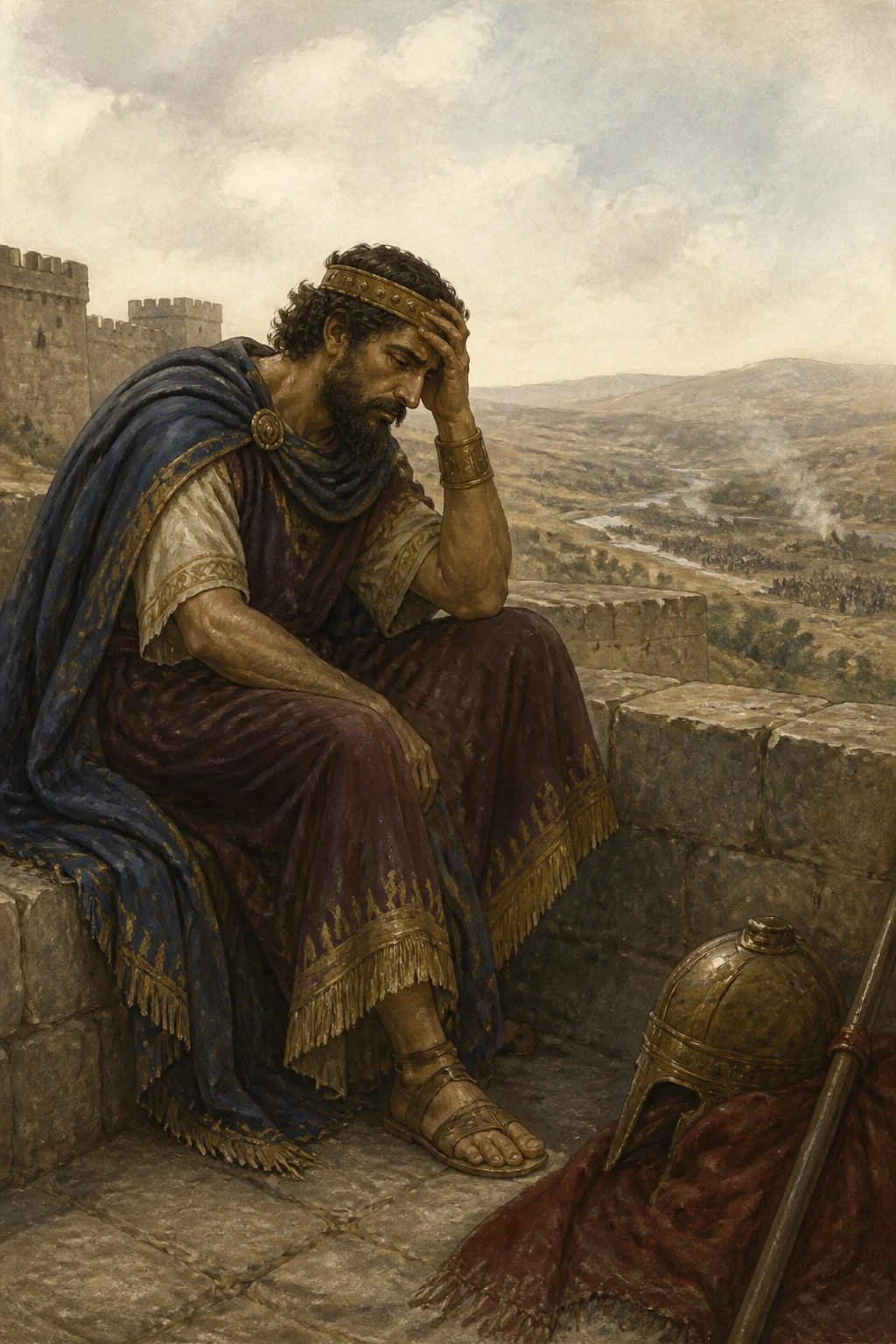
It was within the double redoubt of the stronghold of Mahanaim. Between the two lines of fortifications, on the ledge of grey stone that supported the casemate, David, exhausted, sat down to await news. For more than two hours he had been pacing impatiently, for the messengers still had not come. His feverish anxiety was heightened by his inability to go in person to the battlefield, since that would violate his firm resolve never to command troops in a civil war. Had it been a matter of fighting the Philistines and renewing the laurels of Balparasim, pouring out the heroic libation of the sacred water of Bethlehem rather than quenching his thirst while his soldiers languished, or of marshalling another battle of Rephaim, where strategy first worked miracles in the ancient world; had war flared against the idolatrous, independent Moabites, or the wealthy Arameans, or the insolent Ammonites who had outraged the ambassadors of Israel—there would have been David the slinger, the gibbor, the adventurer to whom the clash of weapons was sweeter music than the harmonies of the lyre. But to oppose his own people, to draw his sword or brandish his spear so that it might seek the flank of a friend, a kinsman, a companion—this had revolted David. And now, in this tragic hour, the king blessed that old resolve, which spared him from fighting his own flesh and blood, the darling of his soul, the light of his right eye, his son!
In violent circumstances and hours of extreme anxiety, there comes a moment when the nerves slacken and the body yields to its need for rest. The old monarch’s agitation and fever subsided once he had let himself sink onto that stone ledge in the lonely fortified enclosure. Through the arrow slits he could see the red light of the setting sun, which scorched the countryside with the glow of an enormous blaze. That crimson, bloody, devouring radiance was the last thing David noticed before closing his eyes and resting his head against the wall, forgetting the present, the anguish of uncertainty, and the terrors of the spirit...
And afterward he still saw that same sunset glow; but its colours had softened, melting into delicate half-tones of orange, gold, and green. It was the divine twilight of Eastern lands, a hundred times more beautiful than dawn. Pearly iridescence brightened the faint wisps of cloud, torn like shreds from the veil of a Philistine dancing girl; and against the glowing horizon the branches of sycamores and cedars formed a canopy of mystery and enticing shade. The cool air tempered the pungent exhalations of resins and gums; a voluptuous languor stole over the heart. David rose, leaned against the jasper balustrade of the terrace, and bent forward to gaze deep into the masses of greenery, drawn by the delicious murmur of jets of water streaming in fine threads into the broad marble basin from ten bronze mouths. And at the very moment the king leaned forward, a living statue appeared on the steps leading down to the pool, tinted rose by the reflected sky, clothed only in the abundance of her black hair, which parted like the strands of water, rippling and shining, playing and spreading, newly anointed with oil of spikenard that the woman, raising her arms, worked through the dark curls, twining them about her fingers...
All the fire of the heavens burned in David’s veins. From that hour onward, he marvelled inwardly, unable to understand. He was quite certain that his faithful cupbearer had not poured into his wine the juice of herbs in which the spell of some sorceress like the Witch of Endor treacherously instils the potion of sudden, fatal passion. David’s youthful days were past, those days when his unerring hand drove the sharp stone into the forehead of the monstrous giant. Countless women had filled the king’s nostrils with the perfume of their hair, and as it faded their images had vanished, for it was unworthy of the sage, the prophet, the leader, the lawgiver to grow soft in the harem, to become the captive of a frail woman. And yet, at that moment, there could be no doubt: it was the fire of heaven that burned in David’s veins, and the king knew that neither all the water in the pool nor that of the torrents rushing down from Cedar and Hebron would suffice to quench it. Bathsheba had stolen his senses, not with the creaking of her sandals—for her delicate feet were bare, and her slender ankle wore not even a silver ring—but with the peculiar fragrance of her curls, black as temptation.
Night swiftly fell, and many more nights followed, during which David sank deep into his sin, vaguely awaiting the hour of repentance. He sensed the coming of conscience, the descent of the stern and terrible angel. It was useless: his sin lay deep within his heart, rooted and fixed there like an arrow in a wound. Not even the arcane wisdom that Suleiman, whom we call Solomon, was to receive in time would be able to explain the causes of constancy in love, that strange phenomenon which draws one being inexorably toward another. David could not live without the wife of Uriah the Hittite, his finest officer, his valiant companion in arms. If only that woman had belonged to an enemy! Shuddering, David thought of the suggestions prompted by his favourite’s fear, of her pleas, tender and insinuating as a serpent’s hiss among the roses of the valley of Jericho. “I will not consent,” he murmured; but already the thought of deceit and crime was slipping into his soul, steeping it in poison. Uriah was condemned... The noblest and most generous feeling that military life engenders—loyal comradeship, the affection of men who face the same dangers and win the same glory—cried out to David: “You are about to commit the vilest of deeds.” And knowingly, David, whose conscience was awake, the great penitent, who felt unceasingly the tremendous presence of Elohim-Jehovah—for the fragrance of a woman’s hair, David sent Captain Uriah, one of the thirty gibborim, or mighty men, beneath the walls of Rabbath-Ammon, bearing a sealed message for General Joab; and in obedience to the royal command, Uriah was placed at the head of a detachment ordered to enter the city at all costs. And Uriah obeyed, joyful, eager for victory, and his body lay stretched at the foot of the wall, bathed in blood!
In David’s ears, filled with Bathsheba’s caressing, ambitious voice, another, terrible voice now sounded: that of Nathan the seer, through whose mouth the Lord spoke. Trembling in the arms of his favourite, the woman who was now his wife, he humbled himself before the wrathful anathema, the fateful curse. “Because you have done evil in my sight, the sword shall never depart from your house, and against your house I shall raise up evil...”
As he recalled the seer’s words, David uttered a moan of pain... and awoke, his temples drenched in cold sweat. He looked about him with bewildered, astonished eyes and recognised the place, that double fortified enclosure of Mahanaim, gloomy and forbidding, where only the sentry’s footsteps echoed, and from time to time the watchman’s guttural call could be heard. The red embers of the sunset had given way to the blackish blue of night, against which the stars twinkled sadly. Still no news? What could have happened out there in the forest of Ephraim, where since morning the forces of the rebel Absalom had been fighting David’s men, commanded by Joab? What havoc was that sword wreaking, the sword that, according to the prophecy, would never depart from his house? Suddenly, cries in the distance, a vast clamour. Mingled together were the trotting of steeds, the clash of arms, the din of infantry striking the earth with their heavy military footwear and driving the captives forward amid death cries and shouts of rage, the lowing of oxen drawing the carts of plunder—all that, to a warrior’s practised ear, proclaims triumph. David rose, pale and terrified: the garrison of the stronghold came hurrying with blazing torches, and the first messenger fell at the king’s feet, breathless, choking. “Let us praise the Lord...” he stammered. “The rebellion crushed, your enemies put to the sword... glory to the king!” Throwing himself upon the messenger, David exclaimed furiously:
“And my son? What of Absalom, my son, my heir, the royal prince?” There was no answer. Another messenger arrived, panting, wild with joy. “The Lord has confounded those who sought to harm you. Twenty thousand lie on the battlefield, consumed by the sword, food for vultures. And Absalom, suspended between heaven and earth, hanging from the branches of a terebinth, has received many darts in his breast. It was your good fortune, O king, that the prince’s beautiful hair, steeped in perfume, became entangled in the branches and checked his headlong flight. But for those black curls that fell like ripe clusters of grapes down his back... your enemy would have escaped, so swiftly did his mule run...”
And the messenger fell silent, for the king had just collapsed upon the ground, clawing his face, tearing his hair, and sobbing: “My son, my son!”
Izvirnik
035 Los cabellos
Naslednje strani prikazujejo izvirno besedilo za primerjavo.
Era en el doble reducto de la plaza fuerte de Mahanaim. Entre ambas líneas de fortificaciones, sobre el reborde de piedra gris que sostenía la casamata, David, estenuado, se sentó á esperar noticias. Más de dos horas hacía que daba vueltas impaciente, porque no acababan de llegar los mensajeros. Aumentaba su fiebre la imposibilidad de acudir en persona al campo de batalla, lo cual rompería su propósito firme de no mandar nunca tropas en casos de guerra civil. Si se tratase de combatir á los filisteos y de renovar los laureles de Balparasim, derramando la heroica libación del agua sagrada de Belén, por no aplacar la sed cuando desfallecían los soldados, ó de organizar otra batalla de Refaim, donde por primera vez en el mundo antiguo hizo milagros la estrategia; si se encendiese la lucha con los Moabitas idólatras y libres, ó con los opulentos Arameos, ó con los insolentes Amonitas, que habían ultrajado á los embajadores de Israel,--allí estaría David el hondero, el gibor, el aventurero para quien es dulce música, más que el acorde de la cítara, el choque de las armas. Pero oponerse á los suyos, desenvainar la espada ó blandir la lanza para que busque el costado de un amigo, de un pariente, de un compañero--había repugnado á David.--Y ahora, en el trágico momento presente, el rey bendecía aquella antigua resolución, que le evitaba luchar con su propia sangre, el preferido de su alma, la luz de su ojo derecho, su hijo!
Hay en las situaciones violentas y en las horas de extremada ansiedad un instante en que los nervios se aflojan y el cuerpo se rinde á la necesidad de descanso. La inquietud, la calentura del viejo monarca se aplacaron desde que se dejó caer sobre aquel reborde de piedra en el solitario fortificado recinto. Por las saeteras veía la luz roja del Poniente, que abrasaba el campo con reflejos de hoguera enorme. Aquella claridad purpúrea, sangrienta, devoradora, fue lo último que advirtió David antes de cerrar los párpados y reclinar la cabeza en el muro, olvidando lo presente, las angustias de la incertidumbre y los terrores del espíritu...
Y después siguió viendo la misma claridad del ocaso; pero sus tonos se habían dulcificado, fundiéndose en suaves medias tintas naranja, oro y verde. Era el divino atardecer de los países orientales, cien veces más hermoso que la aurora. Irisaciones de perla abrillantaban las imperceptibles nubecillas desgarradas como girones del velo de una danzarina filistea; y sobre el arrebolado horizonte, las ramas de los sicomoros y de los cedros formaban un pabellón de misterio y sombra sugestiva. La frescura del aire atenuaba las emanaciones fuertes de las resinas y las gomas; una languidez voluptuosa se apoderaba del corazón. David se levantaba, se apoyaba en el balaustre de jaspe de la terraza, se inclinaba para hundir la mirada en los macizos de verdura, atraído por el rumor delicioso de los chorros de agua que se deshilan en el ancho pilón de mármol, surtiendo por diez bocas de bronce. Y al punto mismo en que el rey se inclina, sobre las gradas que conducen á la pila aparece una viviente estatua, rosada por el reflejo del cielo, vestida únicamente de la negra cabellera caudalosa, que se reparte como los hilos del agua, y ondea y brilla, y juega y se esparce, recién ungida de aceite de nardo que la mujer, alzando los brazos, extiende por los rizos sombríos, enredándolos entre los dedos...
Todo el incendio del firmamento ardió en las venas de David. Él mismo, desde aquella hora, se maravilló dentro de sí, no comprendiendo. Estaba bien seguro de que su fiel copero no le había vertido en el vino zumo de hierbas, en las cuales el conjuro de alguna nigromántica como la de Endor insinúa traidoramente el filtro de la pasión repentina y mortal. Pasados eran para David los días de la juventud, cuando su mano certera clavaba el guijarro afilado en la frente del descomunal gigante. Innumerables mujeres habían impregnado el olfato del rey con el perfume de sus cabelleras, y al disiparse éste se borraba la imagen, porque es indigno del sabio, del profeta, del caudillo, del legislador, reblandecerse en el harem, ser cautivo de una débil hembra. Y sin embargo, en aquel instante, no cabía duda, era el incendio del cielo el que ardía en las venas de David, y el rey conocía que ni toda el agua de la piscina, ni la de los torrentes que bajan impetuosos de Cedar y Hebrón, sería bastante á extinguirlo. Betsabé le había robado el seso, no con el crujir de sus sandalias--porque descalzos tenía los finos pies y hasta sin argolla de plata el sutil tobillo,--sino con el aroma peculiar de sus bucles negros como la tentación.
Rápidamente sobrevenía la noche, y muchas noches más, durante las cuales David se abismaba en su pecado, esperando de un modo confuso la hora del arrepentimiento. Presentía la aparición de la conciencia, el descenso del ángel severo y terrible. Era inútil: su pecado yacía hondo en su corazón, arraigado allí y fijo á manera de saeta en la herida. Ni la ciencia arcana que había de recibir andando el tiempo Suleimán, á quien llamamos Salomón, acertará á explicar las causas de la perseverancia en el amor, fenómeno extraño que induce fatalmente á un sér hacia otro sér. David no podía vivir sin la esposa de Urías el Héteo, el mejor oficial, el valiente compañero de armas. ¡Si aquella mujer hubiese pertenecido á un enemigo! David, estremeciéndose, pensaba en las sugestiones del miedo de la favorita, en las súplicas tiernas é insinuantes como silbo de culebra entre las rosas del valle de Jericó. «No accederé», murmuraba; pero la idea del engaño y del crimen iba ya deslizándose en su alma, impregnándola de veneno. Urías estaba sentenciado... El sentimiento más generoso y bello que crea la vida militar; el leal compañerismo, el cariño de los que á un mismo riesgo se exponen y ganan la misma gloria, le gritaba á David: «Vas á cometer la mayor de las infamias». Y á sabiendas, David, el de la conciencia despierta, el gran arrepentido, el que sentía incesantemente la tremenda presencia de Eloim-Jehová,--por el olor de unos cabellos de mujer envió al capitán Urías, uno de los treinta gibores ó valientes, bajo los muros de Rabat-Amón, con mensaje cerrado para el general Joab; y en cumplimiento de la real orden, Urías fue puesto á la cabeza de un destacamento que á toda costa debía entrar en la ciudad. Y Urías obedeció, gozoso, ansioso de victoria, y su cuerpo quedó tendido al pie de la muralla, bañado en sangre!
En los oídos de David, llenos de la voz acariciadora y ambiciosa de Betsabé, sonaba entonces otra voz terrible, la del vidente Natán, por cuya boca hablaba el Señor. Trémulo en brazos de la favorita, de la que ya era su esposa, se humillaba ante el airado anatema, la maldición fatídica. «Porque hiciste lo malo en mi presencia, no se apartará espada de tu casa, y sobre tu casa levantaré el mal...»
Al evocar las palabras del vidente, David exhalaba un gemido doloroso... y se despertaba, empapadas las sienes en sudor frío. Miraba alrededor con ojos extraviados y atónitos, y reconocía el lugar, aquel doble recinto fortificado de Mahanaim, tétrico y ceñudo, donde sólo resonaban los pasos del centinela y se escuchaba, á trechos, el alerta gutural del vigía. A la roja brasa del Poniente había sucedido el azul negruzco de la noche, sobre el cual parpadeaban las estrellas tristemente. ¿Sin noticias aún? ¿Qué podía haber sucedido allá en la selva de Efraim, donde desde la hora de la mañana luchaban las fuerzas del rebelde Absalón con las de David, mandadas por Joab? ¿Qué estragos hacía la espada aquella, nunca apartada de su casa, según la profecía? De súbito, un clamoreo á distancia, una algazara inmensa. Confundíanse el trotar de los corceles, el choque de las armas, el estrépito de la infantería hiriendo la tierra con el duro calzado militar, y empujando á los cautivos entre alaridos de muerte y gritos de cólera, el mugir de los bueyes que arrastraban las carretas del botín,--todo lo que al oído experto del guerrero suena á triunfo. David se incorporó, pálido y espantado: la guarnición de la plaza acudía con teas ardiendo, y el primer mensajero caía á los pies del rey, sin aliento, ahogándose. «Alabemos al Señor»... tartamudeaba. «Deshecha la rebelión, pasados á cuchillo tus enemigos... ¡gloria al rey!»--Arrojándose sobre el emisario, David exclamó furiosamente:
--¿Y mi hijo? ¿Y Absalón, mi hijo, mi heredero, el príncipe real?
No hubo respuesta. Otro emisario llegaba jadeante, loco de júbilo. «El Señor ha confundido á los que te querían dañar. Veinte mil quedan en el campo de batalla, consumidos por la espada, sirviendo de pasto á los buitres, Y Absalón, suspenso entre el cielo y la tierra, colgado de las ramas de un terebinto, ha recibido en el pecho muchos dardos. Dicha tuya ha sido ¡oh rey! que los hermosos cabellos del príncipe, todos impregnados de esencia, se enredaran en las ramas y le detuviesen en su precipitada fuga. A no ser por los negros bucles, que caían como maduros racimos de vid á lo largo de la espalda... tu enemigo se hubiese salvado; tan ligera iba su mula...»
Y el emisario calló, porque el rey acababa de desplomarse en tierra arañándose el rostro, arrancándose el pelo y sollozando: ¡Hijo, hijo mío!
Nadaljuj z branjem