Prevod
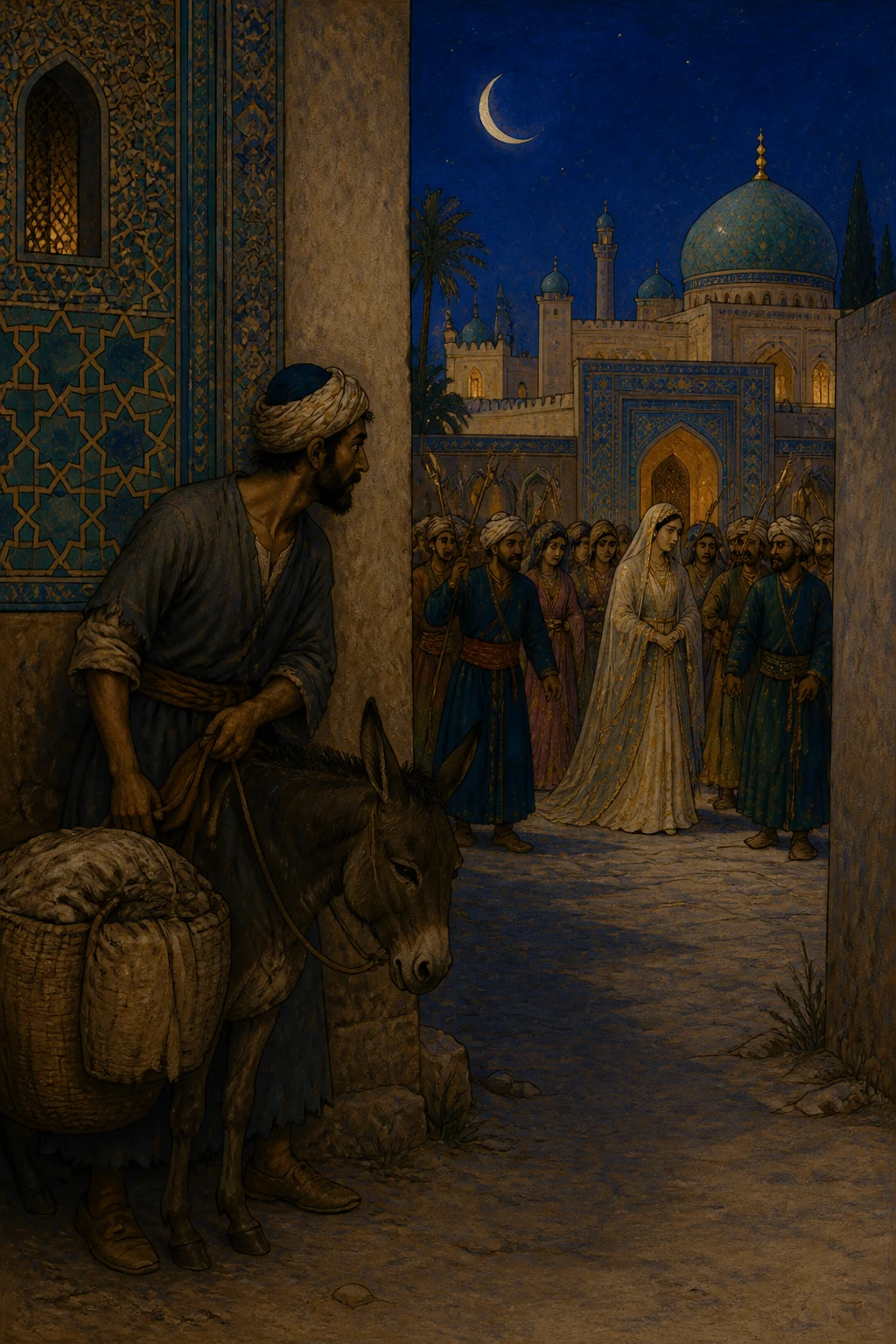
Know, then, O Commander of the Faithful, that my first brother, the lame one, was a tailor in Baghdad. He worked in a shop he had rented from a wealthy man who lived above it, and on the ground floor of the man’s house there was a mill. One day, as my lame brother sat sewing in his shop, he raised his head and saw a woman as lovely as the rising full moon at the projecting window of the house, looking out at the passersby. The moment he saw her, his heart was caught in the snares of love, and he spent the whole day gazing at her, neglecting his sewing until evening. The next morning he opened his shop and sat down to work, but with every stitch he glanced up at the window. He went on in this way for some time, scarcely sewing anything worth a dirham. Then one day the owner of the house came to my brother with some cloth and said, “Cut this out for me and make it into shirts.” “I hear and obey,” replied my brother. He kept cutting until, by nightfall, he had cut out twenty shirts, without tasting a morsel of food. Then the man asked him, “What is your charge?” My brother said nothing, for the young woman signaled to him with her eyes to take no payment. Though he sorely needed even a single copper coin, he spent three days eating and drinking next to nothing, so hard did he labor at the sewing. When he had finished their work, he brought them the shirts. The young woman had told her husband of my brother’s infatuation, though my brother knew nothing of this, and the two had agreed to make him sew for them without pay and amuse themselves at his expense.
When my brother had finished all their work, they played a trick on him and married him to their slave girl. On the night when he was to go in to his bride, they told him, “Spend tonight in the mill. Tomorrow all will be well.” Believing that they meant him well, my brother spent the night alone in the mill. The young woman’s husband went and gave the miller a hint that he should make my brother turn the mill. At midnight the miller came in, saying, “This ox is doing no work, though there is so much wheat, and the customers are asking for their flour. I shall harness him to the mill until all the wheat is ground.” So he harnessed my brother to the mill and kept him at it until nearly dawn. Then the owner of the house came, saw my brother harnessed to the mill while the miller lashed him with a whip, and went away, leaving him there. Early that morning, the slave girl whom my brother had married came and released him from the mill. “My mistress and I were deeply distressed by what happened to you,” she said, “and we have been very worried about you.” He had been so badly beaten that he could not find his tongue to answer her. He returned home, and there the sheikh who had drawn up the marriage contract came and greeted him, saying, “God give you life! May your marriage be blessed! You must have passed the night in bliss and delight, embracing your bride from evening until morning.” My brother replied, “May God grant no peace to a liar, you thousandfold pimp! By God, I came only to grind in place of the ox until morning.” “Tell me what happened,” said the sheikh. My brother told him the whole story, and the sheikh said, “Your star was not in accord with hers. But if you wish, I can alter the marriage contract and draw up a better one, so that your star will agree with hers.” My brother said, “See whether you have any other trick left to play.”
Then my brother left him and went to his shop, hoping someone would bring him work whose wages would buy him food. Presently the slave girl came to him, having plotted this new trick with her mistress, and said, “My mistress longs for you. She has gone upstairs to look at your face from the window.” Before my brother knew it, the lady appeared at the window, weeping and saying, “Why have you broken off all dealings with us?” He gave her no answer, so she swore that everything that had happened to him in the mill had been against her wishes. When my brother looked upon her loveliness and beauty, he forgot all he had suffered, accepted her excuse, and rejoiced to see her. He greeted her and spoke with her, then sat at his sewing for a while. Afterward the slave girl came to him and said, “My mistress sends you greetings and says that her husband intends to spend tonight with some friends. Once he has gone to them, you can come to our house and pass the night with my mistress in the sweetest pleasure until morning.” Now her husband had said to her, “How shall we arrange for him to come to you, so that I can seize him and drag him before the governor?” She had replied, “Leave me to devise a trick that will disgrace him and make him notorious throughout this city.” But my brother knew nothing of women’s wiles.
When evening came, the slave girl went to my brother and brought him back to her mistress, who said to him, “By God, my dear sir, I have longed for you so much!” “For God’s sake,” he replied, “make haste and give me a kiss before anything else.” Scarcely had he finished speaking when the young woman’s husband appeared from his neighbor’s house, seized my brother, and said, “By God, I will not let you go until we stand before the chief of police!” My brother pleaded with him, but he would not listen. Instead, he took him to the governor’s house, where the governor had him whipped, mounted him on a camel, and paraded him through the streets of the city while people cried out, “This is the reward of anyone who intrudes upon another man’s women!” He fell from the camel and broke his leg, and so became lame. Then the governor banished him from the city, and he set out with no idea where to go. I was so distressed that I went after him and brought him back, and I have provided him with food and drink ever since.
The caliph laughed at my tale and said, “Well done!” But I replied, “I cannot accept this honor from you unless you listen while I tell you what happened to the rest of my brothers. And do not think me a man of many words.” The caliph said, “Tell me what happened to all your brothers. Delight my ears with these charming tales, and spare no detail in recounting such amusing adventures.”