O besedilu
Zevs pošlje sanje in vojske se zberejo
- Vir
- Iliada
- Avtor
- Homer
- Jezik branja
- English
- Jezik izvirnika
- Ancient Greek
- Čas branja
- 41 min branja
- Obseg
- 33 strani
- Naslov izvirnika
- Zeus Sends the Dream and the Armies Gather
O izvirniku
Iliada
Junaški svet Troje, jeze, časti in vojne, razrezan v velike epizode za branje. Bralni jezik je English, izvirnik pa prihaja iz vira Iliada v jeziku Ancient Greek.
Besedilo
Zevs pošlje sanje in vojske se zberejo
All the other gods and the horse-armed warriors slept through the night, but sweet sleep did not hold Zeus. He pondered in his heart how he might honor Achilles and destroy many men beside the Achaean ships.
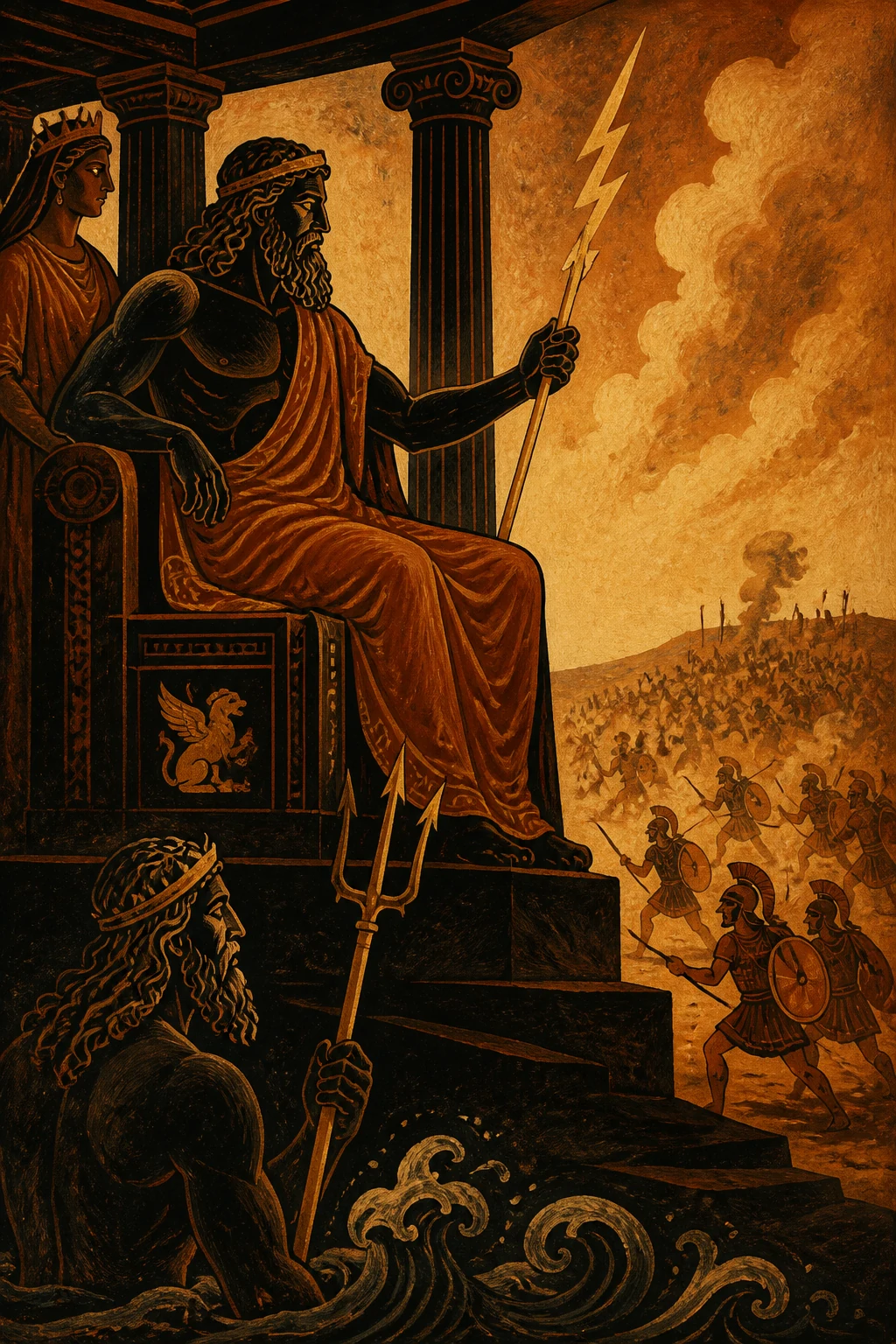
This seemed to him the best course: to send a ruinous Dream to Agamemnon, son of Atreus. Summoning it, he spoke these winged words: “Go, ruinous Dream, to the swift ships of the Achaeans. Enter the hut of Agamemnon, son of Atreus, and tell him everything exactly as I command. Bid him arm the long-haired Achaeans with all their forces: now he may take the broad-streeted city of the Trojans. For the immortals who dwell on Olympus are no longer divided in their counsels. Hera has won them all over with her entreaties, and sorrow hangs over Troy.”
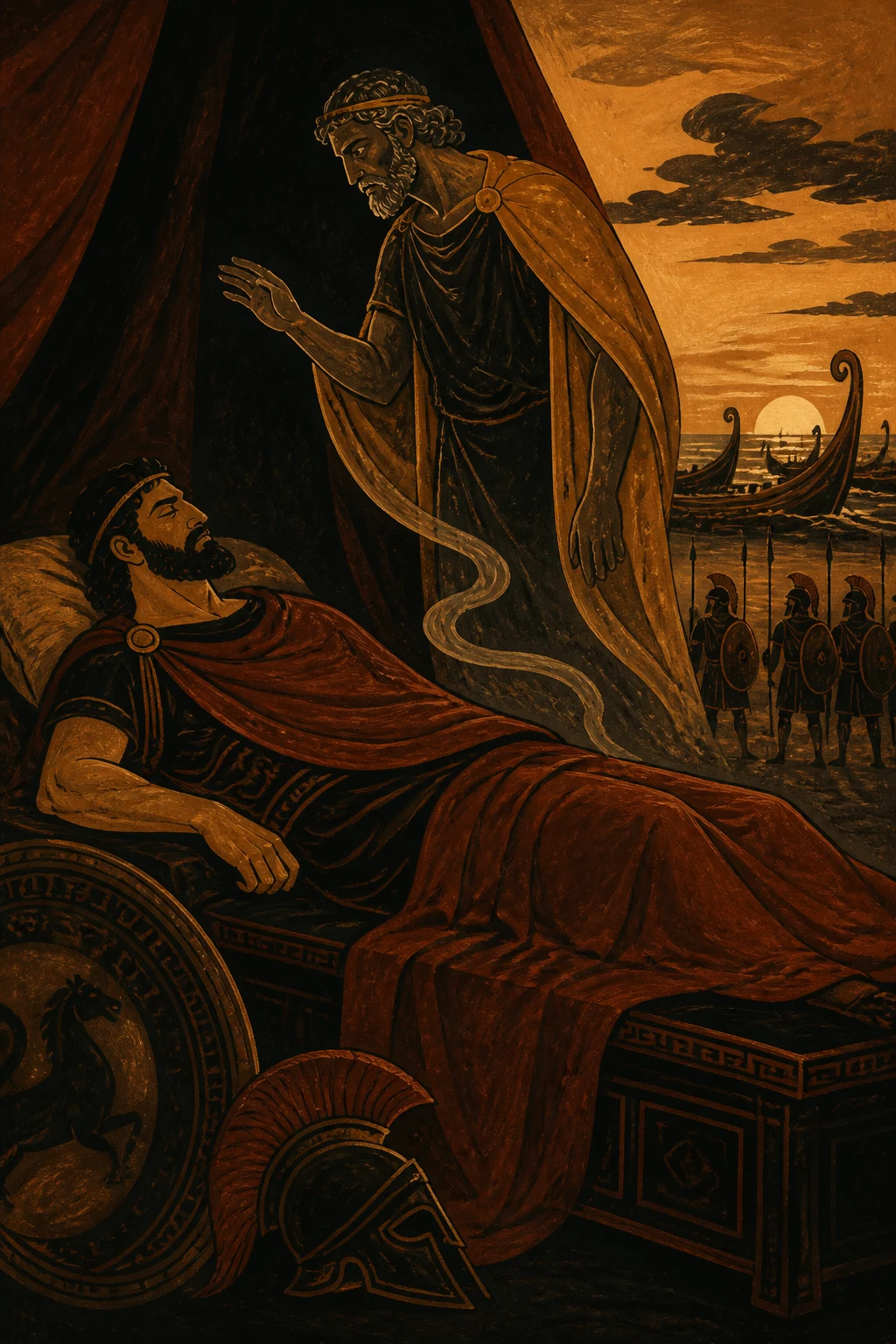
So he spoke, and the Dream departed when it had heard his command. Swiftly it reached the swift ships of the Achaeans and went to Agamemnon, son of Atreus. It found him sleeping in his hut, with immortal slumber poured about him.
It stood above his head in the likeness of Nestor, son of Neleus, whom Agamemnon honored above all the elders. In his shape the divine Dream addressed him: “Are you asleep, son of Atreus, the warlike tamer of horses? A man entrusted with counsel, to whose care an army is committed and on whom so much depends, should not sleep the whole night through. Listen to me now without delay. I am a messenger from Zeus, who, far away though he is, cares deeply for you and pities you.
“He bids you arm the long-haired Achaeans with all their forces: now you may take the broad-streeted city of the Trojans. For the immortals who dwell on Olympus are no longer divided in their counsels. Hera has won them all over with her entreaties, and sorrow from Zeus hangs over Troy. Hold this fast in your heart, and do not let forgetfulness take you when honey-sweet sleep releases you.”
Having spoken, the Dream departed, leaving him there with thoughts in his heart that were never to be fulfilled. He believed he would take Priam’s city that very day, the fool, knowing nothing of the deeds Zeus was planning. For Zeus would yet bring grief and groaning upon Trojans and Danaans alike through the clash of mighty battles.
He woke from sleep, the divine voice still sounding about him. Sitting upright, he put on a soft tunic, fine and newly woven, and cast a great cloak around him. Beneath his shining feet he bound fine sandals, and slung his silver-studded sword over his shoulders. He took up his ancestral scepter, imperishable forever, and with it went among the ships of the bronze-clad Achaeans. The goddess Dawn was climbing high Olympus to announce the light to Zeus and the other immortals, when he ordered the clear-voiced heralds to summon the long-haired Achaeans to assembly. The heralds called, and the men gathered swiftly. But first he seated a council of the great-hearted elders beside the ship of Nestor, the king born in Pylos. Calling them together, he laid a careful plan before them: “Listen, friends. A divine Dream came to me in my sleep through the immortal night. In face and stature and bearing it was very like noble Nestor. It stood above my head and spoke to me: ‘Are you asleep, son of Atreus, the warlike tamer of horses? A man entrusted with counsel, to whose care an army is committed and on whom so much depends, should not sleep the whole night through. Listen to me now without delay. I am a messenger from Zeus, who, far away though he is, cares deeply for you and pities you. He bids you arm the long-haired Achaeans with all their forces: now you may take the broad-streeted city of the Trojans. For the immortals who dwell on Olympus are no longer divided in their counsels. Hera has won them all over with her entreaties, and sorrow from Zeus hangs over Troy. Hold this fast in your heart.’ So it spoke and flew away, and sweet sleep released me.
“Come, then, let us see whether we can arm the sons of the Achaeans. But first I shall test them with words, as is my right, and order them to flee in their many-benched ships. You must restrain them with your words, each from his own place.”
With that he sat down, and Nestor rose among them, the lord of sandy Pylos. With their welfare at heart, he addressed them: “Friends, leaders and rulers of the Argives, if any other Achaean had told us of this dream, we might have called it false and turned away from it. But the man who saw it claims to be by far the greatest of the Achaeans. Come, then, let us see whether we can arm the sons of the Achaeans.”
So saying, he led the way out of the council, and the scepter-bearing kings rose and obeyed the shepherd of the people. The troops streamed after them. As dense swarms of bees come pouring from a hollow rock, fresh swarms forever following, and fly in clusters over the spring flowers, some hovering thickly here, others there, so the many companies of men marched in troops from ships and huts along the broad beach toward the assembly. Among them blazed Rumor, the messenger of Zeus, urging them onward; and they gathered.
The assembly seethed, and the earth groaned beneath the men as they sat down. A great clamor rose, and nine heralds shouted to restrain them, hoping they would cease their cries and listen to the kings nurtured by Zeus.
At last, with difficulty, the people sat and settled in their places, their clamor stilled. Then lord Agamemnon rose, holding the scepter Hephaestus had labored to fashion. Hephaestus gave it to lord Zeus, son of Cronus; Zeus gave it to the messenger, the slayer of Argus; lord Hermes gave it to Pelops, driver of horses; Pelops in turn gave it to Atreus, shepherd of the people. Atreus, dying, left it to Thyestes, rich in flocks, and Thyestes in turn left it for Agamemnon to bear, ruling over many islands and all Argos.
Leaning upon it, he addressed the Argives: “Friends, Danaan warriors, servants of Ares, Zeus son of Cronus has bound me fast in grievous delusion. Cruel god! Once he promised me, and bowed his head in pledge, that I should sack well-walled Ilios and return home. But now he has devised a wicked deception and bids me go back to Argos in disgrace, after losing so many men.
“Such, it seems, is the pleasure of almighty Zeus, who has brought down the crowning heights of many cities and will bring down still more, for his power is greatest of all. Yet it will be shameful even for generations to come to hear how so great and splendid an Achaean host fought this futile war in vain, battling against fewer men, with no end yet in sight. For if we Achaeans and the Trojans were willing to swear a binding truce and count ourselves on either side, and the Trojans were to muster all who live within their city, while we Achaeans divided ourselves into tens, and each ten chose one Trojan to pour their wine, many tens would lack a cupbearer.
“So much, I tell you, do the sons of the Achaeans outnumber the Trojans who dwell within the city. But they have allies from many cities, men who wield the spear, who thwart me at every turn and will not let me sack the well-peopled stronghold of Ilios, though I long to do it.
“Nine years of mighty Zeus have now passed. Our ships’ timbers have rotted and their rigging has come loose. Our wives and little children sit at home awaiting us, while the task for which we came here remains unfinished.
“Come, then, let us all do as I say. Let us flee in our ships to our dear native land, for we shall never take broad-streeted Troy.” So he spoke, and stirred the hearts of all those in the multitude who had not heard his counsel. The assembly heaved like the long waves of the Icarian Sea, when the East Wind and the South Wind swoop from Father Zeus’s clouds and stir them up.
As when the West Wind sweeps down in a furious gust and sets a deep cornfield stirring, bending the ears beneath its force, so the whole assembly surged. With shouts they rushed toward the ships, and dust rose billowing beneath their feet. They called to one another to seize the ships and drag them down into the shining sea. They cleared the launching channels, and their cries rose to heaven in their eagerness for home; they pulled the props from beneath the ships.
Then the Argives would have won their homecoming before its destined time, had Hera not spoken to Athena: “Ah, tireless daughter of Zeus who bears the aegis! Is this how the Argives are to flee home to their dear native land over the sea’s broad back? Will they leave Helen of Argos as a boast for Priam and the Trojans, Helen for whose sake so many Achaeans have died at Troy, far from their dear native land? Go now among the bronze-clad Achaeans. Restrain each man with your gentle words, and do not let them drag their curved ships down to the sea.”
So she spoke, and bright-eyed Athena did not disobey. She darted down from the peaks of Olympus and swiftly reached the swift ships of the Achaeans. There she found Odysseus, the equal of Zeus in counsel, standing still. He laid no hand upon his well-benched black ship, for grief had taken hold of his heart and spirit. Standing close beside him, bright-eyed Athena said: “Son of Laertes, sprung from Zeus, resourceful Odysseus, is this how you will fling yourselves into your many-benched ships and flee home to your dear native land? Will you leave Helen of Argos as a boast for Priam and the Trojans, Helen for whose sake so many Achaeans have died at Troy, far from their dear native land?
“Go now among the Achaeans and delay no longer. Restrain each man with your gentle words, and do not let them drag their curved ships down to the sea.” So she spoke, and he knew the goddess’s voice. He set off at a run, throwing off his cloak, which his attendant, the Ithacan herald Eurybates, picked up. He himself went straight to Agamemnon, son of Atreus, and took from him his ancestral scepter, imperishable forever. With it he went among the ships of the bronze-clad Achaeans.
Whenever he met a king or a man of distinction, he stood beside him and restrained him with gentle words: “Good sir, it does not become you to take fright like a coward. Sit down yourself and make the other men sit down. You do not yet know clearly what the son of Atreus intends. He is only testing them now; soon he will strike the sons of the Achaeans.
“Did we not all hear what he said in council? Take care that his anger does not bring harm upon the sons of the Achaeans. Great is the spirit of kings nurtured by Zeus. Their honor comes from Zeus, and Zeus the counselor loves them.”
But whenever he saw a common soldier and found him shouting, he struck him with the scepter and rebuked him sharply: “Fellow, sit still and listen to those who are better men than you. You are no warrior, but a weakling, of no account in battle or in council. Surely we Achaeans cannot all be kings here. The rule of many is no good. Let there be one commander, one king, to whom the son of crooked-counseling Cronus has given the scepter and the laws, so that he may govern his people.”
So he passed through the army, imposing order, and the men streamed back to the assembly from ships and huts with a roar like a wave of the loud-resounding sea crashing on a broad beach, while the deep thunders.
The others sat down and were quiet in their places. Only Thersites, unbridled in speech, went on clamoring. His mind was full of a jumbled store of words with which to wrangle pointlessly and improperly with kings, saying whatever he thought would make the Argives laugh. He was the ugliest man who came to Ilios: bowlegged and lame in one foot, with hunched shoulders drawn together over his chest. Above them his head rose to a point, with sparse hair sprouting on it.
Achilles and Odysseus hated him most of all, for he was forever reviling them. This time, however, he screeched sharp insults at noble Agamemnon. The Achaeans were furious with him, their hearts filled with indignation.
But he shouted aloud, railing at Agamemnon: “Son of Atreus, what are you grumbling about now? What do you lack? Your huts are full of bronze, and there are plenty of choice women in them, whom we Achaeans give you first of all whenever we take a town.
“Do you still want gold, which some horse-taming Trojan may bring from Ilios as ransom for his son, a man I or another Achaean have bound and led away? Or a young woman to lie with in love, one you can keep apart for yourself? It is not right that you, our leader, should bring the sons of the Achaeans into misery.
“You soft creatures, disgraces, Achaean women, no longer men! Let us sail home in our ships and leave him here at Troy to brood over his prizes, so that he may see whether we are any help to him or not. Even now he has dishonored Achilles, a far better man than he is, seizing his prize and keeping it for himself.
“But Achilles has no true anger in his heart; he lets things pass. Otherwise, son of Atreus, this would have been your last outrage.” So Thersites spoke, railing at Agamemnon, shepherd of the people. Noble Odysseus quickly stood beside him, glared at him, and rebuked him harshly: “Thersites, reckless babbler, shrill speaker though you are, hold your tongue. Do not presume to wrangle alone with kings. I tell you, there is no worse man than you among all who came to Ilios with the sons of Atreus.
“So you should not take the names of kings upon your lips, heap insults on them, and watch for a chance to go home. We do not yet know clearly how these things will end, whether we sons of the Achaeans will return in triumph or disgrace.
“Yet here you sit, insulting Agamemnon, son of Atreus, shepherd of the people, because the Danaan warriors give him so much. Your talk is nothing but mockery. But I tell you this, and it shall be fulfilled: if I find you playing the fool again as you are now, may Odysseus’s head no longer rest upon his shoulders, and may I no longer be called Telemachus’s father, if I do not seize you, strip off your clothes, your cloak and tunic that cover your nakedness, and send you weeping back to the swift ships, driven from the assembly with shameful blows.”
So he spoke, and struck him across the back and shoulders with the scepter. Thersites doubled up, and a great tear fell from his eye. A bloody welt rose on his back beneath the golden scepter. He sat down in fear and, aching and looking helpless, wiped away his tears.
Grieved though the men were, they laughed heartily at him. One would turn to his neighbor and say: “Well now! Odysseus has done countless good things, taking the lead in sound counsel and ordering our battles. But this is by far the best thing he has ever done among the Argives: he has stopped this foul-mouthed slanderer from speaking in assembly.
“His proud spirit will hardly urge him again to revile the kings with insulting words.” So the multitude spoke. Then Odysseus, sacker of cities, rose with the scepter in his hand. Beside him bright-eyed Athena, in the likeness of a herald, bade the people be silent, so that the sons of the Achaeans, from the foremost ranks to the hindmost, might all hear his words and consider his counsel. With their welfare at heart, he addressed them: “Son of Atreus, my king, the Achaeans now mean to make you the most disgraced of all mortal men. They will not fulfill the promise they gave you when they were still setting out from horse-pasturing Argos: that they would sack well-walled Ilios before returning home.
“Like little children or widowed women, they bewail their lot to one another and long to go home. True, the hardship is enough to make a man return disheartened. Even someone kept from his wife for a single month frets beside his many-benched ship when winter gales and the swelling sea confine him. Yet this is the ninth returning year that we have waited here. So I do not blame the Achaeans for fretting beside their curved ships. But still, it is shameful to wait so long and then return empty-handed.
“Endure, my friends, and stay a little longer, so that we may learn whether Calchas prophesies truly or not. For we remember this well in our hearts, and you are all witnesses, all whom the spirits of death have not carried away. It seems only yesterday, or the day before, when the Achaean ships gathered at Aulis, bringing ruin to Priam and the Trojans. Around a spring, at the holy altars, we were offering perfect hecatombs to the immortals beneath a lovely plane tree from whose roots bright water flowed. There a great sign appeared: a terrible serpent, blood-red along its back, which the Olympian himself had brought into the light, darted from beneath the altar and sprang toward the plane tree.
“There were a sparrow’s nestlings there, helpless young, crouching beneath the leaves on the highest branch: eight of them, and the mother who bore them made the ninth. The serpent devoured them as they chirped pitifully, while the mother fluttered about, lamenting her dear young. It coiled and caught her by the wing as she flitted around it in distress.
“But when it had devoured the sparrow’s young and the mother herself, the god who had revealed it made it a lasting wonder: the son of crooked-counseling Cronus turned it to stone. We stood amazed at what had happened.
“When this dreadful portent from the gods broke in upon our sacrifice, Calchas at once proclaimed the gods’ will: ‘Why have you fallen silent, long-haired Achaeans? Zeus the counselor has shown us this great sign, late in coming and late to be fulfilled, whose fame shall never perish.
“‘Just as this serpent devoured the sparrow’s young and the mother herself—eight young, and the mother who bore them made the ninth—so shall we wage war here for that many years, but in the tenth we shall take the broad-streeted city.’
“So he spoke, and now it is all coming to pass. Come, all you well-greaved Achaeans, stand firm here until we take Priam’s mighty city.” So he spoke, and the Argives shouted aloud. The ships all around echoed fearfully with the Achaeans’ cries as they applauded noble Odysseus’s words. Then the Gerenian horseman Nestor addressed them: “Shame on you! You speak in assembly like little children who care nothing for the work of war.
“What will become of our agreements and our oaths? Let the counsels and plans of men be cast into the fire, the unmixed libations and the handclasps in which we trusted! For we wrangle uselessly with words and can find no remedy, though we have been here so long.
“Son of Atreus, hold fast as before to your unshakable purpose and lead the Argives through the fierce battles. Leave the few who plan apart from the Achaeans to waste away, one or two of them. They will achieve nothing by plotting to return to Argos before we know whether the promise of Zeus who bears the aegis is false or true.
“For I declare that almighty Cronus’s son gave his pledge on the day the Argives boarded their swift ships, bearing death and doom to the Trojans: he flashed lightning on our right, revealing favorable signs.
“So let no man hurry home before he has lain with a Trojan’s wife and exacted vengeance for Helen’s struggles and groans. But if anyone is desperately eager to return home, let him lay hands on his well-benched black ship, so that before all others he may meet death and doom.
“But you, my king, take good counsel yourself and listen to another. What I have to say is not advice to cast aside. Divide the men by tribes and clans, Agamemnon, so that clan may help clan and tribe help tribe.
“If you do this and the Achaeans obey you, you will learn which leaders and which men are cowards, and which are brave; for they will fight each in their own company.
“You will also learn whether it is by the gods’ will that you cannot sack the city, or through the men’s cowardice and ignorance of war.” Lord Agamemnon answered him: “Once again, old man, you surpass the sons of the Achaeans in assembly.
“Father Zeus, Athena, and Apollo, if only I had ten such counselors among the Achaeans! Then the city of lord Priam would soon bow beneath our hands, captured and laid waste.
“But Zeus son of Cronus, who bears the aegis, has given me sorrow, casting me into futile quarrels and disputes. Achilles and I fought over a girl, exchanging hostile words, and I was the first to grow angry. But if ever we are united in counsel, there will no longer be any postponement of disaster for the Trojans, not even for a moment.
“Now go and take your meal, so that we may join battle. Let each man sharpen his spear well and see that his shield is ready. Let each feed his swift-footed horses well and inspect his chariot carefully, thinking of the war, so that all day long we may be tested in hateful battle.
“There will be no pause, not even for a moment, until night comes and parts the fury of the fighters. The strap of each man’s sheltering shield will be drenched with sweat across his chest, and his hand will tire upon the spear. His horses will sweat as they draw the polished chariot.
“But any man I see choosing to linger beside the curved ships, far from battle, will have no sure escape from the dogs and birds.” So he spoke, and the Argives shouted aloud, like a wave driven by the South Wind against a towering shore, against a jutting cliff never left in peace by the waves that every wind sends surging from one quarter or another.
They rose and scattered among the ships, kindled fires in their huts, and took their meal. Each man sacrificed to one or another of the everlasting gods, praying to escape death and the turmoil of Ares.
But Agamemnon, lord of men, sacrificed a fat five-year-old bull to almighty Cronus’s son and summoned the elders, the foremost men of all the Achaeans: Nestor first and lord Idomeneus, then the two Ajaxes and the son of Tydeus, and sixth Odysseus, the equal of Zeus in counsel.
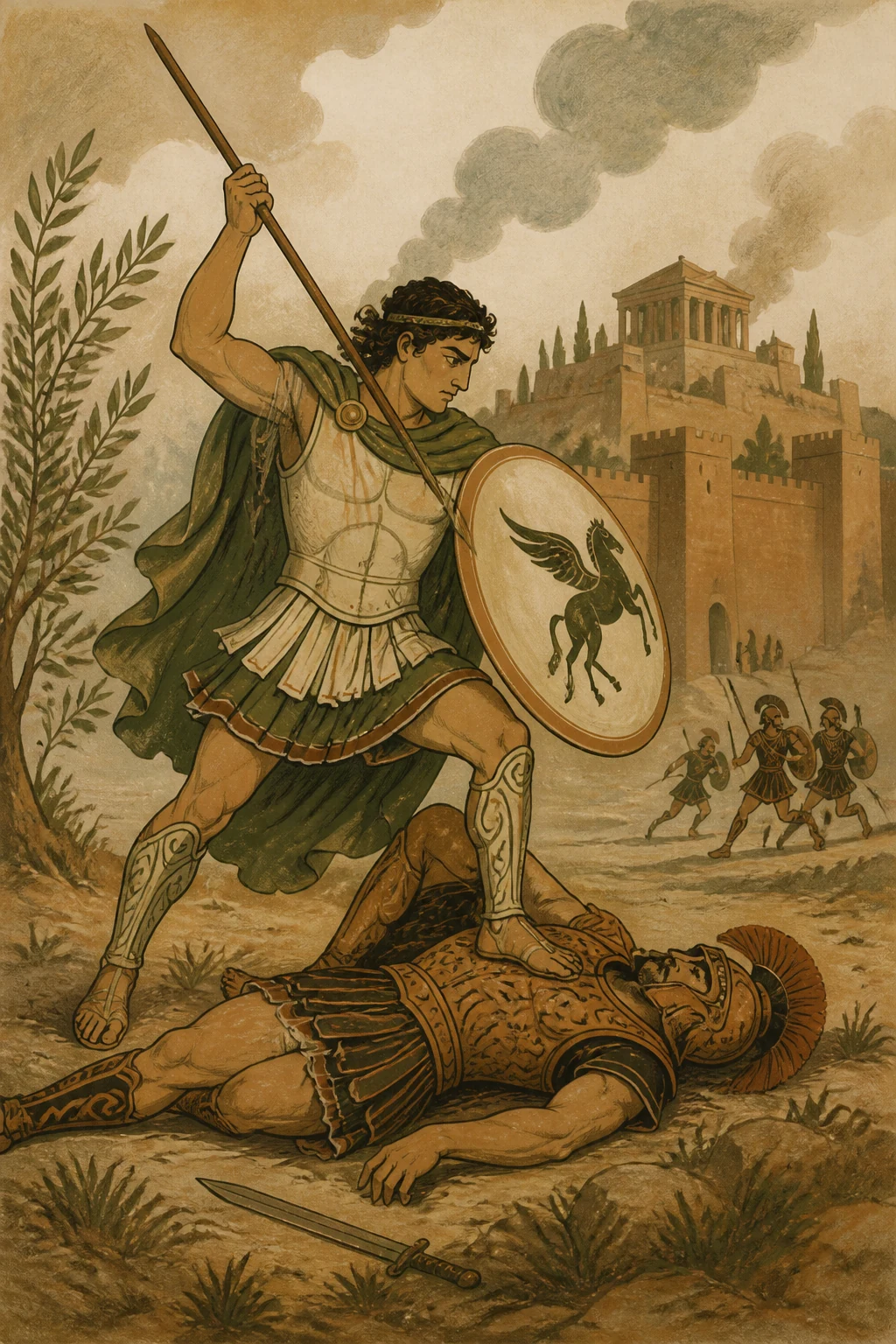
Menelaus, good at the war cry, came of his own accord, for he knew in his heart how heavily his brother labored. They stood around the bull and took up the barley grains. Then lord Agamemnon prayed among them: “Zeus, most glorious and greatest, lord of the dark clouds, dwelling in the high air, do not let the sun go down or darkness come before I have hurled Priam’s smoke-blackened palace headlong to the ground and burned its gates with consuming fire, before I have torn Hector’s tunic about his breast to shreds with bronze, and many of his comrades lie face down around him in the dust, biting the earth.”
So he prayed, but Cronus’s son would not yet fulfill his wish. He accepted the sacrifice, but increased their grievous toil. When they had prayed and cast the barley grains, they first drew back the bull’s head, cut its throat, and flayed it. They cut out the thigh bones and wrapped them in a double layer of fat, laying pieces of raw flesh upon them.
These they burned on leafless split wood, and, piercing the entrails with spits, held them over Hephaestus’s flame. When the thigh bones were burned and they had tasted the entrails, they cut up the rest, threaded it onto spits, roasted it carefully, and drew it all off.
When their work was done and the feast prepared, they ate, and no one’s appetite lacked its fair share. When they had satisfied their desire for food and drink, the Gerenian horseman Nestor began to speak: “Most glorious son of Atreus, Agamemnon, lord of men, let us talk here no longer, nor delay the work the god has placed in our hands.
“Come, let the heralds go among the ships of the bronze-clad Achaeans and summon the people. Let us go together through the broad Achaean camp, so that we may the sooner rouse fierce battle.”
So he spoke, and Agamemnon, lord of men, did not disobey. At once he ordered the clear-voiced heralds to summon the long-haired Achaeans to battle. The heralds called, and the men gathered swiftly.
The kings nurtured by Zeus hurried about the son of Atreus, marshaling the troops. Among them was bright-eyed Athena, bearing the precious aegis, ageless and immortal, from which a hundred tassels of pure gold hung fluttering, all finely woven and each worth a hundred oxen. With it flashing she swept through the Achaean host, urging them forward, and in each man’s heart she roused the strength to fight and battle without ceasing.
At once war became sweeter to them than sailing home in their hollow ships to their dear native land. As a consuming fire burns a boundless forest on a mountain’s heights, and its glare can be seen far off, so the dazzling gleam of their wondrous bronze rose through the clear air to heaven as they marched.
As countless flocks of winged birds, geese or cranes or long-necked swans, fly this way and that over the Asian meadow beside the streams of Cayster, delighting in their wings and settling with cries as the meadow rings, so their many companies poured from ships and huts onto the plain of Scamander. Beneath the feet of men and horses the earth resounded fearfully.
They took their stand in the flowering meadow of Scamander, countless as the leaves and blossoms in their season. As the dense swarms of flies that wander through a herdsman’s yard in spring, when milk brims in the pails, so many long-haired Achaeans stood on the plain facing the Trojans, eager to tear them apart.
As goatherds easily sort the broad-ranging herds of goats when they have mingled at pasture, so the leaders marshaled the men here and there to enter battle. Among them stood lord Agamemnon, his eyes and head like Zeus who delights in thunder, his waist like Ares, his chest like Poseidon.
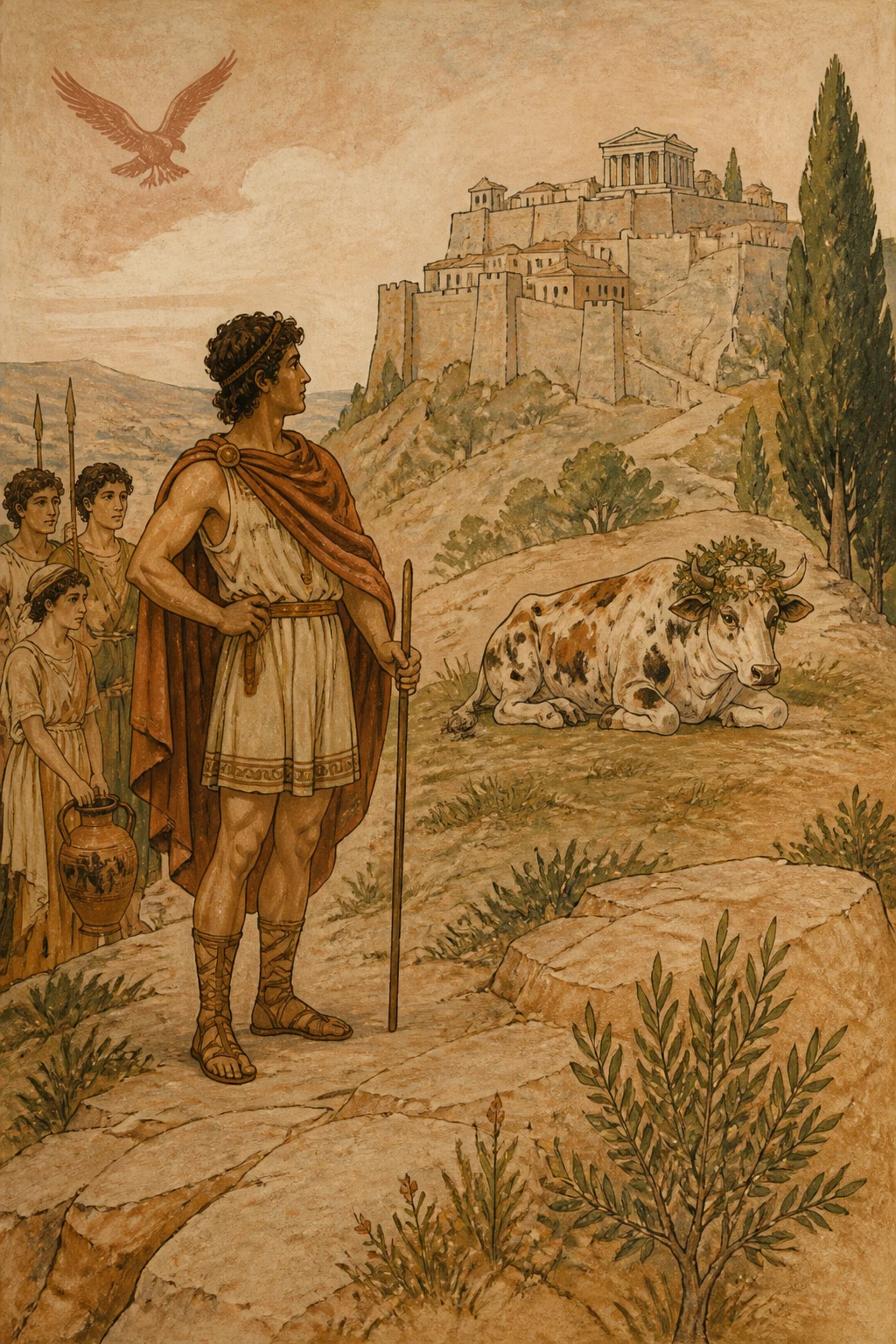
As a bull stands out far above all the cattle in a herd, conspicuous among the gathered beasts, so on that day Zeus made the son of Atreus conspicuous among the multitude, foremost among the warriors.
Tell me now, Muses who dwell on Olympus—for you are goddesses, present everywhere, and know all things, while we hear only rumor and know nothing—who were the leaders and commanders of the Danaans? The multitude I could not tell or name, not if I had ten tongues and ten mouths, an unbreakable voice, and a heart of bronze, unless the Olympian Muses, daughters of Zeus who bears the aegis, recalled to me all who came to Ilios. But I shall tell the captains of the ships, and all the ships together.
The Boeotians were led by Peneleos and Leitus, Arcesilaus, Prothoenor, and Clonius: those who dwelt in Hyria and rocky Aulis, Schoenus and Scolus and many-ridged Eteonus, Thespia, Graea, and spacious Mycalessus; those who lived around Harma, Eilesium, and Erythrae; those who held Eleon, Hyle, and Peteon, Ocalea and the well-built town of Medeon, Copae, Eutresis, and Thisbe of the many doves; those who held Coronea and grassy Haliartus, Plataea, and Glisas; those who held the well-built town of Hypothebae and holy Onchestus, Poseidon’s splendid grove; those who held Arne, rich in vineyards, and Mideia, holy Nisa and Anthedon on the farthest border. With these sailed fifty ships, and in each embarked a hundred and twenty young Boeotians.
Those who dwelt in Aspledon and Minyan Orchomenus were led by Ascalaphus and Ialmenus, sons of Ares. Astyoche bore them to mighty Ares in the house of Actor, son of Azeus, when she, a modest maiden, went up to her upper chamber and the god lay with her in secret. Thirty hollow ships sailed in their ranks.
The Phocians were led by Schedius and Epistrophus, sons of great-hearted Iphitus, son of Naubolus: those who held Cyparissus and rocky Pytho, holy Crisa, Daulis, and Panopeus; those who dwelt around Anemoreia and Hyampolis; those who lived beside the sacred river Cephisus; and those who held Lilaea at the springs of Cephisus. Forty black ships followed with them.
They went about marshaling the Phocian ranks, who armed themselves beside the Boeotians on their left. The Locrians were led by swift Ajax, son of Oileus, the lesser Ajax, not nearly so great as Ajax son of Telamon, but far smaller. Small he was, and clad in linen armor, yet with the spear he surpassed all the Hellenes and Achaeans. His people dwelt in Cynus, Opus, and Calliarus, Bessa, Scarphe, and lovely Augeiae, Tarphe and Thronium beside the streams of Boagrius. With him followed forty black ships of the Locrians who dwell across from holy Euboea.
The Abantes, breathing fury, held Euboea: Chalcis and Eretria, Histiaea rich in vines, Cerinthus by the sea, and the steep stronghold of Dion. Those who held Carystus and dwelt in Styra were led by Elephenor, a scion of Ares, son of Chalcodon and commander of the great-hearted Abantes.
With him came the swift Abantes, their hair worn long behind, spearmen eager to thrust out their ashwood spears and pierce the breastplates on their enemies’ chests. Forty black ships followed him.
Those who held Athens, the well-built city, the realm of great-hearted Erechtheus—whom Athena, daughter of Zeus, once reared, though the grain-giving earth had borne him, and settled in Athens in her own rich temple, where the young men of Athens appease him with bulls and rams as the years come round—were led by Menestheus, son of Peteos.
No mortal man on earth had yet been his equal in marshalling horses and shield-bearing men. Nestor alone could rival him, for he was older. Fifty black ships followed him.
Ajax brought twelve ships from Salamis and stationed them where the Athenian ranks stood. Those who held Argos and walled Tiryns, Hermione and Asine, which lie along a deep gulf, Troezen, Eiones, and vine-rich Epidaurus, and the young Achaeans who held Aegina and Mases, were led by Diomedes, mighty in the battle cry, and Sthenelus, the beloved son of far-famed Capaneus. With them came a third commander, godlike Euryalus, son of Mecisteus, the son of lord Talaus. Over them all commanded Diomedes, mighty in the battle cry. Eighty black ships followed them.
Those who held Mycenae, the well-built city, wealthy Corinth and well-built Cleonae, who dwelt in Orneae and lovely Araethyrea and Sicyon, where Adrastus first reigned, and those who held Hyperesia, steep Gonoessa, and Pellene, who lived around Aegium and throughout the coastland and about broad Helice—their hundred ships were commanded by lord Agamemnon, son of Atreus. With him came by far the largest and finest host. He himself put on his gleaming bronze in pride, standing out among all the heroes, for he was foremost among them and led by far the greatest army.
Those who held Lacedaemon’s deep, ravined valley, Pharis and Sparta and Messe, haunt of many doves, who dwelt in Bryseae and lovely Augeiae, who held Amyclae and Helos, a city by the sea, and those who held Laas and lived about Oetylus—these were led by his brother Menelaus, mighty in the battle cry, with sixty ships. They armed apart from the rest, and he moved among them, trusting in his own zeal and urging them to battle. More than any other, his heart longed to avenge the struggles and sorrows he had suffered for Helen.
Those who dwelt in Pylos and lovely Arene, in Thryon, the ford of the Alpheus, and well-built Aepy, who lived in Cyparisseeis and Amphigeneia, Pteleos and Helos and Dorion—where the Muses met Thamyris the Thracian and silenced his song as he came from Oechalia, from the house of Eurytus the Oechalian. For he had boasted that he would win even if the Muses themselves, daughters of aegis-bearing Zeus, should sing against him. In anger they maimed him, took away his wondrous gift of song, and made him forget his lyre-playing. These men were led by Nestor, the Gerenian horseman, and ninety hollow ships sailed in his ranks.
Those who held Arcadia beneath the steep mountain of Cyllene, beside the tomb of Aepytus, where men fight at close quarters, who dwelt in Pheneus and Orchomenus rich in sheep, in Rhipe and Stratie and windswept Enispe, who held Tegea and lovely Mantinea, who held Stymphalus and dwelt in Parrhasia—these were commanded by lord Agapenor, son of Ancaeus, with sixty ships. In each ship sailed many Arcadian men well versed in war.
For Agamemnon himself, son of Atreus and lord of men, had given them well-benched ships to cross the wine-dark sea, since they had no concern with seafaring. Those who dwelt in Buprasium and holy Elis, in all the land bounded by Hyrmine and farthest Myrsinus, the Olenian Rock and Alesium, had four commanders. Ten swift ships followed each, and many Epeians sailed aboard them.
Amphimachus and Thalpius led two divisions, the one a son of Cteatus, the other of Eurytus, both descended from Actor. Mighty Diores, son of Amarynceus, led another, and the fourth was commanded by godlike Polyxenus, son of lord Agasthenes, the son of Augeias.
Those from Dulichium and the sacred Echinades, islands lying across the sea opposite Elis, were led by Meges, the equal of Ares, son of Phyleus. His father was the horseman Phyleus, dear to Zeus, who had once left his home in anger at his father and settled in Dulichium. Forty black ships followed Meges.
Odysseus led the great-hearted Cephallenians, who held Ithaca and leaf-quivering Neriton, who dwelt in Crocyleia and rugged Aegilips, who held Zacynthus and lived about Samos, and those who held the mainland and dwelt along the opposite shore. These were commanded by Odysseus, the equal of Zeus in cunning. Twelve ships with vermilion bows followed him.
The Aetolians were led by Thoas, son of Andraemon: those who dwelt in Pleuron, Olenus, and Pylene, in Chalcis by the sea and rocky Calydon. For the sons of great-hearted Oeneus were no longer living, nor was he himself alive, and fair-haired Meleager was dead. So Thoas had been entrusted with rule over all the Aetolians. Forty black ships followed him.
The Cretans were led by Idomeneus, famed for his spear: those who held Cnossus and walled Gortyn, Lyctus, Miletus, and white Lycastus, Phaestus and Rhytium, populous cities, and all the others who dwelt throughout Crete with its hundred cities.
These were commanded by Idomeneus, famed for his spear, and Meriones, the equal of man-slaying Enyalius. Eighty black ships followed them. Tall and valiant Tlepolemus, son of Heracles, brought nine ships from Rhodes, carrying the proud Rhodians, who dwelt in Rhodes in three divisions: Lindus, Ialysus, and white Cameirus.
These were led by Tlepolemus, famed for his spear, whom Astyocheia bore to mighty Heracles. Heracles had carried her away from Ephyra, beside the river Selleis, after sacking many cities of young warriors nurtured by Zeus.
When Tlepolemus had grown to manhood in the well-built palace, he killed his father’s dear maternal uncle, Licymnius, a scion of Ares, who was already growing old. Quickly he built ships, gathered a great following, and fled over the sea, for the other sons and grandsons of mighty Heracles had threatened him.
After wandering and suffering many hardships, he reached Rhodes. There his people settled in three divisions, by tribes, and won the love of Zeus, who rules over gods and men; and the son of Cronus poured wondrous wealth upon them.
Nireus brought three trim ships from Syme—Nireus, son of Aglaia and lord Charopus, Nireus, the handsomest of all the Danaans who came beneath Ilium, after the peerless son of Peleus. But he was weak, and few men followed him.
Those who held Nisyrus, Crapathus, and Casus, and Cos, the city of Eurypylus, and the Calydnian islands, were led by Pheidippus and Antiphus, the two sons of lord Thessalus, son of Heracles. Thirty hollow ships sailed in their ranks.
Now for all those who dwelt in Pelasgian Argos, who lived in Alos, Alope, and Trachis, who held Phthia and Hellas with its beautiful women, and were called Myrmidons, Hellenes, and Achaeans: Achilles commanded their fifty ships.
But they gave no thought to the harsh din of war, for there was no one to lead their ranks. Swift-footed, godlike Achilles lay beside his ships, angry over the girl Briseis with her lovely hair, whom he had taken from Lyrnessus after much toil, when he sacked Lyrnessus and the walls of Thebe and struck down Mynes and Epistrophus, spearmen both, sons of lord Evenus, the son of Selepus. For her he lay grieving, but soon he was to rise again.
Those who held Phylace and flowery Pyrasus, the sacred precinct of Demeter, and Iton, mother of flocks, Antron by the sea and Pteleos with its grassy meadows, had been led by warlike Protesilaus while he lived. But by then the black earth held him fast.
He had left behind in Phylace a wife who tore her cheeks in grief, and a house half built. A Dardanian had killed him as he leapt from his ship, far the first of the Achaeans to land. Yet his men were not without a leader, though they missed their commander. Podarces, a scion of Ares, marshalled them, the son of Iphiclus, rich in sheep, who was the son of Phylacus. He was the full brother of great-hearted Protesilaus, but younger; the hero Protesilaus, warlike as he was, had been both older and braver. So the men did not lack a leader, though they missed the noble one they had lost. Forty black ships followed him.
Those who dwelt in Pherae beside Lake Boebeis, in Boebe and Glaphyrae and well-built Iolcus, were commanded, with eleven ships, by Eumelus, the beloved son of Admetus. Alcestis, noblest of women and loveliest in form of the daughters of Pelias, had borne him to Admetus.
Those who dwelt in Methone and Thaumacia, who held Meliboea and rugged Olizon, were commanded by Philoctetes, skilled with the bow, with seven ships. In each had sailed fifty oarsmen, well trained to fight mightily with their bows.
But he lay on an island, suffering grievous pain, in sacred Lemnos, where the sons of the Achaeans had left him, tormented by the cruel wound of a deadly serpent. There he lay in anguish; but soon the Argives beside their ships were to remember lord Philoctetes.
Yet his men were not without a leader, though they missed their commander. Medon marshalled them, the bastard son whom Rhene bore to Oileus, sacker of cities. Those who held Tricca and rocky Ithome, and who held Oechalia, the city of Eurytus the Oechalian, were led by the two sons of Asclepius, the skilled healers Podalirius and Machaon. Thirty hollow ships sailed in their ranks.
Those who held Ormenium and the spring Hypereia, who held Asterium and the white peaks of Titanus, were commanded by Eurypylus, the splendid son of Euaemon. Forty black ships followed him.
Those who held Argissa and dwelt in Gyrtone, Orthe, Elone, and the white city of Oloosson, were led by Polypoetes, steadfast in battle, son of Peirithous, whom immortal Zeus had fathered. Famous Hippodameia bore Polypoetes to Peirithous on the day when he punished the shaggy Centaurs, drove them from Pelion, and thrust them back upon the Aethices. Nor did Polypoetes command alone: with him was Leonteus, a scion of Ares, son of high-hearted Coronus, the son of Caeneus. Forty black ships followed them.
Guneus brought twenty-two ships from Cyphus. With him came the Enienes and the Peraebians, steadfast in battle, who had made their homes about wintry Dodona and tilled the fields along the lovely Titaressus. That river pours its fair-flowing waters into the Peneius, yet does not mingle with the Peneius and its silver eddies, but flows over it like oil, for it is a branch of the waters of Styx, the dread river of oaths.
The Magnetes were commanded by Prothous, son of Tenthredon, those who dwelt about the Peneius and leaf-quivering Pelion. Swift Prothous led them, and forty black ships followed him.
These, then, were the leaders and lords of the Danaans. Tell me, Muse, who was far the best of them, of the men and of the horses that followed the sons of Atreus. By far the finest horses were the mares of the son of Pheres, driven by Eumelus, swift as birds, alike in coat and age, their backs level as a plumb line. Apollo of the silver bow had reared them in Pereia, both mares, bearing the terror of Ares.
Of the men, by far the best was Ajax, son of Telamon, while Achilles remained in anger; for Achilles was far mightier, as were the horses that carried the peerless son of Peleus. But he lay beside his curved, seagoing ships, nursing his anger against Agamemnon, son of Atreus, shepherd of the people. His men amused themselves along the breaking surf, throwing the discus and hunting spears and shooting with their bows. Their horses stood beside their chariots, each grazing on lotus and marsh-grown parsley, while their lords’ well-crafted chariots lay in the huts. Longing for their warlike leader, the men wandered here and there through the camp and did not fight.
The others advanced as though fire were devouring all the earth. The ground groaned beneath them, as when Zeus who delights in thunder, in his anger, lashes the earth about Typhoeus in the land of the Arimi, where men say Typhoeus has his resting place. So the earth groaned loudly beneath their marching feet, and swiftly they crossed the plain.
To the Trojans came swift Iris, wind-footed messenger, with grievous tidings from aegis-bearing Zeus. They were holding an assembly at Priam’s gates, all gathered together, young and old alike. Swift-footed Iris stood near and spoke, taking the voice of Priam’s son Polites. Trusting in his fleetness, he sat as the Trojans’ lookout on the very summit of old Aesyetes’ tomb, watching for the moment when the Achaeans should set out from their ships. In his likeness swift-footed Iris spoke: “Old king, endless talk is always dear to you, as once in days of peace; but relentless war has risen.
“I have entered many battles among men, yet never have I seen an army so great and so strong. Like leaves or grains of sand, they come across the plain to fight against the city.
“Hector, above all I charge you to do this. There are many allies throughout Priam’s great city, and these men from scattered lands speak different tongues. Let each commander give orders to his own men, marshal his countrymen, and lead them out.”
So she spoke, and Hector understood the goddess’s words. At once he dismissed the assembly, and they rushed to their arms. All the gates were opened, and the host poured out, foot soldiers and charioteers, and a great tumult rose.
Before the city, apart upon the plain, stands a steep mound with open ground around it on every side. Men call it Batieia, but the immortals call it the tomb of nimble Myrine. There the Trojans and their allies formed their separate ranks.
The Trojans were led by great Hector of the flashing helmet, Priam’s son. With him by far the largest and finest host took up their arms, eager to wield their spears. The Dardanians were commanded by Aeneas, the valiant son of Anchises, whom divine Aphrodite bore to Anchises on the slopes of Ida, a goddess lying with a mortal man. Nor did he command alone: with him were the two sons of Antenor, Archelochus and Acamas, well versed in every kind of fighting.
Those who dwelt in Zeleia, beneath the lowest slopes of Ida, wealthy Trojans who drank the dark water of the Aesepus, were commanded by Pandarus, the splendid son of Lycaon, to whom Apollo himself had given his bow.
Those who held Adresteia and the land of Apaesus, who held Pityeia and the steep mountain of Tereia, were commanded by Adrastus and Amphius in his linen breastplate, the two sons of Merops of Percote. More than all others their father knew the art of prophecy, and he would not let his sons go to the war that destroys men. But they would not heed him, for the powers of black death were leading them on.
Those who dwelt about Percote and Practius, who held Sestus and Abydus and holy Arisbe, were commanded by Asius, son of Hyrtacus, a leader of men—Asius, son of Hyrtacus, whom tall, fiery horses had brought from Arisbe, from the river Selleis.
Hippothous led the tribes of the spear-fighting Pelasgians, who dwelt in fertile Larisa. They were commanded by Hippothous and Pylaeus, a scion of Ares, the two sons of Pelasgian Lethus, son of Teutamus.
Acamas and the hero Peirous led the Thracians, all those enclosed by the strong-flowing Hellespont. Euphemus commanded the spearmen of the Cicones, the son of Troezen, nurtured by Zeus, who was the son of Ceas.
Pyraechmes led the Paeonians with their curved bows, from distant Amydon, from the broad-flowing Axius—the Axius, whose waters are the loveliest that flow over the earth. The stout-hearted Pylaemenes led the Paphlagonians from the land of the Eneti, where wild mules breed, those who held Cytorus and dwelt about Sesamus, who lived in splendid homes beside the river Parthenius, in Cromna and Aegialus and lofty Erythini.
Odius and Epistrophus commanded the Halizones from distant Alybe, where silver is born. Chromis and Ennomus the augur commanded the Mysians; but his omens did not ward off black death. He was struck down by the hands of the swift-footed grandson of Aeacus in the river, where Achilles slaughtered other Trojans too.
Phorcys and godlike Ascanius led the Phrygians from distant Ascania, eager to fight in the press of battle. Mesthles and Antiphus commanded the Maeonians, the two sons of Talaemenes whom Lake Gygaea had borne. They led the Maeonians whose homes lay beneath Tmolus.
Nastes led the Carians, speakers of a foreign tongue, who held Miletus and the densely wooded mountain of Phthires, the streams of the Maeander and the steep peaks of Mycale. Amphimachus and Nastes commanded them, Nastes and Amphimachus, the splendid sons of Nomion. He went to war wearing gold like a girl—the fool! It did nothing to save him from a cruel death: he was struck down by the hands of the swift-footed grandson of Aeacus in the river, and warlike Achilles carried off his gold.
Sarpedon and peerless Glaucus commanded the Lycians, from distant Lycia and the eddying Xanthus.
Izvirnik
Zeus Sends the Dream and the Armies Gather
Naslednje strani prikazujejo izvirno besedilo za primerjavo.
ἄλλοι μέν ῥα θεοί τε καὶ ἀνέρες ἱπποκορυσταὶ εὗδον παννύχιοι, Δία δʼ οὐκ ἔχε νήδυμος ὕπνος, ἀλλʼ ὅ γε μερμήριζε κατὰ φρένα ὡς Ἀχιλῆα τιμήσῃ, ὀλέσῃ δὲ πολέας ἐπὶ νηυσὶν Ἀχαιῶν. ἥδε δέ οἱ κατὰ θυμὸν ἀρίστη φαίνετο βουλή, πέμψαι ἐπʼ Ἀτρεΐδῃ Ἀγαμέμνονι οὖλον ὄνειρον· καί μιν φωνήσας ἔπεα πτερόεντα προσηύδα· βάσκʼ ἴθι οὖλε ὄνειρε θοὰς ἐπὶ νῆας Ἀχαιῶν· ἐλθὼν ἐς κλισίην Ἀγαμέμνονος Ἀτρεΐδαο πάντα μάλʼ ἀτρεκέως ἀγορευέμεν ὡς ἐπιτέλλω· θωρῆξαί ἑ κέλευε κάρη κομόωντας Ἀχαιοὺς πανσυδίῃ· νῦν γάρ κεν ἕλοι πόλιν εὐρυάγυιαν
Τρώων· οὐ γὰρ ἔτʼ ἀμφὶς Ὀλύμπια δώματʼ ἔχοντες ἀθάνατοι φράζονται· ἐπέγναμψεν γὰρ ἅπαντας Ἥρη λισσομένη, Τρώεσσι δὲ κήδεʼ ἐφῆπται. ὣς φάτο, βῆ δʼ ἄρʼ ὄνειρος ἐπεὶ τὸν μῦθον ἄκουσε· καρπαλίμως δʼ ἵκανε θοὰς ἐπὶ νῆας Ἀχαιῶν, βῆ δʼ ἄρʼ ἐπʼ Ἀτρεΐδην Ἀγαμέμνονα· τὸν δὲ κίχανεν εὕδοντʼ ἐν κλισίῃ, περὶ δʼ ἀμβρόσιος κέχυθʼ ὕπνος. στῆ δʼ ἄρʼ ὑπὲρ κεφαλῆς Νηληΐῳ υἷι ἐοικώς Νέστορι, τόν ῥα μάλιστα γερόντων τῖʼ Ἀγαμέμνων· τῷ μιν ἐεισάμενος προσεφώνεε θεῖος ὄνειρος· εὕδεις Ἀτρέος υἱὲ δαΐφρονος ἱπποδάμοιο· οὐ χρὴ παννύχιον εὕδειν βουληφόρον ἄνδρα
ᾧ λαοί τʼ ἐπιτετράφαται καὶ τόσσα μέμηλε· νῦν δʼ ἐμέθεν ξύνες ὦκα· Διὸς δέ τοι ἄγγελός εἰμι, ὃς σεῦ ἄνευθεν ἐὼν μέγα κήδεται ἠδʼ ἐλεαίρει. θωρῆξαί σε κέλευσε κάρη κομόωντας Ἀχαιοὺς πανσυδίῃ· νῦν γάρ κεν ἕλοις πόλιν εὐρυάγυιαν Τρώων· οὐ γὰρ ἔτʼ ἀμφὶς Ὀλύμπια δώματʼ ἔχοντες ἀθάνατοι φράζονται· ἐπέγναμψεν γὰρ ἅπαντας Ἥρη λισσομένη, Τρώεσσι δὲ κήδεʼ ἐφῆπται ἐκ Διός· ἀλλὰ σὺ σῇσιν ἔχε φρεσί, μηδέ σε λήθη αἱρείτω εὖτʼ ἄν σε μελίφρων ὕπνος ἀνήῃ.
ὣς ἄρα φωνήσας ἀπεβήσετο, τὸν δὲ λίπʼ αὐτοῦ τὰ φρονέοντʼ ἀνὰ θυμὸν ἅ ῥʼ οὐ τελέεσθαι ἔμελλον· φῆ γὰρ ὅ γʼ αἱρήσειν Πριάμου πόλιν ἤματι κείνῳ νήπιος, οὐδὲ τὰ ᾔδη ἅ ῥα Ζεὺς μήδετο ἔργα· θήσειν γὰρ ἔτʼ ἔμελλεν ἐπʼ ἄλγεά τε στοναχάς τε Τρωσί τε καὶ Δαναοῖσι διὰ κρατερὰς ὑσμίνας. ἔγρετο δʼ ἐξ ὕπνου, θείη δέ μιν ἀμφέχυτʼ ὀμφή· ἕζετο δʼ ὀρθωθείς, μαλακὸν δʼ ἔνδυνε χιτῶνα καλὸν νηγάτεον, περὶ δὲ μέγα βάλλετο φᾶρος· ποσσὶ δʼ ὑπὸ λιπαροῖσιν ἐδήσατο καλὰ πέδιλα, ἀμφὶ δʼ ἄρʼ ὤμοισιν βάλετο ξίφος ἀργυρόηλον· εἵλετο δὲ σκῆπτρον πατρώϊον ἄφθιτον αἰεὶ
σὺν τῷ ἔβη κατὰ νῆας Ἀχαιῶν χαλκοχιτώνων· ἠὼς μέν ῥα θεὰ προσεβήσετο μακρὸν Ὄλυμπον Ζηνὶ φόως ἐρέουσα καὶ ἄλλοις ἀθανάτοισιν· αὐτὰρ ὃ κηρύκεσσι λιγυφθόγγοισι κέλευσε κηρύσσειν ἀγορὴν δὲ κάρη κομόωντας Ἀχαιούς· οἳ μὲν ἐκήρυσσον, τοὶ δʼ ἠγείροντο μάλʼ ὦκα· βουλὴν δὲ πρῶτον μεγαθύμων ἷζε γερόντων Νεστορέῃ παρὰ νηῒ Πυλοιγενέος βασιλῆος· τοὺς ὅ γε συγκαλέσας πυκινὴν ἀρτύνετο βουλήν· κλῦτε φίλοι· θεῖός μοι ἐνύπνιον ἦλθεν ὄνειρος ἀμβροσίην διὰ νύκτα· μάλιστα δὲ Νέστορι δίῳ εἶδός τε μέγεθός τε φυήν τʼ ἄγχιστα ἐῴκει·
στῆ δʼ ἄρʼ ὑπὲρ κεφαλῆς καί με πρὸς μῦθον ἔειπεν· εὕδεις Ἀτρέος υἱὲ δαΐφρονος ἱπποδάμοιο· οὐ χρὴ παννύχιον εὕδειν βουληφόρον ἄνδρα, ᾧ λαοί τʼ ἐπιτετράφαται καὶ τόσσα μέμηλε· νῦν δʼ ἐμέθεν ξύνες ὦκα· Διὸς δέ τοι ἄγγελός εἰμι, ὃς σεῦ ἄνευθεν ἐὼν μέγα κήδεται ἠδʼ ἐλεαίρει· θωρῆξαί σε κέλευσε κάρη κομόωντας Ἀχαιοὺς πανσυδίῃ· νῦν γάρ κεν ἕλοις πόλιν εὐρυάγυιαν Τρώων· οὐ γὰρ ἔτʼ ἀμφὶς Ὀλύμπια δώματʼ ἔχοντες ἀθάνατοι φράζονται· ἐπέγναμψεν γὰρ ἅπαντας Ἥρη λισσομένη, Τρώεσσι δὲ κήδεʼ ἐφῆπται ἐκ Διός· ἀλλὰ σὺ σῇσιν ἔχε φρεσίν· ὣς ὃ μὲν εἰπὼν
ᾤχετʼ ἀποπτάμενος, ἐμὲ δὲ γλυκὺς ὕπνος ἀνῆκεν. ἀλλʼ ἄγετʼ αἴ κέν πως θωρήξομεν υἷας Ἀχαιῶν· πρῶτα δʼ ἐγὼν ἔπεσιν πειρήσομαι, ἣ θέμις ἐστί, καὶ φεύγειν σὺν νηυσὶ πολυκλήϊσι κελεύσω· ὑμεῖς δʼ ἄλλοθεν ἄλλος ἐρητύειν ἐπέεσσιν. ἤτοι ὅ γʼ ὣς εἰπὼν κατʼ ἄρʼ ἕζετο, τοῖσι δʼ ἀνέστη Νέστωρ, ὅς ῥα Πύλοιο ἄναξ ἦν ἠμαθόεντος, ὅ σφιν ἐὺ φρονέων ἀγορήσατο καὶ μετέειπεν· ὦ φίλοι Ἀργείων ἡγήτορες ἠδὲ μέδοντες εἰ μέν τις τὸν ὄνειρον Ἀχαιῶν ἄλλος ἔνισπε ψεῦδός κεν φαῖμεν καὶ νοσφιζοίμεθα μᾶλλον· νῦν δʼ ἴδεν ὃς μέγʼ ἄριστος Ἀχαιῶν εὔχεται εἶναι·
ἀλλʼ ἄγετʼ αἴ κέν πως θωρήξομεν υἷας Ἀχαιῶν. ὣς ἄρα φωνήσας βουλῆς ἐξῆρχε νέεσθαι, οἳ δʼ ἐπανέστησαν πείθοντό τε ποιμένι λαῶν σκηπτοῦχοι βασιλῆες· ἐπεσσεύοντο δὲ λαοί. ἠΰτε ἔθνεα εἶσι μελισσάων ἁδινάων πέτρης ἐκ γλαφυρῆς αἰεὶ νέον ἐρχομενάων, βοτρυδὸν δὲ πέτονται ἐπʼ ἄνθεσιν εἰαρινοῖσιν· αἳ μέν τʼ ἔνθα ἅλις πεποτήαται, αἳ δέ τε ἔνθα· ὣς τῶν ἔθνεα πολλὰ νεῶν ἄπο καὶ κλισιάων ἠϊόνος προπάροιθε βαθείης ἐστιχόωντο ἰλαδὸν εἰς ἀγορήν· μετὰ δέ σφισιν ὄσσα δεδήει ὀτρύνουσʼ ἰέναι Διὸς ἄγγελος· οἳ δʼ ἀγέροντο.
τετρήχει δʼ ἀγορή, ὑπὸ δὲ στεναχίζετο γαῖα λαῶν ἱζόντων, ὅμαδος δʼ ἦν· ἐννέα δέ σφεας κήρυκες βοόωντες ἐρήτυον, εἴ ποτʼ ἀϋτῆς σχοίατʼ, ἀκούσειαν δὲ διοτρεφέων βασιλήων. σπουδῇ δʼ ἕζετο λαός, ἐρήτυθεν δὲ καθʼ ἕδρας παυσάμενοι κλαγγῆς· ἀνὰ δὲ κρείων Ἀγαμέμνων ἔστη σκῆπτρον ἔχων τὸ μὲν Ἥφαιστος κάμε τεύχων. Ἥφαιστος μὲν δῶκε Διὶ Κρονίωνι ἄνακτι, αὐτὰρ ἄρα Ζεὺς δῶκε διακτόρῳ ἀργεϊφόντῃ· Ἑρμείας δὲ ἄναξ δῶκεν Πέλοπι πληξίππῳ, αὐτὰρ ὃ αὖτε Πέλοψ δῶκʼ Ἀτρέϊ ποιμένι λαῶν, Ἀτρεὺς δὲ θνῄσκων ἔλιπεν πολύαρνι Θυέστῃ,
αὐτὰρ ὃ αὖτε Θυέστʼ Ἀγαμέμνονι λεῖπε φορῆναι, πολλῇσιν νήσοισι καὶ Ἄργεϊ παντὶ ἀνάσσειν. τῷ ὅ γʼ ἐρεισάμενος ἔπεʼ Ἀργείοισι μετηύδα· ὦ φίλοι ἥρωες Δαναοὶ θεράποντες Ἄρηος Ζεύς με μέγα Κρονίδης ἄτῃ ἐνέδησε βαρείῃ, σχέτλιος, ὃς πρὶν μέν μοι ὑπέσχετο καὶ κατένευσεν Ἴλιον ἐκπέρσαντʼ εὐτείχεον ἀπονέεσθαι, νῦν δὲ κακὴν ἀπάτην βουλεύσατο, καί με κελεύει δυσκλέα Ἄργος ἱκέσθαι, ἐπεὶ πολὺν ὤλεσα λαόν.
οὕτω που Διὶ μέλλει ὑπερμενέϊ φίλον εἶναι, ὃς δὴ πολλάων πολίων κατέλυσε κάρηνα ἠδʼ ἔτι καὶ λύσει· τοῦ γὰρ κράτος ἐστὶ μέγιστον. αἰσχρὸν γὰρ τόδε γʼ ἐστὶ καὶ ἐσσομένοισι πυθέσθαι μὰψ οὕτω τοιόνδε τοσόνδε τε λαὸν Ἀχαιῶν ἄπρηκτον πόλεμον πολεμίζειν ἠδὲ μάχεσθαι ἀνδράσι παυροτέροισι, τέλος δʼ οὔ πώ τι πέφανται· εἴ περ γάρ κʼ ἐθέλοιμεν Ἀχαιοί τε Τρῶές τε ὅρκια πιστὰ ταμόντες ἀριθμηθήμεναι ἄμφω, Τρῶας μὲν λέξασθαι ἐφέστιοι ὅσσοι ἔασιν, ἡμεῖς δʼ ἐς δεκάδας διακοσμηθεῖμεν Ἀχαιοί, Τρώων δʼ ἄνδρα ἕκαστοι ἑλοίμεθα οἰνοχοεύειν,
πολλαί κεν δεκάδες δευοίατο οἰνοχόοιο. τόσσον ἐγώ φημι πλέας ἔμμεναι υἷας Ἀχαιῶν Τρώων, οἳ ναίουσι κατὰ πτόλιν· ἀλλʼ ἐπίκουροι πολλέων ἐκ πολίων ἐγχέσπαλοι ἄνδρες ἔασιν, οἵ με μέγα πλάζουσι καὶ οὐκ εἰῶσʼ ἐθέλοντα Ἰλίου ἐκπέρσαι εὖ ναιόμενον πτολίεθρον. ἐννέα δὴ βεβάασι Διὸς μεγάλου ἐνιαυτοί, καὶ δὴ δοῦρα σέσηπε νεῶν καὶ σπάρτα λέλυνται· αἳ δέ που ἡμέτεραί τʼ ἄλοχοι καὶ νήπια τέκνα εἵατʼ ἐνὶ μεγάροις ποτιδέγμεναι· ἄμμι δὲ ἔργον αὔτως ἀκράαντον οὗ εἵνεκα δεῦρʼ ἱκόμεσθα.
ἀλλʼ ἄγεθʼ ὡς ἂν ἐγὼ εἴπω πειθώμεθα πάντες· φεύγωμεν σὺν νηυσὶ φίλην ἐς πατρίδα γαῖαν· οὐ γὰρ ἔτι Τροίην αἱρήσομεν εὐρυάγυιαν. ὣς φάτο, τοῖσι δὲ θυμὸν ἐνὶ στήθεσσιν ὄρινε πᾶσι μετὰ πληθὺν ὅσοι οὐ βουλῆς ἐπάκουσαν· κινήθη δʼ ἀγορὴ φὴ κύματα μακρὰ θαλάσσης πόντου Ἰκαρίοιο, τὰ μέν τʼ Εὖρός τε Νότος τε ὤρορʼ ἐπαΐξας πατρὸς Διὸς ἐκ νεφελάων. ὡς δʼ ὅτε κινήσῃ Ζέφυρος βαθὺ λήϊον ἐλθὼν λάβρος ἐπαιγίζων, ἐπί τʼ ἠμύει ἀσταχύεσσιν, ὣς τῶν πᾶσʼ ἀγορὴ κινήθη· τοὶ δʼ ἀλαλητῷ νῆας ἔπʼ ἐσσεύοντο, ποδῶν δʼ ὑπένερθε κονίη
ἵστατʼ ἀειρομένη· τοὶ δʼ ἀλλήλοισι κέλευον ἅπτεσθαι νηῶν ἠδʼ ἑλκέμεν εἰς ἅλα δῖαν, οὐρούς τʼ ἐξεκάθαιρον· ἀϋτὴ δʼ οὐρανὸν ἷκεν οἴκαδε ἱεμένων· ὑπὸ δʼ ᾕρεον ἕρματα νηῶν. ἔνθά κεν Ἀργείοισιν ὑπέρμορα νόστος ἐτύχθη εἰ μὴ Ἀθηναίην Ἥρη πρὸς μῦθον ἔειπεν· ὢ πόποι αἰγιόχοιο Διὸς τέκος Ἀτρυτώνη, οὕτω δὴ οἶκον δὲ φίλην ἐς πατρίδα γαῖαν Ἀργεῖοι φεύξονται ἐπʼ εὐρέα νῶτα θαλάσσης, κὰδ δέ κεν εὐχωλὴν Πριάμῳ καὶ Τρωσὶ λίποιεν Ἀργείην Ἑλένην, ἧς εἵνεκα πολλοὶ Ἀχαιῶν ἐν Τροίῃ ἀπόλοντο φίλης ἀπὸ πατρίδος αἴης·
ἀλλʼ ἴθι νῦν κατὰ λαὸν Ἀχαιῶν χαλκοχιτώνων· σοῖς ἀγανοῖς ἐπέεσσιν ἐρήτυε φῶτα ἕκαστον, μηδὲ ἔα νῆας ἅλα δʼ ἑλκέμεν ἀμφιελίσσας. ὣς ἔφατʼ, οὐδʼ ἀπίθησε θεὰ γλαυκῶπις Ἀθήνη, βῆ δὲ κατʼ Οὐλύμποιο καρήνων ἀΐξασα· καρπαλίμως δʼ ἵκανε θοὰς ἐπὶ νῆας Ἀχαιῶν. εὗρεν ἔπειτʼ Ὀδυσῆα Διὶ μῆτιν ἀτάλαντον ἑσταότʼ· οὐδʼ ὅ γε νηὸς ἐϋσσέλμοιο μελαίνης ἅπτετʼ, ἐπεί μιν ἄχος κραδίην καὶ θυμὸν ἵκανεν· ἀγχοῦ δʼ ἱσταμένη προσέφη γλαυκῶπις Ἀθήνη· διογενὲς Λαερτιάδη πολυμήχανʼ Ὀδυσσεῦ, οὕτω δὴ οἶκον δὲ φίλην ἐς πατρίδα γαῖαν
φεύξεσθʼ ἐν νήεσσι πολυκλήϊσι πεσόντες, κὰδ δέ κεν εὐχωλὴν Πριάμῳ καὶ Τρωσὶ λίποιτε Ἀργείην Ἑλένην, ἧς εἵνεκα πολλοὶ Ἀχαιῶν ἐν Τροίῃ ἀπόλοντο φίλης ἀπὸ πατρίδος αἴης; ἀλλʼ ἴθι νῦν κατὰ λαὸν Ἀχαιῶν, μηδʼ ἔτʼ ἐρώει, σοῖς δʼ ἀγανοῖς ἐπέεσσιν ἐρήτυε φῶτα ἕκαστον, μηδὲ ἔα νῆας ἅλα δʼ ἑλκέμεν ἀμφιελίσσας. ὣς φάθʼ, ὃ δὲ ξυνέηκε θεᾶς ὄπα φωνησάσης, βῆ δὲ θέειν, ἀπὸ δὲ χλαῖναν βάλε· τὴν δὲ κόμισσε κῆρυξ Εὐρυβάτης Ἰθακήσιος ὅς οἱ ὀπήδει· αὐτὸς δʼ Ἀτρεΐδεω Ἀγαμέμνονος ἀντίος ἐλθὼν δέξατό οἱ σκῆπτρον πατρώϊον ἄφθιτον αἰεί·
σὺν τῷ ἔβη κατὰ νῆας Ἀχαιῶν χαλκοχιτώνων. ὅν τινα μὲν βασιλῆα καὶ ἔξοχον ἄνδρα κιχείη τὸν δʼ ἀγανοῖς ἐπέεσσιν ἐρητύσασκε παραστάς· δαιμόνιʼ οὔ σε ἔοικε κακὸν ὣς δειδίσσεσθαι, ἀλλʼ αὐτός τε κάθησο καὶ ἄλλους ἵδρυε λαούς· οὐ γάρ πω σάφα οἶσθʼ οἷος νόος Ἀτρεΐωνος· νῦν μὲν πειρᾶται, τάχα δʼ ἴψεται υἷας Ἀχαιῶν. ἐν βουλῇ δʼ οὐ πάντες ἀκούσαμεν οἷον ἔειπε. μή τι χολωσάμενος ῥέξῃ κακὸν υἷας Ἀχαιῶν· θυμὸς δὲ μέγας ἐστὶ διοτρεφέων βασιλήων, τιμὴ δʼ ἐκ Διός ἐστι, φιλεῖ δέ ἑ μητίετα Ζεύς.
ὃν δʼ αὖ δήμου τʼ ἄνδρα ἴδοι βοόωντά τʼ ἐφεύροι, τὸν σκήπτρῳ ἐλάσασκεν ὁμοκλήσασκέ τε μύθῳ· δαιμόνιʼ ἀτρέμας ἧσο καὶ ἄλλων μῦθον ἄκουε, οἳ σέο φέρτεροί εἰσι, σὺ δʼ ἀπτόλεμος καὶ ἄναλκις οὔτέ ποτʼ ἐν πολέμῳ ἐναρίθμιος οὔτʼ ἐνὶ βουλῇ· οὐ μέν πως πάντες βασιλεύσομεν ἐνθάδʼ Ἀχαιοί· οὐκ ἀγαθὸν πολυκοιρανίη· εἷς κοίρανος ἔστω, εἷς βασιλεύς, ᾧ δῶκε Κρόνου πάϊς ἀγκυλομήτεω σκῆπτρόν τʼ ἠδὲ θέμιστας, ἵνά σφισι βουλεύῃσι.
ὣς ὅ γε κοιρανέων δίεπε στρατόν· οἳ δʼ ἀγορὴν δὲ αὖτις ἐπεσσεύοντο νεῶν ἄπο καὶ κλισιάων ἠχῇ, ὡς ὅτε κῦμα πολυφλοίσβοιο θαλάσσης αἰγιαλῷ μεγάλῳ βρέμεται, σμαραγεῖ δέ τε πόντος. ἄλλοι μέν ῥʼ ἕζοντο, ἐρήτυθεν δὲ καθʼ ἕδρας· Θερσίτης δʼ ἔτι μοῦνος ἀμετροεπὴς ἐκολῴα, ὃς ἔπεα φρεσὶν ᾗσιν ἄκοσμά τε πολλά τε ᾔδη μάψ, ἀτὰρ οὐ κατὰ κόσμον, ἐριζέμεναι βασιλεῦσιν, ἀλλʼ ὅ τι οἱ εἴσαιτο γελοίϊον Ἀργείοισιν ἔμμεναι· αἴσχιστος δὲ ἀνὴρ ὑπὸ Ἴλιον ἦλθε· φολκὸς ἔην, χωλὸς δʼ ἕτερον πόδα· τὼ δέ οἱ ὤμω κυρτὼ ἐπὶ στῆθος συνοχωκότε· αὐτὰρ ὕπερθε
φοξὸς ἔην κεφαλήν, ψεδνὴ δʼ ἐπενήνοθε λάχνη. ἔχθιστος δʼ Ἀχιλῆϊ μάλιστʼ ἦν ἠδʼ Ὀδυσῆϊ· τὼ γὰρ νεικείεσκε· τότʼ αὖτʼ Ἀγαμέμνονι δίῳ ὀξέα κεκλήγων λέγʼ ὀνείδεα· τῷ δʼ ἄρʼ Ἀχαιοὶ ἐκπάγλως κοτέοντο νεμέσσηθέν τʼ ἐνὶ θυμῷ. αὐτὰρ ὃ μακρὰ βοῶν Ἀγαμέμνονα νείκεε μύθῳ· Ἀτρεΐδη τέο δʼ αὖτʼ ἐπιμέμφεαι ἠδὲ χατίζεις; πλεῖαί τοι χαλκοῦ κλισίαι, πολλαὶ δὲ γυναῖκες εἰσὶν ἐνὶ κλισίῃς ἐξαίρετοι, ἅς τοι Ἀχαιοὶ πρωτίστῳ δίδομεν εὖτʼ ἂν πτολίεθρον ἕλωμεν.
ἦ ἔτι καὶ χρυσοῦ ἐπιδεύεαι, ὅν κέ τις οἴσει Τρώων ἱπποδάμων ἐξ Ἰλίου υἷος ἄποινα, ὅν κεν ἐγὼ δήσας ἀγάγω ἢ ἄλλος Ἀχαιῶν, ἠὲ γυναῖκα νέην, ἵνα μίσγεαι ἐν φιλότητι, ἥν τʼ αὐτὸς ἀπονόσφι κατίσχεαι; οὐ μὲν ἔοικεν ἀρχὸν ἐόντα κακῶν ἐπιβασκέμεν υἷας Ἀχαιῶν. ὦ πέπονες κάκʼ ἐλέγχεʼ Ἀχαιΐδες οὐκέτʼ Ἀχαιοὶ οἴκαδέ περ σὺν νηυσὶ νεώμεθα, τόνδε δʼ ἐῶμεν αὐτοῦ ἐνὶ Τροίῃ γέρα πεσσέμεν, ὄφρα ἴδηται ἤ ῥά τί οἱ χἠμεῖς προσαμύνομεν ἦε καὶ οὐκί· ὃς καὶ νῦν Ἀχιλῆα ἕο μέγʼ ἀμείνονα φῶτα ἠτίμησεν· ἑλὼν γὰρ ἔχει γέρας αὐτὸς ἀπούρας.
ἀλλὰ μάλʼ οὐκ Ἀχιλῆϊ χόλος φρεσίν, ἀλλὰ μεθήμων· ἦ γὰρ ἂν Ἀτρεΐδη νῦν ὕστατα λωβήσαιο· ὣς φάτο νεικείων Ἀγαμέμνονα ποιμένα λαῶν, Θερσίτης· τῷ δʼ ὦκα παρίστατο δῖος Ὀδυσσεύς, καί μιν ὑπόδρα ἰδὼν χαλεπῷ ἠνίπαπε μύθῳ· Θερσῖτʼ ἀκριτόμυθε, λιγύς περ ἐὼν ἀγορητής, ἴσχεο, μηδʼ ἔθελʼ οἶος ἐριζέμεναι βασιλεῦσιν· οὐ γὰρ ἐγὼ σέο φημὶ χερειότερον βροτὸν ἄλλον ἔμμεναι, ὅσσοι ἅμʼ Ἀτρεΐδῃς ὑπὸ Ἴλιον ἦλθον.
τὼ οὐκ ἂν βασιλῆας ἀνὰ στόμʼ ἔχων ἀγορεύοις, καί σφιν ὀνείδεά τε προφέροις, νόστόν τε φυλάσσοις. οὐδέ τί πω σάφα ἴδμεν ὅπως ἔσται τάδε ἔργα, ἢ εὖ ἦε κακῶς νοστήσομεν υἷες Ἀχαιῶν. τὼ νῦν Ἀτρεΐδῃ Ἀγαμέμνονι ποιμένι λαῶν ἧσαι ὀνειδίζων, ὅτι οἱ μάλα πολλὰ διδοῦσιν ἥρωες Δαναοί· σὺ δὲ κερτομέων ἀγορεύεις. ἀλλʼ ἔκ τοι ἐρέω, τὸ δὲ καὶ τετελεσμένον ἔσται· εἴ κʼ ἔτι σʼ ἀφραίνοντα κιχήσομαι ὥς νύ περ ὧδε, μηκέτʼ ἔπειτʼ Ὀδυσῆϊ κάρη ὤμοισιν ἐπείη, μηδʼ ἔτι Τηλεμάχοιο πατὴρ κεκλημένος εἴην, εἰ μὴ ἐγώ σε λαβὼν ἀπὸ μὲν φίλα εἵματα δύσω,
χλαῖνάν τʼ ἠδὲ χιτῶνα, τά τʼ αἰδῶ ἀμφικαλύπτει, αὐτὸν δὲ κλαίοντα θοὰς ἐπὶ νῆας ἀφήσω πεπλήγων ἀγορῆθεν ἀεικέσσι πληγῇσιν. ὣς ἄρʼ ἔφη, σκήπτρῳ δὲ μετάφρενον ἠδὲ καὶ ὤμω πλῆξεν· ὃ δʼ ἰδνώθη, θαλερὸν δέ οἱ ἔκπεσε δάκρυ· σμῶδιξ δʼ αἱματόεσσα μεταφρένου ἐξυπανέστη σκήπτρου ὕπο χρυσέου· ὃ δʼ ἄρʼ ἕζετο τάρβησέν τε, ἀλγήσας δʼ ἀχρεῖον ἰδὼν ἀπομόρξατο δάκρυ. οἳ δὲ καὶ ἀχνύμενοί περ ἐπʼ αὐτῷ ἡδὺ γέλασσαν· ὧδε δέ τις εἴπεσκεν ἰδὼν ἐς πλησίον ἄλλον· ὢ πόποι ἦ δὴ μυρίʼ Ὀδυσσεὺς ἐσθλὰ ἔοργε βουλάς τʼ ἐξάρχων ἀγαθὰς πόλεμόν τε κορύσσων·
νῦν δὲ τόδε μέγʼ ἄριστον ἐν Ἀργείοισιν ἔρεξεν, ὃς τὸν λωβητῆρα ἐπεσβόλον ἔσχʼ ἀγοράων. οὔ θήν μιν πάλιν αὖτις ἀνήσει θυμὸς ἀγήνωρ νεικείειν βασιλῆας ὀνειδείοις ἐπέεσσιν. ὣς φάσαν ἣ πληθύς· ἀνὰ δʼ ὃ πτολίπορθος Ὀδυσσεὺς ἔστη σκῆπτρον ἔχων· παρὰ δὲ γλαυκῶπις Ἀθήνη εἰδομένη κήρυκι σιωπᾶν λαὸν ἀνώγει, ὡς ἅμα θʼ οἳ πρῶτοί τε καὶ ὕστατοι υἷες Ἀχαιῶν μῦθον ἀκούσειαν καὶ ἐπιφρασσαίατο βουλήν· ὅ σφιν ἐὺ φρονέων ἀγορήσατο καὶ μετέειπεν· Ἀτρεΐδη νῦν δή σε ἄναξ ἐθέλουσιν Ἀχαιοὶ πᾶσιν ἐλέγχιστον θέμεναι μερόπεσσι βροτοῖσιν,
οὐδέ τοι ἐκτελέουσιν ὑπόσχεσιν ἥν περ ὑπέσταν ἐνθάδʼ ἔτι στείχοντες ἀπʼ Ἄργεος ἱπποβότοιο Ἴλιον ἐκπέρσαντʼ εὐτείχεον ἀπονέεσθαι. ὥς τε γὰρ ἢ παῖδες νεαροὶ χῆραί τε γυναῖκες ἀλλήλοισιν ὀδύρονται οἶκον δὲ νέεσθαι. ἦ μὴν καὶ πόνος ἐστὶν ἀνιηθέντα νέεσθαι· καὶ γάρ τίς θʼ ἕνα μῆνα μένων ἀπὸ ἧς ἀλόχοιο ἀσχαλάᾳ σὺν νηῒ πολυζύγῳ, ὅν περ ἄελλαι χειμέριαι εἰλέωσιν ὀρινομένη τε θάλασσα· ἡμῖν δʼ εἴνατός ἐστι περιτροπέων ἐνιαυτὸς ἐνθάδε μιμνόντεσσι· τὼ οὐ νεμεσίζομʼ Ἀχαιοὺς ἀσχαλάαν παρὰ νηυσὶ κορωνίσιν· ἀλλὰ καὶ ἔμπης
αἰσχρόν τοι δηρόν τε μένειν κενεόν τε νέεσθαι. τλῆτε φίλοι, καὶ μείνατʼ ἐπὶ χρόνον ὄφρα δαῶμεν ἢ ἐτεὸν Κάλχας μαντεύεται ἦε καὶ οὐκί. εὖ γὰρ δὴ τόδε ἴδμεν ἐνὶ φρεσίν, ἐστὲ δὲ πάντες μάρτυροι, οὓς μὴ κῆρες ἔβαν θανάτοιο φέρουσαι· χθιζά τε καὶ πρωΐζʼ ὅτʼ ἐς Αὐλίδα νῆες Ἀχαιῶν ἠγερέθοντο κακὰ Πριάμῳ καὶ Τρωσὶ φέρουσαι, ἡμεῖς δʼ ἀμφὶ περὶ κρήνην ἱεροὺς κατὰ βωμοὺς ἕρδομεν ἀθανάτοισι τεληέσσας ἑκατόμβας καλῇ ὑπὸ πλατανίστῳ ὅθεν ῥέεν ἀγλαὸν ὕδωρ· ἔνθʼ ἐφάνη μέγα σῆμα· δράκων ἐπὶ νῶτα δαφοινὸς σμερδαλέος, τόν ῥʼ αὐτὸς Ὀλύμπιος ἧκε φόως δέ,
βωμοῦ ὑπαΐξας πρός ῥα πλατάνιστον ὄρουσεν. ἔνθα δʼ ἔσαν στρουθοῖο νεοσσοί, νήπια τέκνα, ὄζῳ ἐπʼ ἀκροτάτῳ πετάλοις ὑποπεπτηῶτες ὀκτώ, ἀτὰρ μήτηρ ἐνάτη ἦν ἣ τέκε τέκνα· ἔνθʼ ὅ γε τοὺς ἐλεεινὰ κατήσθιε τετριγῶτας· μήτηρ δʼ ἀμφεποτᾶτο ὀδυρομένη φίλα τέκνα· τὴν δʼ ἐλελιξάμενος πτέρυγος λάβεν ἀμφιαχυῖαν. αὐτὰρ ἐπεὶ κατὰ τέκνα φάγε στρουθοῖο καὶ αὐτήν, τὸν μὲν ἀρίζηλον θῆκεν θεὸς ὅς περ ἔφηνε· λᾶαν γάρ μιν ἔθηκε Κρόνου πάϊς ἀγκυλομήτεω· ἡμεῖς δʼ ἑσταότες θαυμάζομεν οἷον ἐτύχθη.
ὡς οὖν δεινὰ πέλωρα θεῶν εἰσῆλθʼ ἑκατόμβας, Κάλχας δʼ αὐτίκʼ ἔπειτα θεοπροπέων ἀγόρευε· τίπτʼ ἄνεῳ ἐγένεσθε κάρη κομόωντες Ἀχαιοί; ἡμῖν μὲν τόδʼ ἔφηνε τέρας μέγα μητίετα Ζεὺς ὄψιμον ὀψιτέλεστον, ὅου κλέος οὔ ποτʼ ὀλεῖται. ὡς οὗτος κατὰ τέκνα φάγε στρουθοῖο καὶ αὐτὴν ὀκτώ, ἀτὰρ μήτηρ ἐνάτη ἦν ἣ τέκε τέκνα, ὣς ἡμεῖς τοσσαῦτʼ ἔτεα πτολεμίξομεν αὖθι, τῷ δεκάτῳ δὲ πόλιν αἱρήσομεν εὐρυάγυιαν.
κεῖνος τὼς ἀγόρευε· τὰ δὴ νῦν πάντα τελεῖται. ἀλλʼ ἄγε μίμνετε πάντες ἐϋκνήμιδες Ἀχαιοὶ αὐτοῦ εἰς ὅ κεν ἄστυ μέγα Πριάμοιο ἕλωμεν. ὣς ἔφατʼ, Ἀργεῖοι δὲ μέγʼ ἴαχον, ἀμφὶ δὲ νῆες σμερδαλέον κονάβησαν ἀϋσάντων ὑπʼ Ἀχαιῶν, μῦθον ἐπαινήσαντες Ὀδυσσῆος θείοιο· τοῖσι δὲ καὶ μετέειπε Γερήνιος ἱππότα Νέστωρ· ὦ πόποι ἦ δὴ παισὶν ἐοικότες ἀγοράασθε νηπιάχοις οἷς οὔ τι μέλει πολεμήϊα ἔργα.
πῇ δὴ συνθεσίαι τε καὶ ὅρκια βήσεται ἥμιν; ἐν πυρὶ δὴ βουλαί τε γενοίατο μήδεά τʼ ἀνδρῶν σπονδαί τʼ ἄκρητοι καὶ δεξιαί, ᾗς ἐπέπιθμεν· αὔτως γὰρ ἐπέεσσʼ ἐριδαίνομεν, οὐδέ τι μῆχος εὑρέμεναι δυνάμεσθα, πολὺν χρόνον ἐνθάδʼ ἐόντες. Ἀτρεΐδη σὺ δʼ ἔθʼ ὡς πρὶν ἔχων ἀστεμφέα βουλὴν ἄρχευʼ Ἀργείοισι κατὰ κρατερὰς ὑσμίνας, τούσδε δʼ ἔα φθινύθειν ἕνα καὶ δύο, τοί κεν Ἀχαιῶν νόσφιν βουλεύωσʼ· ἄνυσις δʼ οὐκ ἔσσεται αὐτῶν· πρὶν Ἄργος δʼ ἰέναι πρὶν καὶ Διὸς αἰγιόχοιο γνώμεναι εἴ τε ψεῦδος ὑπόσχεσις εἴ τε καὶ οὐκί.
φημὶ γὰρ οὖν κατανεῦσαι ὑπερμενέα Κρονίωνα ἤματι τῷ ὅτε νηυσὶν ἐν ὠκυπόροισιν ἔβαινον Ἀργεῖοι Τρώεσσι φόνον καὶ κῆρα φέροντες ἀστράπτων ἐπιδέξιʼ ἐναίσιμα σήματα φαίνων. τὼ μή τις πρὶν ἐπειγέσθω οἶκον δὲ νέεσθαι πρίν τινα πὰρ Τρώων ἀλόχῳ κατακοιμηθῆναι, τίσασθαι δʼ Ἑλένης ὁρμήματά τε στοναχάς τε. εἰ δέ τις ἐκπάγλως ἐθέλει οἶκον δὲ νέεσθαι ἁπτέσθω ἧς νηὸς ἐϋσσέλμοιο μελαίνης, ὄφρα πρόσθʼ ἄλλων θάνατον καὶ πότμον ἐπίσπῃ.
ἀλλὰ ἄναξ αὐτός τʼ εὖ μήδεο πείθεό τʼ ἄλλῳ· οὔ τοι ἀπόβλητον ἔπος ἔσσεται ὅττί κεν εἴπω· κρῖνʼ ἄνδρας κατὰ φῦλα κατὰ φρήτρας Ἀγάμεμνον, ὡς φρήτρη φρήτρηφιν ἀρήγῃ, φῦλα δὲ φύλοις. εἰ δέ κεν ὣς ἕρξῃς καί τοι πείθωνται Ἀχαιοί, γνώσῃ ἔπειθʼ ὅς θʼ ἡγεμόνων κακὸς ὅς τέ νυ λαῶν ἠδʼ ὅς κʼ ἐσθλὸς ἔῃσι· κατὰ σφέας γὰρ μαχέονται. γνώσεαι δʼ εἰ καὶ θεσπεσίῃ πόλιν οὐκ ἀλαπάξεις, ἦ ἀνδρῶν κακότητι καὶ ἀφραδίῃ πολέμοιο.
τὸν δʼ ἀπαμειβόμενος προσέφη κρείων Ἀγαμέμνων· ἦ μὰν αὖτʼ ἀγορῇ νικᾷς γέρον υἷας Ἀχαιῶν. αἲ γὰρ Ζεῦ τε πάτερ καὶ Ἀθηναίη καὶ Ἄπολλον τοιοῦτοι δέκα μοι συμφράδμονες εἶεν Ἀχαιῶν· τώ κε τάχʼ ἠμύσειε πόλις Πριάμοιο ἄνακτος χερσὶν ὑφʼ ἡμετέρῃσιν ἁλοῦσά τε περθομένη τε. ἀλλά μοι αἰγίοχος Κρονίδης Ζεὺς ἄλγεʼ ἔδωκεν, ὅς με μετʼ ἀπρήκτους ἔριδας καὶ νείκεα βάλλει. καὶ γὰρ ἐγὼν Ἀχιλεύς τε μαχεσσάμεθʼ εἵνεκα κούρης ἀντιβίοις ἐπέεσσιν, ἐγὼ δʼ ἦρχον χαλεπαίνων· εἰ δέ ποτʼ ἔς γε μίαν βουλεύσομεν, οὐκέτʼ ἔπειτα Τρωσὶν ἀνάβλησις κακοῦ ἔσσεται οὐδʼ ἠβαιόν.
νῦν δʼ ἔρχεσθʼ ἐπὶ δεῖπνον ἵνα ξυνάγωμεν Ἄρηα. εὖ μέν τις δόρυ θηξάσθω, εὖ δʼ ἀσπίδα θέσθω, εὖ δέ τις ἵπποισιν δεῖπνον δότω ὠκυπόδεσσιν, εὖ δέ τις ἅρματος ἀμφὶς ἰδὼν πολέμοιο μεδέσθω, ὥς κε πανημέριοι στυγερῷ κρινώμεθʼ Ἄρηϊ. οὐ γὰρ παυσωλή γε μετέσσεται οὐδʼ ἠβαιὸν εἰ μὴ νὺξ ἐλθοῦσα διακρινέει μένος ἀνδρῶν. ἱδρώσει μέν τευ τελαμὼν ἀμφὶ στήθεσφιν ἀσπίδος ἀμφιβρότης, περὶ δʼ ἔγχεϊ χεῖρα καμεῖται· ἱδρώσει δέ τευ ἵππος ἐΰξοον ἅρμα τιταίνων.
ὃν δέ κʼ ἐγὼν ἀπάνευθε μάχης ἐθέλοντα νοήσω μιμνάζειν παρὰ νηυσὶ κορωνίσιν, οὔ οἱ ἔπειτα ἄρκιον ἐσσεῖται φυγέειν κύνας ἠδʼ οἰωνούς. ὣς ἔφατʼ, Ἀργεῖοι δὲ μέγʼ ἴαχον ὡς ὅτε κῦμα ἀκτῇ ἐφʼ ὑψηλῇ, ὅτε κινήσῃ Νότος ἐλθών, προβλῆτι σκοπέλῳ· τὸν δʼ οὔ ποτε κύματα λείπει παντοίων ἀνέμων, ὅτʼ ἂν ἔνθʼ ἢ ἔνθα γένωνται. ἀνστάντες δʼ ὀρέοντο κεδασθέντες κατὰ νῆας, κάπνισσάν τε κατὰ κλισίας, καὶ δεῖπνον ἕλοντο.
ἄλλος δʼ ἄλλῳ ἔρεζε θεῶν αἰειγενετάων εὐχόμενος θάνατόν τε φυγεῖν καὶ μῶλον Ἄρηος. αὐτὰρ ὃ βοῦν ἱέρευσε ἄναξ ἀνδρῶν Ἀγαμέμνων πίονα πενταέτηρον ὑπερμενέϊ Κρονίωνι, κίκλησκεν δὲ γέροντας ἀριστῆας Παναχαιῶν, Νέστορα μὲν πρώτιστα καὶ Ἰδομενῆα ἄνακτα, αὐτὰρ ἔπειτʼ Αἴαντε δύω καὶ Τυδέος υἱόν, ἕκτον δʼ αὖτʼ Ὀδυσῆα Διὶ μῆτιν ἀτάλαντον. αὐτόματος δέ οἱ ἦλθε βοὴν ἀγαθὸς Μενέλαος· ᾔδεε γὰρ κατὰ θυμὸν ἀδελφεὸν ὡς ἐπονεῖτο.
βοῦν δὲ περιστήσαντο καὶ οὐλοχύτας ἀνέλοντο· τοῖσιν δʼ εὐχόμενος μετέφη κρείων Ἀγαμέμνων· Ζεῦ κύδιστε μέγιστε κελαινεφὲς αἰθέρι ναίων μὴ πρὶν ἐπʼ ἠέλιον δῦναι καὶ ἐπὶ κνέφας ἐλθεῖν πρίν με κατὰ πρηνὲς βαλέειν Πριάμοιο μέλαθρον αἰθαλόεν, πρῆσαι δὲ πυρὸς δηΐοιο θύρετρα, Ἑκτόρεον δὲ χιτῶνα περὶ στήθεσσι δαΐξαι χαλκῷ ῥωγαλέον· πολέες δʼ ἀμφʼ αὐτὸν ἑταῖροι πρηνέες ἐν κονίῃσιν ὀδὰξ λαζοίατο γαῖαν.
ὣς ἔφατʼ, οὐδʼ ἄρα πώ οἱ ἐπεκραίαινε Κρονίων, ἀλλʼ ὅ γε δέκτο μὲν ἱρά, πόνον δʼ ἀμέγαρτον ὄφελλεν. αὐτὰρ ἐπεί ῥʼ εὔξαντο καὶ οὐλοχύτας προβάλοντο, αὐέρυσαν μὲν πρῶτα καὶ ἔσφαξαν καὶ ἔδειραν, μηρούς τʼ ἐξέταμον κατά τε κνίσῃ ἐκάλυψαν δίπτυχα ποιήσαντες, ἐπʼ αὐτῶν δʼ ὠμοθέτησαν. καὶ τὰ μὲν ἂρ σχίζῃσιν ἀφύλλοισιν κατέκαιον, σπλάγχνα δʼ ἄρʼ ἀμπείραντες ὑπείρεχον Ἡφαίστοιο.
αὐτὰρ ἐπεὶ κατὰ μῆρε κάη καὶ σπλάγχνα πάσαντο, μίστυλλόν τʼ ἄρα τἆλλα καὶ ἀμφʼ ὀβελοῖσιν ἔπειραν, ὤπτησάν τε περιφραδέως, ἐρύσαντό τε πάντα. αὐτὰρ ἐπεὶ παύσαντο πόνου τετύκοντό τε δαῖτα δαίνυντʼ, οὐδέ τι θυμὸς ἐδεύετο δαιτὸς ἐΐσης. αὐτὰρ ἐπεὶ πόσιος καὶ ἐδητύος ἐξ ἔρον ἕντο, τοῖς ἄρα μύθων ἦρχε Γερήνιος ἱππότα Νέστωρ· Ἀτρεΐδη κύδιστε ἄναξ ἀνδρῶν Ἀγάμεμνον, μηκέτι νῦν δήθʼ αὖθι λεγώμεθα, μηδʼ ἔτι δηρὸν ἀμβαλλώμεθα ἔργον ὃ δὴ θεὸς ἐγγυαλίζει.
ἀλλʼ ἄγε κήρυκες μὲν Ἀχαιῶν χαλκοχιτώνων λαὸν κηρύσσοντες ἀγειρόντων κατὰ νῆας, ἡμεῖς δʼ ἀθρόοι ὧδε κατὰ στρατὸν εὐρὺν Ἀχαιῶν ἴομεν ὄφρα κε θᾶσσον ἐγείρομεν ὀξὺν Ἄρηα. ὣς ἔφατʼ, οὐδʼ ἀπίθησεν ἄναξ ἀνδρῶν Ἀγαμέμνων. αὐτίκα κηρύκεσσι λιγυφθόγγοισι κέλευσε κηρύσσειν πόλεμον δὲ κάρη κομόωντας Ἀχαιούς· οἳ μὲν ἐκήρυσσον, τοὶ δʼ ἠγείροντο μάλʼ ὦκα. οἳ δʼ ἀμφʼ Ἀτρεΐωνα διοτρεφέες βασιλῆες θῦνον κρίνοντες, μετὰ δὲ γλαυκῶπις Ἀθήνη αἰγίδʼ ἔχουσʼ ἐρίτιμον ἀγήρων ἀθανάτην τε, τῆς ἑκατὸν θύσανοι παγχρύσεοι ἠερέθονται,
πάντες ἐϋπλεκέες, ἑκατόμβοιος δὲ ἕκαστος· σὺν τῇ παιφάσσουσα διέσσυτο λαὸν Ἀχαιῶν ὀτρύνουσʼ ἰέναι· ἐν δὲ σθένος ὦρσεν ἑκάστῳ καρδίῃ ἄλληκτον πολεμίζειν ἠδὲ μάχεσθαι. τοῖσι δʼ ἄφαρ πόλεμος γλυκίων γένετʼ ἠὲ νέεσθαι ἐν νηυσὶ γλαφυρῇσι φίλην ἐς πατρίδα γαῖαν. ἠΰτε πῦρ ἀΐδηλον ἐπιφλέγει ἄσπετον ὕλην οὔρεος ἐν κορυφῇς, ἕκαθεν δέ τε φαίνεται αὐγή, ὣς τῶν ἐρχομένων ἀπὸ χαλκοῦ θεσπεσίοιο αἴγλη παμφανόωσα διʼ αἰθέρος οὐρανὸν ἷκε.
τῶν δʼ ὥς τʼ ὀρνίθων πετεηνῶν ἔθνεα πολλὰ χηνῶν ἢ γεράνων ἢ κύκνων δουλιχοδείρων Ἀσίω ἐν λειμῶνι Καϋστρίου ἀμφὶ ῥέεθρα ἔνθα καὶ ἔνθα ποτῶνται ἀγαλλόμενα πτερύγεσσι κλαγγηδὸν προκαθιζόντων, σμαραγεῖ δέ τε λειμών, ὣς τῶν ἔθνεα πολλὰ νεῶν ἄπο καὶ κλισιάων ἐς πεδίον προχέοντο Σκαμάνδριον· αὐτὰρ ὑπὸ χθὼν σμερδαλέον κονάβιζε ποδῶν αὐτῶν τε καὶ ἵππων. ἔσταν δʼ ἐν λειμῶνι Σκαμανδρίῳ ἀνθεμόεντι μυρίοι, ὅσσά τε φύλλα καὶ ἄνθεα γίγνεται ὥρῃ.
ἠΰτε μυιάων ἁδινάων ἔθνεα πολλὰ αἵ τε κατὰ σταθμὸν ποιμνήϊον ἠλάσκουσιν ὥρῃ ἐν εἰαρινῇ ὅτε τε γλάγος ἄγγεα δεύει, τόσσοι ἐπὶ Τρώεσσι κάρη κομόωντες Ἀχαιοὶ ἐν πεδίῳ ἵσταντο διαρραῖσαι μεμαῶτες. τοὺς δʼ ὥς τʼ αἰπόλια πλατέʼ αἰγῶν αἰπόλοι ἄνδρες ῥεῖα διακρίνωσιν ἐπεί κε νομῷ μιγέωσιν, ὣς τοὺς ἡγεμόνες διεκόσμεον ἔνθα καὶ ἔνθα ὑσμίνην δʼ ἰέναι, μετὰ δὲ κρείων Ἀγαμέμνων ὄμματα καὶ κεφαλὴν ἴκελος Διὶ τερπικεραύνῳ, Ἄρεϊ δὲ ζώνην, στέρνον δὲ Ποσειδάωνι.
ἠΰτε βοῦς ἀγέληφι μέγʼ ἔξοχος ἔπλετο πάντων ταῦρος· ὃ γάρ τε βόεσσι μεταπρέπει ἀγρομένῃσι· τοῖον ἄρʼ Ἀτρεΐδην θῆκε Ζεὺς ἤματι κείνῳ ἐκπρεπέʼ ἐν πολλοῖσι καὶ ἔξοχον ἡρώεσσιν. ἔσπετε νῦν μοι Μοῦσαι Ὀλύμπια δώματʼ ἔχουσαι· ὑμεῖς γὰρ θεαί ἐστε πάρεστέ τε ἴστέ τε πάντα, ἡμεῖς δὲ κλέος οἶον ἀκούομεν οὐδέ τι ἴδμεν· οἵ τινες ἡγεμόνες Δαναῶν καὶ κοίρανοι ἦσαν· πληθὺν δʼ οὐκ ἂν ἐγὼ μυθήσομαι οὐδʼ ὀνομήνω, οὐδʼ εἴ μοι δέκα μὲν γλῶσσαι, δέκα δὲ στόματʼ εἶεν, φωνὴ δʼ ἄρρηκτος, χάλκεον δέ μοι ἦτορ ἐνείη, εἰ μὴ Ὀλυμπιάδες Μοῦσαι Διὸς αἰγιόχοιο
θυγατέρες μνησαίαθʼ ὅσοι ὑπὸ Ἴλιον ἦλθον· ἀρχοὺς αὖ νηῶν ἐρέω νῆάς τε προπάσας. Βοιωτῶν μὲν Πηνέλεως καὶ Λήϊτος ἦρχον Ἀρκεσίλαός τε Προθοήνωρ τε Κλονίος τε, οἵ θʼ Ὑρίην ἐνέμοντο καὶ Αὐλίδα πετρήεσσαν Σχοῖνόν τε Σκῶλόν τε πολύκνημόν τʼ Ἐτεωνόν, Θέσπειαν Γραῖάν τε καὶ εὐρύχορον Μυκαλησσόν, οἵ τʼ ἀμφʼ Ἅρμʼ ἐνέμοντο καὶ Εἰλέσιον καὶ Ἐρυθράς, οἵ τʼ Ἐλεῶνʼ εἶχον ἠδʼ Ὕλην καὶ Πετεῶνα, Ὠκαλέην Μεδεῶνά τʼ ἐϋκτίμενον πτολίεθρον, Κώπας Εὔτρησίν τε πολυτρήρωνά τε Θίσβην, οἵ τε Κορώνειαν καὶ ποιήενθʼ Ἁλίαρτον,
οἵ τε Πλάταιαν ἔχον ἠδʼ οἳ Γλισᾶντʼ ἐνέμοντο, οἵ θʼ Ὑποθήβας εἶχον ἐϋκτίμενον πτολίεθρον, Ὀγχηστόν θʼ ἱερὸν Ποσιδήϊον ἀγλαὸν ἄλσος, οἵ τε πολυστάφυλον Ἄρνην ἔχον, οἵ τε Μίδειαν Νῖσάν τε ζαθέην Ἀνθηδόνα τʼ ἐσχατόωσαν· τῶν μὲν πεντήκοντα νέες κίον, ἐν δὲ ἑκάστῃ κοῦροι Βοιωτῶν ἑκατὸν καὶ εἴκοσι βαῖνον. οἳ δʼ Ἀσπληδόνα ναῖον ἰδʼ Ὀρχομενὸν Μινύειον, τῶν ἦρχʼ Ἀσκάλαφος καὶ Ἰάλμενος υἷες Ἄρηος οὓς τέκεν Ἀστυόχη δόμῳ Ἄκτορος Ἀζεΐδαο, παρθένος αἰδοίη ὑπερώϊον εἰσαναβᾶσα Ἄρηϊ κρατερῷ· ὃ δέ οἱ παρελέξατο λάθρῃ·
τοῖς δὲ τριήκοντα γλαφυραὶ νέες ἐστιχόωντο. αὐτὰρ Φωκήων Σχεδίος καὶ Ἐπίστροφος ἦρχον υἷες Ἰφίτου μεγαθύμου Ναυβολίδαο, οἳ Κυπάρισσον ἔχον Πυθῶνά τε πετρήεσσαν Κρῖσάν τε ζαθέην καὶ Δαυλίδα καὶ Πανοπῆα, οἵ τʼ Ἀνεμώρειαν καὶ Ὑάμπολιν ἀμφενέμοντο, οἵ τʼ ἄρα πὰρ ποταμὸν Κηφισὸν δῖον ἔναιον, οἵ τε Λίλαιαν ἔχον πηγῇς ἔπι Κηφισοῖο· τοῖς δʼ ἅμα τεσσαράκοντα μέλαιναι νῆες ἕποντο.
οἳ μὲν Φωκήων στίχας ἵστασαν ἀμφιέποντες, Βοιωτῶν δʼ ἔμπλην ἐπʼ ἀριστερὰ θωρήσσοντο. Λοκρῶν δʼ ἡγεμόνευεν Ὀϊλῆος ταχὺς Αἴας μείων, οὔ τι τόσος γε ὅσος Τελαμώνιος Αἴας ἀλλὰ πολὺ μείων· ὀλίγος μὲν ἔην λινοθώρηξ, ἐγχείῃ δʼ ἐκέκαστο Πανέλληνας καὶ Ἀχαιούς· οἳ Κῦνόν τʼ ἐνέμοντʼ Ὀπόεντά τε Καλλίαρόν τε Βῆσσάν τε Σκάρφην τε καὶ Αὐγειὰς ἐρατεινὰς Τάρφην τε Θρόνιον τε Βοαγρίου ἀμφὶ ῥέεθρα· τῷ δʼ ἅμα τεσσαράκοντα μέλαιναι νῆες ἕποντο Λοκρῶν, οἳ ναίουσι πέρην ἱερῆς Εὐβοίης.
οἳ δʼ Εὔβοιαν ἔχον μένεα πνείοντες Ἄβαντες Χαλκίδα τʼ Εἰρέτριάν τε πολυστάφυλόν θʼ Ἱστίαιαν Κήρινθόν τʼ ἔφαλον Δίου τʼ αἰπὺ πτολίεθρον, οἵ τε Κάρυστον ἔχον ἠδʼ οἳ Στύρα ναιετάασκον, τῶν αὖθʼ ἡγεμόνευʼ Ἐλεφήνωρ ὄζος Ἄρηος Χαλκωδοντιάδης μεγαθύμων ἀρχὸς Ἀβάντων. τῷ δʼ ἅμʼ Ἄβαντες ἕποντο θοοὶ ὄπιθεν κομόωντες αἰχμηταὶ μεμαῶτες ὀρεκτῇσιν μελίῃσι θώρηκας ῥήξειν δηΐων ἀμφὶ στήθεσσι· τῷ δʼ ἅμα τεσσαράκοντα μέλαιναι νῆες ἕποντο.
οἳ δʼ ἄρʼ Ἀθήνας εἶχον ἐϋκτίμενον πτολίεθρον δῆμον Ἐρεχθῆος μεγαλήτορος, ὅν ποτʼ Ἀθήνη θρέψε Διὸς θυγάτηρ, τέκε δὲ ζείδωρος ἄρουρα, κὰδ δʼ ἐν Ἀθήνῃς εἷσεν ἑῷ ἐν πίονι νηῷ· ἔνθα δέ μιν ταύροισι καὶ ἀρνειοῖς ἱλάονται κοῦροι Ἀθηναίων περιτελλομένων ἐνιαυτῶν· τῶν αὖθʼ ἡγεμόνευʼ υἱὸς Πετεῶο Μενεσθεύς. τῷ δʼ οὔ πώ τις ὁμοῖος ἐπιχθόνιος γένετʼ ἀνὴρ κοσμῆσαι ἵππους τε καὶ ἀνέρας ἀσπιδιώτας· Νέστωρ οἶος ἔριζεν· ὃ γὰρ προγενέστερος ἦεν· τῷ δʼ ἅμα πεντήκοντα μέλαιναι νῆες ἕποντο.
Αἴας δʼ ἐκ Σαλαμῖνος ἄγεν δυοκαίδεκα νῆας, στῆσε δʼ ἄγων ἵνʼ Ἀθηναίων ἵσταντο φάλαγγες. οἳ δʼ Ἄργός τʼ εἶχον Τίρυνθά τε τειχιόεσσαν Ἑρμιόνην Ἀσίνην τε, βαθὺν κατὰ κόλπον ἐχούσας, Τροιζῆνʼ Ἠϊόνας τε καὶ ἀμπελόεντʼ Ἐπίδαυρον, οἵ τʼ ἔχον Αἴγιναν Μάσητά τε κοῦροι Ἀχαιῶν, τῶν αὖθʼ ἡγεμόνευε βοὴν ἀγαθὸς Διομήδης καὶ Σθένελος, Καπανῆος ἀγακλειτοῦ φίλος υἱός· τοῖσι δʼ ἅμʼ Εὐρύαλος τρίτατος κίεν ἰσόθεος φὼς Μηκιστέος υἱὸς Ταλαϊονίδαο ἄνακτος· συμπάντων δʼ ἡγεῖτο βοὴν ἀγαθὸς Διομήδης· τοῖσι δʼ ἅμʼ ὀγδώκοντα μέλαιναι νῆες ἕποντο.
οἳ δὲ Μυκήνας εἶχον ἐϋκτίμενον πτολίεθρον ἀφνειόν τε Κόρινθον ἐϋκτιμένας τε Κλεωνάς, Ὀρνειάς τʼ ἐνέμοντο Ἀραιθυρέην τʼ ἐρατεινὴν καὶ Σικυῶνʼ, ὅθʼ ἄρʼ Ἄδρηστος πρῶτʼ ἐμβασίλευεν, οἵ θʼ Ὑπερησίην τε καὶ αἰπεινὴν Γονόεσσαν Πελλήνην τʼ εἶχον ἠδʼ Αἴγιον ἀμφενέμοντο Αἰγιαλόν τʼ ἀνὰ πάντα καὶ ἀμφʼ Ἑλίκην εὐρεῖαν, τῶν ἑκατὸν νηῶν ἦρχε κρείων Ἀγαμέμνων Ἀτρεΐδης· ἅμα τῷ γε πολὺ πλεῖστοι καὶ ἄριστοι λαοὶ ἕποντʼ· ἐν δʼ αὐτὸς ἐδύσετο νώροπα χαλκὸν κυδιόων, πᾶσιν δὲ μετέπρεπεν ἡρώεσσιν οὕνεκʼ ἄριστος ἔην πολὺ δὲ πλείστους ἄγε λαούς.
οἳ δʼ εἶχον κοίλην Λακεδαίμονα κητώεσσαν, Φᾶρίν τε Σπάρτην τε πολυτρήρωνά τε Μέσσην, Βρυσειάς τʼ ἐνέμοντο καὶ Αὐγειὰς ἐρατεινάς, οἵ τʼ ἄρʼ Ἀμύκλας εἶχον Ἕλος τʼ ἔφαλον πτολίεθρον, οἵ τε Λάαν εἶχον ἠδʼ Οἴτυλον ἀμφενέμοντο, τῶν οἱ ἀδελφεὸς ἦρχε βοὴν ἀγαθὸς Μενέλαος ἑξήκοντα νεῶν· ἀπάτερθε δὲ θωρήσσοντο· ἐν δʼ αὐτὸς κίεν ᾗσι προθυμίῃσι πεποιθὼς ὀτρύνων πόλεμον δέ· μάλιστα δὲ ἵετο θυμῷ τίσασθαι Ἑλένης ὁρμήματά τε στοναχάς τε.
οἳ δὲ Πύλον τʼ ἐνέμοντο καὶ Ἀρήνην ἐρατεινὴν καὶ Θρύον Ἀλφειοῖο πόρον καὶ ἐΰκτιτον Αἰπὺ καὶ Κυπαρισσήεντα καὶ Ἀμφιγένειαν ἔναιον καὶ Πτελεὸν καὶ Ἕλος καὶ Δώριον, ἔνθά τε Μοῦσαι ἀντόμεναι Θάμυριν τὸν Θρήϊκα παῦσαν ἀοιδῆς Οἰχαλίηθεν ἰόντα παρʼ Εὐρύτου Οἰχαλιῆος· στεῦτο γὰρ εὐχόμενος νικησέμεν εἴ περ ἂν αὐταὶ Μοῦσαι ἀείδοιεν κοῦραι Διὸς αἰγιόχοιο· αἳ δὲ χολωσάμεναι πηρὸν θέσαν, αὐτὰρ ἀοιδὴν θεσπεσίην ἀφέλοντο καὶ ἐκλέλαθον κιθαριστύν· τῶν αὖθʼ ἡγεμόνευε Γερήνιος ἱππότα Νέστωρ· τῷ δʼ ἐνενήκοντα γλαφυραὶ νέες ἐστιχόωντο.
οἳ δʼ ἔχον Ἀρκαδίην ὑπὸ Κυλλήνης ὄρος αἰπὺ Αἰπύτιον παρὰ τύμβον ἵνʼ ἀνέρες ἀγχιμαχηταί, οἳ Φενεόν τʼ ἐνέμοντο καὶ Ὀρχομενὸν πολύμηλον Ῥίπην τε Στρατίην τε καὶ ἠνεμόεσσαν Ἐνίσπην καὶ Τεγέην εἶχον καὶ Μαντινέην ἐρατεινὴν Στύμφηλόν τʼ εἶχον καὶ Παρρασίην ἐνέμοντο, τῶν ἦρχʼ Ἀγκαίοιο πάϊς κρείων Ἀγαπήνωρ ἑξήκοντα νεῶν· πολέες δʼ ἐν νηῒ ἑκάστῃ Ἀρκάδες ἄνδρες ἔβαινον ἐπιστάμενοι πολεμίζειν.
αὐτὸς γάρ σφιν δῶκεν ἄναξ ἀνδρῶν Ἀγαμέμνων νῆας ἐϋσσέλμους περάαν ἐπὶ οἴνοπα πόντον Ἀτρεΐδης, ἐπεὶ οὔ σφι θαλάσσια ἔργα μεμήλει. οἳ δʼ ἄρα Βουπράσιόν τε καὶ Ἤλιδα δῖαν ἔναιον ὅσσον ἐφʼ Ὑρμίνη καὶ Μύρσινος ἐσχατόωσα πέτρη τʼ Ὠλενίη καὶ Ἀλήσιον ἐντὸς ἐέργει, τῶν αὖ τέσσαρες ἀρχοὶ ἔσαν, δέκα δʼ ἀνδρὶ ἑκάστῳ νῆες ἕποντο θοαί, πολέες δʼ ἔμβαινον Ἐπειοί. τῶν μὲν ἄρʼ Ἀμφίμαχος καὶ Θάλπιος ἡγησάσθην υἷες ὃ μὲν Κτεάτου, ὃ δʼ ἄρʼ Εὐρύτου, Ἀκτορίωνε· τῶν δʼ Ἀμαρυγκεΐδης ἦρχε κρατερὸς Διώρης· τῶν δὲ τετάρτων ἦρχε Πολύξεινος θεοειδὴς
υἱὸς Ἀγασθένεος Αὐγηϊάδαο ἄνακτος. οἳ δʼ ἐκ Δουλιχίοιο Ἐχινάων θʼ ἱεράων νήσων, αἳ ναίουσι πέρην ἁλὸς Ἤλιδος ἄντα, τῶν αὖθʼ ἡγεμόνευε Μέγης ἀτάλαντος Ἄρηϊ Φυλεΐδης, ὃν τίκτε Διῒ φίλος ἱππότα Φυλεύς, ὅς ποτε Δουλίχιον δʼ ἀπενάσσατο πατρὶ χολωθείς· τῷ δʼ ἅμα τεσσαράκοντα μέλαιναι νῆες ἕποντο. αὐτὰρ Ὀδυσσεὺς ἦγε Κεφαλλῆνας μεγαθύμους, οἵ ῥʼ Ἰθάκην εἶχον καὶ Νήριτον εἰνοσίφυλλον καὶ Κροκύλειʼ ἐνέμοντο καὶ Αἰγίλιπα τρηχεῖαν, οἵ τε Ζάκυνθον ἔχον ἠδʼ οἳ Σάμον ἀμφενέμοντο, οἵ τʼ ἤπειρον ἔχον ἠδʼ ἀντιπέραιʼ ἐνέμοντο·
τῶν μὲν Ὀδυσσεὺς ἦρχε Διὶ μῆτιν ἀτάλαντος· τῷ δʼ ἅμα νῆες ἕποντο δυώδεκα μιλτοπάρῃοι. Αἰτωλῶν δʼ ἡγεῖτο Θόας Ἀνδραίμονος υἱός, οἳ Πλευρῶνʼ ἐνέμοντο καὶ Ὤλενον ἠδὲ Πυλήνην Χαλκίδα τʼ ἀγχίαλον Καλυδῶνά τε πετρήεσσαν· οὐ γὰρ ἔτʼ Οἰνῆος μεγαλήτορος υἱέες ἦσαν, οὐδʼ ἄρʼ ἔτʼ αὐτὸς ἔην, θάνε δὲ ξανθὸς Μελέαγρος· τῷ δʼ ἐπὶ πάντʼ ἐτέταλτο ἀνασσέμεν Αἰτωλοῖσι· τῷ δʼ ἅμα τεσσαράκοντα μέλαιναι νῆες ἕποντο.
Κρητῶν δʼ Ἰδομενεὺς δουρὶ κλυτὸς ἡγεμόνευεν, οἳ Κνωσόν τʼ εἶχον Γόρτυνά τε τειχιόεσσαν, Λύκτον Μίλητόν τε καὶ ἀργινόεντα Λύκαστον Φαιστόν τε Ῥύτιόν τε, πόλεις εὖ ναιετοώσας, ἄλλοι θʼ οἳ Κρήτην ἑκατόμπολιν ἀμφενέμοντο. τῶν μὲν ἄρʼ Ἰδομενεὺς δουρὶ κλυτὸς ἡγεμόνευε Μηριόνης τʼ ἀτάλαντος Ἐνυαλίῳ ἀνδρειφόντῃ· τοῖσι δʼ ἅμʼ ὀγδώκοντα μέλαιναι νῆες ἕποντο. Τληπόλεμος δʼ Ἡρακλεΐδης ἠΰς τε μέγας τε ἐκ Ῥόδου ἐννέα νῆας ἄγεν Ῥοδίων ἀγερώχων, οἳ Ῥόδον ἀμφενέμοντο διὰ τρίχα κοσμηθέντες Λίνδον Ἰηλυσόν τε καὶ ἀργινόεντα Κάμειρον.
τῶν μὲν Τληπόλεμος δουρὶ κλυτὸς ἡγεμόνευεν, ὃν τέκεν Ἀστυόχεια βίῃ Ἡρακληείῃ, τὴν ἄγετʼ ἐξ Ἐφύρης ποταμοῦ ἄπο Σελλήεντος πέρσας ἄστεα πολλὰ διοτρεφέων αἰζηῶν. Τληπόλεμος δʼ ἐπεὶ οὖν τράφʼ ἐνὶ μεγάρῳ εὐπήκτῳ, αὐτίκα πατρὸς ἑοῖο φίλον μήτρωα κατέκτα ἤδη γηράσκοντα Λικύμνιον ὄζον Ἄρηος· αἶψα δὲ νῆας ἔπηξε, πολὺν δʼ ὅ γε λαὸν ἀγείρας βῆ φεύγων ἐπὶ πόντον· ἀπείλησαν γάρ οἱ ἄλλοι υἱέες υἱωνοί τε βίης Ἡρακληείης.
αὐτὰρ ὅ γʼ ἐς Ῥόδον ἷξεν ἀλώμενος ἄλγεα πάσχων· τριχθὰ δὲ ᾤκηθεν καταφυλαδόν, ἠδὲ φίληθεν ἐκ Διός, ὅς τε θεοῖσι καὶ ἀνθρώποισιν ἀνάσσει, καί σφιν θεσπέσιον πλοῦτον κατέχευε Κρονίων. Νιρεὺς αὖ Σύμηθεν ἄγε τρεῖς νῆας ἐΐσας Νιρεὺς Ἀγλαΐης υἱὸς Χαρόποιό τʼ ἄνακτος Νιρεύς, ὃς κάλλιστος ἀνὴρ ὑπὸ Ἴλιον ἦλθε τῶν ἄλλων Δαναῶν μετʼ ἀμύμονα Πηλεΐωνα· ἀλλʼ ἀλαπαδνὸς ἔην, παῦρος δέ οἱ εἵπετο λαός.
οἳ δʼ ἄρα Νίσυρόν τʼ εἶχον Κράπαθόν τε Κάσον τε καὶ Κῶν Εὐρυπύλοιο πόλιν νήσους τε Καλύδνας, τῶν αὖ Φείδιππός τε καὶ Ἄντιφος ἡγησάσθην Θεσσαλοῦ υἷε δύω Ἡρακλεΐδαο ἄνακτος· τοῖς δὲ τριήκοντα γλαφυραὶ νέες ἐστιχόωντο. νῦν αὖ τοὺς ὅσσοι τὸ Πελασγικὸν Ἄργος ἔναιον, οἵ τʼ Ἄλον οἵ τʼ Ἀλόπην οἵ τε Τρηχῖνα νέμοντο, οἵ τʼ εἶχον Φθίην ἠδʼ Ἑλλάδα καλλιγύναικα, Μυρμιδόνες δὲ καλεῦντο καὶ Ἕλληνες καὶ Ἀχαιοί, τῶν αὖ πεντήκοντα νεῶν ἦν ἀρχὸς Ἀχιλλεύς.
ἀλλʼ οἵ γʼ οὐ πολέμοιο δυσηχέος ἐμνώοντο· οὐ γὰρ ἔην ὅς τίς σφιν ἐπὶ στίχας ἡγήσαιτο· κεῖτο γὰρ ἐν νήεσσι ποδάρκης δῖος Ἀχιλλεὺς κούρης χωόμενος Βρισηΐδος ἠϋκόμοιο, τὴν ἐκ Λυρνησσοῦ ἐξείλετο πολλὰ μογήσας Λυρνησσὸν διαπορθήσας καὶ τείχεα Θήβης, κὰδ δὲ Μύνητʼ ἔβαλεν καὶ Ἐπίστροφον ἐγχεσιμώρους, υἱέας Εὐηνοῖο Σεληπιάδαο ἄνακτος· τῆς ὅ γε κεῖτʼ ἀχέων, τάχα δʼ ἀνστήσεσθαι ἔμελλεν.
οἳ δʼ εἶχον Φυλάκην καὶ Πύρασον ἀνθεμόεντα Δήμητρος τέμενος, Ἴτωνά τε μητέρα μήλων, ἀγχίαλόν τʼ Ἀντρῶνα ἰδὲ Πτελεὸν λεχεποίην, τῶν αὖ Πρωτεσίλαος ἀρήϊος ἡγεμόνευε ζωὸς ἐών· τότε δʼ ἤδη ἔχεν κάτα γαῖα μέλαινα. τοῦ δὲ καὶ ἀμφιδρυφὴς ἄλοχος Φυλάκῃ ἐλέλειπτο καὶ δόμος ἡμιτελής· τὸν δʼ ἔκτανε Δάρδανος ἀνὴρ νηὸς ἀποθρῴσκοντα πολὺ πρώτιστον Ἀχαιῶν. οὐδὲ μὲν οὐδʼ οἳ ἄναρχοι ἔσαν, πόθεόν γε μὲν ἀρχόν· ἀλλά σφεας κόσμησε Ποδάρκης ὄζος Ἄρηος Ἰφίκλου υἱὸς πολυμήλου Φυλακίδαο αὐτοκασίγνητος μεγαθύμου Πρωτεσιλάου
ὁπλότερος γενεῇ· ὁ δʼ ἅμα πρότερος καὶ ἀρείων ἥρως Πρωτεσίλαος ἀρήϊος· οὐδέ τι λαοὶ δεύονθʼ ἡγεμόνος, πόθεόν γε μὲν ἐσθλὸν ἐόντα· τῷ δʼ ἅμα τεσσαράκοντα μέλαιναι νῆες ἕποντο. οἳ δὲ Φερὰς ἐνέμοντο παραὶ Βοιβηΐδα λίμνην Βοίβην καὶ Γλαφύρας καὶ ἐϋκτιμένην Ἰαωλκόν, τῶν ἦρχʼ Ἀδμήτοιο φίλος πάϊς ἕνδεκα νηῶν Εὔμηλος, τὸν ὑπʼ Ἀδμήτῳ τέκε δῖα γυναικῶν Ἄλκηστις Πελίαο θυγατρῶν εἶδος ἀρίστη.
οἳ δʼ ἄρα Μηθώνην καὶ Θαυμακίην ἐνέμοντο καὶ Μελίβοιαν ἔχον καὶ Ὀλιζῶνα τρηχεῖαν, τῶν δὲ Φιλοκτήτης ἦρχεν τόξων ἐῢ εἰδὼς ἑπτὰ νεῶν· ἐρέται δʼ ἐν ἑκάστῃ πεντήκοντα ἐμβέβασαν τόξων εὖ εἰδότες ἶφι μάχεσθαι. ἀλλʼ ὃ μὲν ἐν νήσῳ κεῖτο κρατέρʼ ἄλγεα πάσχων Λήμνῳ ἐν ἠγαθέῃ, ὅθι μιν λίπον υἷες Ἀχαιῶν ἕλκεϊ μοχθίζοντα κακῷ ὀλοόφρονος ὕδρου· ἔνθʼ ὅ γε κεῖτʼ ἀχέων· τάχα δὲ μνήσεσθαι ἔμελλον Ἀργεῖοι παρὰ νηυσὶ Φιλοκτήταο ἄνακτος.
οὐδὲ μὲν οὐδʼ οἳ ἄναρχοι ἔσαν, πόθεόν γε μὲν ἀρχόν· ἀλλὰ Μέδων κόσμησεν Ὀϊλῆος νόθος υἱός, τόν ῥʼ ἔτεκεν Ῥήνη ὑπʼ Ὀϊλῆϊ πτολιπόρθῳ. οἳ δʼ εἶχον Τρίκκην καὶ Ἰθώμην κλωμακόεσσαν, οἵ τʼ ἔχον Οἰχαλίην πόλιν Εὐρύτου Οἰχαλιῆος, τῶν αὖθʼ ἡγείσθην Ἀσκληπιοῦ δύο παῖδε ἰητῆρʼ ἀγαθὼ Ποδαλείριος ἠδὲ Μαχάων· τοῖς δὲ τριήκοντα γλαφυραὶ νέες ἐστιχόωντο. οἳ δʼ ἔχον Ὀρμένιον, οἵ τε κρήνην Ὑπέρειαν, οἵ τʼ ἔχον Ἀστέριον Τιτάνοιό τε λευκὰ κάρηνα, τῶν ἦρχʼ Εὐρύπυλος Εὐαίμονος ἀγλαὸς υἱός· τῷ δʼ ἅμα τεσσαράκοντα μέλαιναι νῆες ἕποντο.
οἳ δʼ Ἄργισσαν ἔχον καὶ Γυρτώνην ἐνέμοντο, Ὄρθην Ἠλώνην τε πόλιν τʼ Ὀλοοσσόνα λευκήν, τῶν αὖθʼ ἡγεμόνευε μενεπτόλεμος Πολυποίτης υἱὸς Πειριθόοιο τὸν ἀθάνατος τέκετο Ζεύς· τόν ῥʼ ὑπὸ Πειριθόῳ τέκετο κλυτὸς Ἱπποδάμεια ἤματι τῷ ὅτε Φῆρας ἐτίσατο λαχνήεντας, τοὺς δʼ ἐκ Πηλίου ὦσε καὶ Αἰθίκεσσι πέλασσεν· οὐκ οἶος, ἅμα τῷ γε Λεοντεὺς ὄζος Ἄρηος υἱὸς ὑπερθύμοιο Κορώνου Καινεΐδαο· τοῖς δʼ ἅμα τεσσαράκοντα μέλαιναι νῆες ἕποντο.
Γουνεὺς δʼ ἐκ Κύφου ἦγε δύω καὶ εἴκοσι νῆας· τῷ δʼ Ἐνιῆνες ἕποντο μενεπτόλεμοί τε Περαιβοὶ οἳ περὶ Δωδώνην δυσχείμερον οἰκίʼ ἔθεντο, οἵ τʼ ἀμφʼ ἱμερτὸν Τιταρησσὸν ἔργα νέμοντο ὅς ῥʼ ἐς Πηνειὸν προΐει καλλίρροον ὕδωρ, οὐδʼ ὅ γε Πηνειῷ συμμίσγεται ἀργυροδίνῃ, ἀλλά τέ μιν καθύπερθεν ἐπιρρέει ἠΰτʼ ἔλαιον· ὅρκου γὰρ δεινοῦ Στυγὸς ὕδατός ἐστιν ἀπορρώξ. Μαγνήτων δʼ ἦρχε Πρόθοος Τενθρηδόνος υἱός, οἳ περὶ Πηνειὸν καὶ Πήλιον εἰνοσίφυλλον ναίεσκον· τῶν μὲν Πρόθοος θοὸς ἡγεμόνευε, τῷ δʼ ἅμα τεσσαράκοντα μέλαιναι νῆες ἕποντο.
οὗτοι ἄρʼ ἡγεμόνες Δαναῶν καὶ κοίρανοι ἦσαν· τίς τὰρ τῶν ὄχʼ ἄριστος ἔην σύ μοι ἔννεπε Μοῦσα αὐτῶν ἠδʼ ἵππων, οἳ ἅμʼ Ἀτρεΐδῃσιν ἕποντο. ἵπποι μὲν μέγʼ ἄρισται ἔσαν Φηρητιάδαο, τὰς Εὔμηλος ἔλαυνε ποδώκεας ὄρνιθας ὣς ὄτριχας οἰέτεας σταφύλῇ ἐπὶ νῶτον ἐΐσας· τὰς ἐν Πηρείῃ θρέψʼ ἀργυρότοξος Ἀπόλλων ἄμφω θηλείας, φόβον Ἄρηος φορεούσας. ἀνδρῶν αὖ μέγʼ ἄριστος ἔην Τελαμώνιος Αἴας ὄφρʼ Ἀχιλεὺς μήνιεν· ὃ γὰρ πολὺ φέρτατος ἦεν, ἵπποι θʼ οἳ φορέεσκον ἀμύμονα Πηλεΐωνα.
ἀλλʼ ὃ μὲν ἐν νήεσσι κορωνίσι ποντοπόροισι κεῖτʼ ἀπομηνίσας Ἀγαμέμνονι ποιμένι λαῶν Ἀτρεΐδῃ· λαοὶ δὲ παρὰ ῥηγμῖνι θαλάσσης δίσκοισιν τέρποντο καὶ αἰγανέῃσιν ἱέντες τόξοισίν θʼ· ἵπποι δὲ παρʼ ἅρμασιν οἷσιν ἕκαστος λωτὸν ἐρεπτόμενοι ἐλεόθρεπτόν τε σέλινον ἕστασαν· ἅρματα δʼ εὖ πεπυκασμένα κεῖτο ἀνάκτων ἐν κλισίῃς· οἳ δʼ ἀρχὸν ἀρηΐφιλον ποθέοντες φοίτων ἔνθα καὶ ἔνθα κατὰ στρατὸν οὐδὲ μάχοντο.
οἳ δʼ ἄρʼ ἴσαν ὡς εἴ τε πυρὶ χθὼν πᾶσα νέμοιτο· γαῖα δʼ ὑπεστενάχιζε Διὶ ὣς τερπικεραύνῳ χωομένῳ ὅτε τʼ ἀμφὶ Τυφωέϊ γαῖαν ἱμάσσῃ εἰν Ἀρίμοις, ὅθι φασὶ Τυφωέος ἔμμεναι εὐνάς· ὣς ἄρα τῶν ὑπὸ ποσσὶ μέγα στεναχίζετο γαῖα ἐρχομένων· μάλα δʼ ὦκα διέπρησσον πεδίοιο. Τρωσὶν δʼ ἄγγελος ἦλθε ποδήνεμος ὠκέα Ἶρις πὰρ Διὸς αἰγιόχοιο σὺν ἀγγελίῃ ἀλεγεινῇ· οἳ δʼ ἀγορὰς ἀγόρευον ἐπὶ Πριάμοιο θύρῃσι πάντες ὁμηγερέες ἠμὲν νέοι ἠδὲ γέροντες· ἀγχοῦ δʼ ἱσταμένη προσέφη πόδας ὠκέα Ἶρις· εἴσατο δὲ φθογγὴν υἷϊ Πριάμοιο Πολίτῃ,
ὃς Τρώων σκοπὸς ἷζε ποδωκείῃσι πεποιθὼς τύμβῳ ἐπʼ ἀκροτάτῳ Αἰσυήταο γέροντος, δέγμενος ὁππότε ναῦφιν ἀφορμηθεῖεν Ἀχαιοί· τῷ μιν ἐεισαμένη προσέφη πόδας ὠκέα Ἶρις· ὦ γέρον αἰεί τοι μῦθοι φίλοι ἄκριτοί εἰσιν, ὥς ποτʼ ἐπʼ εἰρήνης· πόλεμος δʼ ἀλίαστος ὄρωρεν. ἤδη μὲν μάλα πολλὰ μάχας εἰσήλυθον ἀνδρῶν, ἀλλʼ οὔ πω τοιόνδε τοσόνδέ τε λαὸν ὄπωπα· λίην γὰρ φύλλοισιν ἐοικότες ἢ ψαμάθοισιν ἔρχονται πεδίοιο μαχησόμενοι προτὶ ἄστυ.
Ἕκτορ σοὶ δὲ μάλιστʼ ἐπιτέλλομαι, ὧδε δὲ ῥέξαι· πολλοὶ γὰρ κατὰ ἄστυ μέγα Πριάμου ἐπίκουροι, ἄλλη δʼ ἄλλων γλῶσσα πολυσπερέων ἀνθρώπων· τοῖσιν ἕκαστος ἀνὴρ σημαινέτω οἷσί περ ἄρχει, τῶν δʼ ἐξηγείσθω κοσμησάμενος πολιήτας. ὣς ἔφαθʼ, Ἕκτωρ δʼ οὔ τι θεᾶς ἔπος ἠγνοίησεν, αἶψα δʼ ἔλυσʼ ἀγορήν· ἐπὶ τεύχεα δʼ ἐσσεύοντο· πᾶσαι δʼ ὠΐγνυντο πύλαι, ἐκ δʼ ἔσσυτο λαὸς πεζοί θʼ ἱππῆές τε· πολὺς δʼ ὀρυμαγδὸς ὀρώρει.
ἔστι δέ τις προπάροιθε πόλιος αἰπεῖα κολώνη ἐν πεδίῳ ἀπάνευθε περίδρομος ἔνθα καὶ ἔνθα, τὴν ἤτοι ἄνδρες Βατίειαν κικλήσκουσιν, ἀθάνατοι δέ τε σῆμα πολυσκάρθμοιο Μυρίνης· ἔνθα τότε Τρῶές τε διέκριθεν ἠδʼ ἐπίκουροι. Τρωσὶ μὲν ἡγεμόνευε μέγας κορυθαίολος Ἕκτωρ Πριαμίδης· ἅμα τῷ γε πολὺ πλεῖστοι καὶ ἄριστοι λαοὶ θωρήσσοντο μεμαότες ἐγχείῃσι. Δαρδανίων αὖτʼ ἦρχεν ἐῢς πάϊς Ἀγχίσαο Αἰνείας, τὸν ὑπʼ Ἀγχίσῃ τέκε δῖʼ Ἀφροδίτη Ἴδης ἐν κνημοῖσι θεὰ βροτῷ εὐνηθεῖσα, οὐκ οἶος, ἅμα τῷ γε δύω Ἀντήνορος υἷε
Ἀρχέλοχός τʼ Ἀκάμας τε μάχης εὖ εἰδότε πάσης. οἳ δὲ Ζέλειαν ἔναιον ὑπαὶ πόδα νείατον Ἴδης ἀφνειοὶ πίνοντες ὕδωρ μέλαν Αἰσήποιο Τρῶες, τῶν αὖτʼ ἦρχε Λυκάονος ἀγλαὸς υἱὸς Πάνδαρος, ᾧ καὶ τόξον Ἀπόλλων αὐτὸς ἔδωκεν. οἳ δʼ Ἀδρήστειάν τʼ εἶχον καὶ δῆμον Ἀπαισοῦ καὶ Πιτύειαν ἔχον καὶ Τηρείης ὄρος αἰπύ, τῶν ἦρχʼ Ἄδρηστός τε καὶ Ἄμφιος λινοθώρηξ υἷε δύω Μέροπος Περκωσίου, ὃς περὶ πάντων ᾔδεε μαντοσύνας, οὐδὲ οὓς παῖδας ἔασκε στείχειν ἐς πόλεμον φθισήνορα· τὼ δέ οἱ οὔ τι πειθέσθην· κῆρες γὰρ ἄγον μέλανος θανάτοιο.
οἳ δʼ ἄρα Περκώτην καὶ Πράκτιον ἀμφενέμοντο καὶ Σηστὸν καὶ Ἄβυδον ἔχον καὶ δῖαν Ἀρίσβην, τῶν αὖθʼ Ὑρτακίδης ἦρχʼ Ἄσιος ὄρχαμος ἀνδρῶν, Ἄσιος Ὑρτακίδης ὃν Ἀρίσβηθεν φέρον ἵπποι αἴθωνες μεγάλοι ποταμοῦ ἄπο Σελλήεντος. Ἱππόθοος δʼ ἄγε φῦλα Πελασγῶν ἐγχεσιμώρων τῶν οἳ Λάρισαν ἐριβώλακα ναιετάασκον· τῶν ἦρχʼ Ἱππόθοός τε Πύλαιός τʼ ὄζος Ἄρηος, υἷε δύω Λήθοιο Πελασγοῦ Τευταμίδαο.
αὐτὰρ Θρήϊκας ἦγʼ Ἀκάμας καὶ Πείροος ἥρως ὅσσους Ἑλλήσποντος ἀγάρροος ἐντὸς ἐέργει. Εὔφημος δʼ ἀρχὸς Κικόνων ἦν αἰχμητάων υἱὸς Τροιζήνοιο διοτρεφέος Κεάδαο. αὐτὰρ Πυραίχμης ἄγε Παίονας ἀγκυλοτόξους τηλόθεν ἐξ Ἀμυδῶνος ἀπʼ Ἀξιοῦ εὐρὺ ῥέοντος, Ἀξιοῦ οὗ κάλλιστον ὕδωρ ἐπικίδναται αἶαν. Παφλαγόνων δʼ ἡγεῖτο Πυλαιμένεος λάσιον κῆρ ἐξ Ἐνετῶν, ὅθεν ἡμιόνων γένος ἀγροτεράων, οἵ ῥα Κύτωρον ἔχον καὶ Σήσαμον ἀμφενέμοντο ἀμφί τε Παρθένιον ποταμὸν κλυτὰ δώματʼ ἔναιον Κρῶμνάν τʼ Αἰγιαλόν τε καὶ ὑψηλοὺς Ἐρυθίνους.
αὐτὰρ Ἁλιζώνων Ὀδίος καὶ Ἐπίστροφος ἦρχον τηλόθεν ἐξ Ἀλύβης, ὅθεν ἀργύρου ἐστὶ γενέθλη. Μυσῶν δὲ Χρόμις ἦρχε καὶ Ἔννομος οἰωνιστής· ἀλλʼ οὐκ οἰωνοῖσιν ἐρύσατο κῆρα μέλαιναν, ἀλλʼ ἐδάμη ὑπὸ χερσὶ ποδώκεος Αἰακίδαο ἐν ποταμῷ, ὅθι περ Τρῶας κεράϊζε καὶ ἄλλους. Φόρκυς αὖ Φρύγας ἦγε καὶ Ἀσκάνιος θεοειδὴς τῆλʼ ἐξ Ἀσκανίης· μέμασαν δʼ ὑσμῖνι μάχεσθαι. Μῄοσιν αὖ Μέσθλης τε καὶ Ἄντιφος ἡγησάσθην υἷε Ταλαιμένεος τὼ Γυγαίη τέκε λίμνη, οἳ καὶ Μῄονας ἦγον ὑπὸ Τμώλῳ γεγαῶτας.
Νάστης αὖ Καρῶν ἡγήσατο βαρβαροφώνων, οἳ Μίλητον ἔχον Φθιρῶν τʼ ὄρος ἀκριτόφυλλον Μαιάνδρου τε ῥοὰς Μυκάλης τʼ αἰπεινὰ κάρηνα· τῶν μὲν ἄρʼ Ἀμφίμαχος καὶ Νάστης ἡγησάσθην, Νάστης Ἀμφίμαχός τε Νομίονος ἀγλαὰ τέκνα, ὃς καὶ χρυσὸν ἔχων πόλεμον δʼ ἴεν ἠΰτε κούρη νήπιος, οὐδέ τί οἱ τό γʼ ἐπήρκεσε λυγρὸν ὄλεθρον, ἀλλʼ ἐδάμη ὑπὸ χερσὶ ποδώκεος Αἰακίδαο ἐν ποταμῷ, χρυσὸν δʼ Ἀχιλεὺς ἐκόμισσε δαΐφρων.
Σαρπηδὼν δʼ ἦρχεν Λυκίων καὶ Γλαῦκος ἀμύμων τηλόθεν ἐκ Λυκίης, Ξάνθου ἄπο δινήεντος.
Nadaljuj z branjem