O besedilu
Bogovi se vključijo v vojno
- Vir
- Iliada
- Avtor
- Homer
- Jezik branja
- English
- Jezik izvirnika
- Ancient Greek
- Čas branja
- 25 min branja
- Obseg
- 20 strani
- Naslov izvirnika
- The Gods Enter the War
O izvirniku
Iliada
Junaški svet Troje, jeze, časti in vojne, razrezan v velike epizode za branje. Bralni jezik je English, izvirnik pa prihaja iz vira Iliada v jeziku Ancient Greek.
Besedilo
Bogovi se vključijo v vojno
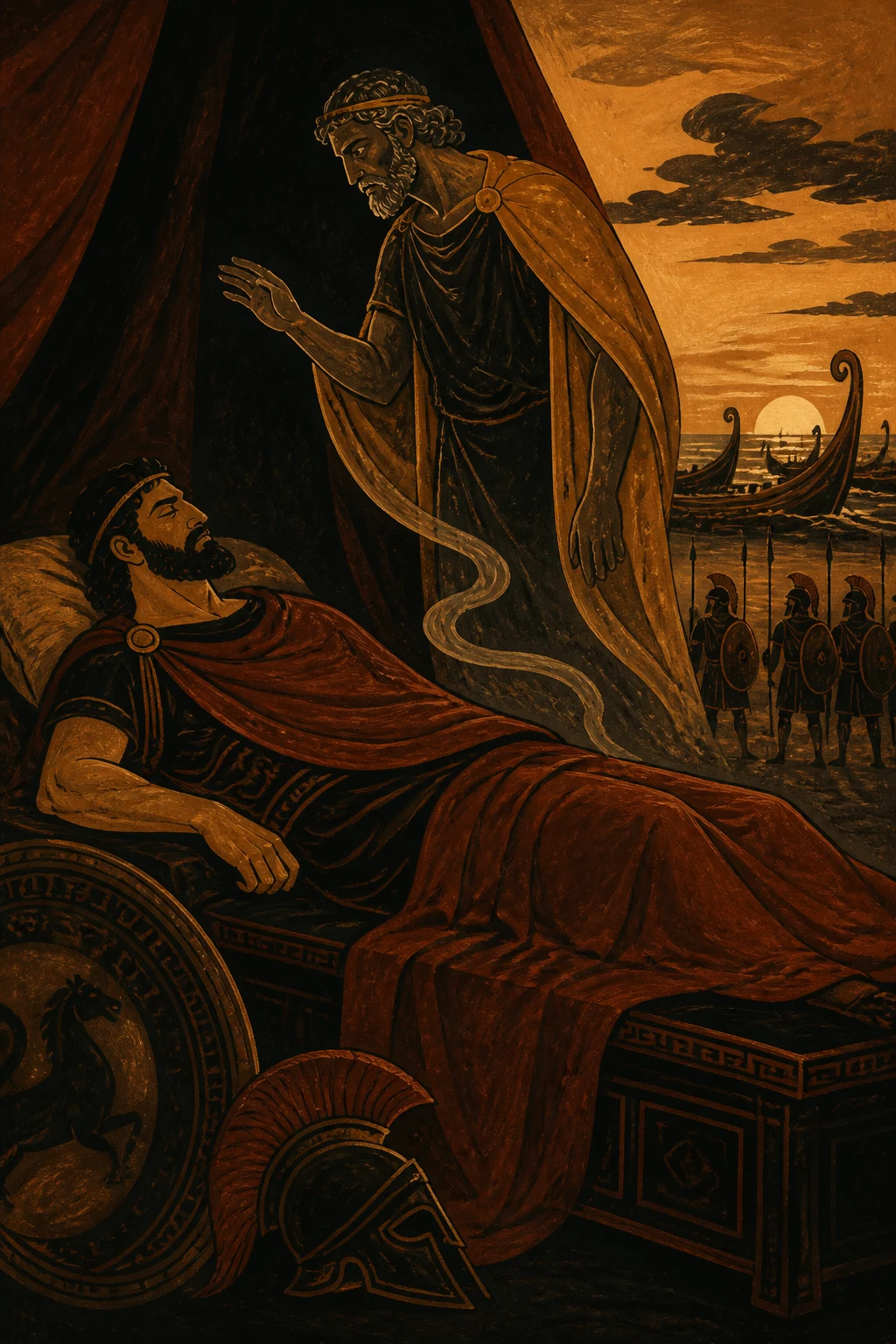
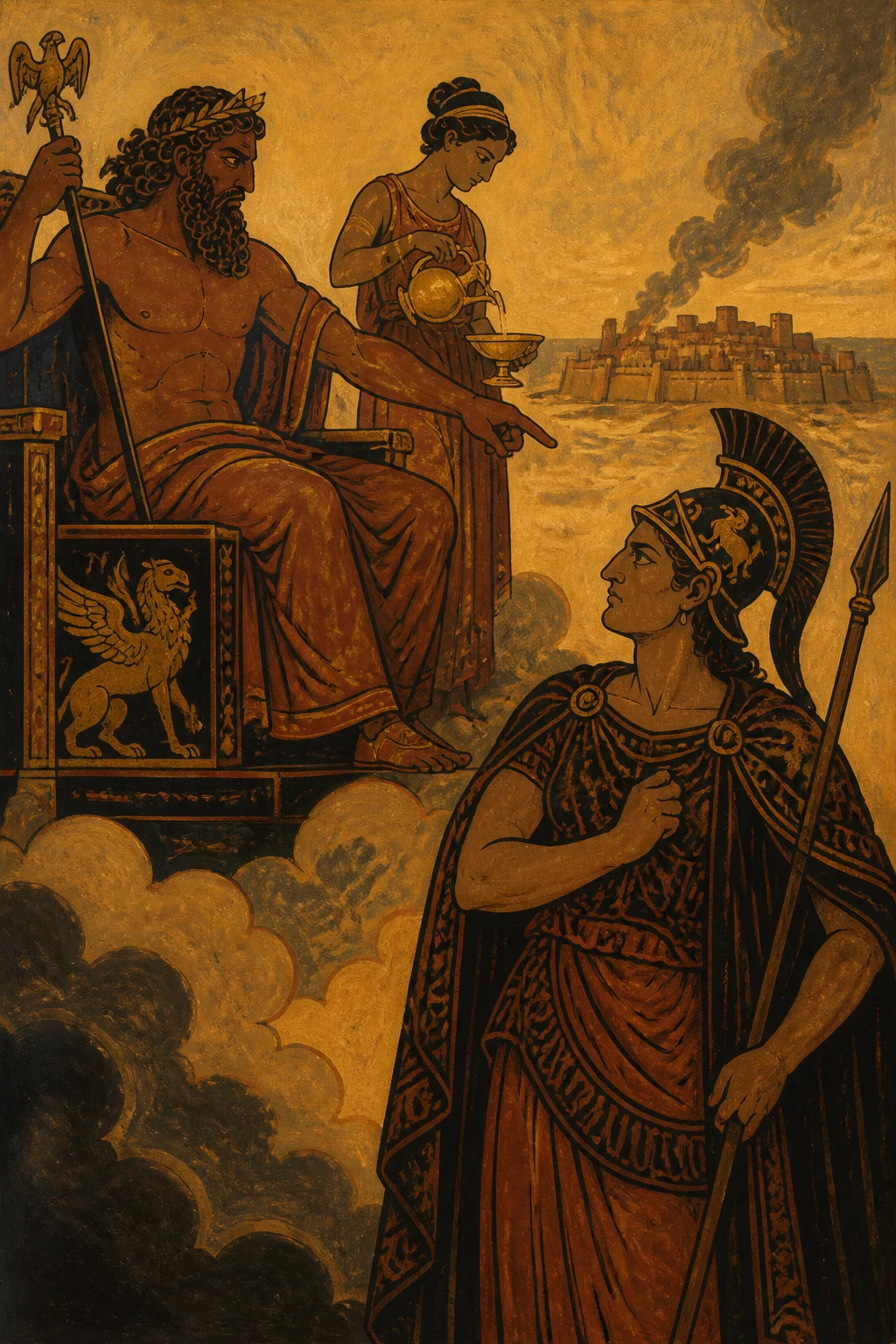
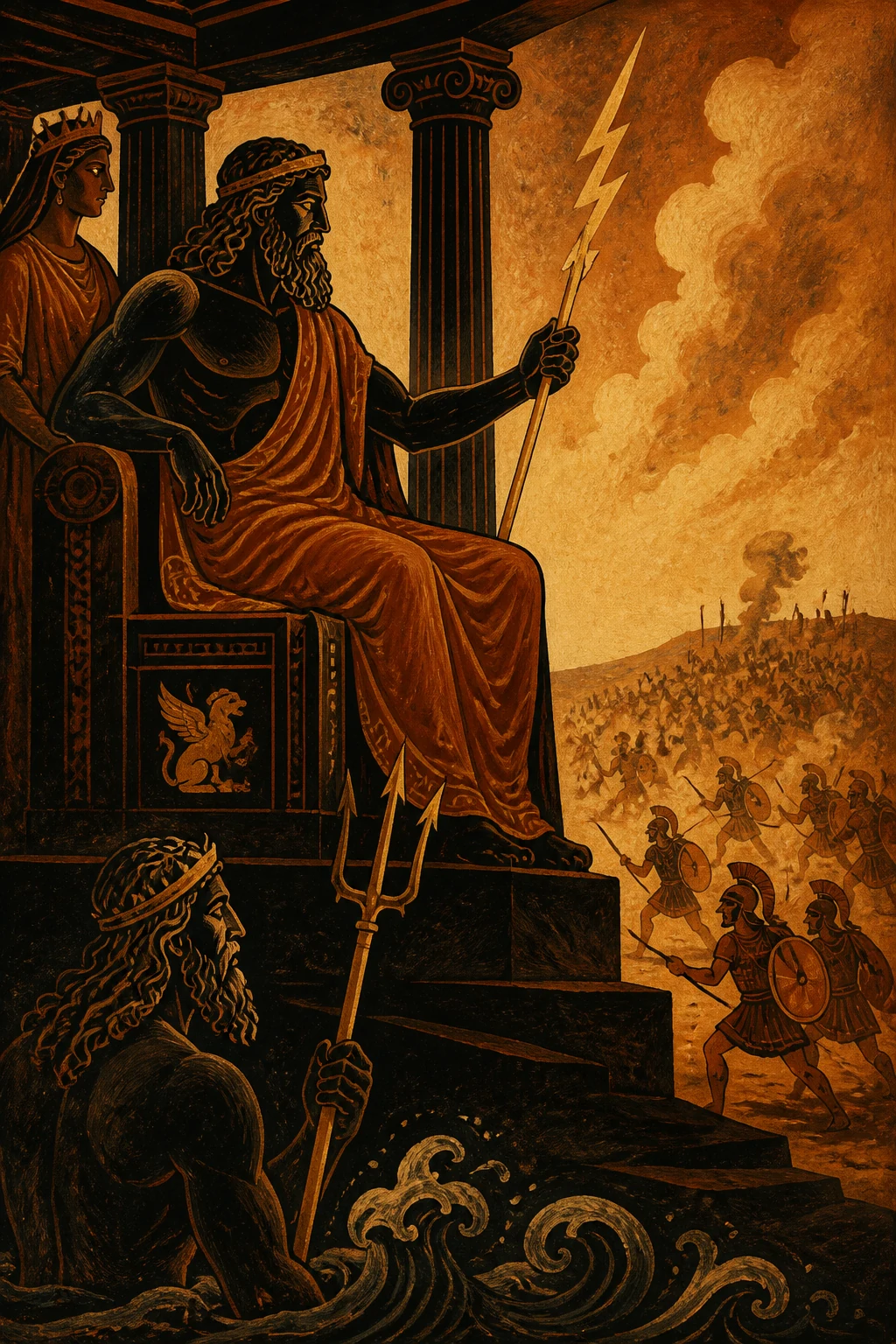
So beside the beaked ships the Achaeans armed themselves around you, son of Peleus, insatiable for battle, while the Trojans armed on the other side, upon the rise of the plain. And Zeus commanded Themis to summon the gods to council from the summit of many-folded Olympus. She went everywhere, bidding them come to the house of Zeus.
Not one of the rivers stayed away, except Ocean, nor any of the nymphs who inhabit lovely groves, the springs of rivers, and grassy meadows. Coming to the house of Zeus the cloud-gatherer, they took their seats in the polished colonnades that Hephaestus, with his knowing craftsmanship, had made for Father Zeus.
Thus they assembled within the house of Zeus. Nor did the Earth-shaker disregard the goddess’s summons: he came up from the sea to join them, seated himself among them, and asked Zeus his purpose: “Why, lord of the bright thunderbolt, have you called the gods to council once again?
“Are you pondering something concerning the Trojans and Achaeans? For now the fighting and the war between them have flared up close at hand.” Zeus the cloud-gatherer answered him: “Earth-shaker, you have understood the purpose in my heart, and why I brought you together. They concern me, doomed though they are to die.
“But I shall remain here, seated in a fold of Olympus, and delight my heart by watching. The rest of you, go down among the Trojans and Achaeans, and help either side, as each of you is inclined.
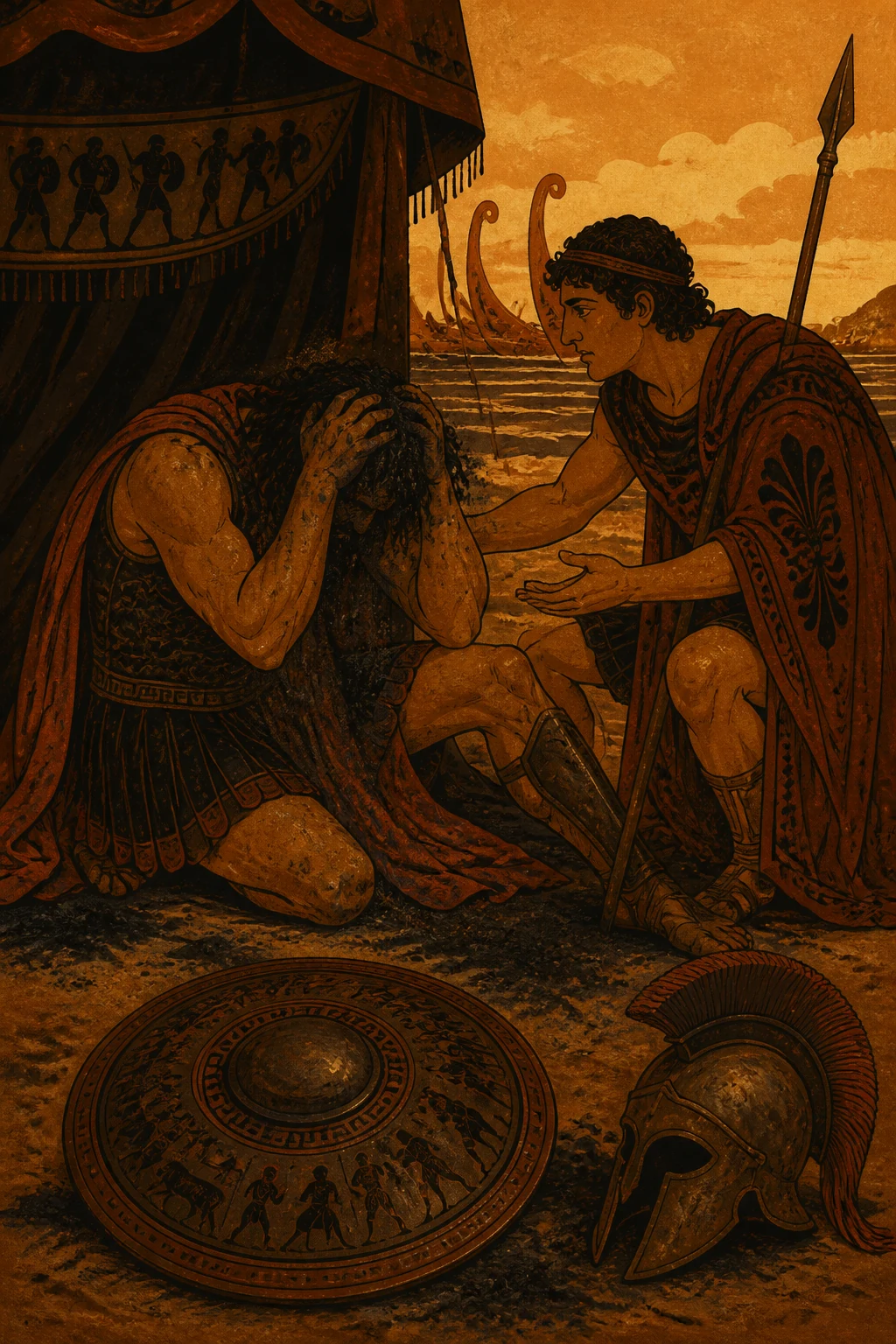
“For if Achilles fights the Trojans alone, they will not hold off the swift-footed son of Peleus even for a little while. They used to tremble at the sight of him before; now that his heart is filled with terrible anger for his comrade, I fear he may even storm their wall before the appointed time.”
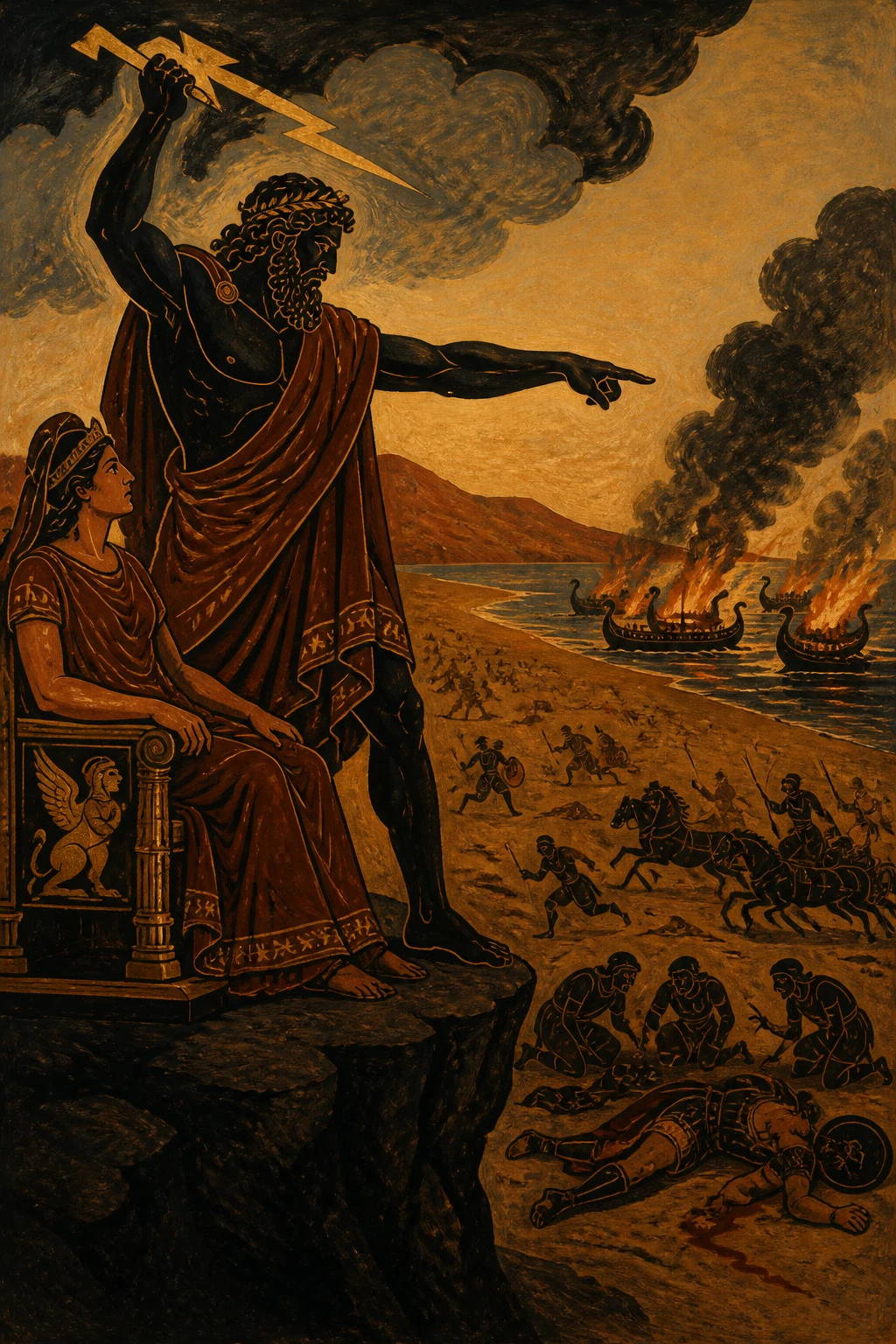
So spoke the son of Cronus, and stirred up relentless war. The gods set out for battle, divided in their loyalties. Hera went to the gathering by the ships, with Pallas Athena, Poseidon who holds the earth, and Hermes the bringer of good fortune, distinguished for his shrewd understanding. Hephaestus went with them, exulting in his strength, limping as his slender legs hurried beneath him.
To the Trojans went Ares of the flashing helmet, and with him Phoebus of the unshorn hair, Artemis the showerer of arrows, Leto, Xanthus, and laughter-loving Aphrodite. As long as the gods remained apart from mortal men, the Achaeans gloried in their strength, because Achilles had appeared after his long absence from grievous battle. But terrible trembling stole through every Trojan’s limbs: they were afraid when they saw the swift-footed son of Peleus gleaming in his armor like Ares, destroyer of men.
But when the Olympians entered the throng of men, mighty Strife, rouser of armies, arose. Athena shouted, standing now beside the dug trench outside the wall, now upon the resounding shore, where she raised her long battle cry.
From the other side Ares shouted, like a black storm, calling piercingly to the Trojans from the city’s highest point, or running beside the Simois over Callicolone. Thus the blessed gods urged on both armies and brought them together, breaking out in fierce strife among themselves. Terribly the father of men and gods thundered from on high, while beneath them Poseidon shook the boundless earth and the mountains’ steep summits.
All the foothills and peaks of Ida of the many springs were shaken, and the city of the Trojans and the ships of the Achaeans. Far below, Hades, lord of the dead, took fright, leaped in terror from his throne, and cried aloud, fearing that Poseidon the Earth-shaker might split open the earth above him and reveal to mortals and immortals his dreadful, dank dwelling, which even the gods abhor. Such was the crashing din when the gods met in strife.
For against Lord Poseidon stood Phoebus Apollo, holding his winged arrows, and against Enyalius stood the goddess, bright-eyed Athena. Against Hera stood clamorous Artemis of the golden spindle, the showerer of arrows, sister of the far-shooting god. Against Leto stood strong Hermes, bringer of good fortune, and against Hephaestus the great river of deep eddies, whom the gods call Xanthus, but men Scamander.
Thus god went out against god. But Achilles longed above all to plunge through the throng against Hector, son of Priam, for his heart urged him above all to glut Ares, the warrior who bears the hide-bound shield, with Hector’s blood.
But Apollo, rouser of armies, drove Aeneas straight against the son of Peleus and filled him with noble courage. He took on the voice of Lycaon, son of Priam, and in that likeness Apollo, son of Zeus, addressed him: “Aeneas, counselor of the Trojans, where are the boasts you made to the Trojan kings as you drank your wine, promising to fight Achilles, son of Peleus, face to face?”
Aeneas answered him: “Son of Priam, why do you urge me, against my will, to fight the proud son of Peleus? This will not be the first time I have faced swift-footed Achilles. Once before he drove me with his spear from Ida, when he fell upon our cattle and sacked Lyrnessus and Pedasus. But Zeus saved me, putting strength into me and making my knees swift.
“Otherwise I would have fallen beneath the hands of Achilles and Athena, who went before him, bringing him light and urging him to slaughter Leleges and Trojans with his bronze spear. So no man can fight Achilles face to face: there is always some god beside him to ward off destruction.
“And apart from that, his spear flies straight and does not stop until it has pierced a man’s flesh. Yet if a god would hold the issue of battle even, he would not overcome me so easily, though he boasts that he is made entirely of bronze.”
Then Lord Apollo, son of Zeus, answered him: “Come, warrior, pray in your turn to the everlasting gods. You too, they say, were born of Aphrodite, daughter of Zeus, while he is the son of a lesser goddess. Your mother is Zeus’s daughter; his is the daughter of the Old Man of the Sea.
“Carry your unyielding bronze straight against him. Do not let him turn you back altogether with his harsh words and threats.” So saying, he breathed great courage into the shepherd of the people, who strode through the front ranks clad in gleaming bronze.
But white-armed Hera did not fail to notice Anchises’ son as he went through the throng of men to face the son of Peleus. Gathering the gods together, she spoke among them: “Consider in your hearts, Poseidon and Athena, how these things are to turn out.
“Here is Aeneas, clad in gleaming bronze, going against the son of Peleus, and Phoebus Apollo has urged him on. Come, let us turn him back at once; or let one of us stand beside Achilles and give him great strength, so that his courage does not fail and he may know that the greatest of the immortals love him, while those who have all along defended the Trojans from war and slaughter are powerless.
“We have all come down from Olympus to meet this battle, so that today he may suffer no harm among the Trojans. Later he will suffer whatever Fate spun into his thread at birth, when his mother bore him.
“But if Achilles does not learn this from a god’s own voice, he will be afraid when some god confronts him in battle. Gods are terrible to behold when they appear unveiled.”
Poseidon the Earth-shaker answered her: “Hera, do not rage beyond reason. There is no need. I would not wish to bring us and the other gods together in strife, since we are far stronger than they. Let us go instead and sit apart from the fighting, at a place where we can watch, and leave the war to men.
“But if Ares or Phoebus Apollo begins the fighting, or if they restrain Achilles and will not let him fight, then at once the quarrel of battle will be roused here among us too. And I think they will very quickly break away and return to Olympus, to the company of the other gods, subdued by force beneath our hands.”
With these words the dark-haired god led the way to the high, banked enclosure of godlike Heracles, which the Trojans and Pallas Athena had built for him, so that he might escape the sea monster and find shelter whenever it drove him from the shore toward the plain.
There Poseidon and the other gods sat down and wrapped their shoulders in an impenetrable cloud. The gods of the other side sat upon the brows of Callicolone, around you, far-shooting Phoebus, and Ares, sacker of cities.
Thus they sat on either side, pondering their plans. Both parties hesitated to begin the woeful war, though Zeus, seated on high, had given the command. The whole plain was filled with men and horses and shone with bronze; the earth rattled beneath their feet as they surged forward together. And two men, far the best of all, advanced into the space between the armies, eager to fight: Aeneas, son of Anchises, and godlike Achilles.
Aeneas came forward first with threatening gestures, nodding his heavy helmet. He held his mighty shield before his breast and shook his bronze spear. From the other side the son of Peleus rushed to meet him like a ravening lion that men, a whole community gathered together, are bent on killing. At first it goes its way disdainfully, but when some battle-eager youth strikes it with a spear, it crouches open-mouthed, foam gathers about its teeth, and its valiant heart groans within its breast. It lashes its ribs and flanks on either side with its tail, goading itself to battle, then with glaring eyes charges straight ahead in fury, either to kill a man or itself be killed amid the foremost throng. So his strength and proud spirit drove Achilles to meet great-hearted Aeneas.
When they had advanced close to one another, swift-footed, godlike Achilles spoke first: “Aeneas, why have you come so far out from the throng to stand here? Does your heart urge you to fight me in the hope of ruling the horse-taming Trojans with Priam’s royal power? Even if you kill me, Priam will not place that prize in your hands. He has sons, and he is steadfast, not a fool.
“Or have the Trojans marked out some estate for you, surpassing all others, fine orchard land and plowland for you to possess if you kill me? That, I think, you will find hard to do. Once before, I tell you, I sent you running before my spear.
“Do you not remember how, when you were alone beside your cattle, I chased you headlong down the mountains of Ida on my swift feet? You did not look behind you as you fled that day. From there you escaped to Lyrnessus, but I attacked and sacked it, with Athena and Father Zeus beside me. I led the women away as captives, robbing them of their day of freedom. But Zeus and the other gods saved you.
“This time I do not think they will save you, as you imagine in your heart. I advise you to draw back and return to the crowd. Do not stand against me before you come to harm. Even a fool learns once the deed is done.”
Aeneas answered him: “Son of Peleus, do not hope to frighten me with words as though I were a child. I too know well enough how to speak in taunts and insults.
“We know each other’s ancestry and parents from the tales we have heard mortal men tell, though you have never seen mine with your own eyes, nor I yours. They say you are the son of noble Peleus, born of Thetis of the lovely hair, daughter of the sea. I declare myself the son of great-hearted Anchises, and Aphrodite is my mother. One pair of these parents will mourn their dear son today. For I do not think that after these childish speeches we shall part and leave the battle untouched.
“But if you wish to hear this too, so that you may know my lineage well—and many men know it—first Zeus the cloud-gatherer fathered Dardanus, who founded Dardania. For sacred Ilios had not yet been built upon the plain as a city of mortal men; they still inhabited the foothills of Ida of the many springs.
“Dardanus in turn fathered a son, King Erichthonius, who became the richest of mortal men. Three thousand mares grazed in his marshland, rejoicing in their tender foals.
“Boreas fell in love with them as they grazed, and, taking the shape of a dark-maned stallion, lay with them. They conceived and bore twelve foals. Whenever these raced over the grain-giving fields, they ran across the very tops of the ears of corn without breaking them; and whenever they raced over the sea’s broad back, they ran upon the crests of the gray salt breakers.
“Erichthonius fathered Tros, king of the Trojans; and Tros in turn had three noble sons, Ilus, Assaracus, and godlike Ganymede, who was the most beautiful of mortal men. For his beauty the gods carried him away to pour wine for Zeus, so that he might live among the immortals.
“Ilus fathered a noble son, Laomedon; and Laomedon fathered Tithonus, Priam, Lampus, Clytius, and Hicetaon, a scion of Ares. Assaracus fathered Capys, and Capys fathered Anchises. Anchises fathered me, and Priam fathered godlike Hector.
“Of this lineage and blood I claim to be. But Zeus increases or diminishes valor in men as he pleases, for he is the strongest of all. Come, let us speak of these things no longer like children, standing in the thick of murderous battle.
“We could both utter so many reproaches that a ship with a hundred benches could not carry the load. A mortal’s tongue is a pliant thing, filled with speeches of every kind; words have a wide pasture to range over, this way and that.
“Whatever word you speak, such a word you may hear in return. But why must the two of us bandy quarrels and insults face to face like women who, enraged by some heart-consuming dispute, come out into the middle of the street and rail at one another, saying many things both true and false? Anger urges them to that as well.
“You will not turn me from my eagerness for battle with words before we have fought face to face with bronze. Come, let us quickly taste one another’s bronze-tipped spears.” He spoke, and drove his mighty spear against Achilles’ dreadful, fearsome shield. The shield rang loudly about the spear point.
The son of Peleus, alarmed, held the shield away from him in his powerful hand, for he thought great-hearted Aeneas’ long-shadowed spear would easily pass through it. Fool that he was, he did not consider in his heart and mind that the glorious gifts of the gods are not easily mastered by mortal men, nor do they yield to them.
Nor did warlike Aeneas’ mighty spear break through the shield then: the gold checked it, the god’s gift. It drove through two layers, but three still remained, for the lame god had hammered out five layers: two of bronze, two within of tin, and one of gold. In that the ashen spear was stopped.
Next Achilles cast his long-shadowed spear and struck Aeneas’ evenly rounded shield beneath its outermost rim, where the bronze was thinnest and the oxhide backing was thinnest too. The ash spear from Pelion darted clean through, and the shield cracked beneath it.
Aeneas crouched and held the shield away from him in fear. The spear flew over his back and fixed itself in the ground, having pierced both circles of the sheltering shield. Having escaped the long spear, he stood still, and overwhelming anguish clouded his eyes, terrified because the weapon had struck so close. But Achilles drew his sharp sword and sprang upon him eagerly with a terrible cry. Aeneas seized a stone in his hand, a mighty burden that no two men could carry, such as mortals are today; yet he wielded it easily alone.
Then Aeneas would have struck Achilles as he charged, hitting his helmet or the shield that warded off grievous death, and the son of Peleus would have taken his life at close quarters with his sword, had Poseidon the Earth-shaker not been quick to notice. At once he spoke among the immortal gods: “Ah, how I grieve for great-hearted Aeneas, who will soon go down to Hades, slain by the son of Peleus because he obeyed the words of far-shooting Apollo! Fool that he is, Apollo will do nothing to save him from grievous death.
“But why should this innocent man suffer needlessly now for the sorrows of others, when he always gives pleasing gifts to the gods who hold the broad heaven? Come, let us save him from death, lest the son of Cronus be angry if Achilles kills him. It is his destiny to escape, so that the line of Dardanus may not perish without offspring and vanish utterly—Dardanus, whom the son of Cronus loved above all the sons born to him by mortal women.
“For already the son of Cronus has come to hate the line of Priam. Now mighty Aeneas shall rule the Trojans, and his children’s children who shall be born in days to come.” Then ox-eyed, queenly Hera answered him: “Earth-shaker, consider for yourself whether you will save Aeneas or allow him, brave though he is, to be overcome by Achilles, son of Peleus.
“For Pallas Athena and I have sworn many oaths before all the immortals that we will never ward off the day of evil from the Trojans—not even when all Troy is burning in devouring fire, kindled by the warlike sons of the Achaeans.”
When Poseidon the Earth-shaker heard this, he went through the battle and the tumult of spears, and came to where Aeneas and renowned Achilles stood. At once he poured a mist over the eyes of Achilles, son of Peleus, and drew the bronze-tipped ash spear from great-hearted Aeneas’ shield. He laid it before Achilles’ feet, then lifted Aeneas high from the earth and sent him flying.
Over many ranks of warriors and many ranks of horses Aeneas soared, borne on from the god’s hand, and came to the furthest edge of the surging battle, where the Caucones were arming themselves for war.
Poseidon the Earth-shaker came close beside him and addressed him with winged words: “Aeneas, which of the gods urges you in such blindness to fight the proud son of Peleus, who is both stronger than you and dearer to the immortals?
“Draw back whenever you encounter him, lest you enter the house of Hades before your destined time. But when Achilles has met his death and doom, then take courage and fight among the foremost, for no other Achaean will slay you.”
Having spoken and made everything clear, he left him there. Then quickly he scattered the wondrous mist from Achilles’ eyes. Achilles gazed about him, and in vexation spoke to his own great heart: “Ah, this is a mighty wonder that I see before my eyes! Here lies my spear upon the ground, yet I cannot see the man at whom I hurled it, eager to kill him.
“So Aeneas too, it seems, was dear to the immortal gods. I thought his boasts were empty words. Let him go! He will have no heart to try me again, after escaping death so gladly now.
“Come, I will urge on the war-loving Danaans, then go to meet the other Trojans and put them to the test.” He spoke and leaped among the ranks, calling to every man: “No longer stand far off from the Trojans, noble Achaeans! Come, let man advance against man, eager to fight.
“Strong though I am, it is hard for me to chase so many men and fight them all. Not even Ares, immortal god though he is, nor Athena could face the mouth of such a battle and labor through it. But whatever I can do with hands and feet and strength, I tell you I shall not hold back in the least. I shall drive straight through their line, and I think no Trojan will rejoice who comes within reach of my spear.”
So he spoke, urging them on. And glorious Hector called aloud to the Trojans, declaring that he would face Achilles: “Proud Trojans, do not fear the son of Peleus! With words I too could fight even the immortals, but with a spear it is hard, since they are far stronger than we are.
“Nor will Achilles bring all his words to fulfillment: some he will fulfill, and some he will leave half done. I will go against him, though his hands are like fire—though his hands are like fire, and his fury like blazing iron.”
So he spoke, urging them on, and the Trojans raised their spears to meet the enemy. Their strength mingled together, and a battle cry arose. Then Phoebus Apollo stood beside Hector and said: “Hector, do not fight Achilles out in front any longer. Wait for him among the mass of men, away from the clash, lest he strike you with a spear or stab you at close quarters with his sword.”
So he spoke, and Hector slipped back into the throng of men, afraid when he heard the god’s voice. But Achilles leaped among the Trojans, his heart clothed in courage, shouting terribly. First he killed noble Iphition, son of Otrynteus, a leader of many men, whom a water nymph had borne to Otrynteus, sacker of cities, beneath snowy Tmolus in the fertile land of Hyde. As he charged straight at him, godlike Achilles struck him with his spear down the middle of the head, splitting it clean in two. He fell with a crash, and godlike Achilles exulted over him: “There you lie, son of Otrynteus, most fearsome of men! Here is your death, though your birth was beside the Gygaean lake, where your ancestral estate lies by the fish-filled Hyllus and the eddying Hermus.”
So he boasted, and darkness covered Iphition’s eyes. The Achaeans’ horses tore him beneath their chariot wheels in the foremost fighting. After him Achilles stabbed Demoleon, a stout defender in battle, son of Antenor, in the temple through his bronze-cheeked helmet.
The bronze helmet did not stop the spear: the point drove through, shattering the bone, and all his brain was spattered within. It brought him down in the midst of his fury. Next Achilles struck Hippodamas in the back with his spear as he leaped from his chariot and fled before him.
As he breathed out his life he bellowed like a bull dragged by young men to the Heliconian lord, while the Earth-shaker takes delight in them. So he bellowed as his proud spirit left his bones. Then Achilles went with his spear after godlike Polydorus, son of Priam. His father would not allow him to fight, for he was the youngest-born of his sons and the dearest to him, and in speed of foot he surpassed them all. But now, in his folly, displaying his swift feet, he raced through the foremost fighters until he lost his life.
As he darted past, swift-footed, godlike Achilles struck him with his spear in the middle of the back, where the golden belt clasps fastened and the breastplate overlapped. The spear point passed straight through beside his navel. He fell to his knees with a groan, and a dark cloud wrapped him round; sinking down, he gathered his entrails to him with his hands.
When Hector saw his brother Polydorus sinking to the ground, holding his entrails in his hands, a mist poured over his eyes. He could no longer bear to range far off, but came against Achilles, brandishing his sharp spear, like a flame. The moment Achilles saw him, he sprang forward and cried in triumph: “Here is the man who has wounded my heart most deeply, who killed my honored comrade! No longer shall we shrink from one another along the paths of battle.”
He spoke, then glared at godlike Hector and said: “Come closer, so that you may reach the bounds of death more quickly.” Undaunted, Hector of the flashing helmet answered him: “Son of Peleus, do not hope to frighten me with words as though I were a child. I too know well enough how to speak in taunts and insults.
“I know that you are strong, and I am far inferior to you. Yet these things lie in the lap of the gods: weaker though I am, I may take your life with a cast of my spear, for my weapon too has a sharp point.”
He spoke, balanced his spear, and hurled it. But Athena turned it back from glorious Achilles with a breath, blowing very gently. It returned to godlike Hector and fell before his feet. Achilles rushed upon him eagerly, longing to kill him, shouting terribly; but Apollo snatched Hector away, easily, as a god can, and hid him in thick mist.
Three times swift-footed, godlike Achilles charged with his bronze spear; three times he struck the deep mist. But when he rushed forward for the fourth time, like a god, he shouted fearfully and spoke these winged words: “Once again you have escaped death, you dog! Destruction came close to you indeed, but now Phoebus Apollo has saved you again—the god to whom, no doubt, you pray as you go into the thunder of spears.
“Yet I shall finish you when I meet you another time, if any god is there to help me too. For now I shall go after the others, whoever I can catch.” So saying, he struck Dryops in the middle of the neck with his spear, and he fell before his feet. Leaving him, Achilles struck Demuchus, the brave, tall son of Philetor, in the knee with his spear and stopped him. Then he took his life with a stroke of his great sword. Next he rushed at Laogonus and Dardanus, the two sons of Bias, and thrust them both from their chariot to the ground, striking one with his spear and the other at close quarters with his sword.
Then Tros, son of Alastor, came to clasp his knees, hoping he might take pity on him and release him alive instead of killing him, out of compassion for one of his own age. Fool that he was, he did not know that he would never persuade him: Achilles was not a gentle or tender-hearted man, but filled with furious purpose. Tros reached for his knees with his hands, eager to plead, but Achilles stabbed him in the liver with his sword. His liver slid out, and the black blood pouring from it filled the fold of his tunic. Darkness covered his eyes as life failed him. Then Achilles came close to Mulius and struck him in the ear with his spear, and the bronze point passed straight through the other ear. He struck Echeclus, son of Agenor, down the middle of the head with his hilted sword, and the whole blade grew hot with blood. Dark death and mighty fate closed over his eyes.
Next he pierced Deucalion’s arm with his bronze spear point where the tendons of the elbow join. Deucalion waited for him with his arm hanging heavy, seeing death before him. Achilles struck his neck with his sword and sent his head, helmet and all, flying far away. Marrow spurted from the vertebrae, and his body lay stretched upon the ground.
Then he went after the noble son of Peires, Rhigmus, who had come from fertile Thrace. He struck him in the middle with his spear, and the bronze lodged in his belly; he fell from the chariot. His attendant Areithous turned the horses back, but Achilles stabbed him in the back with his sharp spear and thrust him from the chariot. The horses plunged in confusion.
As a fierce-blazing fire rages through the deep glens of a parched mountain, and the dense forest burns while the wind drives the flames whirling in every direction, so Achilles stormed everywhere with his spear like a god, pursuing those he slaughtered, and the black earth ran with blood.
As when a man yokes broad-browed oxen to tread white barley on a well-laid threshing floor, and quickly the grain is crushed beneath the feet of the bellowing cattle, so beneath great-hearted Achilles his solid-hoofed horses trampled corpses and shields together. The axle underneath was spattered all over with blood, as were the rails around the chariot, struck by drops flung up from the horses’ hooves and the wheel rims. And the son of Peleus pressed on to win glory, his invincible hands stained with gore.
Izvirnik
The Gods Enter the War
Naslednje strani prikazujejo izvirno besedilo za primerjavo.
ὣς οἳ μὲν παρὰ νηυσὶ κορωνίσι θωρήσσοντο ἀμφὶ σὲ Πηλέος υἱὲ μάχης ἀκόρητον Ἀχαιοί, Τρῶες δʼ αὖθʼ ἑτέρωθεν ἐπὶ θρωσμῷ πεδίοιο· Ζεὺς δὲ Θέμιστα κέλευσε θεοὺς ἀγορὴν δὲ καλέσσαι κρατὸς ἀπʼ Οὐλύμποιο πολυπτύχου· ἣ δʼ ἄρα πάντῃ φοιτήσασα κέλευσε Διὸς πρὸς δῶμα νέεσθαι. οὔτέ τις οὖν ποταμῶν ἀπέην νόσφʼ Ὠκεανοῖο, οὔτʼ ἄρα νυμφάων αἵ τʼ ἄλσεα καλὰ νέμονται καὶ πηγὰς ποταμῶν καὶ πίσεα ποιήεντα.
ἐλθόντες δʼ ἐς δῶμα Διὸς νεφεληγερέταο ξεστῇς αἰθούσῃσιν ἐνίζανον, ἃς Διὶ πατρὶ Ἥφαιστος ποίησεν ἰδυίῃσι πραπίδεσσιν. ὣς οἳ μὲν Διὸς ἔνδον ἀγηγέρατʼ· οὐδʼ ἐνοσίχθων νηκούστησε θεᾶς, ἀλλʼ ἐξ ἁλὸς ἦλθε μετʼ αὐτούς, ἷζε δʼ ἄρʼ ἐν μέσσοισι, Διὸς δʼ ἐξείρετο βουλήν· τίπτʼ αὖτʼ ἀργικέραυνε θεοὺς ἀγορὴν δὲ κάλεσσας; ἦ τι περὶ Τρώων καὶ Ἀχαιῶν μερμηρίζεις; τῶν γὰρ νῦν ἄγχιστα μάχη πόλεμός τε δέδηε.
τὸν δʼ ἀπαμειβόμενος προσέφη νεφεληγερέτα Ζεύς· ἔγνως ἐννοσίγαιε ἐμὴν ἐν στήθεσι βουλὴν ὧν ἕνεκα ξυνάγειρα· μέλουσί μοι ὀλλύμενοί περ. ἀλλʼ ἤτοι μὲν ἐγὼ μενέω πτυχὶ Οὐλύμποιο ἥμενος, ἔνθʼ ὁρόων φρένα τέρψομαι· οἳ δὲ δὴ ἄλλοι ἔρχεσθʼ ὄφρʼ ἂν ἵκησθε μετὰ Τρῶας καὶ Ἀχαιούς, ἀμφοτέροισι δʼ ἀρήγεθʼ ὅπῃ νόος ἐστὶν ἑκάστου. εἰ γὰρ Ἀχιλλεὺς οἶος ἐπὶ Τρώεσσι μαχεῖται οὐδὲ μίνυνθʼ ἕξουσι ποδώκεα Πηλεΐωνα.
καὶ δέ τί μιν καὶ πρόσθεν ὑποτρομέεσκον ὁρῶντες· νῦν δʼ ὅτε δὴ καὶ θυμὸν ἑταίρου χώεται αἰνῶς δείδω μὴ καὶ τεῖχος ὑπέρμορον ἐξαλαπάξῃ. ὣς ἔφατο Κρονίδης, πόλεμον δʼ ἀλίαστον ἔγειρε. βὰν δʼ ἴμεναι πόλεμον δὲ θεοὶ δίχα θυμὸν ἔχοντες· Ἥρη μὲν μετʼ ἀγῶνα νεῶν καὶ Παλλὰς Ἀθήνη ἠδὲ Ποσειδάων γαιήοχος ἠδʼ ἐριούνης Ἑρμείας, ὃς ἐπὶ φρεσὶ πευκαλίμῃσι κέκασται· Ἥφαιστος δʼ ἅμα τοῖσι κίε σθένεϊ βλεμεαίνων χωλεύων, ὑπὸ δὲ κνῆμαι ῥώοντο ἀραιαί.
ἐς δὲ Τρῶας Ἄρης κορυθαίολος, αὐτὰρ ἅμʼ αὐτῷ Φοῖβος ἀκερσεκόμης ἠδʼ Ἄρτεμις ἰοχέαιρα Λητώ τε Ξάνθός τε φιλομειδής τʼ Ἀφροδίτη. εἷος μέν ῥʼ ἀπάνευθε θεοὶ θνητῶν ἔσαν ἀνδρῶν, τεῖος Ἀχαιοὶ μὲν μέγα κύδανον, οὕνεκʼ Ἀχιλλεὺς ἐξεφάνη, δηρὸν δὲ μάχης ἐπέπαυτʼ ἀλεγεινῆς· Τρῶας δὲ τρόμος αἰνὸς ὑπήλυθε γυῖα ἕκαστον δειδιότας, ὅθʼ ὁρῶντο ποδώκεα Πηλεΐωνα τεύχεσι λαμπόμενον βροτολοιγῷ ἶσον Ἄρηϊ.
αὐτὰρ ἐπεὶ μεθʼ ὅμιλον Ὀλύμπιοι ἤλυθον ἀνδρῶν, ὦρτο δʼ Ἔρις κρατερὴ λαοσσόος, αὖε δʼ Ἀθήνη στᾶσʼ ὁτὲ μὲν παρὰ τάφρον ὀρυκτὴν τείχεος ἐκτός, ἄλλοτʼ ἐπʼ ἀκτάων ἐριδούπων μακρὸν ἀΰτει. αὖε δʼ Ἄρης ἑτέρωθεν ἐρεμνῇ λαίλαπι ἶσος ὀξὺ κατʼ ἀκροτάτης πόλιος Τρώεσσι κελεύων, ἄλλοτε πὰρ Σιμόεντι θέων ἐπὶ Καλλικολώνῃ. ὣς τοὺς ἀμφοτέρους μάκαρες θεοὶ ὀτρύνοντες σύμβαλον, ἐν δʼ αὐτοῖς ἔριδα ῥήγνυντο βαρεῖαν· δεινὸν δὲ βρόντησε πατὴρ ἀνδρῶν τε θεῶν τε ὑψόθεν· αὐτὰρ νέρθε Ποσειδάων ἐτίναξε γαῖαν ἀπειρεσίην ὀρέων τʼ αἰπεινὰ κάρηνα.
πάντες δʼ ἐσσείοντο πόδες πολυπίδακος Ἴδης καὶ κορυφαί, Τρώων τε πόλις καὶ νῆες Ἀχαιῶν. ἔδεισεν δʼ ὑπένερθεν ἄναξ ἐνέρων Ἀϊδωνεύς, δείσας δʼ ἐκ θρόνου ἆλτο καὶ ἴαχε, μή οἱ ὕπερθε γαῖαν ἀναρρήξειε Ποσειδάων ἐνοσίχθων, οἰκία δὲ θνητοῖσι καὶ ἀθανάτοισι φανείη σμερδαλέʼ εὐρώεντα, τά τε στυγέουσι θεοί περ· τόσσος ἄρα κτύπος ὦρτο θεῶν ἔριδι ξυνιόντων. ἤτοι μὲν γὰρ ἔναντα Ποσειδάωνος ἄνακτος ἵστατʼ Ἀπόλλων Φοῖβος ἔχων ἰὰ πτερόεντα, ἄντα δʼ Ἐνυαλίοιο θεὰ γλαυκῶπις Ἀθήνη· Ἥρῃ δʼ ἀντέστη χρυσηλάκατος κελαδεινὴ
Ἄρτεμις ἰοχέαιρα κασιγνήτη ἑκάτοιο· Λητοῖ δʼ ἀντέστη σῶκος ἐριούνιος Ἑρμῆς, ἄντα δʼ ἄρʼ Ἡφαίστοιο μέγας ποταμὸς βαθυδίνης, ὃν Ξάνθον καλέουσι θεοί, ἄνδρες δὲ Σκάμανδρον. ὣς οἳ μὲν θεοὶ ἄντα θεῶν ἴσαν· αὐτὰρ Ἀχιλλεὺς Ἕκτορος ἄντα μάλιστα λιλαίετο δῦναι ὅμιλον Πριαμίδεω· τοῦ γάρ ῥα μάλιστά ἑ θυμὸς ἀνώγει αἵματος ἆσαι Ἄρηα ταλαύρινον πολεμιστήν. Αἰνείαν δʼ ἰθὺς λαοσσόος ὦρσεν Ἀπόλλων ἀντία Πηλεΐωνος, ἐνῆκε δέ οἱ μένος ἠΰ· υἱέϊ δὲ Πριάμοιο Λυκάονι εἴσατο φωνήν· τῷ μιν ἐεισάμενος προσέφη Διὸς υἱὸς Ἀπόλλων·
Αἰνεία Τρώων βουληφόρε ποῦ τοι ἀπειλαὶ ἃς Τρώων βασιλεῦσιν ὑπίσχεο οἰνοποτάζων Πηλεΐδεω Ἀχιλῆος ἐναντίβιον πολεμίξειν; τὸν δʼ αὖτʼ Αἰνείας ἀπαμειβόμενος προσέειπε· Πριαμίδη τί με ταῦτα καὶ οὐκ ἐθέλοντα κελεύεις ἀντία Πηλεΐωνος ὑπερθύμοιο μάχεσθαι; οὐ μὲν γὰρ νῦν πρῶτα ποδώκεος ἄντʼ Ἀχιλῆος στήσομαι, ἀλλʼ ἤδη με καὶ ἄλλοτε δουρὶ φόβησεν ἐξ Ἴδης, ὅτε βουσὶν ἐπήλυθεν ἡμετέρῃσι, πέρσε δὲ Λυρνησσὸν καὶ Πήδασον· αὐτὰρ ἐμὲ Ζεὺς εἰρύσαθʼ, ὅς μοι ἐπῶρσε μένος λαιψηρά τε γοῦνα.
ἦ κʼ ἐδάμην ὑπὸ χερσὶν Ἀχιλλῆος καὶ Ἀθήνης, ἥ οἱ πρόσθεν ἰοῦσα τίθει φάος ἠδʼ ἐκέλευεν ἔγχεϊ χαλκείῳ Λέλεγας καὶ Τρῶας ἐναίρειν. τὼ οὐκ ἔστʼ Ἀχιλῆος ἐναντίον ἄνδρα μάχεσθαι· αἰεὶ γὰρ πάρα εἷς γε θεῶν ὃς λοιγὸν ἀμύνει. καὶ δʼ ἄλλως τοῦ γʼ ἰθὺ βέλος πέτετʼ, οὐδʼ ἀπολήγει πρὶν χροὸς ἀνδρομέοιο διελθέμεν. εἰ δὲ θεός περ ἶσον τείνειεν πολέμου τέλος, οὔ κε μάλα ῥέα νικήσειʼ, οὐδʼ εἰ παγχάλκεος εὔχεται εἶναι.
τὸν δʼ αὖτε προσέειπεν ἄναξ Διὸς υἱὸς Ἀπόλλων· ἥρως ἀλλʼ ἄγε καὶ σὺ θεοῖς αἰειγενέτῃσιν εὔχεο· καὶ δὲ σέ φασι Διὸς κούρης Ἀφροδίτης ἐκγεγάμεν, κεῖνος δὲ χερείονος ἐκ θεοῦ ἐστίν· ἣ μὲν γὰρ Διός ἐσθʼ, ἣ δʼ ἐξ ἁλίοιο γέροντος. ἀλλʼ ἰθὺς φέρε χαλκὸν ἀτειρέα, μηδέ σε πάμπαν λευγαλέοις ἐπέεσσιν ἀποτρεπέτω καὶ ἀρειῇ. ὣς εἰπὼν ἔμπνευσε μένος μέγα ποιμένι λαῶν, βῆ δὲ διὰ προμάχων κεκορυθμένος αἴθοπι χαλκῷ.
οὐδʼ ἔλαθʼ Ἀγχίσαο πάϊς λευκώλενον Ἥρην ἀντία Πηλεΐωνος ἰὼν ἀνὰ οὐλαμὸν ἀνδρῶν· ἣ δʼ ἄμυδις στήσασα θεοὺς μετὰ μῦθον ἔειπε· φράζεσθον δὴ σφῶϊ Ποσείδαον καὶ Ἀθήνη ἐν φρεσὶν ὑμετέρῃσιν, ὅπως ἔσται τάδε ἔργα. Αἰνείας ὅδʼ ἔβη κεκορυθμένος αἴθοπι χαλκῷ ἀντία Πηλεΐωνος, ἀνῆκε δὲ Φοῖβος Ἀπόλλων. ἀλλʼ ἄγεθʼ, ἡμεῖς πέρ μιν ἀποτρωπῶμεν ὀπίσσω αὐτόθεν· ἤ τις ἔπειτα καὶ ἡμείων Ἀχιλῆϊ παρσταίη, δοίη δὲ κράτος μέγα, μηδέ τι θυμῷ δευέσθω, ἵνα εἰδῇ ὅ μιν φιλέουσιν ἄριστοι ἀθανάτων, οἳ δʼ αὖτʼ ἀνεμώλιοι οἳ τὸ πάρος περ
Τρωσὶν ἀμύνουσιν πόλεμον καὶ δηϊοτῆτα. πάντες δʼ Οὐλύμποιο κατήλθομεν ἀντιόωντες τῆσδε μάχης, ἵνα μή τι μετὰ Τρώεσσι πάθῃσι σήμερον· ὕστερον αὖτε τὰ πείσεται ἅσσά οἱ αἶσα γιγνομένῳ ἐπένησε λίνῳ ὅτε μιν τέκε μήτηρ. εἰ δʼ Ἀχιλεὺς οὐ ταῦτα θεῶν ἐκ πεύσεται ὀμφῆς δείσετʼ ἔπειθʼ, ὅτε κέν τις ἐναντίβιον θεὸς ἔλθῃ ἐν πολέμῳ· χαλεποὶ δὲ θεοὶ φαίνεσθαι ἐναργεῖς. τὴν δʼ ἠμείβετʼ ἔπειτα Ποσειδάων ἐνοσίχθων· Ἥρη μὴ χαλέπαινε παρʼ ἐκ νόον· οὐδέ τί σε χρή.
οὐκ ἂν ἔγωγʼ ἐθέλοιμι θεοὺς ἔριδι ξυνελάσσαι ἡμέας τοὺς ἄλλους, ἐπεὶ ἦ πολὺ φέρτεροί εἰμεν· ἀλλʼ ἡμεῖς μὲν ἔπειτα καθεζώμεσθα κιόντες ἐκ πάτου ἐς σκοπιήν, πόλεμος δʼ ἄνδρεσσι μελήσει. εἰ δέ κʼ Ἄρης ἄρχωσι μάχης ἢ Φοῖβος Ἀπόλλων, ἢ Ἀχιλῆʼ ἴσχωσι καὶ οὐκ εἰῶσι μάχεσθαι, αὐτίκʼ ἔπειτα καὶ ἄμμι παρʼ αὐτόθι νεῖκος ὀρεῖται φυλόπιδος· μάλα δʼ ὦκα διακρινθέντας ὀΐω ἂψ ἴμεν Οὔλυμπον δὲ θεῶν μεθʼ ὁμήγυριν ἄλλων ἡμετέρῃς ὑπὸ χερσὶν ἀναγκαίηφι δαμέντας.
ὣς ἄρα φωνήσας ἡγήσατο κυανοχαίτης τεῖχος ἐς ἀμφίχυτον Ἡρακλῆος θείοιο ὑψηλόν, τό ῥά οἱ Τρῶες καὶ Παλλὰς Ἀθήνη ποίεον, ὄφρα τὸ κῆτος ὑπεκπροφυγὼν ἀλέαιτο, ὁππότε μιν σεύαιτο ἀπʼ ἠϊόνος πεδίον δέ. ἔνθα Ποσειδάων κατʼ ἄρʼ ἕζετο καὶ θεοὶ ἄλλοι, ἀμφὶ δʼ ἄρʼ ἄρρηκτον νεφέλην ὤμοισιν ἕσαντο· οἳ δʼ ἑτέρωσε καθῖζον ἐπʼ ὀφρύσι Καλλικολώνης ἀμφὶ σὲ ἤϊε Φοῖβε καὶ Ἄρηα πτολίπορθον.
ὣς οἳ μέν ῥʼ ἑκάτερθε καθήατο μητιόωντες βουλάς· ἀρχέμεναι δὲ δυσηλεγέος πολέμοιο ὄκνεον ἀμφότεροι, Ζεὺς δʼ ἥμενος ὕψι κέλευε. τῶν δʼ ἅπαν ἐπλήσθη πεδίον καὶ λάμπετο χαλκῷ ἀνδρῶν ἠδʼ ἵππων· κάρκαιρε δὲ γαῖα πόδεσσιν ὀρνυμένων ἄμυδις. δύο δʼ ἀνέρες ἔξοχʼ ἄριστοι ἐς μέσον ἀμφοτέρων συνίτην μεμαῶτε μάχεσθαι Αἰνείας τʼ Ἀγχισιάδης καὶ δῖος Ἀχιλλεύς. Αἰνείας δὲ πρῶτος ἀπειλήσας ἐβεβήκει νευστάζων κόρυθι βριαρῇ· ἀτὰρ ἀσπίδα θοῦριν πρόσθεν ἔχε στέρνοιο, τίνασσε δὲ χάλκεον ἔγχος.
Πηλεΐδης δʼ ἑτέρωθεν ἐναντίον ὦρτο λέων ὣς σίντης, ὅν τε καὶ ἄνδρες ἀποκτάμεναι μεμάασιν ἀγρόμενοι πᾶς δῆμος· ὃ δὲ πρῶτον μὲν ἀτίζων ἔρχεται, ἀλλʼ ὅτε κέν τις ἀρηϊθόων αἰζηῶν δουρὶ βάλῃ ἐάλη τε χανών, περί τʼ ἀφρὸς ὀδόντας γίγνεται, ἐν δέ τέ οἱ κραδίῃ στένει ἄλκιμον ἦτορ, οὐρῇ δὲ πλευράς τε καὶ ἰσχία ἀμφοτέρωθεν μαστίεται, ἑὲ δʼ αὐτὸν ἐποτρύνει μαχέσασθαι, γλαυκιόων δʼ ἰθὺς φέρεται μένει, ἤν τινα πέφνῃ ἀνδρῶν, ἢ αὐτὸς φθίεται πρώτῳ ἐν ὁμίλῳ· ὣς Ἀχιλῆʼ ὄτρυνε μένος καὶ θυμὸς ἀγήνωρ ἀντίον ἐλθέμεναι μεγαλήτορος Αἰνείαο.
οἳ δʼ ὅτε δὴ σχεδὸν ἦσαν ἐπʼ ἀλλήλοισιν ἰόντες, τὸν πρότερος προσέειπε ποδάρκης δῖος Ἀχιλλεύς· Αἰνεία τί σὺ τόσσον ὁμίλου πολλὸν ἐπελθὼν ἔστης; ἦ σέ γε θυμὸς ἐμοὶ μαχέσασθαι ἀνώγει ἐλπόμενον Τρώεσσιν ἀνάξειν ἱπποδάμοισι τιμῆς τῆς Πριάμου; ἀτὰρ εἴ κεν ἔμʼ ἐξεναρίξῃς, οὔ τοι τοὔνεκά γε Πρίαμος γέρας ἐν χερὶ θήσει· εἰσὶν γάρ οἱ παῖδες, ὃ δʼ ἔμπεδος οὐδʼ ἀεσίφρων. ἦ νύ τί τοι Τρῶες τέμενος τάμον ἔξοχον ἄλλων καλὸν φυταλιῆς καὶ ἀρούρης, ὄφρα νέμηαι αἴ κεν ἐμὲ κτείνῃς; χαλεπῶς δέ σʼ ἔολπα τὸ ῥέξειν.
ἤδη μὲν σέ γέ φημι καὶ ἄλλοτε δουρὶ φοβῆσαι. ἦ οὐ μέμνῃ ὅτε πέρ σε βοῶν ἄπο μοῦνον ἐόντα σεῦα κατʼ Ἰδαίων ὀρέων ταχέεσσι πόδεσσι καρπαλίμως; τότε δʼ οὔ τι μετατροπαλίζεο φεύγων. ἔνθεν δʼ ἐς Λυρνησσὸν ὑπέκφυγες· αὐτὰρ ἐγὼ τὴν πέρσα μεθορμηθεὶς σὺν Ἀθήνῃ καὶ Διὶ πατρί, ληϊάδας δὲ γυναῖκας ἐλεύθερον ἦμαρ ἀπούρας ἦγον· ἀτὰρ σὲ Ζεὺς ἐρρύσατο καὶ θεοὶ ἄλλοι. ἀλλʼ οὐ νῦν ἐρύεσθαι ὀΐομαι, ὡς ἐνὶ θυμῷ βάλλεαι· ἀλλά σʼ ἔγωγʼ ἀναχωρήσαντα κελεύω ἐς πληθὺν ἰέναι, μηδʼ ἀντίος ἵστασʼ ἐμεῖο, πρίν τι κακὸν παθέειν· ῥεχθὲν δέ τε νήπιος ἔγνω.
τὸν δʼ αὖτʼ Αἰνείας ἀπαμείβετο φώνησέν τε· Πηλεΐδη μὴ δὴ ἐπέεσσί με νηπύτιον ὣς ἔλπεο δειδίξεσθαι, ἐπεὶ σάφα οἶδα καὶ αὐτὸς ἠμὲν κερτομίας ἠδʼ αἴσυλα μυθήσασθαι. ἴδμεν δʼ ἀλλήλων γενεήν, ἴδμεν δὲ τοκῆας πρόκλυτʼ ἀκούοντες ἔπεα θνητῶν ἀνθρώπων· ὄψει δʼ οὔτʼ ἄρ πω σὺ ἐμοὺς ἴδες οὔτʼ ἄρʼ ἐγὼ σούς. φασὶ σὲ μὲν Πηλῆος ἀμύμονος ἔκγονον εἶναι, μητρὸς δʼ ἐκ Θέτιδος καλλιπλοκάμου ἁλοσύδνης· αὐτὰρ ἐγὼν υἱὸς μεγαλήτορος Ἀγχίσαο εὔχομαι ἐκγεγάμεν, μήτηρ δέ μοί ἐστʼ Ἀφροδίτη· τῶν δὴ νῦν ἕτεροί γε φίλον παῖδα κλαύσονται
σήμερον· οὐ γάρ φημʼ ἐπέεσσί γε νηπυτίοισιν ὧδε διακρινθέντε μάχης ἐξαπονέεσθαι. εἰ δʼ ἐθέλεις καὶ ταῦτα δαήμεναι, ὄφρʼ ἐῢ εἰδῇς ἡμετέρην γενεήν, πολλοὶ δέ μιν ἄνδρες ἴσασι· Δάρδανον αὖ πρῶτον τέκετο νεφεληγερέτα Ζεύς, κτίσσε δὲ Δαρδανίην, ἐπεὶ οὔ πω Ἴλιος ἱρὴ ἐν πεδίῳ πεπόλιστο πόλις μερόπων ἀνθρώπων, ἀλλʼ ἔθʼ ὑπωρείας ᾤκεον πολυπίδακος Ἴδης. Δάρδανος αὖ τέκεθʼ υἱὸν Ἐριχθόνιον βασιλῆα, ὃς δὴ ἀφνειότατος γένετο θνητῶν ἀνθρώπων· τοῦ τρισχίλιαι ἵπποι ἕλος κάτα βουκολέοντο θήλειαι, πώλοισιν ἀγαλλόμεναι ἀταλῇσι.
τάων καὶ Βορέης ἠράσσατο βοσκομενάων, ἵππῳ δʼ εἰσάμενος παρελέξατο κυανοχαίτῃ· αἳ δʼ ὑποκυσάμεναι ἔτεκον δυοκαίδεκα πώλους. αἳ δʼ ὅτε μὲν σκιρτῷεν ἐπὶ ζείδωρον ἄρουραν, ἄκρον ἐπʼ ἀνθερίκων καρπὸν θέον οὐδὲ κατέκλων· ἀλλʼ ὅτε δὴ σκιρτῷεν ἐπʼ εὐρέα νῶτα θαλάσσης, ἄκρον ἐπὶ ῥηγμῖνος ἁλὸς πολιοῖο θέεσκον. Τρῶα δʼ Ἐριχθόνιος τέκετο Τρώεσσιν ἄνακτα· Τρωὸς δʼ αὖ τρεῖς παῖδες ἀμύμονες ἐξεγένοντο Ἶλός τʼ Ἀσσάρακός τε καὶ ἀντίθεος Γανυμήδης, ὃς δὴ κάλλιστος γένετο θνητῶν ἀνθρώπων· τὸν καὶ ἀνηρείψαντο θεοὶ Διὶ οἰνοχοεύειν
κάλλεος εἵνεκα οἷο ἵνʼ ἀθανάτοισι μετείη. Ἶλος δʼ αὖ τέκεθʼ υἱὸν ἀμύμονα Λαομέδοντα· Λαομέδων δʼ ἄρα Τιθωνὸν τέκετο Πρίαμόν τε Λάμπόν τε Κλυτίον θʼ Ἱκετάονά τʼ ὄζον Ἄρηος· Ἀσσάρακος δὲ Κάπυν, ὃ δʼ ἄρʼ Ἀγχίσην τέκε παῖδα· αὐτὰρ ἔμʼ Ἀγχίσης, Πρίαμος δʼ ἔτεχʼ Ἕκτορα δῖον. ταύτης τοι γενεῆς τε καὶ αἵματος εὔχομαι εἶναι. Ζεὺς δʼ ἀρετὴν ἄνδρεσσιν ὀφέλλει τε μινύθει τε ὅππως κεν ἐθέλῃσιν· ὃ γὰρ κάρτιστος ἁπάντων.
ἀλλʼ ἄγε μηκέτι ταῦτα λεγώμεθα νηπύτιοι ὣς ἑσταότʼ ἐν μέσσῃ ὑσμίνῃ δηϊοτῆτος. ἔστι γὰρ ἀμφοτέροισιν ὀνείδεα μυθήσασθαι πολλὰ μάλʼ, οὐδʼ ἂν νηῦς ἑκατόζυγος ἄχθος ἄροιτο. στρεπτὴ δὲ γλῶσσʼ ἐστὶ βροτῶν, πολέες δʼ ἔνι μῦθοι παντοῖοι, ἐπέων δὲ πολὺς νομὸς ἔνθα καὶ ἔνθα. ὁπποῖόν κʼ εἴπῃσθα ἔπος, τοῖόν κʼ ἐπακούσαις. ἀλλὰ τί ἢ ἔριδας καὶ νείκεα νῶϊν ἀνάγκη νεικεῖν ἀλλήλοισιν ἐναντίον ὥς τε γυναῖκας, αἵ τε χολωσάμεναι ἔριδος πέρι θυμοβόροιο νεικεῦσʼ ἀλλήλῃσι μέσην ἐς ἄγυιαν ἰοῦσαι πόλλʼ ἐτεά τε καὶ οὐκί· χόλος δέ τε καὶ τὰ κελεύει.
ἀλκῆς δʼ οὔ μʼ ἐπέεσσιν ἀποτρέψεις μεμαῶτα πρὶν χαλκῷ μαχέσασθαι ἐναντίον· ἀλλʼ ἄγε θᾶσσον γευσόμεθʼ ἀλλήλων χαλκήρεσιν ἐγχείῃσιν. ἦ ῥα καὶ ἐν δεινῷ σάκει ἤλασεν ὄβριμον ἔγχος σμερδαλέῳ· μέγα δʼ ἀμφὶ σάκος μύκε δουρὸς ἀκωκῇ. Πηλεΐδης δὲ σάκος μὲν ἀπὸ ἕο χειρὶ παχείῃ ἔσχετο ταρβήσας· φάτο γὰρ δολιχόσκιον ἔγχος ῥέα διελεύσεσθαι μεγαλήτορος Αἰνείαο νήπιος, οὐδʼ ἐνόησε κατὰ φρένα καὶ κατὰ θυμὸν ὡς οὐ ῥηΐδιʼ ἐστὶ θεῶν ἐρικυδέα δῶρα ἀνδράσι γε θνητοῖσι δαμήμεναι οὐδʼ ὑποείκειν.
οὐδὲ τότʼ Αἰνείαο δαΐφρονος ὄβριμον ἔγχος ῥῆξε σάκος· χρυσὸς γὰρ ἐρύκακε, δῶρα θεοῖο· ἀλλὰ δύω μὲν ἔλασσε διὰ πτύχας, αἳ δʼ ἄρʼ ἔτι τρεῖς ἦσαν, ἐπεὶ πέντε πτύχας ἤλασε κυλλοποδίων, τὰς δύο χαλκείας, δύο δʼ ἔνδοθι κασσιτέροιο, τὴν δὲ μίαν χρυσῆν, τῇ ῥʼ ἔσχετο μείλινον ἔγχος. δεύτερος αὖτʼ Ἀχιλεὺς προΐει δολιχόσκιον ἔγχος, καὶ βάλεν Αἰνείαο κατʼ ἀσπίδα πάντοσʼ ἐΐσην ἄντυγʼ ὕπο πρώτην, ᾗ λεπτότατος θέε χαλκός, λεπτοτάτη δʼ ἐπέην ῥινὸς βοός· ἣ δὲ διὰ πρὸ Πηλιὰς ἤϊξεν μελίη, λάκε δʼ ἀσπὶς ὑπʼ αὐτῆς.
Αἰνείας δʼ ἐάλη καὶ ἀπὸ ἕθεν ἀσπίδʼ ἀνέσχε δείσας· ἐγχείη δʼ ἄρʼ ὑπὲρ νώτου ἐνὶ γαίῃ ἔστη ἱεμένη, διὰ δʼ ἀμφοτέρους ἕλε κύκλους ἀσπίδος ἀμφιβρότης· ὃ δʼ ἀλευάμενος δόρυ μακρὸν ἔστη, κὰδ δʼ ἄχος οἱ χύτο μυρίον ὀφθαλμοῖσι, ταρβήσας ὅ οἱ ἄγχι πάγη βέλος. αὐτὰρ Ἀχιλλεὺς ἐμμεμαὼς ἐπόρουσεν ἐρυσσάμενος ξίφος ὀξὺ σμερδαλέα ἰάχων· ὃ δὲ χερμάδιον λάβε χειρὶ Αἰνείας, μέγα ἔργον, ὃ οὐ δύο γʼ ἄνδρε φέροιεν, οἷοι νῦν βροτοί εἰσʼ· ὃ δέ μιν ῥέα πάλλε καὶ οἶος.
ἔνθά κεν Αἰνείας μὲν ἐπεσσύμενον βάλε πέτρῳ ἢ κόρυθʼ ἠὲ σάκος, τό οἱ ἤρκεσε λυγρὸν ὄλεθρον, τὸν δέ κε Πηλεΐδης σχεδὸν ἄορι θυμὸν ἀπηύρα, εἰ μὴ ἄρʼ ὀξὺ νόησε Ποσειδάων ἐνοσίχθων· αὐτίκα δʼ ἀθανάτοισι θεοῖς μετὰ μῦθον ἔειπεν· ὢ πόποι ἦ μοι ἄχος μεγαλήτορος Αἰνείαο, ὃς τάχα Πηλεΐωνι δαμεὶς Ἄϊδος δὲ κάτεισι πειθόμενος μύθοισιν Ἀπόλλωνος ἑκάτοιο νήπιος, οὐδέ τί οἱ χραισμήσει λυγρὸν ὄλεθρον.
ἀλλὰ τί ἢ νῦν οὗτος ἀναίτιος ἄλγεα πάσχει μὰψ ἕνεκʼ ἀλλοτρίων ἀχέων, κεχαρισμένα δʼ αἰεὶ δῶρα θεοῖσι δίδωσι τοὶ οὐρανὸν εὐρὺν ἔχουσιν; ἀλλʼ ἄγεθʼ ἡμεῖς πέρ μιν ὑπὲκ θανάτου ἀγάγωμεν, μή πως καὶ Κρονίδης κεχολώσεται, αἴ κεν Ἀχιλλεὺς τόνδε κατακτείνῃ· μόριμον δέ οἵ ἐστʼ ἀλέασθαι, ὄφρα μὴ ἄσπερμος γενεὴ καὶ ἄφαντος ὄληται Δαρδάνου, ὃν Κρονίδης περὶ πάντων φίλατο παίδων οἳ ἕθεν ἐξεγένοντο γυναικῶν τε θνητάων.
ἤδη γὰρ Πριάμου γενεὴν ἔχθηρε Κρονίων· νῦν δὲ δὴ Αἰνείαο βίη Τρώεσσιν ἀνάξει καὶ παίδων παῖδες, τοί κεν μετόπισθε γένωνται. τὸν δʼ ἠμείβετʼ ἔπειτα βοῶπις πότνια Ἥρη· ἐννοσίγαιʼ, αὐτὸς σὺ μετὰ φρεσὶ σῇσι νόησον Αἰνείαν ἤ κέν μιν ἐρύσσεαι ἦ κεν ἐάσῃς Πηλεΐδῃ Ἀχιλῆϊ δαμήμεναι, ἐσθλὸν ἐόντα. ἤτοι μὲν γὰρ νῶϊ πολέας ὠμόσσαμεν ὅρκους πᾶσι μετʼ ἀθανάτοισιν ἐγὼ καὶ Παλλὰς Ἀθήνη μή ποτʼ ἐπὶ Τρώεσσιν ἀλεξήσειν κακὸν ἦμαρ, μηδʼ ὁπότʼ ἂν Τροίη μαλερῷ πυρὶ πᾶσα δάηται καιομένη, καίωσι δʼ ἀρήϊοι υἷες Ἀχαιῶν.
αὐτὰρ ἐπεὶ τό γʼ ἄκουσε Ποσειδάων ἐνοσίχθων, βῆ ῥʼ ἴμεν ἄν τε μάχην καὶ ἀνὰ κλόνον ἐγχειάων, ἷξε δʼ ὅθʼ Αἰνείας ἠδʼ ὃ κλυτὸς ἦεν Ἀχιλλεύς. αὐτίκα τῷ μὲν ἔπειτα κατʼ ὀφθαλμῶν χέεν ἀχλὺν Πηλεΐδῃ Ἀχιλῆϊ· ὃ δὲ μελίην εὔχαλκον ἀσπίδος ἐξέρυσεν μεγαλήτορος Αἰνείαο· καὶ τὴν μὲν προπάροιθε ποδῶν Ἀχιλῆος ἔθηκεν, Αἰνείαν δʼ ἔσσευεν ἀπὸ χθονὸς ὑψόσʼ ἀείρας. πολλὰς δὲ στίχας ἡρώων, πολλὰς δὲ καὶ ἵππων Αἰνείας ὑπερᾶλτο θεοῦ ἀπὸ χειρὸς ὀρούσας, ἷξε δʼ ἐπʼ ἐσχατιὴν πολυάϊκος πολέμοιο, ἔνθά τε Καύκωνες πόλεμον μέτα θωρήσσοντο.
τῷ δὲ μάλʼ ἐγγύθεν ἦλθε Ποσειδάων ἐνοσίχθων, καί μιν φωνήσας ἔπεα πτερόεντα προσηύδα· Αἰνεία, τίς σʼ ὧδε θεῶν ἀτέοντα κελεύει ἀντία Πηλεΐωνος ὑπερθύμοιο μάχεσθαι, ὃς σεῦ ἅμα κρείσσων καὶ φίλτερος ἀθανάτοισιν; ἀλλʼ ἀναχωρῆσαι ὅτε κεν συμβλήσεαι αὐτῷ, μὴ καὶ ὑπὲρ μοῖραν δόμον Ἄϊδος εἰσαφίκηαι. αὐτὰρ ἐπεί κʼ Ἀχιλεὺς θάνατον καὶ πότμον ἐπίσπῃ, θαρσήσας δὴ ἔπειτα μετὰ πρώτοισι μάχεσθαι· οὐ μὲν γάρ τίς σʼ ἄλλος Ἀχαιῶν ἐξεναρίξει.
ὣς εἰπὼν λίπεν αὐτόθʼ, ἐπεὶ διεπέφραδε πάντα. αἶψα δʼ ἔπειτʼ Ἀχιλῆος ἀπʼ ὀφθαλμῶν σκέδασʼ ἀχλὺν θεσπεσίην· ὃ δʼ ἔπειτα μέγʼ ἔξιδεν ὀφθαλμοῖσιν, ὀχθήσας δʼ ἄρα εἶπε πρὸς ὃν μεγαλήτορα θυμόν· ὢ πόποι ἦ μέγα θαῦμα τόδʼ ὀφθαλμοῖσιν ὁρῶμαι· ἔγχος μὲν τόδε κεῖται ἐπὶ χθονός, οὐδέ τι φῶτα λεύσσω, τῷ ἐφέηκα κατακτάμεναι μενεαίνων. ἦ ῥα καὶ Αἰνείας φίλος ἀθανάτοισι θεοῖσιν ἦεν· ἀτάρ μιν ἔφην μὰψ αὔτως εὐχετάασθαι.
ἐρρέτω· οὔ οἱ θυμὸς ἐμεῦ ἔτι πειρηθῆναι ἔσσεται, ὃς καὶ νῦν φύγεν ἄσμενος ἐκ θανάτοιο. ἀλλʼ ἄγε δὴ Δαναοῖσι φιλοπτολέμοισι κελεύσας τῶν ἄλλων Τρώων πειρήσομαι ἀντίος ἐλθών. ἦ, καὶ ἐπὶ στίχας ἆλτο, κέλευε δὲ φωτὶ ἑκάστῳ· μηκέτι νῦν Τρώων ἑκὰς ἕστατε δῖοι Ἀχαιοί, ἀλλʼ ἄγʼ ἀνὴρ ἄντʼ ἀνδρὸς ἴτω, μεμάτω δὲ μάχεσθαι. ἀργαλέον δέ μοί ἐστι καὶ ἰφθίμῳ περ ἐόντι τοσσούσδʼ ἀνθρώπους ἐφέπειν καὶ πᾶσι μάχεσθαι· οὐδέ κʼ Ἄρης, ὅς περ θεὸς ἄμβροτος, οὐδέ κʼ Ἀθήνη τοσσῆσδʼ ὑσμίνης ἐφέποι στόμα καὶ πονέοιτο· ἀλλʼ ὅσσον μὲν ἐγὼ δύναμαι χερσίν τε ποσίν τε
καὶ σθένει, οὔ μʼ ἔτι φημὶ μεθησέμεν οὐδʼ ἠβαιόν, ἀλλὰ μάλα στιχὸς εἶμι διαμπερές, οὐδέ τινʼ οἴω Τρώων χαιρήσειν, ὅς τις σχεδὸν ἔγχεος ἔλθῃ. ὣς φάτʼ ἐποτρύνων· Τρώεσσι δὲ φαίδιμος Ἕκτωρ κέκλεθʼ ὁμοκλήσας, φάτο δʼ ἴμεναι ἄντʼ Ἀχιλῆος· Τρῶες ὑπέρθυμοι μὴ δείδιτε Πηλεΐωνα. καί κεν ἐγὼ ἐπέεσσι καὶ ἀθανάτοισι μαχοίμην, ἔγχεϊ δʼ ἀργαλέον, ἐπεὶ ἦ πολὺ φέρτεροί εἰσιν. οὐδʼ Ἀχιλεὺς πάντεσσι τέλος μύθοις ἐπιθήσει, ἀλλὰ τὸ μὲν τελέει, τὸ δὲ καὶ μεσσηγὺ κολούει.
τοῦ δʼ ἐγὼ ἀντίος εἶμι καὶ εἰ πυρὶ χεῖρας ἔοικεν, εἰ πυρὶ χεῖρας ἔοικε, μένος δʼ αἴθωνι σιδήρῳ. ὣς φάτʼ ἐποτρύνων, οἳ δʼ ἀντίοι ἔγχεʼ ἄειραν Τρῶες· τῶν δʼ ἄμυδις μίχθη μένος, ὦρτο δʼ ἀϋτή. καὶ τότʼ ἄρʼ Ἕκτορα εἶπε παραστὰς Φοῖβος Ἀπόλλων· Ἕκτορ μηκέτι πάμπαν Ἀχιλλῆϊ προμάχιζε, ἀλλὰ κατὰ πληθύν τε καὶ ἐκ φλοίσβοιο δέδεξο, μή πώς σʼ ἠὲ βάλῃ ἠὲ σχεδὸν ἄορι τύψῃ. ὣς ἔφαθʼ, Ἕκτωρ δʼ αὖτις ἐδύσετο οὐλαμὸν ἀνδρῶν ταρβήσας, ὅτʼ ἄκουσε θεοῦ ὄπα φωνήσαντος.
ἐν δʼ Ἀχιλεὺς Τρώεσσι θόρε φρεσὶν εἱμένος ἀλκὴν σμερδαλέα ἰάχων, πρῶτον δʼ ἕλεν Ἰφιτίωνα ἐσθλὸν Ὀτρυντεΐδην πολέων ἡγήτορα λαῶν, ὃν νύμφη τέκε νηῒς Ὀτρυντῆϊ πτολιπόρθῳ Τμώλῳ ὕπο νιφόεντι Ὕδης ἐν πίονι δήμῳ· τὸν δʼ ἰθὺς μεμαῶτα βάλʼ ἔγχεϊ δῖος Ἀχιλλεὺς μέσσην κὰκ κεφαλήν· ἣ δʼ ἄνδιχα πᾶσα κεάσθη, δούπησεν δὲ πεσών, ὃ δʼ ἐπεύξατο δῖος Ἀχιλλεύς· κεῖσαι Ὀτρυντεΐδη πάντων ἐκπαγλότατʼ ἀνδρῶν· ἐνθάδε τοι θάνατος, γενεὴ δέ τοί ἐστʼ ἐπὶ λίμνῃ Γυγαίῃ, ὅθι τοι τέμενος πατρώϊόν ἐστιν Ὕλλῳ ἐπʼ ἰχθυόεντι καὶ Ἕρμῳ δινήεντι.
ὣς ἔφατʼ εὐχόμενος, τὸν δὲ σκότος ὄσσε κάλυψε. τὸν μὲν Ἀχαιῶν ἵπποι ἐπισσώτροις δατέοντο πρώτῃ ἐν ὑσμίνῃ· ὃ δʼ ἐπʼ αὐτῷ Δημολέοντα ἐσθλὸν ἀλεξητῆρα μάχης Ἀντήνορος υἱὸν νύξε κατὰ κρόταφον, κυνέης διὰ χαλκοπαρῄου. οὐδʼ ἄρα χαλκείη κόρυς ἔσχεθεν, ἀλλὰ διʼ αὐτῆς αἰχμὴ ἱεμένη ῥῆξʼ ὀστέον, ἐγκέφαλος δὲ ἔνδον ἅπας πεπάλακτο· δάμασσε δέ μιν μεμαῶτα. Ἱπποδάμαντα δʼ ἔπειτα καθʼ ἵππων ἀΐξαντα πρόσθεν ἕθεν φεύγοντα μετάφρενον οὔτασε δουρί.
αὐτὰρ ὃ θυμὸν ἄϊσθε καὶ ἤρυγεν, ὡς ὅτε ταῦρος ἤρυγεν ἑλκόμενος Ἑλικώνιον ἀμφὶ ἄνακτα κούρων ἑλκόντων· γάνυται δέ τε τοῖς ἐνοσίχθων· ὣς ἄρα τόν γʼ ἐρυγόντα λίπʼ ὀστέα θυμὸς ἀγήνωρ· αὐτὰρ ὃ βῆ σὺν δουρὶ μετʼ ἀντίθεον Πολύδωρον Πριαμίδην. τὸν δʼ οὔ τι πατὴρ εἴασκε μάχεσθαι, οὕνεκά οἱ μετὰ παισὶ νεώτατος ἔσκε γόνοιο, καί οἱ φίλτατος ἔσκε, πόδεσσι δὲ πάντας ἐνίκα δὴ τότε νηπιέῃσι ποδῶν ἀρετὴν ἀναφαίνων θῦνε διὰ προμάχων, εἷος φίλον ὤλεσε θυμόν.
τὸν βάλε μέσσον ἄκοντι ποδάρκης δῖος Ἀχιλλεὺς νῶτα παραΐσσοντος, ὅθι ζωστῆρος ὀχῆες χρύσειοι σύνεχον καὶ διπλόος ἤντετο θώρηξ· ἀντικρὺ δὲ διέσχε παρʼ ὀμφαλὸν ἔγχεος αἰχμή, γνὺξ δʼ ἔριπʼ οἰμώξας, νεφέλη δέ μιν ἀμφεκάλυψε κυανέη, προτὶ οἷ δʼ ἔλαβʼ ἔντερα χερσὶ λιασθείς. Ἕκτωρ δʼ ὡς ἐνόησε κασίγνητον Πολύδωρον ἔντερα χερσὶν ἔχοντα λιαζόμενον ποτὶ γαίη κάρ ῥά οἱ ὀφθαλμῶν κέχυτʼ ἀχλύς· οὐδʼ ἄρʼ ἔτʼ ἔτλη δηρὸν ἑκὰς στρωφᾶσθʼ, ἀλλʼ ἀντίος ἦλθʼ Ἀχιλῆϊ ὀξὺ δόρυ κραδάων φλογὶ εἴκελος· αὐτὰρ Ἀχιλλεὺς ὡς εἶδʼ, ὣς ἀνεπᾶλτο, καὶ εὐχόμενος ἔπος ηὔδα·
ἐγγὺς ἀνὴρ ὃς ἐμόν γε μάλιστʼ ἐσεμάσσατο θυμόν, ὅς μοι ἑταῖρον ἔπεφνε τετιμένον· οὐδʼ ἂν ἔτι δὴν ἀλλήλους πτώσσοιμεν ἀνὰ πτολέμοιο γεφύρας. ἦ, καὶ ὑπόδρα ἰδὼν προσεφώνεεν Ἕκτορα δῖον· ἆσσον ἴθʼ ὥς κεν θᾶσσον ὀλέθρου πείραθʼ ἵκηαι. τὸν δʼ οὐ ταρβήσας προσέφη κορυθαίολος Ἕκτωρ· Πηλεΐδη μὴ δὴ ἐπέεσσί με νηπύτιον ὣς ἔλπεο δειδίξεσθαι, ἐπεὶ σάφα οἶδα καὶ αὐτὸς ἠμὲν κερτομίας ἠδʼ αἴσυλα μυθήσασθαι.
οἶδα δʼ ὅτι σὺ μὲν ἐσθλός, ἐγὼ δὲ σέθεν πολὺ χείρων. ἀλλʼ ἤτοι μὲν ταῦτα θεῶν ἐν γούνασι κεῖται, αἴ κέ σε χειρότερός περ ἐὼν ἀπὸ θυμὸν ἕλωμαι δουρὶ βαλών, ἐπεὶ ἦ καὶ ἐμὸν βέλος ὀξὺ πάροιθεν. ἦ ῥα, καὶ ἀμπεπαλὼν προΐει δόρυ, καὶ τό γʼ Ἀθήνη πνοιῇ Ἀχιλλῆος πάλιν ἔτραπε κυδαλίμοιο ἦκα μάλα ψύξασα· τὸ δʼ ἂψ ἵκεθʼ Ἕκτορα δῖον, αὐτοῦ δὲ προπάροιθε ποδῶν πέσεν. αὐτὰρ Ἀχιλλεὺς ἐμμεμαὼς ἐπόρουσε κατακτάμεναι μενεαίνων, σμερδαλέα ἰάχων· τὸν δʼ ἐξήρπαξεν Ἀπόλλων ῥεῖα μάλʼ ὥς τε θεός, ἐκάλυψε δʼ ἄρʼ ἠέρι πολλῇ.
τρὶς μὲν ἔπειτʼ ἐπόρουσε ποδάρκης δῖος Ἀχιλλεὺς ἔγχεϊ χαλκείῳ, τρὶς δʼ ἠέρα τύψε βαθεῖαν. ἀλλʼ ὅτε δὴ τὸ τέταρτον ἐπέσσυτο δαίμονι ἶσος, δεινὰ δʼ ὁμοκλήσας ἔπεα πτερόεντα προσηύδα· ἐξ αὖ νῦν ἔφυγες θάνατον κύον· ἦ τέ τοι ἄγχι ἦλθε κακόν· νῦν αὖτέ σʼ ἐρύσατο Φοῖβος Ἀπόλλων, ᾧ μέλλεις εὔχεσθαι ἰὼν ἐς δοῦπον ἀκόντων. ἦ θήν σʼ ἐξανύω γε καὶ ὕστερον ἀντιβολήσας, εἴ πού τις καὶ ἔμοιγε θεῶν ἐπιτάρροθός ἐστι.
νῦν αὖ τοὺς ἄλλους ἐπιείσομαι, ὅν κε κιχείω. ὣς εἰπὼν Δρύοπʼ οὖτα κατʼ αὐχένα μέσσον ἄκοντι· ἤριπε δὲ προπάροιθε ποδῶν· ὃ δὲ τὸν μὲν ἔασε, Δημοῦχον δὲ Φιλητορίδην ἠΰν τε μέγαν τε κὰγ γόνυ δουρὶ βαλὼν ἠρύκακε. τὸν μὲν ἔπειτα οὐτάζων ξίφεϊ μεγάλῳ ἐξαίνυτο θυμόν· αὐτὰρ ὃ Λαόγονον καὶ Δάρδανον υἷε Βίαντος ἄμφω ἐφορμηθεὶς ἐξ ἵππων ὦσε χαμᾶζε, τὸν μὲν δουρὶ βαλών, τὸν δὲ σχεδὸν ἄορι τύψας.
Τρῶα δʼ Ἀλαστορίδην, ὃ μὲν ἀντίος ἤλυθε γούνων, εἴ πώς εὑ πεφίδοιτο λαβὼν καὶ ζωὸν ἀφείη μηδὲ κατακτείνειεν ὁμηλικίην ἐλεήσας, νήπιος, οὐδὲ τὸ ᾔδη ὃ οὐ πείσεσθαι ἔμελλεν· οὐ γάρ τι γλυκύθυμος ἀνὴρ ἦν οὐδʼ ἀγανόφρων, ἀλλὰ μάλʼ ἐμμεμαώς· ὃ μὲν ἥπτετο χείρεσι γούνων ἱέμενος λίσσεσθʼ, ὃ δὲ φασγάνῳ οὖτα καθʼ ἧπαρ· ἐκ δέ οἱ ἧπαρ ὄλισθεν, ἀτὰρ μέλαν αἷμα κατʼ αὐτοῦ κόλπον ἐνέπλησεν· τὸν δὲ σκότος ὄσσε κάλυψε θυμοῦ δευόμενον· ὃ δὲ Μούλιον οὖτα παραστὰς δουρὶ κατʼ οὖς· εἶθαρ δὲ διʼ οὔατος ἦλθʼ ἑτέροιο αἰχμὴ χαλκείη· ὃ δʼ Ἀγήνορος υἱὸν Ἔχεκλον
μέσσην κὰκ κεφαλὴν ξίφει ἤλασε κωπήεντι, πᾶν δʼ ὑπεθερμάνθη ξίφος αἵματι· τὸν δὲ κατʼ ὄσσε ἔλλαβε πορφύρεος θάνατος καὶ μοῖρα κραταιή. Δευκαλίωνα δʼ ἔπειθʼ, ἵνα τε ξυνέχουσι τένοντες ἀγκῶνος, τῇ τόν γε φίλης διὰ χειρὸς ἔπειρεν αἰχμῇ χαλκείῃ· ὃ δέ μιν μένε χεῖρα βαρυνθεὶς πρόσθʼ ὁρόων θάνατον· ὃ δὲ φασγάνῳ αὐχένα θείνας τῆλʼ αὐτῇ πήληκι κάρη βάλε· μυελὸς αὖτε σφονδυλίων ἔκπαλθʼ, ὃ δʼ ἐπὶ χθονὶ κεῖτο τανυσθείς.
αὐτὰρ ὃ βῆ ῥʼ ἰέναι μετʼ ἀμύμονα Πείρεω υἱὸν Ῥίγμον, ὃς ἐκ Θρῄκης ἐριβώλακος εἰληλούθει· τὸν βάλε μέσσον ἄκοντι, πάγη δʼ ἐν νηδύϊ χαλκός, ἤριπε δʼ ἐξ ὀχέων· ὃ δʼ Ἀρηΐθοον θεράποντα ἂψ ἵππους στρέψαντα μετάφρενον ὀξέϊ δουρὶ νύξʼ, ἀπὸ δʼ ἅρματος ὦσε· κυκήθησαν δέ οἱ ἵπποι. ὡς δʼ ἀναμαιμάει βαθέʼ ἄγκεα θεσπιδαὲς πῦρ οὔρεος ἀζαλέοιο, βαθεῖα δὲ καίεται ὕλη, πάντῃ τε κλονέων ἄνεμος φλόγα εἰλυφάζει, ὣς ὅ γε πάντῃ θῦνε σὺν ἔγχεϊ δαίμονι ἶσος κτεινομένους ἐφέπων· ῥέε δʼ αἵματι γαῖα μέλαινα.
ὡς δʼ ὅτε τις ζεύξῃ βόας ἄρσενας εὐρυμετώπους τριβέμεναι κρῖ λευκὸν ἐϋκτιμένῃ ἐν ἀλωῇ, ῥίμφά τε λέπτʼ ἐγένοντο βοῶν ὑπὸ πόσσʼ ἐριμύκων, ὣς ὑπʼ Ἀχιλλῆος μεγαθύμου μώνυχες ἵπποι στεῖβον ὁμοῦ νέκυάς τε καὶ ἀσπίδας· αἵματι δʼ ἄξων νέρθεν ἅπας πεπάλακτο καὶ ἄντυγες αἳ περὶ δίφρον, ἃς ἄρʼ ἀφʼ ἱππείων ὁπλέων ῥαθάμιγγες ἔβαλλον αἵ τʼ ἀπʼ ἐπισσώτρων· ὃ δὲ ἵετο κῦδος ἀρέσθαι Πηλεΐδης, λύθρῳ δὲ παλάσσετο χεῖρας ἀάπτους.
Nadaljuj z branjem