O besedilu
Meleager in Altaja
- Vir
- Ovidove preobrazbe
- Avtor
- Ovid
- Jezik branja
- English
- Jezik izvirnika
- Latin
- Čas branja
- 6 min branja
- Obseg
- 5 strani
- Naslov izvirnika
- Meleager and Althaea
O izvirniku
Ovidove preobrazbe
Pesniški tok antičnih preobrazb, kjer bogovi, ljudje in narava stalno menjavajo obliko. Bralni jezik je English, izvirnik pa prihaja iz vira Ovidove preobrazbe v jeziku Latin.
Besedilo
Meleager in Altaja
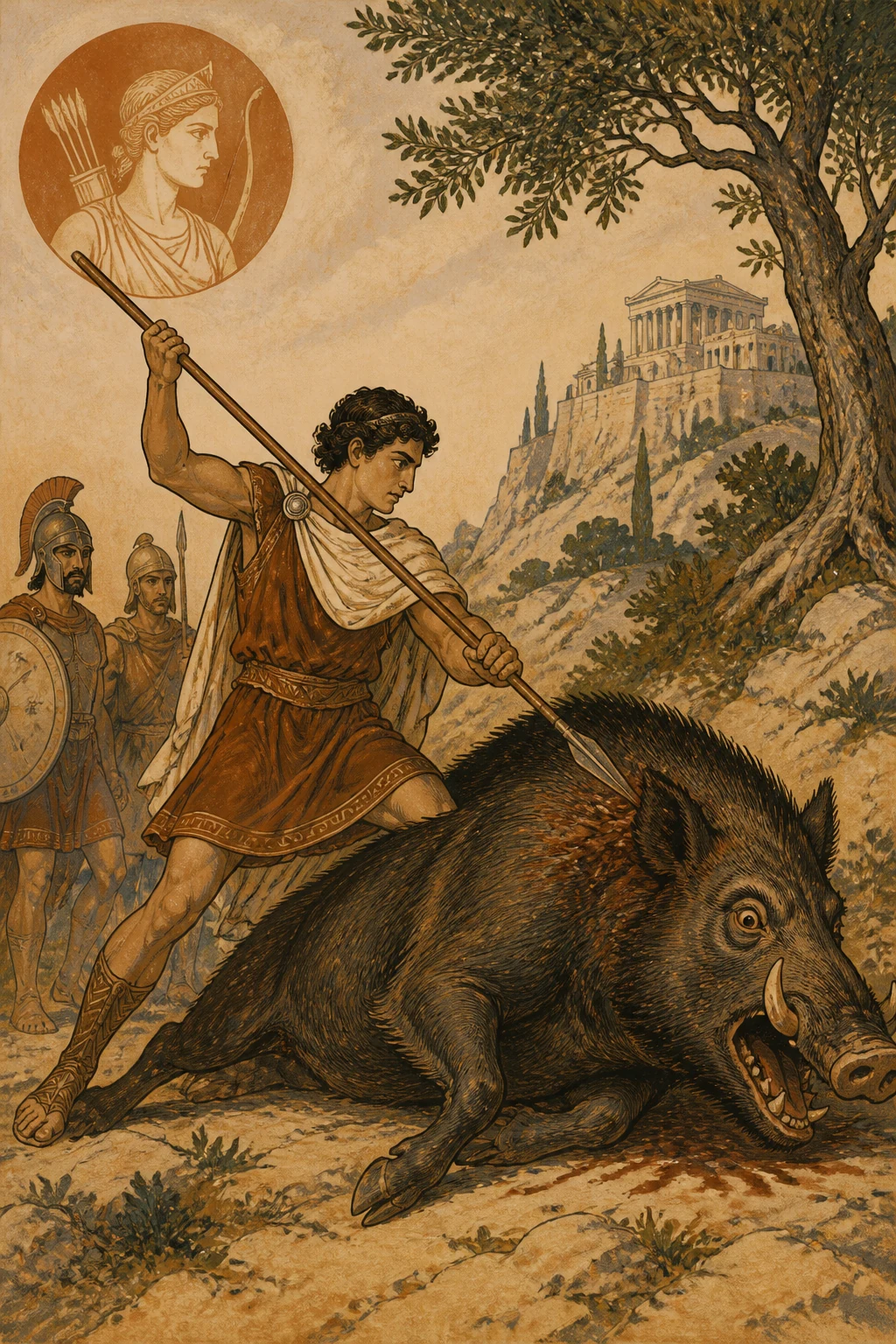
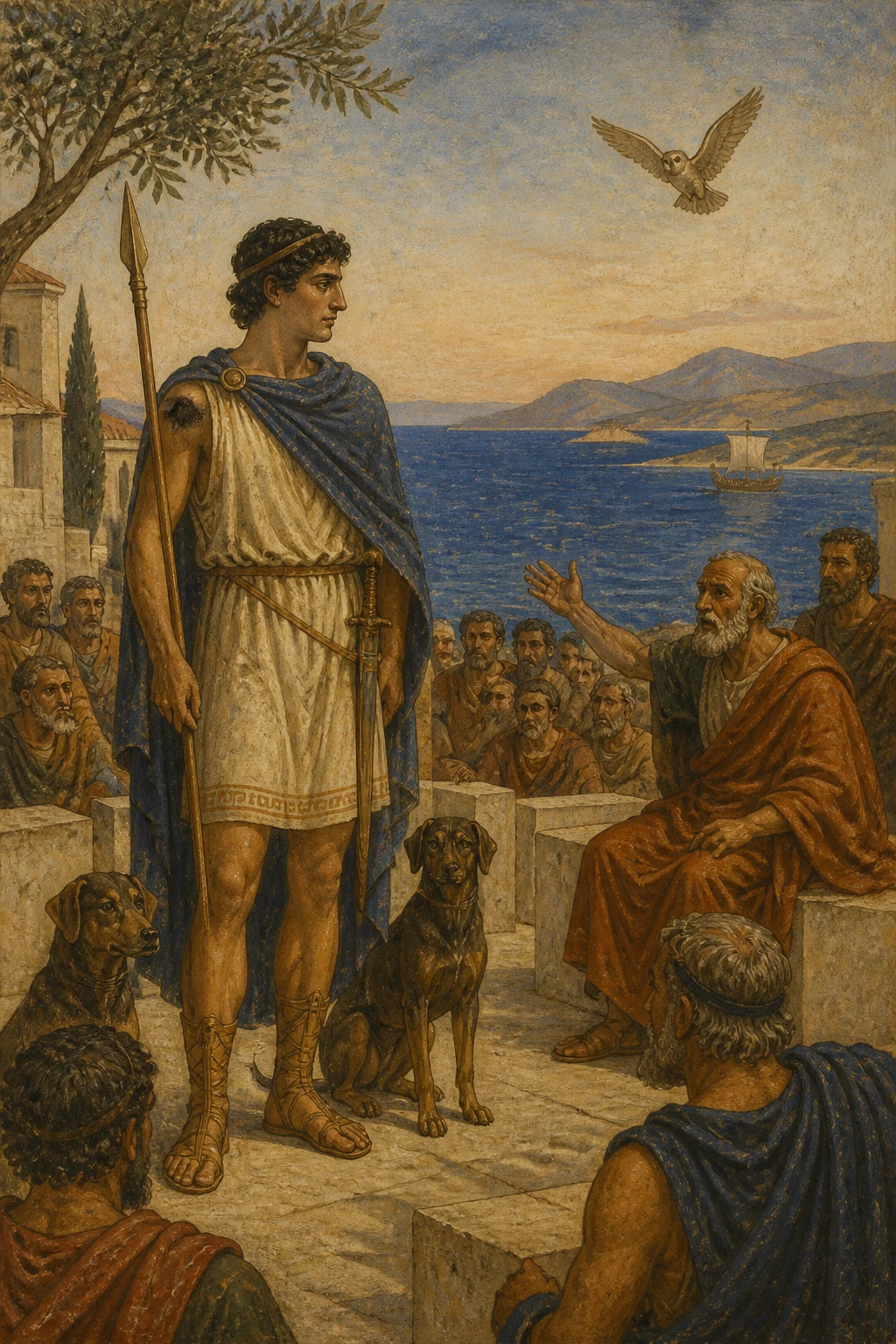
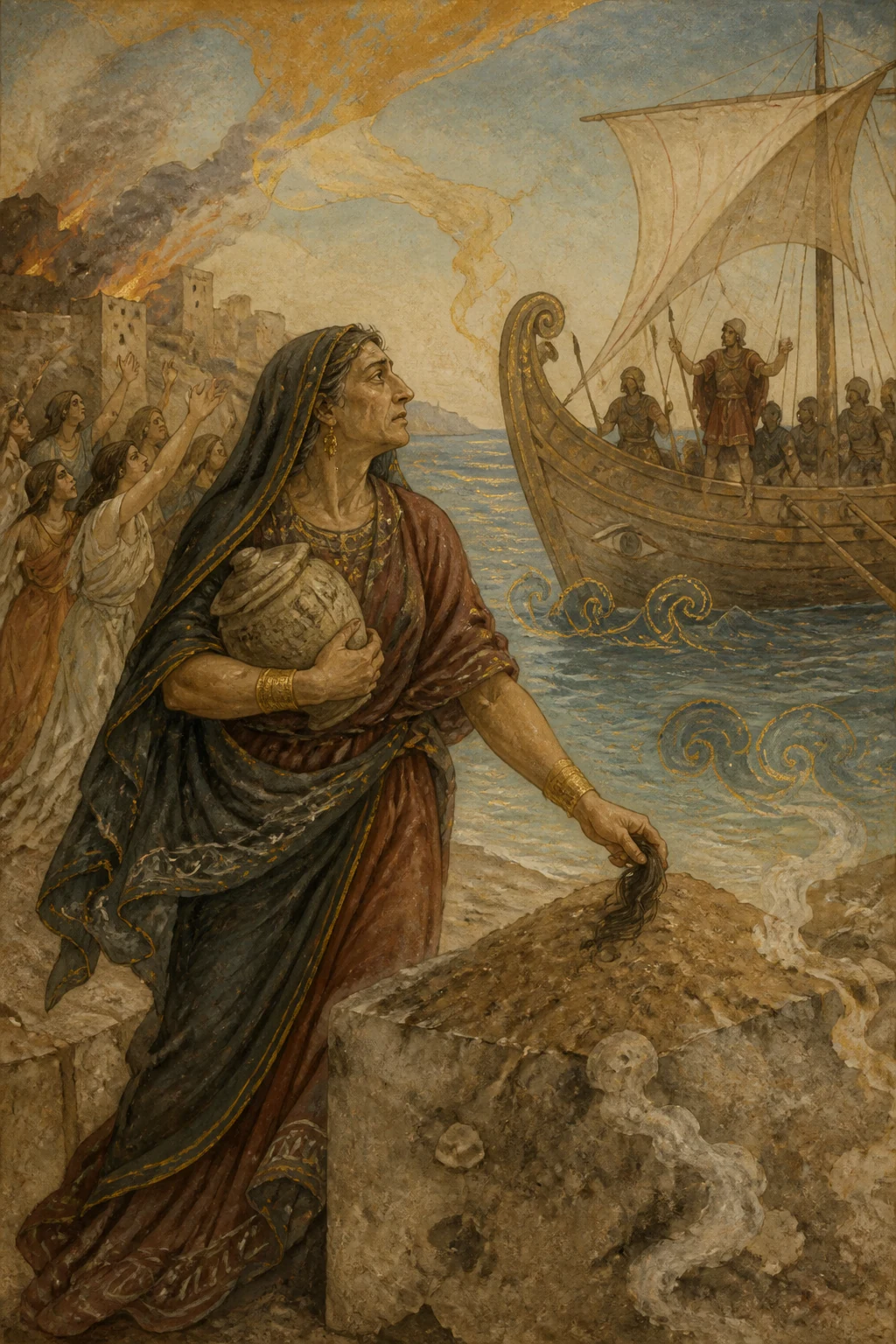
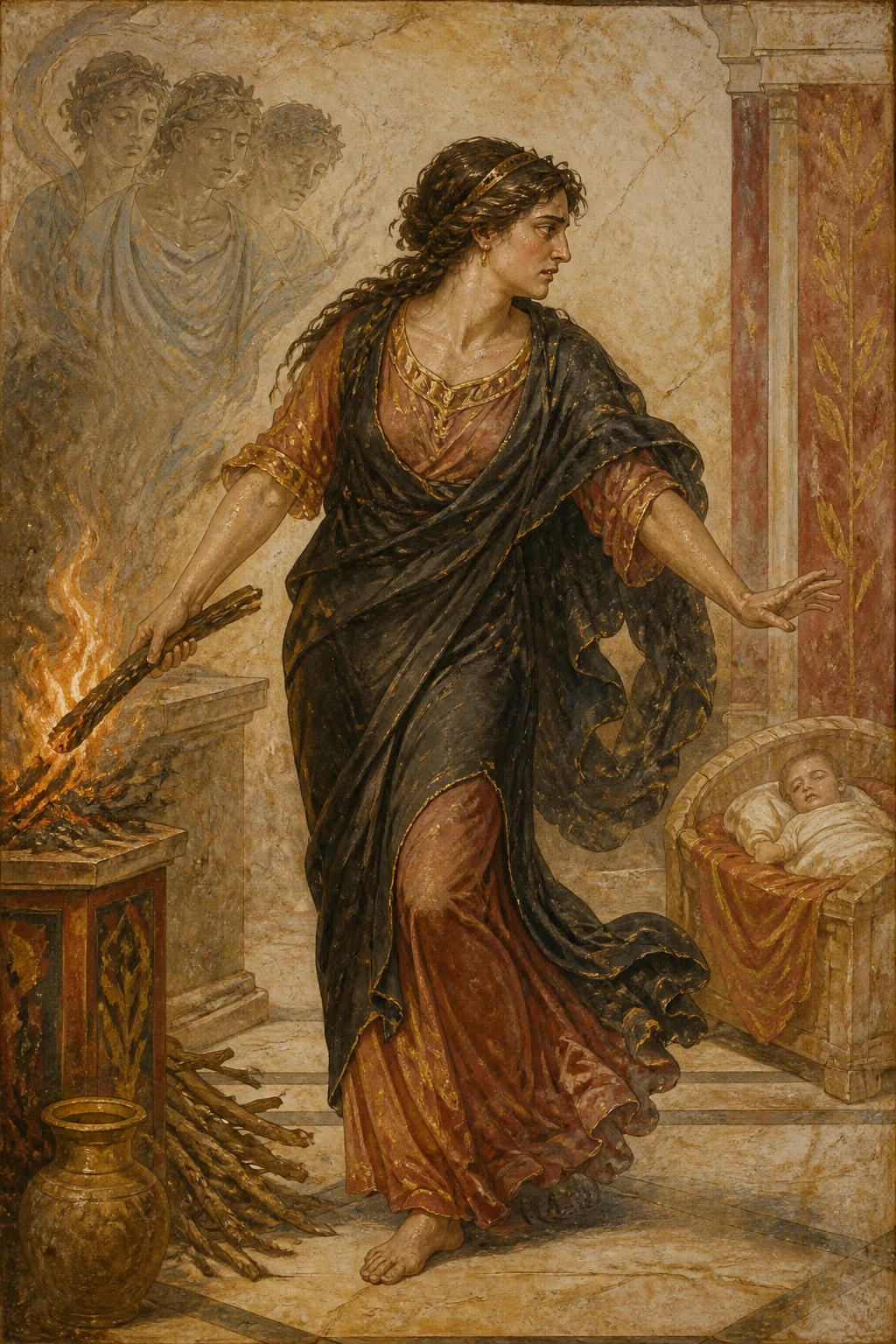
Althaea was bringing gifts to the gods’ temples for her victorious son, when she saw her dead brothers being carried home. Beating her breast, she filled the city with cries of grief and exchanged her golden robes for black. But once she learned who had killed them, all her mourning fell away, and her tears turned to a thirst for vengeance. There was a log which, as Thestius’s daughter lay newly delivered of her child, the three sisters had placed in the fire; and spinning the threads of fate beneath their pressing thumbs, they said, “We grant the same span of life to this wood and to you, newborn child.” When the goddesses had spoken this decree and departed, the mother snatched
the burning branch from the fire and drenched it with water. Long it had lain hidden in the innermost rooms, and, preserved, had preserved your years, young man. Now his mother brought it out, ordered torches and splintered wood to be piled together, and set the deadly fire beneath them. Four times she tried to lay the branch upon the flames, four times she checked her hand. Mother and sister fought within her, and those two names pulled one heart in opposite directions.
Often her face grew pale with dread of the crime to come; often blazing anger flushed her eyes with its own red glow. Now her expression seemed to threaten some nameless cruelty, now it was one you might have thought capable of pity. And when the fierce heat of her heart had dried her tears, still fresh tears were found. As a ship, seized by the wind and a current running against it, feels their double force and sways uncertainly between them, so Thestius’s daughter wavered between conflicting passions, by turns laying aside her anger and rousing it again.
Yet she began to be a better sister than a mother, and, to appease her kindred’s shades with blood, she made a crime of duty. For when the deadly fire burned strong, she said, “Let this pyre consume my own flesh.” And holding the fatal wood in her ruthless hand, the unhappy woman stood before the funeral altar. “Threefold goddesses of punishment,” she said, “Eumenides, turn your faces towards this sacrifice of fury.
I take revenge and commit a crime: death must atone for death, crime must be added to crime, funeral to funeral. Let this accursed house perish beneath its piled-up griefs. Shall Oeneus rejoice in his victorious son, while Thestius is childless? Better that you both should mourn. Only you, my brothers’ shades, souls newly dead, acknowledge this service I render you, and accept the costly offering I prepare—the ill-fated child of my womb!— Ah me! Where am I swept away? Brothers, forgive a mother.
My hands fail at the task I have begun. I admit that he deserves to die: it is his killer I cannot bear.— Shall he then go unpunished, alive and victorious, swollen with pride in his success, and rule the kingdom of Calydon, while you lie there, a little ash and chilly shades? I will not allow it. Let the wicked man perish too, and drag down his father’s hopes, his kingdom, and his country.
Where is my mother’s heart? Where are the sacred bonds of parenthood, and the ten months of hardship I endured? Oh, if only you had burned in those first flames as an infant, and I had let you! You lived by my gift; now you will die by your own deserts. Take the reward of your deed, and give back the life twice granted you—first at your birth, then when I snatched the log away—or lay me in my brothers’ tomb!
I long to do it, yet I cannot. What shall I do? Now my brothers’ wounds stand before my eyes, and the vision of that terrible slaughter; now love and the very name of mother break my resolve.— Wretched woman that I am! Yours will be an evil victory, brothers, yet prevail, so long as I myself may follow you and the solace I shall give you.” She spoke, and, turning away, with trembling hand cast the death-dealing brand into the heart of the fire.
The log itself groaned, or seemed to groan, as the reluctant flames caught it and it burned. Far away and unaware, Meleagros was scorched by that fire and felt his vitals roasting in unseen flames, yet mastered the great pain with courage. Still, he grieved to fall by a coward’s bloodless death, and called Ancaeus fortunate in his wounds. Groaning, with his last breath he called upon his aged father, his brothers, his loving sisters, and the wife who shared his bed, perhaps his mother too. The fire and the pain grew stronger, then dwindled again; together both were quenched, and little by little his spirit passed into the weightless air,
as little by little pale ash veiled the glowing ember. Lofty Calydon lay stricken: young and old mourned, commoners and nobles groaned, and the women of Calydon beside the Euenus tore their hair and beat their breasts. His father, stretched upon the ground, fouled his white hair and aged face with dust, and cursed his long life. As for his mother, her own hand, conscious of its dreadful deed, had exacted punishment by driving a sword through her body.
Not even if a god had given me a hundred mouths with sounding tongues, a mind to match, and all of Helicon, could I recount the sorrowful words of his wretched sisters. Forgetful of decorum, they beat their bruised breasts, and while his body remained, they cherished it and held it close, kissing him, kissing the bier on which he lay. When he was ash, they gathered the ashes and pressed them to their breasts, and lay prostrate upon his tomb, embracing the name carved on the stone and pouring their tears upon it.
At last Leto’s daughter, sated with the ruin of Parthaon’s house, raised them up—all but Gorge and noble Alcmene’s daughter-in-law—with feathers sprouting on their bodies, stretched long wings along their arms, made their mouths into horny beaks, and sent them transformed through the air.
Izvirnik
Meleager and Althaea
Naslednje strani prikazujejo izvirno besedilo za primerjavo.
Source ID: ovid_metamorphoses_story_056 Citation: Ovid, Metamorphoses 8.445-8.546 Original language: Latin Source: PerseusDL canonical-latinLit Source URL: https://github.com/PerseusDL/canonical-latinLit/blob/master/data/phi0959/phi006/phi0959.phi006.perseus-lat2.xml Segmentation certainty: medium 445: Dona deum templis nato victore ferebat, 446: cum videt exstinctos fratres Althaea referri.
447: Quae plangore dato maestis clamoribus urbem 448: implet et auratis mutavit vestibus atras. 449: At simul est auctor necis editus, excidit omnis 450: luctus et a lacrimis in poenae versus amorem est. 451: Stipes erat, quem, cum partus enixa iaceret 452: Thestias, in flammam triplices posuere sorores; 453: staminaque impresso fatalia pollice nentes 454: “tempora” dixerunt “eadem lignoque tibique, 455: o modo nate, damus.” Quo postquam carmine dicto 456: excessere deae, flagrantem mater ab igne 457: eripuit ramum sparsitque liquentibus undis.
458: Ille diu fuerat penetralibus abditus imis 459: servatusque tuos, iuvenis, servaverat annos. 460: Protulit hunc genetrix taedasque et fragmina poni 461: imperat et positis inimicos admovet ignes. 462: Tum conata quater flammis imponere ramum, 463: coepta quater tenuit. Pugnant materque sororque, 464: et diversa trahunt unum duo nomina pectus. 465: Saepe metu sceleris pallebant ora futuri, 466: saepe suum fervens oculis dabat ira ruborem.
467: Et modo nescio quid similis crudele minanti 468: vultus erat, modo quem misereri credere posses. 469: Cumque ferus lacrimas animi siccaverat ardor, 470: inveniebantur lacrimae tamen. Utque carina, 471: quam ventus ventoque rapit contrarius aestus, 472: vim geminam sentit paretque incerta duobus: 473: Thestias haud aliter dubiis adfectibus errat 474: inque vices ponit positamque resuscitat iram.
475: Incipit esse tamen melior germana parente, 476: et consanguineas ut sanguine leniat umbras, 477: impietate pia est. Nam postquam pestifer ignis 478: convaluit, “rogus iste cremet mea viscera” dixit. 479: Utque manu dira lignum fatale tenebat, 480: ante sepulcrales infelix adstitit aras 481: “poenarum” que “deae triplices, furialibus,” inquit, 482: “Eumenides, sacris vultus advertite vestros.
483: Ulciscor facioque nefas: mors morte pianda est, 484: in scelus addendum scelus est, in funera funus. 485: Per coacervatos pereat domus impia luctus. 486: An felix Oeneus nato victore fruetur, 487: Thestius orbus erit? Melius lugebitis ambo. 488: Vos modo, fraterni manes animaeque recentes, 489: officium sentite meum magnoque paratas 490: accipite inferias, uteri mala pignera nostri! — 491: Ei mihi! quo rapior? Fratres, ignoscite matri.
492: Deficiunt ad coepta manus. Meruisse fatemur 493: illum, cur pereat: mortis mihi displicet auctor. — 494: Ergo impune feret, vivusque et victor et ipso 495: successu tumidus regnum Calydonis habebit: 496: vos cinis exiguus gelidaeque iacebitis umbrae? 497: Haud equidem patiar. Pereat sceleratus et ille 498: spemque patris regnumque trahat patriaeque ruinam. 499: Mens ubi materna est? Ubi sunt pia iura parentum 500: et quos sustinui bis mensum quinque labores?
501: O utinam primis arsisses ignibus infans, 502: idque ego passa forem! Vixisti munere nostro: 503: nunc merito moriere tuo. Cape praemia facti 504: bisque datam, primum partu, mox stipite rapto, 505: redde animam — vel me fraternis adde sepulcris! 506: Et cupio et nequeo. Quid agam? modo vulnera fratrum 507: ante oculos mihi sunt et tantae caedis imago, 508: nunc animum pietas maternaque nomina frangunt. — 509: Me miseram! male vincetis, sed vincite, fratres: 510: dummodo quae dedero vobis solacia vosque 511: ipsa sequar.” Dixit, dextraque aversa trementi 512: funereum torrem medios coniecit in ignes.
513: Aut dedit aut visus gemitus est ipse dedisse 514: stipes, ut invitis correptus ab ignibus arsit. 515: Inscius atque absens flamma Meleagros ab illa 516: uritur et caecis torreri viscera sentit 517: ignibus ac magnos superat virtute dolores. 518: Quod tamen ignavo cadat et sine sanguine leto, 519: maeret et Ancaei felicia vulnera dicit 520: grandaevumque patrem fratresque piasque sorores 521: cum gemitu sociamque tori vocat ore supremo, 522: forsitan et matrem. Crescunt ignisque dolorque 523: languescuntque iterum: simul est exstinctus uterque, 524: inque leves abiit paulatim spiritus auras
525: paulatim cana prunam velante favilla. 526: Alta iacet Calydon: lugent iuvenesque senesque, 527: vulgusque proceresque gemunt, scissaeque capillos 528: planguntur matres Calydonides Eueninae. 529: Pulvere canitiem genitor vultusque seniles 530: foedat humi fusus spatiosumque increpat aevum. 531: Nam de matre manus diri sibi conscia facti 532: exegit poenas acto per viscera ferro.
533: Non mihi si centum deus ora sonantia linguis 534: ingeniumque capax totumque Helicona dedisset, 535: tristia persequerer miserarum dicta sororum. 536: Inmemores decoris liventia pectora tundunt, 537: dumque manet corpus, corpus refoventque foventque, 538: oscula dant ipsi, posito dant oscula lecto. 539: Post cinerem cineres haustos ad pectora pressant, 540: adfusaeque iacent tumulo signataque saxo 541: nomina complexae lacrimas in nomina fundunt.
542: Quas Parthaoniae tandem Latonia clade 543: exsatiata domus praeter Gorgenque nurumque 544: nobilis Alcmenae natis in corpore pennis 545: adlevat et longas per bracchia porrigit alas 546: corneaque ora facit versasque per aera mittit.
Nadaljuj z branjem