Prevod
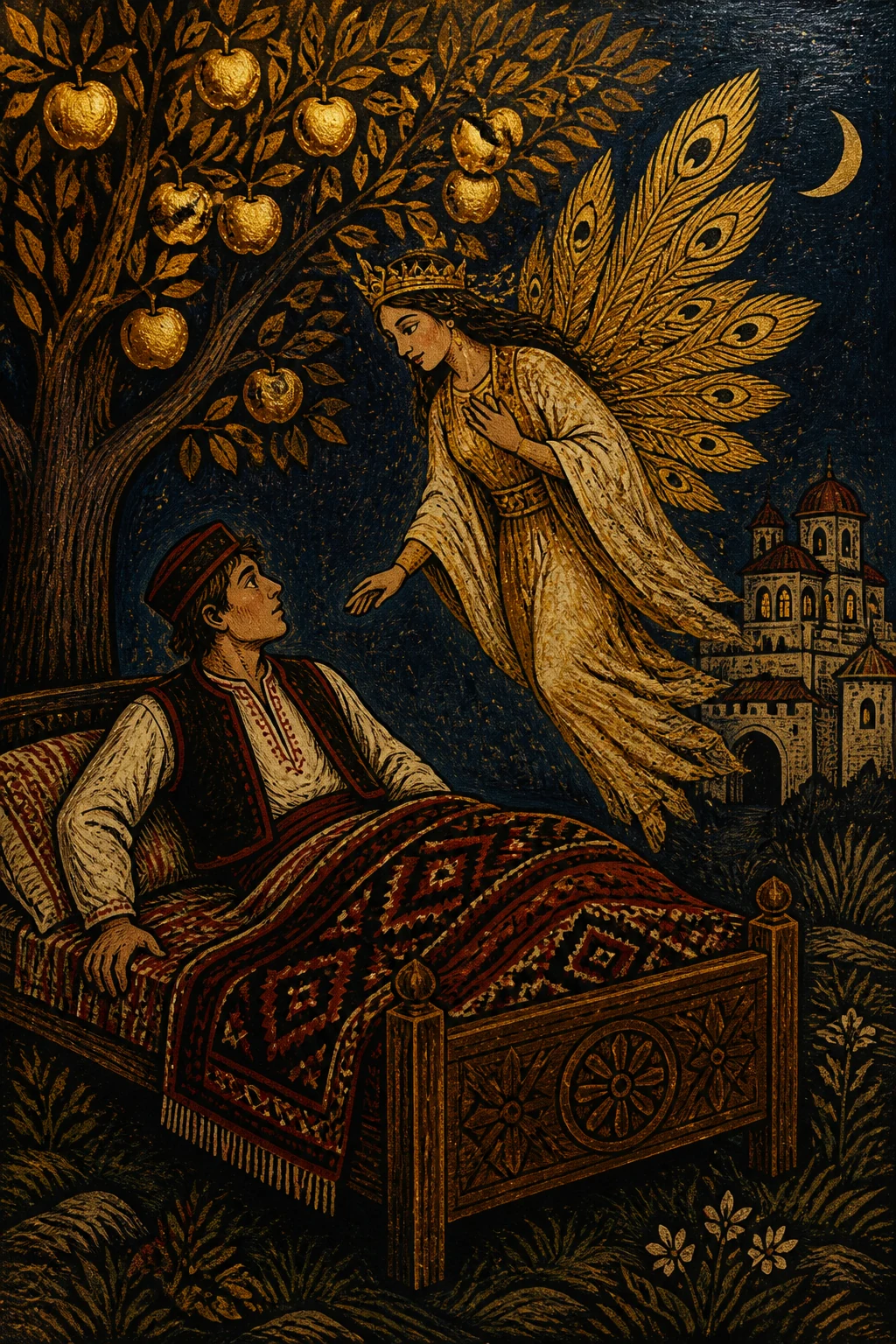
Once upon a time, as there never was before, there lived an emperor who had three daughters. When the time came for him to go to war, he called his daughters to him and said, “My dear girls, I must go to battle. An enemy has risen against us with a mighty army. It grieves me sorely to part from you. While I am away, be sensible, behave yourselves, and see to the affairs of the household. You may walk in the garden and enter every room in the palace; only do not go into the room at the back, in the right-hand corner, or no good will come of it.” “Rest easy, Father,” they answered. “We have never disobeyed you. Go without a care, and may God grant you a glorious victory.” When everything was ready for his departure, the emperor gave them the keys to all the rooms, reminded them once more of his counsel, and bade them farewell. With tears in their eyes, his daughters kissed his hand and wished him victory, and the eldest took the keys from him. When the girls found themselves alone, they scarcely knew what to do for sorrow and loneliness. To pass the time, they decided to spend part of each day working, part reading, and part walking in the garden. They did so, and all went well. But the Evil One begrudged the girls their peace and began to meddle. “My sisters,” said the eldest, “all day long we spin, sew, and read. We have been alone for several days now, and there is not a corner of the garden where we have not walked. We have been into every room in our father’s palace and seen how richly and beautifully they are furnished. Why should we not go into that room too, the one Father forbade us to enter?” “Heaven help us, Sister!” said the youngest. “How could such a thought enter your head, that you should urge us to disobey our father? If Father told us not to go in there, he must have known what he was saying and why he wished us to obey.” “Well, we shan’t tear a hole in heaven by going in,” said the middle sister. “Surely there are no dragons in there to eat us, or any other beasts. Besides, how will Father ever know whether we have been in or not?” Talking in this way and egging one another on, they came to the very door of the room. The eldest sister, who kept the keys, put one into the lock and turned it, and the door creaked open. The girls went in. And what should they see? The room had no ornaments at all, but in the middle stood a large table covered with a costly carpet, and on it lay a great open book. Impatient to know what the book said, the eldest stepped forward and read: “The eldest daughter of this emperor shall marry an emperor’s son from the east.” The middle sister went up, turned the page, and read in her turn: “The middle daughter of this emperor shall marry an emperor’s son from the west.” The girls laughed and rejoiced, giggling and teasing one another. The youngest, however, did not want to go near it. Her elder sisters would not leave her alone, but brought her to the table whether she wished it or not. Full of misgivings, she too turned the page and read: “The youngest daughter of this emperor shall be taken to wife by a pig.” Had a thunderbolt fallen from the sky, it could not have struck her more cruelly than those words. She nearly died of grief. If her sisters had not caught her, she would have split her head as she fell. When she recovered from the swoon into which her anguish had thrown her, her sisters began to comfort her. “What!” they said. “Do you really believe all that? Whoever heard of an emperor’s daughter marrying a pig?” “What a child you are!” said the other. “Hasn’t Father soldiers enough to save you, even if so loathsome a beast should come to ask for your hand?” The emperor’s youngest daughter would gladly have believed what her sisters told her, but her heart would not let her. Her thoughts kept returning to the book, which had promised her sisters such splendid fortunes, while for her alone it foretold something never before heard of in the world. And then her disobedience to their father gnawed at her heart. She began to pine. In only a few days she changed beyond recognition: once rosy and cheerful, she grew wan and withered, and nothing pleased her. She no longer cared to play with her sisters in the garden, to gather flowers for her hair, or to sing with them as they spun or sewed. Meanwhile, the girls’ father, the emperor, had won a victory greater than he had hoped, defeating his enemies and driving them away. As his thoughts were always with his daughters, he arranged matters so that he could return home sooner. Crowds upon crowds came out to meet him with horns, drums, and pipes, rejoicing at the emperor’s victorious return. Before going home, he first gave thanks to the Lord for helping him overcome the enemies who had risen against him. Then he went to the palace, where his daughters came out to greet him. His joy grew when he saw them safe and well. The youngest did all she could to hide her sadness. Even so, before long the emperor noticed that she was growing thinner and more downcast by the day. A burning iron seemed to pierce his heart at the thought that perhaps they had disobeyed him. And how could it be otherwise? To make certain, he summoned his daughters and questioned them, commanding them to tell the truth. They confessed, but took care not to say which of them had urged the others on. When the emperor heard what had happened, he lamented bitterly to himself and was almost overcome with grief. Yet he mastered himself and tried to comfort the daughter whom he could see wasting away. What was done was done, and he knew that a thousand words would not now be worth a penny. The affair was beginning to fade from their minds when, one day, the son of an emperor from the east appeared before him and asked for the eldest daughter’s hand. The emperor gladly gave her to him. They held a magnificent wedding, and after three days he sent her on her way with great honor, escorting her to the borders of his realm. Before long he did the same for his middle daughter, whose hand had been sought by an emperor’s son from the west. The more closely the words of the book came true, the more sorrowful the youngest daughter became. She would no longer eat, dress herself finely, or go out walking. Rather than become the laughingstock of the world, she wished to let herself die. But the emperor gave her no opportunity to carry out so sinful a deed, comforting her with every kind of counsel. Some time passed, and then, one day, lo and behold, a great pig came into the emperor’s palace and said, “Health to you, Emperor! May you be rosy and cheerful as the rising sun on a cloudless day.” “Welcome, friend, and may you be well. But what wind brings you here?” “I have come to ask for a bride,” answered the pig. The emperor marveled to hear such fine words from a pig and at once suspected that there was something uncanny in all this. He would have liked to find some way to avoid giving him his daughter, but when he heard that the courtyard and the streets were swarming with pigs who had accompanied the suitor, he had no choice but to promise her to him. The pig was not content with a promise alone: he entered into discussions and settled that the wedding should take place in a week. Only after securing the emperor’s word did he leave. In the meantime, the emperor counseled his daughter to submit to her fate, if that was God’s will. Then he said, “My daughter, this pig’s speech and wise behavior are not those of a beast. I would stake my life that he was not born a pig. There must be some enchantment or other devilry at work here. But you must be obedient and do as he says, for God will not leave you to suffer long.” “If you think this is right, Father,” answered the girl, “I shall obey you and put my hope in God. Let Him do with me as He wills. Such is the fate allotted to me; I see that I cannot escape it.” At last the wedding day arrived. The marriage was performed rather secretly. Then the pig and his wife got into an imperial carriage and set off for his home. On the way they had to pass a great patch of mud. The pig ordered the carriage to stop, climbed down, and rolled in the mire until he was covered in filth. Then he got back in and told his bride to kiss him. What could the poor girl do? She took out her handkerchief, wiped his snout a little, and kissed him, remembering to follow her father’s advice. By the time they reached the pig’s home in a great forest, evening had fallen. They rested a little after their journey, ate supper together, and went to bed. During the night, the emperor’s daughter felt that it was a man lying beside her, not a pig. She was astonished, but remembered her father’s words and began to take heart, full of hope in God’s help. In the evening the pig slipped out of his pigskin without the girl noticing, and in the morning, before she woke, he put it on again. One night passed, then two, then many more, and the girl could not understand how her husband could be a pig by day and a man by night. For he was under an enchantment, bewitched to live in this way. In time she began to love him, and she felt the fruit of their marriage stirring within her. Only one thing troubled her: she did not know what sort of child she would bring into the world in a few months’ time. Then one day she saw an old woman passing by, who was a witch. Having seen no other human being for so long, she longed for company and called the old woman over to talk. The witch said that she could tell fortunes, give remedies, and do all manner of wonders. “May you live long, good old mother,” said the girl. “Tell me, I beg you, what is wrong with my husband, that he is a pig by day, yet at night, when he sleeps beside me, I feel that he is a man?” “What you tell me, my little chick, I was just about to tell you myself. They do not call me a fortune-teller for nothing. Let your old mother give you a remedy to break his spell.” “Then give it to me, dear little mother, and I shall pay whatever you ask, for I can no longer bear to see him so.” “Here, my little darling, take this thread. He must know nothing about it, or it will have no power. Get up very quietly when he is asleep and tie it around his left leg as tightly as you can. You will see, my dear, that in the morning he will remain a man. I want no money. I shall be paid well enough when I hear that you have escaped such a curse. My heartstrings are breaking with pity for you, my little flower, and I grieve and grieve that I did not hear of this sooner, so that I might have come to your aid.” When the wicked old witch had gone, the emperor’s daughter carefully hid the thread. That night she rose so softly that not even the fairy birds could have heard her, and with her heart pounding she tied the thread around her husband’s leg. But as she pulled the knot tight—snap! The thread broke, for it was rotten. Her husband woke with a start and cried, “What have you done, unhappy woman! I had only three days left before I was free of this filthy enchantment. Now who knows how much longer I must wear this loathsome beast’s skin? And you will find me again only when you have worn out three pairs of iron shoes and an iron staff in searching for me, for I am going away.” With that, he vanished. When the poor emperor’s daughter found herself utterly alone, she began to weep and wail so bitterly that it would have broken your heart. She heaped fiery curses on the accursed fortune-teller, but all in vain. Seeing that lamentation would get her nowhere, she rose and set out wherever God’s mercy and her longing for her husband might lead her. When she reached a town, she ordered three pairs of iron shoes and a steel staff, made ready for the road, and began her journey in search of him. On and on she went, across nine seas and nine lands, through great forests whose tree trunks were as thick as vats. She stumbled over fallen trees, and as often as she fell, she rose again. Branches struck her face and thickets scratched her hands, but she kept going forward and never looked back. At last, weary from her journey and her pregnancy, bowed down by sorrow yet still hopeful at heart, she came to a house. This was where the Holy Moon lived. She knocked at the little gate and begged to be allowed inside to rest a while, all the more urgently because her labor pains had begun. The Holy Moon’s mother took pity on her suffering, brought her in, and cared for her. Then she asked, “How can a mortal from another realm have made her way as far as this?” The poor emperor’s daughter told her everything that had happened and ended by saying, “First I thank God for guiding my steps to this place, and then I thank you for not leaving me to perish in childbirth. Now I beg you to tell me whether your daughter, the Holy Moon, might know where my husband is.” “She cannot know, my dear,” answered the Holy Moon’s mother. “But go eastward until you reach the Holy Sun. Perhaps he may know something.” She gave her a roast chicken to eat and told her to take care not to lose a single bone, for they would be of great use to her. After thanking her once more for her kind hospitality and helpful counsel, the girl cast off one pair of iron shoes, which had worn through, and put on another. She tied the chicken bones in a bundle, took her child in her arms and her staff in her hand, and set out again. On and on she walked, across plains of nothing but sand. The going was so hard that for every two steps forward she slipped one step back. She struggled and struggled until she was through the sandy wastes, then crossed jagged, hollowed-out mountains, leaping from boulder to boulder and crag to crag. Whenever she reached a level stretch of mountainside, she felt as though she had caught God Himself by the foot. After resting a little, she would set off once more, always pressing onward. The sharp stones and flinty peaks scraped her feet, knees, and elbows until they were covered in blood, for I must tell you that those mountains rose higher than the clouds. Where there were no chasms for her to leap, she could only crawl upward on her hands, helping herself along with her staff. At last, utterly exhausted, she reached a palace. This was where the Sun lived. She knocked at the gate and begged to be admitted. The Sun’s mother welcomed her, amazed to see a mortal from another realm in that place, and wept with pity when she heard her story. Then, promising to ask her son about the girl’s husband, she hid her in the cellar so that the Sun would not sense her presence when he came home, for he always returned in an ill temper in the evening. The next day the emperor’s daughter learned that she had nearly been eaten, for the Sun had caught the scent of a human being from the other world. But his mother had soothed him with kind words, telling him he was imagining things. Encouraged by the kindness with which she was treated, the girl asked, “But tell me, dear mother, how can the Sun be unhappy, when he is so beautiful and does so much good for mortals?” “This is why,” answered the Sun’s mother. “In the morning he stands at the gates of heaven, and then he is joyful, joyful, and smiles upon the whole world. During the day he is full of disgust, because he sees all the wickedness of humankind, and that is why he sends down such scorching heat. In the evening he is sorrowful and angry, because he stands at the gates of hell. That is his accustomed path, and from there he comes home.” She also told the girl that she had asked about her husband, but her son had answered that he knew nothing of him. For if he lived in a great, dense forest, the Sun’s gaze could not penetrate every hidden corner and hollow. Her only hope, he had said, was to go to the Wind. There too she was given a chicken to eat and told to keep its bones with care. She cast off her second pair of iron shoes, for those too had worn through, took the bundle of bones, her child in her arms and her staff in her hand, and set out toward the Wind. On this journey she met with still greater hardships, for one after another she came upon mountains of flint from which flames burst forth, forests where no foot had ever trodden, and fields of ice heaped with snowdrifts. The poor woman nearly perished. Yet through perseverance and God’s help she overcame these great difficulties too and reached a hollow
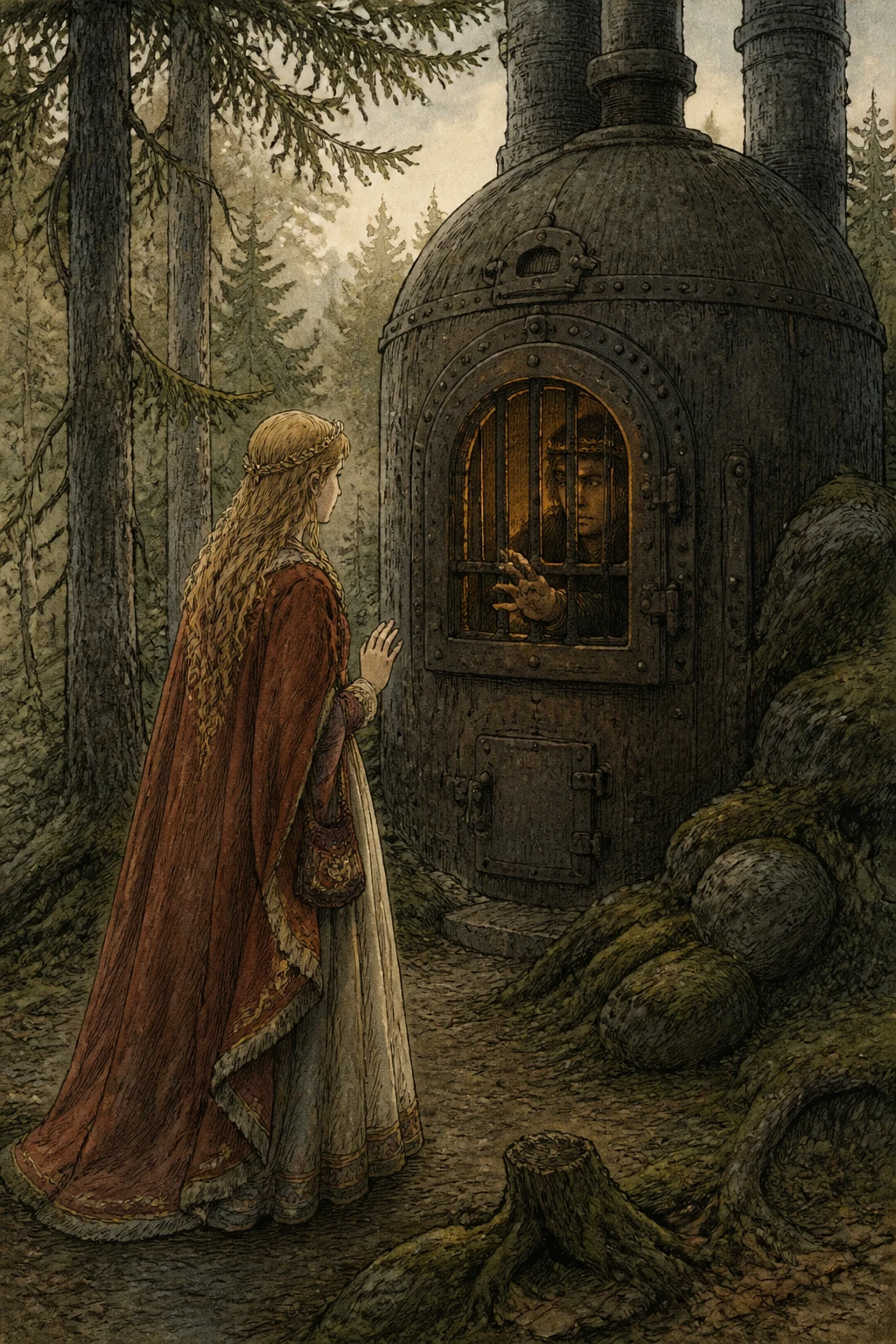
in the flank of a mountain, so vast that seven cities could have fitted inside it. This was where the Wind lived. The fence around it had a little gate. She knocked and begged to be admitted. The Wind’s mother took pity on her and let her in to rest. As at the Sun’s house, she was hidden so that the Wind would not sense her presence. The next day his mother told her that her husband lived in a great, thick forest where no axe had ever reached. There he had built himself a kind of house by piling logs one upon another and weaving branches between them, and there he lived all alone for fear of wicked people. After giving her a chicken to eat and telling her to keep the bones, the Wind’s mother advised her to follow the Slaves’ Road, which can be seen across the sky at night, and to keep going until she arrived. And so she did. With tears of joy she thanked her hostess for her kindness and the good news, then set out. The poor woman turned night into day. She no longer cared about food or rest, so fiercely did she long to find the husband fate had given her. On and on she walked until these shoes too wore through. She cast them off and went barefoot. She paid no heed to the sharp stones, the thorns piercing her feet, or the blows she suffered when she stumbled over a rock. At last she reached a lovely green clearing at the edge of a forest. Her heart grew a little lighter at the sight of the flowers and the soft grass. She stopped and rested a while. Then, seeing the little birds sitting in pairs on the branches, she burned with longing for her husband and began to weep bitterly. With her child in her arms and the bundle of bones over her shoulder, she set off into the forest. She took no notice of the lovely green grass caressing her feet, would not listen to the birds whose chirping filled the air, and paid no heed to the flowers hiding in the thickets, but went feeling her way through the woods. From the signs the Wind’s mother had given her, she knew that this must be the forest where her husband lived. For three days and three nights she wandered blindly through it, finding nothing. So utterly worn out was she that she fell and lay where she had fallen for a day and a night, without moving, without eating or drinking anything. At last she gathered all her strength and rose, swaying, and tried to walk with the help of her staff. But that was impossible, for it too had worn down until it was of no use at all. Yet out of pity for the child, who could no longer find milk at her breast, and longing for the husband she sought with faith in God, she struggled onward as best she could. She had scarcely gone ten paces when, beside a thicket, she caught sight of a house just like the one the Wind’s mother had described. She made her way toward it and barely managed to reach it. The house had neither windows nor a door. Its entrance, it seemed, was up above. She walked all around it, but there was no ladder. What was she to do? She wanted to get inside. She thought and thought again, and tried to climb up, but in vain. Despair was almost overcoming her. How could she let herself drown just as she reached the shore? Then she remembered the chicken bones she had carried so far and said to herself, “Surely I was not told to keep these bones for no reason, but because they would help me in my hour of need.” She took them out of the bundle, considered a little, thought a little more, and put two of the bones end to end. To her wonder, they stuck together. She added another, and then another, and saw that those too held fast. So she made two poles of bones as tall as the house. She leaned them against the wall a royal handspan apart. Then she joined more bones end to end to make little bars, which she laid crosswise between the long poles to form the rungs of a ladder. As she set each rung in place, it too held fast. Thus she went on, one by one, all the way up. As she put a rung in place, she climbed onto it; then she added another, and another, until she reached the top. But just at the very top of the ladder, she had not enough bones left for one last rung. What could she do? She could not manage without it. It seemed she had lost one little bone. She could not stay where she was, and she could not bear to give up entering the house. So she cut off her little finger, and as soon as she set it in place, it held fast. She took her child in her arms, climbed up once more, and entered the house. There she marveled at how neatly everything was arranged. She set about tidying a little herself. Then she caught her breath, laid the child in a wooden trough she found there, and placed it on the bed. When her husband came home, he was frightened by what he saw. He could scarcely believe his eyes as he gazed at the ladder of bones and the finger at its top. He feared that some new enchantment was at work and very nearly abandoned his house. But God put it into his mind to go inside. Then, turning himself into a dove so that no spell could take hold of him, he flew up without touching the ladder and slipped quietly into the house. There he saw a woman tending a child. He remembered then that his wife had been with child when he left her, and such longing for her and such pity swept over him, as he thought of all she must have endured before finding him, that he became a man again at once. He almost failed to recognize her, so greatly had suffering and hardship changed her. The emperor’s daughter sprang to her feet when she saw him, her heart pounding with fear, for she did not know who he was. But once he made himself known, she regretted nothing and forgot all she had suffered. He was a man as handsome and straight as a fir tree. They sat down to talk. She told him all her adventures, and he wept with pity for her. Then he began his own story. “I am an emperor’s son,” he said. “My father once went to war against some dragons, neighbors of his, who were very wicked and kept invading his lands. In that war I killed the youngest of them. As it happened, you had been promised to him by fate. Then his mother, a witch whose spells could make even water stand still, cursed me
to wear the skin of that loathsome beast, thinking that she would keep me from marrying you. But God thwarted her, and I took you to wife. The old woman who gave you the thread to tie around my leg was she. And though I had only three days left before I escaped the curse, I was condemned to wear the pig’s foul hide for another three years. Now you have suffered for me, and I for you. Let us give thanks to the Lord and return to our parents. Without you, I had resolved to live as a hermit. That is why I chose this deserted place and built my house so that no human soul could reach me.” Then they embraced for joy and promised each other that they would both forget their past sorrows. Early the next morning they rose and set out together, going first to the emperor who was his father. When word spread that he and his wife had come, everyone wept for joy to see them. His father and mother clasped him tightly in their arms, and the celebrations lasted three days and three nights. Then they went to the emperor who was his wife’s father. He nearly went out of his mind with joy at the sight of them. He listened as they told him all that had happened. Then he said, “Did I not tell you that I could not believe the beast who asked for your hand had been born a pig? You did well to obey me, my daughter.” And because he was old and had no heir, he stepped down from his imperial throne and set them upon it. They ruled as rulers do who have passed through every kind of trial, sorrow, and hardship. And if they have not died, they are still alive to this very day, reigning in peace. And I mounted a saddle, and so on.