Prevod
A Danish mile from the capital stood an old manor house with thick walls, towers, and stepped gables. A wealthy family of high nobility lived here, though only in summer; of all the estates they owned, this was the finest and most beautiful. Outside it looked as fresh as if newly built, and inside it was cosy and comfortable. The family coat of arms was carved in stone above the gateway; lovely roses twined about the arms and the bay window, and a broad carpet of grass stretched before the house. There were red and white hawthorns, and rare flowers grew even outside the conservatory.
The family also had a skilful gardener; the flower garden, orchard, and kitchen garden were a delight to see. Adjoining them, a remnant of the manor’s original garden still survived: a few box hedges clipped into crowns and pyramids. Behind these stood two enormous old trees. They were almost always bare of leaves, and one might easily have imagined that a gale or a whirlwind had strewn them with great lumps of manure, but every lump was a bird’s nest.
From time immemorial a host of shrieking rooks and crows had nested here. It was a whole town of birds, and the birds were the gentry, the landowners, the oldest family on the estate, the true masters of the manor. The human beings down below were no concern of theirs, though they tolerated these low-walking creatures, even when they occasionally let off a gun with a bang that sent a shiver down the birds’ backbones, making every bird fly up in alarm and cry, “Caw! Caw!”
The gardener often spoke to his employers about having the old trees felled. They were unsightly, and if they were removed, the shrieking birds would probably go too and settle somewhere else. But the family would part with neither the trees nor the swarms of birds. These were something the estate could not afford to lose, something left from the old days, which ought not to be wiped out altogether.
“Those trees are the birds’ inheritance. Let them keep it, my good Larsen!” The gardener’s name was Larsen, though that is of no particular importance here. “Haven’t you scope enough for your work, dear Larsen? The whole flower garden, the greenhouses, the orchard, and the kitchen garden?”
He had indeed, and he tended, cared for, and cultivated them with zeal and skill. His employers acknowledged this, but they did not conceal from him that, when visiting other people, they often ate fruit and saw flowers that surpassed those in their own garden. This saddened the gardener, for he wished to do his best and did his best. He was good at heart and good at his work.
One day the family sent for him and told him, with the utmost graciousness and condescension, that the day before, while visiting some distinguished friends, they had been served a variety of apples and pears so juicy and delicious that they and all the other guests had expressed their admiration. The fruit was surely not native to the country, but it ought to be introduced and grown here, if the climate would allow it. They knew it had been bought in town from the leading fruiterer; the gardener must ride in and find out where these apples and pears had come from, and then order some grafting shoots.
The gardener knew the fruiterer very well, for it was to him that he sold, on the family’s behalf, the surplus fruit grown in the manor garden.
So the gardener went into town and asked the fruiterer where he had obtained these highly praised apples and pears. “They are from your own garden!” said the fruiterer, showing him both an apple and a pear, which he recognised.
How delighted the gardener was! He hurried back to his employers and told them that both the apples and the pears had come from their own garden. They could not believe it. “That is impossible, Larsen! Can you get written confirmation from the fruiterer?”
He could indeed, and he brought them a written statement. “How very remarkable!” said the family. Now great bowls of these splendid apples and pears from their own garden appeared on their table every day. Bushels and barrels of the fruit were sent to friends in town and in the country, and even abroad. It was a great pleasure! Still, they felt obliged to add that the past two summers had been unusually good for tree fruit, which had done well throughout the country.
Some time passed. One evening the family dined at court. The next day the gardener was summoned. At the royal table they had been served melons from His Majesty’s greenhouse, so juicy and delicious.
“You must go to the royal gardener, good Larsen, and get us some seeds from those exquisite melons!” “But the royal gardener got his seeds from us!” said the gardener, quite pleased.
“Then the man has known how to bring the fruit to greater perfection!” his employers replied. “Every melon was excellent!” “Then I may well be proud!” said the gardener. “I must tell you, my gracious employers, that the palace gardener has had no luck with his melons this year, and when he saw how splendidly ours were growing and tasted them, he ordered three to be sent up to the palace!”
“Larsen! Do not imagine that those were the melons from our garden!” “I believe they were!” said the gardener. He went to the palace gardener and obtained a written statement that the melons served at the royal table had come from the manor.
This was a genuine surprise to the family, and they made no secret of the story. They showed everyone the statement, and melon seeds were sent far and wide, just as the grafting shoots had been before.
Reports came back that these had taken well and borne exceptionally fine fruit, which had been named after the family’s estate, so that its name could now be read in English, German, and French.
They had never imagined such a thing. “Let us only hope the gardener does not get too high an opinion of himself!” said the family. He took it differently: now he would strive all the harder to uphold his name as one of the country’s best gardeners, and try each year to produce something outstanding in every branch of gardening. And so he did; yet he was often told that the very first fruit he had brought them, the apples and pears, had really been the best, and all the later varieties fell far short. The melons had certainly been very good, but they were quite a different kind of fruit. The strawberries might be called excellent, but they were no better than those other families had; and when the radishes failed one year, nothing was spoken of but the unfortunate radishes, and not a word of all the other good things he had produced.
It was almost as though his employers felt relieved to be able to say, “It has not worked out this year, dear Larsen!” They were quite pleased to be able to say, “It has not worked out this year!”
A couple of times a week the gardener brought fresh flowers up to the drawing room, always so tastefully arranged that the colours seemed to shine more brightly for being set together.
“You have taste, Larsen!” said the family. “It is a gift bestowed on you by Our Lord, not something you gave yourself!” One day the gardener came with a large crystal bowl containing a water-lily leaf. Upon it lay a brilliant blue flower, as large as a sunflower, with its long, thick stem in the water.
“The lotus of Hindustan!” exclaimed the family. They had never seen such a flower. By day it was placed in the sunshine, and in the evening under reflected lamplight. Everyone who saw it thought it extraordinarily beautiful and rare; even the most distinguished young lady in the land said so, and she was a princess, clever and kind-hearted.
The family made a point of honour of presenting her with the flower, and it went back to the palace with her. Now they went down into the garden to pick another of the same kind for themselves, if there was still one to be had, but none could be found. So they called the gardener and asked him where he had obtained the blue lotus.
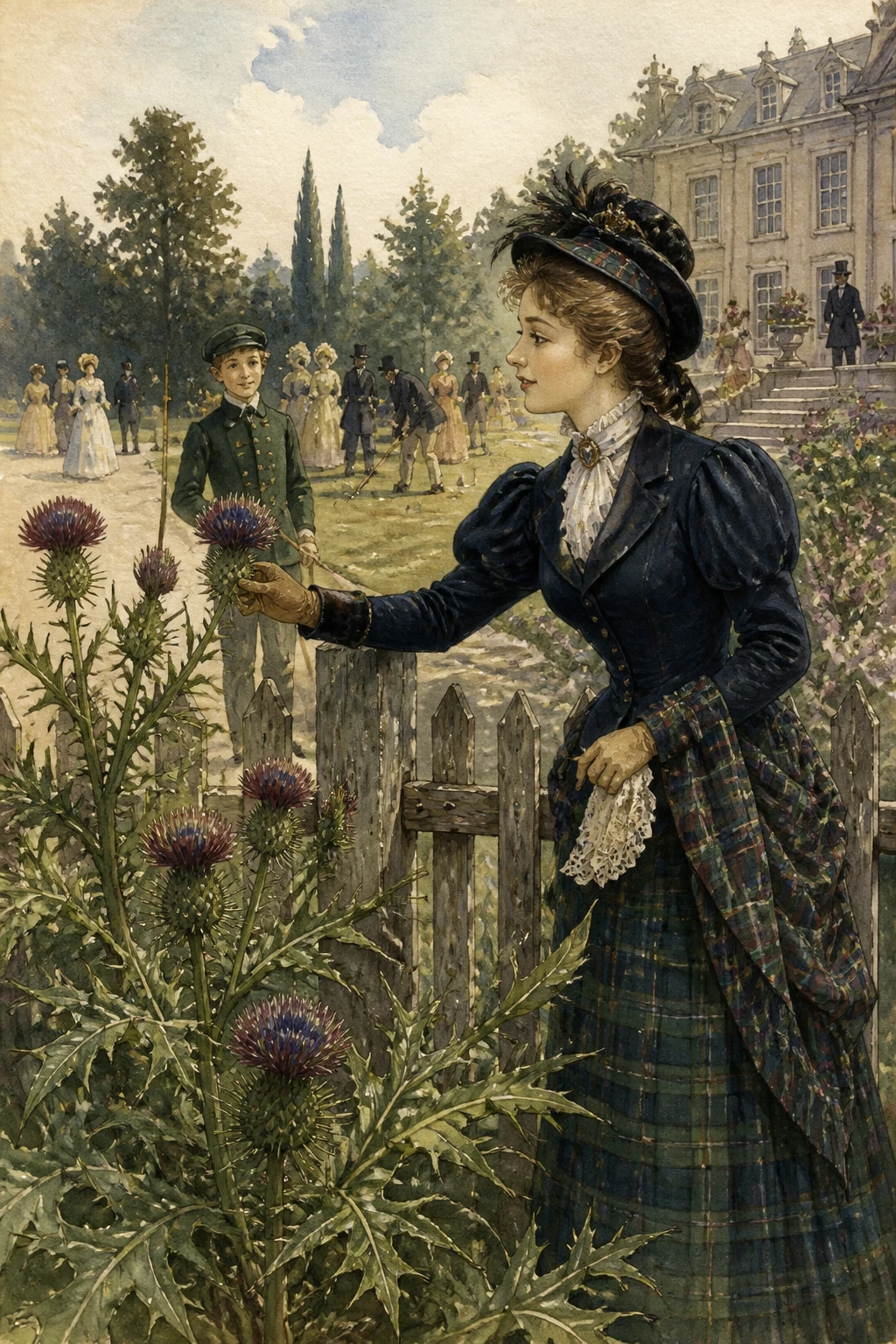
“We have searched in vain!” they said. “We have been through the greenhouses and all round the flower garden!” “No, indeed, it is not there!” said the gardener. “It is only a humble flower from the kitchen garden! But isn’t it beautiful? It looks like a blue cactus, yet it is only the blossom of an artichoke!”
“You ought to have told us that at once!” said the family. “Naturally we thought it was some rare foreign flower. You have disgraced us in the eyes of the young princess! She saw the flower here, thought it so beautiful, and did not recognise it, though she is thoroughly versed in botany; but that science has nothing to do with kitchen vegetables. How could you think of putting such a flower in the drawing room, good Larsen? You have made us ridiculous!”
And the splendid blue flower, brought from the kitchen garden, was banished from the family’s drawing room, where it did not belong. They even apologised to the princess, explaining that the flower was only a kitchen vegetable which the gardener had taken it into his head to display, but that he had been severely reprimanded for it.
“That was unkind and unjust!” said the princess. “Why, he has opened our eyes to a magnificent flower we had never noticed, and shown us beauty where we should never have thought to look for it! The palace gardener shall bring one up to my room every day, as long as the artichokes are in flower!”
And so he did. The family sent word to their gardener that he might bring them another fresh artichoke blossom. “It really is beautiful!” they said. “Most remarkable!” And the gardener was praised.
“Larsen likes that!” said the family. “He is a spoilt child!” That autumn there was a terrible storm. It grew so violent as the night wore on that many great trees on the edge of the forest were torn up by the roots. To the family’s great sorrow—sorrow, as they called it—but to the gardener’s delight, the two great trees with all the birds’ nests blew down. The servants at the manor said that the cries of rooks and crows could be heard through the storm, and that the birds beat their wings against the windowpanes.
“Well, you must be pleased now, Larsen!” said the family. “The storm has felled the trees, and the birds have gone to the forest. There is nothing left here to remind us of the old days; every trace, every suggestion of them is gone! It has saddened us!”
The gardener said nothing, but he thought of a plan he had long cherished: to make full use of that splendid sunny spot which had never before been at his disposal. It should become an ornament to the garden and a delight to his employers.
The great fallen trees had crushed and shattered the ancient box hedges with all their clipped shapes. Here he planted a dense growth of native plants from the fields and woods.
Plants that no other gardener had thought of introducing in such abundance into a manor garden he set here, each in the soil it needed, and in shade or sunshine as each kind required. He tended them lovingly, and they grew gloriously.
The juniper from the Jutland heath rose like an Italian cypress in shape and colour. The glossy, prickly holly, green alike in winter’s cold and summer’s sun, was beautiful to see. In front grew ferns of many different kinds; some looked like children of the palm tree, and others like parents of that delicate, lovely plant we call maidenhair. Here stood the despised burdock, so beautiful in its freshness that it can grace a bouquet. The burdock grew on dry ground, but lower down, in the damper soil, grew the dock, another despised plant, yet so picturesquely beautiful with its height and its mighty leaves. A mullein brought in from the fields towered a fathom high, blossom upon blossom, like a great many-branched candelabrum. Here were woodruff, cowslips, and woodland lilies of the valley, wild arum, and delicate, three-leaved wood sorrel. It was a delight to behold.
In front, trained along wires, grew a row of very small pear trees brought from French soil. They had sunshine and good care, and soon bore large, juicy fruit, just as they had in the country they came from.
In place of the two old, leafless trees a tall flagpole had been set up, from which the Dannebrog flew. Close beside it stood another pole, around which the hop vine twined in summer and autumn with its fragrant cones; but in winter, according to ancient custom, a sheaf of oats was hung there, so that the birds of the air might have a meal at merry Christmastime.
“Good Larsen is growing sentimental in his old age!” said the family. “But he is loyal and devoted to us!” At New Year, one of the capital’s illustrated papers carried a picture of the old manor. There were the flagpole and the sheaf of oats for the birds of the air at merry Christmastime, and the accompanying article singled out as a lovely thought the revival and honouring of an old custom, so particularly in keeping with the ancient manor.
“Everything Larsen does,” said the family, “is trumpeted abroad. He is a lucky man! We ought almost to be proud of having him!” But they were not proud of it at all! They felt that they were the masters; they could dismiss Larsen, but they did not. They were good people, and there are many good people of their sort, which is a fortunate thing for every Larsen.
Yes, that is the story of “The Gardener and His Employers.” Now you may think it over!