Waltey
Zgodba o Aliju Nurudinu in Marjam
Tisoč in ena noč · arabska pripovedna tradicijaO besedilu
Zgodba o Aliju Nurudinu in Marjam
- Vir
- Tisoč in ena noč
- Avtor
- arabska pripovedna tradicija
- Jezik branja
- English
- Jezik izvirnika
- Arabic
- Čas branja
- 173 min branja
- Obseg
- 139 strani
- Naslov izvirnika
- حكاية علي نور الدين ومريم - الليالي ٨٦٣ إلى ٨٩٤
O izvirniku
Tisoč in ena noč
Zgodbe v zgodbah, polne trgovcev, dvorov, preoblek in nočnih zapletov. Bralni jezik je English, izvirnik pa prihaja iz vira Tisoč in ena noč v jeziku Arabic.
Besedilo
Zgodba o Aliju Nurudinu in Marjam
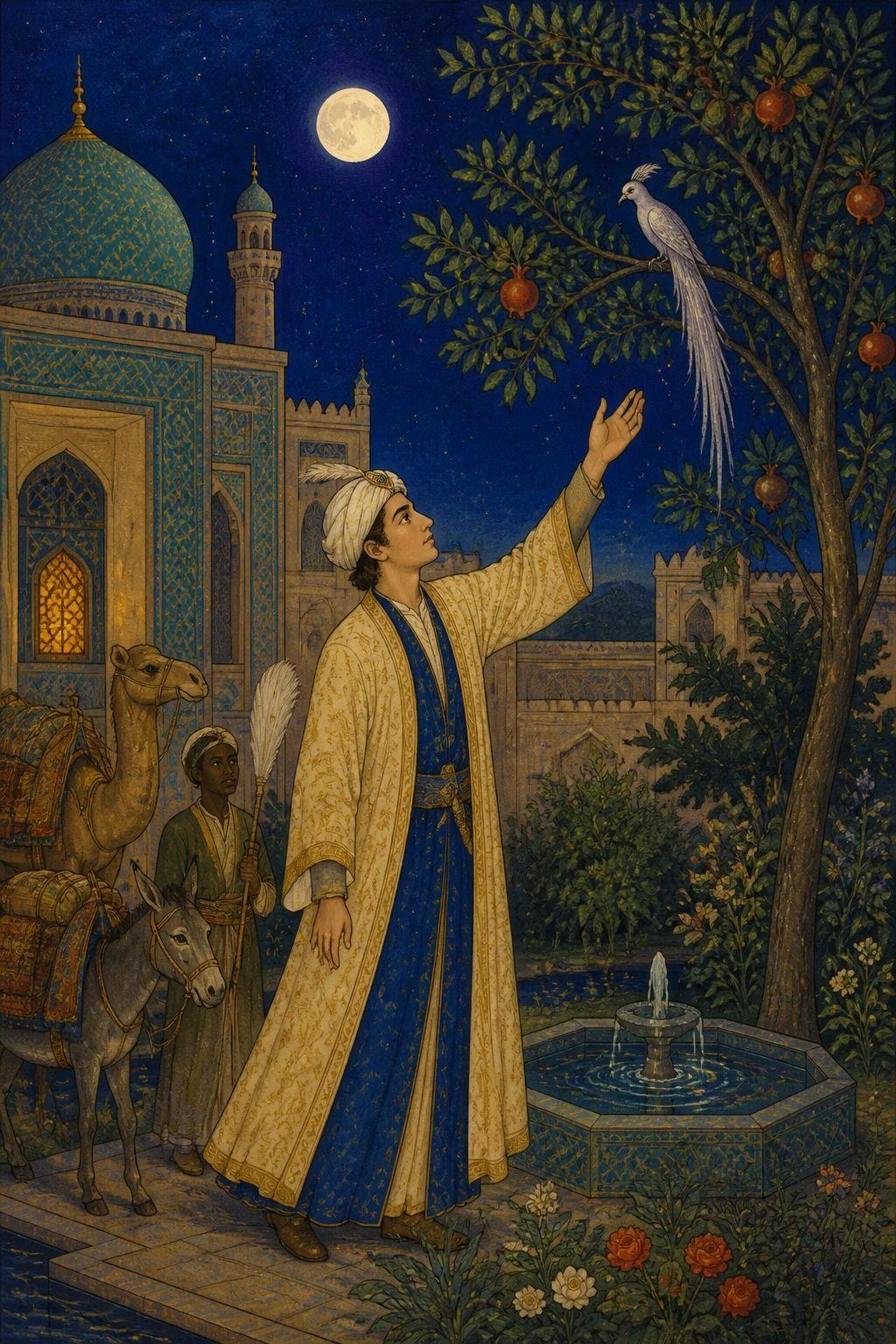
Among the tales they tell is this: in ancient times, in ages and seasons long gone by, there lived in Egypt a merchant named Taj al-Din. He was one of the foremost merchants, a man of honor and trust, yet much given to traveling through every land. He loved to journey across wilderness and desert, over plains and rugged country, and among the islands of the seas, in pursuit of dirhams and dinars. He owned slaves and mamluks, servants and slave girls, and had often braved dangers and endured hardships on his travels that would turn a little child’s hair white. He was the wealthiest merchant of his day and the most gracious in speech, possessing horses and mules, Bactrian camels and dromedaries, sacks and bales, merchandise and money, and fabrics beyond compare: sashes from Homs, garments from Baalbek, lengths of fine silk brocade, cloth from Merv, Indian dress materials, Baghdad buttons, Maghrebi burnouses, Turkish mamluks, Abyssinian servants, Greek slave girls, and Egyptian pages. Even the sacks in which he packed his goods were silk, for he was abundantly wealthy and wondrously handsome, supple of limb and graceful in every movement. As one who described him said:
A merchant’s lovers met my eyes, with warfare raging in their throng. “Why all this uproar?” he inquired. “Your eyes, O merchant, are the cause!” Another described him admirably, hitting the mark:
A merchant came to grant us union, and his glances left my heart bewildered. “What has bewildered you?” he asked. “Your eyes, O merchant,” I replied. This merchant had a son named Ali Nur al-Din, who was like the moon when it rises full on the fourteenth night, exquisite in beauty, with a graceful figure and perfectly proportioned limbs. One day the boy sat, as was his custom, in his father’s shop, buying and selling, taking and giving. The merchants’ sons gathered around him, and he shone among them like the moon among the stars, with a radiant brow, rosy cheeks, the first dark down upon his face, and a body like marble. As the poet said of him:
A beauty said, “Describe me: in matters of beauty your judgment is sound.” I answered briefly, “Everything about you is fair.” And as another who described him said: Upon the smooth expanse of his cheek a mole lies like a drop of ambergris upon a marble dish; his glances cry, with swords unsheathed, “God is most great!” against all who defy love. The merchants’ sons invited him out, saying, “My lord Nur al-Din, we should like you to come with us today and enjoy ourselves in such-and-such a garden.” “Let me consult my father,” he replied, “for I cannot go without his permission.” As they were speaking, his father Taj al-Din arrived. The boy looked at him and said, “Father, the merchants’ sons have invited me to go with them and enjoy ourselves in such-and-such a garden. Will you give me leave?” “Yes, my son,” he answered, and gave him some money, saying, “Go with them.” The merchants’ sons mounted asses and mules, and Nur al-Din mounted a mule and rode with them to a garden containing all that souls desire and eyes delight in. Its walls were stoutly built and its buildings lofty. It had an arched gateway like an iwan, and a sky-blue door resembling the gates of Paradise; its gatekeeper’s name was Ridwan. Over it were a hundred grape arbors bearing fruit of every hue: red grapes like coral, black grapes like the noses of Black Africans, and white grapes like pigeons’ eggs. There were peaches and pomegranates, pears, plums, and apples, all of different colors, growing from shared roots and separate roots. Then morning overtook Shahrazad, and she ceased her permitted tale.
When it was the eight hundred and sixty-fourth night,
She said: It has reached me, O fortunate king, that when the merchants’ sons entered the garden, they saw there everything that lips and tongue could desire. They found grapes of many colors, growing from shared roots and separate roots, as the poet said:
Grapes whose flavor is the flavor of wine, whose hue is black as the raven’s wing, shine proudly among their leaves like women’s fingers amid the henna. And as another poet said:
The clusters, dangling from their stems, rivaled my body in slenderness; they were like honey mixed with water in a bowl, and from sour green fruit had ripened into wine. At last they reached the garden arbor, where they saw Ridwan the gatekeeper sitting like Ridwan, the keeper of Paradise. Over the arbor’s entrance they found these two verses written:
May God water a garden whose clusters hang low, bending the branches, so deeply have they drunk. When the east wind’s hand sets its boughs dancing, the rain adorns them with glistening pearls. Inside the arbor they found these two verses written:
Come with us, friend, into a garden that scours from the heart the rust of care; its breeze goes stumbling over its trailing skirts, and its flowers laugh within their sleeves. In that garden were spreading fruit trees and birds of every kind and color: ringdoves, nightingales, curlews, turtledoves, and pigeons, singing upon the boughs. Water flowed through its streams, and lovely were those waterways amid the blossoms and delicious fruits. As the poet said in these two verses:
The breeze passed through the branches, and they swayed like a lovely maiden stumbling in her splendid robes; the streams resembled swords drawn from their scabbards by the hands of horsemen. And as another poet said:
The river stretched beneath the boughs and ever held their images within its heart, until the breeze perceived it, and in jealousy stole toward them, bending them away from its embrace. The trees in that garden bore every kind of fruit in pairs. Among its pomegranates were some like the balls of Kairouan, as the poet so finely said:
Thin-skinned pomegranates rival the breasts of a maiden when they swell to fullness; peel them, and there appear before us rubies whose brilliance bewilders the mind. And as another poet said:
A rounded globe reveals to those who seek its heart red rubies folded in wondrous brocade. When I beheld a pomegranate, I likened it to a maiden’s breast or a marble dome. It holds a cure and health for the sick; the pure Prophet spoke of its virtues, and God, exalted be His majesty, spoke eloquently of it in the written Book. In that garden were sugar apples and musk apples that astonished all who looked upon them, as the poet said:
An apple joined two colors, like the cheeks of lover and beloved brought together. Upon the branch they shone, wondrous opposites: one dark, the other bright. They clasped each other; then a talebearer appeared and startled them: one blushed for shame, the other paled with longing. In that garden were almond apricots and camphor apricots, and varieties from Gilan and Aintab, as the poet said:
The almond apricot resembles a lover whose beloved has come and bewildered his heart. Enough to prove its passion is this: its skin turns yellow and its heart is broken. Another poet put it finely:
Look at the apricot in blossom: gardens whose radiance clears the eyes! Like brilliant stars in their splendor, the blossoms adorn the bough amid its leaves. In that garden were plums, cherries, and jujubes to cure the sick of their ailments; and figs upon their branches, red and green, that bewildered the minds of those who gazed upon them. As the poet said:
The figs, white and green, appearing among the leaves of the trees, are like Greeks atop their towers, keeping fearful vigil when darkness closes round them. Another put it finely:
Welcome to figs brought to us neatly arrayed upon a dish, like a traveling tablecloth folded together without fastening rings. Another said admirably: How excellent the fig, delicious in taste, clothed in beauty, its appearance almost matching its inward worth! Taste it, and it offers the scent of chamomile and the sweet savor of sugar; poured upon its platters, it resembles balls fashioned of green silk. How fine, too, is this poet’s saying:
They said, when my soul had grown fond of taking its pleasure in figs, while they were enamored of other fruits, “Why do you love figs?” I answered, “Figs have their people, and sycamore figs have theirs.” Finer still is another’s saying:
I prize the fig above all fruits when it ripens and bends upon its flourishing branch, like a worshipper beneath the pouring clouds, whose tears flow freely in the fear of God. In that garden were pears from Tur, Aleppo, and the lands of the Greeks, of many colors, growing from shared roots and separate roots. Then morning overtook Shahrazad, and she ceased her permitted tale.
When it was the eight hundred and sixty-fifth night,
She said: It has reached me, O fortunate king, that when the merchants’ sons entered the garden, they saw the fruits we have described. They found pears from Tur, Aleppo, and the lands of the Greeks, of many colors, growing from shared roots and separate roots, yellow and green, astonishing to behold. As the poet said:
May you enjoy pears whose color has become that of a lover pale beyond measure, like a maiden within her chamber, her face concealed beneath a hanging veil. In that garden were royal peaches of various colors, yellow and red, as the poet said:
The peaches in their garden, showing the crimson of dragon’s blood, are like balls of yellow gold whose faces have been smeared with blood. In that garden were green almonds of surpassing sweetness, like palm hearts, their kernels enclosed within three garments: the handiwork of the all-bountiful King. As was said of them:
Three garments clothe a tender body, each shaped differently by the handiwork of the Lord; night and day they threaten it with death, though the prisoner within them has committed no crime. Another put it finely:
Do you not see the almond when a bending hand brings it forth from the branches? Its shell reveals its heart to us, like a pearl within an oyster. Finer still is another’s saying:
How lovely are almonds, green and yellow, filling the hand! Their down is like the first growth on a beardless youth’s cheek. Their hearts lie within, in pairs or singly, like pearls treasured in emerald. Another said admirably:
My eyes have never seen the almond’s equal in beauty when its blossoms show: its crown shines white as hoary hair, while, in its flourishing prime, its cheek-down has turned green. In that garden were lote fruits of many colors, growing from shared roots and separate roots, of which one poet wrote:
Look at the lote fruits ranged along the branches, like lovely apricots displaying themselves upon the boughs. Their yellow hue seems to the beholder like little bells fashioned out of gold. Another said admirably:
A lote tree shows new arts of beauty every day; its fruits, revealed to our eyes, are little bells of pure gold suspended from the branches. In that garden were bitter oranges like galangal, of which an impassioned poet said:
A red fruit fills the palm, resplendent in its beauty: outside it is fire, within it snow. A marvel, that snow should not melt beside fire; a marvel, that fire should give off no heat! Another put it finely:
The fruits of the bitter-orange trees, when the discerning eye beholds them, are the cheeks of women who have decked themselves for a feast day in robes of fine silk. Another said admirably:
It is as though the east wind had gilded the bitter-orange groves, and their swaying branches had become cheeks radiant with beauty, approached by other cheeks exchanging greetings. Another said admirably:
We said to a young gazelle, “Describe this garden and our bitter oranges.” He answered, “Your garden is my face; whoever gathers its bitter oranges gathers fire.” In that garden were citrons the color of gold dust, hanging down from the heights among the branches in perfect beauty, like ingots of pure gold. Of them the impassioned poet said:
Do you not see the citron grove laden with fruit, so that one fears its branches may break as they bend? When the breeze passes through, it is like a bough bearing rods of gold. In that garden were large citrons hanging among their branches like the breasts of gazelle-like maidens, perfect beyond desire. As the poet so finely said:
I saw a citron in the garden upon a supple branch like a slender beauty’s form. When the wind let it swing, it swayed like a golden ball upon an emerald polo stick. In that garden were fragrant lemons resembling hens’ eggs, though their yellow was a freely bestowed adornment and their scent delighted those who plucked them. As one who described them said:
Do you not see the lemons appearing, their radiance plain to the eye, like hens’ eggs that a painter has daubed with saffron? In that garden were all manner of fruits and fragrant herbs, greens and scented plants: jasmine, henna blossom, pepper, amber-scented spikenard, roses of every kind, plantain, myrtle, and every species of sweet herb. Without exaggeration, that garden seemed to all who saw it a piece of Paradise. If a sick man entered, he came out like a raging lion. No tongue could describe the marvels and wonders it contained, such as are found only in Paradise. And why not, when its gatekeeper was named Ridwan? Yet how far apart were the two domains! When the merchants’ sons had admired the garden and wandered at their leisure, they sat in one of its iwans, placing Nur al-Din in the middle. Then morning overtook Shahrazad, and she ceased her permitted tale.
When it was the eight hundred and sixty-sixth night,
She said: It has reached me, O fortunate king, that when the merchants’ sons sat in the iwan, they seated Nur al-Din in its midst upon a mat of embroidered leather, reclining against a cushion stuffed with ostrich feathers and covered with rounded panels of squirrel fur. They handed him an ostrich-feather fan on which these two verses were written:
A fan whose breeze is fragrant recalls the sweetness of blissful hours, and at every moment wafts its perfume toward the face of a noble, generous youth. Then the young men took off their turbans and outer garments and sat talking, keeping one another company, and exchanging pleasant conversation. Each gazed at Nur al-Din and contemplated his handsome face. After they had been comfortably seated for an hour, a slave approached carrying upon his head a meal served in vessels of porcelain and crystal, for one of the merchants’ sons had ordered his household to prepare it before he left for the garden. The meal included creatures that walk, creatures that fly, and creatures that swim in the seas: sandgrouse, quail, young pigeons, lambs, and the finest fish. When it was set before them, they drew near and ate their fill. Having finished, they rose from the meal and washed their hands in clear water with musk-scented soap, then dried them on napkins woven with silk and gold thread. They offered Nur al-Din a napkin embroidered in red gold, and he wiped his hands on it. Coffee was brought, and each drank as much as he wished; then they settled down to talk. Presently the gardener went away and returned with a basket full of roses. “What do you say to some fragrant flowers, my lords?” he asked. One of the merchants’ sons replied, “Very welcome, especially roses, which are never to be refused.” “Indeed,” said the gardener, “but our custom is to give roses only in exchange for convivial verse. Whoever wishes to take some must recite poetry suited to the occasion.” There were ten merchants’ sons, and one of them said, “Very well, give me some, and I shall recite verses suited to the occasion.” The gardener handed him a bunch of roses, which he took, reciting:
The rose holds a place in my heart, for it never wearies me. All other flowers are soldiers; it is their glorious prince. In its absence they grow proud and haughty; when it comes, they bow in submission. Then he handed the second a bunch of roses, and he took them and recited these two verses:
Here, my lord, is a rose whose breath the scent of musk recalls, like a lovely girl who, seeing her lover, covers her head with her sleeves. Then he handed the third a bunch of roses, and he took them and recited these two verses:
A precious rose whose sight delights the heart, whose scent rivals the sweetest blended incense; the branch joyfully enfolds it in its leaves, like a kiss upon a mouth that offers no resistance. Then he handed the fourth a bunch of roses, and he took them and recited these two verses:
Do you not see the rosebush, its wondrous beauties set upon the stems, like rubies encircled by emeralds that hold a little gold? Then he handed the fifth a bunch of roses, and he took them and recited these two verses:
Rods of emerald bear their burden, and their fruits are ingots of pure gold; the drops that fall from their leaves are tears shed by languid eyes. Then he handed the sixth a bunch of roses, and he took them and recited these two verses:
O rose that gathers wondrous beauty, in which God has placed His subtle mysteries! It is as though you were a beloved’s cheek, upon which a yearning lover, at their reunion, has bestowed a dinar. Then he handed the seventh a bunch of roses, and he took them and recited these two verses:
I said to the rose, “Why do your thorns so swiftly wound whoever touches them?” It answered, “The fragrant flowers are my army; I am their sultan, and my thorns my weapons.” Then he handed the eighth a bunch of roses, and he took them and recited these two verses:
May God preserve the yellow rose, lovely and fresh, resembling gold, and the beautiful branches that have borne it, laden with little suns. Then he handed the ninth a bunch of roses, and he took them and recited these two verses:
Yellow rosebushes have stirred delight in every lover’s heart. How marvelous a tree, watered with liquid silver, that bears a crop of gold! Then he handed the tenth a bunch of roses, and he took them and recited these two verses:
Have you not seen the army of roses glorying in its yellow and red blossoms? With the thorns among them, I have likened them to emerald spearheads upon a shield of gold. When the roses were in their hands, the gardener brought the wine service and set among them a tray adorned with red gold, reciting these two verses:
Dawn has called aloud in radiance: pour old wine that turns the wise man foolish. So delicate and clear is it, I cannot tell whether it is in the cup, or the cup in it. Then the gardener filled a cup and drank, and the cup passed around until the turn came to Nur al-Din, son of the merchant Taj al-Din. The gardener filled a cup and handed it to him, but Nur al-Din said, “You know this is something unfamiliar to me. I have never drunk it, for it is a great sin, and the almighty Lord has forbidden it in His Book.” The gardener replied, “My lord Nur al-Din, if you abstain only because it is sinful, God, glorified and exalted be He, is generous and forbearing, forgiving and merciful. He pardons the greatest sin, and His mercy encompasses all things. May God have mercy on the poet who said:
Be as you will, for God is bountiful, and no harm need come to you if you sin, save in two things, which you must never approach: setting partners beside God, and doing injury to others.” Then one of the merchants’ sons said, “By my life, my lord Nur al-Din, you must drink this cup!” Another young man came forward and swore by the divorce of his wife that he must drink, while another stood before him in supplication. Nur al-Din grew embarrassed, took the cup from the gardener, and swallowed a mouthful, but spat it out. “This is bitter,” he said. The young gardener replied, “My lord Nur al-Din, were it not bitter, it would not possess these benefits. Do you not know that even sweet things taste bitter when taken as medicine? This wine has many virtues. Among them are that it aids digestion, dispels sorrow and care, relieves wind, purifies the blood, clears the complexion, invigorates the body, emboldens the coward, and strengthens a man’s vigor for intercourse. Were we to list all its benefits, the explanation would be long indeed. As one poet said:
We drank, with God’s forgiveness all around us, and I treated my ailments with sips from the cup. Knowing its sin, nothing tempted me to it save His words: ‘In it are benefits for mankind.’” At once the gardener rose to his feet, opened one of the iwan’s closets, and took out a loaf of refined sugar. He broke off a large piece and put it in Nur al-Din’s cup, saying, “My lord, if you feared to drink wine because of its bitterness, drink now, for it has become sweet.” Nur al-Din took the cup and drank it. Then one of the merchants’ sons filled the cup and said, “My lord Nur al-Din, I am your slave.” Another said, “I am your servant.” Another rose, saying, “For my sake!” And another stood and said, “By God, my lord Nur al-Din, grant me this favor.” The ten merchants’ sons kept at him until they had made him drink ten cups, one from each of them. Now Nur al-Din’s stomach was virgin ground: never in his life had he drunk wine until that hour. The wine went to his head, and drunkenness overcame him. He rose to his feet, his tongue heavy and his speech slurred, and said, “My friends, by God, you are handsome, your conversation is delightful, and your place is charming, but it lacks sweet music. For wine without music is better left undrunk, as the poet said in these two verses:
Pass it round in cups both great and small, and take it from the hand of a shining moon. Do not drink without music, for I have seen that horses drink to whistling.” At this the young man who owned the garden rose, mounted one of the merchants’ sons’ mules, and went away. He returned with an Egyptian girl, soft as fresh tail fat, pure as silver, like a dinar upon a tray or a gazelle in the wilderness. Her face put the shining sun to shame. She had nightingale eyes, eyebrows like bent bows, rosy cheeks, pearly teeth, sugary lips, languid glances, ivory breasts, a slender belly with folded creases, buttocks like stuffed cushions, and thighs like Syrian streams, with something between them like a little purse inside a folded bundle. As these verses said of her:
Had she appeared before idolaters, they would have taken her face for a god instead of their idols. Had she shone upon a monk in the east, he would have abandoned the east and followed her west. Had she spat into the salt sea, its water would have become sweet from her saliva. Another poet said:
More radiant than the full moon, with kohl-dark eyes, she appeared like a doe that has hunted lion cubs. Night draped her with her tresses, a tent of hair held up without pegs. The fires kindled by the roses of her cheeks burn only in melting hearts and aching breasts. Had the beauties of the age beheld her, they would have stood upon their heads before her, saying, “Precedence belongs to the one who came first.” How fine, too, is this poet’s saying:
Three things kept her from visiting us, for fear of the watcher and the wrathful envier: the light of her brow, the whisper of her jewelry, and the fragrant ambergris enfolded in her limbs. Suppose she veils her brow with her flowing sleeve and takes her jewels off—what can she do about her fragrant sweat? That girl was like the full moon rising on the fourteenth night. She wore a blue gown and a green veil above her radiant brow, bewildering the mind and confounding men of reason. Then morning overtook Shahrazad, and she ceased her permitted tale.
When it was the eight hundred and sixty-seventh night,
She said: It has reached me, O fortunate king, that when the gardener brought them the girl whom we have described as supremely beautiful, graceful in figure and perfectly proportioned, she seemed the very one intended by the poet’s words:
She approached in a blue gown, lapis-blue as the color of the sky; and in that gown I recognized the summer moon amid the nights of winter. How fine and excellent, too, is another’s saying:
She came veiled, and I said to her, “Uncover your face, that bright and shining moon.” “I fear disgrace,” she said. “Enough,” I answered. “Do not be bewildered by the turns of time.” She lifted beauty’s veil from her cheeks, and crystal fell upon the jewels. So great was my love that I thought to kill her, that she might plead against me at the Resurrection, and we might be the first two lovers to dispute before the almighty Lord on Judgment Day. Then I would say, “Prolong our reckoning, that I may gaze upon my beloved all the longer.” The young gardener said to the girl, “Know, O mistress of beauties and of every shining star, that we have brought you here only to keep company with this gracious and handsome young man, my lord Nur al-Din, for today is the first time he has visited us.” The girl replied, “I wish you had told me, so that I could have brought what I had with me.” “My lady,” he said, “I shall go and fetch it for you.” “Do as you please,” she answered. “Give me a token,” he said, and she gave him a handkerchief. He hurried out, was absent for an hour, and returned with a green satin bag fitted with two gold clasps. The girl took it from him, untied it, and shook it out, and thirty-two pieces of wood fell from it. She fitted the pieces together, male into female and female into male, bared her wrists, and set it upright. It became a polished, smooth-scraped oud of Indian workmanship. Then she bent over it as a mother bends over her child and tickled it with her fingertips. The oud moaned and rang, yearning for its former home. It remembered the waters that had nourished it and the soil in which it had sprouted and grown; it remembered the carpenters who had cut it, the varnishers who had coated it, the merchants who had traded in it, and the ships that had carried it. It cried and wailed, lamented and mourned, as though she had asked it about all these things and it answered in the language of its own condition, reciting these verses:
I was once a bough where nightingales made their home; I swayed with them in rapture, my branches green. They lamented above me, and I learned their lament; because of that mourning my secret is made known. Though I had done no wrong, my cutter cast me to the earth and made me the slender oud you see. A knowing player struck me with his fingers, declaring me a slain one, patiently enduring among mankind. Hence every drinking companion who hears my mourning is carried away in passion and grows drunk. The Lord has softened their hearts toward me, and now I am given the highest place upon their breasts. Every surpassing beauty embraces my form, every dark-eyed gazelle with drowsy glances. May God the Protector never part us, and may no beloved live to be rejected and forsaken. The girl paused for a while. Then she took the oud into her lap, bent over it as a mother bends over her child, and played in many modes before returning to her first melody and singing these verses:
If they would incline toward the lovesick one, or visit him, the burdens of longing would be lifted from his shoulders. A nightingale contends with a branch, like a lover whose home is far away. Rise and awake! The nights of union are moonlit, and in reunion they seem like the hours before dawn. Today our enviers are heedless of us, and strings have summoned us to delight. Do you not see four things brought together before our eyes: myrtle, roses, gillyflowers, and blossoms? Today four things are joined for us to see: a lover, a beloved, a drink, and a dinar. Seize your share of this world, for its pleasures vanish, while tales and tidings remain. When Nur al-Din heard the girl sing these verses, he gazed at her with loving eyes, scarcely able to contain himself for the strength of his desire. She felt the same, for she had looked at all the merchants’ sons present and then at Nur al-Din, and had seen him among them like the moon among the stars. His speech was sweet, his manner charming, his figure and proportions perfect, his beauty and splendor complete. He was gentler than the breeze and more delicate than the waters of Tasnim, as these verses said of him:
I swear by his cheek and his smiling lips, by the arrows he has steeped in his enchantment; by his supple form and the shafts of his glances, by his radiant brow and his raven hair; by the eyebrow that has banished sleep from my eyes and tyrannized over me with its commands and prohibitions; by the scorpions of curls let loose from his temples, which seek to slay his lovers through estrangement; by the roses of his cheeks and the myrtle of his down, the carnelian of his lips and the pearls of his teeth; by the bough of his stature, whose pomegranates ripen proudly upon his breast; by his rounded hips, a very Mars in motion and at rest, and by the slenderness of his waist; by his silken clothing and his graceful lightness, and by all the beauty gathered in him: fragrance indeed rises from his breath, and the sweet wind tells the tale of his perfume. The shining sun falls short of him, and the crescent moon is but a clipping from his nail. And dawn overtook Shahrazad, and she fell silent, leaving her tale untold.
When it was the eight hundred and sixty-eighth night,
She said: It has reached me, O fortunate king, that when Nur al-Din heard the young woman’s words and poetry, he admired her verses. By then he was swaying with wine, and began praising her, saying: “A lute-player has carried us away in the rapture of the wine-drinker. Her strings said to us, ‘God has given us speech, He who—’” When Nur al-Din spoke these words and recited these verses, the young woman gazed at him lovingly, and her passion and longing grew. She cried out in wonder at his beauty and loveliness, his graceful figure and perfect proportions. Unable to restrain herself, she embraced the lute once more and sang these verses:
He reproaches me for gazing at him, and shuns me, though my soul is in his hands. He keeps me far away, yet knows what lies within my heart, as though God had revealed it to him. I traced his likeness in the palm of my hand and told my eyes, “Rest your hopes on this.” My eyes will look upon no other in his place, nor will my heart grant me patience in his presence. O heart, I have torn you from my breast, for in hostility you are one of his own sons. Whenever I say, “O heart, take comfort,” it answers me, “How hateful you are!” When the young woman had sung these verses, Nur al-Din marvelled at the beauty of her poetry and the eloquence of her speech, the sweetness of her words and the fluency of her tongue. His wits fled before the force of passion, yearning, and desire. He could not bear to be apart from her even for an hour, but leaned towards her and clasped her to his breast. She clung to him in turn, yielding herself entirely to his embrace, and kissed him between the eyes. He held her slender figure close and kissed her mouth, exchanging kisses with her as doves feed one another. She turned to him and returned his kisses. The company were beside themselves with delight and sprang to their feet, whereupon Nur al-Din grew bashful and withdrew his hand from her. Then she took up her lute and played several melodies before returning to the first mode and singing these verses:
A moon who draws swords from his eyelids when he turns in anger, and puts the gazelle to shame when he looks; a king whose wondrous beauties are his army, whose figure in the fray resembles a spear. If the tenderness of his waist were in his heart, he would never wrong a lover or do him injury. O cruel heart of his, O tender waist, why will you not exchange your places? You who blame me for loving him, excuse me instead: yours is to survive his beauty, mine to perish. When Nur al-Din heard her lovely words and exquisite verses, he swayed towards her in delight, quite overcome with wonder. Then he recited these verses:
I thought her the morning sun, and so she seemed, yet its scorching blaze was in my heart. What harm would it do her to greet us with a gesture of her fingertips, to beckon us a welcome? My censurer saw her face and, lost in those charms that put all beauty to shame, said, “Is this the one whose love has driven you mad with longing? Then you are excused.” I answered, “She is the one who deliberately pierced me with the arrow of her glance, yet took no pity on my plight, my abasement, my broken spirit, or my exile. So I remain heart-robbed and love-enslaved, lamenting and weeping all day and all night.” When Nur al-Din had finished his poem, the young woman marvelled at his eloquence and refinement. She took her lute and played it with her finest skill, running through all the melodies, then sang these verses:
By the life of your face, O life of souls, I shall never turn from you, whether I despair or not. Though you are cruel, your phantom visits me; though you are absent from my sight, your memory keeps me company. You leave my eyes desolate, knowing that I have never found solace in any love but yours. Your cheeks are roses, your mouth’s moisture wine: will you not freely offer it at this gathering? Nur al-Din was transported with delight at the young woman’s singing, and his wonder knew no bounds. He answered her poem with these verses:
She unveiled her sun-bright face at dusk only to eclipse the full moon on the horizon. Her forelock never showed itself to the eyes of morning without my invoking the Lord of Daybreak to protect that parting in her hair. Take from the flowing channels of my tears their unbroken chain, and relate the tale of love by the shortest path. To many a maiden shooting arrows I have said, “Gently with your shafts, for my heart is afraid.” If my tears are kin to the River Nile, your affection is kin to flattery. She said, “Then give me all your wealth.” I answered, “Take it.” “And your sleep as well,” she said. I answered, “Take it from my eyes.” When the young woman heard Nur al-Din’s words and his fine eloquence, her heart flew from her and her mind was bewildered. He had taken complete possession of her heart, and she clasped him to her breast, kissing him as doves feed one another. He answered her with kiss upon kiss, though the credit belonged to her who began. When she had finished kissing him, she took the lute and sang these verses:
Alas, alas for the reproaches of my censurer! Shall I complain of him, or tell him of my restlessness? You who forsake me, I never thought to meet humiliation in loving you, when you were mine. I once rebuked those whom passion afflicted; now, for your sake, I lay my abasement bare before those who blame you. Yesterday I reproached the slaves of love; today I excuse every afflicted lover. And if the anguish of parting from you overwhelms me, I call upon God by your name, O Ali. When the young woman had finished her poem, she also sang these two verses:
The lovers have said, “If he will not give us to drink of the moisture of his lips and the sweet, flowing nectar of his mouth, we shall call upon the Lord of all the worlds, who will answer us; and every one of us shall cry, ‘O Ali!’” When Nur al-Din heard these words and verses from the young woman, he marvelled at the eloquence of her tongue and thanked her for the charming variety of her art. On hearing Nur al-Din’s praise, she rose to her feet at once, removed all the clothes and ornaments she was wearing, and stripped herself of them entirely. Then she knelt, kissed him between the eyes and upon the two beauty spots on his cheeks, and presented him with everything she had taken off. And dawn overtook Shahrazad, and she fell silent, leaving her tale untold.
When it was the eight hundred and sixty-ninth night,
She said: It has reached me, O fortunate king, that the young woman gave Nur al-Din everything she had been wearing and said to him, “Know, beloved of my heart, that a gift reflects the means of its giver.” Nur al-Din accepted it from her, then gave it back and kissed her on the mouth, cheeks, and eyes. When all this was over—and none endures save the Ever-Living, the Self-Subsisting, who provides for peacock and owl alike—Nur al-Din rose from the gathering and stood up. The young woman asked him, “Where are you going, my lord?” “To my father’s house,” he answered. The merchants’ sons implored him to spend the night with them, but he refused, mounted his mule, and rode on until he reached his father’s house. His mother rose to meet him and said, “My son, why have you stayed away so late? By God, your absence has distressed both your father and me, and we have been anxious about you.” Then she went up to kiss his mouth and caught the smell of wine on his breath. “My son,” she said, “after prayer and devotion, have you taken to drinking wine and disobeying Him to whom creation and command belong?” While they were speaking, his father arrived. Nur al-Din threw himself upon his bed and fell asleep. His father asked, “What is the matter with Nur al-Din?” His mother replied, “It seems the air of the garden has given him a headache.” His father went up to greet him and ask about his pain, and smelled the wine on his breath. Now this merchant, whose name was Taj al-Din, had no liking for anyone who drank wine, and he said, “Woe to you, my son! Has your folly gone so far that you drink wine?” Hearing his father’s words, Nur al-Din raised his hand in his drunkenness and struck him. As fate had decreed, the blow fell upon his father’s right eye, which ran down his cheek, and he collapsed unconscious on the ground. He remained senseless for some time, and they sprinkled rosewater over him. When he recovered, he tried to beat his son, but the mother restrained him. He then swore an oath, binding himself to divorce her if he broke it, that when morning came he would cut off his son’s right hand. Hearing her husband’s words, the mother was sorely distressed and feared for her son. She continued soothing his father and coaxing him until sleep overcame him. Then she waited until the moon rose and went to her son, who had now sobered up. “Nur al-Din,” she said, “what is this dreadful thing you have done to your father?” “What have I done to my father?” he asked. She replied, “You struck him with your hand upon his right eye, and it ran down his cheek. He has sworn, on pain of divorcing me, that when morning comes he will cut off your right hand.” Nur al-Din regretted what he had done, when regret could no longer help him. His mother said, “My son, this remorse will do you no good. You must get up this instant, flee, and seek safety. Keep out of sight when you leave until you reach one of your friends, and wait to see what God will do, for He changes one condition into another.”
Then his mother opened the money chest and took out a purse containing a hundred dinars. “My son,” she said, “take these dinars and use them for your needs. When they are gone, send word to me and I shall send you more. Whenever you write, send me news of yourself in secret. Perhaps God will decree relief for you, and you will return home.” She bade him farewell and wept as bitterly as could be. Nur al-Din took the purse of dinars from his mother and was about to leave when he saw a large purse beside the chest, which his mother had forgotten. It held a thousand dinars. He took it, tied both purses about his waist, went out of the lane, and made for Bulaq before dawn.
When morning came, and all creatures rose to proclaim the oneness of the Sovereign who opens every way, and everyone set out about his business to obtain what God had allotted him, Nur al-Din had reached Bulaq. He walked along the riverbank and saw a vessel with its gangplank extended and people going aboard and coming ashore, while its mooring stakes were driven into the bank. Seeing the sailors standing there, he asked, “Where are you bound?” “For the city of Alexandria,” they replied. “Take me with you,” said Nur al-Din. “Gladly! A hearty welcome to you, handsome young man,” they answered. Nur al-Din at once went to the market and bought the provisions, bedding, and covering he needed, then returned to the vessel, which was ready to depart. Soon after he boarded, it set off without delay and sailed on until it reached the city of Rashid. There Nur al-Din saw a small boat bound for Alexandria. He boarded it and crossed the canal, travelling on until he reached a bridge called al-Jami Bridge. He stepped ashore there and entered through a gate called the Sidra Gate. God sheltered him from notice, and none of those standing at the gate saw him. So Nur al-Din walked into the city of Alexandria. And dawn overtook Shahrazad, and she fell silent, leaving her tale untold.
When it was the eight hundred and seventieth night,
She said: It has reached me, O fortunate king, that when Nur al-Din entered Alexandria, he found it a city with strong walls and lovely pleasure grounds, delightful to its inhabitants and inviting to those who wished to settle there. Winter and its cold had departed, and spring had come with its roses. Its flowers bloomed, its trees put forth leaves, its fruits ripened, and its waterways flowed abundantly. It was a city beautifully planned and proportioned, and its people were soldiers of the finest kind. Once its gates were shut, its inhabitants were secure. It was as these verses describe it:
One day I said to a friend gifted with eloquence, “Describe Alexandria to me.” “A lovely port,” he answered. “And can one earn a living there?” I asked. “If the wind blows,” he replied. And another poet said:
Alexandria is a mouth whose moisture is sweet to taste. How delightful union is there, if no crow comes to spoil it! Nur al-Din walked through the city, passing first into the carpenters’ market, then the money-changers’ market, the sellers of nuts and dried delicacies, the fruit sellers, and finally the perfumers’ market. He marvelled at the city, for its appearance matched the fame of its name. As he walked through the perfumers’ market, an elderly man came down from his shop, greeted him, took him by the hand, and led him to his house. Nur al-Din saw a lovely lane, swept and sprinkled with water, where a clear breeze blew beneath the shade of leafy trees. There were three houses in that lane. At its far end stood a house whose foundations were rooted in the water and whose walls rose towards the clouds. The space before it had been swept and sprinkled, and those approaching it caught the scent of flowers and were met by a breeze as though from the gardens of Paradise. The entrance to the lane was swept and watered, and its farther end was paved with marble. The old man took Nur al-Din into this house, set food before him, and ate with him. When they had finished, the old man asked, “When did you arrive here from Cairo?” “My father, only last night,” he replied. “What is your name?” “Ali Nur al-Din.” The old man said, “My son Nur al-Din, I swear by a threefold divorce that so long as you remain in this city you shall not leave me. I shall make a place ready for you to live in.” Nur al-Din replied, “My lord, tell me more about yourself.” The old man said, “My son, some years ago I went to Cairo with merchandise, which I sold there, and bought other goods. I found myself in need of a thousand dinars, and your father Taj al-Din paid them on my behalf, though he did not know me. He took no written bond from me, but waited patiently until I returned to this city and sent the money to him with one of my servants, together with a gift. I saw you when you were little, and now, God willing, I shall repay you for some of your father’s kindness to me.”
When Nur al-Din heard this, he showed his pleasure and smiled. He took out the purse containing the thousand dinars and gave it to the old man, saying, “Keep this in trust for me until I buy some merchandise to trade in.” Nur al-Din stayed in Alexandria for several days, exploring a different street each day, eating and drinking, enjoying himself and making merry, until the hundred dinars he had brought for his expenses were gone. Then he went to the old perfumer to take some of the thousand dinars for his needs, but did not find him in his shop. He sat down there to wait for his return, watching the merchants and looking to right and left. While he was thus occupied, a foreigner came into the market riding a mule, with a slave girl behind him. She was like pure silver, a tilapia in a fountain pool, or a gazelle in the wilderness, with a face that put the shining sun to shame, eyes full of Babylonian enchantment, ivory breasts, pearl-like teeth, a slender belly, a supple waist, and legs as delicate as the tips of a supple branch. She was perfect in beauty and loveliness, graceful in figure and proportion, as one who described her said:
She seems created in the very shape you love, radiant in beauty, neither tall nor short. The rose blushes for shame before her cheek, and the bough takes pride in the fruit her figure bears. The full moon is her face, musk her breath, a branch her stature: no mortal is her equal. She seems poured from the liquid of a pearl, and every lovely limb of hers is a moon. The foreigner dismounted from his mule and helped the young woman down, then called for the broker. When the broker came before him, he said, “Take this slave girl and offer her for sale in the market.” The broker took her into the middle of the market and disappeared for a while, then returned with an ebony chair inlaid with white ivory. He set it on the ground, seated the young woman upon it, and lifted the veil from her face. Beneath it appeared a face like a Daylamite shield or a brilliant star. She was like the full moon rising on the fourteenth night, dazzling in her beauty, as the poet said:
The full moon foolishly challenged the beauty of her face, then went away eclipsed and split with anger. If the willow’s stature is compared with hers, perish the hands of that mere bearer of firewood! And how finely the poet said:
Say to the beauty in the gilded veil, “What have you done to a devout and cloistered worshipper? The light of your veil and the light of your face beneath it have routed the armies of darkness with their radiance. Whenever my eye approaches to steal a glance, the guards upon your cheek drive it away with a shooting star.” Then the broker said to the merchants, “What do you offer for this pearl of the diver, this quarry that escaped the hunter?” One merchant said, “A hundred dinars from me.” Another said, “Two hundred.” Another said, “Three hundred.” The merchants continued bidding against one another until her price reached nine hundred and fifty dinars, and the sale awaited only offer and acceptance. And dawn overtook Shahrazad, and she fell silent, leaving her tale untold.
When it was the eight hundred and seventy-first night,
She said: It has reached me, O fortunate king, that the merchants continued bidding for the slave girl until her price reached nine hundred and fifty dinars. Then the broker went to her foreign master and said, “Your slave girl has fetched nine hundred and fifty dinars. Shall we sell her and collect the money for you?” The foreigner replied, “Is she content with that? I wish to respect her feelings, for I fell ill on this journey and she tended me with the greatest care. I therefore swore that I would sell her only to someone she desired and chose. I have put the sale in her hands, so consult her. If she says, ‘I consent,’ sell her to the man she chooses; if she says no, do not sell her.” The broker went up to her and said, “Mistress of beauties, know that your master has placed your sale in your own hands. Your price has reached nine hundred and fifty dinars. Will you allow me to sell you?” The slave girl answered, “Show me the man who wishes to buy me before the sale is concluded.” The broker brought her to a merchant who was a very old and decrepit man. She looked at him for a while, then turned to the broker and said, “Broker, are you mad, or have you lost your wits?” “Why do you say that to me, mistress of beauties?” he asked. The slave girl replied, “Can you answer to God for selling someone like me to this decrepit old man, who said these verses about his wife:
She says to me, angry in her coquetry, after calling on me for something that never came to pass, ‘If you will not fuck me as a man should fuck his wife, do not blame me when you find yourself a cuckold. Your cock is soft as wax: the more my palm rubs it, the softer it grows.’ And he also said of his cock:
I have a cock that sleeps, spiteful and ill-omened, whenever I attain union with a beloved; but when I find myself alone at home, it insists on thrusting and doing battle all by itself. And he also said of his cock:
I have a wretched cock, cruel and unkind, that treats its benefactor shamefully. When I sleep, it rises; when I rise, it sleeps. May God have no mercy on anyone who pities it!” When the elder of the merchants heard this vile satire from the young woman, he was enraged beyond measure. He said to the broker, “Most ill-fated of brokers! Have you brought nothing to our market but a cursed slave girl who dares to mock me before the merchants?” The broker took her away and said, “My lady, do not be so ill-mannered. That old man you lampooned is the elder of the market, its inspector, and the merchants’ counsellor.” She laughed and recited these two verses:
For the rulers of our age—and this is no more than their due—the governor should be hanged at his own gate, and the market inspector beaten with his own rod. Then the slave girl said to the broker, “By God, sir, I will not be sold to that old man. Sell me to someone else. He might feel humiliated before me and sell me on to another, and so I should be passed about and degraded. I must not sully myself with such treatment, and you know that the decision to sell rests with me.” “I hear and obey,” replied the broker. He took her to another of the great merchants and said, “My lady, shall I sell you to this gentleman, Sharaf al-Din, for nine hundred and fifty dinars?” The slave girl looked at him and saw that he too was old, though his beard was dyed. “Are you mad or out of your wits,” she asked the broker, “to sell me to this worn-out old man? Am I a bundle of coarse tow or a heap of tattered rags, that you should lead me from one old man to another? Both are like walls about to fall, or demons struck down by a shooting star. As for the first, his very condition speaks in the words of the poet:
I asked her for a kiss upon the lips, but she said, ‘No, by Him who brought all things into being from nothing! I have no desire for white hair. Must my mouth be stuffed with cotton while I am still alive?’ And how finely the poet said:
They said, ‘White hair is a shining light that clothes the face in dignity and radiance.’ But when the first streak of grey appeared upon my head, I wished never to be deprived of darkness. If a greybeard’s beard were the record he must present on the Day of Return, he would never choose to have it white. And finer still are another’s words:
A shameless guest has settled on my head: the sword deals more kindly with one’s locks than it. Begone, and far from me, O whiteness with no brightness in it! To my eyes you are blacker than darkness. As for the other, he is full of faults and deceit, blackening the face of old age. In dyeing his grey hair he has committed the ugliest lie, and his condition proclaims these two verses:
She said, ‘I see you have dyed your grey hair.’ I answered, ‘I hid it from you, O my hearing and my sight.’ She burst out laughing, then said, ‘How astonishing! Fraud has grown so common that it has reached even the hair.’ And how finely the poet said:
You who dye your grey hair black to secure and keep your youth, come, dye it once with the blackness of my fortune, and I guarantee the colour will never fade.” When the old man with the dyed beard heard these words from the slave girl, he was enraged beyond measure. “Most ill-fated of brokers,” he said, “have you brought to our market today nothing but an insolent slave girl who abuses everyone here in turn, lampooning them with poetry and filthy talk?” Then the merchant came down from his shop and struck the broker in the face. The broker took her away in anger, saying, “By God, in all my life I have never seen a more shameless slave girl than you! You have ruined both my livelihood and your prospects today, and because of you all the merchants have come to hate me.” A merchant met them on the way and raised her price by ten dinars. His name was Shihab al-Din. The broker asked the slave girl’s permission to sell her, and she said, “Show him to me, so I may look at him and ask him about something. If he has it in his house, I shall be sold to him; otherwise, no.” The broker left her standing where she was, went up to the merchant, and said, “My lord Shihab al-Din, this slave girl says she wishes to ask you about something. If you possess it, she will agree to be sold to you. You have heard what she said to your fellow merchants.” And dawn overtook Shahrazad, and she fell silent, leaving her tale untold.
When it was the eight hundred and seventy-second night,
She said: It has reached me, O fortunate king, that the broker said to the merchant, “You heard what this slave girl said to your fellow merchants. By God, I am afraid to bring her to you, lest she treat you as she treated your neighbours and leave me disgraced before you. If you give me permission, I shall bring her.” “Bring her to me,” he replied. “I hear and obey,” said the broker. He went and brought the slave girl, who looked at the merchant and asked, “My lord Shihab al-Din, do you have round cushions in your house stuffed with scraps of squirrel fur?” “Yes, mistress of beauties,” he replied. “I have ten round cushions at home stuffed with scraps of squirrel fur. But by God, what would you do with them?” “I would wait until you fell asleep,” she said, “then put them over your mouth and nose until you died.” She turned to the broker and said, “Vilest of brokers, you must be mad! In the last little while you have offered me to two old men, each with two defects, and now you offer me to my lord Shihab al-Din, who has three: first, he is short; second, his nose is large; and third, his beard is long. A poet has said of him:
Never have we seen or heard of anyone like this among all mankind: his beard is a cubit long, his nose a span, and his stature a finger’s length. And another said:
Beside his face the mosque’s minaret is as slender as a little finger in a ring. If all mankind entered his nose, the world would be left without a soul.” When the merchant Shihab al-Din heard this, he came down from his shop, seized the broker by the collar, and said, “Most ill-fated of brokers! How dare you bring us a slave girl who rebukes and lampoons us one by one with poetry and filthy talk?” The broker took her away and said, “By God, all my life I have followed this trade, and never have I seen a more ill-mannered slave girl than you, or one whose star has brought me worse luck! You have robbed me of my livelihood today, and all I have earned from you is blows on the neck and a hauling by the collar.” Then the broker stopped with her before a merchant who owned slaves and servants, and asked, “Will you be sold to this merchant, my lord Ala al-Din?” She looked at him, saw that he was a hunchback, and said, “This man is hunchbacked, and the poet has said of him:
His shoulders are short and his spine is long: he looks like a devil struck by a shooting star. It is as though he has felt the first stroke of the rod and, sensing the second, has bent himself into a marvel. And another poet said of him:
When one of your sort mounted a mule, he became a spectacle among the people. Laughter bent him double, so do not wonder if the mule shies beneath him. And as another poet said:
Many a hunchback’s hump has so increased his ugliness that every eye rejects him. He seems a dry and shrunken bough, bent over time beneath the weight of its citron.” The broker hurried up, took her away, and brought her to another merchant. “Will you be sold to this one?” he asked. She looked at him and found that he had bleary eyes. “This man is blear-eyed,” she said. “How can you sell me to him? A poet has said of him:
His eyes are inflamed, and his ailments have sapped the strength of his beard. Come, people, rise and look at the muck in his eyes!” The broker took her to another merchant and asked, “Will you be sold to this one?” She looked at him and saw that he had an enormous beard. “Woe to you!” she told the broker. “This man is a ram, only his tail has sprouted from his throat. How can you sell me to him, most ill-fated of brokers? Have you not heard that every long-bearded man is short of wit, and that the longer the beard, the smaller the understanding? This is well known among sensible people, as one poet said:
No man ever grew a beard so long that it increased his dignity, but what he lost in understanding was added to the length of his beard. And as another poet said:
We have a friend with a beard that God has lengthened to no purpose. It is like a winter’s night: long, dark, and cold.” Then the broker took her away and turned back. “Where are you taking me?” she asked. “To your foreign master,” he replied. “We have had quite enough trouble on your account today. Your bad manners have cost both him and me our livelihood.” The slave girl looked about the market, turning right and left, behind her and before her, and as fate decreed, her gaze fell upon Nur al-Din Ali of Cairo. She saw a handsome youth, smooth-cheeked and graceful, fourteen years of age, exquisite in beauty and loveliness, charm and elegance. He was like the full moon rising on the fourteenth night, with a radiant brow, rosy cheeks, a neck like marble, teeth like jewels, and lips sweeter than sugar, as one who described him said:
Moons and gazelles came forth to rival his beauty and loveliness, but I told them, “Stop! Gently, gazelles: do not liken yourselves to him. And you, moons, do not attempt what is beyond you.” And how finely another poet said:
A slender youth, whose hair and brow divide the world between darkness and light. Do not fault the beauty spot upon his cheek: every anemone has a black mark. When the slave girl looked at Nur al-Din, the sight of him robbed her of her senses. He made a profound impression upon her, and her heart became attached to him in love. And dawn overtook Shahrazad, and she fell silent, leaving her tale untold.
When it was the eight hundred and seventy-third night,
She said: “It has reached me, O fortunate king, that when the slave girl saw Ali Nur al-Din, her heart became enamored of him. She turned to the broker and asked, ‘That young merchant sitting among the others, wearing a brown woolen robe—has he made no bid for me?’ The broker replied, ‘O queen of beauties, this young man is a stranger from Cairo. His father is one of that city’s greatest merchants, a man whose generosity extends to all its merchants and notables. He has been in this city only a short while and is staying with a friend of his father’s. He has said nothing about your price, one way or the other.’ When the girl heard this, she slipped a costly ruby ring from her finger and said to the broker, ‘Take me over to that handsome young man. If he buys me, this ring shall be yours in payment for your trouble with us today.’ Delighted, the broker led her to Nur al-Din. When she stood before him, she gazed at him and saw that he was like the full moon, so exquisite was his beauty, so graceful and well-proportioned his figure. As one who described him said:
The waters of beauty shine clear in his face, and arrows fly from his glances. Every lover chokes if, after union, he gives him the bitter draught of rejection. His brow, his stature, and my love are perfection upon perfection upon perfection. His gossamer garments are buttoned about the crescent moon. His dark eyes, his two beauty spots, and my tears are nights within nights within nights. His eyebrow, his countenance, and my wasted body are crescent upon crescent upon crescent. When he passes before me, his eyes bear a cup of wine around the company of lovers. On the day of union he let me sip, in my thirst, clear water from his smiling mouth. To him my death, and the shedding of my blood, are lawful beyond all doubt. Then the girl looked at Nur al-Din and said, ‘My lord, I ask you by God, am I not beautiful?’ He replied, ‘O queen of beauties, is there anyone in the world more beautiful than you?’ She said, ‘Then why have I seen all the merchants bidding for me, while you remain silent, saying nothing, not adding so much as a single dinar to my price? It is as though I have not pleased you, my lord.’ He answered, ‘My lady, if I were in my own country, I would buy you with every penny I possessed.’ She said, ‘My lord, I am not asking you to buy me against your wishes. But if you raised my price a little, you would gladden my heart, even if you did not buy me. Then the merchants would say, “Had this girl not been beautiful, that Egyptian merchant would never have bid for her,” for the people of Cairo are connoisseurs of slave girls.’ Nur al-Din was abashed by her words, and his face flushed. He asked the broker, ‘How much has she fetched?’ ‘Nine hundred and fifty dinars,’ he replied, ‘not including the brokerage. The sultan’s levy is payable by the seller.’ Nur al-Din said, ‘Let her be mine for a thousand dinars, price and brokerage together.’ At once the girl left the broker’s side and said, ‘I have sold myself to this handsome young man for a thousand dinars.’ Nur al-Din said nothing. One man said, ‘Sold!’ Another said, ‘He deserves her.’ A third said, ‘Accursed, and the son of an accursed man, is he who bids and does not buy.’ Another said, ‘By God, they are well suited to each other.’ Before Nur al-Din knew what was happening, the broker had brought the judges and witnesses, who drew up the deed of sale on a sheet of paper. The broker handed it to Nur al-Din and said, ‘Take possession of your slave girl. May God bless her for you! She is suited to none but you, and you to none but her.’ Then he recited these two verses:
Good fortune came meekly to him, trailing her skirts behind her. She was suited to none but him, and he was suited to none but her. Nur al-Din, embarrassed before the merchants, rose at once and paid out the thousand dinars he had left on deposit with the perfumer, his father’s friend. He took the girl and brought her to the house the perfumer had given him to live in. When she entered, she saw only a worn rug and an old leather mat. ‘My lord,’ she said, ‘do I hold so little place in your esteem? Do I not deserve to be taken to your own house, where your belongings are? Why have you not taken me to your father’s home?’ Nur al-Din replied, ‘By God, O queen of beauties, this is the house where I live. It belongs to an elderly perfumer of this city, who vacated it and lodged me here. I told you that I am a stranger, a native of Cairo.’ The girl said, ‘My lord, the humblest house will suffice until we return to your country. But I beg you, go and bring us some roast meat, wine, sweetmeats, and fruit.’ Nur al-Din replied, ‘By God, O queen of beauties, I had no money but the thousand dinars I paid for you. Beyond those dinars, I possess nothing. I did have a few dirhams, but I spent them yesterday.’ She asked, ‘Have you no friend in this city from whom you could borrow fifty dirhams? Bring them to me, and I shall tell you what to do with them.’ ‘I have no friend but the perfumer,’ he said. He went straight to the perfumer and greeted him: ‘Peace be upon you, uncle.’ The man returned his greeting and asked, ‘My son, what did you buy today with those thousand dinars?’ ‘A slave girl,’ he replied. ‘My son, are you mad, to buy a single slave girl for a thousand dinars? Pray tell me, what race is this girl?’ Nur al-Din answered, ‘Uncle, she is a Frankish girl.’ But morning overtook Shahrazad, and she ceased her permitted tale.
When it was the eight hundred and seventy-fourth night,
She said: “It has reached me, O fortunate king, that Nur al-Din said to the old perfumer, ‘She is a Frankish girl.’ The old man replied, ‘Know, my son, that the finest Frankish girl in this city costs a hundred dinars. By God, you have been tricked over this girl! If you have taken a liking to her, spend tonight with her and satisfy your desire; then, in the morning, take her down to the market and sell her, even if you lose two hundred dinars. Reckon that you were shipwrecked at sea, or set upon by robbers on the road.’ Nur al-Din said, ‘What you say is sound. But, uncle, you know that I had nothing beyond the thousand dinars I paid for her. I have not a single dirham left to spend. I ask of your kindness and generosity that you lend me fifty dirhams to live on until tomorrow, when I shall sell her and repay you from her price.’ ‘Gladly, my son,’ said the old man. He weighed out fifty dirhams, then said, ‘My son, you are young, and this girl is beautiful. Your heart may become attached to her, so that you cannot bear to sell her, though you have nothing to live on. These fifty dirhams will run out, and you will come to me. I shall lend to you once, twice, three times, even ten times. But if you come after that, I shall not so much as return your greeting of peace, and my friendship with your father will be lost.’ Then he handed him the fifty dirhams. Nur al-Din took them to the girl, who said, ‘My lord, go to the market at once. Spend twenty dirhams on silk of five different colors, and with the other thirty buy us meat, bread, fruit, wine, and fragrant flowers.’ Nur al-Din went to the market and bought everything she had requested. When he brought it to her, she immediately rolled up her sleeves and cooked a meal with the utmost skill. She set it before him, and they ate together until they had their fill. Then she brought out the wine and drank with him, keeping his cup filled and entertaining him until he grew drunk and fell asleep. At once she rose, took from her bundle a pouch of Taif leather, opened it, and brought out two pins. She sat down to her work and continued until she had made a beautiful girdle. After smoothing and tidying it, she wrapped it in a cloth and put it beneath the pillow. Then she undressed, lay down beside Nur al-Din, and pressed him in her embrace. He awoke to find beside him a young woman like pure silver, softer than silk and more tender than a lamb’s fat tail, more renowned than a landmark and more precious than red camels. She was of graceful, moderate stature, with firm breasts, eyebrows like archers’ bows, eyes like a gazelle’s, cheeks like anemones, a slender belly with delicate folds, a navel that could hold an ounce of ben-oil, and thighs like two cushions stuffed with ostrich down. Between them lay something the tongue fails to describe, at whose mention tears overflow. It was as though the poet had intended her in these verses:
Her hair is night, its parting dawn; her cheek a rose, her spittle wine. Her embrace is shelter, her rejection flame; her teeth are pearls, her face the moon. And how beautifully another poet said:
She appeared, a moon; she swayed, a willow bough; she breathed ambergris and gazed, a gazelle. Sorrow seems enamored of my heart: whenever she departs, it finds its hour of union. Her face outshines the Pleiades, her brow’s radiance surpasses the crescent moon. Another poet also said:
They unveiled full moons, revealed young crescents, swayed like branches, and turned like gazelle fawns. Among them was a dark-eyed beauty for whose loveliness the Pleiades longed to become the dust beneath her feet. At once Nur al-Din turned to the girl and clasped her to his breast. He sucked her upper lip after her lower, then slipped his tongue between them and mounted her. He found her a pearl yet unpierced, a mount yet unridden; he took her maidenhead and attained union with her. Love bound them together without loosening or parting. He showered kisses on her cheeks like pebbles falling into water, and thrust like spears plunging into a cavern in the dark. For Nur al-Din had longed to embrace fair maidens, suck their lips, loosen their hair, clasp their waists, bite their cheeks, and bestride their breasts, with Egyptian movements, Yemeni coquetry, Abyssinian gasps, Indian languor, Nubian ardor, a countrywoman’s restlessness, the moaning of Damietta, the heat of Upper Egypt, and Alexandrian languor. This girl united all these qualities with surpassing beauty and charm, as the poet said of her:
This is she whom all my life I had forgotten; never shall I turn to one who cannot equal her. Her form is like the full moon: glory to her Creator, glory to her Maker! If my love for her is a grievous sin, there is no repentance I shall ever hope for. She has left me sorrowful, sleepless, sick with longing, my heart bewildered in contemplating her charms. She recited a verse known only to a youth well versed in poetry: “None knows longing but he who endures it, nor ardent love but he who suffers it.” Then Nur al-Din and the girl slept until morning in pleasure and delight. But morning overtook Shahrazad, and she ceased her permitted tale.
When it was the eight hundred and seventy-fifth night,
She said: “It has reached me, O fortunate king, that Nur al-Din and the girl slept until morning in pleasure and delight, clothed in the tightly fastened robes of each other’s embrace, safe from the visitations of night and day. They passed the night in the happiest of states, fearing no gossip about their union, as the excellent poet said of such a pair:
Visit your beloved and heed no envious tongue: the envious lend no aid to love. The Merciful has made no lovelier sight than two lovers upon a single bed, embracing, clad in robes of contentment, each pillowed on a wrist or forearm. When hearts are joined in love, all others hammer upon cold iron. You who reproach lovers for their love, can you restore a heart gone astray? If in your lifetime one true friend remains, what a blessed friend! Live content with that one. When morning dawned and its light shone bright, Nur al-Din awoke to find that she had brought water. They washed, and he performed the prayers he owed his Lord. Then she brought whatever food and drink were at hand, and he ate and drank. Afterward she reached beneath the pillow, took out the girdle she had made during the night, and handed it to him. ‘My lord,’ she said, ‘take this girdle.’ ‘Where did it come from?’ he asked. ‘My lord, it is the silk you bought yesterday for twenty dirhams. Take it to the foreigners’ market and give it to the broker to auction. Do not sell it for less than twenty dinars clear in your hand.’ Nur al-Din said, ‘O queen of beauties, can something made in a single night from twenty dirhams’ worth of material be sold for twenty dinars?’ She replied, ‘My lord, you do not know its worth. Take it to the market and give it to the broker; once he calls for bids, you will discover its value.’ Nur al-Din took the girdle to the foreigners’ market and gave it to a broker, asking him to offer it for sale. Then he sat on the raised bench of a shop. The broker was away for a while before returning to say, ‘My lord, come and collect the price of your girdle. It has fetched twenty dinars, clear in your hand.’ Nur al-Din was astonished and trembled with delight. Scarcely believing it, he rose to collect the twenty dinars. As soon as he had received them, he spent the whole sum on silk of every color, so that the girl might make it all into girdles. He returned home, gave her the silk, and said, ‘Make all this into girdles, and teach me too, so that I can work with you. In all my life I have never seen a finer craft, or one that brings in greater profit. By God, it is a thousand times better than trade!’ The girl laughed at his words and said, ‘My lord Nur al-Din, go to your friend the perfumer and borrow thirty dirhams. Tomorrow repay him from the price of the girdle, together with the fifty dirhams you borrowed before.’ Nur al-Din went to his friend the perfumer and said, ‘Uncle, lend me thirty dirhams. Tomorrow, God willing, I shall bring you all eighty dirhams together.’ The old perfumer weighed out thirty dirhams for him. Nur al-Din took them to the market and bought meat, bread, sweetmeats, fruit, and fragrant flowers, as he had done the day before, and brought them to the girl, whose name was Maryam the Girdle-Maker. As soon as she received the meat, she rose and prepared a sumptuous meal, which she set before her master Nur al-Din. Then she laid out the wine service and sat down to drink with him. She filled his cup and gave him to drink, and he did the same for her. When the wine began to play with their wits, she was so delighted by his graceful manners and delicate wit that she recited these two verses:
I said to a slender youth who greeted me with a cup, sealed with the musk of his breath, “Was this pressed from your cheeks?” He answered, “No indeed! When was wine ever pressed from roses?”
The girl continued drinking with Nur al-Din and he with her. She handed him cup and goblet, asking him to fill hers and give her the drink that sweetens the breath. Whenever he laid a hand on her, she coyly drew away, for drunkenness had only increased her beauty and charm. He recited these two verses:
A slender girl who loved wine said to her lover at a merry gathering, while he feared to weary her, “Unless you pass the cup and give me wine, I shall leave you forsaken tonight.” And he feared her displeasure. They continued thus until drink overcame him and he fell asleep. At once she rose and worked upon her girdle as usual. When she had finished, she put it in order and wrapped it in paper. Then she took off her clothes and lay beside him until morning. But morning overtook Shahrazad, and she ceased her permitted tale.
When it was the eight hundred and seventy-sixth night,
She said: “It has reached me, O fortunate king, that when Maryam the Girdle-Maker finished her girdle, she put it in order and wrapped it in paper, then undressed and lay beside him until morning. Between them there passed what passes between lovers. Then Nur al-Din rose and attended to his needs. She handed him the girdle and said, ‘Take it to the market and sell it for twenty dinars, as you sold the other yesterday.’ He took it to the market and sold it for twenty dinars, then went to the perfumer and repaid the eighty dirhams, thanking him for his kindness and invoking blessings upon him. ‘My son,’ the perfumer asked, ‘have you sold the girl?’ Nur al-Din replied, ‘How could I sell the soul from my body?’ Then he told him the story from beginning to end, relating everything that had happened. The old perfumer was overjoyed beyond measure and said, ‘By God, my son, you have made me happy! God willing, may you always prosper. I wish you well because of my love for your father and our enduring friendship.’
Then Nur al-Din left the old perfumer and went straight to the market, where he bought meat, fruit, wine, and everything else he needed, as usual, and brought it home to the girl. Nur al-Din and the girl continued for a year in eating, drinking, play, delight, affection, and companionship. Every night she made a girdle, and every morning he sold it for twenty dinars. He spent what they needed and gave her the remainder to keep against a time of need. After the year had passed, the girl said to him, ‘My lord Nur al-Din, when you sell the girdle tomorrow, buy me silk in six colors with some of the money. I have thought of making you a kerchief to wear over your shoulder, the like of which has never delighted the sons of merchants or even the sons of kings.’ Nur al-Din went to the market, sold the girdle, and bought the colored silk she had requested. He brought it to her, and Maryam the Girdle-Maker spent a whole week making the kerchief, for each night, after finishing a girdle, she worked a little on it until it was done. Then she handed it to Nur al-Din, who draped it over his shoulder and walked through the market wearing it. Merchants, townspeople, and the city’s notables stood in rows to admire his beauty, the kerchief, and its exquisite workmanship. One night, as Nur al-Din lay sleeping, he awoke to find his girl weeping bitterly and reciting these verses:
Parting from my beloved draws near, ever nearer. Alas for parting, alas! My heart is breaking: how I grieve for the nights we passed in joy. Surely the envious will cast an evil eye upon us and attain their desire. Nothing harms us more than envy and the eyes of slanderers and watchers. Nur al-Din asked, ‘My lady Maryam, why are you weeping?’ She replied, ‘I weep at the pain of parting, for my heart foresees it.’ He said, ‘O queen of beauties, who could separate us, when I love and adore you more than anyone alive?’ She answered, ‘My love is many times greater than yours. But trusting in the nights brings people grief. How well the poet said:
You thought well of the days when they were kind, and feared none of the evils fate might bring. The nights left you in peace, and you were deceived: it is when nights are clearest that trouble comes. There are countless stars in heaven, yet only the sun and moon suffer eclipse. How many plants grow on earth, green or dry, yet stones are thrown only at those that bear fruit. Do you not see carrion floating on the sea, while pearls lie still upon its deepest bed? Then she said, ‘My lord Nur al-Din, if you are anxious that we should not be parted, beware of a Frank blind in the right eye and lame in the left leg, an old man with a dusty complexion and a thick, rounded beard. He will be the cause of our separation. I have seen him here in this city, and I believe he has come only in search of me.’ Nur al-Din said, ‘O queen of beauties, if I set eyes on him, I shall kill and mutilate him.’ Maryam replied, ‘My lord, do not kill him or speak to him. Do not sell to him or buy from him, have any dealings with him, sit with him, or walk with him. Never exchange a single word with him, and pray to God to protect us from his wickedness and deceit.’ When morning came, Nur al-Din took the girdle to the market and sat on a shop bench, talking with the merchants’ sons. Drowsiness overtook him, and he fell asleep there. While he slept, that very Frank passed through the market with seven other Franks. He saw Nur al-Din sleeping on the shop bench, his face covered by the kerchief, one end of it in his hand. The Frank sat down beside him, took the end of the kerchief, and turned it over in his hands. He continued examining it for some time, until Nur al-Din sensed him and woke. Seeing the very Frank the girl had described sitting by his head, Nur al-Din shouted so loudly that he frightened him. ‘Why are you shouting at us?’ the Frank asked. ‘Have we taken anything from you?’ Nur al-Din replied, ‘By God, you accursed fellow, if you had taken anything from me, I would have hauled you before the governor!’ The Frank said, ‘Muslim, by your religion and all you hold sacred, tell me where you got this kerchief.’ Nur al-Din replied, ‘It is my mother’s handiwork.’ But morning overtook Shahrazad, and she ceased her permitted tale.
When it was the eight hundred and seventy-seventh night,
She said: “It has reached me, O fortunate king, that when the Frank asked Nur al-Din who had made the kerchief, he answered, ‘This kerchief is my mother’s work. She made it for me with her own hands.’ The Frank asked, ‘Will you sell it to me and take its price?’ Nur al-Din replied, ‘By God, you accursed fellow, I will sell it neither to you nor to anyone else. She made it expressly for me, and has made no other.’ ‘Sell it to me,’ he said, ‘and I shall give you five hundred dinars for it this instant. Let the woman who made it make you another, finer than this.’ Nur al-Din replied, ‘I shall never sell it, for it has no equal in this city.’ The Frank said, ‘My lord, will you sell it for six hundred dinars in pure gold?’ He kept raising his offer by a hundred at a time until he reached nine hundred dinars. Nur al-Din said, ‘May God provide for me without my selling it! I would not sell it for two thousand dinars, or even more.’ The Frank continued tempting him with money for the kerchief until his offer reached a thousand dinars. Then some of the merchants present said, ‘We have sold you this kerchief. Pay the price.’ ‘By God, I will not sell it,’ said Nur al-Din. One of the merchants said to him, ‘My son, you must understand that this kerchief is worth a hundred dinars at the very most, and then only if a willing buyer can be found. Yet this Frank has offered a full thousand dinars for it. Your profit is nine hundred dinars. What greater profit could you want? My advice is to sell the kerchief, take the thousand dinars, and tell the woman who made it to make you another, or a better one. Take this thousand dinars from the accursed Frank, the enemy of our faith.’ Abashed before the merchants, Nur al-Din sold the kerchief to the Frank for a thousand dinars, which he paid on the spot. Nur al-Din wanted to leave and go to his girl Maryam, to give her the good news of what had happened with the Frank. But the Frank said, ‘Merchants, keep Nur al-Din here! You and he are my guests tonight. I have a cask of aged Greek wine, a fat lamb, fruit, sweetmeats, and fragrant flowers. You must keep me company tonight; not one of you is to stay away.’ The merchant said, ‘My lord Nur al-Din, we should like you to join us tonight so that we may talk together. Be so kind as to come with us. We are all this Frank’s guests, and he is a generous man.’ Then they swore by the divorce of their wives that he must come, and forcibly prevented him from going home. They rose at once, shut their shops, and took Nur al-Din with them, following the Frank to a spacious, perfumed hall with two raised alcoves. He seated them there and set before them a table covering of extraordinary and exquisite workmanship, depicting conqueror and conquered, lover and beloved, petitioner and patron. Upon it the Frank placed precious vessels of porcelain and crystal, all filled with the choicest sweetmeats, fruit, and fragrant flowers. Then he brought them a cask full of aged Greek wine and ordered a fat lamb to be slaughtered.
The Frank lit a fire and began roasting the meat, feeding the merchants and pouring them wine. He winked at them to ply Nur al-Din with drink, and they kept filling his cup until he was drunk and lost all awareness of himself. Seeing him sunk in drunkenness, the Frank said, ‘You have honored us with your company tonight, my lord Nur al-Din. Welcome, and welcome again!’ He entertained him with conversation, then drew close and sat beside him, speaking privately to him for a while. At last he said, ‘My lord Nur al-Din, will you sell me the slave girl you bought a year ago for a thousand dinars in the presence of these merchants? I shall give you five thousand dinars for her this instant.’ Nur al-Din refused. But the Frank continued feeding him, pouring him wine, and tempting him with money until his offer for the girl reached ten thousand dinars. Then Nur al-Din, in his drunkenness, said before the merchants, ‘I have sold her to you. Give me the ten thousand dinars.’ The Frank was delighted beyond measure at these words and called upon the merchants to witness them. They spent the rest of the night eating, drinking, and making merry until morning.
Then the Frank called to his servants, ‘Bring me the money!’ They brought it, and he counted out ten thousand dinars in cash for Nur al-Din, saying, ‘My lord Nur al-Din, take this money, the price of your slave girl whom you sold me last night before these Muslim merchants.’ Nur al-Din replied, ‘You accursed fellow, I have sold you nothing! You are lying about me. I have no slave girls.’ The Frank said, ‘You sold me your slave girl, and these merchants are witnesses to the sale.’ All the merchants said, ‘Yes, Nur al-Din, you sold him your girl before us. We bear witness that you sold her for ten thousand dinars. Come, take the money and hand the girl over to him. May God give you a better in her place! Why should you be displeased, Nur al-Din? You bought a girl for a thousand dinars and have spent a year and a half enjoying her beauty and loveliness, delighting every day and night in her company and embraces. Now you have made nine thousand dinars above her original price. Every day she has made you a kerchief that you sold for twenty dinars, and after all this you deny the sale and think the profit too little? What profit could be greater? What gain could exceed it? If you love her, you have had your fill of her during this time. Take the money and buy another, more beautiful girl. Or we shall marry you to one of our daughters for a dowry of less than half this sum, and she will be more beautiful than your girl. The money left over will give you capital to trade with.’ The merchants continued coaxing and cajoling Nur al-Din until he accepted the ten thousand dinars as the girl’s price. At once the Frank brought the judges and witnesses, who drew up a deed recording his purchase from Nur al-Din of the slave girl named Maryam the Girdle-Maker.
Such was the case with Nur al-Din. As for Maryam the Girdle-Maker, she sat waiting for her master all that day until sunset, and from sunset until midnight, but still he did not return. Distraught, she began to weep bitterly. The old perfumer heard her crying and sent his wife to her. She entered and found her in tears. ‘My lady,’ she asked, ‘why are you weeping?’ Maryam replied, ‘Mother, I have been waiting for my master Nur al-Din to return, but he has not come even now. I fear someone has played a trick upon him on my account, to make him sell me, and that he has fallen for it and sold me.’ But morning overtook Shahrazad, and she ceased her permitted tale.
When it was the eight hundred and seventy-eighth night,
She said: “It has reached me, O fortunate king, that Maryam the Girdle-Maker said to the perfumer’s wife, ‘I fear someone has played a trick upon my master on my account, to make him sell me, and that he has fallen for it and sold me.’ The perfumer’s wife replied, ‘My lady Maryam, if they offered your master enough gold to fill this hall, he would not sell you. I know how dearly he loves you. But perhaps some people have come from his mother in Cairo, and he has given them a feast at their lodgings. He may have felt embarrassed to bring them here because the house is too small, or because their standing is too low for him to bring them home. Or he may have wished to conceal your existence from them. So he has stayed with them until morning and, God Almighty willing, he will return to you tomorrow safe and sound. Do not burden yourself with worry and grief, my lady. That is why he is absent tonight. I shall stay here with you and keep you company until your master returns.’ The perfumer’s wife continued distracting Maryam and comforting her with talk until the whole night had passed. When morning came, Maryam saw her master Nur al-Din entering the alley, with the Frank behind him and the merchants gathered about him. At the sight, her limbs shook and her face turned pale. She trembled like a ship at sea in a violent wind. Seeing her, the perfumer’s wife said, ‘My lady Maryam, why have you changed so? Why has your face grown pale, and why do you look so stricken?’ The girl replied, ‘My lady, by God, my heart has sensed our parting and the remoteness of reunion.’ Then she moaned, sigh after sigh rising from her breast, and recited these verses:
Never incline to parting, for bitter is its taste. The sun at setting turns yellow with the pain of separation; and at its rising it grows bright with joy at reunion. Then Maryam the Girdle-Maker wept with the utmost bitterness, certain now that parting was at hand. She said to the perfumer’s wife, ‘My lady, did I not tell you that my master Nur al-Din had been tricked into selling me? I have no doubt that last night he sold me to this Frank. I warned him against the man, but caution is of no avail against fate. Now you can see that what I said was true.’ While she was speaking with the perfumer’s wife, her master Nur al-Din entered. The girl looked at him and saw that his color had changed, his limbs were trembling, and grief and remorse were plain upon his face. She said, ‘My lord Nur al-Din, it seems you have sold me?’ He wept bitterly, groaned, and heaved a deep sigh, then recited these verses:
These are the decrees of fate—what use is caution? If you have erred, destiny has not. When God wills something to befall a man, though he possess reason, hearing, and sight, He deafens his ears, blinds his eyes, and plucks his reason from him as one plucks a hair. Then, when He has carried out His judgment upon him, He restores his reason so that he may learn. Do not ask of what has happened, “How did it happen?” For all things come by divine decree and destiny. Then Nur al-Din apologized to the girl and said, “By God, my lady Maryam, the Pen has written what God decreed. Those men schemed against me to bring about your sale, and I fell into their trap and sold you. I have been grievously remiss in parting with you; yet perhaps He who ordained our separation will graciously grant our reunion.” She replied, “I warned you of this, for I feared it would happen.” Then she clasped him to her breast, kissed him between the eyes, and recited these verses:
“By the love I bear you, I have never forgotten your affection, though my soul should perish of love and longing. I lament and weep each day and night, as a turtledove laments in the trees upon the dunes. Life has grown bitter since you left me, my beloved; whenever you are absent, I have no meeting place of joy.” While they were thus occupied, the Frank appeared and came forward to kiss Lady Maryam’s hands. She slapped him on the cheek and said, “Away with you, accursed man! You never ceased pursuing me until you had deceived my master. Yet, accursed wretch, God willing, all will still be well.” The Frank laughed at her words and marveled at her conduct, then sought to excuse himself. “My lady Maryam,” he said, “what fault is mine? It was your master, this Nur al-Din, who sold you of his own free will and with a willing heart. By Christ, had he loved you, he would never have let you go. Had he not had his fill of you, he would not have sold you. As one of the poets has said:
“‘Let him who tires of me go his way. If I ever think of him again, I have lost my senses. The whole wide world has not grown so narrow that you should see me desire one who has no desire for me.’” Now this girl was the daughter of the king of Ifranja, a spacious city abounding in crafts, wonders, and maidens, much like Constantinople. There was a strange tale and a wondrous story behind her departure from her father’s city, which we shall relate in due order for the listener’s delight and pleasure. But dawn overtook Shahrazad, and she ceased her permitted tale.
When it was the eight hundred and seventy-ninth night
She said, “It has reached me, O fortunate king, that there was a wondrous cause and a strange story behind Maryam al-Zunnariyya’s departure from her father and mother. She had grown up with them in honor and indulgence, learning eloquence, writing, arithmetic, horsemanship, and feats of courage. She had learned every craft: embroidery, sewing, weaving, girdle-making, knotwork, inlaying silver with gold and gold with silver. Indeed, she learned all the crafts of men and women until she became peerless in her time, unrivaled in her age. God, mighty and glorious, had endowed her with such beauty, grace, wit, and perfection that she surpassed all her contemporaries. The kings of the islands sought her hand from her father, but he refused every suitor, for he loved her dearly and could not bear to be parted from her for a single hour. He had no other daughter, though he had many sons, and his devotion to her exceeded his love for them. One year she fell so gravely ill that she was near death, and she vowed that, if she recovered, she would visit a certain monastery on a certain island. This monastery was held in great reverence among her people, who made vows to it and sought its blessings. When Maryam recovered, she wished to fulfill her vow, so her father, the king of Ifranja, sent her to the monastery in a small ship, accompanied by daughters of the city’s leading men and some patricians to attend her. As she drew near the monastery, a vessel of Muslim warriors fighting in God’s cause appeared. They seized everything aboard her ship—the patricians, the girls, the money, and the precious objects—and sold their booty in the city of al-Qayrawan. Maryam came into the possession of a Persian merchant. This Persian was impotent and did not approach women; he had never exposed his nakedness to a woman, and he employed her as a servant. Then he fell so gravely ill that he was near death, and his illness lasted for months. Maryam tended him with the utmost devotion until God restored him to health. Remembering her compassion, tenderness, and faithful service, the Persian wished to reward her kindness. ‘Ask a favor of me, Maryam,’ he said. She replied, ‘My master, I ask that you sell me only to someone I choose and love.’ ‘Yes,’ he said, ‘you have my promise. By God, Maryam, I shall sell you only to someone you desire. I leave your sale in your own hands.’ She rejoiced greatly. The Persian had invited her to embrace Islam, and she had done so. He taught her the practices of worship, and during her time with him she learned her religion and its obligations. He taught her the Quran by heart, together with what he could of religious law and the traditions of the Prophet. When he brought her to Alexandria, he sold her to the man she desired, leaving the choice in her hands, as we have related. Thus Ali Nur al-Din acquired her, as we have told.
“Such was the cause of her departure from her country. As for her father, the king of Ifranja, when he learned what had befallen his daughter and her companions, it was as though the Day of Judgment had come upon him. He sent ships after her, bearing patricians, knights, and valiant warriors. They searched the Muslim islands but found no news of her, and returned to her father with tidings of woe, ruin, and calamity. He grieved bitterly for her, then sent in search of her that man who was blind in his right eye and lame in his left leg, for he was his chief vizier—a stubborn tyrant, full of guile and deceit. He ordered him to search all the Muslim lands for her and buy her, even if she cost a shipload of gold. The accursed man searched the islands of the seas and every city, finding no trace of her, until he reached Alexandria and made inquiries. There he learned that she was with Nur al-Din Ali the Egyptian. What happened between them happened as we have already related: he tricked Nur al-Din into selling her after identifying her by the handkerchief whose workmanship none but she could accomplish. He had instructed the merchants beforehand and agreed with them upon a scheme to recover her. When she was in his possession, she continued to weep and wail. ‘My lady Maryam,’ he said, ‘put aside this sorrow and these tears, and come with me to your father’s city, the seat of your kingdom, your home of honor, your native land. There you will be among your servants and pages. Leave this humiliation and exile behind. Enough of the hardship, travel, and expense I have endured on your account! I have spent some year and a half traveling, toiling, and spending money, and your father commanded me to buy you even for a shipload of gold.’
“Then the king of Ifranja’s vizier began kissing her feet and humbling himself before her. He continued kissing her hands and feet, but every such gesture of deference only increased her anger. ‘Accursed man,’ she said, ‘may God Most High never grant you your desire!’ At that moment the pages brought her a mule with an embroidered saddle and seated her upon it. They raised above her head a canopy of silk on poles of gold and silver, and the Franks walked around her until they had brought her through the Sea Gate. They set her in a small boat and rowed her to the great ship, where they brought her aboard. Then the one-eyed vizier rose and said to the sailors, ‘Raise the mast!’ They raised it at once, spread the sails and banners, unfurled the cotton and linen canvas, plied the oars, and the ship sailed away. All the while Maryam gazed toward Alexandria until it vanished from her sight, and then she wept bitterly in secret.” But dawn overtook Shahrazad, and she ceased her permitted tale.
When it was the eight hundred and eightieth night
She said, “It has reached me, O fortunate king, that when the king of Ifranja’s vizier sailed away with Maryam al-Zunnariyya aboard, she kept gazing toward Alexandria until it disappeared from view. Then she wept and sobbed, shedding floods of tears, and recited these verses:
“‘O dwelling of my beloved, shall you ever return to me? I cannot know what God will bring to pass. The ships of separation bore us swiftly away, while tears wore away my wounded eyes. I am parted from a beloved who was my heart’s whole desire, who healed my sickness and banished all my pain. O my God, watch over him in my stead, for what is entrusted to You is never lost.’ Whenever Maryam remembered him, she wept and lamented. The patricians came to soothe her, but she would hear none of their words, so wholly was she possessed by longing and love. Then she wept, moaned, and complained, reciting these verses:
“‘The tongue of love speaks for you within my soul, declaring on my behalf that I adore you. Love’s embers have melted my very heart, and wounded by our parting it throbs within me. How long must I conceal this love that has consumed me? My eyelids are wounded, and my tears outrun one another.’ Throughout the voyage Maryam remained in this state, finding neither rest nor patience. Such was her case with the one-eyed vizier. As for Nur al-Din Ali the Egyptian, son of the merchant Taj al-Din, after Maryam had boarded the ship and sailed away, the whole world closed in upon him, and he could find neither rest nor patience. He went to the chamber where he and Maryam had lived and found it black and gloomy before his eyes. He saw the tools with which she had made her girdles and the clothes she had worn, and he clasped them to his breast and wept. Tears streamed from his eyes as he recited these verses:
“‘Shall we ever be reunited after my life has been scattered, after all my grief and endless looking back? Alas, what has gone will not return! Yet shall I ever be blessed with my beloved’s presence? Will God bring us together once again, and will my beloved remember our pledges of affection? Will she whom I lost through my folly preserve her love for me, honoring our vows and our former companionship? I am no more than dead since she departed; would my beloved ever consent to my death? Alas for my sorrow—if sorrow could avail me! I have melted with longing as my grief increases. Gone are the days when we were together; will time ever grant me my desire? O heart, increase your longing! O eyes, pour out your tears and leave not one within you! Alas for my beloved’s distance and my lost endurance! My helpers have grown few, my affliction greater. I ask my God to make my joy complete by bringing back my beloved and restoring our union as before.’ Then Nur al-Din wept with the utmost bitterness, and, looking into the corners of the chamber, recited these two verses:
“‘I see the traces they have left and melt with longing, shedding my tears in the places where they dwelt. I beseech Him who decreed our separation to grant me, one day, the grace of their return.’ At once Nur al-Din rose, locked the house, and ran down to the sea. He gazed toward the place where the ship that carried Maryam had lain, then wept and heaved deep sighs, reciting these verses:
“‘Peace be upon you! I cannot do without you, whether you are near or far. I yearn for you at every moment, thirsting for you as the parched thirst for water. My hearing, my reason, and my sight are all with you; remembrance of you is sweeter to me than honey. Alas for the moment when you set out, and that ship bore you away from all I desired!’ Then Nur al-Din lamented and wept, moaned, yearned, and complained, crying, ‘Maryam! Maryam! Was it only in sleep that I saw you, or was it all a tangle of dreams?’ As his anguish deepened, he recited these verses:
“‘After this separation, shall my eyes behold you, and shall I hear your voice from a dwelling close to mine? Will the house that once rejoiced in us bring us together again, and shall my heart’s desire and yours be granted? Wherever you travel, carry a litter for my bones, and wherever you settle, bury me beside you. Had I two hearts, I would live by one and leave the other captive to your love. Were I asked what I desired of God, I would say, “The favor of the All-Merciful, and then your own.”’ While Nur al-Din remained thus, weeping and crying, ‘Maryam! Maryam!’ an old man came ashore from a ship and approached him. He found him weeping and reciting these two verses:
“‘O Maryam of surpassing beauty, return! My eyes pour forth such tears that rain clouds borrow their torrents. Ask those who reproach me, rather than anyone else, and you will find my eyes drowned in their own bright stars.’ The old man said to him, ‘My son, it seems you are weeping for the girl who sailed away yesterday with the Frank.’ When Nur al-Din heard the old man’s words, he fell unconscious and remained so for a while. Then he came to himself and wept with the utmost bitterness, reciting these verses:
“‘After this separation, may I still hope to be with her, and may the joy of her companionship return in all its fullness? My heart is filled with burning grief and longing, and the gossip of slanderers torments me. All day I remain bewildered and distraught; at night I hope her image will visit my dreams. By God, not for an hour shall I forget my love—how could I, when my soul is so wearied by the slanderers? Her limbs are delicate, her waist slender; her eyes have lodged their arrows in my heart. Her figure rivals a willow wand in the garden, and her beauty puts the sunlight to shame. Did I not fear God—exalted be His majesty—I would say of that beauty, “Exalted be her majesty!”’ When the old man looked at Nur al-Din and saw his beauty, his well-proportioned figure, his eloquent tongue, and the tenderness of his passion, his heart grieved for him and he took pity on his plight. Now this old man was captain of a ship bound for the girl’s city, carrying a hundred merchants who were believing Muslims. ‘Be patient,’ he said, ‘and all will be well. God Most High willing, I shall take you to her.’” But dawn overtook Shahrazad, and she ceased her permitted tale.
When it was the eight hundred and eighty-first night
She said, “It has reached me, O fortunate king, that when the old captain said to Nur al-Din, ‘God Most High willing, I shall take you to her,’ Nur al-Din asked, ‘When do you sail?’ ‘In three days,’ replied the captain, ‘we shall set out in safety and good fortune.’ Nur al-Din rejoiced greatly at these words and thanked him for his kindness and generosity. Then he remembered the days of union with his peerless beloved, and wept bitterly, reciting these verses:
“‘Will the All-Merciful bring us together again? Shall I attain my desire, my beloved, or shall I not? Will the changes of fortune grant me a visit from you, that I may close my eyelids upon your image and jealously keep it there? Were union with you for sale, I would buy it with my soul; yet even my soul, I think, would be too low a price.’ Nur al-Din immediately went up to the market and bought the provisions and traveling necessities he required, then returned to the captain. Seeing him, the captain asked, ‘My son, what have you brought?’ ‘My provisions and what I need for the voyage,’ he replied. The captain laughed at his words and said, ‘My son, are you merely going on an outing to the Pillar of the Columns? Your destination is two months’ journey away, even with fair winds and favorable weather.’ Then the old man took some money from Nur al-Din, went to the market, and bought enough of everything he would need for the voyage, filling a cask of fresh water for him as well. Nur al-Din remained aboard for three days, until the merchants had made their preparations, finished their business, and embarked. Then the captain unfurled the sails, and they voyaged for fifty-one days. After that, pirates, the robbers of the sea, fell upon them, plundered the ship, and took everyone aboard captive. They brought them to the city of Ifranja and presented them to the king. Nur al-Din was among them, and the king ordered them imprisoned. As they were being taken from his presence to prison, the galley bearing Princess Maryam al-Zunnariyya and the one-eyed vizier arrived. When it reached the city, the vizier went to the king and gave him the glad news that his daughter Maryam al-Zunnariyya had returned safely. Drums sounded in celebration, and the city was splendidly decorated. The king rode out with all his troops and dignitaries and made his way to the sea to meet her. When the ship came in, his daughter Maryam disembarked. He embraced and greeted her, and she returned his greeting. A horse was brought for her, and she mounted. When she reached the palace, her mother met her, embraced her, and greeted her. She asked how she had fared, and whether she was still a virgin as she had been when she left them, or had become a woman who had known a man. Maryam replied, ‘Mother, when someone is sold in Muslim lands from one merchant to another and is subject to their will, how can she remain a virgin? The merchant who bought me threatened to beat me, forced himself upon me, took my virginity, and sold me to another, who in turn sold me to another.’ When her mother heard these words, the light in her face turned to darkness. She repeated them to Maryam’s father, who was deeply distressed and considered the matter grievous indeed. He laid her case before his dignitaries and patricians, and they said, ‘O king, the Muslims have defiled her, and nothing will purify her but the beheading of a hundred Muslims.’ He therefore ordered the prisoners brought from their cells. They were all led before him, Nur al-Din among them, and the king ordered their heads struck off. The first to be beheaded was the ship’s captain. Then they beheaded the merchants one after another until only Nur al-Din remained. They slit the hem of his robe, bound his eyes, brought him forward to the execution mat, and were about to strike off his head when an old woman approached the king and said, ‘My lord, you vowed that, if God restored your daughter Maryam to you, you would give every church five Muslim captives to help with its work. Now your daughter, Lady Maryam, has returned to you, so fulfill the vow you made.’ The king replied, ‘Mother, by Christ and the true faith, I have no captives left but this one, whom they are about to kill. Take him with you to help you serve the church. When more Muslim captives come to us, I shall send you four others. Had you arrived before these prisoners were beheaded, we would have given you all you wished.’ The old woman thanked the king for his kindness and prayed that his glory, life, and blessings might endure. Then she went straight to Nur al-Din and took him from the execution mat. Looking at him, she saw a graceful, handsome young man with delicate skin and a face like the full moon on its fourteenth night. She took him away to the church and said, ‘My son, take off the clothes you are wearing; they are fit only for service at the royal court.’ Then she brought him a gown of black wool, a length of black woolen cloth, and a broad leather belt. She dressed him in the gown, wound the cloth about his head as a turban, fastened the belt around his waist, and ordered him to serve the church. He worked there for seven days. Then the old woman came to him and said, ‘Muslim, take your silken clothes and put them on. Take these ten dirhams, too, and go out this very moment to amuse yourself for the day. Do not stay here another hour, lest you lose your life.’ Nur al-Din asked, ‘Mother, what is the matter?’ The old woman replied, ‘Know, my son, that the king’s daughter, Lady Maryam al-Zunnariyya, is coming to the church now to visit it, seek its blessing, and make an offering in thanksgiving for her safe deliverance from Muslim lands. She will also fulfill the vows she made if Christ should save her. Four hundred maidens are coming with her, every one of them perfect in beauty and loveliness, including the vizier’s daughter and the daughters of the emirs and dignitaries. They will be here at any moment. If their eyes should fall upon you in this church, they might cut you to pieces with their swords.’ So Nur al-Din put on his clothes, took the ten dirhams from the old woman, and went out to the market. He wandered through the streets until he had learned the quarters of the city and its gates.” But dawn overtook Shahrazad, and she ceased her permitted tale.
When it was the eight hundred and eighty-second night
She said, “It has reached me, O fortunate king, that after Nur al-Din had put on his clothes and taken the ten dirhams from the old woman, he went out to the market and stayed away for a while, learning his way about the city. Then he returned to the church and saw Maryam al-Zunnariyya, daughter of the king of Ifranja, approaching with four hundred young, full-breasted virgins, lovely as moons. Among them were the one-eyed vizier’s daughter and the daughters of the emirs and dignitaries, while she walked among them like the moon among the stars. When Nur al-Din’s eyes fell upon her, he could no longer master himself, but cried from the depths of his heart, ‘Maryam! Maryam!’ When the maidens heard him shouting her name, they rushed at him and drew their gleaming blades like thunderbolts, intending to kill him on the spot. But Maryam turned, looked closely at him, and recognized him beyond all doubt. ‘Leave this young man alone,’ she told them. ‘He is certainly mad; the signs of madness are plain upon his face.’ When Nur al-Din heard Lady Maryam’s words, he uncovered his head, rolled his eyes, flung his hands about, twisted his legs, and foamed at the mouth. ‘Did I not tell you he was mad?’ said Lady Maryam. ‘Bring him to me and stand aside, so that I may hear what he says. I know the language of the Arabs, and I shall examine his condition to see whether his madness can be cured.’ The maidens carried him before her and then withdrew. She said to him, ‘Have you come here for my sake, risking your life and pretending to be mad?’ Nur al-Din replied, ‘My lady, have you not heard the poet’s words?
“‘They said, “You have gone mad for the one you love.” I answered, “Life holds no sweetness save for madmen. Bring me my madness, and bring me the one for whom I am mad. If my beloved rewards my madness with faithfulness, do not reproach me.”’ Maryam said to him, ‘By God, Nur al-Din, you have brought this upon yourself. I warned you before it happened, but you would not heed me and followed your own desires. I did not speak through any gift of revelation, intuition, or vision in a dream, but from what I had seen with my own eyes. I had seen the one-eyed vizier and knew he had come to that city only to seek me.’ Nur al-Din replied, ‘My lady Maryam, may God preserve us from a wise man’s lapse!’ Then his emotion overcame him still more, and he recited:
“‘Forgive the fault of one whose foot has slipped; a servant may yet be embraced by his master’s generosity. Enough punishment for the wrongdoer is his overwhelming remorse, when remorse can no longer avail him. I confess that I have done what calls for chastisement; where, then, is the pardon that mercy and generosity demand?’ Nur al-Din and Lady Maryam al-Zunnariyya continued exchanging reproaches too lengthy to relate. Each told the other all that had happened, and they recited poetry while tears flowed down their cheeks like seas. They complained to one another of the force of love, the pain of loneliness, and the anguish of longing, until neither had strength left to speak. Day had departed and darkness had fallen. Lady Maryam wore a green robe embroidered with red gold and set with pearls and jewels, which enhanced her beauty, loveliness, and grace. Well did the poet describe her:
“‘She appeared like the full moon in robes of green, her buttons undone and her hair unbound. I asked her, “What is your name?” She said, “I am she who has seared lovers’ hearts upon the coals. I am white silver and the gold that ransoms the prisoner from his bitter captivity.” I said, “Your coldness has melted me away.” She answered, “Do you complain to me, whose heart is stone?” I said, “Though your heart be stone, God has made sweet water spring from stone.”’ When night had fallen, Lady Maryam turned to the maidens and asked, ‘Have you shut the door?’ ‘We have shut it,’ they replied. Then she took them to a place called the Shrine of Our Lady Mary the Virgin, Mother of Light, for the Christians believed that her spiritual presence and mystery dwelt there. The maidens sought its blessing and made their rounds throughout the church. When they had finished their visit, Lady Maryam turned to them and said, ‘I wish to enter this sanctuary alone and seek its blessing, for my long absence in Muslim lands has filled me with longing for it. As for you, since you have finished your devotions, sleep wherever you please.’ They replied, ‘Most gladly. Do whatever you wish.’ Then they dispersed through the church and fell asleep. Maryam waited until they were unaware, then rose to look for Nur al-Din. She found him sitting in a corner as though upon burning coals, waiting for her. As she approached, he rose to his feet and kissed her hands. She sat down and seated him beside her, then took off her jewels, robes, and costly garments, clasped Nur al-Din to her breast, and drew him into her lap. They continued kissing and embracing, with murmurs and sighs of pleasure, saying, ‘How short is the night of reunion, and how long the day of separation!’ And they recited the poet’s words:
“‘O night of union, rarest gift of time, brightest of all bright nights! You have brought me morning while it is still afternoon—were you no more than a trace of kohl in the eyes of dawn? O night of separation, how long you are! Your ending joins your beginning, like a seamless ring that has no end, and Judgment Day will come before you cease.’ While they were absorbed in this great delight and all-encompassing joy, a handsome young page began striking the bell upon the church roof to summon the worshippers to their rites. It was as the poet said:
“‘I saw him strike the bell and asked, “Who taught this gazelle to ring the bells?” And I said to my soul, “Weigh them well: which blow pains you more—the striking of the bells or the blow of separation?”’” But dawn overtook Shahrazad, and she ceased her permitted tale.
When it was the eight hundred and eighty-third night
She said, “It has reached me, O fortunate king, that Maryam al-Zunnariyya and Nur al-Din remained in delight and rapture until the bell-ringing page climbed to the church roof and struck the bell. At once she rose and put on her clothes and jewels. This grieved Nur al-Din and spoiled his happiness. He wept and shed tears, reciting these verses:
“‘I went on kissing the rose of a tender cheek, biting it with ever greater ardor, until, when we were happy and our watcher slept, his eyes at last overcome by slumber, the bells rang out, like a muezzin calling the faithful to obligatory prayer. She rose in haste to put her garments on, fearing our watcher might swoop upon us like a falling star. She said, “O my desire, my every wish, morning has come with its whitening face!” I swore that, were I granted sovereignty for a day and made a sultan with a mighty grip, I would tear down the walls of every church and slay every priest upon the earth.’ Then Lady Maryam clasped Nur al-Din to her breast, kissed his cheek, and said, ‘Nur al-Din, how many days have you been in this city?’ ‘Seven days,’ he replied. ‘Have you walked about the city,’ she asked, ‘and learned its roads, its ways out, and its gates toward the land and the sea?’ ‘Yes,’ he said. ‘And do you know the way to the offerings chest in the church?’ ‘Yes.’ She said, ‘Since you know all this, tomorrow night, when the first third of the night has passed, go to the offerings chest and take as much as you wish. Open the church door with the wicket that leads to the sea, and you will find a small vessel with ten sailors aboard. When the captain sees you, he will stretch out his hands. Give him your hand, and he will help you aboard. Sit with him until I come to you. But beware, beware of falling asleep that night, lest you regret it when regret can no longer help you.’ Then Lady Maryam bade Nur al-Din farewell and left him at once. She woke her serving girls and all the other maidens, brought them to the church door, and knocked. The old woman opened it. When Maryam stepped outside, she found the attendants and patricians waiting. They brought her a mule, and she mounted it. They let down a silken canopy over her, and the patricians took the mule’s bridle, with the maidens following behind. The guards surrounded her, drawn swords in hand, and escorted her until she reached her father’s palace.”
Such was the case with Maryam al-Zunnariyya. As for Nur al-Din the Egyptian, he remained concealed behind the curtain where he and Maryam had hidden until day broke, the church doors opened, and people came thronging in. He mingled with them and went to the old woman who tended the church. “Where did you sleep last night?” she asked. “Somewhere inside the city, as you told me,” he replied. “You did right, my son,” said the old woman. “Had you spent the night in the church, she would have killed you most horribly.” Nur al-Din said, “Praise be to God, who saved me from the evil of this night!” He continued his work in the church until the day had passed and night came with its gathering darkness. Then he rose, opened the chest of votive offerings, and took from it jewels of great value and little weight. He waited until the first third of the night had gone, then made his way toward the little postern leading to the sea, praying to God to keep him hidden. At last he reached the door, opened it, passed through, and went down to the water. There he found the ship moored beside the gate. Its captain was a fine-looking old man with a long beard, standing amidships with ten men before him. Nur al-Din held out his hand, as Maryam had instructed him, and the captain caught it and hauled him up from the water into the ship. Then the old captain shouted to the sailors, “Cast off from shore and put to sea before daybreak!” One of the ten sailors said, “Master captain, how can we sail when the king has told us that tomorrow he means to come aboard and inspect these waters? He fears that Muslim thieves may carry off his daughter Maryam.” The captain shouted, “Woe to you, accursed wretches! Have you gone so far as to disobey me and dispute my orders?” Then he drew his sword and struck the speaker’s neck, the blade flashing as it passed clean through. Another man said, “What wrong has our companion done that you should cut off his head?” The captain swung his sword and struck off this man’s head too, and went on beheading the sailors one after another until he had killed all ten and thrown them onto the shore. Then he turned on Nur al-Din and gave such a mighty shout that he terrified him. “Get down and pull up the mooring stake!” Fearing a stroke of the sword, Nur al-Din sprang to his feet, leaped ashore, pulled up the stake, and returned to the ship faster than a flash of lightning. The captain began ordering him, “Do this and that! Turn this way and that! Watch the stars!” Nur al-Din obeyed every command, his heart trembling with fear. Then the captain raised the sail, and the ship carried them out upon the roaring sea and its clashing waves. And dawn overtook Shahrazad, and she fell silent, leaving her tale untold.
When it was the eight hundred and eighty-fourth night
She said: I have heard, O fortunate King, that when the old captain raised the sail, he set out with Nur al-Din upon the roaring sea. The wind favored them, while Nur al-Din held the running line in his hand, drowned in a sea of troubled thoughts. He remained lost in reflection, ignorant of what the unseen held in store for him. Whenever he looked at the captain, his heart shook with fear. He had no idea where the captain was taking him, and so remained prey to anxious thoughts and forebodings until well into the morning. Then he looked at the captain and saw him grasp his long beard and pull it away, so that it came off in his hand. Nur al-Din examined it and saw that it was a false beard, stuck in place. He looked more closely at the captain and recognized the lady Maryam, his beloved and the darling of his heart. She had contrived this disguise by killing the captain, flaying his face with its beard, and fitting the skin over her own face. Nur al-Din marveled at her deed, her courage, and her stout heart. He was beside himself with joy, and his breast opened with relief. “Welcome, my heart’s desire,” he cried, “my longing and the utmost object of my quest!” Then yearning and delight stirred him, and, certain that his hopes and wishes were fulfilled, he lifted his voice in the sweetest melody and recited these verses:
Tell those who know nothing of my love for a beloved beyond their reach: ask my people of my passion; sweet has my verse become, and tender my song of love. The thought of my beloved banishes sickness from my heart and drives away its pain. My longing and my madness grew when my heart became a sorrowing captive of love. I will hear no blame of those I cherish, nor seek forgetfulness of them; but love has cast me into grief and kindled a glowing coal within my breast. How strange that they should deem my sickness lawful, and my sleeplessness through all the darkened night! How could they seek my death through cold disdain, and find it sweet to shed my blood in love? Who, I wonder, counseled you to turn away from one who loves you? By my life and by Him who made you, whatever my reproachers say of you, may God never rid me of my sickness, nor may any healer quench my heart’s burning thirst, if ever I complain that I am weary of your love. I will accept no other in your stead. Mine is a heart that will not turn from loving you, though it endure the anguish of your rejection. Anger and favor alike are yours to bestow: do with your servant as you will. When Nur al-Din had finished his poem, the lady Maryam marveled greatly and thanked him for his words. “A man in such a state,” she said, “should follow the ways of men, not behave like a coward and a knave.” Now the lady Maryam was stouthearted, skilled in sailing ships upon the salt sea, knowledgeable about the winds and their changes, and familiar with every sea route. Nur al-Din said to her, “By God, my lady, had you kept this up much longer, I should have died of sheer terror, especially with the fire of longing and desire already burning in me, and the bitter torment of separation.” She laughed at his words, then rose at once and brought out food and drink. They ate and drank, taking their pleasure and rejoicing. Afterward she brought out rubies, jewels, precious metals, costly treasures, and gold and silver, all light to carry and high in value, which she had taken from her father’s palace and treasuries. She displayed them to Nur al-Din, who rejoiced exceedingly. All the while the wind held steady and the ship sailed on. They continued until Alexandria came into view, and they saw its landmarks, old and new, and the Pillar of the Columns. When they reached the harbor, Nur al-Din at once climbed onto the ship’s side and made her fast to one of the fullers’ stones. Taking some of the treasures the maiden had brought, he said to the lady Maryam, “Stay here in the ship, my lady, until I can bring you into Alexandria in the manner I wish and desire.” “But you must be quick,” she replied, “for delay in such matters breeds regret.” “I shall not delay,” he said. Maryam remained in the ship, while Nur al-Din went to the house of the druggist, his father’s friend, to borrow from his wife a face veil, a striped silk outer garment, slippers, and a wrapping cloak, such as the women of Alexandria wore. Little did he know what unimagined marvels Fate, the father of wonders, had in store for him.
Such was the case with Nur al-Din and Maryam al-Zunnariyya. As for her father, the king of the Franks, when morning came he looked for his daughter Maryam and could not find her. He questioned her maids and servants, and they said, “Our lord, she went out in the night to the church, and since then we have heard nothing of her.” While the king was speaking with the maids and servants, two mighty cries rang out beneath the palace, making the whole place resound. “What has happened?” asked the king. “O King,” they told him, “ten men have been found slain on the seashore, and the king’s ship is missing. We found the church’s postern door on the seaward side standing open, and the captive who served in the church has disappeared.” The king said, “If my ship is missing from the sea, then without a doubt my daughter Maryam is aboard her.” And dawn overtook Shahrazad, and she fell silent, leaving her tale untold.
When it was the eight hundred and eighty-fifth night
She said: I have heard, O fortunate King, that when the king of the Franks missed his daughter Maryam, they came and told him, “Your ship is missing.” He said, “If my ship is missing, then without a doubt my daughter Maryam is aboard her.” At once he summoned the harbor captain and said, “By Christ and the true faith, unless you pursue my ship this very hour with soldiers and bring her back to me with everyone aboard, I shall put you to the most hideous death and mutilate you!” Then the king roared at him, and he withdrew trembling. He sent for the old woman from the church and asked, “What did you hear the captive in your charge say about his country? What land does he come from?” “He used to say, ‘I come from the city of Alexandria,’” she replied. On hearing this, the captain hurried back to the harbor and called to the sailors, “Make ready and loose the sails!” They did as he ordered and put to sea. They sailed night and day until they came in sight of Alexandria at the very hour when Nur al-Din had left the ship, leaving the lady Maryam aboard. Among the Franks was the one-eyed vizier who had bought her from Nur al-Din. They saw the moored ship and recognized her, so they made their own vessels fast some distance away and approached in a small boat that drew only two cubits of water. There were a hundred fighting men aboard it, among them the one-eyed, lame vizier, a stubborn tyrant, a rebellious devil, and a crafty thief whose cunning no one could match, like Abu Muhammad al-Battal. They went on until they reached the ship, then stormed aboard in a single rush. They found no one there but the lady Maryam, and seized her and the ship she was in, after going ashore and remaining there a long while. Then they returned at once to their vessels, having gained their object without a battle or so much as drawing a weapon. They set their course for the lands of the Rum, and sailed with a favorable wind, continuing safely until they reached the city of the Franks. They brought the lady Maryam before her father as he sat upon his royal throne. When he saw her, he said, “Woe to you, traitress! How could you abandon the faith of your fathers and forefathers, and the sure stronghold of Christ, to follow the religion of Islam, which arose by the sword in defiance of the cross and the idols?” Maryam replied, “I am not to blame. I went out at night to the church to visit the Virgin Mary and seek her blessing. While I was off my guard, Muslim thieves fell upon me, stopped my mouth, bound me fast, put me aboard the ship, and sailed away with me toward their country. I deceived them, speaking with them about their religion until they loosened my bonds. I could scarcely believe it when your men overtook me and rescued me. By Christ and the true faith, by the cross and Him who was crucified upon it, I rejoiced beyond measure to be freed from their hands! My heart opened with relief when I escaped captivity among the Muslims.” Her father said, “You lie, you shameless harlot! By the divine ordinances of the holy Gospel, which declare what is forbidden and what is lawful, I shall put you to the foulest death and mutilate you most hideously! Was it not enough that you deceived us once before and we fell for your tricks, that now you return to us with these lies?” Then the king ordered her killed and her body hung upon the palace gate. At that moment the one-eyed vizier entered. He had long been passionately in love with her, and said, “O King, do not kill her. Marry her to me, and I shall guard her with the utmost care. I will not go in to her until I have built her a palace of solid stone, so lofty that no thief can climb onto its roof. When it is finished, I shall slaughter thirty Muslims at its gate as an offering to Christ on her behalf and mine.” The king granted him her hand and gave the priests, monks, and patriarchs leave to marry them. They married her to the one-eyed vizier, and the king ordered work to begin on a lofty palace worthy of her. So the workmen set to work.
Such was the case with Queen Maryam, her father, and the one-eyed vizier. As for Nur al-Din and the old druggist, Nur al-Din went to the druggist, his father’s friend, and borrowed from his wife a wrapping cloak, a face veil, slippers, and clothes such as the women of Alexandria wore. He returned with them to the sea and made for the ship where the lady Maryam was, only to find the place deserted and his beloved far beyond his reach. And dawn overtook Shahrazad, and she fell silent, leaving her tale untold.
When it was the eight hundred and eighty-sixth night
She said: I have heard, O fortunate King, that when Nur al-Din found the place deserted and his beloved far beyond his reach, sorrow filled his heart. He wept in torrents and recited the poet’s words: Sa‘da’s phantom came to me by night and roused me before dawn, while my companions slept in the wilderness. But when we woke to greet the vision that had passed, I found the place deserted and my beloved far away. Nur al-Din walked along the seashore, looking right and left, until he saw a crowd gathered there. They were saying, “O Muslims, has Alexandria lost all sanctity, that the Franks can enter it, snatch away its people, and return unhurried to their own land, with neither Muslim nor soldier pursuing them?” Nur al-Din asked, “What has happened?” They replied, “My son, a Frankish vessel full of soldiers attacked this harbor just now. They seized a ship moored here, with everyone aboard her, and made off safely toward their own country.” When Nur al-Din heard this, he fell senseless. On recovering, he was asked what had happened to him, and he told them his story from beginning to end. When they understood, they all began cursing and abusing him. “Why would you not bring her ashore without a cloak and veil?” they demanded. Everyone had something painful to say, though some said, “Leave him alone. What has happened to him is enough.” They wounded him with their words and shot him with the arrows of reproach until he fainted again. While the people stood around Nur al-Din in this state, the old druggist came by. Seeing the crowd, he approached to learn what had happened and found Nur al-Din lying unconscious among them. He sat down by his head and brought him round. When he recovered, the old man asked, “My son, what has brought you to this state?” Nur al-Din replied, “Uncle, I brought back the maiden I had lost from her father’s city in a ship, suffering all manner of hardships to bring her here. When I reached this city with her, I moored the ship to the shore and left her aboard. Then I went to your house and took from your wife the things the maiden needed so that I could bring her into the city. But the Franks came, seized the ship with the maiden aboard, and got safely back to their own vessels.”
When the old druggist heard Nur al-Din’s words, the light turned to darkness before his eyes. He grieved deeply for him and said, “My son, why did you not bring her ashore into the city without a cloak? But words are of no use now. Come, my son, and go into the city with me. Perhaps God will grant you a maiden better than she, to console you for her loss. Praise be to God that you lost nothing on her account, but instead made a profit. Know, my son, that union and separation lie in the hands of the Most High King.” Nur al-Din replied, “By God, uncle, I can never forget her, nor will I cease to seek her, even if I must drink the cup of death for her sake.” The druggist said, “My son, what is it you intend to do?” “I mean to return to the lands of the Rum,” he replied, “and enter the city of the Franks, risking my life. I shall either win her or die for her.” The old man said, “My son, as the proverb goes, ‘The pitcher does not come back whole every time.’ If they did you no harm the first time, they may kill you this time, especially now that they know you so well.” Nur al-Din answered, “Uncle, let me go and die swiftly for love of her, rather than die a lingering death of grief and longing away from her.”
As fate would have it, a ship lay in the harbor ready to sail, her passengers aboard and all her business finished. At that very moment they pulled up her mooring stakes, and Nur al-Din went aboard. The ship sailed for several days in fair weather and a favorable wind. As they were making their way, a Frankish ship appeared, cruising the roaring sea and capturing every vessel it saw, for fear that Muslim thieves might carry off the king’s daughter. Whenever they took a ship, they brought everyone aboard to the king of the Franks, who slaughtered them in fulfillment of the vow he had made on account of his daughter Maryam. They sighted the ship carrying Nur al-Din, seized her, and took everyone aboard to Maryam’s father. When the prisoners were brought before him, they proved to be a hundred Muslim men. He ordered them slaughtered at once, Nur al-Din among them. They killed them all until only Nur al-Din remained; the executioner seemed to have left him until last out of pity for his youth and graceful form. When the king saw him, he knew him at once. “Are you not Nur al-Din,” he said, “who was here with us once before?” Nur al-Din replied, “I have never been here with you, and my name is not Nur al-Din. My name is Ibrahim.” “You lie,” said the king. “You are Nur al-Din, whom I gave to the old woman who tends the church, to help her with its service.” “My lord,” said Nur al-Din, “my name is Ibrahim.” The king said, “When the old church keeper comes and sees you, she will know whether you are Nur al-Din or someone else.” While they were speaking, the one-eyed vizier who had married the king’s daughter entered and kissed the ground before him. “O King,” he said, “know that the palace is finished. You know I vowed to Christ that when its building was complete, I would slaughter thirty Muslims at its gate. I have come to take thirty Muslims from you, to slaughter them and fulfill my vow to Christ. Let them be a loan to me, and when captives come into my hands, I shall give you others in their place.” The king said, “By Christ and the true faith, I have no captive left but this one.” He pointed to Nur al-Din. “Take him and slaughter him now. When more Muslim captives come to me, I shall send you the rest.” The one-eyed vizier rose, took Nur al-Din, and led him to the palace to slaughter him on its threshold. But the painters said, “Our lord, we still have two days’ painting to do. Bear with us, and postpone killing this captive until we have finished. Perhaps the rest of the thirty will come to you, and you can slaughter them all together and fulfill your vow in a single day.” So the vizier ordered Nur al-Din imprisoned. And dawn overtook Shahrazad, and she fell silent, leaving her tale untold.
When it was the eight hundred and eighty-seventh night
She said: I have heard, O fortunate King, that when the vizier ordered Nur al-Din imprisoned, they took him away in chains, hungry and thirsty, lamenting his fate, for he had looked death in the face. Now, by predestined decree and irrevocable fate, the king had two stallions, full brothers, one named Sabiq and the other Lahiq. Mighty kings yearned to possess even one of them. One was a pure gray, the other black as the darkest night. All the kings of the islands used to say, “Whoever steals either of these two stallions for us shall have all the red gold, pearls, and jewels he asks.” Yet no one had been able to steal either horse. One of them developed a disease of the eyes, and the king summoned every horse doctor to treat him, but all failed. The one-eyed vizier who had married his daughter came before the king and found him troubled over the stallion. Wishing to relieve his distress, he said, “O King, give me this horse, and I shall cure him.” The king gave him the horse, and he had him taken to the stable where Nur al-Din was confined. When the stallion was parted from his brother, he cried out and neighed so loudly that he disturbed everyone. The vizier realized that he was crying only because he had been separated from his brother, so he went and told the king. When the king was satisfied that this was true, he said, “If a beast cannot bear to be parted from his brother, how much harder must it be for those endowed with reason!” He ordered the servants to take the other stallion to his brother at the house of the vizier, Maryam’s husband. “Tell the vizier,” he said, “that the king bestows both stallions upon him for the sake of his daughter Maryam.”
As Nur al-Din lay in the stable, bound and fettered, he looked at the two stallions and saw that one had a film over his eyes. He knew something of horses and had some experience in treating them, so he said to himself, “By God, this is my chance! I shall lie to the vizier and tell him I can cure this horse. Then I shall put something in his eyes that will destroy them, and he will kill me, and I shall be rid of this wretched life.” Nur al-Din waited until the vizier came into the stable to inspect the horses. When he entered, Nur al-Din said, “My lord, what will you give me if I cure this stallion and apply something that restores his eyes?” The vizier replied, “By my head, if you cure him, I shall spare you from slaughter and grant whatever you wish of me.” “My lord,” he said, “order my fetters struck off.” The vizier ordered him released. Nur al-Din rose, took some unused glass and ground it to powder, then took unslaked lime and mixed it with onion juice. He put the whole mixture into the stallion’s eyes and bandaged them, saying to himself, “Now his eyes will be ruined, and they will kill me, and I shall be free of this wretched life.”
That night Nur al-Din slept with a heart free of anxious cares. He prayed humbly to God Most High, saying, “Lord, Your knowledge of my state makes asking needless.” When morning came and the sun shone over hill and plain, the vizier went to the stable, removed the bandage from the stallion’s eyes, and examined them. By the power of the King who opens every door, he found them as fine and beautiful as any eyes could be. “Muslim,” said the vizier, “I have never seen anyone in the world with knowledge as excellent as yours. By Christ and the true faith, you have amazed me beyond measure! Every horse doctor in our land failed to cure this stallion.” He went up to Nur al-Din and undid his bonds with his own hands, dressed him in a splendid robe, and appointed him overseer of his horses. He assigned him wages and provisions and lodged him in a room above the stable. In the new palace he had built for the lady Maryam, there was a window overlooking the vizier’s house and the upper room where Nur al-Din lived. For several days Nur al-Din ate and drank, enjoyed himself and took his ease, issuing orders to the grooms. Any man who absented himself and failed to feed the horses at the row of stalls in his charge, Nur al-Din would throw down and beat severely, then clap iron fetters on his feet. The vizier was delighted with Nur al-Din, and his heart expanded with joy, little knowing what the outcome would be. Every day Nur al-Din went down to the two stallions and stroked them with his hand, knowing how highly the vizier prized and loved them. Now the one-eyed vizier had an unmarried daughter of surpassing beauty, like a startled gazelle or a swaying bough. One day she happened to be sitting at the window overlooking the vizier’s house and Nur al-Din’s lodging when she heard him singing these verses to console himself for his sufferings:
O you who reproach me, living at ease and glorying in your pleasures, had Time bitten you with its afflictions, you too would taste its bitterness and cry: Ah, love and all its torments! Its fires have burned my heart. But today you are safe from its treachery, its excesses, and its tyranny. Then do not blame one bewildered by his plight, who cries in the extremity of longing: Ah, love and all its torments! Its fires have burned my heart. Make allowance for lovers in their distress; do not join those who reproach them. Beware of tightening the bonds about them, or making them drink the bitterness of love’s anguish. Ah, love and all its torments! Its fires have burned my heart. Before you, I too lived among men like one whose heart was free of care. I knew neither love nor the taste of sleeplessness until it called me into its domain. Ah, love and all its torments! Its fires have burned my heart. None knows love and its humiliation save one whom its long sway has sickened, who has lost his wits in passion and drunk its bitter draughts. Ah, love and all its torments! Its fires have burned my heart. How many a lover’s eye has it kept waking in the dark, denying the eyelids the sweetness of repose! How many tears has it sent flowing in rivers down the cheek through its anguish! Ah, love and all its torments! Its fires have burned my heart. How many a lovesick soul is there in the world, awake with longing, far removed from sleep! The one who robbed him of his slumber has clothed him in wasting sickness. Ah, love and all its torments! Its fires have burned my heart. How little patience I have left! A slender beloved has worn away my bones and made my tears flow red as dragon’s blood, turning all that once tasted sweet into bitterness upon my tongue. Ah, love and all its torments! Its fires have burned my heart. Wretched is the one who loves as I do, lying sleepless beneath the wings of night. If he swims in the sea of estrangement, he drowns, lamenting love and all its sighs. Ah, love and all its torments! Its fires have burned my heart. Who has never been afflicted by love? Who has escaped even the gentlest of its snares? Who lives beneath its sway with an untroubled heart, and where is the one who has found ease in it? Ah, love and all its torments! Its fires have burned my heart. Lord, guide the one afflicted by it, and take him in Your care, for excellent is Your guardianship. Grant him steadfastness from Yourself, and deal gently with him in all his trials. Ah, love and all its torments! Its fires have burned my heart. When Nur al-Din had finished his song and brought his verses to an end, the vizier’s daughter said to herself, “By Christ and the true faith, this Muslim is a handsome youth! Yet he is surely a lover parted from his beloved. I wonder, is the one he loves as beautiful as he? Does that beloved possess such charms as his, or not? If his beloved is as fair as he, then he has every right to shed tears and lament his longing. But if not, he has wasted his life in sorrow and denied himself the taste of pleasure.” And dawn overtook Shahrazad, and she fell silent, leaving her tale untold.
When it was the eight hundred and eighty-eighth night
She said: I have heard, O fortunate King, that the vizier’s daughter said to herself, “If his beloved is beautiful, then he has every right to shed tears; but if not, he has wasted his life in sorrow.” Now Maryam al-Zunnariyya, the vizier’s wife, had been moved into the palace the day before. The vizier’s daughter knew how troubled she was and resolved to go and tell her about the youth and the verses she had heard him recite. She had scarcely finished thinking this when the lady Maryam, her father’s wife, sent for her to keep her company in conversation. She went to her and found her sorely distressed, tears streaming down her cheeks as she wept with boundless grief, wiping away her tears and reciting these verses:
My life has passed, but longing’s life endures; my breast is straitened by desire’s excess. My heart has melted with the pain of parting, hoping the days of union will return. Spare your reproaches for one whose heart is stolen, whose body wastes with longing and distress. Do not shoot arrows of rebuke at love, for none in all creation is more wretched than a lover. The vizier’s daughter said to the lady Maryam, “What troubles you, O Queen, that your heart is so heavy and your thoughts so scattered?” When the lady Maryam heard her words, she recalled the great delights that had passed and recited these two verses:
I shall be patient, schooling myself to bear my beloved’s absence, and scatter pearls of tears, shower upon shower. Perhaps God will bring deliverance, for He has folded every ease beneath the wing of hardship. The vizier’s daughter said, “O Queen, do not grieve. Come with me now to the palace window. In our stable there is a handsome youth, graceful of form and sweet of speech, who seems to be a lover parted from his beloved.” The lady Maryam asked, “By what sign did you know that he is a lover parted from his beloved?” The vizier’s daughter replied, “O Queen, I knew it from the poems and verses he recites through the watches of the night and at either end of the day.” The lady Maryam said to herself, “If what the vizier’s daughter says is true, these are the signs of that sorrowing, hapless one, Ali Nur al-Din. Could he be the youth she speaks of?” Then love and yearning, longing and passion surged within the lady Maryam. She rose at once and went with the vizier’s daughter to the window. Looking out, she saw her beloved and lord, Nur al-Din. She gazed closely and knew him beyond all doubt, though he was sick with the depth of his love for her, wasted by the fire of longing, the pain of separation, distraction, and desire. His thinness had increased, and he was reciting these words:
My heart is captive, and my eyes run free; no rain cloud can rival their flow. Between my weeping, sleeplessness, and passion, my lamentation and grief for those I love, my burning, my sorrow, and my anguish, their number has reached eight. Five upon five come in their train: stop, then, and listen to my tale! Remembrance, brooding, sighs, wasting sickness, excessive longing, and a troubled mind; in affliction, exile, yearning, distress, and joy you see me. My endurance and my strength to bear love’s pain have dwindled; when patience fled, my undoing drew near. Love’s torments have grown fiercer in my heart, O you who ask what fire burns within it! Why do my tears kindle flames within my soul? The fire in my heart is never cool. I have drowned in the deluge of my tears and fallen into the abyss of this love’s blaze. When Lady Maryam saw her lord Nur al-Din and heard his eloquent verse and exquisite prose, she knew for certain that it was he. But she concealed the matter from the vizier’s daughter and said to her, “By Christ and the true faith, I never thought you knew how heavy my heart was.” Then she rose at once, left the window, and returned to her place, while the vizier’s daughter went about her business. Lady Maryam waited an hour, then returned to sit at the window, gazing at her lord Nur al-Din and contemplating his grace and the tenderness of his sentiments. She saw him like the full moon rising on its fourteenth night, yet sighing without cease and shedding endless tears, for he remembered all that had passed. Then he recited these verses:
I hoped for union with my beloved, but never gained it; only life’s bitterness has kept me company. My tears flow like the sea, but when I see those who reproach me, I wipe them away. Alas for him who called for our parting! Could I lay hold of his tongue, I would cut it out. I have no reproach for the deeds of time, though it has mingled all I drank with undiluted bitterness. To whom but you should I make my way, when I have left my heart within your dwelling? Who will give me justice against a tyrant who grows more cruel the more authority I grant him? I gave him sovereignty over my soul, that he might guard his realm; he wasted me and all I placed within his keeping. I spent my life in loving him—would that the life I spent might buy me union! O gazelle that haunts my inmost heart, enough of the estrangement I have tasted! Yours is the face that gathers every beauty, yet for its sake I have scattered all my patience. I lodged him in my heart, and calamity lodged there too; yet I am content with what I welcomed in. My tears have flowed like a surging sea; had I known a path to him, I would have taken it. I trembled lest I die of sorrow and all I hoped for slip beyond my reach. When Maryam heard these verses from Nur al-Din, the poor, parted lover, his words stirred her heart. Tears poured from her eyes, and she recited these two couplets:
I longed for the one I loved, but when we met, I was bewildered, master neither of tongue nor glance. I had prepared whole volumes of reproaches, but when we came together, I could not find a single letter. When Nur al-Din heard Lady Maryam’s words, he recognized her and wept bitterly, saying, “By God, that is the voice of Lady Maryam al-Zunnariyya, beyond all doubt or question, and no mere guess.” But dawn overtook Shahrazad, and she fell silent, leaving her tale untold.
When it was the eight hundred and eighty-ninth night
She said: It has reached me, O fortunate King, that when Nur al-Din heard her reciting the verses, he said to himself, “That is Lady Maryam’s voice, beyond all doubt or question, and no mere guess. Can my belief be true? Is it she herself, or someone else?” Then his sorrow grew greater, and he sighed and recited these verses:
When the man who reproached my love saw me meet my beloved in an open place, and utter no reproach at our meeting—though reproach may sometimes heal a sorrowing heart—he said, “What is this silence that keeps you from making the proper reply?”
I answered, “You who know nothing of lovers’ ways and stand there full of doubts, the sign of a lover’s love is his silence when he meets his beloved.” When he had finished his verses, Lady Maryam brought an inkwell and a sheet of paper, and after the noble invocation, “In the name of God,” she wrote: “Peace be upon you, and God’s mercy and blessings. Know that your handmaid Maryam sends you her greetings and longs exceedingly for you. This is her message to you: the moment this letter falls into your hands, rise at once and attend with the utmost care to what she asks of you. Beware, beware of disobeying, or of falling asleep. When the first third of the night has passed—that is a most fortunate hour—let nothing occupy you but saddling the two horses and taking them outside the city. If anyone asks where you are going, tell him, ‘I am taking them out for exercise.’ If you say this, no one will stop you, for the people of this city trust to the locking of their gates.”
Then Lady Maryam wrapped the letter in a silk handkerchief and threw it down to Nur al-Din from the window. He took it, read it, and understood its contents, recognizing Lady Maryam’s handwriting. He kissed it and pressed it between his eyes. Remembering the sweet union he had enjoyed with her, he shed tears and recited these two couplets:
A letter came from you in the deep of night, stirring my longing for you and wearing me away. It recalled the life I once enjoyed in union with you: glory to my Lord, who has afflicted me with parting! When night fell upon Nur al-Din, he busied himself preparing the two horses and waited until the first third of the night had passed. Then he rose at once, put two of the finest saddles upon them, led them through the stable door, locked it, and went with them to the city gate, where he sat down to await Lady Maryam.
Such was the case with Nur al-Din. As for Queen Maryam, she went straight to the chamber prepared for her in the palace, where she found the one-eyed vizier seated, reclining on a cushion stuffed with ostrich feathers. He was too abashed to reach out to her or address her. When she saw him, she prayed silently to her Lord, saying, “O God, do not let him obtain his desire of me, nor condemn me to defilement after purity.” Then she approached him with a show of affection, sat beside him, and caressed him, saying, “My lord, why do you turn away from us? Is it pride and coyness on your part? But as the familiar proverb says, ‘When greetings find no takers, the seated greet the standing.’ If you will not come to me and speak, my lord, then I shall come to you and speak.” The vizier replied, “The grace and kindness are yours, O queen of all the earth in its length and breadth! Am I anything but one of your servants, the least of your slaves? I am merely too abashed to venture to address your august self, O peerless pearl; before you my face is bowed to the ground.” She said, “Let us leave such talk and bring us food and drink.” At once the vizier called to his slave girls and servants and ordered them to bring food and drink. They set before him a table laden with all that walks, flies, and swims in the seas: sandgrouse, quail, young pigeons, suckling lamb, fat geese, roast chickens, and dishes of every kind and color. Lady Maryam reached out and ate, feeding the vizier morsels and kissing him on the mouth. They continued eating until they were satisfied, then washed their hands. The servants cleared away the food and brought the wine. Maryam began filling the cups, drinking and giving him drink, attending to him so devotedly that his heart nearly flew with joy, and his spirits expanded in delight. When his reason had deserted him and the wine had mastered him, she reached into her bosom and drew out a pellet of pure Moroccan bhang, of which the faintest whiff would send an elephant to sleep from one year to the next. She had prepared it for this very hour. Catching the vizier off his guard, she crumbled it into the cup, filled it, and handed it to him. He was beside himself with joy and could scarcely believe that she was offering it to him. He took the cup and drank; no sooner had it settled in his belly than he fell senseless to the ground. Lady Maryam rose, took two large saddlebags, and filled them with things light to carry and dear in price: jewels, rubies, and precious metals of every kind. She also took some food and drink, dressed herself in armor and weapons for battle, and brought splendid royal garments and formidable arms to delight Nur al-Din. Then she hoisted the two saddlebags onto her shoulders and left the palace, for she was a woman of strength and courage, and made her way toward Nur al-Din. Such was the case with Maryam. As for Nur al-Din… But dawn overtook Shahrazad, and she fell silent, leaving her tale untold.
When it was the eight hundred and ninetieth night
She said: It has reached me, O fortunate King, that when Maryam left the palace she made her way toward Nur al-Din, being a woman of strength and courage. Such was her case. As for Nur al-Din, the poor lover, he sat at the city gate awaiting her, holding the reins of the two horses. But Almighty God sent sleep upon him, and he slept—glory be to Him who never sleeps! Now in those days the kings of the islands offered money as a bribe to anyone who would steal those two horses, or even one of them. There was at that time a black slave, brought up among the islands, who was known as a horse thief. The kings of the Franks offered him a great sum to steal one of the horses, and promised that if he stole both, they would give him a whole island and bestow splendid robes of honor upon him. This slave had long been prowling in disguise about the city of the Franks, but had been unable to take the horses while they belonged to the king. When the king gave them to the one-eyed vizier and had them moved to his stable, the slave was overjoyed and began to hope that he might seize them. “By Christ and the true faith,” he said, “I shall steal them!”
That night the slave set out for the stable to steal the two horses. As he walked along, he happened to glance aside and saw Nur al-Din asleep with their reins in his hand. He slipped the bridles from their heads and was about to mount one and drive the other before him when Lady Maryam approached, carrying the two saddlebags on her shoulders. Thinking the slave was Nur al-Din, she handed him one of the bags, which he placed on a horse; then she gave him the other, which he placed on the second horse. All this while he said nothing, and she believed him to be Nur al-Din. Then she went out through the city gate, and still the slave was silent. “My lord Nur al-Din,” she said, “why do you say nothing?” The slave turned to her angrily and said, “What are you saying, girl?” Hearing his jabbering, she knew it was not Nur al-Din’s speech. She raised her head and looked at him, and saw that his nostrils were like the spout of a pitcher. At the sight of him, the light in her face turned to darkness. “Who are you, O elder of the sons of Ham?” she asked. “And by what name are you known among men?” He answered, “Daughter of scoundrels, my name is Mas‘ud, stealer of horses while others sleep.” She made him no reply, but instantly drew her sword and struck him on the shoulder, so that the blade flashed out through the straps at his waist. He fell to the ground, writhing in his blood, and God sped his soul to the Fire—an evil abode!
Then Lady Maryam took the two horses, mounted one, and led the other by hand, retracing her steps in search of Nur al-Din. She found him asleep at their appointed meeting place, the reins still in his hand, snoring so soundly that he knew neither his hands nor his feet. She dismounted and prodded him with her hand. He woke in terror and said, “My lady, praise be to God that you have come safely!” She said, “Get up, mount this horse, and say nothing.” He rose and mounted, while Lady Maryam mounted the other horse. They left the city and rode for an hour, after which Maryam turned to Nur al-Din and said, “Did I not tell you not to sleep? No sleeper prospers.” He replied, “My lady, I fell asleep only because your promise had set my heart at ease. What has happened, my lady?” She told him the story of the slave from beginning to end, and Nur al-Din said, “Praise be to God for our deliverance!” Then they pressed on at speed, entrusting their affairs to the Gracious, the All-Aware. They talked as they rode until they came to the slave whom Lady Maryam had killed. Nur al-Din saw him lying in the dust like an ifrit. Maryam said, “Dismount, strip off his clothes, and take his weapons.” He answered, “My lady, by God, I cannot get down from this horse, or stand beside him, or go anywhere near him.” Nur al-Din marveled at the slave’s appearance, thanked Lady Maryam for what she had done, and wondered at her courage and stout heart. Then they rode on, pressing hard for the rest of the night until morning dawned and spread its light, and the sun shone over hills and plains. They came to a spacious meadow where gazelles frolicked, its borders green and fruits of every kind growing on all sides. Its flowers were like the bellies of snakes, birds made their home there, and streams of many kinds flowed through it. As the poet said, aptly and beautifully:
A valley sheltered me from the scorching heat, its mouth clothed in layer upon layer of luxuriant growth. We alighted beneath a great tree, which bent above us as tenderly as a nurse bends over a weaned child. It gave us, in our thirst, clear water sweeter than wine to a boon companion. Wherever the sun faced us, it barred its way, shutting it out while welcoming the breeze. Its pebbles so astonished jewel-decked maidens that they felt for the strings of pearls at their sides. And as another poet said:
When its birds and pools sing together, the lovelorn yearn for it in the hours before dawn. It is as though Paradise lies within its bounds: shade, fruit, and running water. Then Lady Maryam and Nur al-Din dismounted to rest in that valley. But dawn overtook Shahrazad, and she fell silent, leaving her tale untold.
When it was the eight hundred and ninety-first night
She said: It has reached me, O fortunate King, that when Lady Maryam and Nur al-Din alighted in the valley, they ate of its fruits and drank from its streams, and let the two horses loose to graze. The horses ate and drank in the valley, while Nur al-Din and Maryam sat talking, recalling their story and all that had befallen them. Each told the other of the pain of parting and the suffering of distance and longing. While they were thus engaged, a cloud of dust suddenly rose until it filled the horizon, and they heard the neighing of horses and the clash of arms. The reason was this: when the king had married his daughter to the vizier, and the vizier had gone in to her that night, the king wished, when morning came, to pay her the customary morning visit that kings pay their daughters. He rose, took silken fabrics with him, and scattered gold and silver for the servants and tirewomen to scramble after. He walked with some of his attendants until he reached the new palace, where he found the vizier sprawled upon the bedding, unable to tell his head from his feet. The king looked to right and left throughout the palace but saw no sign of his daughter. Distressed and troubled, he ordered hot water, strong vinegar, and frankincense to be brought. When they came, he mixed them and poured the mixture into the vizier’s nostrils, then shook him, whereupon the bhang came out of his stomach in lumps like cheese. The king administered the mixture a second time, and the vizier awoke. He asked him what had happened to him and to his daughter Maryam. The vizier replied, “Most mighty King, I know nothing of her, save that she gave me a cup of wine with her own hand. From that moment until this hour I have known nothing, and I do not know what has become of her.” When the king heard this, the light in his face turned to darkness. He drew his sword and struck the vizier on the head, so that the blade flashed out through his back teeth. Then he immediately sent for the stable lads and grooms. When they appeared, he demanded the two horses. They said, “O King, the two horses disappeared last night, and our head groom has vanished with them. This morning we found all the doors open.” The king said, “By my faith and all that I hold sacred, none has taken the horses but my daughter and the captive who served the church! He was the one who carried her off the first time. I knew him perfectly well, and no one saved him from my hands but that one-eyed vizier, who has now received his reward.”
Then the king summoned his three sons, who were valiant champions, each the equal of a thousand horsemen on the field of battle amid blows and thrusts. He shouted to them to mount. They mounted, and the king rode with them, accompanied by his chosen patricians and the great officers and nobles of his realm. They followed the fugitives’ tracks and overtook them in that valley. When Maryam saw them, she sprang up, mounted her charger, girded on her sword, and took up her weapons. She said to Nur al-Din, “How do you fare? How stout is your heart for fighting, warfare, and combat?” He replied, “I stand as firm in battle as a stake driven into bran.” Then he recited:
O Maryam, spare me your bitter reproaches; do not seek my death and endless torment! How should I ever be a warrior? The cawing of a crow gives me a fright. If I see a mouse, I tremble in terror and piss upon my clothes for fear. I love no thrusting save in privacy, and cunts know well the onslaught of cocks. This is the sound opinion; any view besides it is mistaken. When Maryam heard these words and verses from Nur al-Din, she laughed and smiled, saying, “My lord Nur al-Din, stay where you are, and I shall protect you from their malice, even if they number as many as the grains of sand.” At once she made ready, mounted her charger, loosened the reins, and turned her spear point forward. The horse shot beneath her like a rushing wind or water bursting from a narrow pipe. Maryam was the bravest of her age, unrivaled in her time, for her father had taught her, while she was still a child, to ride horses and plunge into the seas of battle in the darkness of night. She said to Nur al-Din, “Mount your horse and stay behind me. If we are defeated, take care not to fall, for no pursuer can catch your steed.” When the king saw his daughter Maryam, he recognized her beyond all doubt. He turned to his eldest son and said, “O Bartut, surnamed Turd-Head, this is surely your sister Maryam, without doubt or question. She has charged upon us, seeking battle and combat. Go out to meet her and attack her. By Christ and the true faith, if you overcome her, do not kill her until you have offered her the Christian faith. If she returns to her old religion, bring her back a captive; if she does not, kill her most cruelly and mutilate her most hideously. And do the same to that accursed fellow with her.” Bartut answered, “I hear and obey.” He rode out at once against his sister Maryam and charged her. She met his charge, advanced, and drew close to him. Bartut said to her, “Maryam, is it not enough that you have abandoned the faith of your fathers and forefathers and followed the religion of those who wander through the lands?”—meaning Islam. Then he said, “By Christ and the true faith, unless you return to the religion of your royal fathers and forefathers and follow it faithfully, I shall kill you most cruelly and mutilate you most hideously.” Maryam laughed at her brother’s words and said, “Never, never shall what is past return, or the dead come back to life! Rather, I shall make you swallow the bitterest regrets. By God, I shall never turn away from the religion of Muhammad son of Abd Allah, whose guidance has spread everywhere, for it is the true faith. I shall not forsake that guidance, even if I am made to drink the cups of death.” But dawn overtook Shahrazad, and she fell silent, leaving her tale untold.
When it was the eight hundred and ninety-second night
She said: It has reached me, O fortunate King, that Maryam said to her brother, “Never, never shall I turn away from the religion of Muhammad son of Abd Allah, whose guidance has spread everywhere. It is the faith of right guidance, even if I am made to drink the cups of death.” When the accursed Bartut heard these words from his sister, the light in his face turned to darkness. He found them grievous and intolerable. Battle flared between them, and the fighting grew fierce. The two plunged through broad, long valleys, enduring the struggle while all eyes stared at them in astonishment. They wheeled about for a long time and fought at length. Whenever Bartut opened a line of attack against his sister, she thwarted it and closed it off with her skill, mastery, knowledge, and horsemanship. They continued thus until the dust rose thickly over their heads and both riders vanished from sight. Maryam kept maneuvering against him and barring his way until he grew weary, his spirit failed, his resolve faded, and his strength ebbed. Then she struck him with her sword upon the shoulder, and the blade passed out through the straps at his waist. God sped his soul to the Fire—an evil abode!
Then Maryam wheeled about the field of battle, the place of blows and thrusts, calling for a challenger and demanding combat. “Is there a fighter?” she cried. “Is there a champion? Let no sluggard or weakling come out against me today! Let none face me but the champions of the enemies of the faith, that I may make them drink the cup of humiliating torment. O worshippers of idols, men of unbelief and tyranny, this is a day when the faces of the faithful shall shine white, and the faces of those who deny the All-Merciful shall turn black!” When the king saw that his eldest son had been killed, he slapped his face and tore his garments. He called to his middle son, saying, “O Bartus, surnamed Weevil-Droppings, go out quickly, my son, to fight your sister Maryam. Take vengeance upon her for your brother Bartut, and bring her to me a captive, abject and despised.” He answered, “Father, I hear and obey.” Then he rode out against his sister and charged her. She met his charge and attacked him, and they fought a fierce battle, fiercer than the first. Her second brother found himself unable to withstand her and tried to flee, but her fierce assault gave him no chance. Whenever he turned to escape, she drew close, pressed upon him, and hemmed him in. Then she struck him with her sword upon the neck, and the blade flashed out through his breast. Thus she sent him to join his brother.
Afterward she wheeled about the field of battle, the place of blows and thrusts, crying, “Where are the horsemen and the champions? Where is the one-eyed, lame vizier with his crooked faith?” At this her father cried out, his heart wounded and his eyes sore with tears, “She has killed my middle son, by Christ and the true faith!” Then he called to his youngest son, saying, “O Fasyan, surnamed Children’s Shit, go out, my son, to fight your sister and avenge your two brothers. Engage her, whether victory be yours or hers, and if you overcome her, kill her most cruelly.” Her youngest brother rode out and charged her. She rose to meet him with all her mastery, attacking with skill, courage, knowledge of warfare, and horsemanship. “Enemy of God and of the Muslims,” she said, “I shall send you to join your brothers—an evil dwelling awaits the unbelievers!” Then she drew her sword from its sheath and struck him, severing his neck and both his arms, and sent him to join his brothers. God sped his soul to the Fire—an evil abode! When the patricians and horsemen who had ridden with her father saw his three sons slain, though they had been the bravest men of their age, terror of Lady Maryam entered their hearts, and awe overwhelmed them. They bowed their heads to the earth, certain of death and destruction, humiliation and ruin. Their hearts burned with the flames of rage, and they turned their backs and fled.
When the king saw his sons slain and his soldiers routed, bewilderment and dismay seized him, and his heart burned as though in flames. He said to himself, “Lady Maryam has made light work of us. If I risk myself and ride out against her alone, she may overcome and defeat me, kill me most hideously, and mutilate me most shamefully, as she killed her brothers. She has no hope left in us, nor have we any hope of her return. The wisest course is to preserve my dignity and return to my city.” So the king gave his horse its head and rode back to his city. When he reached his palace, his heart blazed at the thought of his three sons’ deaths, his army’s defeat, and his honor’s disgrace. Not half an hour had passed before he summoned his officers and the great men of his kingdom. He complained to them of what his daughter Maryam had done to him, how she had killed her brothers, and of the humiliation and grief he had suffered. He asked their counsel, and they all advised him to write to God’s Caliph upon earth, the Commander of the Faithful, Harun al-Rashid, and inform him of the affair. So he wrote al-Rashid a letter to this effect: “After greetings to the Commander of the Faithful: we have a daughter named Maryam al-Zunnariyya, whom a Muslim captive named Nur al-Din Ali, son of the Egyptian merchant Taj al-Din, has corrupted and turned against us. He took her by night and carried her away toward his own country. I ask of the bounty of our lord the Commander of the Faithful that he write to all the Muslim lands, ordering that she be found and sent back to us with a trustworthy messenger.” But dawn overtook Shahrazad, and she fell silent, leaving her tale untold.
When it was the eight hundred and ninety-third night
She said: It has reached me, O fortunate King, that the king of the Franks wrote to the Caliph, the Commander of the Faithful, Harun al-Rashid, beseeching him to restore his daughter Maryam and asking of his bounty that he write to all the Muslim lands to have her found and sent back with a trustworthy messenger from among the servants of the Commander of the Faithful. Among the contents of the letter was this: “In return for your assistance in this matter, we shall grant you half the city of Rome the Great, where you may build mosques for the Muslims, and its revenues shall be sent to you.” Having written the letter on the advice of his nobles and the great officers of his realm, he folded it and summoned the vizier whom he had appointed in place of the one-eyed vizier. He ordered him to seal it with the royal seal, and the officers of state likewise sealed it after adding their signatures. Then he said to his vizier, “If you bring her back, I shall grant you the fiefs of two emirs and bestow upon you a robe of honor with two embroidered bands.” He handed him the letter and ordered him to journey to Baghdad, the Abode of Peace, and deliver it into the hands of the Commander of the Faithful himself. The vizier set out with the letter, crossing valleys and wildernesses until he reached Baghdad. He remained there three days to settle himself and rest, then inquired after the palace of the Commander of the Faithful, Harun al-Rashid, and was shown the way. On reaching it, he requested permission to enter the Caliph’s presence, and permission was granted. He entered, kissed the ground before him, and presented the letter from the king of the Franks, together with gifts and wondrous rarities worthy of the Commander of the Faithful. When the Caliph opened the letter, read it, and understood its contents, he immediately ordered his viziers to write to all the Muslim lands. They did so, setting down descriptions of Maryam and Nur al-Din, their names, and the fact that they were fugitives. Whoever found them was to arrest them and send them to the Commander of the Faithful. The governors were warned against any delay, neglect, or inattention in the matter. The letters were sealed and dispatched by couriers to the provincial governors, who hastened to obey and began searching throughout their lands for anyone matching these descriptions.
Such was the case with those kings and their followers. As for Nur al-Din the Egyptian and Maryam al-Zunnariyya, daughter of the king of the Franks, as soon as the king and his soldiers had fled, they mounted and rode toward Syria. The Veiler sheltered them, and they reached Damascus. The dispatches sent by the Caliph had arrived there a day before them, so the emir of Damascus knew that he was ordered to arrest them whenever they were found and bring them before the Caliph. On the day they entered Damascus, the spies approached and asked their names. They answered truthfully and recounted their story and all that had befallen them. The spies recognized them, arrested them, and took them to the emir of Damascus, who sent them to the Caliph in Baghdad, the Abode of Peace. When they arrived, their escort sought permission to enter the presence of the Commander of the Faithful, Harun al-Rashid, and he admitted them. They entered and kissed the ground before him, saying, “O Commander of the Faithful, this is Maryam al-Zunnariyya, daughter of the king of the Franks, and this is the captive Nur al-Din, son of the Egyptian merchant Taj al-Din, who corrupted her and turned her against her father, stole her away from his lands and kingdom, and fled with her to Damascus. We found them as they entered Damascus and asked their names, which they gave us truthfully. So we have brought them here and placed them before you.” The Commander of the Faithful looked at Maryam and saw a woman graceful in figure and bearing, eloquent in speech, the beauty of her age and the peerless wonder of her time, sweet of tongue, steadfast in spirit, and stout of heart. When she approached him, she kissed the ground before him and prayed that his glory and blessings might endure, and that misery and affliction might be kept from him. The Caliph admired her graceful form, her sweet words, and her ready answers. “Are you Maryam al-Zunnariyya, daughter of the king of the Franks?” he asked. She replied, “Yes, O Commander of the Faithful, Imam of those who profess God’s oneness, defender of the faith’s domain, and kinsman of the Lord of the Messengers.” Then the Caliph turned and saw Ali Nur al-Din, a handsome youth of lovely appearance, like the radiant moon on the night of its fullness. “Are you Ali Nur al-Din, the captive, son of the Egyptian merchant Taj al-Din?” he asked. “Yes,” he replied, “O Commander of the Faithful, support of all who seek your aid.” The Caliph said, “How did you take this girl from her father’s kingdom and flee with her?” Nur al-Din began relating everything that had happened to him from beginning to end. When he had finished his account, the Caliph marveled exceedingly, his astonishment filling him with delight, and said, “How much men must endure!” But dawn overtook Shahrazad, and she fell silent, leaving her tale untold.
When it was the eight hundred and ninety-fourth night
She said: It has reached me, O happy King, that when the Caliph Harun asked Nur al-Din for his story, he told him all that had happened to him, from beginning to end. The Caliph marveled greatly and said, “How much men must endure!” Then he turned to Lady Maryam and said, “Maryam, know that your father, the King of the Franks, has written to us concerning you. What have you to say?” She replied, “O Caliph of God upon His earth, upholder of His Prophet’s way and His commandments, may God preserve His blessings upon you and shield you from misery and calamity! You are God’s Caliph upon His earth. I have embraced your faith because it is the true and upright religion, and have forsaken the creed of the unbelievers who utter falsehoods about the Messiah. I now believe in God the Bountiful and affirm the message brought by His merciful Messenger. I worship God, glorified and exalted be He, and acknowledge His oneness; I bow before Him in submission and praise His glory. Here before the Caliph I declare: I bear witness that there is no god but God, and I bear witness that Muhammad is the Messenger of God, whom He sent with guidance and the religion of truth, that He might cause it to prevail over all religion, though the idolaters be averse. Can you then, O Commander of the Faithful, heed the letter of the king of the faithless and send me to the land of unbelievers, who ascribe partners to the All-Knowing King, exalt the cross and worship idols, and believe Jesus to be divine, though he is a created being? If you do this to me, O Caliph of God, I shall cling to the hem of your robe on the day we are brought before God, and complain of you to your cousin, the Messenger of God, God bless him and grant him peace, on the day when neither wealth nor sons shall avail, save for him who comes to God with a sound heart.” The Commander of the Faithful replied, “Maryam, God forbid that I should ever do such a thing! How could I send a Muslim woman, who acknowledges the oneness of God and believes in His Messenger, back to what God and His Messenger have forbidden?” Maryam said, “I bear witness that there is no god but God, and I bear witness that Muhammad is the Messenger of God.” The Commander of the Faithful said to her, “Maryam, may God bless you and guide you ever more firmly in Islam. Since you are a Muslim and acknowledge the oneness of God, you have a binding claim upon us: I shall never surrender you, even if I were offered the whole earth filled with jewels and gold in exchange. So be at ease, let your eyes be comforted and your heart rejoice, and harbor no troubled thought. Will you consent to take this young man, Ali the Egyptian, as your husband and become his wife?” Maryam replied, “O Commander of the Faithful, how could I not consent to take him as my husband? He bought me with his own money and treated me with the utmost kindness; and, to crown his kindness, he has risked his life for my sake many times.” So our lord the Commander of the Faithful married her to him and provided her with a dowry. On their wedding day he summoned the judge, the witnesses, and the great officers of his realm for the drawing up of the marriage contract. It was a memorable day.
Then, at that very moment, the Commander of the Faithful turned to the vizier of the King of the Greeks, who was present, and said, “Have you heard her words? How can I send her to her unbelieving father when she is a Muslim who acknowledges the oneness of God? He might ill-treat her and deal harshly with her, especially since she has killed his sons, and I should bear the guilt for what befell her on the Day of Resurrection. God Most High has said, ‘God will never grant the unbelievers a way to prevail over the believers.’ Return to your king and tell him, ‘Abandon this demand and cherish no hope of attaining it.’” But the vizier was a fool, and he said to the Caliph, “O Commander of the Faithful, by the Messiah and the true religion, I cannot return without Maryam, even if she is a Muslim, for if I go back to her father without her, he will kill me.” The Caliph said, “Seize this accursed man and put him to death!” Then he recited this verse:
“Such is the reward of one who defies his superior and disobeys me.” Then he ordered that the accursed vizier be beheaded and burned. But Lady Maryam said, “O Commander of the Faithful, do not defile your sword with this accursed man’s blood.” She drew her own sword and struck him, sending his head flying from his body. Thus he went to the abode of perdition, and his dwelling was Hell—an evil resting place! The Caliph marveled at the strength of her arm and the courage of her heart. Then he bestowed a splendid robe of honor upon Nur al-Din and set aside apartments in his palace for him and Maryam. He assigned them allowances, salaries, and provisions, and ordered that everything they needed in the way of clothing, bedding, and precious vessels be brought to them. They remained in Baghdad for a time, living in the greatest comfort and contentment.
After a while, Nur al-Din began to long for his mother and father. He laid the matter before the Caliph and asked his leave to return to his own country and visit his kin. The Caliph summoned Maryam into his presence, granted Nur al-Din permission to depart, and lavished costly gifts and treasures upon him. He charged Maryam and Nur al-Din to care for one another, then ordered letters to be written to the emirs, scholars, and notables of Egypt the Well-Guarded, commending Nur al-Din, his parents, and his slave girl to their care and bidding them show them every honor. When the news reached Egypt, the merchant Taj al-Din rejoiced at the return of his son Nur al-Din, and his mother too was filled with joy. The notables, emirs, and officers of state went out to meet him in accordance with the Caliph’s instructions. They welcomed Nur al-Din, and it was a glorious, wondrous, memorable day, when lover and beloved were reunited and the seeker found what he had sought. Each day a different emir gave a feast, and they rejoiced exceedingly in the couple’s arrival and vied with one another in honoring them. When Nur al-Din was reunited with his mother and father, their joy in one another knew no bounds, and all their grief and sorrow vanished. They also rejoiced in Lady Maryam and treated her with the greatest honor. Gifts and treasures poured in from all the emirs and the great merchants, and each day brought fresh delight and joy greater than that of a feast day. They continued for a time in happiness and pleasure, amid abundant blessings that gladdened the heart, eating and drinking in joy and contentment, until there came to them the Destroyer of Delights and the Sunderer of Companions, the one who lays waste houses and palaces and fills the hollows of the graves. So they departed this world in death and were numbered among the dead. Glory be to the Ever-Living, who never dies, in whose hand are the keys of earthly sovereignty and the heavenly kingdom.
Izvirnik
حكاية علي نور الدين ومريم - الليالي ٨٦٣ إلى ٨٩٤
Naslednje strani prikazujejo izvirno besedilo za primerjavo.
فلما كانت الليلة ٨٦٣
ومما يُحكَى أنه كان في قديم الزمان، وسالف العصر والأوان، رجل تاجر بالديار المصرية يُسمَّى تاج الدين، وكان من أكابر التجار ومن الأمناء الأحراء، إلا أنه كان مولعًا بالسفر إلى جميع الأقطار، ويحب السير في البراري والقِفار، والسهول والأوعار وجزائر البحار، في طلب الدرهم والدينار، وكان له عبيد ومماليك وخدم وجوارٍ، وطالما ركب الأخطار، وقاسَى في السفر ما يشيب الأطفال الصغار، وكان أكثر التجار في ذلك الزمان مالًا، وأحسنهم مقالًا، صاحب خيول وبغال، وبخاتي وجِمال، وغرائر وأعدال، وبضائع وأموال، وأقمشة عديمة المثال، من شدود حمصية، وثياب بعلبكية، ومقاطع سندسية، وثياب مرزوية، وتفاصيل هندية، وأزرار بغدادية، وبرانس مغربية، ومماليك تركية، وخدم حبشية، وجوارٍ رومية، وغلمان مصرية، وكانت غرائر أحماله من الحرير؛ لأنه كان كثير الأموال بديع الجمال، مائس الأعطاف شهي الانعطاف، كما قال فيه بعض واصفيه:
وَتَاجِرٌ عَايَنْتُ عُشَّاقَهْ وَالْحَرْبُ فِيمَا بَيْنَهُمْ ثَائِرْ
فَقَالَ: مَا لِلنَّاسِ فِي ضَجَّةْ؟ قُلْتُ: عَلَى عَيْنِكَ يَا تَاجِرْ
وقال آخَر في وصفه وأجاد، وأتى فيه بالمراد:
وَتَاجِرٌ فِي وَصْلِهِ زَارَنَا وَالْقَلْبُ مِنْ أَلْحَاظِهِ حَائِرُ
فَقَالَ لِي: مَا لَكَ فِي حِيرَةٍ؟ قُلْتُ: عَلَى عَيْنِكَ يَا تَاجِرُ
وكان لذلك التاجر ولد ذكر يُسمَّى علي نور الدين، كأنه البدر إذا بدر في ليلة أربعة عشر، بديع الحسن والجمال، ظريف القدِّ والاعتدال، فجلس ذلك الصبي يومًا من الأيام في دكان والده على جري عادته، للبيع والشراء والأخذ والعطاء، وقد دارت حوله أولادُ التجَّار، فصار هو بينهم كأنه القمر بين النجوم، بجبين أزهر وخدٍّ أحمر، وعِذار أخضر وجسم كالمرمر، كما قال فيه الشاعر:
وَمَلِيحٌ قَالَ: صِفْنِي أَنْتَ فِي الْحُسْنِ رَجِيحْ
قُلْتُ قَوْلًا بِاخْتِصَارٍ: كُلُّ مَا فِيكَ مَلِيحْ
وكما قال فيه بعض واصفيه:
لَهُ خَالٌ عَلَى صَفَحَاتِ خَدٍّ كَنُقْطَةِ عَنْبَرٍ فِي صَحْنِ مَرْمَرْ
وَأَلْحَاظٌ بِأَسْيَافٍ تُنَادِي عَلَى عَاصِي الْهَوَى اللهُ أَكْبَرْ
فعزمه أولاد التجار وقالوا له: يا سيدي نور الدين، نشتهي في هذا اليوم أننا نتفرَّج وإياك في البستان الفلاني. فقال لهم: حتى أشاور والدي، فإني لا أقدر أن أروح إلا بإجازته. فبينما هم في الكلام وإذا بوالده تاج الدين قد أتى، فنظر إليه وقال: يا أبي، إن أولاد التجار قد عزموني لأجل أن أتفرَّجَ أنا وإياهم في البستان الفلاني، فهل تأذن لي في ذلك؟ فقال: نعم يا ولدي. ثم إنه أعطاه شيئًا من المال وقال: توجَّهَ معهم. فركب أولاد التجار حميرًا وبغالًا، وركب نور الدين بغلة وسار معهم إلى بستانٍ فيه ما تشتهي الأنفس وتلذُّ الأعين، وهو مشيد الأركان رفيع البنيان، له باب مُقنطَر كأنه إيوان، وباب سماوي يشبه أبواب الجِنان، وبوَّابه اسمُه رضوان، وفوقه مائة مكعب عنب من سائر الألوان، الأحمر كأنه مرجان، والأسود كأنه أنوف السودان، والأبيض كأنه بيض الحمام، وفيه الخوخ والرمَّان، والكمثرى والبرقوق والتفاح، كل هذه الأنواع مختلفة الألوان، صنوان وغير صنوان. وأدرك شهرزاد الصباح، فسكتَتْ عن الكلام المباح.
فلما كانت الليلة ٨٦٤
قالت: بلغني أيها الملك السعيد، أن أولاد التجار لما دخلوا البستان رأوا فيه كامل ما تشتهي الشفة واللسان، ووجدوا العنب مختلفَ الألوان، صنوانًا وغيرَ صنوان، كما قال فيه الشاعر:
عِنَبٌ طَعْمُهُ كَطَعْمِ الشَّرَابِ حَالِكٌ لَوْنُهُ كَلَوْنِ الْغُرَابِ
بَيْنَ أَوْرَاقِهِ زُهًا فَتَرَاهُ كَبَنَانِ النِّسَاءِ بَيْنَ الْخِضَابِ
وكما قال فيه الشاعر أيضًا:
عَنَاقِيدُ حَكَتْ، لَمَّا تَدَلَّتْ عَلَى قُضْبَانِهَا، جِسْمِي نُحُولَا
حَكَتْ عَسَلًا وَمَاءً فِي إِنَاءٍ وَعَادَتْ بَعْدَ حِصْرِمِهَا شَمُولَا
ثم انتهوا إلى عريشة البستان، فرأوا رضوانَ بوَّابَ البستان جالسًا في تلك العريشة كأنه رضوان خازِنُ الجنان، ورأوا مكتوبًا على باب العريشة هذان البيتان:
سَقَى اللهُ بُسْتَانًا تَدَلَّتْ قُطُوفُهُ فَمَالَتْ بِهَا الْأَغْصَانُ مِنْ شِدَّةِ الشُّرْبِ
إِذَا رَقَّصَتْ أَغْصَانُهُ بِيد الصَّبَا تُنَقِّطُهَا الْأَنْوَاءُ بِاللُّؤْلُؤِ الرَّطْبِ
ورأوا مكتوبًا في داخل العريشة هذان البيتان:
ادْخُلْ بِنَا يَا صَاحِ فِي رَوْضَةٍ تَجْلُو عَنِ الْقَلْبِ صَدَى هَمِّهِ
نَسِيمُهَا يَعْثُرُ فِي ذَيْلِهِ وَزَهْرُهَا يَضْحَكُ فِي كِمِّهِ
وفي ذلك البستان فواكه ذات أفنان، وأطيار من جميع الأصناف والألوان، مثل فاخت وبلبل وكروان، وقمري وحمام، يغرِّد على الأغصان، وأنهارها بها الماء الجاري، وقد راقَتْ تلك المجاري، بأزهارها وأثمار ذات لذات، كما قال فيه الشاعر هذين البيتين:
سَرَتِ النَّسِيمُ عَلَى الْغُصُونِ فَشَابَهَتْ خَوْدًا تَعَثَّرُ فِي جَمِيلِ ثِيَابِهَا
وَحَكَتْ جَدَاوِلُهَا السُّيُوفَ إِذَا انْتَضَتْ أَيْدِي الْفَوَارِسِ مِنْ غِلَافِ قِرَابِهَا
وكما قال فيه الشاعر أيضًا:
وَالنَّهْرُ مَدَّ عَلَى الْغُصُونِ وَلَمْ يَزَلْ أَبَدًا يُمَثِّلُ شَخْصَهَا فِي قَلْبِهِ
حَتَّى إِذَا فَطَنَ النَّسِيمُ سَرَى لَهَا مِنْ غَيْرَةٍ فَأَمَالَهَا مِنْ قُرْبِهِ
وأشجار ذلك البستان عليها من كل فاكهة زوجان، وفيه من الرمان ما يُشبِه أكر القيروان، كما قال فيه الشاعر وأجاد:
وَرُمَّانٌ رَقِيقُ الْقِشْرِ يَحْكِي نُهُودَ الْبِكْرِ إِذْ بَرَزَتْ فُحُولَا
إِذَا قَشَّرْتَهُ يَبْدُو لَدَيْنَا مِنَ الْيَاقُوتِ مَا بَهَرَ الْعُقُولَا
وكما قال فيه الشاعر:
مُلَمْلَمَةٌ تُبْدِي لِقَاصِدِ جَوْفِهَا يَوَاقِيتَ حَمْرَا فِي مَعَاطِفِ عَبْقَرِي
وَرُمَّانَةٌ شَبَّهْتُهَا إِذْ رَأَيْتُهَا بِنَهْدِ الْعَذَارَى أَوْ بِقُبَّةِ مَرْمَرِ
وَفِيهَا شِفَاءٌ لِلْمَرِيضِ وَصِحَّةٌ وَفِيهَا حَدِيثٌ لِلنَّبِيِّ الْمُطَهَّرِ
وَفِيهَا يَقُولُ اللهُ جَلَّ جَلَالُهُ مَقَالًا بَلِيغًا فِي الْكِتَابِ الْمُسَطَّرِ
وفي ذلك البستان تفاح سكري ومسكي يدهش الناظر، كما قال فيه الشاعر:
تُفَّاحَةٌ جَمَعَتْ لَوْنَيْنِ قَدْ حَكَيَا خَدَّيْ حَبِيبٍ وَمَحْبُوبٍ قَدِ اجْتَمَعَا
لَاحَا عَلَى الْغُصْنِ كَالضِّدَّيْنِ مِنْ عَجَبٍ فَذَاكَ أَسْوَدُ وَالثَّانِي بِهِ لَمَعَا
تَعَانَقَا فَبَدَا وَاشٍ فَرَاعَهُمَا فَاحْمَرَّ ذَا خَجَلًا وَاصْفَرَّ ذَا وَلَعَا
وفي ذلك البستان مشمش لوزي وكافوري، وجيلاني وعنتابي، كما قال فيه الشاعر:
وَالْمِشْمِشُ اللَّوْزِيُّ يَحْكِي عَاشِقًا جَاءَ الْحَبِيبُ لَهُ فَحَيَّرَ لُبَّهُ
وَكَفَاهُ مِنْ صِفَةِ الْمُتَيَّمِ مَا بِهِ يَصْفَرُّ ظَاهِرُهُ وَيَكْسِرُ قَلْبَهُ
وقال فيه آخَر وأجاد:
انْظُرْ إِلَى الْمِشْمِشِ فِي زَهْرِهِ حَدَائِقُ يَجْلُو سَنَاهَا الْحَدَقْ
كَالْأَنْجُمِ الزُّهْرِ إِذَا مَا زَهَتْ الْغُصْنُ يَزْهُو بِهَا فِي الْوَرَقْ
وفي ذلك البستان برقوق وقراصيا وعنَّاب، تشفي السقيم من الأوصاب، والتين فوق أغصانه ما بين أحمر وأخضر يحيِّر العقول النواظر، كما قال فيه الشاعر:
كَأَنَّمَا التِّينُ يَبْدُو مِنْهُ أَبْيَضُهُ مَعْ أَخْضَرَ بَيْنَ أَوْرَاقٍ مِنَ الشَّجَرِ
أَبْنَاءُ رُومٍ عَلَى أَعْلَى الْقُصُورِ وَقَدْ جَنَّ الظَّلَامُ بِهِمْ بَاتُوا عَلَى حَذَرِ
وقال آخَر وأجاد:
أَهْلًا بِتِينٍ جَاءَنَا مُنَضَّدًا عَلَى طَبَقْ
كَسُفْرَةٍ مَضْمُومَةٍ قَدْ جُمِعَتْ بِلَا حَلَقْ
وقال آخَر وأجاد:
أَنْعِمْ بِتِينٍ طَابَ طَعْمًا وَاكْتَسَى حُسْنًا وَقَارَبَ مَنْظَرًا مِنْ مَخْبَرِ
يُبْدِي تَعَاطِيهِ إِذَا مَا ذُقْتَهُ رِيحَ الْأَقَاحِ وَطِيبَ طَعْمِ السُّكَّرِ
وَحَكَى إِذَا مَا صُبَّ فِي أَطْبَاقِهِ أكَرًا صُنِعْنَ مِنَ الْحَرِيرِ الْأَخْضَرِ
وما أحسن قول بعضهم:
قَالُوا وَقَدْ أَلِفَتْ نَفْسِي تَفَكُّهَهَا بِغَيْرِ فَاكِهَةٍ فِي حُبِّهَا هَامُوا
لِأَيِّ شَيْءٍ تُحِبُّ التِّينَ قُلْتُ لَهُمْ لِلتِّينِ قَوْمٌ وَلِلْجُمَّيْزِ أَقْوَامُ
وأحسن منه قول الآخَر:
التِّينُ يُعْجِبُنِي عَنْ كُلِّ فَاكِهَةٍ لَمَّا اسْتَوَى وَالْتَوَى فِي غُصْنِهِ الزَّاهِي
كَأَنَّهُ عَابِدٌ وَالسُّحْبُ مَاطِرَةٌ فَاضَتْ مَدَامِعُهُ مِنْ خَشْيَةِ اللهِ
وفي ذلك البستان من الكمثرى الطوري والحلبي والرومي، ما هو مختلف الألوان، صنوان وغير صنوان. وأدرك شهرزاد الصباح، فسكتَتْ عن الكلام المباح.
فلما كانت الليلة ٨٦٥
قالت: بلغني أيها الملك السعيد، أن أولاد التجار لما نزلوا البستان رأوا فيه من الفواكه ما ذكرناه، ووجدوا فيه من الكمثرى الطوري والحلبي والرومي، ما هو مختلف الألوان، صنوان وغير صنوان، ما بين أصفر وأخضر يدهش الناظر، كما قال فيه الشاعر:
يَهْنِيكَ كُمَّثْرَى غَدَا لَوْنُهَا لَوْنَ مُحِبٍّ زَائِدِ الصُّفْرَةْ
شَبِيهَةٌ بِالْبِكْرِ فِي خِدْرِهَا وَالْوَجْهُ مِنْهَا مُسْبِلُ السُّتْرَةْ
وفي ذلك البستان من الخوخ السلطاني ما هو مختلف الألوان من أصفر وأحمر، كما قال فيه الشاعر:
كَأَنَّمَا الْخُوخُ فِي رَوْضِهِ وَقَدْ بَدَا حُمْرَةَ الْعَنْدَمِ
بَنَادِقُ مِنْ ذَهَبٍ أَصْفَرَ قَدْ خَضَّبَتْ وَجْهَهَا بِالدَّمِ
وفي ذلك البستان من اللوز الأخضر ما هو شديد الحلاوة يشبه الجمار، ولبُّه من داخل ثلاثة أثواب، صنعة الملك الوهَّاب، كما قيل فيه:
ثَلَاثَةُ أَثْوَابٍ عَلَى جَسَدٍ رَطْبِ مُخَالِفَةِ الْأَشْكَالِ مِنْ صَنْعَةِ الرَّبِّ
تُرِيهِ الرَّدَى فِي لَيْلِهِ وَنَهَارِهِ وَإِنْ يَكُنِ الْمَسْجُونُ فِيهَا بِلَا ذَنْبِ
وقال آخَر وأجاد:
أَمَا تَرَى اللَّوْزَ حِينَ تُظْهِرُهُ مِنَ الْأَفَانِينِ كَفُّ مُعْتَطِفِ
وَقِشْرُهُ قَدْ جَلَا الْقُلُوبَ لَنَا كَأَنَّهُ الدُّرُّ مِنْ دَاخِلِ الصَّدَفِ
وأحسن منه قول الآخَر:
يَا حُسْنَ لَوْزٍ أَخْضَرَ أَصْفَرَ مِلْءُ الْيَدِ
كَأَنَّمَا زُبَيْرُهُ نَبْتُ عِذَارِ الْأَمْرَدِ
وَقَدْ غَدَتْ قُلُوبُهُ مِنْ مُزْدَوِجٍ وَمُفْرَدِ
كَأَنَّهَا لُؤْلُؤَةٌ تُصَانُ فِي زَبَرْجَدِ
وقال آخَر وأجاد:
مَا أَبْصَرَتْ عَيْنايَ مِثْلَ اللَّوْزِ فِي حَسَنَاتِهِ لَمَّا بَدَتْ أَنْوَارُهْ
الرَّأْسُ مِنْهُ بِاشْتِعَالٍ شَائِبُ حِينَ انْتَشَى وَاخْضَرَّ مِنْهُ عِذَارُهْ
وفي ذلك البستان النبق مختلف الألوان، صنوان وغير صنوان، كما قال فيه بعض واصفيه هذا الشعر:
انْظُرْ إِلَى النَّبْقِ فِي الْأَغْصَانِ مُنْتَظِمًا كَمِشْمِشٍ مُعْجَبٍ يَزْهُو عَلَى الْقُضُبِ
كَأَنَّ صُفْرَتَهُ لِلنَّاظِرِينَ غَدَتْ تَحْكِي جَلَاجِلَ قَدْ صِيغَتْ مِنَ الذَّهَبِ
وقال آخَر وأجاد:
وَسِدْرَةٍ كُلَّ يَوْمٍ مِنْ حُسْنِهَا فِي فُنُونِ
كَأَنَّمَا النَّبْقُ فِيهَا وَقَدْ بَدَا لِلْعُيُونِ
جَلَاجِلُ مِنْ نُضَارٍ قَدْ عُلِّقَتْ فِي غُصُونِ
وفي ذلك البستان النارنج كأنه خولجان، كما قال فيها الشاعر الولهان:
وَحَمْرَاءُ مِلْءُ الْكَفِّ تَزْهُو بِحُسْنِهَا فَظَاهِرُهَا نَارٌ وَبَاطِنُهَا ثَلْجُ
وَمِنْ عَجَبٍ ثَلْجٌ مِعَ النَّارِ لَمْ يَذُبْ وَمِنْ عَجَبٍ نَارٌ وَلَيْسَ لَهَا وَهْجُ
وقال بعضهم وأجاد:
وَأَشْجَارُ نَارَنْجَ كَأَنَّ ثِمَارَهَا إِذَا مَا بَدَتْ لِلنَّاظِرِ الْمُتَفَرِّسِ
خُدُودُ نِسَاءٍ قَدْ تَبَرَّجْنَ زِينَةً بِأَيَّامِ عِيدٍ فِي غَلَائِلِ سُنْدُسِ
وقال الآخَر وأجاد:
كَأَنَّ رُبَى النَّارَنْجِ أَذْهَبَتِ الصَّبَا وَأَضْحَتْ بِهِ الْأَغْصَانُ وَهْيَ تَمِيدُ
خُدُودٌ عَلَيْهَا بَهْجَةُ الْحُسْنِ أَقْبَلَتْ عَلَيْهَا بِأَوْقَاتِ السَّلَامِ خُدُودُ
وقال آخَر وأجاد:
وَشَادِنٌ قُلْنَا لَهُ صِفْ لَنَا بُسْتَانَنَا هَذَا وَنَارَنْجَنَا
فَقَالَ لِي: بُسْتَانُكُمْ طَلْعَتِي وَمَنْ جَنَى النَّارَنْجَ نَارًا جَنَى
وفي ذلك البستان الأترج لونه كلون التِّبْر، وقد حطَّ من أعلى مكانٍ، وتدلى في الأغصان كمال فيه كأنه سبائك العقبين، وقد قال فيه الشاعر الولهان:
أَمَا تَرَى أَيْكَةَ الْأُتْرُجِّ مُثْمِرَةً يُخْشَى عَلَيْهَا إِذَا مَالَتْ مِنَ الْعَطَبِ
كَأَنَّهَا عِنْدَمَا مَرَّ النَّسِيمُ بِهَا غُصْنٌ تَحَمَّلَ قُضْبَانًا مِنَ الذَّهَبِ
وفي ذلك البستان الكباد منسدل في أغصانه كنهود أبكار تشبه الغزلان، وهو على غاية المراد، كما قال فيه الشاعر وأجاد:
وَكَبَّادَةٌ بَيْنَ الرِّيَاضِ نَظَرْتُهَا عَلَى غُصُنٍ رَطْبٍ كَقَامَةِ أَغْيَدِ
إِذَا سَبَلَتْهَا الرِّيحُ مَالَتْ كَأَكْرَةٍ بَدَتْ ذَهَبًا فِي صَوْلَجَانِ زَبَرْجَدِ
وفي ذلك البستان الليمون ذاكي الرائحة يشبه بيض الدجاج، ولكن صفرته زينة مجانية، وريحه يزهو لجانيه، كما قال فيه بعض واصفيه:
أَمَا تَرَى اللَّيْمُونَ لَمَّا بَدَا يَأْخُذُ إِشْرَاقَهُ بِالْعِيَانِ
كَأَنَّهُ بَيْضُ دَجَاجٍ وَقَدْ لَطَّخَهُ الْمُخَمَّسُ بِالزَّعْفَرَانِ
وفي ذلك البستان من سائر الفواكه والرياحين، والخضراوات والمشمومات من الياسمين والفاغية والفلفل والسنبل العنبري والورد بسائر أنواعه، ولسان الحمل والآس وكامل الرياحين من جميع الأجناس، وذلك البستان من غير تشبيه كأنه قطعة من الجنان لرائيه، إذا دخله العليل خرج منه كالأسد الغضبان، ولا يَقدرُ على وصْفه اللسان، لِمَا فيه من العجائب والغرائب التي لا توجد إلا في الجنان، كيف لا واسمُ بوَّابِه رضوان، لكن بين المقامَيْنِ شتَّان. فلما تفرَّج أولاد التجار في ذلك البستان، جلسوا بعد التفرُّج والتنزُّه على ليوان من لواوينه، وأجْلَسُوا نورَ الدين في وسط الإيوان. وأدرك شهرزاد الصباح، فسكتَتْ عن الكلام المباح.
فلما كانت الليلة ٨٦٦
قالت: بلغني أيها الملك السعيد، أن أولاد التجار لما جلسوا في الليوان، أجلسوا نور الدين في وسط الإيوان، على نطع من الأديم المزركش، متَّكِئًا على مخدة مَحْشوَّة بريش النعام، وظهارتها مدوَّرة سنجابية، ثم ناوَلُوه مروحةً من ريش النعام، مكتوبًا عليها هذان البيتان:
وَمِرْوَحَةٌ مُعَطَّرَةُ النَّسِيمِ تُذَكِّرُ طِيبَ أَوْقَاتِ النَّعِيمِ
وَتَهْدِي طِيبَهَا فِي كُلِّ وَقْتٍ إِلَى وَجْهِ الْفَتَى الْحُرِّ الْكَرِيمِ
ثم إن هؤلاء الشبان خلعوا ما كان عليهم من العمائم والثياب، وجلسوا يتحدَّثون ويتنادمون ويتجاذبون أطرافَ الكلام بينهم، وكل منهم يتأمَّلُ في نور الدين وينظر إلى حُسْن صورتِه، وبعد أن اطمأَنَّ بهم الجلوس ساعةً من الزمان، أقبَلَ عليهم عبدٌ وعلى رأسه سُفْرة طعام، فيها أوانٍ من الصيني والبلور؛ لأن بعض أولاد التجار كان وصَّى أهلَ بيته بها قبل خروجه إلى البستان. وكانت تلك السُّفْرة مما درج وطار، وسبح في البحار، كالقطا والسمان وأفراخ الحمام، وشِياه الضأن وألطف السمك، فلما وُضِعت تلك السُّفْرة بينهم تقدَّموا وأكلوا بحسب الكفاية، ولما فرغوا من الأكل قاموا عن الطعام وغسلوا أيديهم بالماء الصافي والصابون الممسك، وبعد ذلك نشفوا أيديهم بالمناديل المنسوجة بالحرير والقصب، وقدَّموا لنور الدين منديلًا مطرَّزًا بالذهب الأحمر، فمسح به يدَيْه، وجاءت القهوة فشرب كلٌّ منهم مطلوبَه، ثم جلسوا للحديث، وإذا بخولي البستان ذهب وجاء بسَلٍّ مملوءة بالورد، وقال: ما تقولون يا سادتنا في المشموم؟ فقال بعض أولاد التجار: لا بأس به، خصوصًا الورد فإنه لا يُرَد. فقال البستاني: نعم، لكن عادتنا إننا لا نعطي الوردَ إلا بالمنادَمة، فمَن أراد أخْذَه فليأتِ بشيء من الشعر يناسب المقام. وكان أولاد التجار عشرة أشخاص، فقال واحد منهم: نعم، أعطني وأنا أنشدك شيئًا من الشعر يناسب المقام. فناوَلَه حزمةً من الورد، فأخذها وأنشد هذه الأبيات:
لِلْوَرْدِ عِنْدِي مَحَلُّ لَأَنَّهُ لَا يُمَلُّ
كُلُّ الرَّيَاحِينِ جُنْدٌ وَهْوَ الْأَمِيرُ الْأَجَلُّ
إِنْ غَابَ عَزُّوا وَتَاهُوا حَتَّى إِذَا جَاءَ ذَلُّوا
ثم ناوَلَ الثاني حزمةَ ورد، فأخذها وأنشد هذين البيتين:
دُونَكَ يَا سَيِّدِي وَرْدَةً يُذَكِّرُكَ الْمِسْكُ أَنْفَاسَهَا
كَغَادَةٍ أَبْصَرَهَا عَاشِقٌ غَطَّتْ بِأَكْمَامِهَا رَأْسَهَا
ثم ناوَلَ الثالثَ حزمةَ وردٍ، فأخذها وأنشد هذين البيتين:
وَرْدٌ نَفِيسٌ تَسُرُّ الْقَلْبَ رُؤْيَتُهُ تَحْكِي رَوَائِحُهُ مَا طَابَ مِنْ نَدِّ
قَدْ ضَمَّهُ الْغُصْنُ فِي أَوْرَاقِهِ طَرَبًا كَقُبْلَةٍ بِفَمٍ مِنْ غَيْرِ مَا صَدِّ
ثم ناوَلَ الرابعَ حزمةَ وردٍ، فأخذها وأنشد هذين البيتين:
أَمَا تَرَى دَوْحَةَ الْوَرْدِ الَّتِي ظَهَرَتْ لَهَا بَدَائِعُ قَدْ رُكِّبْنَ فِي قُضُبِ
كَأَنَّهُنَّ يَوَاقِيتُ يَطُوفُ بِهَا زَبَرْجَدٌ قَدْ حَوَى شَيْئًا مِنَ الذَّهَبِ
ثم ناوَلَ الخامسَ حزمةَ وردٍ، فأخذها وأنشد هذين البيتين:
قُضُبُ الزَّبَرْجَدِ قَدْ حَمَلْنَ وَإِنَّمَا أَثْمَارُهُنَّ سَبَائِكُ الْعُقْيَانِ
وَكَأَنَّ وَقْعَ الْقَطْرِ مِنْ أَوْرَاقِهِ دَمْعٌ بَكَتْهُ فَوَاتِرُ الْأَجْفَانِ
ثم ناوَلَ السادسَ حزمةَ وردٍ، فأخذها وأنشد هذين البيتين:
يَا وَرْدَةً لِبَدِيعِ الْحُسْنِ قَدْ جَمَعَتْ وَأَوْدَعَ اللهُ فِيهَا لُطْفَ أَسْرَارِ
كَأَنَّهَا خَدُّ مَحْبُوبٍ وَنَقَّطَهُ لَدَى التَّوَاصُلِ مُشْتَاقٌ بِدِينَارِ
ثم ناوَلَ السابعَ حزمةَ وردٍ، فأخذها وأنشد هذين البيتين:
قُلْتُ لِلْوَرْدِ مَا لِشَوْكِكَ يُؤْذِي كُلَّ مَنْ مَسَّهُ سَرِيعُ الْجِرَاحِ
قَالَ لِي: مَعْشَرُ الرَّيَاحِينِ جُنْدِي أَنَا سُلْطَانُهَا وَشَوْكِي سِلَاحِي
ثم ناوَلَ الثامنَ حزمةَ وردٍ، فأخذها وأنشد هذين البيتين:
رَعَى اللهُ وَرْدًا غَدَا أَصْفَرَا بَهِيًّا نَضِيرًا يُحَاكِي النُّضَارَا
وَحُسْنَ غُصُونٍ بِهِ أَثْمَرَتْ حَمَلْنَ مِنْهُ شُمُوسًا صِغَارَا
ثم ناوَلَ التاسعَ حزمةَ وردٍ، فأخذها وأنشد هذين البيتين:
شَجَرَاتُ وَرْدٍ أَصْفَرَ جَذَبَتْ فِي قَلْبِ كُلِّ مُتَيَّمٍ طَرَبَا
عَجَبًا لَهَا مِنْ دَوْحَةٍ سُقِيَتْ مَاءَ اللُّجَيْنِ فَأَثْمَرَتْ ذَهَبَا
ثم ناوَلَ العاشرَ حزمةَ وردٍ، فأخذها وأنشد هذين البيتين:
أَلَمْ تَرَ أَنَّ جُنْدَ الْوَرْدِ يَزْهُو بِصُفْرٍ مِنْ مَطَالِعِهِ وَحُمْرِ
وَقَدْ شَبَّهْتُهُ وَالشَّوْكُ فِيهِ نِصَالَ زُمُرُّدٍ فِي تُرْسِ تِبْرِ
فلما استقرَّ الوردَ في أيديهم أحضرَ البستاني سفرة المُدَام، فوضع بينهم صينية مزركشة بالذهب الأحمر، وأنشد يقول هذين البيتين:
هَتَفَ الْفَجْرُ بِالسَّنَا فَاسْقِ خَمْرًا عَانِسًا تَجْعَلُ الْحَلِيمَ سَفِيهَا
لَسْتُ أَدْرِي مِنْ لُطْفِهَا وَصَفَاهَا أَبِكَأْسٍ تُرَى أَمِ الْكَأْسُ فِيهَا
ثم إن خولي البستان ملأ وشرب، ودار الدور إلى أن وصل إلى نور الدين ابن التاجر تاج الدين، فملأ خولي البستان كأسًا وناوَلَه إياه، فقال نور الدين: أنت تعرف أن هذا شيء لا أعرفه ولا شربته قطُّ؛ لأن فيه إثمًا كبيرًا، وقد حرَّمَه في كتابه الربُّ القدير. فقال خولي البستان: يا سيدي نور الدين، إنْ كنتَ ما تركْتَ شُرْبَه إلا من أجل الإثم، فإن الله سبحانه وتعالى كريم حليم غفور رحيم، يغفر الذنب العظيم، ورحمته وسعت كل شيء، ورحمة الله على بعض الشعراء حيث قال:
كُنْ كَيْفَ شِئْتَ فَإِنَّ اللهَ ذُو كَرَمٍ وَمَا عَلَيْكَ إِذَا أَذْنَبْتَ مِنْ بَاسِ
إِلَّا اثْنَتَيْنِ فَلَا تَقْرَبْهُمَا أَبَدًا الشِّرْكَ بِاللهِ وَالْإِضْرَارَ بِالنَّاسِ
ثم قال واحد من أولاد التجار: بحياتي عليك يا سيدي نور الدين أن تشرب هذا القدح. وتقدَّمَ شاب آخَر وحلف عليه بالطلاق، وآخَر وقف بين يدَيْه على أقدامه، فاستحى نور الدين وأخذ القدح من خولي البستان وشرب منه جرعة، ثم بصَقَها، وقال: هذا مرٌّ. فقال له الشاب خولي البستان: يا سيدي نور الدين، لولا أنه مُرٌّ ما كانت فيه هذه المنافع، أَلَمْ تعلم أن كلَّ حلو إذا أُكِل على سبيل التداوي يجده الآكِل مرًّا؟ وأن هذه الخمرة منافعها كثيرة؟ فمن جملة منافعها أنها تهضم الطعام، وتصرف الهم والغم، وتزيل الأرياح وتروق الدم، وتصفي اللون وتنعش البدن، وتشجع الجبان وتقوي همة الرجل على الجماع، ولو كنا ذكرنا منافعها كلها لَطال علينا شرح ذلك، وقد قال بعض الشعراء:
شَرِبْنَا وَعَفْوُ اللهِ مِنْ كُلِّ جَانِبٍ وَدَاوَيْتُ أَسْقَامِي بِرَشْفِي لِلْكَاسِ
وَمَا غَرَّنِي فِيهَا وَأَعْرِفُ إِثْمَهَا سِوَى قَوْلِهِ: فِيهَا مَنَافِعُ لِلنَّاسِ
ثم إن خولي البستان نهض قائمًا على أقدامه من وقته وساعته، وفتح مخدعًا من مخادع ذلك الإيوان، وأخرج منه قمع سكرٍ مكرَّرٍ وكسر منه قطعة كبيرة ووضعها لنور الدين في القدح، وقال له: يا سيدي، إنْ كنتَ هِبتَ شرْبَ الخمر من مرارته، فاشرب الآن فقد حلا. فعند ذلك أخذ نور الدين القدح وشربه، ثم ملأ الكأسَ واحدٌ من أولاد التجار وقال: يا سيدي نور الدين، أنا عبدك. وكذا الآخر قال: أنا خدَّامك. وقام الآخَر وقال: من أجل خاطري. وقام الآخَر وقال: بالله عليك يا سيدي نور الدين اجبرْ بخاطري. ولم يزل العشرة أولاد التجار بنور الدين إلى أن أسقَوْه العشرة أقداح، كل واحد قدحًا. وكان نور الدين باطنه بكر، عمره ما شرب خمرًا قطُّ إلا في تلك الساعة، فدار الخمر في دماغه، وقوي عليه السكر فوقف على حيله، وقد ثقل لسانه واستعجم كلامه، وقال: يا جماعة، والله أنتم ملاح، وكلامكم مليح، ومكانكم مليح، إلا أنه يحتاج إلى سماع طيب، فإن الشراب بلا سماع عدمه أولى من وجوده، كما قال فيه الشاعر هذين البيتين:
أَدِرْهَا بِالْكَبِيرِ وَبِالصَّغِيرِ وَخُذْهَا مِنْ يَدِ الْقَمَرِ الْمُنِيرِ
وَلَا تَشْرَبْ بِلَا طَرَبٍ فَإِنِّي رَأَيْتُ الْخَيْلَ تَشْرَبُ بِالصَّفِيرِ
فعند ذلك نهض الشاب صاحب البستان وركب بغلة من بغال أولاد التجار وغاب، ثم عاد ومعه صبِيَّة مصرية كأنها لية طرية، أو فضة نقية، أو دينار في صينية، أو غزال في برية، بوجهٍ يُخجِل الشمس المضيئة، وعيونٍ بلبلية وحواجبَ كأنها قسي محنية، وخدودٍ وردية وأسنانٍ لؤلُئِيَّة، ومراشفَ سكَّريةٍ وعيونٍ مَرْخية، ونُهودٍ عاجيَّة وبطنٍ خماصية، وأعكانٍ مطوية وأردافٍ كأنهن مخدات محشيَّة، وفخذين كالجداول الشامية، وبينهما شيء كأنه صرَّة في بقجة مطوية، كما قيل فيها هذه الأبيات:
وَلَوْ أَنَّهَا لِلْمُشْرِكِينَ تَعَرَّضَتْ رَأَوْا وَجْهَهَا مِنْ دُونِ أَصْنَامِهِمْ رَبَّا
وَلَوْ أَنَّهَا فِي الشَّرْقِ لَاحَتْ لِرَاهِبٍ لَخَلَّى سَبِيلَ الشَّرْقِ وَاتَّبَعَ الْغَرْبَا
وَلَوْ تَفَلَتْ فِي الْبَحْرِ وَالْبَحْرُ مَالِحٌ لَأَصْبَحَ مَاءُ الْبَحْرِ مِنْ رِيقِهَا عَذْبَا
وقال آخَر هذه الأبيات:
أَبْهَى مِنَ الْبَدْرِ كَحْلَاءُ الْعُيُونِ بَدَتْ كَظَبْيَةٍ قَنَصَتْ أَشْبَالَ آسَادِ
أَرْخَتْ عَلَيْهَا اللَّيَالِي مِنْ ذَوَائِبِهَا بَيْتًا مِنَ الشَّعْرِ لَمْ يُشْدَدْ بَأَوْتَادِ
مِنْ وَرْدِ وَجْنَتِهَا النِّيرَانُ مَا اتَّقَدَتْ إِلَّا بِأَفْئِدَةٍ ذَابَتْ وَأَكْبَادِ
فَلَوْ رَآهَا حِسَانُ الْعَصْرِ قُمْنَ لَهَا عَلَى الرُّءُوسِ وَقُلْنَ: الْفَضْلُ لِلْبَادِي
وما أحسن قول بعض الشعراء:
ثَلَاثَةٌ مَنَعَتْهَا عَنْ زِيَارَتِنَا خَوْفَ الرَّقِيبِ وَخَوْفَ الْحَاسِدِ الْحَنِقِ
ضَوْءُ الْجَبِينِ وَوَسْوَاسُ الْحُلِيِّ وَمَا حَوَتْ مَعَاطِفُهَا مِنْ عَنْبَرٍ عَبِقِ
هَبِ الْجَبِينَ بِفَضْلِ الْكِمِّ تَسْتُرُهُ وَالْحَلْيَ تَنْزَعُهُ مَا حِيلَةُ الْعَرَقِ
وتلك الصَّبِيَّة كأنها البدر إذا بدر في ليلةِ أربعةَ عشرَ، وعليها بدلة زرقاء بقناع أخضر فوق جبين أزهر، تدهش العقول وتحيِّر أربابَ المعقول. وأدرك شهرزاد الصباح، فسكتَتْ عن الكلام المباح.
فلما كانت الليلة ٨٦٧
قالت: بلغني أيها الملك السعيد، أن خولي البستان لما جاءَ لهم بالصَّبِيَّة التي ذكرنا أنها في غايةٍ من الحُسْن والجمال، ورشاقة القَدِّ والاعتدال، كأنها المُرَادة بقول الشاعر:
أَقْبَلَتْ فِي غِلَالَةٍ زَرْقَاءَ لَازَوَرْدِيَّةٍ كَلَوْنِ السَّمَاءِ
فَتَحَقَّقْتُ فِي الْغِلَالَةِ مِنْهَا قَمَرَ الصَّيْفِ فِي لَيَالِي الشِّتَاءِ
وما أحسن قول الآخَر وأجوده:
جَاءَتْ مُبَرْقِعَةً فَقُلْتُ لَهَا اسْفِرِي عَنْ وَجْهِكِ الْقَمَرِ الْمُنِيرِ الْأَزْهَرِي
قَالَتْ أَخَافُ الْعَارَ قُلْتُ لَهَا اقْصِرِي بِحَوَادِثِ الْأَيَّامِ لَا تَتَحَيَّرِي
رَفَعَتْ نِقَابَ الْحُسْنِ عَنْ وَجَنَاتِهَا فَتَسَاقَطَ الْبَلُّورُ فَوْقَ الْجَوْهَرِ
وَلَقَدْ هَمَمْتُ بِقَتْلِهَا مِنْ حُبِّهَا كَيْمَا تَكُونَ خَصِيمَتِي فِي الْمَحْشَرِ
وَنَكُونَ أَوَّلَ عَاشِقَيْنِ تَخَاصَمَا يَوْمَ الْقِيَامَةِ عِنْدَ رَبٍّ أَكْبَرِ
وَأَقُولُ طَوِّلْ فِي الْحِسَابِ وُقُوفَنَا حَتَّى يَطُولَ إِلَى الْحَبِيبَةِ مَنْظَرِي
ثم إن الشاب خولي البستان قال لتلك الصَّبِيَّة: اعلمي يا سيدة الملاح وكل كوكبٍ لاحَ، أننا ما قصدنا بحضورك في هذا المكان إلا أن تُنادِمي هذا الشابَّ المليح الشمائل، سيدي نور الدين، فإنه لم يأتِ محلَّنا إلا في هذا اليوم. فقالت له الصَّبِيَّة: ليتكَ كنتَ أخبرتني لأجل أن أجيء بالذي كان معي. فقال لها: يا سيدتي، أنا أروح وأجيء به إليك. فقالت الصبية: افعل ما بَدَا لكَ. فقال لها: أعطيني أمارة. فأعطَتْه منديلًا، فعند ذلك خرج سريعًا وغاب ساعة زمانية، ثم عاد ومعه كيس أخضر من حرير أطلس بشكلين من الذهب، فأخذته الصَّبِيَّة منه وحلَّتْه ونفضته، فنزل من اثنتان وثلاثون قطعة خشب، ثم ركَّبتِ الخشبَ في بعضه على صورة ذكر في أنثى، وأنثى في ذكر، وكشفت عن معاصمها وأقامته، فصار عودًا محكوكًا مجرودًا صنعة الهنود، ثم انحنَتْ عليه تلك الصبِيَّة انحناءَ الوالدة على ولدها وزغزغته بأنامل يدها، فعند ذلك أنَّ العودُ ورَنَّ، ولأماكنه القديمة قد حَنَّ، وقد تذكَّرَ المياهَ التي قد سقته، والأرض التي نبَتَ منها وتربَّى فيها، وتذكَّرَ النجَّارين الذين قطعوه، والدهَّانين الذين دهنوه، والتجار الذين جلبوه، والمراكب التي حملته، فصرخ وصاح وعدَّدَ وناح، وكأنها سألته عن ذلك كله فأجابها بلسان الحال منشدًا هذه الأبيات:
لَقَدْ كُنْتُ عُودًا لِلْبَلَابِلِ مَنْزِلًا أَمِيلُ بِهَا وَجْدًا وَفَرْعِي أَخْضَرُ
يَنُوحُونَ مِنْ فَوْقِي تَعَلَّمْتُ نَوْحَهُمْ وَمِنْ أَجْلِ ذَاكَ النَّوْحِ سِرِّيَ مُجْهَرُ
رَمَانِي بِلَا ذَنْبٍ عَلَى الْأَرْضِ قَاطِعِي وَصَيَّرَنِي عُودًا نَحِيلًا كَمَا تَرُوا
وَقَدْ ضَرَّ بِيَّ بِالْأَنَامِلِ مُخْبِرٌ بِأَنِّي قَتِيلٌ فِي الْأَنَامِ مُصَبَّرُ
فَمِنْ أَجْلِ هَذَا صَارَ كُلُّ مُنَادِمٍ إِذَا مَا رَأَى نَوْحِي يَهِيمُ وَيَسْكَرُ
وَقَدْ حَنَّنَ الْمَوْلَى عَلَيَّ قُلُوبَهُمْ وَقَدْ صِرْتُ فِي أَعْلَى الصُّدُورِ أُصَدَّرُ
تُعَانِقُ قَدِّي كُلُّ مَنْ فَاقَ حُسْنُهَا وَكُلُّ غَزَالٍ نَاعِسِ الطَّرْفِ أَحْوَرُ
فَلَا فَرَّقَ اللهُ الْمُهَيْمِنُ بَيْنَنَا وَلَا عَاشَ مَحْبُوبٌ يُصَدُّ وَيُهْجَرُ
ثم سكتَتِ الصبِيَّةُ ساعةً، وبعد ذلك أخذَتْ ذلك العود في حجرها وانحنَتْ عليه انحناءَ الوالدة على ولدها، وضربَتْ عليه طُرقًا عديدة، ثم عادت إلى طريقتها الأولى، وأنشدَتْ هذه الأبيات:
لَوْ أَنَّهُمْ جَنَحُوا لِلصَّبِّ أَوْ زَارُوا لَحُطَّ عَنْهُ مِنَ الْأَشْوَاقِ أَوْزَارُ
وَعَنْدَلِيبٌ عَلَى غُصْنٍ يُشَاجِرُهُ كَأَنَّهُ عَاشِقٌ شَطَّتْ بِهِ الدَّارُ
قُمْ وَانْتَبِهْ فَلَيَالِي الْوَصْلِ مُقْمِرَةٌ كَأَنَّهَا بِاجْتِمَاعِ الشَّمْلِ أَسْحَارُ
وَالْيَوْمَ فِي غَفْلَةٍ عَنَّا حَوَاسِدُنَا وَقَدْ دَعَتْنَا إِلَى اللَّذَاتِ أَوْتَارُ
أَمَا تَرَى أَرْبَعًا فِي اللَّحْظِ قَدْ جُمِعَتْ آسٌ وَوَرْدٌ وَمَنْثُورٌ وَأَنْوَارُ
وَالْيَوْمَ قَدْ جُمِعَتْ لِلَّحْظِ أَرْبَعَةٌ صَبٌّ وَخِلٌّ وَمَشْرُوبٌ وَدِينَارُ
فَاظْفَرْ بِحَظِّكَ فِي الدُّنْيَا فَلَذَّتُهَا تَفْنَى وَتَبْقَى رِوَايَاتٌ وَأَخْبَارُ
فلما سمع نور الدين من الصبِيَّة هذه الأبيات، نظر إليها بعين المحبَّة حتى كاد لا يملك نفسه من شدة الميل إليها، وهي الأخرى كذلك؛ لأنها نظرت إلى الجماعة الحاضرين من أولاد التجار كلهم وإلى نور الدين، فرأته بينَهم كالقمر بين النجوم؛ لأنه كان رخيمَ اللفظ والدلال، كامِلَ القَدِّ والاعتدال، والبهاء والجمال، ألطف من النسيم وأرق من التسنيم، كما قيل فيه هذه الأبيات:
قَسَمًا بِوَجْنَتِهِ وَبَاسِمِ ثَغْرِهِ وَبِأَسْهُمٍ قَدْ رَانَهَا مِنْ سِحْرِهِ
وَبِلِينِ مِعْطَفِهِ وَنَبْلِ لِحَاظِهِ وَبَيَاضِ غُرَّتِهِ وَأَسْوَدِ شَعْرِهِ
وَبِحَاجِبٍ حَجَبَ الْكَرَى عَنْ نَاظِرِي وَسَطَا عَلَيَّ بِنَهْيِهِ وَبِأَمْرِهِ
وَعَقَارِبَ قَدْ أُرْسِلَتْ مِنْ صُدْغِهِ وَسَعَتْ لِقَتْلِ الْعَاشِقِينَ بِهَجْرِهِ
وَبِوَرْدِ خَدَّيْهِ وَآسِ عِذَارِهِ وَعَقِيقِ مَبْسِمِهِ وَلُؤْلُؤِ ثَغْرِهِ
وَبِغُصْنِ قَامَتِهِ الَّذِي هُوَ مُثْمِرٌ رُمَّانُهُ يَزْهُو جَنَاهُ بِصَدْرِهِ
وَبِرِدْفِهِ الْمَرِّيخُ فِي حَرَكَاتِهِ وَسُكُونِهِ وَبِدِقَّةٍ فِي خَصْرِهِ
وَحَرِيرِ مَلْبَسِهِ وَخِفَّةِ ذَاتِهِ وَبِمَا حَوَاهُ مِنَ الْجَمَالِ بِأَسْرِهِ
إِنَّ الشَّذَا قَدْ فَاحَ مِنْ أَنْفَاسِهِ وَالرِّيحُ يَرْوِي طِيبُهَا عَنْ نَشْرِهِ
وَكَذَلِكَ الشَّمْسُ الْمُنِيرَةُ دُونَهُ وَكَذَا الْهِلَالُ قُلَامَةٌ مِنْ ظُفْرِهِ
وأدرك شهرزاد الصباح، فسكتَتْ عن الكلام المباح.
فلما كانت الليلة ٨٦٨
قالت: بلغني أيها الملك السعيد، أن نور الدين لما سمع كلام تلك الصبِيَّة وشِعْرها، أعجبه نظامها، وكان قد مالَ من السُّكْر، فجعل يمدحها ويقول:
عَوَّادَةٌ مَالَتْ بِنَا فِي نَشْوَةِ الْمُتَنَبِّذِ
قَالَتْ لَنَا أَوْتَارُهَا أَنْطَقَنَا اللهُ الَّذِي
فلما تكلَّمَ نور الدين بهذا الكلام، وأنشد هذا الشعر والنظام، نظرت له تلك الصبِيَّة بعين المَحبَّة، وزادت فيه عِشْقًا وغَرامًا، وقد صاحت متعجِّبةً من حُسْنه وجماله، ورَشاقة قَدِّه واعتداله، فلم تملك نفسَها بل احتضنَتِ العودَ ثانيًا، وأنشدت هذه الأبيات:
يُعَاتِبُنِي عَلَى نَظَرِي إِلَيْهِ وَيَهْجُرُنِي وَرُوحِي فِي يَدَيْهِ
وَيُبْعِدُنِي وَيَعْلَمُ مَا بِقَلْبِي كَأَنَّ اللهَ قَدْ أَوْحَى إِلَيْهِ
كَتَبْتُ مِثَالَهُ فِي وَسْطِ كَفِّي وَقُلْتُ لِنَاظِرِي عَوِّلْ عَلَيْهِ
فَلَا عَيْنِي تَرَى مِنْهُ بَدِيلًا وَلَا قَلْبِي يُصَبِّرُنِي لَدَيْهِ
فَيَا قَلْبِي نَزَعْتُكَ مِنْ فُؤَادِي لِأَنَّكَ فِي الْعَدَاوَةِ مِنْ بَنِيهِ
إِذَا مَا قُلْتُ يَا قَلْبِي تَسَلَّى يُجَاوِبُنِي فَيَا لَكَ مِنْ كَرِيهِ
فلما أنشدت الصبِيَّة تلك الأبيات، تعجَّبَ نور الدين من حُسْن شِعْرها وبلاغة كلامها، وعذوبة لفظها وفصاحة لسانها، فطار عقله من شدة الغرام، والوَجْد والهيام، ولم يَقْدر أن يصبر عنها ساعةً من الزمان، بل مالَ إليها وضمَّها إلى صدره، فانطبقت الأخرى عليه وصارت بكلِّيَّتِها لديه، وقبَّلَتْه بين عينَيْه، وقبَّلَ هو فاهَها بعد ضمِّ القوام، ولعب معها في التقبيل زقَّ الحمام، فالتفتت له وفعلَتْ معه مثل ما فعل معها، فهام الحاضرون وقاموا على أقدامهم، فاستحى نور الدين ورفع يده عنها. ثم إنها أخذَتْ عودها وضربَتْ عليه طرائقَ عديدةً، ثم عادت إلى الطريقة الأولى وأنشدت هذه الأبيات:
قَمَرٌ يَسُلُّ مِنَ الْجُفُونِ إِذَا انْثَنَى غَضَبًا وَيَهْزَأُ بِالْغَزَالِ إِذَا رَنَا
مَلِكٌ مَحَاسِنُهُ الْبَدِيعَةُ جُنْدُهُ وَلَدَى الطِّعَانِ قَوَامُهُ يَحْكِي الْقَنَا
لَوْ أَنَّ رِقَّةَ خَصْرِهِ فِي قَلْبِهِ مَا جَارَ قَطُّ عَلَى الْمُحِبِّ وَلَا جَنَى
يَا قَلْبَهُ الْقَاسِي وَرِقَّةَ خَصْرِهِ هَلَّا انْتَقَلْتَ إِلَى هنَا مِنْ هَا هُنَا
يَا عَاذِلِي فِي حُبِّهِ كُنْ عَاذِرِي فَلَكَ الْبَقَاءُ بِحُسْنِهِ وَلِيَ الْفَنَا
فلما سمع نور الدين حُسْنَ كلامها وبديع نظامها، مالَ إليها من الطرب، ولم يملك عقلَه من شدة العجب، ثم إنه أنشد هذه الأبيات:
لَقَدْ خِلْتُهَا شَمْسَ الضُّحَى فَتُخُيِّلَتْ وَلَكِنْ لَهِيبُ الْحَرِّ مِنْهَا بِمُهْجَتِي
وَمَاذَا عَلَيْهَا لَوْ أَشَارَتْ فَسَلَّمَتْ عَلَيْنَا بِأَطْرَافِ الْبَنَانِ وَأَوْمَتِ
رَأَى وَجْهَهَا اللَّاحِي فَقَالَ وَتَاهَ فِي مَحَاسِنِهَا اللَّاتِي عَنِ الْحُسْنِ أَجْلَتِ
أَهَذِي الَّتِي قَدْ هِمْتَ شَوْقًا بِحُبِّهَا فَإِنَّكَ مَعْذُورٌ فَقُلْتُ هِيَ الَّتِي
رَمَتْنِي بِسَهْمِ اللَّحْظِ عَمْدًا وَمَا رَثَتْ لِحَالِي وَذُلِّي وَانْكِسَارِي وَغُرْبَتِي
فَأَصْبَحْتُ مَسْلُوبَ الْفُؤَادِ مُتَيَّمًا أَنُوحُ وَأَبْكِي طُولَ يَوْمِي وَلَيْلَتِي
فلما فرغ نور الدين من شعره، تعجبَّتِ الصبِيَّة من فصاحته ولطافته، وأخذت عودَها وضربَتْ عليه بأحسن حركاتها، وأعادت جميعَ النغمات، ثم أنشدت هذه الأبيات:
وَحَيَاةِ وَجْهِكَ يَا حَيَاةَ الْأَنْفُسِ لَا حِلْتُ عَنْكَ يَئِسْتُ أَمْ لَمْ أَيْأَسِ
فَلَئِنْ جَفَوْتَ فَإِنَّ طَيْفَكَ وَاصِلٌ أَوْ غِبْتَ عَنْ عَيْنِي فَذِكْرُكَ مُؤْنِسِي
يَا مُوحِشًا طَرْفِي وَتَعْلَمُ أَنَّنِي أَبَدًا بِغَيْرِ هَوَاكَ لَمْ أَسْتَأْنِسِ
خَدَّاكَ مِنْ وَرْدٍ وَرِيقُكَ قَهْوَةٌ هَلَّا سَمَحْتَ بِهَا بِهَذَا الْمَجْلِسِ
فعند ذلك طرب نور الدين من إنشاد تلك الصبِيَّة غاية الطرب، وتعجَّبَ منها غاية العجب، ثم أجابَها عن شعرها بهذه الأبيات:
مَا أَسْفَرَتْ عَنْ مُحَيَّا الشَّمْسِ فِي الْغَسَقِ إِلَّا لِتَحْجُبَ بَدْرَ التِّمِّ فِي الْأُفُقِ
وَلَا بَدَتْ لِعُيُونِ الصُّبْحِ طُرَّتُهَا إِلَّا وَعَوَّذْتُ ذَاكَ الْفَرْقَ بِالْفَلَقِ
خُذْ عَنْ مَجَارِي دُمُوعِي فِي تَسَلْسُلِهَا وَارْوِ حَدِيثَ الْهَوَى مِنْ أَقْرَبِ الطُّرُقِ
وَرُبَّ رَامِيَةٍ بِالنَّبْلِ قُلْتُ لَهَا مَهْلًا بِنَبْلِكِ إِنَّ الْقَلْبَ فِي فَرَقِ
إِنْ كَانَ دَمْعِي لِبَحْرِ النِّيلِ نِسْبَتُهُ فَإِنْ وُدَّكِ مَنْسُوبٌ إِلَى الْمَلَقِ
قَالَتْ: فَهَاتِ جَمِيعَ الْمَالِ قُلْتُ: خُذِي قَالَتْ: وَنَوْمَكَ أَيْضًا قُلْتُ: مِنْ حَدَقِي
فلما سمعَتِ الصبِيَّةُ كلامَ نور الدين وحُسْنَ فصاحته، طار قلبُها واندهش لبُّها، وقد احتوى على مجامع قلبها، فضمَّتْه إلى صدرها وصارت تقبِّله تقبيلًا كزق الحمام، وكذلك الآخَر قابَلَها بتقبيلٍ متلاحِق، ولكنَّ الفضل للسابق. وبعد أن فرغَتْ من التقبيل، أخذت العود وأنشدت هذه الأبيات:
وَيْلَاهُ وَيْلِي مِنْ مَلَامَةِ عَاذِلِي أَشْكُوهُ أَمْ أَشْكُو إِلَيْهِ تَمَلْمُلِي
يَا هَاجِرِي مَا كُنْتُ أَحْسَبُ أَنَّنِي أَلْقَى الْإِهَانَةَ فِي هَوَاكَ وَأَنْتَ لِي
عَنَّفْتُ أَرْبَابَ الصَّبَابَةِ بِالْجَوَى وَأَبَحْتُ فِيكَ لِعَاذِلِيكَ تَذَلُّلِي
بِالْأَمْسِ كُنْتُ أَلُومُ أَرْبَابَ الْهَوَى وَالْيَوْمَ أَعْذُرُ كُلَّ صَبٍّ مُبْتَلِ
وَإِنِ اعْتَرَتْنِي مِنْ فِرَاقِكَ شِدَّةٌ أَصْبَحْتُ أَدْعُو اللهَ بِاسْمِكَ يَا عَلِي
فلما فرغت تلك الصَّبِيَّة من شِعْرها، أنشدت أيضًا هذين البيتين:
قَدْ قَالَتِ الْعُشَّاقُ إِنْ لَمْ يَسْقِنَا مِنْ رِيقِهِ وَرَحِيقِ فِيهِ السَّلْسَلِ
نَدْعُ إِلَهَ الْعَالَمِينَ يُجِيبُنَا وَيَقُولُ فِيهِ الْكُلُّ مِنَّا يَا عَلِي
فلما سمع نور الدين من تلك الصبِيَّةِ هذا الكلام، والشعر والنظام، تعجَّبَ من فصاحة لسانها، وشكرها على ظرافة افتنانها. فلما سمعت الصبيةُ ثناءَ نور الدين عليها قامَتْ من وقتها وساعتها على قدمَيْها، وخلعَتْ جميعَ ما كان عليها من ثياب ومَصاغ، وتجرَّدَتْ من ذلك كله، ثم جلست على ركبتَيْها وقبَّلَتْه بين عينَيْه، وعلى شامتَيْ خدَّيْه، ووهبت له جميع ذلك. وأدرك شهرزاد الصباح، فسكتَتْ عن الكلام المباح.
فلما كانت الليلة ٨٦٩
قالت: بلغني أيها الملك السعيد، أن الصبِيَّةَ وهبَتْ كلَّ ما كان عليها لنور الدين، وقالت له: اعلم يا حبيبَ قلبي أن الهدية على مقدار هاديها. فقبِلَ ذلك منها نور الدين، ثم ردَّه عليها وقبَّلَها في فمها وخدَّيْها وعينَيْها، فلما انقضى ذلك ولم يَدُمْ إلا الحي القيوم، رازق الطاووس والبوم، قام نور الدين من ذلك المجلس ووقف على قدمَيْه، فقالت له الصبِيَّةُ: إلى أين يا سيدي؟ فقال لها: إلى بيت والدي. فحلف عليه أولاد التجار أنه ينام عندهم، فأبَى وركب بغلته، ولم يزل سائرًا حتى وصل إلى بيت والده، فقامت له أمه وقالت له: يا ولدي، ما سبب غيابك إلى هذا الوقت؟ والله إنكَ قد شوَّشْتَ عليَّ وعلى والدك بغيابك عنَّا، وقد اشتغل خاطرنا عليك. ثم إن أمه تقدَّمَتْ إليه لتقبِّله في فمه، فشمَّتْ منه رائحةَ الخمر. فقالت: يا ولدي، كيف بعد الصلاة والعبادة صرْتَ تشرب الخمر، وتعصي مَن له الخلق والأمر؟ فبينما هما في الكلام وإذا بوالده قد أقبَلَ، ثم إن نور الدين ارتَمَى في الفراش ونام، فقال أبوه: ما لنور الدين هكذا؟ قالت له أمه: كأن رأسه أوجَعَه من هواء البستان. فعند ذلك تقدَّمَ له والده ليسأله عن وجعه ويسلِّم عليه، فشمَّ منه رائحةَ الخمر، وكان ذلك التاجر المسمَّى تاج الدين لا يحبُّ مَن يشرب الخمر، فقال له: ويلك يا ولدي، هل بلغ بك السَّفَهُ إلى هذا الحدِّ حتى تشرب الخمر؟ فلما سمع نور الدين كلامَ والده رفع يدَه في سُكْره ولطَمَه بها، فجاءَتِ اللطمةُ بالأمر المقدَّر على عين والده اليمنى، فسالت على خدِّه فوقع على الأرض مغشيًّا عليه، واستمرَّ في غشيته ساعةً فرَشُّوا عليه ماءَ الورد، فلما أفاقَ من غشيته أراد أن يضربه فمنعته أمه، فحلف بالطلاق من أمه أنه إذا أصبَحَ الصباح لا بد من قطع يده اليمنى. فلما سمعَتْ أمه كلامَ والده ضاقَ صدرها وخافت على ولدها، ولم تزل تداري والده وتأخذ بخاطره إلى أن غلب عليه النوم، فصبرت إلى أن طلع القمر وأتَتْ إلى ولدها وقد زال عنه السُّكْر، فقالت له: يا نور الدين، ما هذا الفعل القبيح الذي فعلْتَه مع والدك؟ فقال لها: وما الذي فعلتُه مع والدي؟ فقالت: إنك لطمْتَه بيدكَ على عينه اليمنى، فسالت على خدِّه، وقد حلف بالطلاق إنه إذا أصبح الصباح، فلا بد أن يقطع يدك اليمنى. فندم نور الدين على ما وقع منه حيث لا ينفعه الندم، فقالت له أمه: يا ولدي، إن هذا الندم لا ينفعك، وإنما ينبغي لك أن تقوم في هذا الوقت وتهرب وتطلب النجاة لنفسك، وتختفي عند خروجك حتى تصل إلى أحدٍ من أصحابك، وانتظِرْ ما يفعل الله، فإنه يغيِّر حالًا بعد حال.
ثم إن أمه فتحَتْ صندوقَ المال وأخرجَتْ منه كيسًا فيه مائة دينار، وقالت له: يا ولدي، خُذْ هذه الدنانير واستعِنْ بها على مصالح حالك، فإذا فرغَتْ منك يا ولدي فأرسِلْ أعلمني حتى أُرسِلَ إليك غيرها، وإذا راسَلَتْني فأرسِلْ إليَّ أخبارك سرًّا، ولعل الله أن يقدِّر لك فرَجًا وتعود إلى منزلك. ثم إنها ودَّعته وبكَتْ بكاءً شديدًا ما عليه من مزيد، فعند ذلك أخذ نور الدين كيسَ الدنانير من أمه، وأراد أن يخرج، فرأى كيسًا كبيرًا قد نسيته أمه بجنب الصندوق فيه ألف دينار، فأخذه نور الدين، ثم ربط الاثنين على وسطه وخرج من الزقاق، وتوجَّهَ إلى جهة بولاق قبل الفجر.
فلما أصبح الصباح، وقامت الخلائق توحِّد الملك الفتَّاح، وخرج كل واحد منهم إلى مقصده ليحصل ما قسم الله له، كان نور الدين وصل إلى بولاق، فصار يمشي على ساحل البحر، فرأى مركبًا سقالتها ممدودة، والناس تطلع فيها وتنزل منها، ومراسيها ربع مدقوقة في البر، ورأى البحرية واقفين، فقال لهم نور الدين: إلى أين أنتم مسافرون؟ فقالوا له: إلى مدينة إسكندرية. فقال لهم نور الدين: خذوني معكم. فقالوا له: أهلًا وسهلًا ومرحبًا بك يا شاب يا مليح. فعند ذلك نهض نور الدين من وقته وساعته، ومضى إلى السوق واشترى ما يحتاج إليه من زوَّادة وفرش وغطاء، ثم رجع إلى المركب، وكانت تلك المركب تجهَّزَتْ للسفر، فلما نزل نور الدين في المركب لم تمكث إلا قليلًا وسارت من وقتها وساعتها، ولم تَزَلْ تلك المركب سائرةً حتى وصلَتْ إلى مدينة رشيد، فلما وصلوا إلى هناك رأى نور الدين زورقًا صغيرًا سائرًا إلى إسكندرية، فنزل فيه وعدَّى الخليج، ولم يَزَلْ سائرًا إلى أن وصل إلى قنطرةٍ تُسمَّى قنطرة الجامي، فطلع نور الدين من ذلك الزورق ودخل من بابٍ يقال له باب السدرة، وقد ستر الله عليه فلم ينظره أحدٌ من الواقفين في الباب، فمشى نور الدين حتى دخل مدينة إسكندرية. وأدرك شهرزاد الصباح، فسكتَتْ عن الكلام المباح.
فلما كانت الليلة ٨٧٠
قالت: بلغني أيها الملك السعيد، أن نور الدين لما دخل مدينة إسكندرية، رآها مدينة حصينة الأسوار حسنة المنتزهات، تلذ لسكانها وترغب في إيطانها، قد ولَّى عنها فصلُ الشتاء ببرده، وأقبل عليه فصل الربيع بورده، وازدهت أزهارها وأَوْرَقَتْ أشجارها، وأينعَتْ أثمارها وتدفَّقَتْ أنهارها، وهي مدينة مليحة الهندسة والقياس، وأهلها أجناد من خيار الناس، إذا غلقت أبوابها أمنت أصحابها، وهي كما قيل فيها هذه الأبيات:
قَدْ قُلْتُ يَوْمًا لِخِلٍّ لَهُ مَقَالٌ فَصِيحُ
إِسْكَنْدَرِيَّةَ صِفْهَا فَقَالَ: ثَغْرٌ مَلِيحُ
قُلْتُ: وَفِيهَا مَعَاشٌ؟ فَقَالَ: إِنْ هَبَّ رِيحُ
وقال بعض الشعراء:
إِسْكَنْدَرِيَّةُ ثَغْرٌ رُضُابُهُ يُسْتَطَابُ
مَا أَحْسَنَ الْوَصْلَ فِيهَا إِنْ لَمْ يُصِبْهَا غُرَابُ
فمشى نور الدين في تلك المدينة، ولم يَزَلْ ماشيًا فيها إلى أن وصل إلى سوق النجارين، ثم إلى سوق الصرَّافين، ثم إلى سوق النقلية، ثم إلى سوق الفكهانية، ثم إلى سوق العطَّارين، وهو يتعجَّب من تلك المدينة؛ لأن وصفها قد شاكَلَ اسمها، فبينما هو يمشي في سوق العطَّارين، وإذا برجل كبير السن نزل من دكانه وسلَّمَ عليه، ثم أخذه من يده ومضى به إلى منزله، فرأى نور الدين زقاقًا مليحًا مكنوسًا مرشوشًا، قد هبَّ عليه النسيم وراقَ، وظلَّلَتْه من الأشجار أوراق، وفي ذلك الزقاق ثلاث دور، وفي صدر ذلك الزقاق دار أساسها راسخ في الماء، وجدرانها شاهقة إلى عنان السماء، قد كنسوا الساحة التي قدَّامها ورشوها، ويشمُّ روائحَ الأزهار قاصِدوها، يقابلها النسيم كأنه من جنات النعيم، فأول ذلك الزقاق مكنوس مرشوش، وآخره بالرخام مفروش، فدخل الشيخ بنور الدين إلى تلك الدار، وقدَّمَ له شيئًا من المأكول وأكل هو وإياه، فلما فرغَا من الأكل قال له الشيخ: متى كان القدوم من مدينة مصر إلى هذه المدينة؟ فقال له: يا والدي، في هذه الليلة. قال له: ما اسمك؟ قال: علي نور الدين. فقال له الشيخ: يا ولدي يا نور الدين، يلزمني الطلاق ثلاثًا إنك ما دمتَ في هذه المدينة لا تفارقني، وأنا أخلي لك موضعًا تسكن فيه. فقال له نور الدين: يا سيدي الشيخ، زدني بك معرفة. فقال له: يا ولدي، اعلم أني دخلتُ مصر في بعض السنين بتجارةٍ، فبعتُها فيها واشتريتُ متجرًا آخَر، فاحتجْتُ إلى ألف دينار، فوزنها عني والدك تاج الدين من غير معرفةٍ له بي، ولم يكتب عليَّ بها منشورًا، وصبر عليَّ بها إلى أن رجعتُ إلى هذه المدينة وأرسلْتُها إليه مع بعض غلماني ومعها هدية، وقد رأيتُكَ وأنت صغير، وإن شاء الله تعالى أجازيك ببعض ما فعل والدك معي.
فلما سمع نور الدين هذا الكلامَ أظهر الفرح والابتسام، وأخرج الكيس الذي فيه الألف دينار، وأعطاه لذلك الشيخ وقال له: خُذْ هذا وديعةً عندك حتى أشتري به شيئًا من البضائع لأتَّجِر فيه. ثم إن نور الدين أقام في مدينة إسكندرية مدة أيام، وهو يتفرج كلَّ يوم في شارع من شوارعها، ويأكل ويشرب ويلتذُّ ويطرب، إلى أن فرغت منه المائة دينار التي كانت معه برسم النفقة، فأتى إلى الشيخ العطار ليأخذ منه شيئًا من الألف دينار وينفقه، فلم يجده في الدكان، فجلس في دكانه ينتظره إلى أن يعود، وصار يتفرج على التجار ويتأمَّل ذات اليمين وذات الشمال، فبينما هو كذلك وإذا بأعجمي قد أقبَلَ على السوق وهو راكب على بغلة، وخلفه جارية كأنها فضة نقية، أو بلطية في فسقية، أو غزالة في برية، بوجْهٍ يُخجِل الشمسَ المضيئة، وعيون بابلية، ونهود عاجية، وأسنان لؤلُئِية، وبطن خماصية، وأعطاف مطوية، وسيقان كأطراف لية، كاملة الحُسْن والجمال، ورشيقة القَدِّ والاعتدال، كما قال فيها بعض واصفيها:
كَأَنَّهَا مِثْلَ مَا تَهْوَاهُ قَدْ خُلِقَتْ فِي رَوْنَقِ الْحُسْنِ لَا طُولٌ وَلَا قِصَرُ
الْوَرْدُ مِنْ خَدِّهَا يَحْمَرُّ مِنْ خَجَلٍ وَالْغُصْنُ مِنْ قَدِّهَا يَزْهُو بِهِ الثَّمَرُ
الْبَدْرُ طَلْعَتُهَا وَالْمِسْكُ نَكْهَتُهَا وَالْغُصْنُ قَامَتُهَا مَا مِثْلُهَا بَشَرُ
كَأَنَّهَا أُفْرِغَتْ مِنْ مَاءِ لُؤْلُؤَةٍ فِي كُلِّ جَارِحَةٍ مِنْ حُسْنِهَا قَمَرُ
ثم إن الأعجمي نزل عن بغلته وأنزَلَ الصبِيَّة، وصاح على الدلَّال، فحضر بين يدَيْه فقال له: خُذْ هذه الجارية، ونادِ عليها في السوق. فأخذها الدلَّال ونزل بها إلى وسط السوق وغاب ساعةً، ثم عاد ومعه كرسي من الأبنوس مزركش بالعاج الأبيض، فوضعه الدلَّال على الأرض وأجلس عليه تلك الصبِيَّة، ثم كشف القناع عن وجهها، فبانَ من تحته وجهٌ كأنه ترس ديلمي أو كوكب دري، وهي كأنها البدر إذا بدر في ليلة أربعة عشر، بغاية الجمال الباهر كما قال الشاعر:
قَدْ عَارَضَ الْبَدْرُ جَهْلًا حُسْنَ صُورَتِهَا فَرَاحَ مُنْكَسِفًا وَانْشَقَّ بِالْغَضَبِ
وَسَرْحَةُ الْبَانِ إِنْ قِيسَتْ بِقَامَتِهَا تَبَّتْ يَدًا مَنْ غَدَتْ حَمَّالَةَ الْحَطَبِ
وما أحسن قول الشاعر:
قُلْ لِلْمَلِيحَةِ فِي الْخِمَارِ الْمُذْهَبِ مَاذَا فَعَلْتِ بِعَابِدٍ مُتَرَهِّبِ
نُورُ الْخِمَارِ وَنُورُ وَجْهِكَ تَحْتَهُ هَزَمَا بِضَوْئِهِمَا جُيُوشَ الْغَيْهَبِ
وَإِذَا أَتَى طَرْفِي لِيَسْرِقَ نَظْرَةً فِي الْخَدِّ حُرَّاسٌ رَمتْهُ بِكَوْكَبِ
فعند ذلك قال الدلَّال للتجار: كم دفعْتُم في دُرَّة الغوَّاص وفَلِيتة القنَّاص؟ فقال له تاجرٌ من التجار: عليَّ بمائة دينار. وقال آخَر: بمائتين. وقال آخَر: بثلاثمائة. ولم يَزَلِ التجارُ يتزايدون في تلك الجارية إلى أن أوصلوا ثمنها إلى تسعمائة وخمسين دينارًا، وتوقَّفَ البيع على الإيجاب والقبول. وأدرك شهرزاد الصباح، فسكتَتْ عن الكلام المباح.
فلما كانت الليلة ٨٧١
قالت: بلغني أيها الملك السعيد، أن التجار صاروا يتزايدون في الجارية إلى أن بلغ ثمنها تسعمائة وخمسين دينارًا، فعند ذلك أقبَلَ الدلَّال على الأعجمي سيدِها، وقال له: إن جاريتك بلغ ثمنها تسعمائة وخمسين دينارًا، فهل نبيع ونقبض لك الثمن؟ فقال الأعجمي: هل هي راضية بذلك؟ فإني أحِبُّ مراعاة خاطرها؛ لأني ضعفت في هذه السفرة، وخدَمَتْني هذه الجارية غايةَ الخدمة، فحلفتُ أني لا أبيعها إلا لمَن تشتهي وتريد، وجعلت بيعها بيدها فشاوِرْها، فإن قالت رضيتُ، فبِعْها لمَن أرادته، وإن قالت لا، فلا تبِعْها. فعند ذلك تقدَّمَ الدلَّالُ إليها وقال لها: يا سيدة الملاح، اعلمي أن سيِّدك قد جعل بيعك بيدك، وقد بلغ ثمنك تسعمائة وخمسين دينارًا، أفتأذنين أن أبيعك؟ فقالت الجارية للدلَّال: أَرِني الذي يريد أن يشتريني قبل انعقاد البيع. فعند ذلك جاء الدلَّال بها إلى رجلٍ من التجار، وهو شيخ كبير هَرِم، فنظرت إليه الجارية ساعةً زمانيةً، وبعد ذلك التفتَتْ إلى الدلال وقالت له: يا دلَّال، هل أنت مجنون أو مصاب في عقلك؟ فقال لها الدلال: لأي شيء يا سيدة الملاح تقولين لي هذا الكلام؟ فقالت له الجارية: أيَحِلُّ لكَ من الله أن تبيع مثلي لهذا الشيخ الهَرِم الذي قال في شأن زوجته هذه الأبيات:
تَقُولُ لِي وَهْيَ غَضْبَى مِنْ تَدَلُّلِهَا وَقَدْ دَعَتْنِي إِلَى شَيْءٍ فَمَا كَانَا
إِنْ لَمْ تَنِكْنِي نَيْكَ الْمَرْءِ زَوْجَتَهُ فَلَا تَلُمْنِي إِذَا أَصْبَحْتَ قَرْنَانَا
كَأَنَّ أَيْرَكَ شَمْعٌ مِنْ رَخَاوَتِهِ فَكُلَّمَا عَرَكَتْهُ رَاحَتِي لَانَا
وقال في أيره أيضًا:
لِيَ أَيْرٌ يَنَامُ لُؤْمًا وَشُؤْمًا كُلَّمَا نِلْتُ مِنْ حَبِيبٍ وِصَالَا
وَإِذَا مَا غَدَوْتُ فِي الْبَيْتِ فَرْدًا طَلَبَ الطَّعْنَ وَحْدَهُ وَالنِّزَالَا
وقال في أيره أيضًا:
وَلِي أَيْرُ سُوءٍ كَثِيرُ الْجَفَا يُعَامِلُ بِاللُّؤْمِ مَنْ يُكْرِمُهْ
إِذَا نِمْتُ قَامَ وَإِنْ قُمْتُ نَامَ فَلَا رَحِمَ اللهُ مَنْ يَرْحَمُهْ
فلما سمع شيخ التجار من تلك الصبية هذا الهجْوَ القبيح، اغتاظَ غيظًا شديدًا ما عليه من مزيد، وقال للدلال: يا أنحس الدلَّالين، ما جئتَ لنا في السوق إلا بجاريةٍ مشئومةٍ تتجارى عليَّ وتهجوني بين التجار. فعند ذلك أخذها الدلَّال وانصرف عنه وقال لها: يا سيدتي، لا تكوني قليلةَ الأدب، إن هذا الشيخ الذي هجوتِه هو شيخ السوق ومحتسبه، وصاحب مشورة التجار. فضحكَتْ وأنشدَتْ هذين البيتين:
يُصْلِحُ لِلْحُكَّامِ فِي عَصْرِنَا وَذَاكَ لِلْحُكَّامِ مِمَّا يَجِبْ
الشَّنْقُ لِلْوَالِي عَلَى بَابِهِ وَالضَّرْبُ بِالدِّرَّةِ لِلْمُحْتَسِبْ
ثم إن تلك الجارية قالت للدلال: والله يا سيدي، أنا لا أُباع لهذا الشيخ، فبعني إلى غيره؛ لأنه ربما خجل مني فيبيعني إلى آخَر، فأصير ممتهنةً، ولا ينبغي لي أن أدنس نفسي بالامتهان، وقد علمت أن أمرَ بيعي مفوَّض إليَّ. فقال لها الدلال: سمعًا وطاعة. ثم توجَّهَ بها إلى رجلٍ من التجار الكبار، فلما وصل بها إلى ذلك الرجل قال لها: يا سيدتي، هل أبيعك إلى سيدي شريف الدين هذا بتسعمائة وخمسين دينارًا؟ فنظرَتْ إليه الجاريةُ فرأَتْه شيخًا، ولكن لحيته مصبوغة، فقالت للدلال: هل أنت مجنون أو مصاب في عقلك حتى تبيعني إلى هذا الشيخ الفاني؟ فهل أنا من كتكت المشاق أو من مهلهل الأخلاق حتى تطوف بي على شيخ بعد شيخ؟ وكلاهما كجدارٍ آيلٍ إلى السقوط، أو عفريت محَقَه النجم بالهبوط؛ أما الأول فإنه ناطقٌ فيه لسانُ الحال بقولِ مَن قال:
طَلَبْتُ قُبْلَتَهَا فِي الثَّغْرِ قَائِلَةً لَا وَالَّذِي أَوْجَدَ الْأَشْيَاءَ مِنْ عَدَمِ
مَا كَانَ لِي فِي بَيَاضِ الشَّيْبِ مِنْ أَرَبٍ أَفِي الْحَيَاةِ يَكُونُ الْقُطْنُ حَشْوَ فَمِي
وما أحسن قول الشاعر:
قَالُوا بَيَاضَ الشَّعْرِ نُورٌ سَاطِعٌ يَكْسُو الْوُجُوهَ مَهَابَةً وَضِيَاءَ
حَتَّى بَدَا وَخْطُ الْمَشِيبِ بِمَفْرَقِي فَوَدَدْتُ أَنْ لَا أُعْدَمَ الظَّلْمَاءَ
لَوْ أَنَّ لِحْيَةَ مَنْ يَشِيبُ صَحِيفَةٌ بِمَعَادِهِ مَا اخْتَارَهَا بَيْضَاءَ
وأحسن منه قول الآخر:
ضَيْفٌ أَلَمَّ بِرَأْسِي غَيْرُ مُحْتَشِمٍ السَّيْفُ أَحْسَنُ فِعْلًا مِنْهُ بِاللِّمَمِ
أَبْعِدْ بَعُدْتَ بَيَاضًا لَا بَيَاضَ لَهُ لَأَنْتَ أَسْوَدُ فِي عَيْنِي مِنَ الظُّلَمِ
وأما الآخَر فإنه ذو عيب وريب، ومسود وجه الشيب، قد أتى في خضاب شيبه بأقبح مين، وأنشد لسان حاله هذين البيتين:
قَالَتْ أَرَاكَ خَضَبْتَ الشَّيْبَ قُلْتُ لَهَا كَتَمْتُهُ عَنْكِ يَا سَمْعِي وَيَا بَصَرِي
فَقَهْقَهَتْ ثُمَّ قَالَتْ إِنَّ ذَا عَجَبٌ تَكَاثَرَ الْغِشُّ حَتَّى صَارَ فِي الشَّعَرِ
وما أحسن قول الشاعر:
يَا مَنْ يُخَضِّبُ بِالسَّوَادِ مَشِيبَهُ كَيْ يَسْتَقِرَّ لَهُ الشَّبَابُ وَيَحْصُلُ
هَا فَاخْتَضِبْ بِسَوَادِ حَظِّي مَرَّةً وَلَكَ الضَّمَانُ بِأَنَّهُ لَا يَنْصُلُ
فلما سمع الشيخ الذي صبغ لحيته من تلك الجارية هذا الكلام، اغتاظ غيظًا شديدًا ما عليه من مزيد، وقال للدلال: يا أنحس الدلالين، ما جئتَ في هذا اليوم سوقنا إلا بجارية سفيهة تسفه على كلِّ مَن في السوق واحدًا بعد واحد، وتهجوهم بالأشعار والكلام الفشار. ثم إن ذلك التاجر نزل من دكانه وضرب الدلَّال على وجهه، فأخذها الدلال ورجع بها وهو غضبان وقال: والله إني ما رأيتُ عمري جاريةً أقل حياءً منك، وقد قطعتِ رزقي ورزقك في هذا النهار، وقد بغضني من أجلك جميعُ التجار. فرآهما في الطريق رجل من التجار، فزاد في ثمنها عشرة دنانير، وكان اسم ذلك التاجر شهاب الدين، فاستأذن الدلَّالُ الجاريةَ في البيع، فقالت: أَرِني إياه حتى أنظر إليه، وأسأله عن حاجة، فإن كانت تلك الحاجة في بيته فأنا أُباع له، وإلا فَلَا. فخلاها الدلال واقفة، ثم تقدَّمَ إليه وقال له: يا سيدي شهاب الدين، اعلم أن هذه الجارية قالت لي إنها تسألك عن حاجةٍ، فإن كانت عندك فإنها تُباع لك، وها أنت قد سمعتَ ما قالته لأصحابك من التجار. وأدرك شهرزاد الصباح، فسكتَتْ عن الكلام المباح.
فلما كانت الليلة ٨٧٢
قالت: بلغني أيها الملك السعيد، أن الدلَّال قال للتاجر: إنك سمعتَ ما قالته هذه الجارية لأصحابك التجار، وأنا والله خائف أن أجيء بها إليك، فتعمل معك مثل ما عملَتْ مع جيرانك، وأبقى أنا معك مفضوحًا، فإن أذنْتَ لي في المجيء بها أجيء بها إليك. فقال: ائتني بها. فقال الدلال: سمعًا وطاعة. ثم ذهب الدلال وأتى بالجارية إليه، فنظرته الجارية وقالت له: يا سيدي شهاب الدين، هل في بيتك مدورات مَحْشوَّة بقطاعة فَرْو السنجاب؟ فقال لها: نعم يا سيدة الملاح، عندي في البيت عشرة مدورات مَحْشوَّة بقطاعة فرو السنجاب، فبالله عليك، ما تصنعين بهذه المدورات؟ فقالت: أصبر عليك حتى ترقد، وأجعلها على فمك وأنفك حتى تموت. ثم إنها التفتَتْ إلى الدلال وقالت له: يا أخس الدلالين، كأنك مجنون حتى تعرضني من منذ ساعة على اثنين من الشيوخ، في كل واحد منهما عيبان، وبعد ذلك تعرضني على سيدي شهاب الدين، وفيه ثلاثة عيوب؛ الأول أنه قصير، والثاني أن أنفه كبير، والثالث أن لحيته طويلة، وقد قال فيه بعض الشعراء:
مَا رَأَيْنَا وَلَا سَمِعْنَا بِشَخْصٍ مِثْلَ هَذَا بَيْنَ الْخَلَائِقِ أَجْمَعْ
فَلَهُ لِحْيَةٌ ذِرَاعٌ وَأَنْفٌ طُولُ شِبْرٍ وَقَامَةٌ طُولُ أُصْبُعْ
وقال بعضهم أيضًا:
مَنَارَةُ الْجَامِعِ فِي وَجْهِهِ كَرِقَّةِ الْخِنْصَرِ فِي الْخَاتِمِ
لَوْ دَخَلَ الْعَالَمُ فِي أَنْفِهِ أَصْبَحَتِ الدُّنْيَا بِلَا عَالَمِ
فلما سمع التاجر شهاب الدين من الجارية ذلك الكلام، نزل من الدكَّان وأخذ بطوق الدلال وقال له: يا أنحس الدلالين، كيف تأتي إلينا بجارية توبِّخنا وتهجونا واحدًا بعد واحد بالأشعار والكلام الفشار؟ فعند ذلك أخذها الدلال وذهب من بين يديه وقال لها: والله طول عمري وأنا في هذه الصناعة، ما رأيت جاريةً أقلَّ أدبًا منك، ولا أنحس عليَّ من نجمك؛ لأنك قطعتِ رزقي في هذا اليوم، ولا ربحتُ منك إلا الصَّفْع على القفا والأخذ بالطوق. ثم إن الدلال وقف بتلك الجارية أيضًا على تاجرٍ صاحبِ عبيدٍ وغلمان، وقال لها: أَتُباعِين لهذا التاجر سيدي علاء الدين؟ فنظرته فوجدته أحدب، فقالت: إن هذا أحدب، وقد قال فيه الشاعر:
قَصُرَتْ مَنَاكِبُهُ وَطَالَ فِقَارُهُ فَحَكَاهُ شَيْطَانٌ يُصَادِفُ كَوْكَبَا
وَكَأَنَّهُ قَدْ ذَاقَ أَوَّلَ دِرَّةٍ وَأَحَسَّ ثَانِيَةً فَصَارَ مُعَجَّبَا
وقال فيه بعض الشعراء أيضًا:
لَمَّا ارْتَقَى أَحَدُكُمْ بَغْلَةً صَارَ بِهَا بَيْنَ الْوَرَى مُثْلَةْ
أَمَالَهُ الضِّحْكُ فَلَا تَعْجَبُوا إِنْ جَفَلَتْ مِنْ تَحْتِهِ الْبَغْلَةْ
وكما قال فيه بعض الشعراء:
وَلَرُبَّ أَحْدَبَ زَادَ فِي حَدَبَاتِهِ قُبْحًا فَقَاطِبَةُ الْعُيُونِ تَمُجُّهُ
فَكَأَنَّهُ غُصْنٌ تَقَلَّصَ يَابِسٌ وَلَوَاهُ مِنْ طُولِ الْمَدَى أَتْرُجُّهُ
فعند ذلك أسرع الدلال إليها وأخذها وأتى بها إلى تاجر آخَر وقال لها: أَتُباعِين لهذا؟ فنظرت إليه فوجدته أعمش، فقالت: إن هذا أعمش، كيف تبيعني له، وقد قال فيه بعض الشعراء:
رَمَدٌ بِهِ أَمْرَاضُهُ هَدَّتْ قُوَى لِحْيَتِهْ
يَا قَوْمُ قُومُوا فَانْظُرُوا هَذَا الْقَذَى فِي عَيْنِهْ
فعند ذلك أخذها الدلال وأتى بها إلى تاجر آخَر وقال لها: أتُبَاعِين لهذا؟ فنظرت إليه فرأت لحيته كبيرة. فقالت للدلال: ويلك، إن هذا الرجل كبش، ولكن طلع ذيله في حلقه، كيف تبيعني له يا أنحس الدلالين؟ أَمَا سمعت أن كلَّ طويل الذقن قليل العقل، وعلى قدر طول اللحية يكون نقصان العقل، وهذا الأمر مشهور بين العقلاء، كما قال بعض الشعراء:
مَا رَجُلٌ طَالَتْ لَهُ لِحْيَةٌ فَزَادَتِ اللِّحْيَةُ فِي هَيْبَتِهْ
إِلَّا وَمَا يَنْقُصُ مِنْ عَقْلِهِ يَكُونُ طُولًا زَادَ فِي لِحْيَتِهْ
وكما قال فيه بعض الشعراء أيضًا:
لَنَا صَدِيقٌ لَهُ لِحْيَةٌ طُوَّلَهَا اللهُ بِلَا فَائِدَةْ
كَأَنَّهَا بَعْضُ لَيَالِي الشِّتَاءِ طَوِيلَةٌ مُظْلِمَةٌ بَارِدَةْ
فعند ذلك أخذها الدلال ورجع، فقالت له: أين تتوجَّه بي؟ فقال لها: إلى سيدك الأعجمي، وكفانا ما جرى لنا بسببك في هذا النهار، وقد تسبَّبتِ في منع رزقي ورزقه بقلة أدبك. ثم إن الجارية نظرت في السوق والتفتَتْ يمينًا وشمالًا، وخلفًا وأمامًا، فوقع نظرها بالأمر المقدَّر على نور الدين علي المصري، فرأته شابًّا مليحًا نقيَّ الخد، رشيقَّ القَد، وهو ابن أربع عشرة سنة، بديع الحُسْن والجمال، والظرف والدلال، كأنه البدر إذا بدا في ليلة أربعة عشر، بجبين أزهر، وخدٍّ أحمر، وعنق كالمرمر، وأسنان كالجوهر، وريق أحلى من السكر، كما قال فيه بعض واصفيه:
بَدَتْ لِتُحَاكِيَ حُسْنَهُ وَجَمَالَهُ بُدُورٌ وَغِزْلَانٌ فَقُلْتُ لَهَا قِفِي
رُوَيْدَكِ يَا غِزْلَانُ لَا تَتَشَبَّهِي بِهَذَا وَيَا أَقْمَارُ لَا تَتَكَلَّفِي
وما أحسن قول بعض الشعراء:
وَمُهَفْهَفٍ مِنْ شَعْرِهِ وَجَبِينِهِ تَغْدُو الْوَرَى فِي ظُلْمَةٍ وَضِيَاءِ
لَا تُنْكِرُوا الْخَالَ الَّذِي فِي خَدِّهِ كُلَّ الشَّقِيقِ بِنُقْطَةٍ سَوْدَاءِ
فلما نظرت تلك الجارية إلى نور الدين حال بينها وبين عقلها، ووقع في خاطرها موقعًا عظيمًا، وتعلَّقَ قلبها بمحبته. وأدرك شهرزاد الصباح، فسكتَتْ عن الكلام المباح.
فلما كانت الليلة ٨٧٣
قالت: بلغني أيها الملك السعيد، أن الجارية لما رأَتْ عليًّا نور الدين تعلَّقَ قلبُها بمحبته، فالتفتَتْ إلى الدلَّال وقالت له: هل هذا الشاب التاجر الذي هو جالس بين التجار وعليه الفرجية الجوخ العودي، ما زاد في ثمني شيئًا؟ فقال لها الدلَّال: يا سيدة الملاح، إن هذا شاب غريب مصري، ووالده من أكابر التجار بمصر، وله الفضل على جميع تجارها وأكابرها، وله مدة يسيرة في هذه المدينة، وهو مقيم عند رجل من أصحاب أبيه، ولم يتكلَّم فيك بزيادة ولا نقصان. فلما سمعَت الجارية كلامَ الدلَّال، نزعت من إصبعها خاتمَ ياقوت مثمنًا، وقالت للدلَّال: وصلني عند هذا الشاب المليح، فإن اشتراني كان هذا الخاتم لك في نظير تعبك في هذا اليوم معنا. ففرح الدلال وتوجَّهَ بها إلى نور الدين، فلما صارت عنده تأمَّلَتْه فرأته كأنه بدر التمام؛ لأنه ظريف الجمال، رشيق القَدِّ والاعتدال، كما قال فيه بعض واصفيه:
صَفَا فِي وَجْهِهِ مَاءُ الْجَمَالِ وَمِنْ أَلْحَاظِهِ رَمْيُ النِّبَالِ
وَيُشْرِقُ كُلُّ صَبٍّ إِنْ سَقَاهُ بِمُرِّ صُدُودِهِ مِنْ وَصْلِ حَالِ
فَغُرَّتُهُ وَقَامَتُهُ وَعِشْقِي كَمَالٌ فِي كَمَالٍ فِي كَمَالِ
وَإِنَّ غَلَائِلَ الْأَثْوَابِ مِنْهُ مُزَرَّرَةٌ عَلَى طَوْقِ الْهِلَالِ
وَمُقْلَتُهُ وَخَالَاهُ وَدَمْعِي لَيَالٍ فِي لَيَالٍ فِي لَيَالِ
وَحَاجِبُهُ وَطَلْعَتُهُ وَجِسْمِي هِلَالٌ فِي هِلَالٍ فِي هِلَالِ
وَطَافَتْ مُقْلَتَاهُ بِكَأْسِ خَمْرٍ عَلَى الْعُشَّاقِ إِنْ مَرَّ حِيَالِي
وَأَرْشَفَنِي عَلَى ظَمَأٍ زُلَالًا بِبِاسِمِ ثَغْرِهِ يَوْمَ الْوِصَالِ
فَقَتْلِي عِنْدَهُ وَدَمِي لَدَيْهِ حَلَالٌ فِي حَلَالٍ فِي حَلَالِ
ثم إن الجارية نظرَتْ إلى نور الدين وقالت له: يا سيدي، بالله عليك أَمَا أنا مليحة؟ فقال لها: يا سيدة الملاح، وهل في الدنيا أحسنُ منك؟! فقالت له الجارية: ولأي شيءٍ رأيت التجارَ كلَّهم زادوا في ثمني، وأنت ساكت ما تكلَّمْتَ بشيءٍ، ولا زدتَ في ثمني دينارًا واحدًا، كأنني ما عجبتك يا سيدي؟ فقال لها: يا سيدتي، لو كنتُ في بلدي كنتُ أشتريك بجميع ما تملكه يدي من المال. فقالت له: يا سيدي، أنا ما قلتُ لك اشتَرِني على غير مرادك، ولكن لو زدتَ في ثمني شيئًا لَجبرتَ بخاطري، ولو كنتَ لا تشتريني لأجل أن تقول التجار لولا أن هذه الجارية مليحة ما زاد فيها هذا التاجر المصري؛ لأن أهل مصر لهم خبرة بالجواري. فعند ذلك استحى نور الدين من كلام الجارية الذي ذكرته، واحمرَّ وجهه وقال للدلَّال: كَمْ بلغ ثمن هذه الجارية؟ قال: بلغ ثمنها تسعمائة وخمسين دينارًا غير الدِّلَالة، وأما قانون السلطان فإنه على البائع. فقال نور الدين للدلَّال: خلِّها عليَّ بالألف دينار دِلَالةً وثمنًا. فبادرَتِ الجارية وتركت الدلَّال وقالت: بِعْتُ نفسي لهذا الشاب المليح بألف دينار. فسكَتَ نور الدين، فقال واحد: بعناه. وقال آخَر: يستأهل. وقال آخَر: ملعون ابن ملعون مَن يزود ولا يشتري. وقال آخَر: والله إنهما يصلحان لبعضهما. فلم يشعر نور الدين إلا والدلَّال أحضر القضاة والشهود، وكتبوا عقدَ البيع والشراء في ورقةٍ وناوَلَها لنور الدين، وقال: تسلَّمْ جاريتك، الله يجعلها مبارَكةً عليك، فهي ما تصلح إلا لك، ولا تصلح أنت إلا لها. وأنشد الدلَّال هذين البيتين:
أَتَتْهُ السَّعَادَةُ مُنْقَادَةً إِلَيْهِ تُجَرْجِرُ أَذْيَالَهَا
فَلَمْ تَكُ تَصْلُحُ إِلَّا لَهُ وَلَمْ يَكُ يَصْلُحُ إِلَّا لَهَا
فعند ذلك استحى نور الدين من التجار، وقام من وقته وساعته ووزن الألف دينار التي كان وضعها وديعةً عند العطار صاحب أبيه، وأخذ الجارية وأتى بها إلى البيت الذي أسكنه فيه العطار، فلما دخلت الجارية البيت رأَتْ فيه خلق بساط ونطعًا عتيقًا، فقالت له: يا سيدي، هل أنا ما لي منزلة عندك، ولا أستحق أن توصلني إلى بيتك الأصلي الذي فيه مصالحك؟ ولأي شيء ما دخلت بي عند أبيك؟ فقال لها نور الدين: والله يا سيدة الملاح، إن هذا بيتي الذي أنا فيه، ولكنه ملك لشيخ عطار من أهل هذه المدينة، وقد أخلاه لي وأسكنني فيه، وقد قلتُ لك إنني غريب، وإنني من أولاد مدينة مصر. فقالت له الجارية: يا سيدي، أقل البيوت يكفي إلى أن نرجع إلى بلدك، ولكن يا سيدي بالله عليك أن تقوم وتأتي لنا بشيء من اللحم المشوي والمُدَام والنُّقْل والفاكهة. فقال لها نور الدين: والله يا سيدة الملاح، ما كان عندي من المال غير الألف دينار الذي وزنته في ثمنك، ولا أملك غير تلك الدنانير شيئًا من المال، وكان معي بعض دراهم صرفتها بالأمس. فقالت له: أَمَا لك في هذه المدينة صديقٌ تقترض منه خمسين درهمًا وتأتيني بها حتى أقول لك أي شيء تفعل بها؟ فقال لها: ما لي صديق سوى العطار. ثم ذهب من وقته وتوجَّهَ إلى العطار وقال له: السلام عليك يا عم. فردَّ عليه السلام وقال: يا ولدي، أي شيء اشتريت بالألف دينار في هذا اليوم؟ فقال له: اشتريتُ بها جارية. فقال له: يا ولدي، هل أنت مجنون حتى تشتري جارية واحدة بألف دينار؟ يا ليت شعري، ما جنسُ هذه الجارية؟ فقال نور الدين: يا عم، إنها جارية من أولاد الإفرنج. وأدرك شهرزاد الصباح، فسكتَتْ عن الكلام المباح.
فلما كانت الليلة ٨٧٤
قالت: بلغني أيها الملك السعيد، أن نور الدين قال للشيخ العطار: إنها جارية من أولاد الإفرنج. فقال له الشيخ: اعلم يا ولدي أن خيار أولاد الإفرنج عندنا في هذه المدينة ثمنه مائة دينار، ولكن والله يا ولدي قد عُمِلت عليك حيلةٌ في هذه الجارية، فإن كنتَ أحببتَها فبِتْ عندها في هذه الليلة، واقضِ غرضك منها، وأصبح انزلْ بها السوق وبِعْها ولو كنتَ تخسر فيها مائتَيْ دينار، وقدِّرْ أنك غرقتَ في البحر أو طلع عليك اللصوص في الطريق. فقال نور الدين: كلامك صحيح، ولكن يا عم أنت تعرف أنه ما كان معي غير الألف دينار التي اشتريتُ بها الجارية، ولم يَبْقَ معي شيء أنفقه ولا درهم واحد، وإني أريد من فضلك وإحسانك أن تقرضني خمسين درهمًا أنفقها إلى غدٍ، فأبيع الجارية وأردُّها لك من ثمنها. فقال الشيخ: أعطيك يا ولدي على الرأس. ثم وزن له خمسين درهمًا وقال له: يا ولدي، أنت شاب صغير السن، وهذه الجارية مليحة وربما تعلَّقَ بها قلبك، فما يهون عليك أن تبيعها وأنت ما تملك شيئًا تنفقه، فتفرغ منك هذه الخمسون درهمًا فتأتيني فأقرضك أول مرة، وثاني مرة، وثالث مرة إلى عشر مرات، فإذا أتيتني بعد ذلك فلا أردُّ عليك السلام الشرعي، وتضيع محبتنا مع والدك. ثم ناوَلَه الشيخ خمسين درهمًا، فأخذها نور الدين وأتى بها إلى الجارية، فقالت له: يا سيدي، رُحِ السوق في هذه الساعة وهاتِ لنا بعشرين درهمًا حريرًا ملونًا خمسةَ ألوان، وهاتِ لنا بالثلاثين الأخرى لحمًا وخبزًا وفاكهةً وشرابًا ومشمومًا. فعند ذلك ذهب نور الدين إلى السوق واشترى منه كلَّ ما طلبته تلك الجارية، وأتى به إليها، فقامت من وقتها وساعتها وشمَّرَتْ عن يدها وطبخت طعامًا وأتقنَتْه غاية الإتقان، ثم قدَّمَتْ له الطعامَ فأكل وأكلَتْ معه حتى اكتفيا، ثم قدَّمَتِ المُدَامَ وشربت هي وإياه، ولم تَزَلْ تسقيه وتؤانسه إلى أن سكر ونام، فقامت الجارية من وقتها وساعتها وأخرجت من بقجتها جرابًا من أديم طائفي وفتحته وأخرجت منه مسمارين، وقعدت عملت شغلها إلى أن فرغ، فصار زنارًا مليحًا فلفَّتْه في خرقةٍ بعد صقله وتنظيفه وجعلته تحت المخدة، ثم قامت تعرَّتْ ونامت بجانب نور الدين وكبسته، فانتبه من نومه فوجد بجانبه صبيةً كأنها فضة نقية، أنعم من الحرير وأطرى من اللية، وهي أشهر من عَلَم وأحسن من حُمْر النَّعَم، خماسيةُ القَدِّ قاعدة النَّهد، بحواجب كأنها قِسِيُّ السهام، وعيونٍ كأنها عيونُ غزلان، وخدودٍ كأنها شقائقُ النعمان، وبطنٍ خميصةِ الأعكان، وسُرَّةٍ تَسَعُ أوقيةً من دهن البان، وفخذَيْن كأنهما مخدَّتان محشوَّتان من ريش النعام، وبينهما شيء يكلُّ عن وصفه اللسان، وتنسكب عند ذِكْره العَبَرات، فكأن الشاعر قصَدَها بهذه الأبيات:
فَمِنْ شَعْرِهَا لَيْلٌ وَمِنْ فَرْقِهَا فَجْرُ وَمِنْ خَدِّهَا وَرْدٌ وَمِنْ رِيقِهَا خَمْرُ
وَمِنْ وَصْلِهَا مَأْوًى وَمِنْ هَجْرِهَا لَظًى وَمِنْ ثَغْرِهَا دُرٌّ وَمِنْ وَجْهِهَا بَدْرُ
وما أحسن قول بعض الشعراء:
بَدَتْ قَمَرًا وَمَاسَتْ غُصْنَ بَانٍ وَفَاحَتْ عَنْبَرًا وَرَنَتْ غَزَالَا
كَأَنَّ الْحُزْنَ مَشْغُوفٌ بِقَلْبِي فَسَاعَةَ هَجْرِهَا يَجِدُ الْوِصَالَا
لَهَا وَجْهٌ يَفُوقُ عَلَى الثُّرَيَّا وَنُورُ جَبِينِهَا فَاقَ الْهِلَالَا
وقال بعضهم أيضًا:
سَفَرْنَ بُدُورًا وَانْجَلَيْنَ أَهِلَّةً وَمِسْنَ غُصُونًا وَالْتَفَتْنَ جَآذِرَا
وَفِيهِنَّ كَحْلَاءُ الْعُيُونِ لِحُسْنِهَا تَوَدُّ الثُّرَيَّا أَنَّ تَكُونَ لَهَا ثَرَى
فعند ذلك التفَتَ نور الدين من وقته وساعته إلى تلك الجارية وضمَّها إلى صدره، ومصَّ شفتها الفوقية بعد أن مصَّ التحتية، ثم زرق اللسان بين الشفتين وقام إليها، فوجدها دُرَّة ما ثُقِبت، ومَطِيَّة ما رُكِبت، فأزال بكارتَها ونال منها الوصال، وانعقدت بينهما المحبة بلا انفكاك ولا انفصال، وتابَعَ في خدها تقبيلًا كوَقْع الحصى في الماء، ورَهْزًا كطعْنِ الرماح في مغارة الشعواء؛ لأن نور الدين كان مشتاقًا إلى اعتناقِ الحُور، ومصِّ الثغور، وحلِّ الشعور، وضمِّ الخصور، وعضِّ الخدود، وركوبِ النُّهود، مع حركاتِ مِصْرية، وغنْجِ يمانية، وشهيقِ حبشية، وفتورِ هندية، وغلمةِ نوبية، وتضجُّرِ ريفية، وأنينِ دمياطية، وحرارةِ صعيدية، وفترةِ إسكندرية، وكانت هذه الجارية جامعةً لهذه الخِصال مع فرط الجمال والدلال، كما قال فيها الشاعر:
هَذِي الَّتِي أَنَا طُولَ الدَّهْرِ نَاسِيهَا فَلَا جَنَحْتُ إِلَى مَنْ لَيْسَ يُدْنِيهَا
كَأَنَّهَا الْبَدْرُ فِي تَكْوِينِ صُورَتِهَا سُبْحَانَ خَالِقِهَا سُبْحَانَ بَارِيهَا
إِنْ كَانَ ذَنْبِي عَظِيمًا فِي مَحَبَّتِهَا فَلَيْسَ لِي تَوْبَةٌ يَوْمًا أُرَجِّيهَا
قَدْ صَيَّرَتْنِي حَزِينًا سَاهِرًا دَنِفًا وَالْقَلْبُ قَدْ حَارَ فِكْرًا فِي مَعَانِيهَا
وَأَنْشَدَتْ بَيْتَ شِعْرٍ لَيْسَ يَعْرِفُهُ إِلَّا فَتًى لِقَوَافِي الشِّعْرِ يَرْوِيهَا
لَا يَعْرِفُ الشَّوْقَ إِلَّا مَنْ يُكَابِدُهُ وَلَا الصَّبَابَةَ إِلَّا مَنْ يُعَانِيهَا
ثم نام نور الدين هو وتلك الجارية إلى الصباح في لذَّةٍ وانشراح. وأدرك شهرزاد الصباح، فسكتَتْ عن الكلام المباح.
فلما كانت الليلة ٨٧٥
قالت: بلغني أيها الملك السعيد، أن نور الدين لما نام هو وتلك الجارية إلى الصباح في لذة وانشراح، لابسين حُلَل العِناق المُحْكَمة الأزرار، آمِنين طوارق الليل والنهار، وقد باتَا على أحسن حالٍ، ولم يخشيَا في الوصال كثرةَ القيل والقال، كما قال فيهما الشاعر المفضال:
زُرْ مَنْ تُحِبُّ وَدَعْ مَقَالَةَ حَاسِدِ لَيْسَ الْحَسُودُ عَلَى الْهَوَى بِمُسَاعِدِ
لَمْ يَخْلُقِ الرَّحْمَنُ أَحْسَنَ مَنْظَرًا مِنْ عَاشِقَيْنِ عَلَى فِرَاشٍ وَاحِدِ
مُتَعَانِقَيْنِ عَلَيْهِمَا حُلَلُ الرِّضَا مَتَوَسِّدَيْنِ بِمِعْصَمٍ وَبِسَاعِدِ
وَإِذَا تَآلَفَتِ الْقُلُوبُ عَلَى الْهَوَى فَالنَّاسُ تَضْرِبُ فِي حَدِيدٍ بَارِدِ
يَا مَنْ يَلُومُ عَلَى الْهَوَى أَهْلَ الْهَوَى هَلْ تَسْتَطِيعُ صَلَاحَ قَلْبٍ فَاسِدِ
وَإِذَا صَفَا لَكَ مِنْ زَمَانِكَ وَاحِدٌ نِعْمَ الصَّدِيقُ وَعِشْ بِذَاكَ الْوَاحِدِ
فلما أصبح الصباح وأضاء بنور ولاح، انتبه نور الدين من نومه، فرآها أحضرَتِ الماءَ فاغتسل هو وإياها وأدَّى ما عليه من الصلاة لربه، ثم أتَتْه بما تيسَّرَ من المأكول والمشروب فأكل وشرب، ثم أدخلَتِ الجاريةُ يدَها تحت المخدة وأخرجت الزنار الذي صنعَتْه بالليل وناولَتْه إياه، وقالت له: يا سيدي، خُذْ هذا الزنار. فقال لها: من أين هذا الزنار؟ فقالت له: يا سيدي، هو الحرير الذي اشتريتَه البارحةَ بالعشرين درهمًا، فقُمْ واذهب به إلى سوق العجم وأعْطِه للدلَّال لينادي عليه، ولا تَبِعْه إلا بعشرين دينارًا سالمةً ليدك. فقال لها نور الدين: يا سيدة الملاح، هل شيء بعشرين درهمًا يُباع بعشرين دينارًا يُعمَل في ليلة واحدة؟ قالت له الجارية: يا سيدي، أنت ما تعرف قيمة هذا، ولكن اذهب به إلى السوق وأعْطِه للدلَّال، فإذا نادى عليه الدلَّال ظهرَتْ لك قيمته. فعند ذلك أخذ نور الدين الزنارَ من الجارية وأتى به إلى سوق الأعاجم، وأعطى الزنار للدلَّال وأمره أن ينادي عليه، وقعد نور الدين على مصطبةِ دكانٍ، فغاب الدلال عنه ساعة، ثم أتى إليه وقال له: يا سيدي، قم اقبض ثمنَ زنارك، فقد بلغ عشرين دينارًا سالمةً ليدك. فلما سمع نور الدين كلامَ الدلَّال، تعجَّبَ غايةَ العجب واهتزَّ من الطرب، وقام ليقبض العشرين دينارًا وهو ما بين مصدِّقٍ ومكذِّبٍ، فلما قبضها ذهب من ساعته واشترى بها كلها حريرًا من سائر الألوان لتعمله الجارية كله زنانير، ثم رجع إلى البيت وأعطاها الحرير، وقال لها: اعمليه كله زنانير، وعلِّميني أيضًا حتى أعمل معك، فإني طول عمري ما رأيتُ صنعةً أحسن من هذه الصنعة، ولا أكثر مكسبًا منها قطُّ، وإنها والله أحسن من التجارة بألف مرةٍ. فضحكت الجارية من كلامه وقالت له: يا سيدي نور الدين، امضِ إلى صاحبك العطار واقترِضْ منه ثلاثين درهمًا، وفي غدٍ ادفعها له من ثمن الزنار هي والخمسين درهمًا التي اقترضْتَها منه قبلها. فقام نور الدين وأتى إلى صاحبه العطار وقال له: يا عم، أقرضني ثلاثين درهمًا، وفي غدٍ إن شاء الله تعالى أجيء لك بالثمانين درهمًا جملةً واحدة. فعند ذلك وزن له الشيخ العطار ثلاثين درهمًا، فأخذها نور الدين وأتى بها إلى السوق، واشترى بها لحمًا وخبزًا ونُقْلًا وفاكهة ومشمومًا كمل فعل بالأمس، وأتى بها إلى الجارية، وكان اسم تلك الجارية مريم الزنارية، فلما أخذت اللحم قامت من وقتها وساعتها وهيَّأَتْ طعامًا فاخرًا ووضعته قدام سيدها نور الدين، ثم بعد ذلك هيَّأَتْ سفرةَ المُدَام وتقدَّمَتْ تشرب هي وإياه وصارت تملأ وتسقيه وهو يملأ ويسقيها، فلما لعب المُدَام بعقلهما أعجبها حُسْن لطافته ورقة معانيه، فأنشدت هذين البيتين:
أَقُولُ لِأَهْيَفٍ حَيَّا بِكَأْسٍ لَهَا مِنْ مِسْكِ نَكْهَتِهِ خِتَامُ
أَمِنْ خَدَّيْكَ تُعْصَرُ؟ قَالَ: كَلَّا مَتَّى عُصِرَتْ مِنَ الْوَرْدِ الْمُدَامُ؟
ولم تزل تلك الجارية تنادِم نور الدين وينادمها، وتعطيه الكأس والطاس، وتطلب أن يملأ لها ويسقيها ما تطيب به الأنفاس، وإذا وضع يدَه عليها تتمنَّع منه دلالًا، وقد زادها السُّكْرُ حُسْنًا وجمالًا، فأنشد هذين البيتين:
وَهَيْفَاءَ تَهْوَى الرَّاحَ قَالَتْ لِصَبِّهَا بِمَجْلِسِ أُنْسٍ وَهْوَ يَخْشَى مَلَالَهَا
إِذَا لَمْ تُدِرْ كَأْسَ الْمُدَامَ وَتَسْقِنِي أَبِيتُكَ مَهْجُورًا فَخَافَ مُلَالَهَا
ولم يزالَا كذلك إلى أن غلب عليه السُّكْرُ ونام، فقامت هي من وقتها وساعتها وعملت شغلها في الزنار على جري عادتها، ولما فرغت أصلحَتْه ولفَّتْه في ورقة، ثم نزعت ثيابها ونامت بجانبه إلى الصباح. وأدرك شهرزاد الصباح، فسكتَتْ عن الكلام المباح.
فلما كانت الليلة ٨٧٦
قالت: بلغني أيها الملك السعيد، أن مريم الزنارية لما فرغَتْ من شغل الزنار أصلحَتْه ولفَّتْه في ورقةٍ، ونزعت ثيابها ونامت بجانبه إلى الصباح، وكان بينهما ما كان من الوصال، ثم قام نور الدين وقضى شغله وناولَتْه الزنارَ، وقالت له: امضِ به إلى السوق وبِعْه بعشرين دينارًا كما بِعْتَ نظيره بالأمس. فعند ذلك أخذه ومضى به إلى السوق وباعه بعشرين دينارًا وأتى إلى العطار ودفع له الثمانين درهمًا، وشكر فضله ودعا له، فقال: يا ولدي، هل أنت بعتَ الجارية؟ فقال نور الدين: كيف أبيع روحي من جسدي؟ ثم إنه حكى له الحكايةَ من المبتدأ إلى المنتهى، وأخبره بجميع ما جرى له، ففرح الشيخ العطار بذلك فرحًا شديدًا ما عليه من مزيد، وقال له: والله يا ولدي، إنك قد فرَّحتني، وإن شاء الله أنت بخيرٍ دائمًا، فإني أودُّ لكَ الخيرَ لمحبتي لوالدك وبقاء صحبتي معه.
ثم إن نور الدين فارَقَ الشيخ العطار وراح من وقته وساعته إلى السوق واشترى اللحمَ والفاكهةَ والشراب، وجميع ما يحتاج إليه على جري العادة، وأتى به إلى تلك الجارية، ولم يزل نور الدين هو والجارية في أكل وشرب ولعب وانشراح وودٍّ ومنادمة مدةَ سنة، وهي تعمل في كل ليلة زنارًا، ويصبح يبيعه بعشرين دينارًا ينفق منها ما يحتاج إليه، والباقي يعطيه لها تحفظه عندها إلى وقت الحاجة إليه، وبعد السنة قالت له الجارية: يا سيدي نور الدين، إذا بِعْتَ الزنار في غدٍ، فخُذْ لي من حقه حريرًا ملوَّنًا ستة ألوان، فإنه قد خطر ببالي أن أصنع لك منديلًا تجعله على كتفك، ما فرحت بمثله أولاد التجار ولا أولاد الملوك. فعند ذلك خرج نور الدين إلى السوق وباع الزنار، واشترى الحرير الملوَّن كما ذكرَتْ له الجارية وجاء به إليها، فقعدت مريم الزنارية تصنع في المنديل جمعة كاملة؛ لأنها كلما فرغت من زنار في ليلة تعمل في المنديل شيئًا إلى أن خلَّصتْه، ثم ناولَتْه لنور الدين فجعله على كتفه، وصار يمشي به في السوق، فصار التجار والناس وأكابر البلد يقفون عنده صفوفًا ليتفرَّجوا على حُسْنه، وعلى ذلك المنديل وحُسْن صنعته، فاتفق أن نور الدين كان نائمًا ذات ليلة من الليالي، فانتبه من منامه فوجد جاريته تبكي بكاءً شديدًا، وتنشد هذه الأبيات:
دَنَا فِرَاقُ الْحَبِيبِ وَاقْتَرَبَا وَا حَرَبَا لِلْفِرَاقِ وَا حَرَبَا
تُفَتَّتْ مُهْجَتِي فَوَا أَسَفِي عَلَى لَيَالٍ مَضَتْ لَنَا طَرَبَا
لَا بُدَّ أَنْ يَنْظُرَ الْحَسُودُ لَنَا بِعَيْنِ سُوءٍ وَيَبْلُغَ الْأَرَبَا
فَمَا عَلَيْنَا أَضَرُّ مِنْ حَسَدٍ وَمِنْ عُيُونِ الْوُشَاةِ وَالرُّقَبَا
فقال لها نور الدين: يا سيدتي مريم، ما لكِ تبكين؟ فقالت له: أبكي من ألم الفراق، فقد أحَسَّ قلبي به. فقال لها: يا سيدة الملاح، ومَن الذي يفرِّق بيننا، وأنا الآن أحَبُّ الخلقِ إليك وأعشقهم لك؟ فقالت له: إن عندي أضعافَ ما عندك، ولكنَّ حُسْنَ الظن بالليالي يُوقِع الناس في الأسف، ولقد أحسن الشاعر حيث قال:
أَحْسَنْتَ ظَنَّكَ بِالْأَيَّامِ إِذْ حَسُنَتْ وَلَمْ تَخَفْ سُوءَ مَا يَأْتِي بِهِ الْقَدَرُ
وَسَالَمَتْكَ اللَّيَالِي فَاغْتَرَرْتَ بِهَا وَعِنْدَ صَفْوِ اللَّيَالِي يَحْدُثُ الْكَدَرُ
وَفِي السَّمَاءِ نُجُومٌ لَا عِدَادَ لَهَا وَلَيْسَ يَكْلَفُ إِلَّا الشَّمْسُ وَالْقَمَرُ
وَكَمْ عَلَى الْأَرْضِ مِنْ خَضْرَاءَ يَابِسَةٍ وَلَيْسَ يُرْجَمُ إِلَّا مَا لَهُ ثَمَرُ
أَمَا تَرَى الْبَحْرَ تَعْلُو فَوْقَهُ جِيَفٌ وَتَسْتَقِرُّ بِأَقْصَى قَاعِهِ الدُّرَرُ
ثم قالت: يا سيدي نور الدين، إذا كنتَ تحرص على عدم الفراق، فخُذْ حذرَكَ من رجلٍ إفرنجي أعورِ العين اليمنى، وأعرجِ الرِّجلِ الشمال، وهو شيخٌ أغبرُ الوجه مكلثم اللحية؛ لأنه هو الذي يكون سببًا لفراقنا، وقد رأيتُه أتى في تلك المدينة، وأظنُّ أنه ما جاء إلا في طلبي. فقال لها نور الدين: يا سيدة الملاح، إن وقع بصري عليه قتلتُه ومثَّلْتُ به. فقالت له مريم: يا سيدي، لا تَقْتله ولا تكلِّمه، ولا تبايعه ولا تُشارِيه، ولا تعامله ولا تجالِسه ولا تُماشِيه، ولا تتحدَّث معه بكلامٍ قطُّ، وادعُ الله أن يكفينا شرَّه ومكْرَه. فلما أصبح الصباح أخذ نور الدين الزنار وذهب به إلى السوق وجلس على مصطبة دكان يتحدَّث هو وأولاد التجار، فأخذته سِنةٌ من النوم، فنام على مصطبة الدكان، فبينما هو نائم وإذا بذلك الإفرنجي مرَّ على ذلك السوق في تلك الساعة، ومعه سبعة من الإفرنج، فرأى نور الدين نائمًا على مصطبة الدكان ووجهه ملفوف بذلك المنديل، وطرفه في يده، فقعد الإفرنجي عنده وأخذ طرف المنديل وقلَّبَه في يده، واستمرَّ يقلِّب فيه ساعة، فأحَسَّ به نور الدين فأفاق من النوم، فرأى الإفرنجي الذي وصفَتْه الجارية بعينه جالسًا عند رأسه، فصرخ عليه نور الدين صرخةً عظيمةً أرعبته، فقال له الإفرنجي: لأي شيء تصرخ علينا؟ هل نحن أخذنا منك شيئًا؟ فقال له نور الدين: والله يا ملعون لو كنتَ أخذْتَ مني شيئًا لَكنتُ ذهبتُ بك إلى الوالي. فقال له الإفرنجي: يا مسلم، بحقِّ دينك وما تعتقده أن تخبرني من أين لك هذا المنديل؟ فقال له نور الدين: هو شغلُ والدتي. وأدرك شهرزاد الصباح، فسكتَتْ عن الكلام المباح.
فلما كانت الليلة ٨٧٧
قالت: بلغني أيها الملك السعيد، أن الإفرنجي لما سأل نور الدين عن الذي عمل المنديل قال له: إن هذا المنديل شغل والدتي عملته لي بيدها. فقال له الإفرنجي: أتبيعه لي وتأخذ ثمنه مني؟ فقال له نور الدين: والله يا ملعون لا أبيعه لك ولا لغيرك، فإنها ما عملَتْه إلا على اسمي، ولم تعمل غيره. فقال له: بِعْه لي وأنا أعطيك ثمنه في هذه الساعة خمسمائة دينار، ودَعِ التي عملته تعمل لك غيره أحسن منه. فقال له نور الدين: أنا ما أبيعه أبدًا؛ لأنه لا نظيرَ له في هذه المدينة. فقال له الإفرنجي: يا سيدي، وهل تبيعه بستمائة دينار من الذهب الخالص؟ ولم يزل يزيده مائة بعد مائة إلى أن أوصله إلى تسعمائة دينار. فقال له نور الدين: يفتح الله، عليَّ بغير بيعه، أنا ما أبيعه ولا بألفَيْ دينار ولا بأكثر أبدًا. ولم يزل ذلك الإفرنجي يرغِّب نور الدين بالمال في ذلك المنديل إلى أن أوصله إلى ألف دينار، فقال له جماعة من التجار الحاضرين: نحن بعناك هذا المنديل، فادفع ثمنه. فقال نور الدين: أنا ما أبيعه والله. فقال له تاجر من التجار: اعلم يا ولدي أن هذا المنديل قيمته مائة دينار إنْ كثرت ووُجِد له راغب، وأن هذا الإفرنجي دفع فيه ألف دينار جملةً، فربحك تسعمائة دينار، فأي ربح تريد أكثر من هذا الربح؟ فالرأي عندي أنك تبيع هذا المنديل وتأخذ الألف دينار، وتقول للتي عملَتْه لك تعمل لك غيره أو أحسن منه، واربح أنت الألف دينار من هذا الإفرنجي الملعون عدو الدين. فاستحى نور الدين من التجار وباع الإفرنجي المنديلَ بألف دينار، ودفع له الثمن في الحضرة، وأراد نور الدين أن ينصرف ويمضي إلى جاريته مريم ليبشِّرَها بما كان من أمر الإفرنجي، فقال الإفرنجي: يا جماعة التجار، احجزوا نور الدين فإنكم وإياه ضيوفي في هذه الليلة، فإن عندي بتيةُ خمرٍ رومي من معتق الخمر، وخروفًا سمينًا، وفاكهةً ونُقْلًا ومشمومًا، فأنتم تؤانسوننا في هذه الليلة، ولا يتأخَّر منكم أحدٌ. فقال التاجر: يا سيدي نور الدين، نشتهي أن تكون معنا في مثل هذه الليلة لنتحدَّثَ وإياك، فمن فضلك وإحسانك أن تكون معنا، فنحن وإياك ضيوف عند هذا الإفرنجي؛ لأنه رجل كريم. ثم إنهم حلفوا عليه بالطلاق، ومنعوه بالغصب عن الرواح إلى بيته، ثم قاموا من وقتهم وساعتهم وقفلوا الدكاكين، وأخذوا نور الدين معهم وراحوا مع الإفرنجي إلى قاعة مُطيَّبة رحيبة بليوانَيْن، فأجلسهم فيها ووضع بين أيديهم سفرة غريبة الصنع بديعة العمل، فيها صورة كاسر ومكسور، وعاشق ومعشوق، وسائل ومسئول، ثم وضع الإفرنجي على تلك السفرة الأواني النفيسة من الصيني والبلور، وكلها مملوءة بنفائس النُّقْل والفاكهة والمشموم، ثم قدَّمَ لهم الإفرنجي بتيةً ملآنة بالخمر الرومي المعتَّق، وأمر بذبح خروف سمين.
ثم إن الإفرنجي أوقَدَ النارَ وصار يشوي من ذلك اللحم ويُطعِم التجار ويسقيهم من ذلك الخمر، ويغمزهم على نور الدين أن ينزلوا عليه بالشراب، فلم يزالوا يسقونه حتى سكر وغاب عن وجوده، فلما رآه الإفرنجي مستغرقًا في السُّكْر قال: آنستنا يا سيدي نور الدين في هذه الليلة، فمرحبًا بك، ثم مرحبًا بك. وصار الإفرنجي يؤانسه بالكلام، ثم تقرَّبَ منه وجلس بجانبه وسارَقَه في الحديث ساعةً زمانية، ثم قال له: يا سيدي نور الدين، هل تبيعني جاريتك التي اشتريتها بحضرة هؤلاء التجار بألف دينار من مدة سنة، وأنا أعطيك في ثمنها الآن خمسة آلاف دينار؟ فأبَى نور الدين ولم يزل ذلك الإفرنجي يُطعِمه ويسقيه ويرغِّبه في المال، حتى أوصَلَ الجارية إلى عشرة آلاف دينار؛ فقال نور الدين وهو في سُكْره قدامَ التجار: بِعْتُكَ إياها، هات العشرة آلاف دينار. ففرح الإفرنجي بذلك القول فرحًا شديدًا، وأشهَدَ عليه التجار وباتوا في أكل وشرب وانشراح إلى الصباح.
ثم صاح الإفرنجي على غلمانه وقال لهم: ائتوني بالمال. فأحضروا له المال، فعَدَّ لنور الدين العشرة آلاف دينار نقدًا وقال له: يا سيدي نور الدين، تسلَّمْ هذا المال ثمن جاريتك التي بِعْتَها لي الليلةَ بحضرة هؤلاء التجار المسلمين. فقال نور الدين: يا ملعون، أنا ما بِعْتُكَ شيئًا، وأنت تكذب عليَّ وليس عندي جوارٍ. فقال له الإفرنجي: قد بعتَني جاريتك، وهؤلاء التجار يشهدون عليك بالبيع. فقال التجار كلهم: نعم يا نور الدين، أنت بِعْتَه جاريتك قدامنا، ونحن نشهد عليك أنك بعته إياها بعشرة آلاف دينار، قُمِ اقبض الثمن وسلِّم إليه الجارية، والله يعوِّضك خيرًا منها، أتكره يا نور الدين أنك اشتريت جاريةً بألف دينار ولك سنة ونصف تتمتَّع بحُسْنها وجمالها، وتتلذَّذ في كل يوم وليلة بمُنادَمتها ووصالها، وبعد ذلك ربحتَ من هذه الجارية تسعةَ آلاف دينار فوق ثمنها الأصلي، وفي كل يوم تعمل لك منديلًا تبيعه بعشرين دينارًا، وبعد ذلك كله تُنكِر البيع وتستقلُّ الربح؟ أي ربحٍ أكثر من هذا الربح؟ وأي مكسبٍ أكثر من هذا المكسب؟ فإن كنتَ تحبها، فها أنت قد شبعتَ منها في هذه المدة، فاقبض الثمن واشترِ غيرها أحسن منها، أو نزوِّجك بنتًا من بناتنا بمهرٍ أقل من نصف هذا الثمن، وتكون البنت أجمل منها، ويصير معك باقي المال رأسَ مالٍ في يدك. ولم يزل التجار يتكلمون مع نور الدين بالملاطفة والمخادعة إلى أن قبض العشرة آلاف دينار ثمن الجارية، وأحضر الإفرنجي من وقته وساعته القضاة والشهود، فكتبوا له حجَّةً باشتراء الجارية التي اسمها مريم الزنارية من نور الدين.
هذا ما كان من أمر نور الدين، وأما ما كان من أمر مريم الزنارية، فإنها قعدت تنتظر سيدها جميع ذلك اليوم إلى المغرب، ومن المغرب إلى نصف الليل، فلم يَعُدْ إليها سيدها، فجزعت وصارت تبكي بكاءً شديدًا، فسمعها الشيخ العطار وهي تبكي، فأرسل إليها زوجته، فدخلَتْ عليها فرأتها تبكي، فقالت لها: يا سيدتي، ما لكِ تبكين؟ فقالت لها: يا أمي، إني قعدتُ أنتظر مجيءَ سيدي نور الدين، فما جاء إلى هذا الوقت، وأنا خائفة أن يكون أحدٌ عمل عليه حيلة من أجلي لأجل أن يبيعني، فدخلت عليه الحيلة وباعني. وأدرك شهرزاد الصباح، فسكتَتْ عن الكلام المباح.
فلما كانت الليلة ٨٧٨
قالت: بلغني أيها الملك السعيد، أن مريم الزنارية قالت لزوجة العطار: أنا خائفة أن يكون أحدٌ عملَ على سيدي حيلةً من شأني لأجل أن يبيعني، فدخلت عليه الحيلة وباعني. فقالت لها زوجة العطار: يا سيدتي مريم، لو أعطَوْا سيدك فيك ملْءَ هذه القاعة ذهبًا لم يبعك لما أعرفه من محبَّتِه لك، ولكن يا سيدتي مريم ربما يكون جماعة أتَوْا من مدينة مصر من عند والدته، فعمل لهم عزومةً في المحل الذي هم نازلون فيه، واستحى أن يأتي بهم إلى هذا المحل لأنه لا يسعهم، أو لأن مَرْتبتَهم أقلُّ من أن يجيء بهم إلى البيت، أو أحَبَّ أن يخفي أمرك عنهم، فبات عندهم إلى الصباح ويأتي إن شاء الله تعالى إليك في غدٍ بخير، فلا تحمِّلي نفسك همًّا ولا غمًّا يا سيدتي، فهذا سبب غيابه عنكِ في هذه الليلة، وها أنا أبيت عندك في هذه الليلة وأسليك إلى أن يأتي إليك سيدك. ثم إن زوجة العطار صارت تلاهي مريم وتسلِّيها بالكلام إلى أن ذهب الليل كله، فلما أصبح الصباح نظرت مريم سيدها نور الدين وهو داخل من الزقاق، وذلك الإفرنجي وراءه وجماعة التجار حواليه، فلما رأتهم مريم ارتعدَتْ فرائصُها واصفرَّ لونها، وصارت ترتعد كأنها سفينة في وسط بحر مع شدة الريح، فلما رأتها امرأة العطار قالت لها: يا سيدتي مريم، ما لي أراكِ قد تغيَّرَ حالك، واصفرَّ وجهك، وزاد بك الذبول؟ فقالت لها الجارية: يا سيدتي، والله إن قلبي قد أحسَّ بالفراقِ وبُعْد التلاقي. ثم إن الجارية تأوَّهَتْ بتصاعد الزفرات، وأنشدت هذه الأبيات:
لَا تَرْكَنَنَّ إِلَى الْفِرَا قِ فَإِنَّهُ مُرُّ الْمَذَاقِ
الشَّمْسُ عِنْدَ غُرُوبِهَا تَصْفَرُّ مِنْ أَلَمِ الْفِرَاقِ
وَكَذَاكَ عِنْدَ شُرُوقِهَا تَبْيَضُّ مِنْ فَرَحِ التَّلَاقِي
ثم إن مريم الزنارية بكَتْ بكاءً شديدًا ما عليه مزيد، وتيقَّنَتِ الفراقَ وقالت لزوجة العطار: يا سيدتي، أَمَا قلتُ لك إن سيدي نور الدين قد عُمِلت عليه حيلة من أجل بيعي؟ فما أشكُّ أنه باعني في هذه الليلة لهذا الإفرنجي، وقد كنتُ حذَّرْتُه منه، ولكن لا ينفع حذر من قدر؛ فقد بانَ لكِ صدْقُ قولي. فبينما هي وزوجة العطار في الكلام، وإذا بسيدها نور الدين قد دخل عليها في تلك الساعة، فنظرت إليه الجارية فرأَتْه قد تغيَّرَ لونه، وارتعدَتْ فرائصُه، ويَلُوح على وجهِهِ أثرُ الحزن والندامة، فقالت له: يا سيدي نور الدين، كأنك بعتَني؟ فبكى بكاءً شديدًا وتأوَّهَ وتنفَّسَ الصعداء، وأنشد هذه الأبيات:
هِيَ الْمَقَادِيرُ فَمَا يُغْنِي الْحَذَرْ إنْ كُنْتَ أَخْطَأْتَ فَمَا أَخْطَا الْقَدَرْ
فَإِذَا أَرَادَ اللهُ أَمْرًا بِامْرِئٍ وَكَانَ ذَا عَقْلٍ وَسَمْعٍ وَبَصَرْ
أَصَمَّ أُذْنَيْهِ وَأَعْمَى عَيْنَهُ وَسَلَّ مِنْهُ عَقْلَهُ سَلَّ الشَّعَرْ
حَتَّى إِذَا أَنْفَذَ فِيهِ حُكْمَهُ رَدَّ إِلَيْهِ عَقْلَهُ لِيَعْتَبِرْ
فَلَا تَقُلْ فِيمَا جَرَى كَيْفَ جَرَى فَكُلُّ شَيْءٍ بِقَضَاءٍ وَقَدَرْ
ثم إن نور الدين اعتذر إلى الجارية وقال لها: والله يا سيدتي مريم، إنه قد جرى القلم بما الله حكم، والناس قد عملوا عليَّ حيلةً من أجل بيعك، فدخلَتْ عليَّ الحيلة فبِعْتُكِ وقد فرَّطتُ فيك أعظمَ تفريط، ولكنْ عسى مَن حكَمَ بالفراقِ أن يمنَّ بالتلاقي. فقالت له: قد حذَّرْتُكَ من هذا وكان في وهمي. ثم ضمَّتْه إلى صدرها وقبَّلَتْه ما بين عينَيْه، وأنشدَتْ هذه الأبيات:
وَحَقِّ هَوَاكُمْ مَا سَلَوْتُ وِدَادَكُمْ وَلَوْ تَلِفَتْ رُوحِي هَوًى وَتَشَوُّقَا
أَنُوحُ وَأَبْكِي كُلَّ يَوْمٍ وَلَيْلَةٍ كَمَا نَاحَ قُمْرِيٌّ عَلَى شَجَرِ النَّقَا
تَنَغَّصَ عَيْشِي بَعْدَكُمْ يَا أَحِبَّتِي مَتَى غِبْتُمُ عَنِّي فَمَا لِيَ مُلْتَقَى
فبينما هما على هذه الحالة، وإذا بالإفرنجي قد طلع عليهما وتقدَّمَ ليقبِّل أيادي السيدة مريم، فلطمَتْه بكفِّها على خده وقالت له: ابعد يا ملعون، فما زلت ورائي حتى خدعْتَ سيدي، ولكن يا ملعون إن شاء الله تعالى لا يكون إلا خيرًا. فضحك الإفرنجي من قولها، وتعجَّبَ من فعلها، واعتذر إليها وقال لها: يا سيدتي مريم، أيُّ شيءٍ ذنبي أنا؟ وإنما سيدك نور الدين هذا هو الذي باعك برضا نفسه وطِيبِ خاطره، وإنه وحقِّ المسيح لو كان يحبك ما فرَّطَ فيك، ولولا أنه فرغ غرضه منك ما باعك، وقد قال بعض الشعراء:
مَنْ مَلَّنِي فَلْيَمْضِ عَنِّي عَامِدًا إِنْ عُدْتُ أَذْكُرُهُ فَلَسْتُ بِرَاشِدِ
مَا ضَاقَتِ الدُّنْيَا عَلَيَّ بِأَسْرِهَا حَتَّى تَرَانِي رَاغِبًا فِي زَاهِدِ
وقد كانت هذه الجارية بنت ملك إفرنجة، وهي مدينة واسعة الجهات كثيرة الصنائع والغرائب والبنات، تشبه مدينة القسطنطينية، وقد كان لخروج تلك الجارية من مدينة أبيها حديثٌ غريب وأمرٌ عجيب، نسوقه على الترتيب حتى يطرب السامع ويطيب. وأدرك شهرزاد الصباح، فسكتَتْ عن الكلام المباح.
فلما كانت الليلة ٨٧٩
قالت: بلغني أيها الملك السعيد، أنَّ لخروج مريم الزنارية من عند أبيها وأمها سببًا عجيبًا وأمرًا غريبًا؛ وذلك أنها تربَّتْ عند أبيها وأمها في العزِّ والدلال، وتعلَّمَتِ الفصاحةَ والكتابةَ والحساب والفروسية والشجاعة، وتعلَّمَتْ جميعَ الصنائع مثل الزركشة والخياطة والحياكة وصنعة الزنار والعقادة، ورمي الذهب على الفضة، والفضة على الذهب، وتعلَّمَتْ جميعَ صنائع الرجال والنساء حتى صارت فريدةَ زمانِها ووحيدةَ عصرها وأوانها، وقد أعطاها الله عزَّ وجلَّ من الحُسْن والجمال والظرف والكمال، ما فاقَتْ به على جميع أهل عصرها، فخطبها ملوك الجزائر من أبيها، وكلُّ مَن خطبها منه يأبى أن يزوِّجَها له؛ لأنه كان يحبُّها حبًّا عظيمًا، ولا يقدر على فراقها ساعةً واحدة، ولم يكن عنده بنت غيرها، وكان معه من الأولاد الذكور كثير، ولكنه كان مشغوفًا بحبها أكثر منهم؛ فاتفق أنها مرضَتْ في بعض السنين مرضًا شديدًا حتى أشرفت على الهلاك، فنذرَتْ على نفسها أنها إذا عُوفِيت من هذا المرض تزور الديرَ الفلاني الذي في الجزيرة الفلانية، وكان ذلك الدير معظَّمًا عندهم، ويُنذِرون له النذورَ ويتبرَّكون به، فلما عُوفِيت مريم من مرضها أرادَتْ أن توفِّي بنذرها الذي نذرَتْه على نفسها لذلك الدير، فأرسَلَها والدها ملك إفرنجة إلى ذلك الدير في مركب صغير، وأرسل معها بعضًا من بنات أكابر المدينة ومن البطارقة لأجل خدمتها، فلما قَرُبتْ من الدير خرجَ مركب من مراكب المسلمين المجاهدين في سبيل الله، فأخذوا جميعَ ما في تلك المركب من البطارقة والبنات والأموال والتُّحَف، فباعوا ما أخذوه من مدينة القيروان، فوقعَتْ مريم في يدِ رجلٍ أعجمي تاجرٍ من التجار، قد كان ذلك الأعجمي عنينًا لا يأتي النساء، ولم تنكشف له عورةٌ على امرأةٍ فجعلها للخِدْمة، ثم إن ذلك الأعجمي مرضَ مرضًا شديدًا حتى أشرَفَ على الهلاك، وطال عليه المرض مدة شهور، فخدمته مريم وبالغَتْ في خدمته إلى أنْ عافاه الله من مرضه، فتذكَّرَ ذلك الأعجمي منها الشفقة والحنية عليه والقيام بخدمته، فأراد أن يُكافِئَها على ما فعلَتْه معه من الجميل، فقال لها: تمنِّي عليَّ يا مريم. فقالت: يا سيدي، تمنَّيْتُ عليك ألَّا تبيعني إلا لمَن أريده وأحبه. فقال لها: نعم، لك عليَّ ذلك، والله يا مريم ما أبيعك إلا لمَن تريدينه، وقد جعلتُ بيعك بيدك. ففرحت فرحًا شديدًا، وكان الأعجمي قد عرض عليها الإسلام فأسلَمَتْ، وعلَّمَها العبادات فتعلَّمَتْ من ذلك الأعجمي في تلك المدة أمرَ دينها، وما وجب عليها، وحفَّظَها القرآن وما تيسَّرَ من العلوم الفقهية والأحاديث النبوية، فلما دخل بها مدينة إسكندرية باعَها لمَن أرادَتْه، وجعل بيعها بيدها كما ذكرنا، فأخذها علي نور الدين كما أخبرنا.
هذا ما كان من سبب خروجها من بلادها، وأما ما كان من أمر أبيها ملك إفرنجة، فإنه لما بلغه أمرُ ابنته ومَن معها، قامت عليه القيامة وأرسَلَ خلفَها المراكب، وصحبتهم البطارقة والفرسان والرجال الأبطال، فلم يقعوا لها على خبرٍ بعدَ التفتيش في جزائر المسلمين، ورجعوا إلى أبيها بالويل والثُّبُور وعظائم الأمور؛ فحزن عليها أبوها حزنًا شديدًا، فأرسل وراءها ذلك الأعوار اليمين والأعرج الشمال؛ لأنه كان أعظم وزرائه، وكان جبَّارًا عنيدًا ذا حِيَلٍ وخداع، وأمره أن يفتِّشَ عليها في جميع بلاد المسلمين ويشتريها ولو بملءِ مركبٍ ذهبًا، ففتَّشَ عليها ذلك الملعون في جزائر البحار وسائر المدن، فلم يقع لها على خبر، إلى أن وصل إلى مدينة إسكندرية وسأل عنها، فوقع على خبرها عند نور الدين علي المصري، فجرى له معه ما جرى، وعمل عليه الحيلة حتى اشتراها منه كما ذكرنا بعد الاستدلال عليها بالمنديل الذي لا يُحسِن صنعتَه غيرها، وكان قد وصَّى التجار واتَّفَق معهم على خلاصها بالحيلة، فلما صارت عنده مكثَتْ في بكاءٍ وعويل، فقال لها: يا سيدتي مريم، خلِّي عنك هذا الحزن والبكاء، وقومي معي إلى مدينة أبيك ومحل مملكتك، ومنزل عزِّكِ ووطنك، لتكوني بين خَدَمِكِ وغلمانك، واتركي هذا الذلَّ وهذه الغربة، ويكفي ما قد حصل لي من التعب والسفر من أجلك وصرف الأموال، فإن لي في السفر والتعب وصرف الأموال نحوَ سنةٍ ونصف، وقد أمرني والدك أن أشتريك ولو بملءِ مركبٍ ذهبًا.
ثم إن وزير ملك إفرنجة صار يقبِّل قدمَيْها ويتخضَّع لها، ولم يَزَلْ يكرِّر تقبيلَ يدَيْها وقدمَيْها ويزداد غضبها عليه كلما فعل ذلك أدبًا معها، وقالت له: يا ملعون، الله تعالى لا يبلِّغك ما في مرادك. ثم قدَّمَ إليها الغلمان في تلك الساعةِ بغلةً بسرْجٍ مزركش، وأركبوها عليها، ورفعوا فوق رأسها سحابةً من حرير بعواميد من ذهب وفضة، وصار الإفرنج يمشون حولها حتى طلعوا بها من باب البحر وأنزلوها في قارب صغير، وصاروا يجدِّفون بها إلى أن أوصلوها إلى المركب الكبير وأنزلوها فيه؛ فعند ذلك نهض الوزير الأعور وقال لبحرية المركب: ارفعوا الصاري. فرفعوه من وقتهم وساعتهم، ونشروا القلوع والأعلام، ونشروا القطن والكتان، وأعملوا المجاديف، وسافر بهم ذلك المركب. هذا كله ومريم تنظر ناحيةَ إسكندرية حتى غابت عن عينها، فصارت تبكي في سرِّها بكاءً شديدًا. وأدرك شهرزاد الصباح، فسكتَتْ عن الكلام المباح.
فلما كانت الليلة ٨٨٠
قالت: بلغني أيها الملك السعيد، أن وزير ملك إفرنجة لما سافَرَ بهم المركب وفيه مريم الزنارية، صارت تنظر إلى ناحية إسكندرية حتى غابَتْ عن عينها، فبكَتْ وانتحبَتْ وسكبَتِ العَبَرات، وأنشدت هذه الأبيات:
أَيَا مَنْزِلَ الْأَحْبَابِ هَلْ لَكَ عَوْدَةٌ إِلَيْنَا وَمَا عِلْمِي بِمَا اللهُ صَانِعُ
فَسَارَتْ بِنَا سُفُنُ الْفِرَاقِ وَأَسْرَعَتْ وَطَرْفِي قَرِيحٌ قَدْ مَحَتْهُ الْمَدَامِعُ
لِفُرْقَةِ خِلٍّ كَانَ غَايَةَ مَقْصِدِي بِهِ يُشْتَفَى سَقْمِي وَتُمْحَى الْمَوَاجِعُ
أَلَا يَا إِلَهِي كُنْ عَلَيْهِ خَلِيفَتِي فَعِنْدَكَ يَوْمًا لَا تَضِيعُ الْوَدَائِعُ
ولم تزل مريم كلما تذكَّرتْه تبكي وتنوح، فأقبَلَ عليها البطارقة يلاطفونها، فلم تقبل منهم كلامًا، بل شغلها داعي الوَجْدِ والغرام، ثم إنها بكَتْ وأنَّتْ واشتكَتْ، وأنشدت هذه الأبيات:
لِسَانُ الْهَوَى فِي مُهْجَتِي لَكَ نَاطِقُ يُخَبِّرُ عَنِّي أَنَّنِي لَكَ عَاشِقُ
وَلِي كَبِدٌ جَمْرُ الْهَوَى قَدْ أَذَابَهَا وَقَلْبِي جَرِيحٌ مِنْ فِرَاقِكَ خَافِقُ
وَكَمْ أَكْتُمُ الْحُبَّ الَّذِي قَدْ أَذَابَنِي فَجَفْنِي قَرِيحٌ وَالدُّمُوعُ سَوَابِقُ
ولم تَزَلْ مريم على هذه الحالة لا يقر لها قرار، ولا يطاوعها اصطبار مدةَ سفَرِها. هذا ما كان من أمرها هي والوزير الأعور، وأما ما كان من أمر نور الدين علي المصري ابن التاجر تاج الدين، فإنه بعد نزول مريم المركب وسفرها، ضاقت عليه الدنيا وصار لا يقرُّ له قرار، ولا يطاوعه اصطبار، فتوجَّهَ إلى القاعة التي كان مُقِيمًا بها هو ومريم، فرآها في وجهه سوداء مُظلِمة، ورأى العدَّةَ التي كانت تشتغل عليها الزنانير، وثيابَها التي كانت على جسدها، فضَمَّها إلى صدره وبكى، وفاضت من جفْنِه العَبَرات، وأنشد هذه الأبيات:
تُرَى هَلْ يَعُودُ الشَّمْلُ بَعْدَ تَشَتُّتِي وَبَعْدَ تَوَالِي حَسْرَتِي وَتَلَفُّتِي
فَهَيْهَاتِ مَا قَدْ كَانَ لَيْسَ بِرَاجِعٍ فَيَا هَلْ تُرَى أَحْظَى بِوَصْلِ حَبِيبَتِي
وَيَا هَلْ تُرَى قَدْ يَجْمَعُ اللهُ شَمْلَنَا وَيَذْكُرُ أَحْبَابِي عُهُودَ مَوَدَّتِي
وَيَحْفَظُ وُدِّي مَنْ بِجَهْلِي أَضَعْتُهُ وَيَرْعَى عُهُودِي ثُمَّ سَالِفَ صُحْبَتِي
فَمَا أَنَا إِلَّا مَيِّتٌ بَعْدَ بُعْدِهِمْ وَهَلْ تَرْتَضِي الْأَحْبَابُ يَوْمًا مَنِيَّتِي
فَيَا أَسَفِي إِنْ كَانَ يُجْدِي تَأَسُّفِي لَقَدْ ذُبْتُ وَجْدًا مِنْ تَزَايُدِ حَسْرَتِي
وَضَاعَ زَمَانٌ كَانَ فِيهِ تَوَاصُلِي فَيَا هَلْ تُرَى دَهْرِي يَجُودُ بِمُنْيَتِي
فَيَا قَلْبُ زِدْ وَجْدًا وَيَا عَيْنُ أَهْمِلِي دُمُوعًا وَلَا تُبْقِي الدُّمُوعَ بِمُقْلَتِي
وَيَا بُعْدَ أَحْبَابِي وَفَقْدَ تَصَبُّرِي وَقَدْ قَلَّ أَنْصَارِي وَزَادَتْ بَلِيَّتِي
سَأَلْتُ إِلَهِي أَنْ يُتَمِّمَ فَرْحَتِي بِعَوْدِ حَبِيبِي وَالْوِصَالِ كَعَادَتِي
ثم إن نور الدين بكى بكاءً شديدًا ما عليه من مزيد، ونظر إلى زوايا القاعة وأنشد هذين البيتين:
أَرَى آثَارَهُمْ فَأَذُوبُ شَوْقًا وَأُجْرِي فِي مَوَاطِنِهِمْ دُمُوعِي
وَأَسْأَلُ مَنْ قَضَى بِالْبُعْدِ عَنْهُمْ يَمُنُّ عَلَيَّ يَوْمًا بِالرُّجُوعِ
ثم إن نور الدين نهض من وقته وساعته، وقفل باب الدار وخرج يجري إلى البحر، وصار يتأمَّل في موضع المركب الذي سافر بمريم، ثم بكى وصعَّد الزَّفَرات، وأنشد هذه الأبيات:
سَلَامٌ عَلَيْكُمْ لَيْسَ لِي عَنْكُمُ غِنًى وَإِنِّي عَلَى الْحَالَيْنِ فِي الْقُرْبِ وَالْبُعْدِ
أَحِنُّ إِلَيْكُمْ كُلَّ وَقْتٍ وَسَاعَةٍ وَأَشْتَاقُكُمْ شَوْقَ الْعِطَاشِ إِلَى الْوَرْدِ
وَعِنْدَكُمُ سَمْعِي وَلُبِّي وَنَاظِرِي وَتَذْكَارُكُمْ عِنْدِي أَلَذُّ مِنَ الشَّهْدِ
فَيَا أَسَفِي لَمَّا اسْتَقَلَّتْ رِكَابُكُمْ وَحَادَتْ بِكُمْ تِلْكَ السَّفِينَةُ عَنْ قَصْدِي
ثم إن نور الدين ناح وبكى، وأَنَّ وحَنَّ واشتكى، ونادى: يا مريم، يا مريم، هل كانت رؤيتي لك في المنام أم أضغاث أحلام؟ ولمَّا زادت به الحسرات أنشد هذه الأبيات:
فَهَلْ بَعْدَ هَذَا الْبُعْدِ عَيْنِي تَرَاكُمُ وَأَسْمَعُ مِنْ قُرْبِ الدِّيَارِ نِدَاكُمُ
وَتَجْمَعُنَا الدَّارُ الَّتِي أَنِسَتْ بِنَا وَأُعْطَى مُنَى قَلْبِي وَأَنْتُمْ مُنَاكُمُ
خُذُوا لِعِظَامِي أَيْنَ سِرْتُمْ مَحَفَّةً وَأَيْنَ حَلَلْتُمْ فَادْفُنُونِي حِذَاكُمُ
فَلَوْ كَانَ لِي قَلْبَانِ عِشْتُ بِوَاحِدٍ وَأَتْرُكُ قَلْبًا مُغْرَمًا فِي هَوَاكُمُ
وَلَوْ قِيلَ لِي مَاذَا عَلَى اللهِ تَشْتَهِي لَقُلْتُ رِضَا الرَّحْمَنِ ثُمَّ رِضَاكُمُ
فبينما نور الدين على هذه الحالة يبكي ويقول: يا مريم، يا مريم. وإذا بشيخٍ قد طلع من مركب وأقبَلَ عليه، فرآه يبكي وينشد هذين البيتين:
يَا مَرْيَمَ الْحُسْنِ عُوْدِي إِنَّ لِي مُقَلًا سَحَائِبُ الْمُزْنِ تَجْرِي مِنْ سَوَاكِبِهَا
وَاسْتَخْبِرِي عُذَّلِي دُونَ الْأَنَامِ تَرِي أَجْفَانَ عَيْنَيَّ غَرْقَى فِي كَوَاكِبِهَا
فقال له الشيخ: يا ولدي، كأنك تبكي على الجارية التي سافرَتِ البارحةَ مع الإفرنجي. فلما سمع نور الدين كلامَ الشيخ خرَّ مغشيًّا عليه ساعةً زمانية، ثم أفاق وبكى بكاءً شديدًا ما عليه من مزيد، وأنشد هذه الأبيات:
فَهَلْ بَعْدَ هَذَا الْبُعْدِ يُرْجَى وِصَالُهَا وَلَذَّةُ أُنْسِي قَدْ يَعُودُ كَمَالُهَا
فَإِنَّ بِقَلْبِي لَوْعَةً وَصَبَابَةً وَيُزْعِجُنِي قِيلُ الْوُشَاةِ وَقَالُهَا
أُقِيمُ نَهَارِي بَاهِتًا مُتَحَيِّرًا وَفِي اللَّيْلِ أَرْجُو أَنْ يَزُورَ خَيَالُهَا
فَوَاللهِ لَا أَسْلُو عَنِ الْعِشْقِ سَاعَةً وَكَيْفَ وَنَفْسِي فِي الْوُشَاةِ مُلَالُهَا
مُنَعَّمَةُ الْأَطْرَافِ مَهْضُومَةُ الْحَشَا لَهَا مُقْلَةٌ فِي الْقَلْبِ مِنِّي نِبَالُهَا
يُحَاكِي قَضِيبَ الْبَانِ فِي الرَّوْضِ قَدُّهَا وَيُخْجِلُ ضَوْءَ الشَّمْسِ حُسْنًا جَمَالُهَا
وَلَوْلَا أَخَافُ اللهَ جَلَّ جَلَالُهُ لَقُلْتُ لِذَاتِ الْحُسْنِ: جَلَّ جَلَالُهَا
فلما نظر ذلك الشيخ إلى نور الدين ورأى جماله وقَدَّه واعتداله، وفصاحةَ لسانه ولطفَ افتتانه، حزن قلبه عليه ورَقَّ لحاله، وكان ذلك الشيخ رئيسَ مركبٍ مسافرة إلى مدينة تلك الجارية، وفيها مائة تاجر من تجَّار المسلمين المؤمنين؛ فقال له: اصبر ولا يكون إلا خير، فإن شاء الله سبحانه وتعالى أوصلك إليها. وأدرك شهرزاد الصباح، فسكتَتْ عن الكلام المباح.
فلما كانت الليلة ٨٨١
قالت: بلغني أيها الملك السعيد، أن الشيخ الريس لما قال لنور الدين: أنا أوصلك إليها إن شاء الله تعالى. قال له نور الدين: متى السفر؟ قال الريس: قد بقي لنا ثلاثة أيام ونسافر في خير وسلامة. فلما سمع نور الدين كلام الريس فرح فرحًا شديدًا وشكر فضله وإحسانه، وبعد ذلك تذكَّرَ أيامَ الوصال واجتماع الشَّمْل بجاريته العديمة المثال، فبكى بكاءً شديدًا، وأنشد هذه الأبيات:
فَهَلْ يَجْمَعُ الرَّحْمَنُ لِي وَلَكُمْ شَمْلًا وَهَلْ أَبْلُغُ الْمَقْصُودَ يَا سَادَتِي أَمْ لَا
وَيَسْمَحُ صَرْفُ الدَّهْرِ مِنْكُمْ بِزَوْرَةٍ وَأُطْبِقُ أَجْفَانِي عَلَى ذَاتِكُمْ بُخْلًا
وَلَوْ كَانَ وَصْلُكُمْ يُبَاعُ اشْتَرَيْتُهُ بِرُوحِي وَلَكِنِّي أَرَى وَصْلَكُمْ أَغْلَى
ثم إن نور الدين طلع من وقته وساعته وتوجَّهَ إلى السوق، وأخذ منه جميع ما يحتاج إليه من الزاد وأدوات السفر، وأقبَلَ على ذلك الريس، فلما رآه قال له: يا ولدي، ما هذا الذي معك؟ قال: زوادتي وما أحتاج إليه في السفر. فضحك الريس من كلامه وقال له: يا ولدي، هل أنت رائح تتفرَّج على عمود السواري؟ إن بينك وبين مقصدك مسيرة شهرين إذا طاب الريح وصفَتِ الأوقات. ثم إن ذلك الشيخ أخذ من نور الدين شيئًا من الدراهم، وطلع إلى السوق واشترى له جميع ما يحتاج إليه في السفر على قدر كفايته، وملأ له بتيةً ماءً حلوًا، ثم أقام نور الدين في المركب ثلاثة أيام إلى أن تجهَّزَ التجار وقضَوْا مصالحهم ونزلوا في المركب، ثم حلَّ الريس قلوعها وساروا مدةَ واحدٍ وخمسين يومًا، وبعد ذلك خرج عليهم القراصِن قطَّاع الطريق، فنهبوا المركب وأسروا جميع مَن فيها، وأتوا بهم إلى مدينة إفرنجة وعرضوهم على الملك، وكان نور الدين من جملتهم، فأمر الملك بحبسهم، وفي وقت نزولهم من عند الملك إلى الحبس، وصل الغُراب الذي فيه الملكة مريم الزنارية مع الوزير الأعور، فلما وصل الغُراب إلى المدينة طلع الوزير إلى الملك وبشَّرَه بوصول ابنته مريم الزنارية سالمةً، فدقُّوا البشائر وزيَّنوا المدينةَ بأحسن زينة، وركب الملك في جميع عسكره وأرباب دولته، وتوجَّهوا إلى البحر ليقابلوها، فلما وصلت المركب طلعت ابنته مريم فعانَقَها وسلَّم عليها وسلَّمت عليه، وقدَّمَ لها جوادًا فركبته، فلما وصلت إلى القصر قابلتها أمها وعانقَتْها وسلَّمَتْ عليها وسألتها عن حالها، وهل هي بِكْر مثل ما كانت عندهم سابقًا أو صارت امرأة ثيِّبًا؟ فقالت لها مريم: يا أمي، بعد أن يباع الإنسان في بلاد المسلمين من تاجر إلى تاجر ويصير محكومًا عليه، كيف يبقى بنتًا بكرًا؟ إن التاجر الذي اشتراني هدَّدني بالضرب وغصبني وأزال بكارتي وباعني لآخَر، وآخَر باعني لآخَر. فلما سمعت أمها منها هذا الكلام، صار الضياء في وجهها ظلامًا، ثم أعادت على أبيها هذا الكلام، فصعب ذلك عليه وكَبُر أمره لديه، وعرض حالها على أرباب دولته وبطارقته، فقالوا له: أيها الملك، إنها تنجَّسَتْ من المسلمين، وما يطهِّرها إلا ضرب مائة رقبة من المسلمين. فعند ذلك أمر بإحضار الأسارى الذين في الحبس، فأحضروهم جميعًا بين يدَيْه ومن جملتهم نور الدين، فأمر الملك بضرب رقابهم، فأول مَن ضربوا رقبته ريس المركب، ثم ضربوا رقاب التجار واحدًا بعد واحدٍ، حتى لم يَبْقَ إلا نور الدين، فشرطوا ذيله وعصبوا عينَيْه وقدَّموه إلى نطع الدم، وأرادوا أن يضربوا رقبته، وإذا بامرأةٍ عجوز أقبلَتْ على الملك في تلك الساعة وقالت له: يا مولاي، أنت كنتَ نذرتَ لكلِّ كنيسةٍ خمسةَ أسارى من المسلمين، إنْ ردَّ الله بنتك مريم، لأجل أن يساعدوا في خدمتها، والآن قد وصلَتْ إليك بنتك السيدة مريم، فأَوْفِ بنذرك الذي نذرته. فقال لها الملك: يا أمي، وحقِّ المسيح والدين الصحيح، لم يَبْقَ عندي من الأسارى غير هذا الأسير الذي يريدون قتله، فخذيه معك يساعدك في خدمة الكنيسة إلى أن يأتي إلينا أسارى من المسلمين، فأُرسِل إليك أربعةً آخَرين، ولو كنتِ سبقت قبل أن يضربوا رقاب هؤلاء الأسارى لَأعطيناك كلَّ ما تريدينه. فشكرَتِ العجوزُ صنيعَ الملك ودعَتْ له بدوام العز والبقاء والنِّعَم، ثم تقدَّمَتِ العجوز من وقتها وساعتها إلى نور الدين وأخرجته من نطع الدم، ونظرَتْ إليه فرأته شابًّا لطيفًا ظريفًا رقيق البشرة، ووجهه كأنه البدر إذا بدر في ليلة أربعة عشر، فأخذته ومضت به إلى الكنيسة وقالت له: يا ولدي، اقلع ثيابَك التي عليك فإنها لا تصلح إلا لخدمة السلطان. ثم إن العجوز جاءت لنور الدين بجبةٍ من صوف أسود، ومِئْزرٍ من صوف أسود، وسير عريض، فألبسته تلك الجبة وعمَّمَتْه بالمِئْزر، وشدَّتْ وسطه بالسير، وأمَرَتْه أن يخدم الكنيسة، فخدم الكنيسة مدة سبعة أيام، فبينما هو كذلك وإذا بتلك العجوز قد أقبلَتْ عليه وقالت له: يا مسلم، خذ ثيابك الحرير والبسها، وخذ هذه العشرة دراهم واخرج في هذه الساعة لتتفرج في هذا اليوم، ولا تقف هنا ساعة واحدة لئلا تروح روحك. فقال لها نور الدين: يا أمي، أيُّ شيءٍ الخبر؟ فقالت له العجوز: اعلم يا ولدي، أن بنت الملك السيدة مريم الزنارية تريد أن تدخل الكنيسة في هذا الوقت لأجل أن تزورها وتتبرَّك بها وتقرِّب لها قربانًا حلاوةَ السلامة بسبب خلاصها من بلاد المسلمين، وتُوفِّي لها النُّذُر التي نذرَتْها إنْ نجَّاها المسيح، ومعها أربعمائة بنت، ما واحدة منهن إلا كاملة في الحُسْن والجمال، ومن جملتهن بنت الوزير وبنات الأمراء وأرباب الدولة، وفي هذه الساعة يحضرون، وربما يقع نظرهن عليك في هذه الكنيسة فيقطِّعنك بالسيوف. فعند ذلك أخذ نور الدين من العجوز العشرة دراهم بعد أن لبس ثيابه وخرج إلى السوق، وصار يتفرج في شوارع المدينة حتى عرف جهاتها وأبوابها. وأدرك شهرزاد الصباح، فسكتَتْ عن الكلام المباح.
فلما كانت الليلة ٨٨٢
قالت: بلغني أيها الملك السعيد، أن نور الدين لمَّا لبس ثيابه أخذ العشرة دراهم من العجوز، ثم خرج إلى السوق وغاب ساعة حتى عرف جهات المدينة، ثم رجع إلى الكنيسة فرأى مريم الزنارية بنت ملك إفرنجة قد أقبلَتْ على الكنيسة ومعها أربعمائة بنت نواهد أبكار كأنهن الأقمار، ومن جملتهن بنت الوزير الأعور وبنات الأمراء وأرباب الدولة، وهي تمشي بينهن كأنها القمر بين النجوم، فلما وقع نظر نور الدين عليها لم يتمالك نفسه، بل صرخ من صميم قلبه وقال: يا مريم، يا مريم. فلما سمعت البنات صياحَ نور الدين وهو ينادي يا مريم، هجَمْنَ عليه وجرَّدْنَ بيضَ الصفاح مثل الصواعق، وأرَدْنَ قتله في تلك الساعة، فالتفتَتْ مريم وتأمَّلَتْه فعرفته غاية المعرفة، فقالت للبنات: اتركْنَ هذا الشاب فإنه مجنون بلا شك؛ لأن علامة الجنون لائحةٌ على وجهه. فلما سمع نور الدين من السيدة مريم هذا الكلام كشف رأسه وحملق عينَيْه، وأشاح بيدَيْه وعوج رجلَيْه، وأخرج الزبد من فِيه وشدقَيْه، فقالت السيدة مريم: أَمَا قلتُ لكُنَّ إن هذا مجنون. أحضِرْنَه عندي وابعدْنَ عنه حتى أسمع ما يقول، فإني أعرف كلام العرب وأنظر حاله، وهل داء جنونه يقبل المداواة أم لا. فعند ذلك حمله البنات وجئْنَ به بين يدَيْها، ثم بعدْنَ عنه، فقالت له: هل جئتَ إلى هنا من أجلي، وخاطرت بنفسك وعملت نفسك مجنونًا؟ فقال لها نور الدين: يا سيدتي، أَمَا سمعتِ قول الشاعر:
قَالُوا جُنِنْتَ بِمَنْ تَهْوَى فَقُلْتُ لَهُمْ مَا لَذَّةُ الْعَيْشِ إِلَّا لِلْمَجَانِينِ
هَاتُوا جُنُونِي وَهَاتُوا مَنْ جُنِنْتُ بِهِ فَإِنْ وَفَى بِجُنُونِي لَا تَلُومُونِي
فقالت له مريم: والله يا نور الدين، إنك الجاني على نفسك، فإني حذَّرْتُكَ من هذا قبل وقوعه، فلم تقبل قولي وتبعت هوى نفسك، وأنا ما أخبرتك لا من باب الكشف ولا من باب الفراسة ولا من باب الرؤية في المنام، وإنما هو من باب المشاهدة والعِيَان؛ لأني رأيتُ الوزيرَ الأعور، فعرفتُ أنه ما دخل في هذه البلدة إلا في طلبي. فقال لها نور الدين: يا سيدتي مريم، نعوذ بالله من زلة العاقل. ثم تزايَدَ بنور الدين الحال فأنشد هذا المقال:
هَبْ لِي جِنَايَةَ مَنْ زَلَّتْ بِهِ الْقَدَمُ قَدْ يَشْمَلُ الْعَبْدَ مِنْ سَادَاتِهِ كَرَمُ
حَسْبُ الْمُسِيءِ بِذَنْبٍ مِنْ جِنَايَتِهِ فَرْطُ النَّدَامَةِ إِذْ لَا يَنْفَعُ النَّدَمُ
فَعَلْتُ مَا يَقْتَضِي التَّأْدِيبُ مُعْتَرِفًا فَأَيْنَ مَا يَقْتَضِيهِ الْعَفْوُ وَالْكَرَمُ
ولم يَزَلْ نور الدين هو والسيدة مريم الزنارية في عتاب يطول شرحه، وكلٌّ منهما يحكي لصاحبه ما جرى له، وينشدان الأشعار ودموعهما تجري على خدودهما شبه البحار، ويشكوان لبعضهما شدة الهوى وأليم الوحدة والجوى، إلى أنْ لم يَبْقَ لأحدهما قوةٌ على الكلام، وكان النهار قد ولَّى وأقبَلَ الظلام، وقد كان على السيدة مريم حلة خضراء مزركشة بالذهب الأحمر، مرصَّعة بالدر والجوهر، فزاد حُسْنها وجمالها وظرف معانيها، وقد أجاد من قال فيها:
تَبَدَّتْ كَبَدْرِ التِّمِّ فِي الْحُلَلِ الْخُضْرِ مُفَكَّكَةَ الْأَزْرَارِ مَحْلُولَةَ الشَّعْرِ
فَقُلْتُ لَهَا: مَا الْإِسْمُ؟ قَالَتْ: أَنَا الَّتِي كَوَيْتُ قُلُوبَ الْعَاشِقِينَ عَلَى الْجَمْرِ
أَنَا الْفِضَّةُ الْبَيْضَاءُ وَالذَّهَبُ الَّذِي يُفَكُّ بِهِ الْمَأْسُورُ مِنْ شِدَّةِ الْأَسْرِ
فَقُلْتُ لَهَا: إِنَّ الصُّدُودَ أَذَابَنِي فَقَالَتْ: أَتَشْكُو لِي وَقَلْبِيَ مِنْ صَخْرِ
فَقُلْتُ لَهَا: إِنْ كَانَ قَلْبُكِ صَخْرَةً فَقَدْ أَنْبَعَ اللهُ الزُّلَالَ مِنَ الصَّخْرِ
فلما جنَّ الليل أقبلَتِ السيدةُ مريم على البنات وقالت لهن: هل أغلقتُنَّ الباب؟ فقلْنَ لها: قد أغلقْناه. فعند ذلك أخذت السيدة مريم البنات وأتَتْ بهِنَّ إلى مكانٍ يُقال له «مكان السيدة مريم العذراء أم النور»؛ لأن النصارى يزعمون أن روحانيتها وسرها في ذلك المكان، فصار البنات يتبرَّكْنَ به ويَطُفْنَ في الكنيسة كلها، ولما فرغْنَ من زيارتها التفتَتِ السيدة مريم إليهنَّ وقالت لهنَّ: إني أريد أن أدخل وحدي في هذه الكنيسة وأتبرَّك بها، فإنه حصل لي اشتياق إليها بسبب طول غيبتي في بلاد المسلمين، وأما أنتنَّ فحيث فرغتُنَّ من الزيارة، فنمْنَ حيث شئتنَّ. فقلْنَ لها: حبًّا وكرامة، وافعلي أنتِ ما تريدينه. ثم إنهن تفرَّقْنَ عنها في الكنيسة ونِمْنَ، فعند ذلك استغفلتهن مريم وقامت تفتِّش على نور الدين، فرأته في ناحيةٍ جالسًا على مقالي الجمر وهو في انتظارها، فلما أقبلَتْ عليه قام لها على قدمَيْه وقبَّلَ يدَيْها، فجلست وأجلسته في جانبها، ثم نزعت ما كان عليها من الحلي والحلل ونفيس القماش، وضمَّتْ نور الدين إلى صدرها وجعلته في حضنها، ولم تزل هي وإياه في بوس وعناق، ونغمات خاق باق، وهما يقولان: ما أقصر ليل التلاقي، وما أطول يوم الفراقِ، وينشدان قول الشاعر:
يَا لَيْلَةَ الْوَصْلِ وَبِكْرُ الدَّهْرِ بَلْ أَنْتِ غُرَّةُ اللَّيَالِي الْغُرِّ
قَدْ جِئْتِنِي بِالصُّبْحِ وَقْتَ الْعَصْرِ هَلْ كُنْتِ كُحْلًا فِي عُيُونِ الْفَجْرِ
يَا لَيْلَةَ الْهَجْرِ وَمَا أَطَوْلَهَا آخِرُهَا مُوَاصِلٌ أَوَّلَهَا
كَحَلْقَةٍ مُفْرَغَةٍ مَا إِنْ لَهَا مِنْ طَرْفٍ وَالْحَشْرُ أَيْضًا قَبْلَهَا
فبينما هما في هذه اللذة العظيمة والفرحة العميمة، وإذا بغلامٍ من الغلمان النفيسة يضرب الناقوس فوق سطح الكنيسة، ليقيم من عبادتهم الشعائر، وهو كما قال الشاعر:
رَأَيْتُهُ يَضْرِبُ النَّاقُوسَ قُلْتُ لَهُ: مَنْ عَلَّمَ الظَّبْيَ ضَرْبًا بِالنَّوَاقِيسِ
وَقُلْتُ لِلنَّفْسِ: أَيُّ الضَّرْبِ يُؤْلِمُكِ ضَرْبُ النَّوَاقِيسِ أَمْ ضَرْبُ النَّوَى قِيسِي
وأدرك شهرزاد الصباح، فسكتَتْ عن الكلام المباح.
فلما كانت الليلة ٨٨٣
قالت: بلغني أيها الملك السعيد، أن مريم الزنارية ما زالت هي ونور الدين في لذة وطرب إلى أن طلع الغلام النواقيسي فوق سطح الكنيسة وضرب الناقوس، فقامت من وقتها وساعتها ولبست ثيابها وحلِيَّها، فشقَّ ذلك على نور الدين وتكدَّر وقته، فبكى وسكب العَبَرات، وأنشد هذه الأبيات:
لَا زِلْتُ أَلْثُمُ وَرْدَ خَدٍّ غَضٍّ وَأَعُضُّ ذَاكَ مُبَالِغًا فِي الْعَضِّ
حَتَّى إِذَا طِبْنَا وَنَامَ رَقِيبُنَا وَعُيُونُهُ مَالَتْ لِنَحْوِ الْغُمْضِ
ضَرَبَتْ نَوَاقِيسَ فَشُبِّهَ مِثْلُهَا بِمُؤَذِّنٍ يَدْعُو صَلَاةَ الْفَرْضِ
قَامَتْ عَلَى عَجَلٍ لِلُبْسِ ثِيَابِهَا مِنْ خَوْفِ نَجْمِ رَقِيبِنَا الْمُنْقَضِّ
وَتَقُولُ: يَا سُؤْلِي وَيَا كُلَّ الْمُنَى جَاءَ الصَّبَاحُ بِوَجْهِهِ الْمُبْيَضِّ
أَقْسَمْتُ لَوْ أُعْطِيتُ يَوْمَ وِلَايَةٍ وَبَقِيتُ سُلْطَانًا شَدِيدَ الْقَبْضِ
لَهَدَمْتُ أَرْكَانَ الْكَنَائِسِ كُلِّهَا وَقَتَلْتُ كُلَّ مُقَسِّسٍ فِي الْأَرْضِ
ثم إن السيدة مريم ضمَّتْ نور الدين إلى صدرها، وقبَّلت خده وقالت له: يا نور الدين، كم يومًا لك في هذه المدينة؟ فقال: سبعة أيام. فقالت له: هل سرتَ في هذه المدينة وعرفت طرقها ومخارجها وأبوابها التي من ناحية البر والبحر؟ قال: نعم. قالت: وهل تعرف طريق صندوق النذر الذي في الكنيسة؟ قال: نعم. قالت له: حيث كنتَ تعرف ذلك كله، إذا كانت الليلة القابلة ومضى ثلث الليل الأول، فاذهب في تلك الساعة إلى صندوق النذر وخذ منه ما تريد وتشتهي، وافتح باب الكنيسة الذي فيه الخوخة التي توصل إلى البحر، فإنك تجد سفينة صغيرة فيها عشرة رجال بحرية، فمتى رآك الريس يمدُّ يدَيْه إليك، فناوِلْه يدك فإنه يطلعك في السفينة، فاقعد عنده حتى أجيء إليك، والحذر ثم الحذر من أن يلحقك النوم في تلك الليلة، فتندم حيث لا ينفعك الندم. ثم إن السيدة مريم ودَّعَتْ نور الدين وخرجت من عنده في تلك الساعة ونبَّهَتْ جواريها وسائر البنات من نومهن، وأخذتهن وأتت إلى باب الكنيسة ودقَّتْه، ففتحت العجوز الباب، فلما طلعت منه رأت الخُدَّام والبطارقة وقوفًا، فقدَّموا لها بغلةً فركبتها وأرخَوْا عليها ناموسية من الحرير، وأخذ البطارقة بزمام البغلة ووراءها البنات، واحتاط بها الجاووشية وبأيديهم السيوف مسلولة، وساروا بها إلى أن وصلوا إلى قصر أبيها.
هذا ما كان من أمر مريم الزنارية، وأما ما كان من أمر نور الدين المصري، فإنه لم يَزَلْ مختفيًا وراء الستارة التي كان مستترًا خلفها هو ومريم إلى أن طلع النهار، وانفتح باب الكنيسة وكثرت الناس فيها، فاختلط بالناس وجاء إلى تلك العجوز قيِّمة الكنيسة، فقالت له: أين كنتَ راقدًا في هذه الليلة؟ قال: في محلٍّ داخلَ المدينة كما أمرتِني. فقالت له العجوز: إنك فعلتَ الصوابَ يا ولدي، ولو كنتَ بِتَّ الليلةَ في الكنيسة كانت قتلتك أقبح قتلة. فقال لها نور الدين: الحمد لله الذي نجَّاني من شر هذه الليلة. ولم يزل نور الدين يقضي شغله في الكنيسة إلى أن مضى النهار وأقبل الليل بدياجي الاعتكار، فقام نور الدين وفتح صندوق النذر وأخذ منه ما خفَّ حمله وغلا ثمنه من الجواهر، ثم صبر إلى أن مضى ثلث الليل الأول وقام ومشى إلى باب الخوخة التي توصل إلى البحر، وهو يطلب الستر من الله، ولم يزل يمشي إلى أن وصل إلى الباب وفتحه وخرج من تلك الخوخة وراح إلى البحر، فوجد السفينة راسيةً على شاطئ البحر بجوار الباب، ووجد الريس شيخًا كبيرًا ظريفًا، لحيته طويلة وهو واقف في وسطها على رجلَيْه، والعشرة رجال واقفون قدامه، فناوله نور الدين يده كما أمرته مريم، فأخذه من يده وجذبه من البحر، فصار في وسط السفينة، فعند ذلك صاح الشيخ الريس على البحرية وقال لهم: اقلعوا مرساة السفينة من البر، وعوموا بنا قبل أن يطلع النهار. فقال واحد من العشرة البحرية: يا سيدي الريس، كيف نعوم والملك أخبرنا أنه في غدٍ يركب السفينة في هذا البحر ليطَّلِع على ما فيه؛ لأنه خائف على ابنته مريم من سرَّاق المسلمين؟ فصاح عليهم الريس وقال: ويلكم يا ملاعين، هل بلغ من أمركم أنكم تخالفونني وتردُّون كلامي؟ ثم إن ذلك الشيخ الريس سلَّ سيفه من غمده وضرب به ذلك المتكلم على عنقه، فخرج السيف يلمع من رقبته، فقال له واحد: وأي شيء عمل صاحبنا من الذنوب حتى تضرب رقبته؟ فمدَّ يده إلى السيف وضرب به عنق هذا المتكلم، ولم يزل ذلك الريس يضرب أعناق البحرية واحدًا بعد واحد حتى قتل العشرة ورماهم على شاطئ البحر، ثم التفت إلى نور الدين وصاح عليه صيحةً عظيمة أرعَبَتْه، وقال له: انزل اقْلعِ الوتد. فخاف نور الدين من ضرب السيف ونهض قائمًا ووثب إلى البر وقلع الوتد، ثم طلع في السفينة أسرع من البرق الخاطف، وصار الريس يقول له: افعل كذا وكذا، ودور كذا وكذا، وانظر في النجوم، ونور الدين يفعل جميع ما يأمره به الريس وقلبه خائف مرعوب، ثم رفع شراع المركب وسارت بهما في البحر العجاج المتلاطم الأمواج. وأدرك شهرزاد الصباح، فسكتَتْ عن الكلام المباح.
فلما كانت الليلة ٨٨٤
قالت: بلغني أيها الملك السعيد، أن الشيخ الريس لما رفع شراع المركب توجَّهَ بالمركب هو ونور الدين في البحر العجاج، وقد طاب لهما الريح، كل ذلك ونور الدين ماسك بيده الراجع وهو غريق في بحر الأفكار، ولم يَزَلْ مستغرقًا في الفكر ولم يعلم بما هو مخبوء له في الغيب، وكلما نظر إلى الريس ارتعب قلبه ولم يعلم بالجهة التي يتوجَّه إليها الريس، بل صار مشغولًا في فكرٍ ووسواسٍ إلى أن تَضحَّى النهار، فعند ذلك نظر نور الدين إلى الريس، فرآه قد أخذ لحيته الطويلة بيده وجذبها، فطلعت من موضعها في يده، وتأمَّلَها نور الدين فوجدها لحية كانت مُلصَقة زورًا، ثم تأمَّلَ نور الدين في ذات الريس ودقَّقَ نظره فيها، فرآه السيدة مريم معشوقته ومحبوبة قلبه، وكانت قد تحيَّلَتْ بتلك الحيلة حتى قتلت الريس، وسلخَتْ وجهه بلحيته وأخذت جلده وركَّبَتْه على وجهها؛ فتعجَّبَ نور الدين من فعلها وشجاعتها، ومن قوة قلبها، وقد طار عقله من الفرح، واتسع صدره وانشرح وقال لها: مرحبًا يا مُنْيَتي وسُؤْلي وغاية مطلبي. ثم إن نور الدين هزَّه الشوق والطرب، وأيقن ببلوغ الأمل والأرب، فردَّدَ صوته بأطيب النغمات، وأنشد هذه الأبيات:
قُلْ لِقَوْمٍ هُمْ لِعِشْقِي جَهِلُوا فِي حَبِيبٍ مَا إِلَيْهِ وَصَلُوا
عَنْ غَرَامِي بَيْنَ قَوْمِي فَاسْأَلُوا قَدْ حَلَا نَظْمِي وَرَقَّ الْغَزَلُ
ذِكْرُهُمْ عِنْدِي يُزِيلُ السَّقَمَا عَنْ فُؤَادِي وَيُزِيحُ الْأَلَمَا
زَادَ شَوْقِي وَهُيَامِي عِنْدَمَا أَصْبَحَ الْقَلْبُ كَئِيبًا مُغْرَمًا
أَنَا لَا أَقْبَلُ فِيهِمْ لَوْمَهْ لَا وَلَا أَقْصُدُ عَنْهُمْ سَلْوَهْ
لَكِنِ الْحُبُّ رَمَانِي حَسْرَهْ أَشْعَلَتْ مِنْهُ بِقَلْبِي جَمْرَهْ
مِنْ عَجِيبٍ قَدْ أَبَاحُوا سَقَمِي مَعْ سُهَادِي طُولَ لَيْلٍ مُظْلِمِ
كَيْفَ رَامُوا بِالتَّجَافِي عَدَمِي وَاسْتَحْلَوْا فِي الْهَوَى سَفْكَ دَمِي
يَا تُرَى مَنْ ذَا الَّذِي أَوْصَاكُمُ بِالتَّجَافِي عَنْ فَتًى يَهْوَاكُمُ
وَلَعَمْرِي وَالَّذِي أَنْشَاكُمُ إِنْ يَقُلْ عُذَّلُ قَوْلًا عَنْكُمُ
لَا أَزَاحَ اللهُ عَنِّي عِلَلَا لَا وَلَا شَافٍ لِقَلْبِي غَلَلَا
يَوْمَ أَشْكُو مِنْ هَوَاكُمْ مَلَلَا أَنَا لَا أَرْضَى سِوَاكُمْ بَدَلَا
لِي فُؤَادٌ لَمْ يَحُلْ عَنْ حُبِّكُمْ لَوْ يُعَانِي حَسْرَةً مِنْ صَدِّكُمْ
سُخْطُ هَذَا وَالرِّضَا مِنْ عِنْدِكُمْ مَا تَشَاءُوا فَافْعَلُوا فِي عَبْدِكُمْ
فلما فرغ نور الدين من شِعْره تعجَّبَتْ منه السيدة مريم غايةَ العجب، وشكرته على قوله، وقالت له: مَن هذه حالته ينبغي أن يسلك مَسالِكَ الرجال، ولا يفعل فعل الأندال والأرذال، وقد كانت السيدة مريم قويةَ القلب، تعرف بأحوال سير المراكب في البحر المالح، وتعرف الأهواء واختلافها، وتعرف جميع طرق البحر، فقال لها نور الدين: والله يا سيدتي، لو أطلتِ عليَّ هذا الأمر لمتُّ من شدة الخوف والفزع، خصوصًا مع نار الوَجْد والاشتياق وأليم عذاب الفراق. فضحكَتْ من كلامه وقامت من وقتها وساعتها وأخرجت شيئًا من المأكول والمشروب، فأكلوا وشربوا وتلذَّذوا وطربوا، بعد ذلك أخرجَتْ من اليواقيت والجواهر وأصناف المعادن والذخائر الغالية وأنواع الذهب والفضة ما خفَّ حمله وغلا ثمنه، من الذي جاءت به وأخرجته من قصر أبيها وخزائنه، وعرضت ذلك على نور الدين، ففرح به غاية الفرح، كل ذلك والريح معتدل والمركب سائرة، ولم يزالوا سائرين حتى أشرفوا على مدينة إسكندرية وشاهدوا أعلامها القديمة والجديدة، وشاهدوا عمود السواري. فلما وصلوا إلى المينا، طلع نور الدين من وقته وساعته على تلك السفينة وربطها في حجر من أحجار القصارين، وأخذ معه شيئًا من الذخائر التي جاءت بها الجارية معها، وقال للسيدة مريم: اقعدي يا سيدتي في السفينة حتى أطلع بك إلى إسكندرية مثل ما أحب وأشتهي. فقالت له: ولكن ينبغي أن يكون ذلك بسرعة؛ لأن التراخي في الأمور يورث الندامة. فقال لها: ما عندي تراخٍ. فقعدت مريم في السفينة وتوجَّهَ نور الدين إلى بيت العطار صاحب أبيه ليستعير لها من زوجته نقابًا وحبرة وخفًّا وإزارًا كعادة نساء إسكندرية، ولم يعلم بما لم يكن له في حساب من تصرُّفات الدهر أبي العجب العجاب.
هذا ما كان من أمر نور الدين ومريم الزنارية، وأما ما كان من أمر أبيها ملك إفرنجة، فإنه لما أصبح الصباح تفقَّدَ ابنته مريم فلم يجدها، فسأل عنها من جواريها وخَدَمِها فقالوا له: يا مولانا، إنها خرجت بالليل وراحت إلى الكنيسة، وبعد ذلك لم نعرف لها خبرًا. فبينما الملك يتحدَّثُ مع الجواري والخَدَم في تلك الساعة، وإذا بصرختين عظيمتين تحت القصر دوَّى لهما المكان؛ فقال الملك: ما الخبر؟ فقالوا له: أيها الملك، إنه وُجِد عشرة رجال مقتولون على ساحل البحر، وسفينة الملك قد فُقِدت، ورأينا باب الخوخة الذي في الكنيسة من جهة البحر مفتوحًا، والأسير الذي كان في الكنيسة يخدمها قد فُقِد. فقال الملك: إن كانت سفينتي التي في البحر فُقِدت فبنتي مريم فيها بلا شك ولا ريب. وأدرك شهرزاد الصباح، فسكتَتْ عن الكلام المباح.
فلما كانت الليلة ٨٨٥
قالت: بلغني أيها الملك السعيد، أن ملك إفرنجة لما فُقِدت ابنته مريم جاءوا له بالخبر وقالوا له: إن سفينتك فُقِدت. فقال: إن كانت سفينتي قد فُقِدت فابنتي مريم فيها بلا شك ولا ريب. ثم إن الملك دعَا من وقته وساعته بريس المينا وقال له: وحقِّ المسيحِ والدينِ الصحيح إن لم تلحق سفينتي في هذه الساعة بعسكرٍ وتأتيني بها وبمَن فيها لَأقتلَنَّك أشنعَ قِتْلة، وأمثِّل بك. ثم صرخ عليه الملك، فخرج من بين يدَيْه وهو يرتعد، وطلب العجوزَ من الكنيسة وقال لها: ما كنتِ تسمعين من الأسير الذي كان عندك في شأن بلاده؟ ومن أي البلاد هو؟ فقالت له: كان يقول أنا من مدينة إسكندرية. فلما سمع الريس كلام العجوز، رجع من وقته وساعته إلى المينا وصاح على البحرية وقال لهم: تجهَّزوا وحلُّوا القلوع. ففعلوا ما أمرهم به وسافروا، ولم يزالوا مسافرين ليلًا ونهارًا حتى أشرفوا على مدينة إسكندرية في الساعة التي طلع فيها نور الدين من السفينة وترك فيها السيدة مريم، وكان من جملة الإفرنج الوزير الأعور الذي كان اشتراها من نور الدين، فرأوا السفينة مربوطة فعرفوها، فربطوا مراكبهم بعيدًا عنها وأتوا إليها في مركب صغير من مراكبهم يعوم على ذراعين من الماء، وفي ذلك المركب مائة مقاتل، ومن جملتهم الوزير الأعور الأعرج؛ لأنه كان جبَّارًا عنيدًا، وشيطانًا مريدًا، ولصًّا محتالًا لا يقدر أحدٌ على احتياله، يشبه أبا محمد البطال؛ ولم يزالوا سائرين إلى أن وصلوا إلى تلك السفينة، فهجموا عليها وحملوا حملة واحدة، فلم يجدوا فيها أحدًا إلا السيدة مريم، فأخذوها هي والسفينة التي هي فيها بعد أن طلعوا على الشاطئ وأقاموا زمنًا طويلًا، ثم عادوا من وقتهم وساعتهم إلى مراكبهم وقد فازوا ببغيتهم من غير قتال ولا شَهْر سلاح، ورجعوا قاصدين بلاد الروم، وسافروا وقد طاب لهم الريح، ولم يزالوا مسافرين على حمايةٍ إلى أن وصلوا إلى مدينة إفرنجة، وطلعوا بالسيدة مريم إلى أبيها وهو في تخت مملكته؛ فلما نظر إليها أبوها قال لها: ويلكِ يا خائنة، كيف تركتِ دينَ الآباء والأجداد وحصن المسيح الذي عليه الاعتماد، واتَّبَعْتِ دينَ الإسلام الذي قام بالسيف على رغم الصليب والأصنام؟ فقالت له مريم: أنا ما لي ذنب؛ لأني خرجت في الليل إلى الكنيسة لأزور السيدة مريم وأتبرَّك بها، فبينما أنا في غفلةٍ وإذا بسرَّاقِ المسلمين قد هجموا عليَّ وسدُّوا فمي وشدُّوا وثاقي، وحطُّوني في السفينة وسافروا بي إلى بلادهم، فخادعتهم وتكلَّمْتُ معهم في دينهم إلى أن فكُّوا وثاقي، وما صدَّقتُ أن رجالك أدركوني وخلَّصوني، وأنا وحقِّ المسيح والدينِ الصحيح، وحقِّ الصليب ومَن صُلِب عليه، قد فرحتُ بفكاكي من أيديهم غايةَ الفرح، واتَّسَعَ صدري وانشرح، حيث خلصت من أَسْر المسلمين. فقال لها أبوها: كذبتِ يا فاجرة يا عاهرة، وحقِّ ما في مُحْكم الإنجيل من منزل التحريم والتحليل، لا بد لي من أن أقتلك أقبح قِتْلة، وأمثِّل بك أشنعَ مُثْلة، أَمَا كفاكِ الذي فعلتِه في الأول ودخل علينا محالك، حتى رجعتِ إلينا ببُهْتانك؟ ثم إن الملك أمر بقتلها وصَلْبها على باب القصر، فدخل عليه الوزير الأعور في تلك الساعة وكان مُغرَمًا بحبها قديمًا وقال له: أيها الملك، لا تقتلها وزوِّجني بها، وأنا أحرص عليها غاية الحرص، وما أدخل عليها حتى أبني لها قصرًا من الحجر الجلمود، وأعلِّي بنيانه حتى لا يستطيع أحدٌ من السارقين الصعودَ على سطحه، وإذا فرغتُ من بنيانه ذبحتُ على بابه ثلاثين من المسلمين، وأجعلهم قربانًا للمسيح عني وعنها. فأنعَمَ عليه الملكُ بزواجها، وأذِنَ للقسيسين والرهبان والبطارقة أن يزوِّجوها له، فزوَّجوها للوزير الأعور، وأذِنَ أن يشرعوا لها في بنيان قصرٍ مشيدٍ يليق بها، فشرعت العمَّال في العمل.
هذا ما كان من أمر الملكة مريم وأبيها والوزير الأعور، وأما ما كان من أمر نور الدين والشيخ العطار، فإن نور الدين لما توجَّهَ إلى العطار صاحب أبيه واستعار من زوجته إزارًا ونقابًا وخفًّا وثيابًا كثياب نساء إسكندرية، ورجع بها إلى البحر وقصد السفينةَ التي فيها السيدة مريم، فوجد الجوَّ قَفْرًا والمزارَ بعيدًا. وأدرك شهرزاد الصباح، فسكتَتْ عن الكلام المباح.
فلما كانت الليلة ٨٨٦
قالت: بلغني أيها الملك السعيد، أن نور الدين لمَّا وجد الجوَّ قَفْرًا والمزار بعيدًا، صار قبله حزينًا، فبكى بدمع متواتر، وأنشد قول الشاعر:
سَرَى طَيْفُ سَعْدَى طَارِقًا فَاسْتَفَزَّنِي سُحِيرًا وَصَحْبِي فِي الفَلَاةِ رُقُودُ
فَلَمَّا انْتَبَهْنَا لِلْخَيَالِ الَّذِي سَرَى أَرَى الْجَوَّ قَفْرًا وَالْمَزَارُ بَعِيدُ
فمشى نور الدين على شاطئ البحر يتلفَّتْ يمينًا وشمالًا، فرأى ناسًا مجتمعين على الشاطئ وهم يقولون: يا مسلمين، ما بقي لمدينة إسكندرية حرمةٌ حتى صار الإفرنج يدخلونها ويخطفون مَن فيها ويعودون إلى بلادهم على هِينَة، ولا يخرج وراءهم أحدٌ من المسلمين ولا من العساكر المغازين؟! فقال لهم نور الدين: ما الخبر؟ فقالوا له: يا ولدي، إن مركبًا من مراكب الإفرنج فيه عساكر هجموا في تلك الساعة على تلك المينا، وأخذوا سفينةً كانت راسيةً هنا بمَن فيها، وراحوا على حمايةٍ إلى بلادهم. فلما سمع نور الدين كلامهم وقع مغشيًّا عليه، فلما أفاقَ سألوه عن قضيته، فأخبرهم بخبره من الأول إلى الآخِر، فلما فهموا خبره صار كلٌّ منهم يشتمه ويسبُّه ويقول له: لأيِّ شيء ما تخرجها إلا بإزار ونقاب؟ وسارَ كلُّ واحدٍ من الناس يقول له كلامًا مُؤلِمًا، ومنهم مَن يقول: خلُّوه في حاله يكفيه ما جرى له. وصار كل واحد يُوجِعه بالكلام ويرميه بسهام المَلَام حتى وقع مغشيًّا عليه، فبينما الناس مع نور الدين على تلك الحالة، وإذا بالشيخ العطار مُقبِلًا فرأى الناس مجتمعين، فتوجَّهَ إليهم ليعرف الخبرَ، فرأى نور الدين راقدًا بينهم وهو مغشي عليه، فقعد عند رأسه ونبَّهَه، فلما أفاق قال له: يا ولدي، ما هذا الحال الذي أنت فيه؟ فقال له: يا عم، إن الجارية التي كانت راحَتْ مني قد جئْتُ بها من مدينة أبيها في مركب، وقاسيت ما قاسيت في المجيء بها، فلما وصلتُ بها إلى هذه المدينة ربطتُ السفينة في البر وتركتُ الجاريةَ فيها، وذهبت إلى منزلك وأخذت من زوجتك مصالحَ للجارية لأطلعها بها إلى المدينة، فجاء الإفرنج وأخذوا السفينة والجارية فيها، وراحوا على حماية حتى وصلوا إلى مراكبهم.
فلما سمع الشيخ العطار من نور الدين هذا الكلامَ، صار الضياءُ في وجهه ظلامًا، وتأسَّفَ على نور الدين تأسُّفًا عظيمًا، وقال له: يا ولدي، لأيِّ شيء ما أخرجتها من السفينة إلى المدينة من غير إزار؟ ولكن في هذا الوقت ما ينفع الكلام، قُمْ يا ولدي واطلع معي إلى المدينة، لعل الله يرزقك بجارية أحسن منها، فتتسلَّى بها عنها، والحمد لله الذي ما خسَّرك فيها شيئًا، بل حصل لك الربح فيها، واعلم يا ولدي أن الاتصال والانفصال بيد الملك المتعال. فقال له نور الدين: والله يا عم إني ما أقدر أن أسلاها أبدًا، ولا أترك طلبها ولو سُقِيتُ من أجلها كأسَ الردى. فقال له العطار: يا ولدي، وأي شيء في ضميرك تريد أن تفعله؟ فقال له: نويتُ أن أرجع إلى بلاد الروم، وأدخل إلى مدينة إفرنجة، وأخاطر بنفسي، فإما عليها وإما لها. فقال له: يا ولدي، إنَّ في الأمثال السائرة: «ما كل مرة تسلم الجرة.» وإنْ كانوا ما فعلوا بك في المرة الأولى شيئًا، ربما يقتلونك في هذه المرة، لا سيما وقد عرفوك حق المعرفة. فقال نور الدين: يا عم، دَعْني أسافر وأُقتَل في هواها سريعًا ولا أُقتَل بتركها صبرًا وتحسُّرًا.
وكان بمصادَفة القدر مركب راسٍ في المينا مجهَّز للسفر وركَّابه، قد قضى جميعَ أشغاله، وفي تلك الساعة قلعوا أوتاده، فنزل فيه نور الدين وسافر ذلك المركب مدة أيام، وقد طاب لركَّابه الوقت والريح، فبينما هم سائرون وإذا بمركب من مراكب الإفرنج دائر في البحر العجاج، لا يرون مركَبًا إلا يأسرونه خوفًا على بنت الملك من سرَّاق المسلمين، وإذا أخذوا مركبًا يوصلون جميع مَن فيه إلى ملك إفرنجة، فيذبحهم ويوفي بهم نَذْره الذي كان نذَرَه من أجل ابنته مريم، فرأوا المركب الذي فيه نور الدين فأسروه وأخذوا كلَّ مَن كان فيها وأتوا بهم إلى الملك أبي مريم، فلما أوقفوهم بين يدَيْه وجدهم مائة رجل من المسلمين، فأمر بذبحهم في الوقت والساعة، ومن جملتهم نور الدين، فذبحوهم كلهم ولم يَبْقَ منهم غير نور الدين، وكأنَّ الجلَّاد قد أخَّره شفقةً عليه لصِغَر سنه ورشاقة قدِّه، فلما رآه الملك عرفه حق المعرفة، فقال: أَمَا أنت نور الدين الذي كنتَ عندنا في المرة الأولى قبل هذه المرة؟ فقال له: ما كنتُ عندكم، وليس اسمي نور الدين، وإنما اسمي إبراهيم. فقال له الملك: تكذب، بل أنت نور الدين الذي وهبتُكَ للعجوز القيِّمة على الكنيسة لتساعِدَها في خدمة الكنيسة. فقال نور الدين: يا مولاي، أنا اسمي إبراهيم. فقال له الملك: إن العجوز قيِّمة الكنيسة إذا حضرَتْ ونظرَتْكَ تعرف هل أنت نور الدين أم غيره. فبينما هم في الكلام وإذا بالوزير الأعور الذي تزوَّجَ بنت الملك قد دخل في تلك الساعة وقبَّلَ الأرض بين أيادي الملك، وقال له: أيها الملك، اعلم أن القصر قد فرغ بنيانه، وأنت تعرف أني نذرتُ للمسيح إذا فرغتُ من بنائه أن أذبح على بابه ثلاثين من المسلمين، وقد أتيتُكَ لآخذ من عندك ثلاثين مسلمًا فأذبحهم وأوفي بهم نَذْر المسيح، ويكونوا في ذمتي على سبيل القرض، ومتى جاءني أسارى أعطيتُكَ بدلهم. فقال الملك: وحقِّ المسيح والدين الصحيح، ما بقي عندي غير هذا الأسير. وأشار إلى نور الدين، وقال له: خذه واذبحه في هذه الساعة حتى أُرسِلَ إليك البقيةَ إذا جاءني أسارى من المسلمين. فعند ذلك قام الوزير الأعور وأخذ نور الدين ومضى به إلى القصر ليذبحه على عتبة بابه، فقال له الدهَّانون: يا مولانا، بقي علينا من الدهان شغل يومين، فاصبر علينا وأخِّرْ ذَبْحَ هذا الأسير حتى نفرغ من الدهان، عسى أن يأتي إليك بقية الثلاثين فتذبح الجميع دفعةً واحدةً، وتوفي بنَذْرك في يوم واحد. فعند ذلك أمر الوزير بحبس نور الدين. وأدرك شهرزاد الصباح، فسكتَتْ عن الكلام المباح.
فلما كانت الليلة ٨٨٧
قالت: بلغني أيها الملك السعيد، أن الوزير لما أمر بحبس نور الدين أخذوه مقيَّدًا جائعًا عطشانًا يتحسَّر على نفسه وقد نظر الموت بعينه، وكان بالأمر المقدَّر والقضاء المبرَم للملك حِصانان أخَوَان شقيقان، أحدهما اسمه سابق والآخَر اسمه لاحق، وكانت بحسرةِ تحصيلِ واحدٍ منهما الملوكُ الأكاسرة، وكان أحدهما أشهبَ نقيًّا، والآخَر أدهمَ كالليل الحالك، وكان ملوك الجزائر جميعًا يقولون: كلُّ مَن سرق لنا حِصانًا من هذين الحِصانَيْن نعطيه جميعَ ما يطلبه من الذهب الأحمر والدر والجوهر، فلم يقدر أحدٌ على سرقة واحد من هذين الحِصانين، فحصل لأحدهما مرض في عينَيْه، فأحضر الملك جميعَ البياطرة لدوائه فعجزوا عنه كلهم، فدخل على الملكِ الوزيرُ الأعور الذي تزوَّجَ ابنته، فرآه مهمومًا من قبل ذلك الحِصان، فأراد أن يزيل همه فقال: أيها الملك، أعطني هذا الحصان وأنا أُداوِيه. فأعطاه له، فنقله إلى الإصطبل الذي محبوس فيه نور الدين، فلمَّا فارَقَ هذا الحِصانُ أخاه، صاحَ صيحةً عظيمة وصهل حتى أزعج الناس من الصياح، فعرف الوزير أنه ما حصل منه هذا الصياح إلا لفراقه من أخيه، فراح وأعلَمَ الملك بذلك، فلما تحقَّقَ الملكُ كلامَه قال: إذا كان ذلك حيوانًا ولم يصبر على فراق أخيه، فكيف بذوي العقول؟ ثم أمر الغلمان أن ينقلوا الحصان عند أخيه بدار الوزير زوج مريم، وقال لهم: قولوا للوزير إن الملك يقول لك إن الحصانين إنعامٌ منه عليك لأجل خاطر ابنته مريم.
فبينما نور الدين نائم في الإصطبل وهو مقيَّد مُكبَّل، إذ نظَرَ الحصانَيْن فوجَدَ على عينَيْ أحدهما غشاوة، وكان عنده بعض معرفة بأحوال الخيل وممارسة دوائها، فقال في نفسه: هذا والله وقت فرصتي، فأقوم وأكذب على الوزير وأقول له أنا أداوي هذا الحِصان، وأعمل له شيئًا يُتلِف عينَيْه فيقتلني وأستريح من هذه الحياة الذميمة. ثم إن نور الدين انتظَرَ الوزير إلى أن دخَلَ الإصطبل ينظر الحِصانين، فلما دخل قال له نور الدين: يا مولاي، أيُّ شيء يكون لي عليك إذا أنا داويْتُ لك هذا الحصان، وأعمل له شيئًا يطيِّب عينَيْه؟ فقال له الوزير: وحياة رأسي إن داويتَه أعتقك من الذبح، وأخليك تتمنَّى عليَّ. فقال له: يا مولاي، مُرْ بفكِّ قيدي. فأمر الوزير بإطلاقه، فنهض نور الدين وأخذ زجاجًا بكرًا وسحقه، وأخذ جيرًا بلا طفي وخلَطَه بماء البصل، ثم وضع الجميع في عينَيِ الحصان وربطهما، وقال في نفسه: الآن تغور عيناه فيقتلوني وأستريح من هذه العيشة الذميمة.
ثم إن نور الدين نام تلك الليلة بقلبٍ خالٍ من وسواس الهمِّ، وتضرَّعَ إلى الله تعالى وقال: يا رب، في علمك ما يُغنِي عن السؤال. فلما أصبح الصباح وأشرقت الشمس على الروابي والبطاح، جاء الوزير إلى الإصطبل وفكَّ الرباط عن عينَي الحصان ونظر إليهما، فرآهما أحسن عيون ملاح بقدرة الملك الفتَّاح. فقال له الوزير: يا مسلم، ما رأيتُ في الدنيا مثلك في حُسْن معرفتك، وحق المسيح والدين الصحيح إنك أعجبتَني غايةَ الإعجاب، فإنه عجز عن دواء هذا الحصان كلُّ بيطار في بلادنا. ثم تقدَّمَ إلى نور الدين وحلَّ قيْدَه بيده، ثم ألبَسَه حلةً سنية وجعله ناظرًا على خيله، ورتَّبَ له مرتبات وجرايات، وأسكنه في طبقة على الإصطبل، وكان في القصر الجديد الذي بناه للسيدة مريم شبَّاك مُطِلٌّ على بيت الوزير وعلى الطبقة التي فيها نور الدين، فقعد نور الدين مدةَ أيام يأكل ويشرب، ويتلذَّذ ويطرب، ويأمر وينهى على خدمة الخيل، وكلُّ مَن غاب منهم ولم يعلق على الخيل المربوطة على الطُّوَالة التي فيها خدمته، يرميه ويضربه ضربًا شديدًا، ويضع في رجلَيْه القيدَ الحديد. وفرح الوزير بنور الدين غايةَ الفرح، واتسع صدره وانشرح، ولم يَدْرِ ما يئول أمره إليه. وكان نور الدين كلَّ يوم ينزل إلى الحصانين ويمسحهما بيده لِمَا يعلم من معزَّتِهما عند الوزير ومحبته لهما، وكان للوزير الأعور بنت بِكْر في غاية الجمال، كأنها غزال شارد وغصن مائد، فاتفق أنها كانت جالسةً ذات يوم من الأيام في الشباك المُطِلِّ على بيت الوزير، وعلى المكان الذي فيه نور الدين، إذ سمعت نور الدين يغني ويسلِّي نفسه على المشقات، بإنشاد هذه الأبيات:
يَا عَاذِلًا أَصْبَحَ فِي ذَاتِهْ مُنَعَّمًا يَزْهُو بِلَذَّاتِهْ
لَوْ عَضَّكَ الدَّهْرُ بِآفَاتِهْ لَقُلْتَ مِنْ ذَوْقِ مَرَارَاتِهْ
آهِ مِنَ الْعِشْقِ وَحَالَاتِهْ أَحْرَقَ قَلْبِي بِحَرَارَاتِهْ
لَكِنْ سَلِمْتَ الْيَوْمَ مِنْ غَدْرِهْ وَمِنْ تَنَاهِيهِ وَمِنْ جُورِهْ
فَلَا تَلُمْ مَنْ حَارَ فِي أَمْرِهْ وَقَالَ مِنْ فَرْطِ صَبَابَاتِهْ
آهِ مِنَ الْعِشْقِ وَحَالَاتِهْ أَحْرَقَ قَلْبِي بِحَرَارَاتِهْ
كُنْ عَاذِرَ الْعُشَّاقِ فِي حَالِهِمْ وَلَا تَكُنْ عَوْنًا عَلَى عَذْلِهِمْ
إِيَّاكَ أَنْ تَشْتَدَّ فِي حَبْلِهِمْ مُجَرَّعًا مِنْ مُرِّ لَوْعَاتِهْ
آهِ مِنَ الْعِشْقِ وَحَالَاتِهْ أَحْرَقَ قَلْبِي بِحَرَارَاتِهْ
قَدْ كُنْتُ مِنْ قَبْلِكَ بَيْنَ الْعِبَادْ كَمِثْلِ مَنْ بَاتَ خَلِيَّ الْفُؤَادْ
لَمْ أَعْرِفِ الْعِشْقَ وَطَعْمَ السُّهَادْ حَتَّى دَعَانِي لِمَقَامَاتِهْ
آهِ مِنَ الْعِشْقِ وَحَالَاتِهْ أَحْرَقَ قَلْبِي بِحَرَارَاتِهْ
لَمْ يَدْرِ مَا الْعِشْقُ وَمَا ذِلُّهْ إِلَّا الَّذِي أَسْقَمَهُ طُولُهْ
وَضَاعَ مِنْهُ فِي الْهَوَى عَقْلُهْ وَشُرْبُهُ مِنْ مُرِّ جُرْعَاتِهْ
آهِ مِنَ الْعِشْقِ وَحَالَاتِهْ أَحْرَقَ قَلْبِي بِحَرَارَاتِهْ
كَمْ عَيْنِ صَبٍّ فِي الدُّجَى أَسْهَرَ وَأَحْرَمَ الْجَفْنَ لَذِيذَ الْكَرَى
وَكَمْ أَسَالَ دَمْعَهُ أَنْهُرَا تَجْرِي عَلَى الْخَدِّ بِلَوْعَاتِهْ
آهِ مِنَ الْعِشْقِ وَحَالَاتِهْ أَحْرَقَ قَلْبِي بِحَرَارَاتِهْ
كَمْ فِي الْوَرَى مِنْ مُغْرَمٍ مُسْتَهَامْ سَهْرَانَ مِنْ وَجْدٍ بَعِيدِ الْمَنَامْ
أَلَبْسَهُ ثَوْبَ الضَّنَى وَالسَّقَامْ مَنْ قَدْ نَفَى عَنْهُ مَنَامَاتِهْ
آهِ مِنَ الْعِشْقِ وَحَالَاتِهْ أَحْرَقَ قَلْبِي بِحَرَارَاتِهْ
كَمْ قَلَّ صَبْرِي وَبَرَى أَعْظُمِي وَسَالَ دَمْعِي مِنْهُ كَالْعَنْدَمِ
مُهَفْهَفٌ أَمَرُّ مِنْ مَطْعَمِي مَا كَانَ حُلْوًا فِي مَذَاقَاتِهْ
آهِ مِنَ الْعِشْقِ وَحَالَاتِهْ أَحْرَقَ قَلْبِي بِحَرَارَاتِهْ
مِسْكِينُ مَنْ فِي النَّاسِ مِثْلِي عَشِقْ وَبَاتَ فِي جُنْحِ اللَّيَالِي أَرِقْ
إِنْ عَامَ فِي بَحْرِ التَّجَافِي غَرِقْ يَشْكُو مِنَ الْعِشْقِ وَزَفْرَاتِهْ
آهِ مِنَ الْعِشْقِ وَحَالَاتِهْ أَحْرَقَ قَلْبِي بِحَرَارَاتِهْ
مَنْ ذَا الَّذِي بِالْعِشْقِ لَمْ يَبْتَلِ وَمَنْ نَجَا مِنْ كَيْدِهِ الْأَسْهَلِ
وَمَنْ يَعِشْ مِنْهُ بِعَيْشِ الْخَلِي وَأَيْنَ مَنْ فَازَ بِرَاحَاتِهْ
آهِ مِنَ الْعِشْقِ وَحَالَاتِهْ أَحْرَقَ قَلْبِي بِحَرَارَاتِهْ
يَا رَبِّ دَبِّرْ مَنْ بِهِ قَدْ بُلِي وَاكْفَلْهُ نِعْمَ أَنْتَ مِنْ كَافِلِ
وَارْزُقْهُ مِنْكَ بِالثَّبَاتِ الْجَلِي وَالْطُفْ بِهِ فِي كُلِّ آفَاتِهْ
آهِ مِنَ الْعِشْقِ وَحَالَاتِهْ أَحْرَقَ قَلْبِي بِحَرَارَاتِهْ
فلما استتم نور الدين أقصى كلامه، وفرغ من شعره ونظامه، قالت في نفسها بنت الوزير: وحقِّ المسيح والدين الصحيح، إن هذا المسلم شاب مليح، ولكنه لا شكَّ عاشق مفارِق، فيا تُرَى هل معشوق هذا الشاب مليحٌ مثله؟ وهل عنده مثل ما عنده أم لا؟ فإن كان معشوقه مليحًا مثله يحقُّ له إسالة العَبَرات وشكوى الصبابات، وإنْ كان غير مليح فقد ضيَّعَ عمره في الحسرات، وحُرِمَ طعْمَ اللذات. وأدرك شهرزاد الصباح، فسكتَتْ عن الكلام المباح.
فلما كانت الليلة ٨٨٨
قالت: بلغني أيها الملك السعيد، أن بنت الوزير قالت في نفسها: فإن كان معشوقه مليحًا يحقُّ له إسالة العَبَرات، وإن كان غير مليح فقد ضيَّعَ عمره في الحسرات. وكانت مريم الزنارية زوجةَ الوزير قد نُقِلت إلى القصر أمس ذلك اليوم، وعلمَتْ منها بنتُ الوزير ضِيقَ الصدر، فعزمت أن تذهب إليها وتحدِّثها بخبر هذا الغلام، وما سمعت منه من النظام، فما استتمَّتِ الفكرَ في هذا الكلام، حتى أرسلت خلفها السيدةُ مريم زوجةُ أبيها لأجلِ أن تؤانسها بالحديث، فذهبت إليها فرأَتْ صدرها ضيِّقًا ودموعها جارية على خدِّها، وهي تبكي بكاءً شديدًا ما عليه من مزيد، تُكفكِف العَبَرات وتنشد هذه الأبيات:
مَضَى عُمْرِي وَعُمْرُ الْوَجْدِ بَاقِ وَصَدْرِي ضَاقَ مِنْ فَرْطِ اشْتِيَاقِي
وَقَلْبِي ذَابَ مِنْ أَلَمِ الْفِرَاقِ يُؤَمِّلُ عَوْدَ أَيَّامِ التَّلَاقِي
أَقِلُّوا اللَّوْمَ عَنْ مَسْلُوبِ قَلْبِ نَحِيلُ الْجِسْمِ مِنْ شَوْقٍ وَكَرْبِ
وَلَا تَرْمُوا هَوَاهُ بِسَهْمِ عَتْبِ فَمَا فِي الْكَوْنِ أَشْقَى مِنْ مُحِبِّ
فقالت بنت الوزير للسيدة مريم: ما لك أيتها المَلِكة ضيِّقة الصدر مشتَّتة الفكر؟ فلما سمعَتِ السيدةُ مريم كلامَ بنت الوزير تذكَّرَتْ ما فات من عظيم اللذات، وأنشدت هذين البيتين:
سَأَصْبِرُ تَوْطِينًا عَلَى هَجْرِ صَاحِبِي وَأُرْسِلُ دُرَّ الدَّمْعِ نَثْرًا عَلَى نَثْرِ
عَسَى فَرَجٌ يَأْتِي بِهِ اللهُ إِنَّهُ طَوَى كُلَّ يُسْرٍ تَحْتَ جَانِحَةِ الْعُسْرِ
فقالت لها بنت الوزير: أيتها الملكة، لا تضيقي صدرًا وقومي معي في هذه الساعة إلى شباك القصر، فإن عندنا في الإصطبل شابًّا مليحًا رشيقَ القوام حلوَ الكلام كأنه عاشق مفارق. فقالت لها السيدة مريم: بأي علامة عرفتِ أنه عاشق مفارِق؟ فقالت لها بنت الوزير: أيتها الملكة، عرفتُ ذلك بإنشاده القصائد والأشعار آناءَ الليل وأطراف النهار. فقالت السيدة مريم في نفسها: إنْ كان قول بنت الوزير بيقين، فهذه صفات الكئيب المسكين علي نور الدين، فيا هل تُرَى هو ذلك الشاب الذي ذكرَتْه بنت الوزير؟ ثم إن السيدة مريم زاد بها العشق والهيام، والوَجْد والغرام، فقامت من وقتها وساعتها ومشَتْ مع بنت الوزير إلى الشباك ونظرت منه، فرأتْ محبوبها وسيدها نور الدين، ودقَّقَتِ النظر فيه فعرفته حق المعرفة، ولكنه سقيمٌ من كثرة عشقه لها ومحبته إياها، ومن نار الوَجْد وألم الفراق والوَلَه والاشتياق، قد زاد به النحول فصار ينشد ويقول:
الْقَلْبُ مَمْلُوكٌ وَعَيْنِي جَارِيَهْ لَيْسَ لَهَا سَحَابَةٌ مُجَارِيَهْ
بَيْنَ بُكَائِي وَسُهَادِي وَالْجَوَى وَالنَّوْحُ وَالْحُزْنُ عَلَى أَحْبَابِيَهْ
وَا حُرْقَتِي وَا حَسْرَتِي وَا لَوْعَتِي تَكَامَلَتْ أَعْدَادُهَا ثَمَانِيَهْ
وَتَابَعَتْهَا خَمْسَةٌ فِي خَمْسَةٍ أَلَا قِفُوا وَاسْتَمِعُوا مَقَالِيَهْ
ذِكْرٌ وَفِكْرٌ وَزَفِيرٌ وَضَنًى وَفَرْطُ شَوْقٍ وَاشْتِغَالُ بَالِيَهْ
فِي مِحْنَةٍ وَغُرْبَةٍ وَصَبْوَةٍ وَلَهْفَةٍ وَفَرْحَةٍ تَرَانِيَهْ
قَلَّ اصْطِبَارِي وَاحْتِمَالِي لِلْجَوَى لَمَّا نَأَى صَبْرِي دَنَا مُحَالِيَهْ
قَدْ زَادَ فِي قَلْبِي تَبَارِيحَ الْجَوَى يَا سَائِلًا عَنْ نَارِ قَلْبِي مَا هِيَهْ
مَا بَالُ دَمْعِي مُوقَدًا فِي مُهْجَتِي فَنَارُ قَلْبِي لَا تَزَالُ حَامِيَهْ
أَصْبَحْتُ فِي طُوفَانِ دَمْعِي غَارِقًا وَمِنْ لَظَى هَذَا الْهَوَى فِي هَاوِيَهْ
فلما رأت السيدة مريم سيدها نور الدين وسمعت بليغَ شِعْره وبديع نَثْره، وتحقَّقَتْ أنه هو، ولكنها كتمت أمرها عن بنت الوزير وقالت لها: وحق المسيح والدين الصحيح، ما كنتُ أحسب أن عندك خبرًا بضِيق صدري. ثم نهضت من وقتها وساعتها وقامت من الشباك ورجعت إلى مكانها، ومضت بنت الوزير إلى شغلها، ثم صبرت السيدة مريم ساعةً زمانية ورجعت إلى الشباك وجلسَتْ فيه، وصارت تنظر إلى سيدها نور الدين وتتأمَّل في لطفه ورقة معانيه، فرأته كالبدر إذا بدَرَ في ليلة أربعة عشر، لكنه دائمُ الحسرات جاري العَبَرات؛ لأنه تذكَّرَ ما فات، فأنشد هذه الأبيات:
أَمِّلْتُ وَصْلَ أَحِبَّتِي مَا نِلْتُهُ أَبَدًا وَمُرُّ الْعَيْشِ قَدْ وَاصَلْتُهُ
دَمْعِي يُحَاكِي الْبَحْرَ فِي جَرَيَانِهِ وَإِذَا رَأَيْتُ عَوَاذِلِي كَفْكَفْتُهُ
آهٍ عَلَى دَاعٍ دَعَا بِفِرَاقِنَا لَوْ نُلْتُ مِنْهُ لِسَانَهُ لَقَطَعْتُهُ
لَا عَتْبَ لِلْأَيَّامِ فِي أَفْعَالِهَا مَزَجَتْ بِصَرْفِ الْمُرِّ مَا جُرِّعْتُهُ
فَلِمَنْ أَسِيرُ إِلَى سِوَاكُمْ قَاصِدًا وَالْقَلْبُ فِي عَرَصَاتِكُمْ خَلَّفْتُهُ
مَنْ مُنْصِفِي مِنْ ظَالِمٍ مُتَحَكِّمٍ يَزْدَادُ ظُلْمًا كُلَّمَا حَكَّمْتُهُ
مَلَّكْتُهُ رُوحِي لِيَحْفَظَ مُلْكَهُ فَأَضَاعَنِي وَأَضَاعَ مَا مَلَّكْتُهُ
أَنْفَقْتُ عُمْرِي فِي هَوَاهُ وَلَيْتَنِي أُعْطَى وِصَالًا بِالَّذِي أَنْفَقْتُهُ
يَا أَيُّهَا الرَّشَأُ الْمُلِمُّ بِمُهْجَتِي يَكْفِي مِنَ الْهِجْرَانِ مَا قَدْ ذُقْتُهُ
أَنْتَ الَّذِي جَمَعَ الْمَحَاسِنَ وَجْهُهُ لَكِنْ عَلَيْهِ تَصَبُّرِي فَرَّقْتُهُ
أَحْلَلْتُهُ قَلْبِي فَحَلَّ بِهِ الْبَلَا إِنِّي لَرَاضٍ بِالَّذِي أَحْلَلْتُهُ
وَجَرَتْ دُمُوعِي مِثْلَ بَحْرٍ زَاخِرٍ لَوْ كُنْتُ أَعْرِفُ مَسْلَكًا لَسَلَكْتُهُ
وَخَشِيتُ خَوْفًا أَنْ أَمُوتَ بِحَسْرَةٍ وَيَفُوتَ مِنِّي كُلُّ مَا أَمَّلْتُهُ
فلما سمعت مريم من نور الدين العاشِق المفارِق المسكين إنشادَ هذه الأشعار، حصل عندها من كلامه إشعار، فأفاضت دموعَ العين وأنشدت هذين البيتين:
تَمَنَّيْتُ مَنْ أَهْوَى فَلَمَّا لَقِيتُهُ ذُهِلْتُ فَلَمْ أَمْلُكْ لِسَانًا وَلَا طَرْفًا
وَكُنْتُ مُعِدًّا لِلْعِتَابِ دَفَاتِرًا فَلَمَّا اجْتَمَعْنَا مَا وَجَدْتُ وَلَا حَرْفَا
فلما سمع نور الدين كلام السيدة مريم عرفها، فبكى بكاءً شديدًا وقال: والله إن هذه نغمة السيدة مريم الزنارية بلا شك ولا ريب ولا رجم الغيب. وأدرك شهرزاد الصباح، فسكتَتْ عن الكلام المباح.
فلما كانت الليلة ٨٨٩
قالت: بلغني أيها الملك السعيد، أن نور الدين لما سمعها تنشد الأشعار قال في نفسه: إن هذه نغمة السيدة مريم بلا شك ولا ريب ولا رجم غيب، فيا تُرَى هل ظنِّي صحيح وأنها هي بعينها أم غيرها؟ ثم إن نور الدين زادت به الحسرات، فتأوَّهَ وأنشد هذه الأبيات:
لَمَّا رَآنيِ لَائِمِي فِي الْهَوَى صَادَفْتُ حِبِّي فِي مَكَانٍ رَحِيبْ
وَلَمْ أَفُهْ بِالْعَتْبِ عِنْدَ اللِّقَا وَرُبَّ عَتْبٍ فِيهِ بُرْءُ الْكَئِيبْ
فَقَالَ: مَا هَذَا السُّكُوتُ الَّذِي صَدَّكَ عَنْ رَدِّ الْجَوَابِ الْمُصِيبْ؟
فَقُلْتُ: يَا مَنْ قَدْ غَدَا جَاهِلًا بِحَالِ أَهْلِ الْعِشْقِ كَالْمُسْتَرِيبْ
عَلَامَةُ الْعَاشِقِ فِي عِشْقِهِ سُكُوتُهُ عِنْدَ لِقَاءِ الْحَبِيبْ
فلما فرغ من شعره أحضرَتِ السيدة مريم دواةً وقرطاسًا، وكتبت فيه بعد البسملة الشريفة: «أما بعد، فسلام الله عليك ورحمته وبركاته، وأخبرك أن الجارية مريم تسلِّم عليك، وهي كثيرة الشوق إليك، وهذه مراسلتها إليك، فساعة وقوع هذه الورقة بين يديك، انهض من وقتك وساعتك واهتم بما تريده منك غاية الاهتمام، والحذرَّ كلَّ الحذرِ من المخالَفة ومن أن تنام، فإذا مضى ثلث الليل الأول، فإن تلك الساعة من أسعد الأوقات، فلا يكون لك فيها شغل إلا أن تشد الفرسين وتخرج بهما خارج المدينة، وكل مَن قال لك: أين أنت رائح؟ فقُلْ له: أنا رائح أسيِّرهما. فإذا قلتَ ذلك لا يمنعك أحدٌ، فإن أهل هذه المدينة واثقون بقفل الأبواب.»
ثم إن السيدة مريم لفَّتِ الورقة في منديل حرير ورمَتْها إلى نور الدين من الشباك، فأخذها وقرأها وفهم ما فيها وعرف أنه خط السيدة مريم، فقبَّلها ووضعها بين عينَيْه، وتذكَّر ما حصل له معها من طيب الوصال، فأسال دمعَ العين وأنشد هذين البيتين:
أَتَانِي كِتَابٌ مِنْكُمُ جُنْحَ لَيْلَةٍ فَهَيَّجَنِي شَوْقًا إِلَيْكُمْ وَأَبْرَانِي
وَذَكَّرَنِي عَيْشًا مَضَى بِوِصَالِكُمْ فَسُبْحَانَ رَبِّي بِالتَّفَرُّقِ أَبْلَانِي
ثم إن نور الدين لما جنَّ عليه الليل، اشتغل بإصلاح الحِصانين، وصبر حتى مضى من الليل ثلثه الأول، ثم قام من وقته وساعته إلى الحِصانين، ووضع عليهما سرجَيْن من أحسن السروج، وخرج بها من باب الإصطبل وقفل الباب وسار بهما إلى باب المدينة، وجلس ينتظر السيدة مريم.
هذا ما كان من أمر نور الدين، وأما ما كان من أمر الملكة مريم، فإنها ذهبت من وقتها وساعتها إلى المجلس الذي هو مُعَدٌّ لها في ذلك القصر، فوجدَتِ الوزير الأعور جالسًا في ذلك المجلس متَّكِئًا على مخدة محشوَّة من ريش النعام، وهو مستحٍ أن يمدَّ يده إليها أو يخاطبها، فلما رأته ناجَتْ ربها في قلبها وقالت: اللهم لا تبلغه مني أرَبًا، ولا تحكم عليَّ بالنجاسة بعد الطهارة. ثم أقبلَتْ عليه وأظهرَتْ له المودَّة، وجلست في جانبه ولاطفَتْه وقالت له: يا سيدي، ما هذا الإعراض عنَّا؟ هل هو منك تِيهٌ ودلالٌ علينا؟ ولكن صاحب المثل السائر يقول: «إذا بار السلام سلمت القعود على القيام.» فإنْ كنتَ يا سيدي ما تجيء عندي وتخاطبني، أجيء أنا عندك وأخاطبك. فقال لها الوزير: الفضل والجميل لك يا ملكة الأرض في الطول والعرض، وهل أنا إلا من بعض خدَّامك وأقل غلمانك؟ وإنما أنا مستحٍ أن أتهجَّمَ على مخاطبتك الفخيمة أيتها الدرة اليتيمة، ووجهي منك في الأرض. فقالت له: دَعْنا من هذا الكلام وآتنا بالمأكل والمشرب. فعند ذلك صاح الوزير على جواريه وخَدَمه، وأمرهم بإحضار المأكل والمشرب، فقدَّموا له سفرة فيها ما درَجَ وطار وسبح في البحار، من قطا وسُمَّان وأفراخ الحمام، ورضيع الضأن وإوز سمين، وفيها دجاج محمَّر وفيها سائر الأشكال والألوان. فمدَّتِ السيدة مريم يدها إلى السفرة وأكلت وصارت تلقِّمُ الوزير وتبوِّسه في فمه، وما زالَا يأكلان حتى اكتفَيَا من الأكل، ثم غسَلَا أيديهما، وبعد ذلك رفع الخدم سفرةَ الطعام وأحضروا سفرةَ المُدَام، فصارت مريم تملأ وتشرب وتسقيه، وقامت بخدمته حق القيام حتى كاد أن يطير قلبه من الفرح، واتسع صدره وانشرح، فلما غاب عقله عن الصواب، وتمكَّنَ منه الشراب، مدَّتْ يدها إلى جيبها وأخرجَتْ منه قرصًا من البنج البكر المغربي، الذي إذا شمَّ منه الفيلُ أدنى رائحةٍ نام من العام إلى العام، كانت أعَدَّتْه لهذه الساعة، ثم غافلَتِ الوزيرَ وفركته في القدح وملأته وأعطته إياه، فطارَ عقله من الفرح وما صدَّقَ أنها تناوله إياه، فأخذ القدح وشربه، فما استقرَّ في جوفه حتى خرَّ صريعًا على الأرض في الحال، فقامت السيدة مريم على قدمَيْها وعمدت إلى خُرْجَيْن كبيرين وملأتهما مما خفَّ حمله وغلا ثمنه، من الجواهر واليواقيت وأصناف المعادن المثمنة، ثم حملت معها شيئًا من المأكل والمشرب، ولبستْ آلة الحرب والكفاح من العدة والسلاح، وأخذت معها لنور الدين ما يسرُّه من الملابس الملوكية الفاخرة وأُهْبة السلاح القاهرة، ثم إنها رفعت الخُرْجَيْن على أكتافها وخرجت من القصر، وكانت ذات قوة وشجاعة، وتوجَّهَتْ إلى نور الدين. هذا ما كان من أمر مريم، وأما ما كان من أمر نور الدين … وأدرك شهرزاد الصباح، فسكتَتْ عن الكلام المباح.
فلما كانت الليلة ٨٩٠
قالت: بلغني أيها الملك السعيد، أن مريم لما خرجت من القصر توجَّهَتْ إلى نور الدين، وكانت ذات قوة وشجاعة. هذا ما كان من أمر مريم، وأما ما كان من أمر نور الدين العاشق المسكين، فإنه قعد على باب المدينة ينتظرها ومقاود الحِصانَيْن في يده، فأرسَلَ الله عز وجل عليه النوم، فنام وسبحان مَن لا ينام، وكانت ملوك الجزائر في ذلك الزمان يبذلون المال رشوةً على سرقة هذين الحِصانَيْن أو واحد منهما، وكان موجودًا في تلك الأيام عبدٌ أسود تربَّى في الجزائر يُعرَف بسرقة الخيل، فصار ملوك الإفرنج يرشونه بمال كثير لأجل أن يسرق أحد الحِصانَيْن، ووعدوه أنه إنْ سرق الحِصانَيْن يعطوه جزيرةً كاملةً، ويخلعوا عليه خِلَعًا سنيَّة، وقد كان لذلك العبد زمان طويل يدور في مدينة إفرنجة وهو متخفٍّ، فلم يقدر على أخذ الحِصانَيْن وهما عند الملك، فلما وهبهما للوزير الأعور ونقلهما إلى إصطبله، فرح العبدُ فرحًا شديدًا وطمع في أخذهما وقال: وحق المسيح والدين الصحيح لَأسرقنهما.
ثم إن العبد خرج في تلك الليلة قاصدًا ذلك الإصطبل ليسرق الحِصانَيْن، فبينما هو ماشٍ في الطريق؛ إذ لاحَتْ منه التفاتة فرأى نور الدين نائمًا ومقاود الحِصانَيْن في يده، فنزع المقاوِد من رأسَيْهما وأراد أن يركب واحدًا ويسوق الآخَر قدامه، وإذا بالسيدة مريم قد أقبلَتْ وهي حاملة الخُرْجَيْن على كتفها، فظنَّتْ أن العبد هو نور الدين، فناولَتْه أحد الخُرْجَيْن فوضعه على الحصان، ثم ناولَتْه الثاني فوضعه على الحصان الآخَر وهو ساكت وهي تظن أنه نور الدين، ثم إنها خرجت من باب المدينة والعبد ساكت، فقالت له: يا سيدي نور الدين، ما لك ساكت؟ فالتفَتَ العبد إليها وهو مغضب وقال لها: أي شيء تقولين يا جارية؟ فسمعت بربرة العبد، فعرفت أنها غير لغة نور الدين، فرفعت رأسها إليه ونظرته فوجدت له مناخير كالإبريق، فلما نظرته صار الضياء في وجهها ظلامًا. فقالت له: مَن تكون يا شيخ بني حام؟ وما اسمك بين الأنام؟ فقال لها: يا بنت اللئام، أنا اسمي مسعود سرَّاق الخيل والناس نيام. فما ردَّتْ عليه بشيء من الكلام، بل جرَّدَتْ من وقتها الحسام وضربته على عاتقه، فطلع يلمع من علائقه، فوقع صريعًا على الأرض يختبط في دمه، وعجَّلَ الله بروحه إلى النار وبئس القرار.
فعند ذلك أخذَتِ السيدةُ مريم الحِصانَيْن وركبت واحدًا منهما، وقبضَتِ الآخرَ بيدها ورجعت على عقبها تفتِّش على نور الدين، فلقيَتْه راقدًا في المكان الذي واعدَتْه بالاجتماع فيه، والمقاود في يده وهو نائم يغطُّ في نومه، ولم يعرف يدَيْه من رجليه، فنزلت عن ظهر الحصان ولكزته بيدها، فانتبه من نومه مرعوبًا، وقال لها: يا سيدتي، الحمد لله على مجيئك سالمة. فقالت له: قُمِ اركَبْ هذا الحصان وأنت ساكت. فقام وركب الحصان والسيدة مريم ركبت الحصان الثاني، وخرجَا من المدينة وسارَا ساعة زمانية، وبعد ذلك التفتَتْ مريم إلى نور الدين وقالت له: أَمَا قلتُ لكَ لا تَنَمْ؟ فإنه لا أفلَحَ مَن ينام. فقال: يا سيدتي، أنا ما نمتُ إلا من برد فؤادي بميعادك، وأي شيء جرى يا سيدتي؟ فأخبرَتْه بحكاية العبد من المبتدأ إلى المنتهى، فقال لها نور الدين: الحمد لله على السلامة، ثم جدَّا في إسراع المسير، وقد أسلمَا أمرهما إلى اللطيف الخبير، وصارَا يتحدثان حتى وصلَا إلى العبد الذي قتلَتْه السيدة مريم، فرآه مرميًّا في التراب كأنه عفريت، فقالت مريم لنور الدين: انزل جرِّدْه من ثيابه وخُذْ سلاحَه. فقال لها: يا سيدتي، والله أنا لا أقدر أن أنزل عن ظهر الحصان ولا أقف عنده ولا أتقرَّب منه. وتعجَّبَ نور الدين من خلقته، وشكر السيدة مريم على فعلها، وتعجَّبَ من شجاعتها وقوة قلبها، ثم سارَا ولم يزالَا سائرين سيرًا عنيفًا بقية الليل إلى أن أصبح الصباح وأضاء بنوره ولاح، وانتشرَتِ الشمسُ على الروابي والبطاح، فوصلَا إلى مرج أفيح فيه الغزلان تمرح، وقد اخضرَّتْ منه الجوانب وتشكَّلَتْ فيه الأثمار من كل جانب، وأزهاره كبطونِ الحيَّات والطيورُ فيه عاكفات، وجداوله تجري مختلفة الصفات، كما قال فيه الشاعر وأجاد، ووفَّى بالمراد:
وَقَانِي لَفْحَةَ الرَّمْضَاءِ وَادٍ وَفَاهُ مُضَاعِفُ النَّبْتِ الْعَمِيمِ
نَزَلْنَا دَوْحَةً فَحَنَا عَلَيْنَا حُنُوَّ الْمُرْضِعَاتِ عَلَى الْفَطِيمِ
وَأَرْشَفَنَا عَلَى ظَمَأٍ زُلَالًا أَلَذَّ مِنَ الْمُدَامَةِ لِلنَّدِيمِ
يَصُدُّ الشَّمْسَ أَنَّى وَاجَهَتْنَا فَيَحْجُبُهَا وَيَأْذَنُ لِلنَّسِيمِ
تَرُوعُ حَصَاهُ حَالِيَةُ الْعَذَارَى فَتَلْمُسُ جَانِبَ الدُّرِّ النَّظِيمِ
وكما قال الآخَر:
وَإِذَا تَرَنَّمَ طَيْرُهُ وَغَدِيرُهُ يَشْتَاقُهُ الْوَلْهَانُ فِي الْأَسْحَارِ
فَكَأَنَّهُ الْفِرْدَوْسُ فِي أَكْنَافِهِ ظِلٌّ وَفَاكِهَةٌ وَمَاءٌ جَارِ
فعند ذلك نزلت السيدة مريم هي ونور الدين ليستريحَا في ذلك الوادي. وأدرك شهرزاد الصباح، فسكتَتْ عن الكلام المباح.
فلما كانت الليلة ٨٩١
قالت: بلغني أيها الملك السعيد، أن السيدة مريم ونور الدين لمَّا نزلَا في ذلك الوادي أكلَا من أثماره، وشربَا من أنهاره، وأطلقَا الحِصانَيْن يأكلان في المرعى، فأكلَا وشربَا من ذلك الوادي، وجلس نور الدين هو ومريم يتحدَّثان ويتذكران حكايتهما وما جرى لهما، وكلٌّ منهما يشكو لصاحبه ما لاقاه من ألم الفراق، وما قاساه من البُعْد والاشتياق، فبينما هما كذلك وإذا بغبار قد ثار حتى سدَّ الأقطار، وسمعَا صهيلَ الخيل وقعقعة السلاح، وكان السبب في ذلك أن الملك لما زوَّجَ ابنته للوزير ودخل عليها في تلك الليلة وأصبح الصباح، أراد الملك أن يصبِّح عليها كما جرت به العادة عند الملوك في بناتهم، فقام وأخذ معه أقمشة الحرير ونثر الذهب والفضة ليتخاطفها الخَدَمة والمواشط، ولم يزل الملك يتمشى هو وبعض الغلمان إلى أن وصل إلى القصر الجديد، فوجد الوزير مرميًّا على الفرش لا يعرف رأسه من رجلَيْه، فالتفت الملك في القصر يمينًا وشمالًا فلم يَرَ ابنته فيه، فتكدَّرَ حاله واشتغل باله وأمر بإحضار الماء السخن والخل البكر والكندر، فلما أحضروا له ذلك خلطها ببعضها وسعَطَ الوزير بهم، ثم هزَّهَ فخرج البنج من جوفه كقطع الجبن. ثم إن الملك سعَطَ الوزير بذلك ثاني مرة فانتبه، فسأله عن حاله وعن حال ابنته مريم، فقال له: أيها الملك الأعظم، لا عِلْمَ لي بها، غير أنها أسقتني قدحًا من الخمر بيدها، فمن ذلك الوقت ما عرفت روحي إلا في هذه الساعة، ولا أعلم ما كان من أمرها. فلما سمع الملك كلام الوزير، صار الضياء في وجهه ظلامًا، وسحب السيف وضرب به الوزير على رأسه، فخرج يلمع من أضراسه، ثم إن الملك أرسَلَ من وقته وساعته إلى الغلمان والسيَّاس، فلما حضروا طلب منهم الحِصانَيْن، فقالوا له: أيها الملك، إن الحِصانَيْن فُقِدَا في هذه الليلة، وكبيرنا فُقِد معهما أيضًا، فإننا أصبحنا وجَدْنا الأبوابَ كلها مفتوحةً. فقال الملك: وحقِّ ديني وما يعتقده يقيني، ما أخذ الحِصانَيْن إلا ابنتي هي والأسير الذي كان يخدم الكنيسة، وكان قد أخذها في المرة الأولى، وعرفته حقَّ المعرفة ولم يخلِّصه من يدي إلا هذا الوزير الأعور، وقد جُوزِي بفعله.
ثم إن الملك دعَا في الوقت بأولاده الثلاثة، وكانوا أبطالًا شجعانًا، كل واحد منهم يقوم بألف فارس في حومة الميدان، ومقام الضرب والطِّعَان، ثم صاح الملك عليهم وأمرهم بالركوب، فركبوا وركب الملك بجملتهم مع خواصِّ بطارقته وأرباب دولته وأكابرهم، وصاروا يتَّبِعون أثرهما، فلحقوهما في ذلك الوادي، فلما رأَتْهم مريم نهضَتْ وركبت جوادها، وتقلَّدَتْ بسيفها وحملت آلةَ سلاحها، وقالت لنور الدين: ما حالك؟ وكيف قلبك في القتال والحرب والنزال؟ فقال لها: إن ثَباتي في النِّزال مثل ثبات الوتد في النخال. ثم أنشد وقال:
يَا مَرْيَمُ اطَّرِحِي أَلِيمَ عِتَابِي لَا تَقْصُدِي قَتْلِي وَطُولَ عَذَابِي
مِنْ أَيْنَ لِي أَنِّي أَكُونُ مُحَارِبًا إِنِّي لَأَفْزَعُ مِنْ نَعِيقِ غُرَابِ
وَإِذَا نَظَرْتُ الْفَارَ أَفْزَعُ خِيفَةً وَأَبُولُ مِنْ خَوْفِي عَلَى أَثْوَابِي
أَنَا لَا أُحِبُّ الطَّعْنَ إِلَّا خَلْوَةً وَالكُسُّ يَعْرِفُ سَطْوَةَ الْأَزْبَابِ
هَذَا هُوَ الْرَأْيُ السَّدِيدُ وَمَا يُرَى مِنْ دُونِ هَذَا الرَّأْيِ غَيْرُ صَوَابِ
فلما سمعت مريم من نور الدين هذا الكلام والشعر والنظام، أظهرت له الضحك والابتسام، وقالت له: يا سيدي نور الدين، استقِمْ مكانك وأنا أكفيك شرَّهم، ولو كانوا عددَ الرمل. ثم إنها تهيَّأَتْ من وقتها وساعتها، وركبت ظهر جوادها، وأطلقَتْ من يدها طرفَ العِنَان، وأدارت من الرمح جهةَ السِّنان، فخرج ذلك الحصان من تحتها كأنه الريح الهبوب، أو الماء إذا اندفق من ضيق الأنبوب، وقد كانت مريم أشجع أهل زمانها وفريدة عصرها وأوانها؛ لأن أباها علَّمَها وهي صغيرةٌ الركوبَ على ظهر الخيل، وخوْضَ بحار الحرب في ظلام الليل، وقالت لنور الدين: اركب جوادَك وكُنْ خلف ظهري، وإذا انهزمنا فاحرص على نفسك من الوقوع، فإن جوادك ما يلحقه لاحق. فلما نظر الملك إلى ابنته مريم، عرفها غايةَ المعرفة والتفَتَ إلى ولده الأكبر وقال له: يا برطوط، يا ملقَّب برأس القلوط، إن هذه أختك مريم لا شكَّ فيها ولا ريب، قد حملت علينا وطلبت حرْبَنا وقتالنا، فابرزْ إليها واحملْ عليها، وحقِّ المسيح والدين الصحيح إنك إنْ ظفرت بها لا تقتلها حتى تعرض عليها دينَ النصارى، فإن رجعَتْ إلى دينها القديم فارجعْ بها أسيرة، وإن لم ترجع إليه فاقتلها أقبحَ قِتْلة، ومثِّلْ بها أشنع مُثْلة، وكذلك هذا الملعون الذي معها مثِّلْ به أقبح مُثْلة. فقال له برطوط: السمع والطاعة. ثم برز لأخته مريم من وقته وساعته، وحمل عليها فلاقَتْه وحملت عليه ودَنَتْ منه وتقرَّبَتْ إليه، فقال لها برطوط: يا مريم، أَمَا يكفي ما جرى منك حيث تركتِ دينَ الآباء والأجداد، واتَّبعتِ دينَ السيَّاحين في البلاد؟ (يعني دين الإسلام)، ثم قال: وحق المسيح والدين الصحيح، إنْ لم ترجعي إلى دين آبائك وأجدادك من الملوك، وتسلكي فيه أحسن السلوك، لَأقتلَنَّك شرَّ قِتْلة وأمثِّل بك أقبح مُثْلة. فضحكَتْ مريم من كلام أخيها وقالت: هيهاتَ هيهاتَ أن يعود ما فات، أو يعيش مَن مات، بل أُجرِّعك أشدَّ الحسرات، أنا والله لستُ براجعةٍ عن دين محمد بن عبد الله الذي عَمَّ هُدَاه، فإنه هو الدين الحق، فلا أترك الهدى ولو سُقِيتُ كئوسَ الرَّدَى. وأدرك شهرزاد الصباح، فسكتَتْ عن الكلام المباح.
فلما كانت الليلة ٨٩٢
قالت: بلغني أيها الملك السعيد، أن مريم قالت لأخيها: هيهاتَ هيهاتَ أن أرجع عن دين محمد بن عبد الله، الذي عمَّ هُدَاه، فإنه دين الهدى، ولو سُقِيتُ كئوسَ الرَّدَى. فلما سمع الملعون برطوط من أخته هذا الكلام، صار الضياء في وجهه ظلامًا، وعظُمَ ذلك عليه وكبُرَ لديه، والتهب بينهما القتال، واشتدَّ الحرب والنزال، وغاص الاثنان في الأودية العِرَاض الطوال، وصبرَا على الشدائد وشَخَصت لهما الأبصار، فأخذهما الانبهار، ثم جالَا مليًّا واعتركَا طويلًا، وصار برطوط كلما يفتح لأخته مريم بابًا من الحرب، تُبطِله عليه وتسدُّه بحُسْن صناعتها وقوة براعتها ومعرفتها وفروسيتها، ولم يزالَا على تلك الحالة حتى انعقَدَ على رأسيهما الغبار، وغاب الفارسان عن الأبصار، ولم تزل مريم تحاوله وتسدُّ عليه طريقه حتى كلَّ وبطلت همته، واضمحلَّ عزمه وضعُفَتْ قوَّته، فضربته بالسيف على عاتقه فخرج من علائقه، وعجَّلَ الله بروحه إلى النار وبئس القرار.
ثم إن مريم جالَتْ في حومة الميدان وموقف الحرب والطِّعان، وطلبت البِراز وسألت الإنجاز. وقالت: هل من مقاتل؟ هل من مناجِز؟ لا يبرز لي اليومَ كسلان ولا عاجز، لا يبرز لي إلا أبطال أعداء الدين لأسقيهم كأسَ العذاب المهين، يا عبَدةَ الأوثان وذوي الكفر والطغيان، هذا يوم تبيضُّ فيه وجوه أهل الإيمان، وتسودُّ وجوه أهل الكفر بالرحمن. فلما رأى الملك ولده الكبير قد قُتِل، لطم على وجهه وشقَّ أثوابه، وصاح على ولده الوسطاني وقال له: يا برطوس، يا ملقَّب بخرء السوس، ابرز يا ولدي بسرعة إلى قتال أختك مريم، وخذ منها ثأر أخيك برطوط، وائتني بها أسيرة ذليلة حقيرة. فقال له: يا أبتِ، السمع والطاعة. ثم إنه برز لأخته مريم وحمل عليها، فلاقَتْه وحملَتْ عليه، فتقاتلَتْ هي وإياه قتالًا شديدًا أشدَّ من القتال الأول، فرأى أخوها الثاني نفسَه عاجزًا عن قتالها، فأراد الفرار والهروب، فلم يمكنه ذلك من شدة بأسها؛ لأنها كلما ركن إلى الفرار تقرَّبَتْ منه ولاصقَتْه وضايقَتْه، ثم ضربته بالسيف على رقبته، فخرج يلمع من لبِّه، وألحقَتْه بأخيه.
وبعد ذلك جالَتْ في حومة الميدان وموقف الحرب والطِّعان، وقالت: أين الفرسان والشجعان؟ أين الوزير الأعور الأعرج صاحب الدين الأعوج؟ فعند ذلك صاح أبوها بقلب جريح، وطرْفٍ من الدمع قريح، وقال: إنها قتلَتْ ولدي الأوسط، وحقِّ المسيح والدين الصحيح. ثم إنه صاح على ولده الصغير وقال له: يا فسيان، يا ملقَّب بسلح الصبيان، اخرج يا ولدي إلى قتال أختك وخُذْ منها ثأرَ أخوَيْك وصادِمْها، إما لك أو عليك، وإنْ ظفرتَ بها فاقتلْها أقبح قِتْلة. فعند ذلك برز لها أخوها الصغير وحمل عليها، فنهضت إليه ببراعتها، وحملت عليه بحُسْن صناعتها وشجاعتها ومعرفتها بالحرب وفروسيتها، وقالت له: يا عدو الله وعدو المسلمين، لَألحقنَّك بأخوَيْك وبئس مَثْوى الكافرين. ثم إنها جذبَتْ سيفها من غِمْده وضربته، فقطعت عنقه وذراعَيْه وألحقَتْه بأخوَيْه، وعجَّلَ الله بروحه إلى النار وبئس القرار. فلما رأى البطارقة والفرسان الذين كانوا راكبين مع أبيها أولاده الثلاثة قد قُتِلوا وكانوا أشجعَ أهلِ زمانهم، وقع في قلوبهم الرعب من السيدة مريم وأدهشتهم الهيبة، ونكَّسُوا رءوسَهم إلى الأرض وأيقنوا بالهلاك والدمار، والذل والبوار، واحترقت قلوبهم من الغيظ بلهيب النار، فولَّوا الأدبار وركنوا إلى الفرار.
فلما نظر الملك إلى أولاده وقد قُتِلوا، وإلى عساكره وقد انهزموا، أخذته الحيرة والانبهار، واحترق قلبه بلهيب النار، وقال في نفسه: إن السيدة مريم قد استقلَّتْ بنا، وإن جازفتُ بنفسي وبرزتُ إليها وحدي، ربما غلبَتْ عليَّ وقهرتني فتقتلني أشنع قِتْلة، وتمثِّل بي أقبح مُثْلة كما قتلَتْ إخوتها؛ لأنها لم يَبْقَ لها فينا رجاء، ولا لنا في رجوعها طمع، والرأي عندي أن أحفظ حرمتي وأرجع إلى مدينتي. ثم إن الملك أرخى عِنان فَرَسه، ورجع إلى مدينته، فلما استقرَّ في قصره انطلقَتْ في قلبه النار من أجل قتل أولاده الثلاثة، وانهزام عسكره وهتك حرمته، فما استقرَّ نصف ساعة حتى طلب أربابَ دولته وكبراء مملكته، وشكا إليهم فِعْلَ ابنته مريم معه، من قتلها لإخوتها، وما لاقاه من القهر والحزن، واستشارهم، فأشاروا عليه كلهم أن يكتب كتابًا إلى خليفة الله في أرضه أمير المؤمنين هارون الرشيد، ويُعلِمه بهذه القضية. فكتب إلى الرشيد مكتوبًا مضمونه: «بعد السلام على أمير المؤمنين، إنَّ لنا بنتًا اسمها مريم الزنارية، قد أفسَدَها علينا أسيرٌ من أسرى المسلمين اسمه نور الدين علي ابن التاجر تاج الدين المصري، وأخذها ليلًا وخرج بها إلى ناحية بلاده، وأنا أسأل من فضل مولانا أمير المؤمنين أن يكتب إلى سائر بلاد المسلمين بتحصيلها وإرسالها إلينا مع رسول أمين.» وأدرك شهرزاد الصباح، فسكتَتْ عن الكلام المباح.
فلما كانت الليلة ٨٩٣
قالت: بلغني أيها الملك السعيد، أن ملك إفرنجة لما كتب إلى الخليفة أمير المؤمنين هارون الرشيد كتابًا يتضرَّع إليه فيه بطلب ابنته مريم، ويسأله من فضله أن يكتب إلى سائر بلاد المسلمين بتحصيلها وإرسالها مع رسول أمين، من خدَّام حضرة أمير المؤمنين، ومن جملة مضمون ذلك الكتاب: «إننا نجعل لكم في نظير مساعدتكم لنا على هذا الأمر، نصفَ مدينة رومة الكبرى لتبنوا فيها مساجد للمسلمين، ويُحمَل إليكم خَراجُها.» وبعد أن كتب الكتاب برأي أهل مملكته وكبراء دولته، طواه ودعا بوزيره الذي جعله وزيرًا مكان الوزير الأعور، وأمره أن يختم الكتاب بختم الملك، وكذلك ختمه أربابُ دولته بعد أن وضعوا خطوط أيديهم فيه، ثم قال لوزيره: إن أتيتَ بها فلك عندي إقطاعُ أميرَيْن، وأخلع عليك خِلْعة بطرزين. ثم ناوَلَه الكتابَ وأمره أن يسافر إلى مدينة بغداد دار السلام، ويوصل الكتاب إلى أمير المؤمنين من يده إلى يده. ثم سافر الوزير بالمكتوب، وسار يقطع الأودية والقفار حتى وصل إلى مدينة بغداد، فلما دخلها مكث فيها ثلاثة أيام حتى استقرَّ واستراح، ثم سأل عن قصر أمير المؤمنين هارون الرشيد فدلُّوه عليه، فلما وصل إليه طلَبَ إذنًا من أمير المؤمنين في الدخول عليه، فأُذِنَ له في ذلك، فدخل عليه وقبَّلَ الأرض بين يدَيْه، وناوَلَه الكتابَ الذي من مَلِك إفرنجة، وصحبته من الهدايا والتُّحَف العجيبة ما يليق بأمير المؤمنين، فلما فتح الخليفة المكتوب وقرأه وفهم مضمونه، أمر وزراءه من وقته أن يكتبوا المكاتيب إلى سائر بلاد المسلمين، ففعلوا ذلك وبيَّنوا في المكاتيب صفة مريم وصفة نور الدين، واسمه واسمها، وأنهما هاربان، فكلُّ مَن وجدهما فَلْيقبض عليهما ويرسلهما إلى أمير المؤمنين، وحذَّروهم من أن يعطوا في ذلك إمهالًا أو إهمالًا أو غفلة، ثم خُتِمت الكتبُ وأُرسِلت مع السعاة إلى العمَّال، فبادروا في امتثال الأمر، وساروا يفتِّشون في سائر البلاد على مَن يكون بهذه الصفة.
هذا ما كان من أمر هؤلاء الملوك وأتباعهم، وأما ما كان من أمر نور الدين المصري ومريم الزنارية بنت ملك إفرنجة، فإنهما ركِبَا بعد انهزام الملك وعساكره من وقتهما وساعتهما، وسارَا إلى بلاد الشام، وقد ستر عليهما الستَّار، فوصَلَا إلى مدينة دمشق، وكانت الطوالع التي أرسلها الخليفة قد سبقتهما إلى دمشق بيوم، فعلم أمير دمشق أنه مأمورٌ بالقبض عليهما متى وجدهما ليُحضِرهما بين يدَيِ الخليفة، فلما كان يوم دخولهما إلى دمشق، أقبَلَ عليهما الجواسيس فسألوهما عن اسمهما، فأخبراهم بالصحيح، وقصَّا عليهم قصتهما وجميع ما جرى عليهما، فعرفوهما وقبضوا عليهما، وأخذوهما وساروا بهما إلى أمير دمشق، فأرسلهما إلى الخليفة بمدينة بغداد دار السلام، فلما وصلوا إليها استأذنوا في الدخول على أمير المؤمنين هارون الرشيد، فأذِنَ لهم، فلما دخلوا عليه قبَّلوا الأرض بين يدَيْه، وقالوا له: يا أمير المؤمنين، إن هذه مريم الزنارية بنت ملك إفرنجة، وهذا نور الدين ابن التاجر تاج الدين المصري الأسير، الذي أفسدها على أبيها وسرقها من بلاده ومملكته، وهرب بها إلى دمشق، فوجدناهما وقت دخولهما دمشق وسألناهما عن اسمَيْهما فأجابانا بالصحيح، فعند ذلك أتينا بهما وأحضرناهما بين يدَيْكَ. فنظر أمير المؤمنين إلى مريم فرآها رشيقةَ القدِّ والقوام، فصيحة الكلام، مليحة أهل زمانها، فريدة عصرها وأوانها، حلوة اللسان، ثابتة الجنان، قوية القلب، فلما وصلَتْ إليه قبَّلَتِ الأرضَ بين يدَيْه ودعَتْ له بدوام العز والنِّعَم، وزوال البؤس والنِّقَم، فأعجَبَ الخليفةَ حُسْنُ قوامها وعذوبةُ ألفاظها وسرعةُ جوابها، فقال لها: هل أنت مريم الزنارية بنت ملك إفرنجة؟ قالت: نعم يا أمير المؤمنين وإمام الموحِّدين، وحامي حومة الدين وابن عمِّ سيد المرسلين. فعند ذلك التفَتَ الخليفة فرأى عليًّا نور الدين، شابًّا مليحًا حسن الشكل كأنه البدر المنير في ليلة تمامه، فقال له الخليفة: هل أنت علي نور الدين الأسير ابن التاجر تاج الدين المصري؟ قال: نعم يا أمير المؤمنين وعمدة القاصدين. فقال الخليفة: كيف أخذتَ هذه الصبية من مملكة أبيها وهربت بها؟ فصار نور الدين يحدِّث الخليفة بجميع ما جرى له من أول الأمر إلى آخِره، فلما فرغ من حديثه تعجَّبَ الخليفة من ذلك غاية العجب، وأخذه من التعجُّب فرط الطرب، وقال: ما أكثر ما يقاسيه الرجال! وأدرك شهرزاد الصباح، فسكتَتْ عن الكلام المباح.
فلما كانت الليلة ٨٩٤
قالت: بلغني أيها الملك السعيد، أن الخليفة هارون لما سأل نور الدين عن قصته، أخبره بجميع ما جرى له من المبتدأ إلى المنتهى، فتعجَّبَ الخليفة من ذلك غايةَ العجب وقال: ما أكثر ما يقاسيه الرجال! ثم إنه التفَتَ إلى السيدة مريم وقال لها: يا مريم، اعلمي أن والدك ملك إفرنجة قد كاتَبَنا في شأنك، فما تقولين؟ قالت: يا خليفة الله في أرضه، وقائمًا بسُنَّة نبيِّه وفرْضِه، خلَّدَ الله عليك النِّعَم، وأجارك من البؤس والنِّقَم، أنت خليفة الله في أرضه، إني قد دخلتُ دينكم لأنه هو الدين القويم الصحيح، وتركت ملة الكَفَرة الذين يتكذَّبون على المسيح، وقد صرتُ مؤمنةً بالله الكريم، ومصدِّقةً بما جاء به رسوله الرحيم، أعبد الله سبحانه وتعالى وأوحِّده، وأسجد خاضعةً إليه وأمجِّده، وأنا قائلة بين يدَيِ الخليفة: أشهد أن لا إله إلا الله، وأشهد أن محمدًا رسول الله، أرسَلَه بالهدى ودين الحق ليُظهِره على الدين كله ولو كره المشركون؛ فهل في وسعك يا أمير المؤمنين أن تقبل كتابَ ملك الملحدين، وتُرسِلني إلى بلاد الكافرين، الذين يشركون بالملك العلَّام، ويعظِّمون الصليب ويعبدون الأصنام، ويعتقدون إلهية عيسى وهو مخلوق؟ فإن فعلتَ بي ذلك يا خليفة الله، أتعلَّقُ بأذيالك يوم العرض على الله، وأشكوك إلى ابن عمك رسول الله ﷺ يوم لا ينفع مال ولا بنون، إلا مَن أتى اللهَ بقلب سليم. فقال أمير المؤمنين: يا مريم، معاذ الله أن أفعل ذلك أبدًا، كيف أردُّ امرأةً مسلمةً موحِّدةً بالله ومصدِّقةً برسوله، إلى ما نهى الله عنه ورسوله؟ فقالت مريم: أشهد أن لا إله إلا الله وأشهد أن محمدًا رسول الله. فقال لها أمير المؤمنين: يا مريم، بارَكَ الله فيك، وزادَكِ هدايةً إلى الإسلام، وحيث كنتِ مسلمةً موحِّدةً بالله، فقد صار لك علينا حقٌّ واجب، وهو أنني لا أفرِّط فيك أبدًا، ولو بُذِل لي من أجلك ملء الأرض جواهر وذهبًا؛ فطِيبي نفسًا وقرِّي عينًا وانشرحي صدرًا، ولا يكن خاطرك إلا طيِّبًا، فهل رضيتِ أن يكون هذا الشاب علي المصري لكِ بَعْلًا وتكوني له أهلًا؟ فقالت مريم: يا أمير المؤمنين، كيف لا أرضى أن يكون لي بعلًا، وقد اشتراني بماله وأحسَنَ إليَّ غايةَ الإحسان، ومن تمام إحسانه أنه خاطَرَ بروحه من أجلي مرات عديدة. فزوَّجَها به مولانا أمير المؤمنين، وعمل لها مهرًا وأحضَرَ القاضي والشهود وأكابر دولته يوم زواجها عند كتب الكتاب، وكان يومًا مشهودًا.
ثم بعد ذلك التفَتَ أمير المؤمنين من وقته وساعته إلى وزير ملك الروم، وكان حاضرًا في تلك الساعة وقال له: هل سمعتَ كلامها؟ كيف أُرسِلها إلى أبيها الكافر وهي مسلمة موحِّدة؟ وربما ساءَها وأغلظ عليها، خصوصًا وقد قتلَتْ أولاده، فأتحمَّلُ أنا ذنبها يوم القيامة، وقد قال الله تعالى: وَلَن يَجْعَلَ اللَّهُ لِلْكَافِرِينَ عَلَى المُؤْمِنِينَ سَبِيلًا ، فارجع إلى مَلِكك وقُلْ له: ارجع عن هذا الأمر ولا تطمع فيه. وكان ذلك الوزير أحمق، فقال للخليفة: يا أمير المؤمنين، وحق المسيح والدين الصحيح، إني لا يمكنني الرجوع دون مريم ولو كانَتْ مسلمةً؛ لأني لو رجعتُ إلى أبيها دونها يقتلني. فقال الخليفة: خذوا هذا الملعون واقتلوه. وأنشد هذا البيت:
هَذَا جَزَاءُ مَنْ عَصَى مَنْ فَوْقَهُ وَعَصَانِيَهْ
ثم أمر بضرب عنق الوزير الملعون وحرقه، فقالت السيدة مريم: يا أمير المؤمنين، لا تنجِّس سيفك بدم هذا الملعون. ثم جرَّدَتْ سيفها وضربَتْه به، فأطاحت رأسه عن جثته، فذهب إلى دار البوار ومأواه جهنم وبئس القرار، فتعجَّبَ الخليفة من صلابة ساعدها وقوة جنانها، ثم خلع على نور الدين خِلْعةً سنيَّة، وأفرَدَ لهما مكانًا في قصره هي ونور الدين ورتَّبَ لهما المرتبات والجوامك والعلوفات، وأمر بأن يُنقَل إليهما جميعُ ما يحتاجان إليه من الملابس والمفارش والأواني النفيسة، وأقامَا في بغداد مدةً من الزمان، وهما في أرغد عيش وأهناه.
وبعد ذلك اشتاق نور الدين إلى أمه وأبيه، فعرض الأمرَ على الخليفة وطلب منه إذنًا في التوجُّهِ إلى بلاده وزيارة أقاربه، ودعَا بمريم وأحضرها بين يدَيْه، فأجازه بالتوجُّه وأتحَفَه بالهدايا والتحف المثمنة، وأوصى مريم ونور الدين ببعضهما، ثم أمر بالمكاتيب إلى أمراء مصر المحروسة وعلمائها وكبرائها بالوصية على نور الدين هو ووالدَيْه وجاريته، وإكرامهم غاية الإكرام. فلما وصلَتِ الأخبارُ إلى مصر، فرح التاجر تاج الدين بعَوْد ولده نور الدين، وكذلك أمه فرحت بذلك غاية الفرح، وخرج للقائه الأكابر والأمراء وأرباب الدولة، من أجل وصية الخليفة، فلاقوا نور الدين، وكان لهم يوم مشهود مليح عجيب، اجتمع فيه المحب والمحبوب، واتصل الطالب بالمطلوب، وصارت الولائم كلَّ يوم على واحد من الأمراء، وفرحوا بهم الفرح الزائد، وأكرموهم الإكرام المتصاعد. فلما اجتمع نور الدين بوالدته ووالده، فرحوا ببعضهم غاية الفرح، وزال عنهم الهمُّ والتَّرَح، وكذلك فرحوا بالسيدة مريم وأكرموها غاية الإكرام، ووصلت إليهم الهدايا والتحف من سائر الأمراء والتجار العظام، وصاروا كلَّ يوم في انشراح جديد وسرور أعظم من سرور العيد. ولم يزالوا في فرح ولذات، ونِعَم جزيلة مطربات، وأكل وشرب وفرح وسرور مدةً من الزمان، إلى أن أتاهم هادم اللذات ومفرِّق الجماعات، ومخرِّب الدور والقصور ومعمِّر بطون القبور، فانتقلوا من الدنيا بالممات، وصاروا في عداد الأموات، فسبحان الحي الذي لا يموت، وبيده مقاليد الملك والملكوت.
Nadaljuj z branjem