Prevod
(To Dr. Don José Mariano Jiménez.) I On a serene afternoon in March, in the year of Our Lord 1665, an Indian family sat gathered at the door of their hut. It consisted of an old woman who claimed descent from the great general Ollantay, two daughters, Carmen and Teresa, and a young man named Tomás.
The hut stood at the foot of Laycacota hill. Together with fifteen or twenty others, it formed what is called a village of a hundred souls.
While the girls amused themselves with their spinning, the mother told her son, for the thousandth time, the traditional story of their family. It is no secret, and I may well share it with my readers, who will find it recounted with extensive and curious details in the important book entitled Annals of Cuzco, published by my learned friend and fellow congressman, Don Pío Benigno Mesa.
Here is the story of Ollantay: Under the rule of the Inca Pachacutec, ninth sovereign of Cuzco, Ollantay, curaca of Ollantaytambo, was commander-in-chief of the armies. His love for one of the ñustas, or princesses, being returned, he asked Pachacutec for the young woman's hand as a reward for his distinguished services. When his request was rejected by the proud monarch, whose blood, under the laws of the empire, could not mingle with that of a family not directly descended from Mango Capac, the enamored chieftain disappeared from Cuzco one night, carrying off his beloved Cusicoyllor.
For five years the Inca was unable to overcome his rebellious vassal, who remained under arms in the fortresses of Ollantaytambo, whose ruins are today the traveler's wonder. But Rumiñahui, another of Pachacutec's generals, persuaded his king in a secret interview that cunning and treachery, rather than force, were needed to subdue Ollantay. The plan they agreed upon was to imprison Rumiñahui on the pretext that he had violated the sanctuary of the Virgins of the Sun. As arranged, he was stripped of his rank and flogged in the public square so that, thus disgraced, he might flee Cuzco and offer his services to Ollantay, who, seeing in him both an illustrious victim and a general of renown, could hardly fail to place complete confidence in him. Everything came to pass as wickedly planned, and the fortress was betrayed by the infamous Rumiñahui, whereupon the Inca ordered the prisoners beheaded[2].
[Note 2: Around 1780, Don Antonio Valdés, parish priest of Tinta, wrote a drama in Quechua on this subject, which was performed in the presence of the rebel Inca Tupac-Amaru.
Tschudi, Markham, Nadal, Barrancas, and many scholars of the Americas insisted that the drama Ollanta had been composed in Inca times and was therefore a literary monument predating the conquest. When it was translated into verse by the Peruvian poet Constantino Carrasco, the author of these Traditions published a brief critical appraisal in which he ventured to suggest—citing, in a few swift strokes of the pen, several reasons for his opinion—that Ollanta was nothing more or less than a Spanish cloak-and-sword play written in Quechua words; and that, whatever Garcilaso might say, he having set down no small number of falsehoods in the Royal Commentaries, the ancient Peruvians were very far from cultivating dramatic literature. We dared to write as much, and the roof came down upon our heads... One Quechua scholar even accused us of being unpatriotic; and a certain Señor Pacheco Zegarra, among other cultured compliments, called us an ignoramus and a charlatan. Arguments of such weight convinced us that we had committed a monumental absurdity to print. But in 1881 the Argentine man of letters Don Bartolomé Mitre, in a serious and extensive study, with abundant evidence and sound reasoning, made clear the genuinely Spanish lineage of the drama Ollanta in its form, its substance, and even its linguistic elements.]
A loyal captain saved Cusicoyllor and her little daughter Imasumac, settling with them at the foot of Laycacota, on the site where the town of San Carlos de Puno was to be founded in 1669.
The old woman was just finishing this story for her son when a man appeared before her, leaning on a staff, his body covered by a long poncho of coarse wool, his head by an old, broad-brimmed felt hat. The stranger was a young man of twenty-five, and despite the shabbiness of his clothes, his bearing was distinguished, his face manly and pleasing, and his speech graceful and courteous.
He said he was an Andalusian, and that misfortune had brought him so low that he had neither bread nor shelter. The descendants of Pachacutec's daughter willingly granted him the hospitality he sought.
A few months passed in this fashion. The family raised livestock and traded in wool, and their guest proved most useful to them. But the truth was that the young Spaniard had fallen passionately in love with Carmen, the old woman's elder daughter, and she took no offense at being the object of the young man's amorous longings.
Since, in matters of earthly affection, platonism does not last forever, a day came when the suitor, weary of conversing with the stars in the solitude of his nights, opened his heart to the mother; and she, who had learned to esteem the Spaniard, said to him:
“My Carmen will bring you a dowry worthy of a descendant of emperors.” The bridegroom attached no importance to the remark at the time; but three days after the wedding, the old woman made him rise before dawn and led him to the mouth of a mine, saying:
“Here is your wife's dowry.” From that day onward, the hitherto unknown and later celebrated mine of Laycacota belonged to Don José Salcedo, for such was the fortunate Andalusian's name.
II The wealth of the mine and the generosity of Salcedo and his brother Don Gaspar soon drew a great number of adventurers to Laycacota.
Let us hear what a historian has to say: “There was pure silver there, and ore whose refining yielded as many marks of silver as the crate weighed. On certain days, hundreds of thousands of pesos were extracted.”
These assertions would seem fabulous were all the historians not unanimous on the matter. Whenever a Spaniard, especially an Andalusian or a Castilian, asked Salcedo for assistance, he gave him whatever he could extract from the mine in a specified number of hours. The gift almost always amounted to at least the value of one bar, which was worth two thousand pesos.
Before long, the Catalans, Galicians, and Biscayans living in the mining settlement fell into disputes with the Andalusians, Castilians, and Creoles favored by the Salcedos. Bloody battles were fought with varying fortunes, until the viceroy, Don Diego de Benavides, Count of Santisteban, entrusted the pacification of the settlement to the Bishop of Arequipa, Fray Juan de Almoguera. The Salcedos' supporters defeated the bishop's troops, and the corregidor Peredo escaped badly wounded.
During these engagements, Salcedo's men, finding themselves short of lead, cast bullets of silver. No one can say they did not kill in style. Such was the state of affairs when Santisteban died in Lima, and the Royal Audiencia assumed power. The governor it appointed to Laycacota, finding himself without sufficient forces to enforce his authority, handed over command to Don José Salcedo, who accepted it under the title of chief magistrate. The Audiencia acknowledged its helplessness and temporized with Salcedo, who, fearing fresh attacks by the Basques, built and armed a fortress on the hill.
Indeed, the Audiencia then had many grave matters to attend to, with the disturbances stirred up in Chile by Governor Meneses and the formidable, far-reaching conspiracy of the Inca Bohorques, discovered in Lima just before it broke out, which brought its leader and his lieutenants to the scaffold.
Order had been fully restored in Laycacota, and all its inhabitants were content with the chief magistrate's good government and gentlemanly conduct.
But in 1667 the Audiencia had to acknowledge the new viceroy arriving from Spain. This was the Count of Lemos, a young man of thirty-three who, according to the historians, lacked only a cassock to be a thoroughgoing Jesuit. In nearly five years of rule, he showed little brilliance as an administrator. His undertakings were limited to sending a powerful squadron, though without success, in pursuit of the buccaneer Morgan, who had burned Panama, and capturing Enrique Clerk off the coast of Chile. A year after its destruction by the buccaneers (1670), old Panama, founded in 1518, was moved to its present site. Two ravenous fires, one in February 1737 and another in March 1756, reduced two-thirds of its buildings to ashes; some of them must have been monumental, judging by the ruins that still attract the traveler's attention.
The viceroy, Count of Lemos, distinguished himself only by his devotion. He was often seen sweeping the floor of the church of Los Desamparados, playing its organ, and serving as cantor at solemn Sunday Mass, caring not a fig for the murmurs of the nobility, who thought such acts unworthy of a grandee of Spain.
Under penalty of imprisonment and a fine, this viceroy decreed that no one should paint a cross where it might be trodden upon, and that everyone should kneel at the ringing of the Angelus; and for godfather to one of his sons he chose the cook of the convent of San Francisco, a black man with lips a handspan wide and a reputation for holiness.
For every person he had executed, he ordered thirty Masses to be celebrated; and he devoted at least three hours each day to reciting the Little Office and the rosary, going to confession and receiving Communion every morning, and attending jubilee observances and every religious feast or service brought to his notice.
Never has Lima seen processions so splendid as those of that time; and Lorente, in his History, describes one that conveyed an image of Mary, which the viceroy had expressly brought from Zaragoza, from the palace to Los Desamparados by a long, circuitous route. One arch erected for that celebration was valued at more than two hundred thousand pesos, so profusely was it adorned with jewels and articles of gold and silver. Mercaderes Street glittered with a pavement of silver bars worth more than two million ducats. Long live luxury—and whoever brought it!
The fanatical Don Pedro Antonio de Castro y Andrade, Count of Lemos, Marquis of Sarria and Gátiva, and Duke of Taratifanco, who prided himself on his descent from Saint Francis Borgia, and who, had it been in his power, as he said, would have founded a Jesuit college in every street of Lima, had scarcely been proclaimed in Lima as the representative of Charles II the Bewitched when he set out for Puno with a great show of force and arrested Salcedo.
The chief magistrate had powerful means of resistance at his disposal, but he would not make himself guilty of rebellion against his king and rightful sovereign. According to many historians, the viceroy took him away a prisoner, treating him with extreme harshness during the journey. The trial was soon concluded, Salcedo sentenced to death, and his property confiscated for the royal treasury.
As we have said, the Jesuits dominated the viceroy. His confessor, Father Castillo, was a Jesuit, as were his secretaries. The chronicles of those times accuse the sons of Loyola of having played an effective part in the tragic end of the wealthy miner, who had rendered no few services to the Crown and sent several million to Spain as the royal fifth of the mine's profits.
When his sentence was read to him, Salcedo proposed that the viceroy allow him to appeal to Spain, offering him a bar of silver for every day that elapsed between the ship's departure and its return with the decision of the court in Madrid.
And bear in mind not only that each bar of silver was valued at two thousand duros, but that the voyage from Callao to Cádiz could not be made in less than six months.
The temptation was powerful, and the Count of Lemos hesitated. But the Jesuits pointed out that he would strike a better bargain by executing Salcedo and confiscating his property.
The man who most influenced His Excellency was Father Francisco del Castillo, a Peruvian Jesuit held in the odor of sanctity, who was godfather to Don Salvador Fernández de Castro, Marquis of Almuña and son of the viceroy.
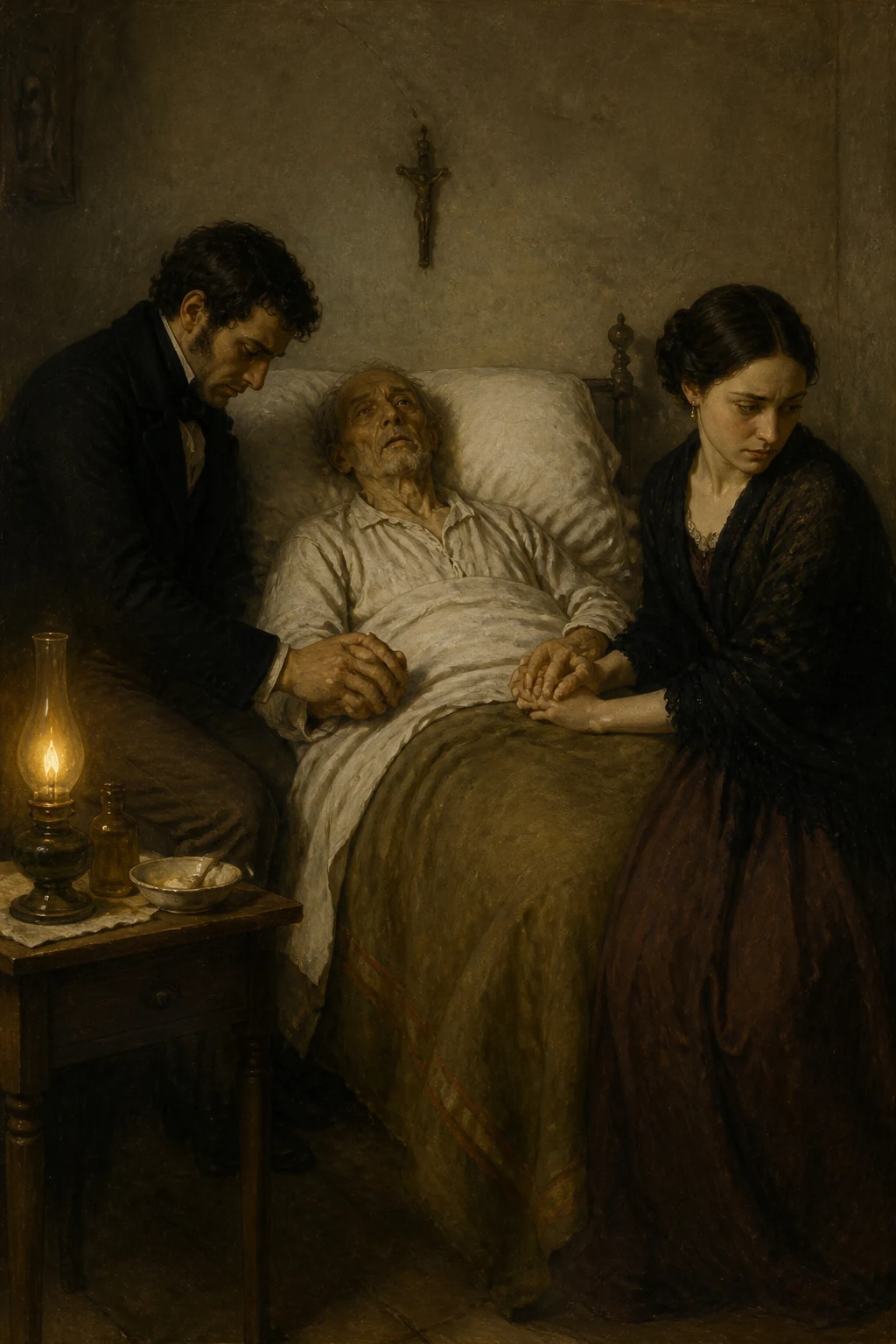
Salcedo was executed at the place called Orcca-Pata, a short distance from Puno. III When Salcedo's wife learned the terrible outcome of the trial, she summoned her kinsmen and said to them:
“My riches have brought me misery. Those who covet them have put the man God gave me for a companion to a shameful death. See to it that you avenge him.”
Three days later the mine of Laycacota had flooded, and its entrance had been covered with rocks, so that to this day its former location has never been discovered.
The kinsmen of Salcedo's wife flooded the mine, making the crime to which greed had driven the chief magistrate's murderers fruitless for them.
Carmen, the desolate widow, had disappeared, and tradition has it that she buried herself alive in one of the mine's galleries. Many maintain that Salcedo's mine was the one now known as El Manto. This is an error we must correct. Salcedo's coveted mine lay between the hills of Laycacota and Cancharani.
The viceroy, Count of Lemos, during whose term of office Saint Rose was canonized, died in December 1673, and his heart was buried beneath the high altar of the church of Los Desamparados.
This viceroy's coat of arms bore, for Castro, a golden sun on a field of gules. As for the descendants of the Salcedo brothers, during the reign of Philip V they obtained the restoration of their family's good name and the title of Marquis of Villarrica for the head of the family.
Izvirnik
CRÓNICA DE LA ÉPOCA DEL DÉCIMONONO VIRREY DEL PERÚ
(Al doctor don José Mariano Jiménez.)
I
En una serena tarde de marzo del año del Señor de 1665, hallábase reunida a la puerta de su choza una familia de indios. Componíase ésta de una anciana que se decía descendiente del gran general Ollantay, dos hijas, Carmen y Teresa, y un mancebo llamado Tomás.
La choza estaba situada a la falda del cerro de Laycacota. Ella con quince o veinte más constituían lo que se llama una aldea de cien habitantes.
Mientras las muchachas se entretenían en hilar, la madre contaba al hijo, por la milésima vez, la tradición de su familia. Esta no es un secreto, y bien puedo darla a conocer a mis lectores, que la hallarán relatada con extensos y curiosos pormenores en el importante libro que con el título Anales del Cuzco, publicó mi ilustrado amigo y compañero de Congreso don Pío Benigno Mesa.
He aquí la tradición sobre Ollantay:
Bajo el imperio del Inca Pachacutec, noveno soberano del Cuzco, era Ollantay, curaca de Ollantaytambo, el generalísimo de los ejércitos. Amante correspondido de una de las ñustas o infantas, solicitó de Pachacutec, y como recompensa a importantes servicios, que le acordase la mano de la joven. Rechazada su pretensión por el orgulloso monarca, cuya sangre, según las leyes del imperio, no podía mezclarse con la de una familia que no descendiese directamente de Mango Capac, el enamorado cacique desapareció una noche del Cuzco, robándose a su querida Cusicoyllor.
Durante cinco años fué imposible al Inca vencer al rebelde vasallo, que se mantuvo en armas en las fortalezas de Ollantaytambo, cuyas ruinas son hoy la admiración del viajero. Pero Rumiñahui, otro de los generales de Pachacutec, en secreta entrevista con su rey, lo convenció de que, más que a la fuerza, era preciso recurrir a la maña y a la traición para sujetar a Ollantay. El plan acordado fué poner preso a Rumiñahui, con el pretexto de que había violado el santuario de las vírgenes del Sol. Según lo pactado, se le degradó y azotó en la plaza pública para que, envilecido así, huyese del Cuzco y fuese a ofrecer sus servicios a Ollantay, que viendo en él una ilustre víctima a la vez que un general de prestigio, no podría menos que dispensarle entera confianza. Todo se realizó como inicuamente estaba previsto, y la fortaleza fué entregada por el infame Rumiñahui, mandando el Inca decapitar a los prisioneros[2].
[Nota 2: Sobre este argumento, el cura de Tinta don Antonio Valdés escribió por los años de 1780 un drama en lengua quechua, el cual se representó en presencia del rebelde Inca Tupac-Amaru.
Tschudi, Markham, Nadal, Barrancas y muchos americanistas se empeñaron en sostener que el drama Ollanta había sido compuesto en los tiempos incásicos, y que era, por consiguiente, un monumento literario anterior a la conquista. Traducido en verso por un poeta peruano, Constantino Carrasco, publicó el autor de estas Tradiciones un ligero juicio crítico, en el que se atrevió a apuntar (alegando muy al correr de la pluma varias razones en apoyo de su opinión) que el Ollanta era ni más ni menos que comedia española, de las de capa y espada, escrita en voces quechuas: y que, aunque lo diga Garcilaso, que no pocos embustes estampó en los Comentarios reales, los antiguos peruanos estuvieron muy lejos de cultivar la literatura dramática. Tanto osamos escribir, y se nos vino la casa a cuestas... Hasta de mal patriota nos acusó un quechuista; y un señor Pacheco Zegarra, entre otros cultos piropos, nos llamó ignorante y charlatán. Con razones de ese fuste nos dimos por convencidos de que habíamos estampado un disparate de a folio. Pero en 1881, el literato argentino don Bartolomé Mitre, en un serio y extenso estudio, con gran acopio de pruebas y con sesuda argumentación, puso en transparencia la filiación, genuinamente española, del drama Ollanta en su forma, en su fondo y hasta en sus elementos lingüísticos.]
Un leal capitán salvó a Cusicoyllor y su tierna hija Imasumac, y se estableció con ellas en la falda del Laycacota, en el sitio donde en 1669 debía erigirse la villa de San Carlos de Puno.
Concluía la anciana de referir a su hijo esta tradición, cuando se presentó ante ella un hombre, apoyado en un bastón, cubierto el cuerpo con un largo poncho de bayeta, y la cabeza por un ancho y viejo sombrero de fieltro. El extranjero era un joven de veinticinco años, y a pesar de la ruindad de su traje, su porte era distinguido, su rostro varonil y simpático y su palabra graciosa y cortesana.
Dijo que era andaluz, y que su desventura lo traía a tal punto que se hallaba sin pan ni hogar. Los vástagos de la hija de Pachacutec le acordaron de buen grado la hospitalidad que demandaba.
Así transcurrieron pocos meses. La familia se ocupaba en la cría de ganado y en el comercio de lanas, sirviéndola el huésped muy útilmente. Pero la verdad era que el joven español se sentía apasionado de Carmen, la mayor de las hijas de la anciana, y que ella no se daba por ofendida con ser objeto de las amorosas ansias del mancebo.
Como el platonismo, en punto a terrenales afectos, no es eterno, llegó un día en que el galán, cansado de conversar con las estrellas en la soledad de sus noches, se espontaneó con la madre, y ésta, que había aprendido a estimar al español, le dijo:
--Mi Carmen te llevará en dote una riqueza digna de la descendiente de emperadores.
El novio no dio por el momento importancia a la frase; pero tres días después de realizado el matrimonio, la anciana lo hizo levantarse de madrugada y lo condujo a una bocamina, diciéndole:
--Aquí tienes la dote de tu esposa.
La hasta entonces ignorada, y después famosísima, mina de Laycacota fué desde ese día propiedad de don José Salcedo, que tal era el nombre del afortunado andaluz.
II
La opulencia de la mina y la generosidad de Salcedo y de su hermano don Gaspar atrajeron, en breve, gran número de aventureros a Laycacota.
Oigamos a un historiador: «Había allí plata pura y metales, cuyo beneficio dejaba tantos marcos como pesaba el cajón. En ciertos días se sacaron centenares de miles de pesos».
Estas aseveraciones parecerían fabulosas si todos los historiadores no estuvieran uniformes en ellas.
Cuando algún español, principalmente andaluz o castellano, solicitaba un socorro de Salcedo, éste le regalaba lo que pudiese sacar de la mina en determinado número de horas. El obsequio importaba casi siempre por lo menos el valor de una barra, que representaba dos mil pesos.
Pronto los catalanes, gallegos y vizcaínos que residían en el mineral entraron en disensiones con los andaluces, castellanos y criollos favorecidos por los Salcedo. Se dieron batallas sangrientas con variado éxito, hasta que el virrey don Diego de Benavides, conde de Santisteban, encomendó al obispo de Arequipa, fray Juan de Almoguera, la pacificación del mineral. Los partidarios de los Salcedo derrotaron a las tropas del obispo, librando mal herido el corregidor Peredo.
En estos combates, hallándose los de Salcedo escasos de plomo, fundieron balas de plata. No se dirá que no mataban lujosamente.
Así las cosas, aconteció en Lima la muerte de Santisteban, y la Real Audiencia asumió el poder. El gobernador que ésta nombró para Laycacota, viéndose sin fuerzas para hacer respetar su autoridad, entregó el mando a don José Salcedo, que lo aceptó bajo el título de justicia mayor. La Audiencia se declaró impotente y contemporizó con Salcedo, el cual, recelando nuevos ataques de los vascongados, levantó y artilló una fortaleza en el cerro.
En verdad que la Audiencia tenía por entonces mucho grave de que ocuparse con los disturbios que promovía en Chile el gobernador Meneses y con la tremenda y vasta conspiración del Inca Bohorques, descubierta en Lima casi al estallar, y que condujo al caudillo y sus tenientes al cadalso.
El orden se había por completo restablecido en Laycacota, y todos los vecinos estaban contentos del buen gobierno y la caballerosidad del justicia mayor.
Pero en 1667, la Audiencia tuvo que reconocer al nuevo virrey llegado de España.
Era éste el conde Lemos, mozo de treinta y tres años, a quien, según los historiadores, sólo faltaba sotana para ser completo jesuíta. En cerca de cinco años de mando, brilló poco como administrador. Sus empresas se limitaron a enviar, aunque sin éxito, una fuerte escuadra en persecución del bucanero Morgán, que había incendiado Panamá, y a apresar en las costas de Chile a Enrique Clerk. Un año después de su destrucción por los bucaneros (1670), la antigua Panamá, fundada en 1518, se trasladó al lugar donde hoy se encuentra. Dos voraces incendios, uno en febrero de 1737 y otro en marzo de 1756, convirtieron en cenizas dos terceras partes de los edificios, entre los que algunos debieron ser monumentales, a juzgar por las ruinas que aun llaman la atención del viajero.
El virrey conde de Lemos se distinguió únicamente por su devoción. Con frecuencia se le veía barriendo el piso de la iglesia de los Desamparados, tocando en ella el órgano, y haciendo el oficio de cantar en la solemne misa dominical, dándosele tres pepinillos de las murmuraciones de la nobleza, que juzgaba tales actos indignos de un grande de España.
Dispuso este virrey, bajo pena de cárcel y multa, que nadie pintase cruz en sitio donde pudiera ser pisada; que todos se arrodillasen al toque de oraciones; y escogió para padrino de uno de sus hijos al cocinero del convento de San Francisco, que era un negro con un jeme de jeta y fama de santidad.
Por cada individuo de los que ajusticiaba, mandaba celebrar treinta misas; y consagró, por lo menos, tres horas diarias al rezo del oficio parvo y del rosario, confesando y comulgando todas las mañanas, y concurriendo al jubileo y a cuanta fiesta o distribución religiosa se le anunciara.
Jamás se han vista en Lima procesiones tan espléndidas como las de entonces; y Lorente, en su Historia, trae la descripción de una que se trasladó desde palacio a los Desamparados, dando largo rodeo, una imagen de María que el virrey había hecho traer expresamente desde Zaragoza. Arco hubo en esa fiesta cuyo valor se estimó en más de doscientos mil pesos, tal era la profusión de alhajas y piezas de oro y plata que lo adornaban. La calle de Mercaderes lució por pavimento barras de plata, que representaban más de dos millones de ducados. ¡Viva el lujo y quien lo trujo!
El fanático don Pedro Antonio de Castro y Andrade, conde de Lemos, marqués de Sarria y de Gátiva y duque de Taratifanco, que cifraba su orgullo en descender de San Francisco de Borja, y que, a estar en sus manos, como él decía, habría fundado en cada calle de Lima un colegio de Jesuítas, apenas fué proclamado en Lima como representante de Carlos II el Hechizado, se dirigió a Puno con gran aparato de fuerza y aprehendió a Salcedo.
El justicia contaba con poderosos elementos para resistir; pero no quiso hacerse reo de rebeldía a su rey y señor natural.
El virrey, según muchos historiadores, lo condujo preso, tratándolo durante la marcha con extremado rigor. En breve tiempo quedó concluída la causa, sentenciado Salcedo a muerte, y confiscados sus bienes en provecho del real tesoro.
Como hemos dicho, los jesuítas dominaban al virrey. Jesuíta era su confesor el padre Castillo, y jesuítas sus secretarios. Las crónicas de aquellos tiempos acusan a los hijos de Loyola de haber contribuido eficazmente al trágico fin del rico minero, que había prestado no pocos servicios a la causa de la corona y enviado a España algunos millones por el quinto de los provechos de la mina.
Cuando leyeron a Salcedo la sentencia, propuso al virrey que le permitiese apelar a España, y que por el tiempo que transcurriese desde la salida del navío hasta su regreso con la resolución de la corte de Madrid, lo obsequiaría diariamente con una barra de plata.
Y téngase en cuenta no sólo que cada barra de plata se valorizaba en dos mil duros, sino que el viaje del Callao a Cádiz no era realizable en menos de seis meses.
La tentación era poderosa, y el conde de Lemos vaciló.
Pero los jesuítas le hicieron presente que mejor partido sacaría ejecutando a Salcedo y confiscándole sus bienes.
El que más influyó en el ánimo de su excelencia fué el padre Francisco del Castillo, jesuíta peruano que está en olor de santidad, el cual era padrino de bautismo de don Salvador Fernández de Castro, marqués de Almuña e hijo del virrey.
Salcedo fué ejecutado en el sitio llamado Orcca-Pata, a poca distancia de Puno.
III
Cuando la esposa de Salcedo supo el terrible desenlace del proceso, convocó a sus deudos y les dijo:
--Mis riquezas han traído mi desdicha. Los que las codician han dado muerte afrentosa al hombre que Dios me deparó por compañero. Mirad cómo le vengáis.
Tres días después la mina de Laycacota había dado en agua, y su entrada fué cubierta con peñas, sin que hasta hoy haya podido descubrirse el sitio donde ella existió.
Los parientes de la mujer de Salcedo inundaron la mina, haciendo estéril para los asesinos del justicia mayor el crimen a que la codicia los arrastrara.
Carmen, la desolada viuda, había desaparecido, y es fama que se sepultó viva en uno de los corredores de la mina.
Muchos sostienen que la mina de Salcedo era la que hoy se conoce con el nombre del Manto. Este es un error que debemos rectificar. La codiciada mina de Salcedo estaba entre los cerros Laycacota y Cancharani.
El virrey, conde Lemos, en cuyo período de mando tuvo lugar la canonización de Santa Rosa, murió en diciembre de 1673, y su corazón fué enterrado bajo el altar mayor de la iglesia de los Desamparados.
Las armas de este virrey eran, por Castro, un sol de oro sobre gules.
En cuanto a los descendientes de los hermanos Salcedo, alcanzaron bajo el reinado de Felipe V la rehabilitación de su nombre y el título de marqués de Villarrica para el jefe de la familia.