Prevod
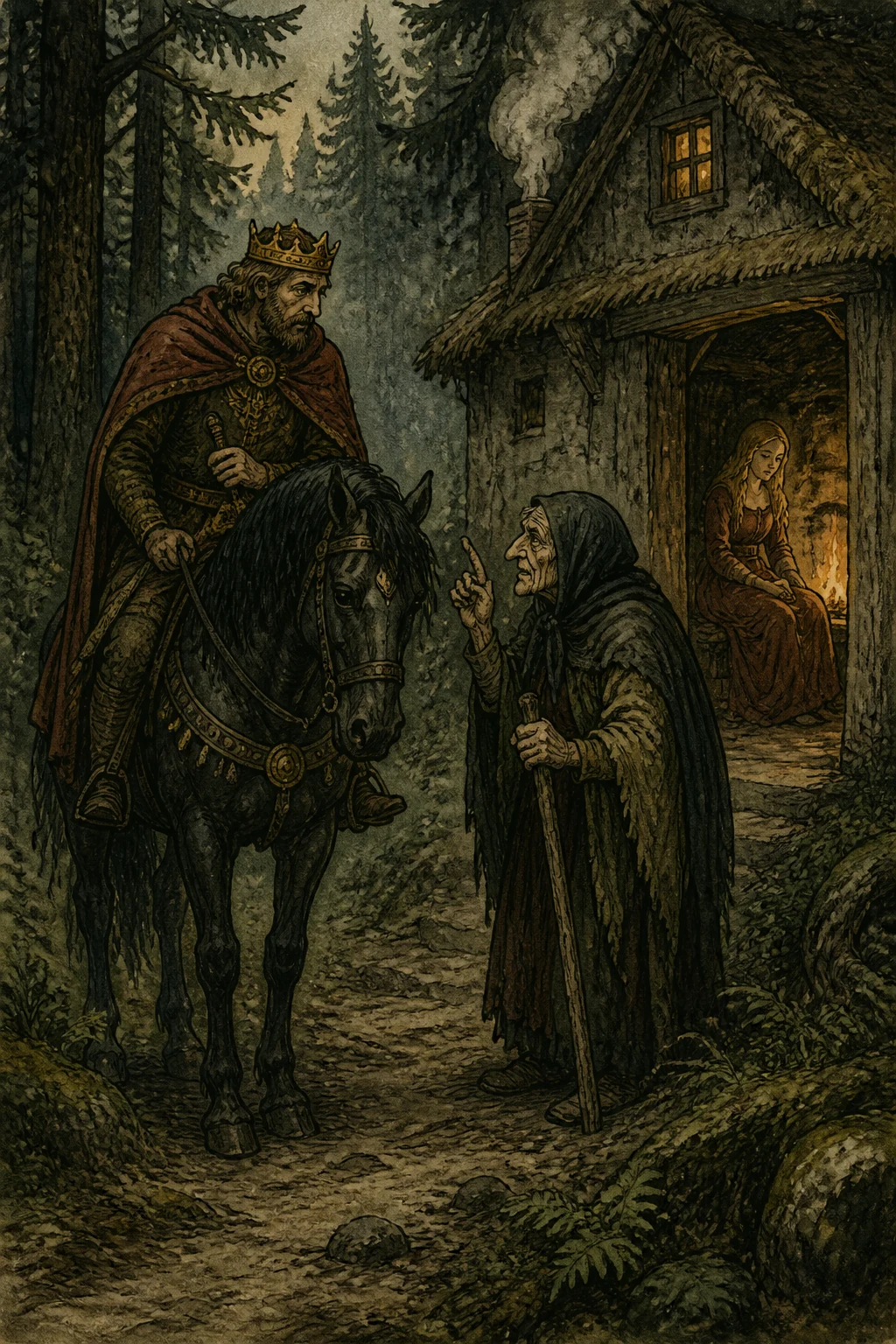
Once upon a time there was a queen who had a little daughter, still so young that she had to be carried in her arms. One day the child was naughty, and whatever her mother said, she would not be quiet. At last the queen grew impatient, and seeing the ravens flying about the castle, she opened the window and said, "I wish you were a raven and would fly away, so that I might have some peace." Scarcely had she spoken when the child turned into a raven and flew from her arms and out through the window. She flew into a dark forest and stayed there for a long time, and her parents heard nothing of her. Some time later, a man's path led him into this forest. He heard the raven calling and followed the sound, and when he came nearer, the raven said, "I am a king's daughter by birth, and I have been put under an enchantment, but you can set me free." "What must I do?" he asked. She said, "Go farther into the forest, and you will find a house where an old woman lives. She will offer you food and drink, but you must take nothing. If you eat or drink anything, you will fall asleep and will not be able to set me free. In the garden behind the house there is a great heap of tanner's bark. You must stand on it and wait for me. For three days I shall come to you at two o'clock each afternoon in a carriage drawn first by four white stallions, then by four red ones, and lastly by four black ones. But if you are asleep instead of awake, I shall not be freed." The man promised to do everything she had asked. But the raven said, "Ah, I know already that you will not set me free. You will take something from the woman." Then the man promised once again that he would certainly touch nothing, neither food nor drink. But when he entered the house, the old woman came up to him and said, "Poor man, how weary you are! Come and refresh yourself. Eat and drink." "No," said the man, "I will neither eat nor drink." But she would give him no peace, and said, "If you will not eat, then at least take a sip from the glass. Once does not count." So he let himself be persuaded and drank. Towards two o'clock that afternoon he went out into the garden and stood on the heap of bark to wait for the raven. As he stood there, he suddenly grew so tired that he could not fight it, and lay down for a little while, though he did not mean to fall asleep. But scarcely had he stretched himself out when his eyes closed of their own accord, and he fell into so deep a sleep that nothing in the world could have woken him. At two o'clock the raven came in a carriage drawn by four white stallions, but she was already filled with sorrow, and said, "I know he is asleep." And when she came into the garden, there he lay on the heap of bark, fast asleep. She stepped out of the carriage, went over to him, shook him and called to him, but he did not wake. At midday the next day, the old woman came again and brought him food and drink, but he would not accept them. Yet she gave him no peace, and coaxed him until he once more took a sip from the glass. Towards two o'clock he went into the garden and stood on the heap of bark to wait for the raven. Suddenly he felt so weary that his legs would no longer support him. He could not help himself, but had to lie down, and fell into a deep sleep. When the raven came in her carriage drawn by four brown stallions, she was already filled with sorrow, and said, "I know he is asleep." She went over to him, but there he lay sleeping, and could not be woken. The next day the old woman asked what he meant by this. He ate nothing and drank nothing—did he want to die? He answered, "I do not wish to eat or drink, nor am I allowed to." But she set a dish of food and a glass of wine before him, and when the smell rose to his nostrils, he could not resist and took a long draught. When the time came, he went out into the garden to the heap of bark and waited for the princess. Then he grew even more tired than on the previous days, lay down, and slept as soundly as a stone. At two o'clock the raven came with four black stallions, and the carriage and everything about it were black. She was already filled with sorrow, and said, "I know he is asleep and cannot set me free." When she reached him, there he lay, fast asleep. She shook him and called to him, but could not wake him. Then she laid a loaf of bread beside him, a piece of meat, and lastly a bottle of wine. He could take as much as he wished of any of them, and they would never grow less. Then she took a golden ring from her finger and put it on his. Her name was engraved upon it. Last of all she left a letter telling him what she had given him and that it would never run out. In it she also wrote, "I see plainly that you cannot set me free here. But if you still wish to free me, come to the golden castle of Stromberg. It lies within your power; of that I am certain."
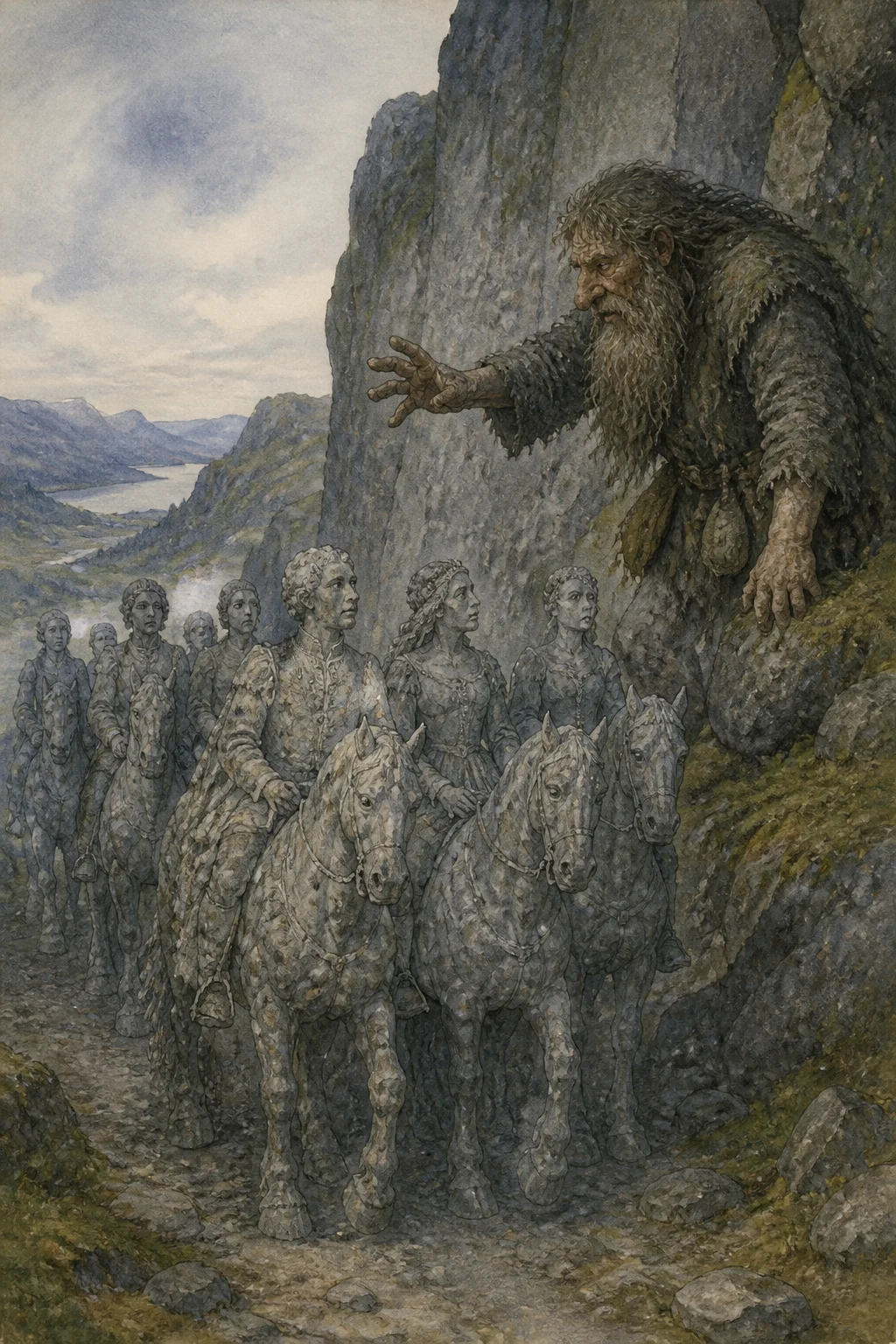
When she had given him all these things, she climbed into her carriage and drove away to the golden castle of Stromberg. When the man awoke and realized that he had been asleep, he was deeply saddened and said, "Surely she has driven past by now, and I have not set her free." Then he caught sight of the things lying beside him and read the letter, which told him what had happened. So he set off, meaning to go to the golden castle of Stromberg, though he did not know where it lay. He had been wandering about the world for a long time when he came to a dark forest. For a fortnight he walked through it, unable to find his way out. Evening fell once more, and he was so tired that he lay down beside a bush and went to sleep. The next day he walked on, and that evening, just as he was about to lie down beside another bush, he heard such howling and wailing that he could not sleep. When the hour came for people to light their lamps, he saw a light glimmering, got up, and followed it. He came to a house that looked very small, for a great giant was standing in front of it. He thought to himself, "If you go in and the giant catches sight of you, it may well cost you your life." At last he ventured to approach. When the giant saw him, he said, "It is a good thing you have come. I have had nothing to eat for a long time, and I shall swallow you straight away for my supper." "You had better not," said the man. "I have no wish to be swallowed. If you want something to eat, I have enough to fill your belly." "If that is true," said the giant, "you need have no fear. I only meant to eat you because I have nothing else." So they went and sat down at the table, and the man brought out the bread, wine, and meat that never ran out. "This is very much to my liking," said the giant, and ate to his heart's content. Afterwards the man said to him, "Can you tell me where the golden castle of Stromberg is?" The giant said, "I shall look on my map. Every town, village, and house is marked on it." He fetched the map he kept in his room and looked for the castle, but it was not there. "No matter," he said. "I have still larger maps up in the cupboard. We shall look on those." But that, too, was in vain. The man was about to go on his way, but the giant asked him to wait a few more days until his brother came home, for he had gone out to fetch provisions. When the brother returned, they asked him about the golden castle of Stromberg. He answered, "When I have eaten my fill, I shall look on the map." Then he went upstairs with them to his room, and they searched his map but could not find it. So he fetched some more old maps, and they kept searching until at last they found the golden castle of Stromberg, but it was many thousands of miles away. "How am I to get there?" asked the man. The giant said, "I have two hours to spare, and I shall carry you most of the way. But then I must go home again and suckle the child we have." So the giant carried the man to within about a hundred hours' journey of the castle, and said, "You can surely walk the rest of the way alone." Then he turned back, while the man pressed on day and night until at last he reached the golden castle of Stromberg. It stood on a glass mountain, and the enchanted maiden drove round the castle in her carriage and then went inside. He rejoiced when he saw her and tried to climb up to her, but whatever he did, he kept slipping down the glass again. When he saw that he could not reach her, he grew very sorrowful and said to himself, "I shall stay down here and wait for her." So he built himself a hut and lived in it for a whole year, watching the princess drive about above him every day, but unable to reach her.
One day, looking out of his hut, he saw three robbers fighting, and called to them, "God be with you!" At his call they stopped, but when they saw no one, they began fighting again, more fiercely than ever. Once more he called, "God be with you!" Again they stopped and looked about, but seeing no one, they went on fighting. Then he called for the third time, "God be with you!" and thought, "You must see what those three are about." He went over and asked why they were beating one another. One of them said he had found a stick that would make any door spring open if he struck it with it. The second said he had found a cloak that made him invisible when he put it on. The third said he had caught a horse that could carry its rider anywhere, even up the glass mountain. Now they could not decide whether to keep these things in common or go their separate ways. The man said, "I will trade you for those three things. I have no money, it is true, but I have other things worth more. First, though, I must try them out to see whether you have told the truth." So they let him mount the horse, put the cloak over his shoulders, and placed the stick in his hand. Once he had all these things, they could no longer see him. Then he gave them a sound beating and cried, "There, you scoundrels! You have what you deserve. Are you satisfied?" Then he rode up the glass mountain, and when he reached the castle at the top, he found it locked. He struck the gate with the stick, and at once it sprang open. He entered and went up the stairs into the great hall, where the maiden sat with a golden goblet of wine before her. But she could not see him, for he was wearing the cloak. When he stood before her, he slipped the ring she had given him from his finger and dropped it into the goblet with a clink. Then she cried, "That is my ring! The man who will set me free must be here too." They searched the whole castle but could not find him, for he had gone outside, mounted the horse, and thrown off the cloak. When they came out through the gate, they saw him and cried out for joy. Then he dismounted and took the princess in his arms, and she kissed him and said, "Now you have set me free, and tomorrow we shall celebrate our wedding."
Izvirnik
Ein Märchen der Brüder Grimm
Es war einmal eine Königin, die hatte ein Töchterchen, das war noch klein und mußte noch auf dem Arm getragen werden. Zu einer Zeit war das Kind unartig, und die Mutter mochte sagen, was sie wollte, es hielt nicht Ruhe. Da ward sie ungeduldig, und weil die Raben so um das Schloß herumflogen, öffnete sie das Fenster und sagte: "Ich wollte, du wärst eine Rabe und flögst fort, so hätt ich Ruhe." Kaum hatte sie das Wort gesagt, so war das Kind in eine Rabe verwandelt und flog von ihrem Arm zum Fenster hinaus. Sie flog aber in einen dunkeln Wald und blieb lange Zeit darin und die Eltern hörten nichts von ihr. Danach führte einmal einen Mann sein Weg in diesen Wald, der hörte die Rabe rufen und ging der Stimme nach, und als er näher kam, sprach die Rabe: "Ich bin eine Königstochter von Geburt und bin verwünscht worden, du aber kannst mich erlösen." "Was soll ich tun?" fragte er. Sie sagte: "Geh weiter in den Wald, und du wirst ein Haus finden, darin sitzt eine alte Frau, die wird dir Essen und Trinken reichen, aber du darfst nichts nehmen; wenn du etwas issest oder trinkst, so verfällst du in einen Schlaf und kannst du mich nicht erlösen. Im Garten hinter dem Haus ist eine große Lohhucke, darauf sollst du stehen und mich erwarten. Drei Tage lang komm ich jeden Mittag um zwei Uhr zu dir in einem Wagen, der ist erst mit vier weißen Hengsten bespannt, dann mit vier roten und zuletzt mit vier schwarzen, wenn du aber nicht wach bist, sondern schläfst, so werde ich nicht erlöst." Der Mann versprach alles zu tun, was sie verlangt hatte. Die Rabe aber sagte: "Ach, ich weiß es schon, du wirst mich nicht erlösen, du nimmst etwas von der Frau." Da versprach der Mann noch einmal, er wollte gewiß nichts anrühren, weder von dem Essen noch von dem Trinken. Wie er aber in das Haus kam, trat die alte Frau zu ihm und sagte: "Armer Mann, was seid Ihr abgemattet, kommt und erquickt Euch, esset und trinket." "Nein," sagte der Mann, "ich will nicht essen und nicht trinken." Sie ließ ihm aber keine Ruhe und sprach: "Wenn Ihr dann nicht essen wollt, so tut einen Zug aus dem Glas, einmal ist keinmal." Da ließ er sich überreden und trank. Nachmittags gegen zwei Uhr ging er hinaus in den Garten auf die Lohhucke und wollte auf die Rabe warten. Wie er da stand, ward er auf einmal so müde, und konnte es nicht überwinden und legte sich ein wenig nieder; doch wollte er nicht einschlafen. Aber kaum hatte er sich hingestreckt, so fielen ihm die Augen von selber zu, und er schlief ein und schlief so fest, daß ihn nichts auf der Welt hätte erwecken können. Um zwei Uhr kam die Rabe mit vier weißen Hengsten gefahren, aber sie war schon in voller Trauer und sprach: "Ich weiß, daß er schläft." Und als sie in den Garten kam, lag er auch da auf der Lohhucke und schlief. Sie stieg aus dem Wagen, ging zu ihm und schüttelte ihn und rief ihn an, aber er erwachte nicht. Am andern Tag zur Mittagszeit kam die alte Frau wieder und brachte ihm Essen und Trinken, aber er wollte es nicht annehmen. Doch sie ließ ihm keine Ruhe und redete ihm so lange zu, bis er wieder einen Zug aus dem Glase tat. Gegen zwei Uhr ging er in den Garten auf die Lohhucke und wollte auf die Rabe warten, da empfand er auf einmal so große Müdigkeit, daß seine Glieder ihn nicht mehr hielten; er konnte sich nicht helfen, mußte sich legen und fiel in tiefen Schlaf. Als die Rabe daherfuhr mit vier braunen Hengsten, war sie schon in voller Trauer und sagte: "Ich weiß, daß er schläft." Sie ging zu ihm hin, aber er lag da im Schlaf und war nicht zu erwecken. Am andern Tage sagte die alte Frau, was das wäre? Er äße und tränke nichts, ob er sterben wollte? Er antwortete: "Ich will und darf nicht essen und nicht trinken." Sie stellte aber die Schüssel mit Essen und das Glas mit Wein vor ihm hin, und als der Geruch davon zu ihm aufstieg, so konnte er nicht widerstehen und tat einen starken Zug. Als die Zeit kam, ging er hinaus in den Garten auf die Lohhucke und wartete auf die Königstochter. da ward er noch müder als die Tage vorher, legte sich nieder und schlief so fest, als wäre er ein Stein. Um zwei Uhr kam die Rabe und hatte vier schwarze Hengste, und die Kutsche und alles war schwarz. Sie war aber schon in voller Trauer und sprach: "Ich weiß, daß er schläft und mich nicht erlösen kann." Als sie zu ihm kam, lag er da und schlief fest. Sie rüttelte ihn und rief ihn, aber sie konnte ihn nicht aufwecken. Da legte sie ein Brot neben ihn hin, dann ein Stück Fleisch, zum dritten eine Flasche Wein, und er konnte von allem so viel nehmen, als er wollte, es ward nicht weniger. Danach nahm sie einen goldenen Ring von ihrem Finger, und steckte ihn an seinen Finger, und war ihr Name eingegraben. Zuletzt legte sie einen Brief hin, darin stand, was sie ihm gegeben hatte, und daß es nie all würde, und es stand auch darin: "Ich sehe wohl, daß du mich hier nicht erlösen kannst, willst du mich aber noch erlösen, so komm nach dem goldenen Schloß von Stromberg, es steht in deiner Macht, das weiß ich gewiß."
Und wie sie ihm das alles gegeben hatte, setzte sie sich in ihren Wagen und fuhr in das goldene Schloß von Stromberg.
Als der Mann aufwachte und sah, daß er geschlafen hatte, ward er von Herzen traurig und sprach: "Gewiß nun ist sie vorbeigefahren, und ich habe sie nicht erlöst." Da fielen ihm die Dinge in die Augen, die neben ihm lagen, und er las den Brief, darin geschrieben stand, wie es zugegangen war. Also machte er sich auf und ging fort, und wollte nach dem goldenen Schloß von Stromberg, aber er wußte nicht, wo es lag. Nun war er schon lange in der Welt herumgegangen, da kam er in einen dunkeln Wald und ging vierzehn Tage darin fort und konnte sich nicht herausfinden. Da ward es wieder Abend, und er war so müde, daß er sich an einen Busch legte und einschlief. Am andern Tag ging er weiter, und abends als er sich wieder an einen Busch legen wollte, hörte er ein Heulen und Jammern, daß er nicht einschlafen konnte. Und wie die Zeit kam, wo die Leute Lichter anstecken, sah er eins schimmern, machte sich auf und ging ihm nach; da kam er vor ein Haus, das schien so klein, denn es stand ein großer Riese davor. Da dachte er bei sich: "Gehst du hinein und der Riese erblickt dich, so ist es leicht um dein Leben geschehen." Endlich wagte er es und trat heran. Als der Riese ihn sah, sprach er: "Es ist gut, daß du kommst, ich habe lange nichts gegessen, ich will dich gleich zum Abendbrot verschlucken." "Laß das lieber sein," sprach der Mann, "ich lasse mich nicht gerne verschlucken; verlangst du zu essen, so habe ich genug, um dich satt zu machen." "Wenn das wahr ist," sagte der Riese, "so kannst du ruhig bleiben; ich wollte dich nur verzehren, weil ich nichts anderes habe." Da gingen sie und setzten sich an den Tisch, und der Mann holte Brot, Wein und Fleisch, das nicht all ward. "Das gefällt mir wohl," sprach der Riese und aß nach Herzenslust. Danach sprach der Mann zu ihm: "Kannst du mir nicht sagen, wo das goldene Schloß von Stromberg ist?" Der Riese sagte: "Ich will auf meiner Landkarte nachsehen, darauf sind alle Städte, Dörfer und Häuser zu finden." Er holte die Landkarte, die er in der Stube hatte, und suchte das Schloß, aber es stand nicht darauf. "Es tut nichts," sprach er, "ich habe oben im Schranke noch größere Landkarten; darauf wollen wir suchen," aber es war auch vergeblich. Der Mann wollte nun weitergehen; aber der Riese bat ihn, noch ein paar Tage zu warten, bis sein Bruder heim käme, der wäre ausgegangen, Lebensmittel zu holen. Als der Bruder heim kam, fragten sie nach dem goldenen Schloß von Stromberg, er antwortete: "Wenn ich gegessen habe und satt bin, dann will ich auf der Karte suchen." Er stieg dann mit ihnen auf seine Kammer und sie suchten auf seiner Landkarte, konnten es aber nicht finden; da holte er noch andere alte Karten, und sie ließen nicht ab, bis sie endlich das goldene Schloß von Stromberg fanden, aber es war viele tausend Meilen weit weg. "Wie werde ich nun dahin kommen?" fragte der Mann. Der Riese sprach: "Zwei Stunden hab ich Zeit, da will ich dich bis in die Nähe tragen, dann aber muß ich wieder nach Haus und das Kind säugen, das wir haben." Da trug der Riese den Mann bis etwa hundert Stunden vom Schloß und sagte: "Den übrigen Weg kannst du wohl allein gehen." Dann kehrte er um, der Mann aber ging vorwärts Tag und Nacht, bis er endlich zu dem goldenen Schloß von Stromberg kam. Es stand aber auf einem gläsernen Berge, und die verwünschte Jungfrau fuhr in ihrem Wagen um das Schloß herum und ging dann hinein. Er freute sich, als er sie erblickte, und wollte zu ihr hinaufsteigen, aber wie er es auch anfing, er rutschte an dem Glas immer wieder herunter. Und als er sah, daß er sie nicht erreichen konnte, ward er ganz betrübt und sprach zu sich selbst: "Ich will hier unten bleiben und auf sie warten." Also baute er sich eine Hütte und saß darin ein ganzes Jahr und sah die Königstochter alle Tage oben fahren, konnte aber nicht zu ihr hinaufkommen.
Da sah er einmal aus seiner Hütte, wie drei Räuber sich schlugen, und rief ihnen zu: "Gott sei mit euch!" Sie hielten bei dem Rufe inne, als sie aber niemand sahen, fingen sie wieder an sich zu schlagen, und das zwar ganz gefährlich. Da rief er abermals: "Gott sei mit euch!" Sie hörten wieder auf, guckten sich um, weil sie aber niemand sahen, fuhren sie auch wieder fort sich zu schlagen. Da rief er zum drittenmal: "Gott sei mit euch!" und dachte "du mußt sehen, was die drei vorhaben," ging hin und fragte, warum sie aufeinander losschlügen. Da sagte der eine, er hätte einen Stock; gefunden, wenn er damit wider eine Tür schlüge, so spränge sie auf; der andere sagte, er hätte einen Mantel gefunden, wenn er den umhinge, so wäre er unsichtbar; der dritte aber sprach, er hätte ein Pferd gefangen, damit könnte man überall hinreiten, auch den gläsernen Berg hinauf. Nun wüßten sie nicht, ob sie das in Gemeinschaft behalten oder ob sie sich trennen sollten. Da sprach der Mann: "Die drei Sachen will ich euch eintauschen: Geld habe ich zwar nicht, aber andere Dinge, die mehr wert sind, doch muß ich vorher eine Probe machen, damit ich sehe, ob ihr auch die Wahrheit gesagt habt." Da ließen sie ihn aufs Pferd sitzen, hingen ihm den Mantel um und gaben ihm den Stock in die Hand, und wie er das alles hatte, konnten sie ihn nicht mehr sehen. Da gab er ihnen tüchtige Schläge und rief: "Nun, ihr Bärenhäuter, da habt ihr, was euch gebührt: seid ihr zufrieden?" Dann ritt er den Glasberg hinauf, und als er oben vor das Schloß kam, war es verschlossen; da schlug er mit dem Stock an das Tor, und alsbald sprang es auf. Er trat ein und ging die Treppe hinauf bis oben in den Saal, da saß die Jungfrau und hatte einen goldenen Kelch mit Wein vor sich. Sie konnte ihn aber nicht sehen, weil er den Mantel umhatte. Und als er vor sie kam, zog er den Ring, den sie ihm gegeben hatte, vom Finger und warf ihn in den Kelch, daß es klang. Da rief sie: "Das ist mein Ring, so muß auch der Mann da sein, der mich erlösen wird." Sie suchten im ganzen Schloß und fanden ihn nicht, er war aber hinausgegangen, hatte sich aufs Pferd gesetzt und den Mantel abgeworfen. Wie sie nun vor das Tor kamen, sahen sie ihn und schrieen vor Freude. Da stieg er ab und nahm die Königstochter in den Arm; sie aber küßte ihn und sagte: "Jetzt hast du mich erlöst, und morgen wollen wir unsere Hochzeit feiern."