Prevod
Nekoč je živela mama koza, ki je imela pet kozličkov, in ti so ji bili tako ljubi, da ji nič na svetu ni moglo biti ljubše. Nekega dne se je odpravila v gozd nabirat drva za ogenj. »No, moji kozlički,« jim je rekla, »zelo previdni morate biti, dokler me ne bo. Za menoj zapahnite vrata in jih nikomur ne odpirajte, dokler se ne vrnem. Če bi hudobni volk prišel v hišo, bi vas zagotovo požrl.«
Kozlički so obljubili, da bodo previdni, mama pa se je odpravila na pot. Brž ko je odšla, so za njo zapahnili vrata.
Prav tistega dne pa je stari volk prežal v bližini. Videl je mamo kozo, kako je drobencljala proti gozdu, in brž ko mu je izginila izpred oči, se je priplazil do hiše in potrkal na vrata — trk, trk, trk!
»Kdo je?« so zaklicali kozlički iz hiše. »Jaz sem, vaša mama, ljubi moji,« je odgovoril volk s svojim globokim, raskavim glasom. »Odprite vrata in me spustite noter.«
Toda kozlički so bili zelo bistri. »Ne, ne,« so zavpili. »Ti nisi naša mama. Naša mama ima nežen, prijeten glas, tvoj pa je hripav in raskav. Gotovo si volk.«
Ko je volk to slišal, se je silno razjezil. Tolkel je in tolkel po vratih, toda kozlički ga niso hoteli spustiti noter. Tedaj se je obrnil in jo ucvrl, kolikor hitro je mogel, dokler ni pritekel do mlekarne. Tam je pomolil glavo skozi okno, ženska v njej pa je ravno nehala pinjiti maslo.
»Ženska, ženska,« je zavpil volk, »daj mi malo masla! Če mi ga ne daš, pridem noter in ti prevrnem pinjo.« Ženska se je prestrašila. Takoj mu je dala obilo masla — toliko, kolikor ga je mogel pojesti.
Volk ga je pogoltnil, nato pa stekel nazaj h kozji hiši in potrkal na vrata — trk, trk, trk! »Kdo je?« so vprašali kozlički iz hiše.
»Vaša mama, ljubi moji,« je odgovoril volk, in zdaj je bil njegov glas zaradi masla, ki ga je pogoltnil, zelo mehak in blag. »Naša mama je!« so vzkliknili kozlički in že hoteli odpreti vrata, toda najmanjši med njimi, ki je bil zelo preudaren kozliček, jih je ustavil.
»Počakajte malo,« je rekel. »Glas je res podoben maminemu, toda preden odpremo vrata, se moramo dobro, dobro prepričati, da ni volk.« Nato je zaklical skozi vrata: »Položi šape na okensko polico!«
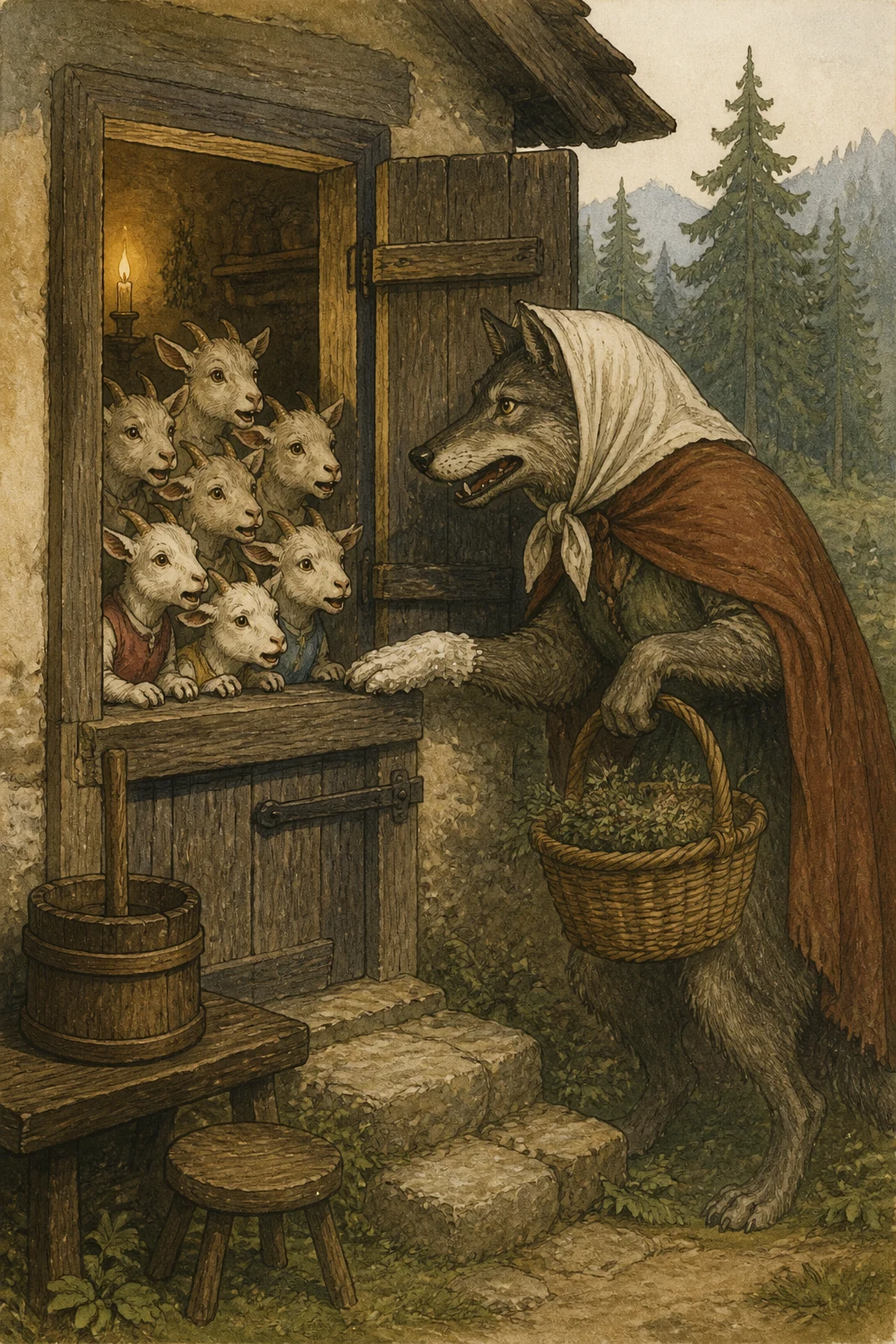
Volk ni ničesar posumil. Položil je šape na okensko polico, in brž ko so jih kozlički zagledali, so vedeli, da to ni njihova mama. »Ne, ne,« so zavpili, »ti nisi naša mama. Naša mama ima lepe bele tačke, tvoje pa so črne kakor saje. Gotovo si volk.«
Ko je volk to slišal, se je razjezil še bolj kot prej. Obrnil se je in spet oddirjal, med tekom pa godrnjal sam pri sebi in škripal z zobmi.
Kmalu je pritekel do pekarne in tam pomolil glavo skozi okno. »Pek, pek, daj mi malo testa!« je zavpil. »Če mi ga ne daš, ti prevrnem pekače in uničim vse, kar pečeš.«
Pek se je prestrašil. Takoj je dal volku toliko testa, kolikor ga je hotel. Volk ga je pograbil in stekel z njim proč. Tekel je, dokler ni prišel do kozje hiše. Tam je sedel in si črne šape z vseh strani oblepil z belim testom. Nato je potrkal na vrata — trk, trk, trk!
»Kdo je?« so zaklicali kozlički iz hiše. »Vaša mama, ljubi moji, spet sem doma,« je odgovoril volk s svojim gladkim glasom, omehčanim z maslom. »Položi šape na okensko polico!«
Volk je položil šape na okensko polico in zaradi testa so bile videti povsem bele. Tedaj so bili kozlički prepričani, da je to njihova mama, in so veselo odprli vrata.
»Hov!« Hudobni volk je planil v hišo. Kozlički so zavreščali in se razbežali, eni v eno smer, drugi v drugo. Eden se je skril za vrata, drugi v nečke za testo, tretji v čeber za pranje, četrti pod posteljo, peti — ta je bil najmanjši od vseh — pa v omarico visoke stoječe ure. Volk je stal sredi sobe in srepeče gledal naokrog, a ni videl niti enega samega repka.
Nato jih je začel iskati, vendar je moral hiteti, saj se je bal, da se bo mama koza vrnila domov. Našel je kozlička za vrati, in ker se mu je tako mudilo, ga je pogoltnil celega, ne da bi ga pri tem kakorkoli poškodoval. Našel je tistega v čebru za pranje in tudi njega pogoltnil celega. Našel je tistega v nečkah in še njega pogoltnil celega. Našel je tistega pod posteljo in tudi njega pogoltnil celega. Edini, ki ga ni našel, je bil kozliček v omarici ure, saj mu niti na misel ni prišlo, da bi pogledal tja. Iskal je in iskal, a dlje si ni upal ostati, ker se je bal, da se bo njihova mama vrnila domov.
Zdaj pa je bil stari volk ves težak in zaspan. Ozrl se je naokrog, da bi našel prostor, kjer bi lahko legel in si odpočil. Nedaleč stran so bile skale in drevesa, ki so dajala prijetno senco. Tam se je volk zleknil in kmalu smrčal tako glasno, da je nad njim trepetalo listje na drevesih.
Kmalu zatem se je mama koza vrnila domov. Brž ko je zagledala na stežaj odprta hišna vrata, je vedela, da se je zgodila nesreča. Vstopila je in se ozrla naokrog. Pohištvo je bilo prevrnjeno in razmetano po sobi. »Gorje, gorje! Moji ljubi kozlički!« je zajokala mama. »Hudobni volk je zagotovo prišel sem in jih vse požrl.«
»Mene ni požrl,« se je oglasil glasek iz omarice ure. Mama koza je odprla vratca in najmanjši kozliček je skočil ven.
»Zakaj pa si bil v omarici ure? In kaj se je zgodilo?« je vprašala mama. Kozliček ji je nato povedal vse: kako je volk prišel z glasom, omehčanim z maslom, in pobeljenimi šapami, kako so ga spustili noter in kako je pogoltnil vse štiri druge kozličke, tako da je ostal samo on.
Ko je mama koza slišala zgodbo, je stopila k vratom in se ozrla naokrog. Tedaj je zaslišala starega volka, ki je smrčal pod orehi v senci skal.
»To gotovo smrči stari volk,« je rekla mama koza, »in ne more biti daleč. Bodi čisto tih, moj kozliček, in pojdi z menoj.«
Mama koza se je pritihotapila do skal, kozliček pa ji je po prstih sledil. Previdno je pokukala naokrog in zagledala starega volka, ki je tako trdno spal, da ga ne bi prebudilo nič manj kot potres.
»Zdaj pa, moj kozliček,« je zašepetala mama, »teci naravnost domov, kolikor hitro moreš, in mi prinesi škarje, iglo in močno nit.«
Kozliček je storil, kakor mu je naročila, in tako tiho tekel po travi, da ga ne bi slišala niti miška. Brž ko se je vrnil, se je mama koza priplazila k staremu volku in mu z ostrimi škarjami razparala kožo, kakor bi bila vreča. Ven je skočil en kozliček, pa še drugi, pa tretji in četrti, in vsi so bili spet tam, živi in zdravi, kakor da jih volk nikoli ne bi pogoltnil. Ves ta čas pa se stari volk ni niti zganil niti nehal smrčati.
»Zdaj pa, moji kozlički,« je zašepetala mama, »naj mi vsak prinese velik okrogel kamen. Toda bodite zelo hitri in tihi, saj je od tega odvisno vaše življenje.«
Kozlički so stekli proč, pobrskali naokrog in vsak ji je prinesel velik okrogel kamen. Pri tem so bili zelo hitri in tihi, prav kakor jim je naročila mama.
Stara koza je položila kamne volku v trebuh, tja, kjer so bili prej kozlički, nato pa stisnila robova kože skupaj in ju zašila z debelo, močno nitjo. Potem se je s kozlički skrila za skale, kjer so oprezali in čakali.
Kmalu je stari volk zazehál in odprl oči. Nato je vstal in se stresel, pri tem pa so kamni v njem tako zaropotali, da so jih koza in kozlički slišali v svojem skrivališču za skalami.
»Ojoj! Ojoj!« je zastokal volk. »Kaj rožlja, kaj ropota ob moje uboge kosti? To niso kozlički, se mi zdi, temveč veliki kamni.«
Zaradi kamnov v trebuhu in vročega sonca nad glavo je volka zdaj hudo zažejalo. V bližini je bil globok vodnjak, v katerem je voda segala skoraj do roba. Stari volk je šel pit. Nagnil se je čezenj, vsi kamni pa so se mu skotalili proti glavi in ga prevrnili. Čof! Padel je v vodo in kamni so ga potegnili naravnost na dno. Sploh ni mogel plavati in tako je utonil.
Vsi kozlički pa so pritekli izza skal in začeli plesati okoli vodnjaka. »Stari volk je mrtev, juhej, juhej! Stari volk je mrtev, juhej!«
so prepevali, mama koza pa je prišla in zaplesala z njimi, saj so bili vsi presrečni.
Izvirnik
There was once a mother goat who had five little kids, and these kids were so dear to her that nothing could have been dearer.
One day the mother goat was going to the forest to gather some wood for her fire. “Now, my little kids,” said she, “you must be very careful while I am away. Bar the door behind me, and open it to nobody until I return. If the wicked wolf should get in he would certainly eat you.”
The little kids promised they would be careful, and then their mother started out, and as soon as she had gone they barred the door behind her.
Now it so happened the old wolf was on the watch that day. He saw the mother goat trotting away toward the forest, and as soon as she was out of sight, he crept down to the house and knocked at the door—rap-tap-tap!
“Who is there?” called the little kids within.
“It is I, your mother, my dears,” answered the wolf in his great rough voice. “Open the door and let me in.”
But the kids were very clever little kids. “No, no,” they cried. “You are not our mother. Our mother has a soft, sweet voice, and your voice is harsh and rough. You must be the wolf.”
When the wolf heard this he was very angry. He battered and battered at the door, but they would not let him in. Then he turned and galloped away as fast as he could until he came to a dairy. There he stuck his head in at the window, and the woman had just finished churning her butter.
“Woman, woman,” cried the wolf, “give me some butter. If you do not I will come in and upset your churn.”
The woman was frightened. At once she gave him a great deal of butter—all he could eat.
The wolf swallowed it down, and then he ran back to the goat’s house and knocked at the door—rat-tat-rat!
“Who is there?” asked the little goats within.
“Your mother, my dears,” answered the wolf, and now his voice was very soft and smooth because of the butter he had swallowed.
“It is our mother,” cried the little kids, and they were about to open the door, but the littlest kid of all, who was a very wise little kid, stopped them.
“Wait a bit,” said he. “It sounds like our mother’s voice, but before we open the door we had better be very, very sure it is not the wolf.” Then he called through the door, “Put your paws up on the windowsill.”
The wolf suspected nothing. He put his paws up on the windowsill, and as soon as the little kids saw them they knew at once that it was not their mother. “No, no,” they cried, “you are not our mother. Our mother has pretty white feet, and your feet are as black as soot. You must be the wolf.”
When the wolf heard this he was angrier than ever. He turned and galloped away again, and as he galloped he growled to himself and gnashed his teeth.
Presently he came to a baker’s shop, and there he stuck his head in at the window.
“Baker, baker, give me some dough,” he cried. “If you do not I will upset your pans and spoil your baking.”
The baker was frightened. At once he gave the wolf all the dough he wanted. The wolf seized it and ran away with it. He ran until he came to the goat’s house. There he sat down and covered his black feet all over with the white dough. Then he knocked at the door—rat-tat-tat!
“Who is there?” cried the little goats within.
“Your mother, my dears, come home again,” answered the wolf, in his smooth buttery voice.
“Put your paws up on the windowsill.”
The wolf put his paws up on the windowsill, and they looked quite white because of the dough. Then the little kids felt sure it was their mother, and they gladly opened the door.
“Woof!” In bounded the wicked wolf.
The little goats cried out and away they ran, some in one direction, and some in another. They hid themselves one behind the door, and one in the dough-trough, and one in the wash-tub, and one under the bed, and one (and he was the littlest one of all) hid in the tall clock-case. The wolf stood there glaring about him, and not as much as a tail of one of them could he see.
Then he began to hunt about for them, but he had to be in a hurry, because he was afraid the mother goat would come home again.
He found the kid behind the door, and he was in such a hurry he swallowed it whole without hurting it in the least. He found the one in the wash-tub, and he swallowed it whole, too. He found the one in the dough-trough, and it, too, he swallowed whole. He found the one under the bed and he swallowed it whole. The only one he did not find was the one in the clock-case, and he never thought of looking there. He hunted around and hunted around, and he was afraid to stay any longer for fear their mother would come home.
But now the old wolf felt very heavy and sleepy. He looked around for a place to go in order to lie down and rest.
Not far away were some rocks and trees that made a pleasant shadow. Here the wolf stretched himself out, and presently he was snoring so loudly that the leaves of the trees shook overhead.
Soon after this the mother goat came home. As soon as she saw the door of the house standing open, she knew at once that some misfortune had happened. She went in and looked about her. The furniture was all upset and scattered about the room. “Alas, alas! My dear little kids!” cried the mother. “The wicked wolf has certainly been here and eaten them all.”
“He didn’t eat me,” said a little voice in the clock-case.
The mother goat opened the door of the clock-case and the littlest kid of all hopped out.
“But why were you in the clock-case? And what has happened?” asked the mother.
Then the little kid told her all about how the wolf had come there with his buttery voice and his whitened paws, and how they had let him in, and how he had swallowed all four of the other little kids, so that he alone was left.
After the mother goat had heard the story she went to the door and looked about. Then she heard the old wolf snoring where he lay asleep under the nut-trees in the shade of the rocks.
“That must be the old wolf snoring,” said the mother goat, “and he cannot be far away. Do not make a noise, my little kid, but come with me.”
The mother goat stole over to the heap of rocks, and the little kid followed her on tiptoes. She peeped and peered, and there lay the old wolf so fast asleep that nothing less than an earthquake would have wakened him.
“Now, my little kid,” whispered the mother, “run straight home again as fast as you can, and fetch me my shears and a needle and some stout thread.”
This the little kid did, and he ran so softly over the grass that not even a mouse could have heard him.
As soon as he returned the mother goat crept up to the old wolf, and with the sharp shears she slit his hide up just as though it had been a sack. Out popped one little kid, and out popped another little kid, and another, and another, and there they all were, just as safe and sound as though they had never been swallowed. And all this while the old wolf never stirred nor stopped snoring.
“And now, my little kids,” whispered the mother, “do you each one of you bring me a big round stone, but be very quick and quiet, for your lives depend upon it.”
So the little kids ran away, and hunted around, and each fetched her back a big round stone, and they were very quick and quiet about it, just as their mother had bade them be.
The old goat put the stones inside the wolf, where the little kids had been, and then she drew the hide together and sewed it up, using the stout, strong thread. After that she and the little kids hid themselves behind the rocks, and watched and waited.
Presently the old wolf yawned and opened his eyes. Then he got up and shook himself, and when he did so the stones inside him rattled together so that the goat and the little kids could hear them, where they hid behind the rocks.
“Oh, dear! Oh, dear me!” groaned the wolf;
“What rattles, what rattles against my poor bones? Not little goats, I fear, but only big stones.”
Now what with the stones inside of him and the hot sun overhead the wolf grew very thirsty. Near by was a deep well, with water almost up to the brink of it. The old wolf went to drink. He leaned over, and all the stones rolled up to his head and upset him. Plump! he went down into the water, and the stones carried him straight to the bottom. He could not swim at all, and so he was drowned.
But all the little kids ran out from behind the rocks and began to dance around the well.
“The old wolf is dead, A-hey! A-hey! The old wolf is dead, A-hey!”
they sang, and the mother goat came and danced with them, they were all so delighted.