O besedilu
Vile
- Vir
- Perraultove pravljice
- Avtor
- Charles Perrault
- Jezik branja
- English
- Jezik izvirnika
- Français
- Čas branja
- 5 min branja
- Obseg
- 4 strani
- Naslov izvirnika
- Les Fées
O izvirniku
Perraultove pravljice
Francoske dvorne pravljice, kjer eleganca pogosto skrije ostro svarilo. Bralni jezik je English, izvirnik pa prihaja iz vira Perraultove pravljice v jeziku Français.
Besedilo
Vile
Once upon a time there was a widow who had two daughters. The elder was so like her in temper and looks that to see her was to see her mother. They were both so disagreeable and proud that no one could live with them. The younger, who was the very image of her father in gentleness and kindness, was also one of the most beautiful girls anyone had ever seen. As we naturally love those who resemble us, the mother doted on her elder daughter, while she felt a dreadful aversion to the younger. She made her eat in the kitchen and work without ceasing.
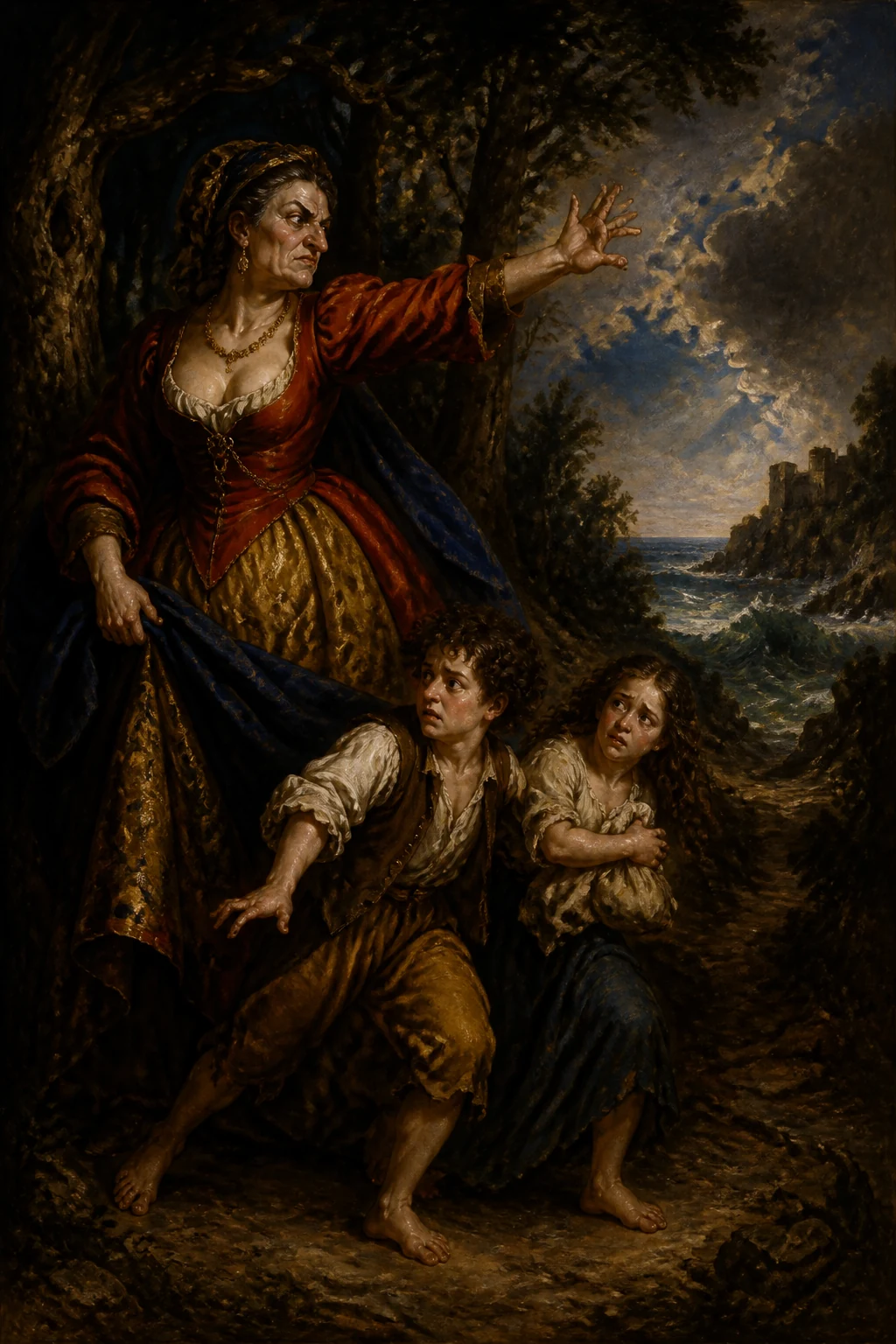
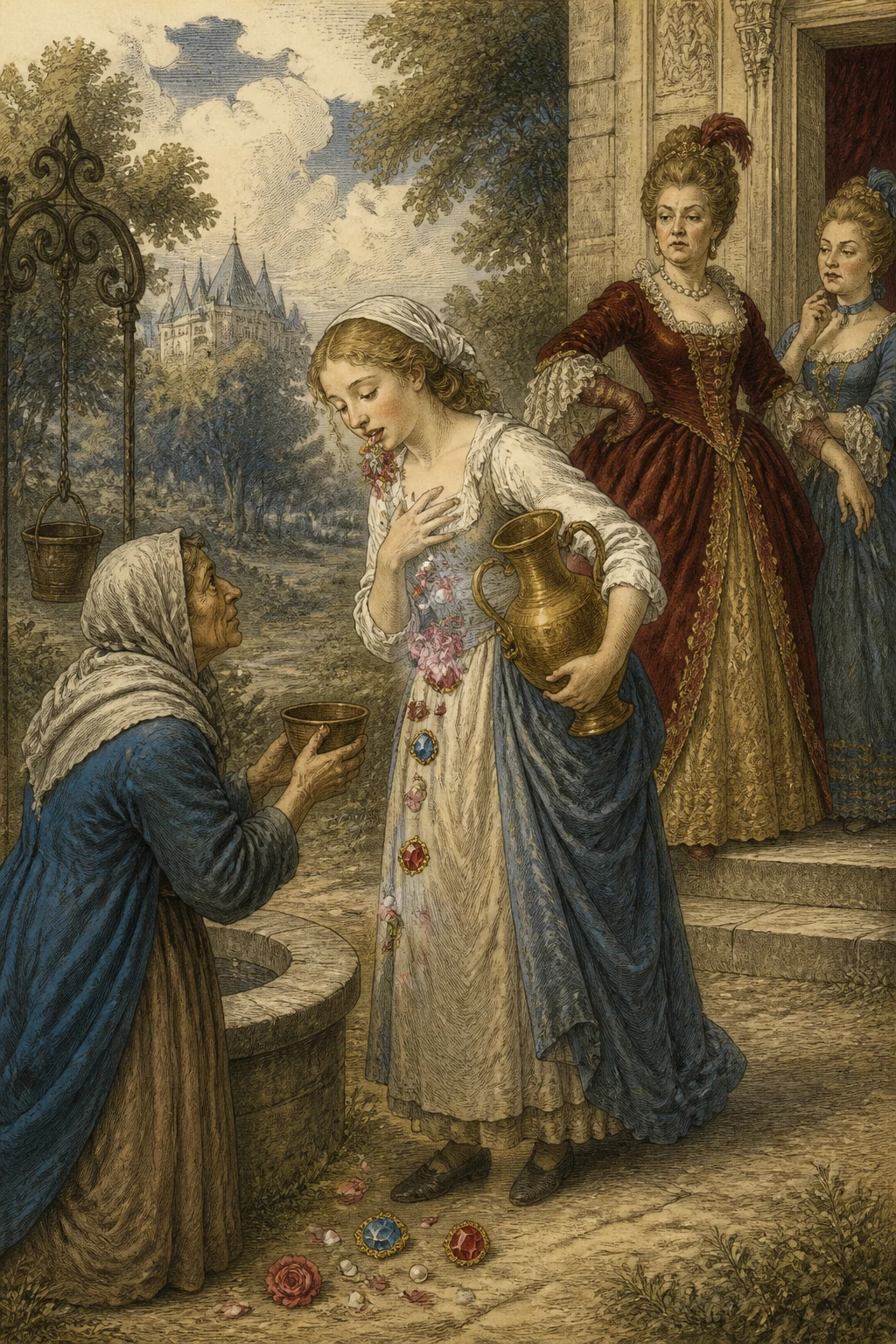
Among other things, this poor child had to go twice a day to fetch water from a spring a good half-league from the house, and bring back a large pitcher filled to the brim. One day, while she was at the spring, a poor woman came up and asked her for a drink. “Why, certainly, good mother,” said the beautiful girl. Rinsing her pitcher at once, she drew water from the clearest part of the spring and offered it to her, holding the pitcher all the while so that she could drink more easily. When the good woman had drunk, she said, “You are so beautiful, so good, and so kind that I cannot help bestowing a gift upon you.” For she was a fairy who had taken the form of a poor village woman to see how far the young girl’s kindness would go. “This is my gift to you,” the fairy went on. “With every word you speak, either a flower or a precious stone shall fall from your mouth.” When the beautiful girl arrived home, her mother scolded her for coming back so late from the spring. “I beg your pardon, Mother,” said the poor girl, “for taking so long.” As she spoke, two roses, two pearls, and two large diamonds fell from her mouth. “What do I see?” said her mother in astonishment. “I believe pearls and diamonds are falling from her mouth! How does this happen, my daughter?” This was the first time she had ever called her her daughter. The poor child told her quite simply everything that had happened, scattering countless diamonds as she spoke. “Indeed,” said the mother, “I must send my daughter there. Come, Fanchon, look at what falls from your sister’s mouth when she speaks. Would you not be glad to have the same gift? All you need do is go and fetch water from the spring, and when a poor woman asks you for a drink, give her one very politely.” “A fine sight I should make,” answered the ill-tempered girl, “going to the spring!” “I insist that you go,” her mother replied, “and this very moment.” She went, but grumbled all the way. She took the finest silver flask in the house. No sooner had she reached the spring than she saw a magnificently dressed lady emerge from the wood and come towards her to ask for a drink. It was the same fairy who had appeared to her sister, but she had assumed the appearance and dress of a princess to see how far this girl’s rudeness would go. “Do you think I came here to give you a drink?” said the proud, ill-tempered girl. “Of course, I brought a silver flask expressly so that Madam might have a drink! A likely story! Drink straight from the spring if you like.” “You are not very polite,” replied the fairy, without growing angry. “Well, since you are so ungracious, this is my gift to you: with every word you speak, either a snake or a toad shall fall from your mouth.” As soon as her mother caught sight of her, she called out, “Well, my daughter?” “Well, Mother,” answered the ill-tempered girl, spitting out two vipers and two toads. “Oh, heavens!” cried her mother. “What do I see? Her sister is to blame for this, and she shall pay for it!” At once she rushed to beat her. The poor child fled and took refuge in the nearby forest. The king’s son, returning from the hunt, met her there, and, seeing how beautiful she was, asked what she was doing all alone and why she was crying. “Alas, sir! My mother has driven me from home.” The king’s son, seeing five or six pearls and as many diamonds fall from her mouth, begged her to tell him how this came about. She told him her whole adventure. The king’s son fell in love with her and, considering that such a gift was worth more than any dowry another bride might bring, took her to the palace of the king his father, where he married her. As for her sister, she made herself so hateful that her own mother drove her out of the house. After wandering far and wide without finding anyone willing to take her in, the wretched girl went off to die at the edge of a wood.
MORAL Diamonds and gold coins may hold great sway over people’s hearts; yet gentle words have greater power still, and are of greater worth.
Another Moral Kindness takes care and a little willingness to please, but sooner or later it meets with its reward, and often when we least expect it.
Izvirnik
Les Fées
Naslednje strani prikazujejo izvirno besedilo za primerjavo.
LES FÉES.
CONTE.
Il estoit une fois une Veuve qui avoit deux filles : l’aisnée luy ressembloit si fort d’humeur et de visage, que qui la voyoit, voyoit la mere. Elles estoient toutes deux si desagreables et si orgueilleuses, qu’on ne pouvoit vivre avec elles. La Cadette, qui estoit le vray portrait de son pere pour la douceur et l’honnesteté, estoit avec cela une des plus belles filles qu’on eust su voir. Comme on aime naturellement son semblable, cette mere estoit folle de sa fille aisnée, et en même temps avoit une aversion effroyable pour la Cadette. Elle la faisoit manger à la Cuisine & travailler sans cesse.
Il falloit entre-autre chose que cette pauvre enfant allast deux fois le jour puiser de l’eau à une grande demy lieue du logis, & qu’elle en raportast plein une grande cruche. Un jour qu’elle estoit à cette fontaine, il vint à elle une pauvre femme qui la pria de luy donner à boire ? Ouy da, ma bonne mere, dit cette belle fille, & rainçant aussi-tost sa cruche, elle puisa de l’eau au plus belle endroit de la fontaine, & la lui presenta, soûtenant toûjours la cruche afin qu’elle bût plus aisément. La bonne femme ayant bu, luy dit, vous estes si belle, si bonne, & si honneste, que je ne puis m’empêcher de vous faire un don, (car c’estoit une Fée qui avoit pris la forme d’une pauvre femme de vilage, pour voir jusqu’où iroit l’honnesteté de cette jeune fille.) Je vous donne pour don, poursuivit la Fée, qu’à chaque parole que vous dirés, il vous sortira de la bouche où une Fleur, où une Pierre précieuse. Lorsque cette belle fille arriva au logis, sa mere la gronda de revenir si tard de la fontaine. Je vous demande pardon, ma mere, dit cette pauvre fille, d’avoir tardé si long-temps, & en disant ces mots il luy sortit de la bouche deux Roses, deux Perles, & deux gros Diamants. Que voy je là, dit sa mere toute estonnée, je crois qu’il luy sort de la bouche des Perles & des Diamants, d’où vient cela, ma fille, (ce fut là la premiere fois qu’elle l’appela sa fille.) La pauvre enfant luy raconta naïvement tout ce qui luy estoit arrivé, non sans jetter une infinité de Diamants. Vrayment, dit la mere, il faut que j’y envoye ma fille, tenez Fanchon, voyez ce qui sort de la bouche de vôtre sœur quand elle parle, ne seriez vous pas bien aise d’avor le même don, vous n’avez qu’à aller puiser de l’eau à la fontaine, & quand une pauvre femme vous demandera à boire, luy en donner bien honnestement. Il me feroit beau voir, répondit la brutale, aller à la fontaine : Je veux que vous y alliez, reprit la mere, & toute à l’heure. Elle y alla, mais toûjours en grondant. Elle prit le plus beau Flacon d’argent qui fut dans le logis. Elle ne fut pas plustost arrivée à la fontaine qu’elle vit sortir du bois une Dame magnifiquement vestuë qui vint luy demander à boire, c’estoit la même Fée qui avoit apparu à sa sœur, mais qui avoit pris l’air & les habits d’une Princesse, pour voir jusqu’où iroit la malhonnesteté de cette fille. Est-ce que je suis icy venuë, luy dit cette brutale orgueileuse, pour vous donner à boire, justement j’ai apporté un Flacon d’argent tout exprés pour donner à boire à Madame ? J’en suis d’avis, beuvez à même si vous voulez. Vous n’estes guere honneste, reprit la Fée, sans se mettre en colere, & bien, puisque vous estes si peu obligeante, je vous donne pour don, qu’à chaque parole que vous direz, il vous sortira de la bouche ou un serpent ou un crapau. D’abord que sa mere l’aperçeut, elle luy cria, Hé bien ma fille ! Hé bien, ma mere, luy répondit la brutale, en jettant deux viperes, & deux crapaux, O ! Ciel, s’écria la mere, que vois-je là, c’est sa sœur qui en est cause, elle me le payera ; & aussi-tost elle courut pour la battre. La pauvre enfant s’enfuit, & alla se sauver dans la Forest prochaine. Le fils du Roi qui revenoit de la chasse, la rencontra, & la voyant si belle, luy demanda ce qu’elle faisoit là toute seule & ce qu’elle avoit à pleurer. Helas ! Monsieur, c’est ma mere qui m’a chassée du logis. Le fils du Roi qui vit sortir de sa bouche cinq ou six Perles, & autant de Diamants, la pria de luy dire d’où cela luy venoit. Elle luy conta toute son avanture. Le fils du Roi en devint amoureux, & considerant qu’un tel don valoit mieux que tout ce qu’on pouvoit donner en mariage à une autre, l’emmena au Palais du Roi son pere, où il l’épousa. Pour sa sœur elle se fit tant haïr, que sa propre mere la chassa de chez elle ; & la malheureuse aprés avoir bien couru sans trouver personne qui voulut la recevoir, alla mourir au coin d’un bois.
MORALITÉ
Les Diamans et les Pistoles
Peuvent beaucoup sur les esprits ;
Cependant les douces paroles
Ont encor plus de force, et sont d’un plus grand prix.
Autre Moralité
L’onnesteté couste des soins,
Et veut un peu de complaisance,
Mais tost ou tard elle a sa récompense,
Et souvent dans le temps qu’on y pense le moins.
Nadaljuj z branjem