Prevod
Once upon a time there was a king who had seven sons, and he loved them so dearly that he could never bear to have them all away at once; one must always stay with him. When they were grown, six of them were to set out in search of brides, but their father wished to keep the youngest at home, and the others were to bring a princess back to the palace for him. The king gave the six the finest clothes anyone had ever seen, so splendid that they shone from far away, and each a horse worth many, many hundreds of dollars, and off they went. After visiting many royal palaces and looking at the princesses, they came at last to a king who had six daughters. Never had they seen such lovely princesses, so each prince asked for the hand of one of them, and when they were all betrothed, they set off home again;
but they quite forgot that they were to bring a princess for Askepot, who had stayed at home, so much in love were they with their sweethearts. When they had travelled a good way on their homeward journey, they passed close by a steep mountainside where a giant lived. The giant came out and caught sight of them, and turned them all to stone, princes and princesses alike. The king waited and waited for his six sons, but however long he waited, none of them came. He grew very sorrowful and said he could never be truly happy again. “If I did not still have you,” he said to Askepot, “I would not wish to live, so deeply do I grieve for the loss of your brothers.” “Well, I was thinking of asking your leave to go out and find them,” said Askepot. “No, you shall certainly not have leave,” said his father. “You will only disappear as well.” But Askepot was determined to go, and he begged and pleaded until the king had to let him leave. Now the king had nothing but a worn-out old nag to give Askepot, for the other six princes and their retinue had taken all his other horses. But Askepot did not mind; he climbed onto the old, mangy horse. “Farewell, Father!” he said to the king. “I shall be back, never fear, and perhaps I shall bring my six brothers with me too.” And with that he rode away.
When he had ridden some distance, he came upon a raven lying in the road, flapping its wings. It was so hungry that it had not the strength to move aside. “Oh, dear friend! Give me a little food, and I shall help you in your hour of greatest need,” said the raven.
“I have little enough food, and you do not look as though you could be much help to me either,” said the prince, “but I suppose I must give you a little, for I can see you need it.” And he gave the raven some of the provisions he had brought with him. When he had travelled a little farther, he came to a brook. There lay a great salmon that had stranded itself on dry land, floundering and unable to get back into the water. “Oh, dear friend! Help me back into the water,” the salmon said to the prince, “and I shall help you in your hour of greatest need.” “I dare say you will be little enough help to me,” said the prince, “but it would be a shame to leave you lying there to starve.” And he pushed the fish back into the brook. Now he travelled a long, long way, and then he met a wolf. It was so hungry that it lay dragging itself along the road. “Dear friend, let me have your horse,” said the wolf. “I am so hungry my belly is crying out; I have had nothing to eat for two years.” “No,” said Askepot, “I cannot do that. First I came upon a raven, and had to give it my provisions; then I came upon a salmon, and had to help it back into the water; and now you want my horse. That will never do, for then I shall have nothing to ride.” “Oh, but you must help me, dear friend,” said Grey-Legs;
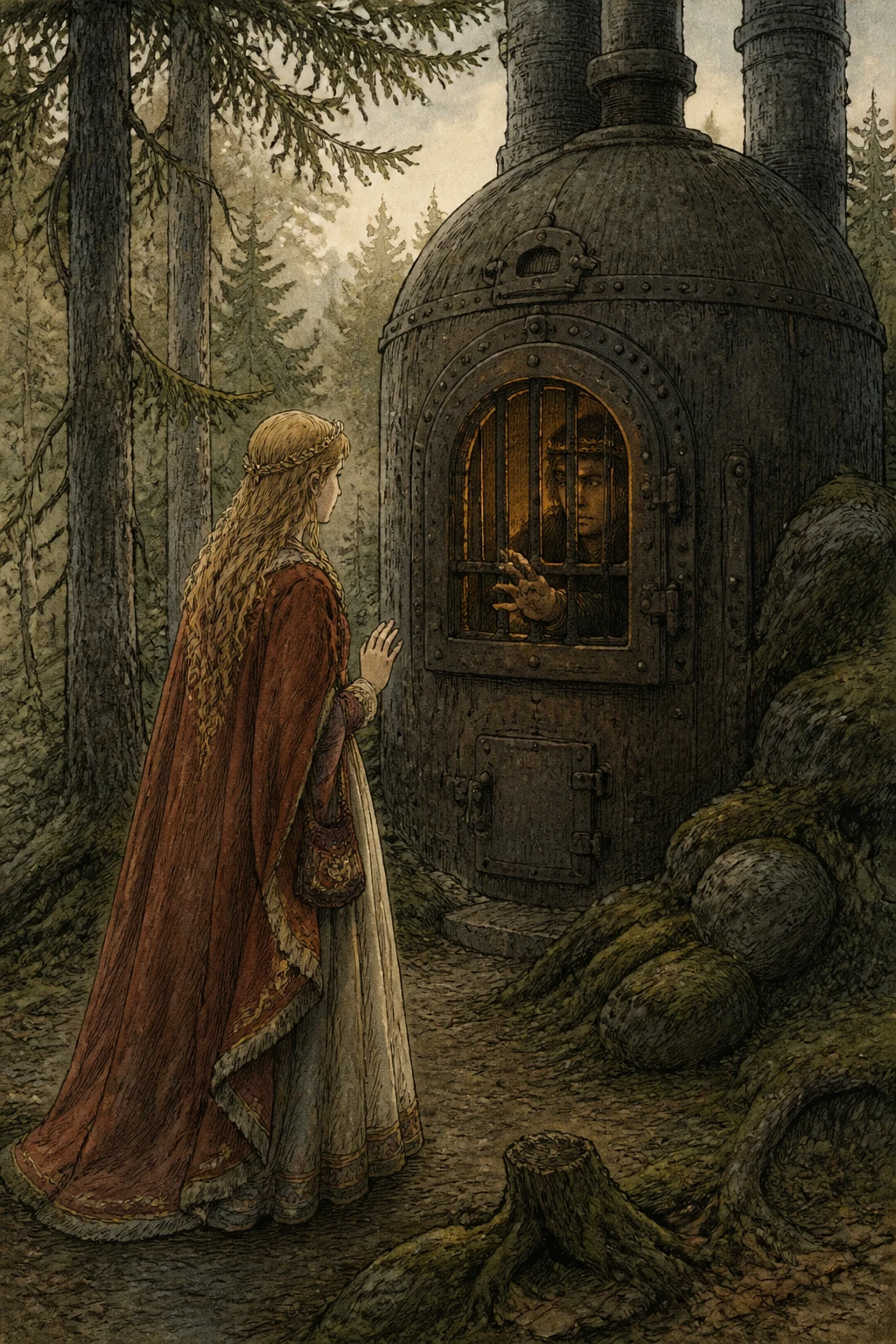
“you can ride on my back. I shall help you in your hour of greatest need,” he said. “Well, I dare say the help I get from you will not amount to much, but you had better take the horse, since your need is so great,” said the prince. When the wolf had eaten the horse, Askepot took the bridle and fastened it in his jaws, and set the saddle on his back. The meal had made the wolf so strong that he sped away with the prince as though he weighed nothing at all; never had Askepot ridden so fast. “When we have gone a little farther, I shall show you the giant’s home,” said Grey-Legs, and before long they were there. “Look, here is the giant’s home,” he said. “There you can see all six of your brothers, whom the giant has turned to stone, and there are their six brides. Over there is the monster’s door; you must go in.” “No, I dare not,” said the prince. “He will kill me.” “Oh, no,” answered the wolf. “When you go in, you will find a princess, and she will tell you how to set about putting an end to the giant. Only do as she tells you.” So Askepot went in, though he was frightened. When he entered, the giant was away, but in one of the rooms sat the princess, just as the wolf had said, and never before had Askepot seen so lovely a maiden. “Oh, God help you! How did you come here?” said the princess when she caught sight of him. “This will be the death of you. No one can put an end to the giant who lives here, for he does not carry his heart about with him.” “Well, now that I am here, I shall have to try all the same,” said Askepot. “And I should like to try to save my brothers, who stand turned to stone outside, and I should like to try to rescue you as well,” he said. “Well, since you are determined to stay, we must see whether we can think of a way,” said the princess.
“Now crawl under that bed, and listen carefully to what I say to him. But be sure to lie perfectly still.” So he crawled under the bed, and scarcely was he there before the giant came home. “Ugh! There is a smell of Christian flesh in here!” said the giant. “Yes, a magpie flew past with a human bone and dropped it down the chimney,” said the princess. “I hurried to throw it out, but I suppose the smell has not gone away yet.” So the giant said no more about it. When evening came, they went to bed, and after they had lain there a while, the princess said, “There is something I should like to ask you, if only I dared.” “What is it?” asked the giant. “Where do you keep your heart, since you do not carry it about with you?” said the princess. “Oh, that is something you have no need to ask about, but as it happens, it lies under the threshold,” said the giant. “Aha! Then we shall see if we cannot find it,” said Askepot, lying under the bed.
The next morning the giant rose very early and hurried off to the forest. No sooner had he gone than Askepot and the princess began searching beneath the threshold for his heart, but dig and search as they might, they found nothing. “He has tricked us this time,” said the princess, “but we must try him once more.” Then she gathered all the loveliest flowers she could find and scattered them around the threshold, which they had put back in its proper place. When it was nearly time for the giant to come home, Askepot crept under the bed again. Scarcely was he underneath when the giant arrived. “Ugh! There is a smell of Christian flesh in here!” said the giant. “Yes, a magpie flew past with a human bone in its beak and dropped it down the chimney,” said the princess. “I hurried to throw it out, but I suppose that is what you can still smell.” So the giant fell silent and said no more about it. A little later, however, he asked who had scattered flowers around the threshold. “Oh, that was me,” said the princess. “And what is that supposed to mean?” asked the giant. “Oh, I love you so dearly that I cannot help doing it, when I know your heart lies there,” said the princess.
“Indeed; but it does not lie there, you know,” said the giant. When they had gone to bed that evening, the princess again asked where his heart was, for she loved him so much that she dearly wished to know, she said. “Oh, it is over there in the cupboard on the wall,” said the giant. Very well, thought Askepot and the princess, then we shall see if we cannot find it. The next morning the giant was up early and hurried off to the forest again, and no sooner had he gone than Askepot and the princess were searching the cupboard for his heart. But search as they might, they found nothing there either. “Well, well, we must try once more,” said the princess. She decorated the cupboard with flowers and garlands, and as evening drew near, Askepot crept under the bed again. Then the giant came home.
“Ugh! There is a smell of Christian flesh in here!” said the giant. “Yes, a little while ago a magpie flew past with a human bone in its beak and dropped it down the chimney,” said the princess. “I hurried to throw it out again, but I suppose that is what you can still smell.” When the giant heard this, he said no more about it; but a little later he noticed that the cupboard was hung all about with flowers and garlands, and asked who had done it. Why, it was the princess. “What is the meaning of this foolishness?” asked the giant. “Oh, I love you so dearly that I cannot help doing it, when I know your heart lies there,” said the princess. “Can you be so foolish as to believe such a thing?” said the giant. “Well, I must believe it when you tell me so,” said the princess. “Oh, you are a simpleton,” said the giant. “You will never reach the place where my heart is!” “Still, it would be amusing to know where it is,” said the princess. Then the giant could hold his tongue no longer; he had to tell her. “Far, far away, in a lake, there is an island,” he said. “On that island stands a church; in that church is a well; in that well swims a duck; in that duck is an egg, and in that egg—there is my heart.” Early the next morning, before even the first grey light of dawn, the giant hurried off to the forest again. “Well, now I must set off too,” said Askepot, “if only I can find the way.” He bade the princess farewell for the time being, and when he came outside the giant’s home, the wolf was still there waiting for him. He told the wolf what had happened inside, and said that he now meant to go to the well in the church, if only he knew the way.
Then the wolf told him to climb onto his back, for he would find the way, he said, and off they went, with the wind whistling about them, over moors and hills, over mountains and valleys. When they had travelled for many, many days, they came at last to the lake.
The prince did not know how he was to get across, but the wolf told him not to be afraid, then plunged into the water with the prince on his back and swam over to the island.
Then they came to the church; but the church key hung high, high up on the tower, and at first the prince did not know how to get it down. “You must call the raven,” said the wolf, and the prince did so. At once the raven came and flew up for the key, and so the prince got into the church. When he came to the well, there was the duck, sure enough, swimming back and forth just as the giant had said. He stood coaxing and coaxing it, and at last he coaxed it close enough to catch hold of it. But just as he lifted it out of the water, the duck dropped the egg into the well, and Askepot had no idea how to get it up again. “Now you must call the salmon,” said the wolf, and the prince did so. The salmon came and brought the egg up from the bottom of the well. Then the wolf told him to squeeze the egg, and the moment Askepot squeezed it, the giant screamed. “Squeeze it once more!” said the wolf, and when the prince did so, the giant screamed more pitifully still and begged and pleaded for his life. He would do anything the prince wished, he said, if only he would not crush his heart. “Tell him that if he changes your six brothers whom he turned to stone back again, and their brides as well, he shall keep his life,” said the wolf, and Askepot did so. The monster readily agreed, and changed the six brothers back into princes and their brides back into princesses. “Now crush the egg!” said the wolf.
So Askepot crushed the egg to pieces, and the giant burst apart. Once he had rid himself of the giant, Askepot rode back to the giant’s home on the wolf. There stood all six of his brothers, alive and well, with their brides, and Askepot went into the mountain to fetch his own bride. Then they all travelled home together to the palace. How happy the old king was when all seven of his sons returned, each with his bride! “But Askepot’s bride is the loveliest of all the princesses,” said the king, “and he shall sit at the head of the table with her.” Then they feasted long and merrily, and if they have not yet finished feasting, they are feasting still.