Prevod
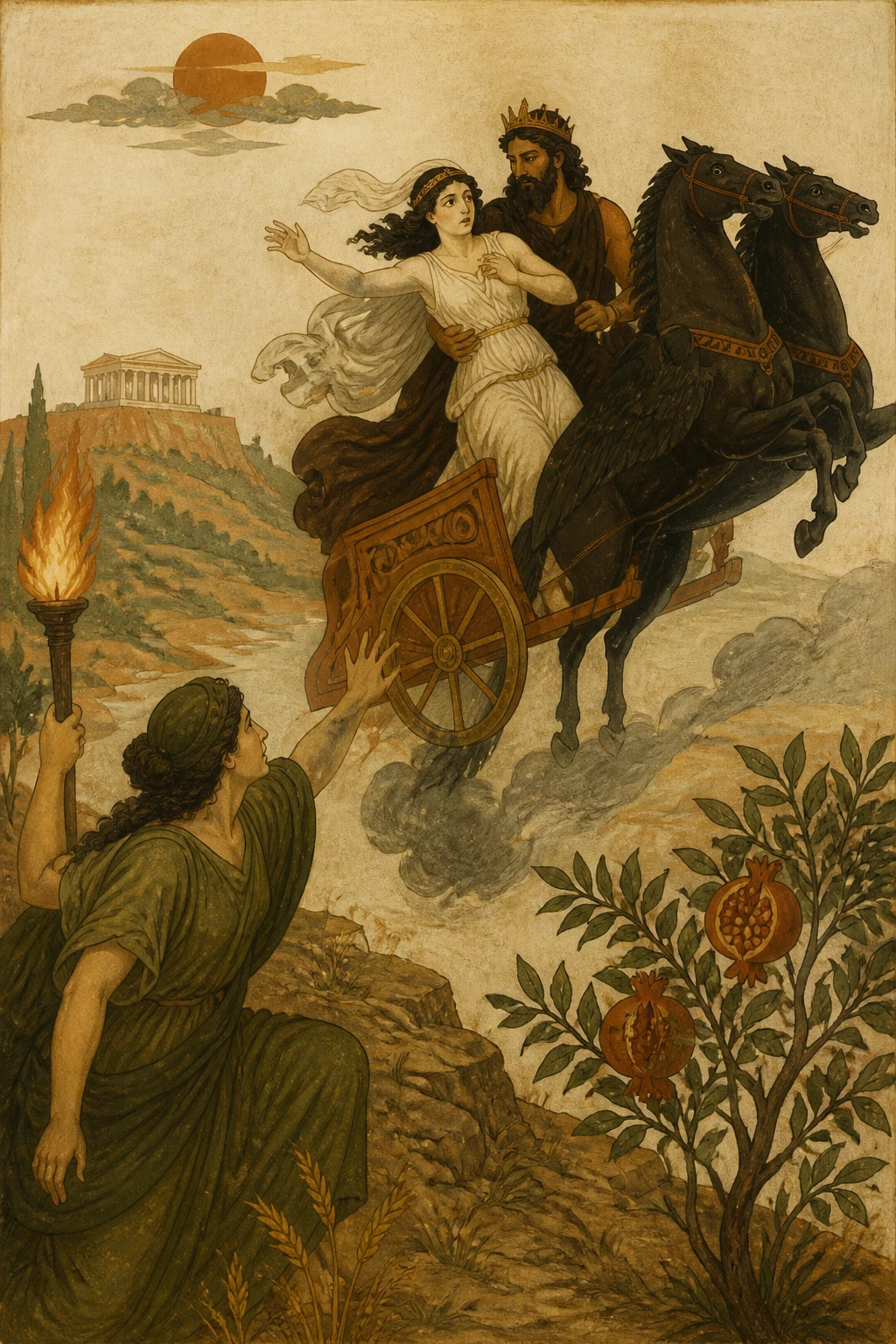
Not far from the walls of lofty Henna lies a lake, Pergus by name. Not even Cayster hears more songs of swans upon its gliding waters. A forest crowns the lake, encircling every shore, and with its leaves, like a veil, keeps out Phoebus’ rays. The branches offer coolness, the moist earth Tyrian-purple flowers: spring reigns forever. While Proserpina played in this grove, gathering violets or white lilies, and with a young girl’s eagerness filled her baskets and the folds of her dress, striving to outdo her companions in gathering, Dis saw her, loved her, and carried her away almost at once: so headlong was his love. The terrified goddess, with mournful
cries, called to her mother and her companions, but to her mother most often; and, as she had torn her dress at its upper edge, the gathered flowers fell from its loosened folds. Such was the innocence of her tender years that even this loss stirred grief in her maiden heart. Her abductor drove his chariot, calling each horse by name to urge it on, and over their necks and manes shook the reins, stained dark as rust.
He sped past deep lakes and the sulphurous pools of the Palici, seething through the broken earth, and past the place where the Bacchiadae, a people sprung from Corinth between two seas, built their walls between unequal harbors. Between Cyane and Arethusa of Pisa lies a stretch of water, narrowed between enclosing headlands. Here lived Cyane, from whom the pool itself took its name, the most renowned among the nymphs of Sicily.
She rose waist-high from the midst of the waters and recognized the goddess. “You shall go no farther!” she said. “You cannot become Ceres’ son-in-law against her will: the girl should have been courted, not abducted. And if I may compare small things with great, Anapis loved me too; yet I was won by pleading, not frightened into marriage like her.” She spoke and stretched her arms out on either side, barring his way. Saturn’s son could no longer restrain his anger: urging on his fearsome horses, into the depths of the pool he hurled his royal scepter with his mighty arm and drove it home. The stricken earth opened a path to Tartarus and through the gaping crater swallowed the plunging chariot.
But Cyane, grieving for the stolen goddess and the violated sanctity of her spring, bore an inconsolable wound in her silent heart and dissolved entirely into tears, into those waters over which she had so lately been a mighty deity. You could see her bones grow pliant, her nails lose their hardness; she dwindled into water, her limbs softening, and first the slenderest parts of her whole body melted: her blue-green hair, her fingers, her legs and feet.
For slight is the passage from slender limbs into cool water. Then her shoulders, her back, her sides, and her breast vanished, flowing away in slender streams. At last, instead of living blood, water entered her altered veins, and nothing remained that hands could grasp. Meanwhile, the frightened mother searched in vain for her daughter through every land and over every sea.
Neither Dawn, arriving with dew-wet hair, nor Hesperus saw her resting. With both hands she kindled pine torches at Aetna’s fires and carried them unresting through the frosty darkness. Again, when kindly daylight dimmed the stars, she sought her child from the setting of the sun to its rising. Weary with toil, she had grown thirsty, and no spring had moistened her lips, when she happened to see a thatched cottage and knocked at its little door. An old woman came out, saw the goddess, and, when she asked for water, gave her a sweet drink sprinkled with toasted barley meal.
While she drank what she had been given, a bold, impudent boy stood before the goddess, laughed, and called her greedy. She took offense, and, before she had drunk it all, the goddess drenched him as he spoke with the barley meal mixed in the drink. His face absorbed its spots, and where he had borne arms he bore legs; a tail was added to his altered limbs. And lest he have much power to do harm, his body shrank to a tiny shape, smaller than a little lizard.
As the old woman marveled and wept and tried to touch the strange creature, he fled from her and sought a hiding place. He bears a name suited to his coloring, his body starred with speckled drops. Through what lands and over what waters the goddess wandered would take too long to tell: the world itself was too small for her search. She returned to Sicily, and, searching everywhere as she went, came at last to Cyane. Had the nymph not been transformed, she would have told her everything; but though she longed to speak, she had neither mouth nor tongue, no means of utterance.
Yet she gave a clear sign, showing the mother on the surface of her waters Persephone’s familiar girdle, which had happened to fall there into the sacred pool. As soon as the goddess recognized it, as though only then had she learned of the abduction, she tore her unadorned hair and struck her breast again and again with her hands. She still did not know where her daughter was; yet she reproached all lands, calling them ungrateful and unworthy of the gift of grain, and Trinacria above all, where she had found the traces of her loss. There, with cruel hands, she broke the plows that turned the clods, and in her anger dealt the same death to farmers and their laboring oxen. She ordered the fields
to betray the seed entrusted to them and blighted what was sown. The land’s fertility, famed throughout the wide world, proved false: the crops died as soon as their first shoots rose, and now excessive sun, now excessive rain destroyed them; stars and winds brought harm, and ravenous birds picked up the scattered seeds; darnel, thistles, and indomitable grass choked the harvests of wheat.
Then Alpheus’ beloved raised her head from her Elean waters, brushed her dripping hair back from her forehead to her ears, and said: “Mother of the maiden sought throughout the world, and mother of the crops, cease your boundless labors, and do not rage so fiercely at a land faithful to you. The earth has done no wrong: unwillingly it opened to the abductor. Nor do I plead for my native country: I came here as a stranger.
Pisa is my home, and from Elis I trace my birth. I dwell in Sicily as a foreigner, yet this land is dearer to me than any other. Here I, Arethusa, now have my home, here my dwelling: spare it, most gentle goddess. Why I left my native place and journeyed over so vast a sea to Ortygia—a fitting time will come to tell my story, when you are relieved of care and wear a happier face. The earth opens a path for me, and, borne beneath its deepest caverns, I lift my head here and behold stars long unfamiliar.
So, while I glided beneath the earth through Stygian waters, there I saw your Proserpina with my own eyes. She was sad indeed, and fear had not yet left her face, but she was a queen nevertheless, the greatest in that shadowy world, the powerful consort of the lord of the underworld.” At these words the mother stood stunned, as though turned to stone, and remained for a long time like one struck senseless. Then, when grief’s heavy weight drove out her deep stupor, she rose in her chariot to the realms of heaven. There, her whole face clouded, her hair disheveled, she stood before Jupiter in bitter reproach.
“I come to plead with you, Jupiter,” she said, “for my own flesh and blood, and yours. If the mother finds no favor, let the daughter move her father; and, I beg you, do not care less for her because it was I who gave her birth. See, after long searching I have at last found my daughter— if you call a surer loss a finding, or if knowing where she is means finding her. I will bear her abduction, provided he gives her back. For your daughter deserves no robber for a husband, even if she is no longer mine.”
Jupiter replied: “Our daughter is a bond and a care shared equally by you and me. But if we choose to call things by their true names, this deed is not an outrage, but love. Nor will such a son-in-law disgrace us, goddess, if only you consent. Though all else were lacking, how much it means to be Jupiter’s brother! Yet all else is not lacking, and only the drawing of lots placed him below me. Still, if your desire to part them is so great, Proserpina shall return to heaven, but on this fixed condition: that she has touched no food there with her lips. So the Fates have decreed.”
He had spoken. But Ceres was resolved to bring her daughter out. The Fates would not allow it, for the maiden had broken her fast: while wandering innocently through the tended gardens, she had plucked a pomegranate from a bending tree and, taking seven seeds from its pale rind, had pressed them in her mouth. Of them all, only Ascalaphus had seen it—he whom Orphne, they say, a nymph by no means unknown among the nymphs of Avernus, once bore to her own Acheron beneath the dark woods.
He saw, and cruelly robbed her of her return by telling. The queen of Erebus groaned and changed the witness into an ill-omened bird. Sprinkling his head with water from Phlegethon, she transformed it into a beak, feathers, and enormous eyes. Robbed of himself, he was clothed in tawny wings; his head swelled, his long nails curved into talons, and he could scarcely stir the feathers grown along his sluggish arms.
He became a loathsome bird, the herald of approaching sorrow, a torpid eagle owl, a dreadful omen to mortals. Yet he may seem to have deserved his punishment for his tale-bearing tongue. But you, daughters of Achelous—why have you feathers and birds’ feet, though you keep the faces of maidens? Was it because, when Proserpina gathered spring flowers, you, melodious Sirens, were among her companions?
After you had sought her in vain throughout the world, so that the seas too might know your anxious search, you prayed to hover above the waves on the oar strokes of wings. The gods were willing, and you saw your limbs suddenly grow golden with feathers. Yet lest that song, born to soothe the ear, and your mouths’ great gift should lose the use of speech, your maiden faces and your human voices remained.
But Jupiter, mediating between his brother and his grieving sister, divided the revolving year into equal portions. Now the goddess, a divinity shared by two kingdoms, spends as many months with her mother as with her husband. At once her spirit and her countenance were transformed: for she who only lately might have seemed sorrowful even to Dis now wore a radiant face, like the sun that, hidden before behind rain-laden clouds, breaks through and shines again.