O besedilu
Romul in Hersilija
- Vir
- Ovidove preobrazbe
- Avtor
- Ovid
- Jezik branja
- English
- Jezik izvirnika
- Latin
- Čas branja
- 4 min branja
- Obseg
- 4 strani
- Naslov izvirnika
- Romulus and Hersilia
O izvirniku
Ovidove preobrazbe
Pesniški tok antičnih preobrazb, kjer bogovi, ljudje in narava stalno menjavajo obliko. Bralni jezik je English, izvirnik pa prihaja iz vira Ovidove preobrazbe v jeziku Latin.
Besedilo
Romul in Hersilija
Next, the soldiers of unjust Amulius ruled Ausonia’s realm, and aged Numitor regained his lost kingdom through his grandson’s gift. On the feast of Pales, the city’s walls were founded. Tatius and the Sabine elders waged war, and Tarpeia, who had opened the way to the citadel, lost her guilty life beneath a heap of weapons. Then the men of Cures, like silent wolves, stifled every sound, fell upon men overcome by sleep, and made for the gates that Ilia’s son had closed with a sturdy bar. But Saturn’s daughter herself opened one, turning its hinge without a sound.
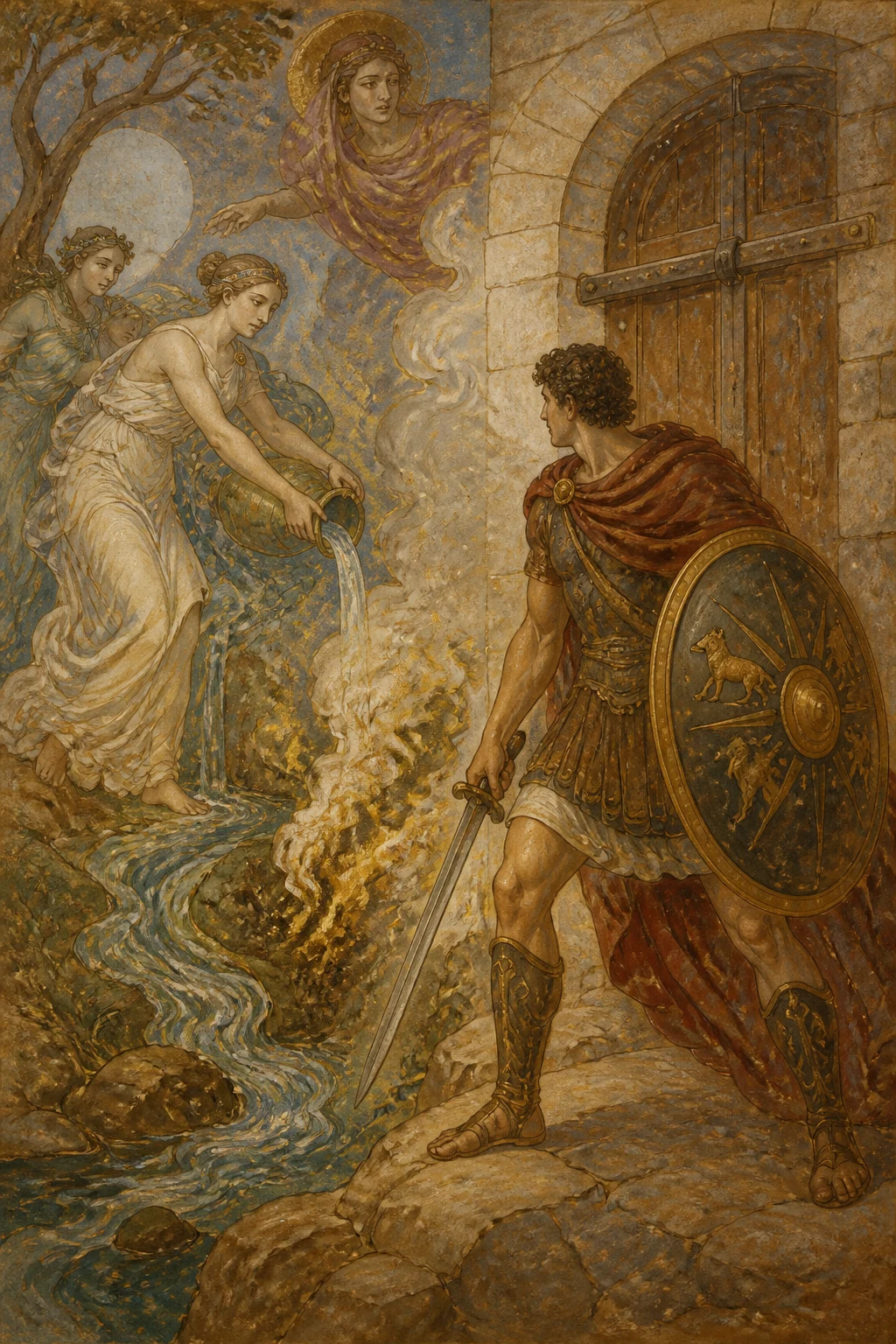
Venus alone sensed that the gate’s bars had fallen and would have closed it, except that no god may ever undo another god’s work. Beside Janus dwelt Ausonian water nymphs, where a cold spring sprinkled the ground. She asked their aid, and the nymphs could not refuse the goddess’s just request. They drew forth the streams and hidden waters of their spring. Yet the open gateway of Janus was still passable: the water had not blocked the way.
They laid pale sulphur beneath the abundant spring and set its hollow channels ablaze with smoking pitch. By these and other powers, heat reached the spring’s deepest recesses; and you waters, who lately dared rival Alpine cold, now yield nothing to fire itself! The twin doorposts smoked beneath the fiery spray, and the gate, promised in vain to the stern Sabines, was barricaded by this new spring until the warriors of Mars could arm themselves. When Romulus marched out to meet the foe, and Roman earth lay strewn with Sabine bodies and their own, and the impious sword mingled a son-in-law’s blood with his father-in-law’s,
they nevertheless agreed to end the war in peace, rather than fight to the bitter end, and to let Tatius share the throne. Tatius had died, and you, Romulus, were giving equal laws to both peoples, when Mars laid aside his helmet and addressed the father of gods and men: “The time has come, Father, now that Rome’s power rests on firm foundations and depends on a single guardian, to grant the reward you promised me and your worthy grandson: take him from the earth and set him in heaven.
Once, in the presence of the assembled gods, you told me—for I remember, and cherished those gracious words— ‘There shall be one whom you will raise to the blue heavens.’ Let the full promise of your words be fulfilled!” The Almighty nodded, veiled the sky in dark clouds, and terrified the world with thunder and lightning. Mars knew these signs confirmed the promised carrying-off.
Leaning on his spear, the fearless god mounted his chariot, whose bloodstained pole weighed upon his horses, cracked his whip, and, swooping down through the air, alighted on the summit of the wooded Palatine. There he carried off Ilia’s son as he gave his citizens laws that were no tyrant’s decrees. His mortal body dissolved in the thin air, as a leaden bullet, hurled from a broad sling, melts away in mid-flight.
A beautiful form took its place, worthier of the gods’ lofty couches: the form of Quirinus in his striped robe. His wife was mourning him as lost when queenly Juno commanded Iris to descend along her curving path to Hersilia and deliver this message to the bereaved woman: “O lady, crowning glory of both Latium and the Sabine people, most worthy once to have been so great a man’s wife, and now to be the wife of Quirinus, cease your weeping. If you long to see your husband, follow me to the grove that flourishes on Quirinus’s hill and shades the Roman king’s temple.”
Iris obeyed, gliding down her many-coloured bow to earth, and addressed Hersilia in the appointed words. Scarcely lifting her eyes, her face modestly lowered, she said, “O goddess—for though I cannot say who you are, I know you are divine—lead me, oh, lead me, and let me see my husband’s face! If only the Fates allow me to see him once, I shall feel that heaven itself is mine.”
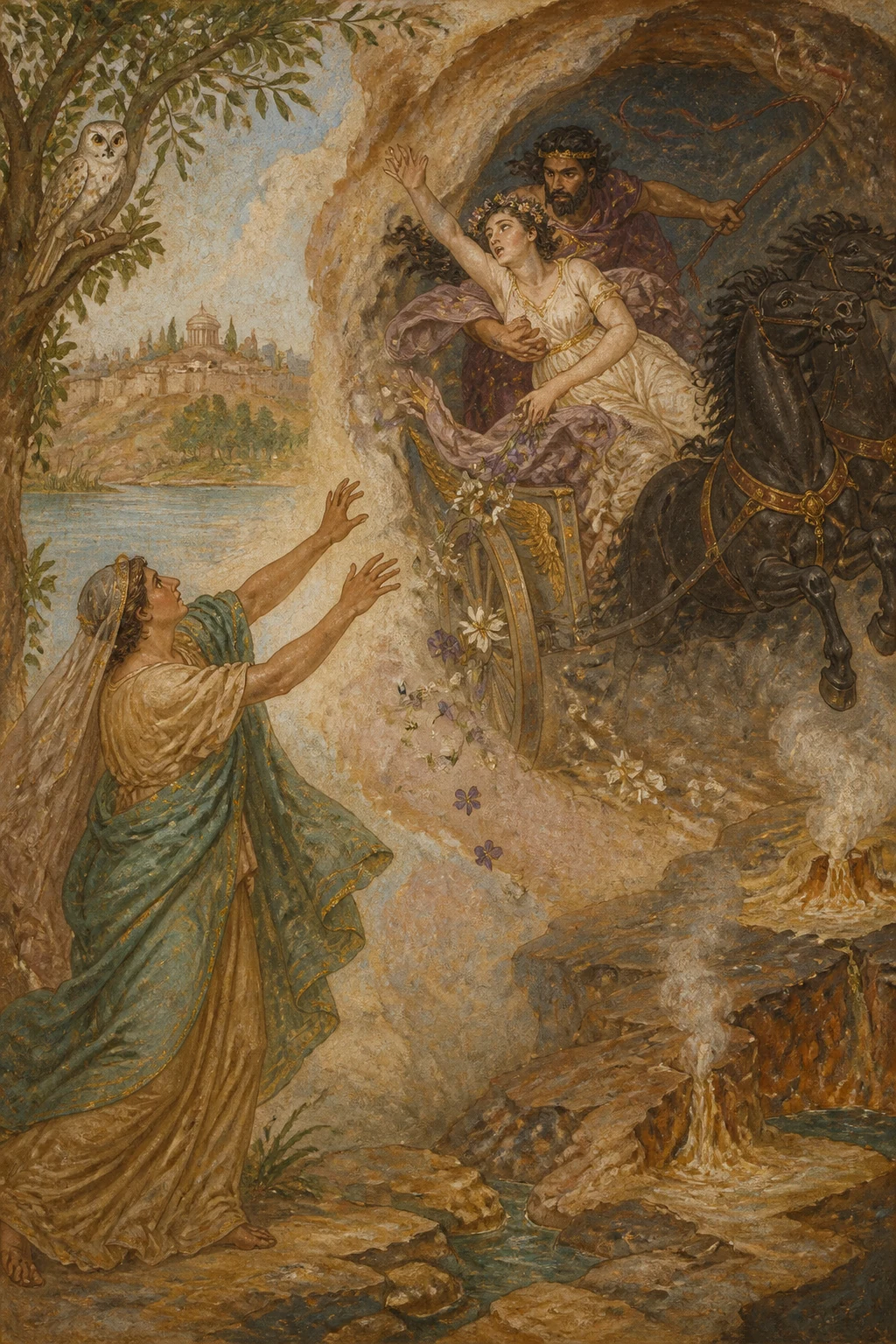
At once she climbed Romulus’s hill with the daughter of Thaumas. There a star fell from the heavens to earth, and Hersilia, her hair ablaze with its light, rose with the star into the air. The founder of Rome welcomed her into his familiar arms and changed her former name along with her body, calling her Hora, the goddess now united with Quirinus.
Izvirnik
Romulus and Hersilia
Naslednje strani prikazujejo izvirno besedilo za primerjavo.
Source ID: ovid_metamorphoses_story_098 Citation: Ovid, Metamorphoses 14.772-14.851 Original language: Latin Source: PerseusDL canonical-latinLit Source URL: https://github.com/PerseusDL/canonical-latinLit/blob/master/data/phi0959/phi006/phi0959.phi006.perseus-lat2.xml Segmentation certainty: medium 772: Proximus Ausonias iniusti miles Amuli 773: rexit opes, Numitorque senex amissa nepotis 774: munere regna capit, festisque Palilibus urbis 775: moenia conduntur, Tatiusque patresque Sabini 776: bella gerunt, arcisque via Tarpeia reclusa 777: dignam animam poena congestis exuit armis.
778: Inde sati Curibus tacitorum more luporum 779: ore premunt voces et corpora victa sopore 780: invadunt portasque petunt, quas obice firmo 781: clauserat Iliades: unam tamen ipsa reclusit 782: nec strepitum verso Saturnia cardine fecit. 783: Sola Venus portae cecidisse repagula sensit 784: et clausura fuit, nisi quod rescindere numquam 785: dis licet acta deum. Iano loca iuncta tenebant 786: naides Ausoniae gelido rorantia fonte: 787: has rogat auxilium, nec nymphae iusta petentem 788: sustinuere deam venasque et flumina fontis 789: elicuere sui; nondum tamen invia Iani
790: ora patentis erant, neque iter praecluserat unda: 791: lurida supponunt fecundo sulphura fonti 792: incenduntque cavas fumante bitumine venas. 793: Viribus his aliisque vapor penetravit ad ima 794: fontis, et Alpino modo quae certare rigori 795: audebatis aquae, non ceditis ignibus ipsis! 796: Flammifera gemini fumant adspergine postes, 797: portaque, nequiquam rigidis promissa Sabinis, 798: fonte fuit praestructa novo, dum Martius arma 799: indueret miles; quae postquam Romulus ultro 800: obtulit, et strata est tellus Romana Sabinis 801: corporibus strata estque suis, generique cruorem
802: sanguine cum soceri permiscuit impius ensis, 803: pace tamen sisti bellum nec in ultima tantum 804: decertare placet Tatiumque accedere regno. 805: Occiderat Tatius, populisque aequata duobus, 806: Romule, iura dabas, posita cum casside Mavors 807: talibus adfatur divumque hominumque parentem: 808: “Tempus adest, genitor, quoniam fundamine magno 809: res Romana valet et praeside pendet ab uno, 810: praemia (sunt promissa mihi dignoque nepoti!)
811: solvere et ablatum terris imponere caelo. 812: Tu mihi concilio quondam praesente deorum 813: (nam memoro memorique animo pia verba notavi) 814: “unus erit, quem tu tolles in caerula caeli” 815: dixisti: rata sit verborum summa tuorum!” 816: Adnuit omnipotens et nubibus aera caecis 817: occuluit tonitruque et fulgure terruit orbem: 818: quae sibi promissae sensit rata signa rapinae 819: innixusque hastae pressos temone cruento 820: impavidus conscendit equos Gradivus et ictu 821: verberis increpuit pronusque per aera lapsus 822: constitit in summo nemorosi colle Palati
823: reddentemque suo non regia iura Quiriti 824: abstulit Iliaden: corpus mortale per auras 825: dilapsum tenues, ceu lata plumbea funda 826: missa solet medio glans intabescere caelo. 827: Pulchra subit facies et pulvinaribus altis 828: dignior, est qualis trabeati forma Quirini. 829: Flebat ut amissum coniunx, cum regia Iuno 830: Irin ad Hersiliam descendere limite curvo 831: imperat et vacuae sua sic mandata referre: 832: “O et de Latio, o et de gente Sabina 833: praecipuum, matrona, decus, dignissima tanti 834: ante fuisse viri, coniunx nunc esse Quirini,
835: siste tuos fletus et, si tibi cura videndi 836: coniugis est, duce me lucum pete, colle Quirini 837: qui viret et templum Romani regis obumbrat.” 838: Paret et in terram pictos delapsa per arcus 839: Hersilien iussis compellat vocibus Iris. 840: Illa verecundo vix tollens lumina vultu 841: “o, dea, namque mihi nec, quae sis, dicere promptum est, 842: et liquet esse deam, duc, o duc” inquit “et offer 843: coniugis ora mihi, quem si modo posse videre 844: fata semel dederint, caelum accepisse fatebor.”
845: Nec mora, Romuleos cum virgine Thaumantea 846: ingreditur colles: ibi sidus ab aethere lapsum 847: decidit in terras, a cuius lumine flagrans 848: Hersilie crines cum sidere cessit in auras. 849: Hanc manibus notis Romanae conditor urbis 850: excipit et priscum pariter cum corpore nomen 851: mutat Horamque vocat, quae nunc dea iuncta Quirino est.
Nadaljuj z branjem