Prevod
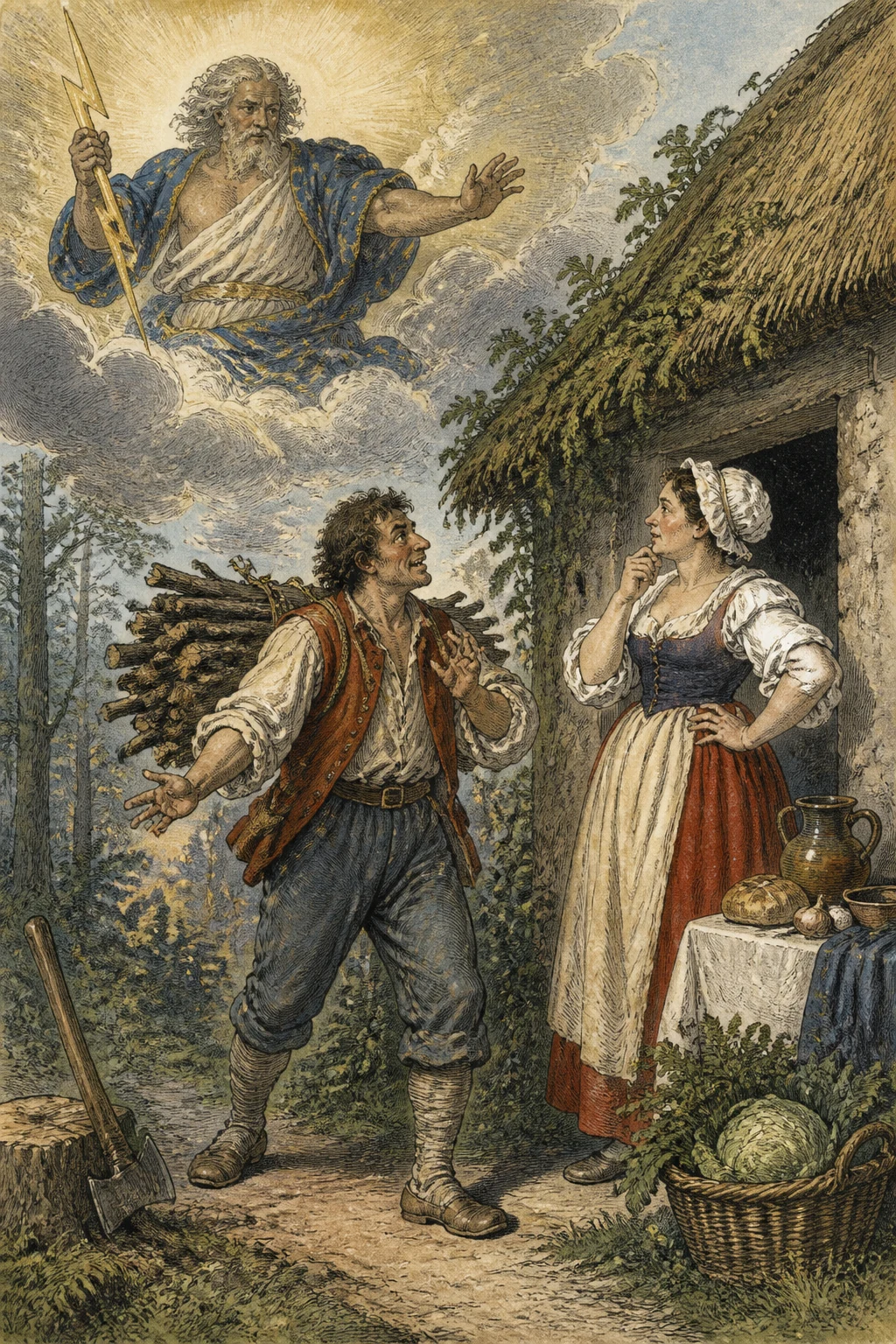
In olden times, when the dear Lord still walked among men on earth, it happened one evening that he grew weary, and night overtook him before he could reach an inn. Now two houses stood opposite each other on the road before him, one large and handsome, the other small and poor-looking. The large house belonged to a rich man, and the small one to a poor man. Then our Lord thought, “I shall be no burden to the rich man; I will spend the night with him.” When the rich man heard a knock at his door, he opened the window and asked the stranger what he wanted. The Lord answered, “I beg a night’s lodging.” The rich man looked the traveler up and down, and because the dear Lord wore plain clothes and did not look like someone with much money in his pocket, he shook his head and said, “I cannot take you in. My rooms are full of herbs and seeds, and if I were to shelter everyone who knocked at my door, I should soon have to take up a beggar’s staff myself. Find somewhere else to stay.” With that he slammed his window shut and left the dear Lord standing outside. So the dear Lord turned his back on him and went across to the little house. Scarcely had he knocked when the poor man lifted the latch of his little door and invited the traveler in. “Stay the night with me,” he said. “It is dark already, and you cannot go any farther today.” This pleased the dear Lord, and he went inside. The poor man’s wife took his hand, welcomed him, and told him to make himself comfortable and be content with what they could offer. They had little, but whatever it was, they gave it gladly and with all their hearts. Then she put some potatoes on the fire, and while they were cooking, she milked her goat so that they might have a little milk with them. When the table was laid, the dear Lord sat down and ate with them, and the humble fare tasted good to him, for there were cheerful faces around the table. After they had eaten, when it was time for bed, the wife called her husband aside and said, “Listen, dear husband, let us make ourselves a bed of straw tonight, so that the poor traveler can lie down in our bed and rest. He has been walking all day, and that is tiring work.” “With all my heart,” he answered. “I will offer it to him.” He went to the dear Lord and begged him, if he was willing, to lie down in their bed and give his limbs a proper rest. The dear Lord did not want to take the old couple’s bed from them, but they would not leave off urging him until at last he lay down in it, while they made themselves a bed of straw on the floor. The next morning they rose before daybreak and prepared as good a breakfast for their guest as their means allowed. When the sun shone through the little window and the dear Lord had risen, he ate with them again and then made ready to go on his way. As he stood in the doorway, he turned and said, “Because you are so compassionate and devout, you may make three wishes, and I will grant them.” Then the poor man said, “What else should I wish for but eternal salvation, and that the two of us may remain healthy as long as we live and have our daily bread? As for a third wish, I can think of nothing.” The dear Lord said, “Would you not like to wish for a new house in place of the old one?” “Oh yes,” said the man. “If I may have that as well, I should be very glad.” So the Lord granted their wishes, changed their old house into a new one, gave them his blessing once more, and went on his way.
It was broad daylight when the rich man got up. He leaned out of his window and saw a neat new house with red tiles opposite him, where an old hovel had stood before. His eyes widened, and he called his wife over and said, “Tell me, what has happened? Last night the wretched old hovel was still there, and today there stands a fine new house. Run over and find out how it came about.” His wife went across and questioned the poor man, who told her, “Last night a traveler came looking for a night’s lodging, and this morning, when he took his leave, he granted us three wishes: eternal salvation, health in this life and our daily bread, and lastly a fine new house in place of our old hovel.” The rich man’s wife hurried back and told her husband how it had all happened. The man said, “I could tear myself to pieces and beat myself black and blue! If only I had known! The stranger came here first and wanted to spend the night with us, but I turned him away.” “Make haste,” said his wife, “and mount your horse. You can still catch up with the man, and then you must have him grant you three wishes too.”
The rich man followed this good advice, galloped off on his horse, and caught up with the dear Lord. He spoke sweetly and politely and begged him not to take offense at not having been admitted at once: he had been looking for the key to the front door, and in the meantime the stranger had gone away. If he came back that way, he must be sure to stay with him. “Yes,” said the dear Lord, “if I come back this way, I will.” Then the rich man asked whether he too might make three wishes, like his neighbor. The dear Lord said that he might indeed, but that it would not be good for him, and he would do better to wish for nothing. The rich man said he would surely choose something that would bring him happiness, if only he knew it would be granted. Then the dear Lord said, “Ride home, and the three wishes you make shall come true.”
Now the rich man had what he wanted. He rode home and began to ponder what he should wish for. As he sat thinking, he let the reins hang loose, and the horse began to prance about, continually interrupting his thoughts so that he could not put them in order. He patted her neck and said, “Steady, Liese,” but the horse reared up again. At last he grew angry and cried impatiently, “I wish you would break your neck!” No sooner had he spoken than down he fell to the ground with a thump, and there lay the horse, dead and motionless. Thus his first wish was fulfilled. But since he was miserly by nature, he would not leave the saddle and harness behind. He cut them free, slung them over his back, and now had to go on foot. “You still have two wishes left,” he thought, and comforted himself with that. As he trudged slowly through the sand, with the midday sun beating down, he grew hot and ill-tempered. The saddle pressed upon his back, and he still had not thought what to wish for. “Even if I wish for all the kingdoms and treasures in the world,” he said to himself, “all sorts of other things will occur to me afterward, this and that—I know it already. But I mean to arrange matters so that there is nothing left for me to wish for.” Then he sighed and said, “Ah, if only I were that Bavarian peasant who had three wishes too! He knew what to do: first he wished for a great deal of beer, then for as much beer as he could drink, and third for another barrel of beer besides.” Sometimes he thought he had found the answer, but afterward it still seemed too little. Then it occurred to him how well off his wife was at that very moment, sitting at home in a cool room and enjoying a good meal. This thoroughly annoyed him, and before he knew it, he said, “I wish she were sitting at home on this saddle and could not get off, instead of my having to drag it along on my back.” As the last word left his mouth, the saddle vanished from his back, and he realized that his second wish had come true as well. Now he felt hotter than ever and began to run, intending to shut himself up alone in his room at home and think of something grand for his last wish. But when he arrived and opened the door to the sitting room, there was his wife in the middle of it, sitting on the saddle and unable to get off, wailing and screaming. “Be easy,” he said. “I shall wish for all the riches in the world for you. Only stay where you are.” But she called him a blockhead and said, “What good are all the riches in the world to me if I am stuck on this saddle? You wished me onto it, and now you must help me off again.” Whether he liked it or not, he had to use his third wish to free her from the saddle so that she could get down, and the wish was granted at once. So he gained nothing but vexation, trouble, a scolding, and the loss of a horse; but the poor couple lived happily, quietly, and devoutly until their blessed end.