Prevod
Once upon a time there lived a King and Queen who were so unhappy at having no children, so unhappy that words cannot tell. They visited every medicinal spring in the world; vows, pilgrimages, little acts of devotion—everything was tried, and nothing did any good. At last, however, the Queen became pregnant and gave birth to a daughter. A splendid christening was held, and all the fairies who could be found in the country were made godmothers to the little Princess—there were seven of them—so that, by each bestowing a gift upon her, as was the custom among fairies in those days, the Princess might possess every imaginable perfection.
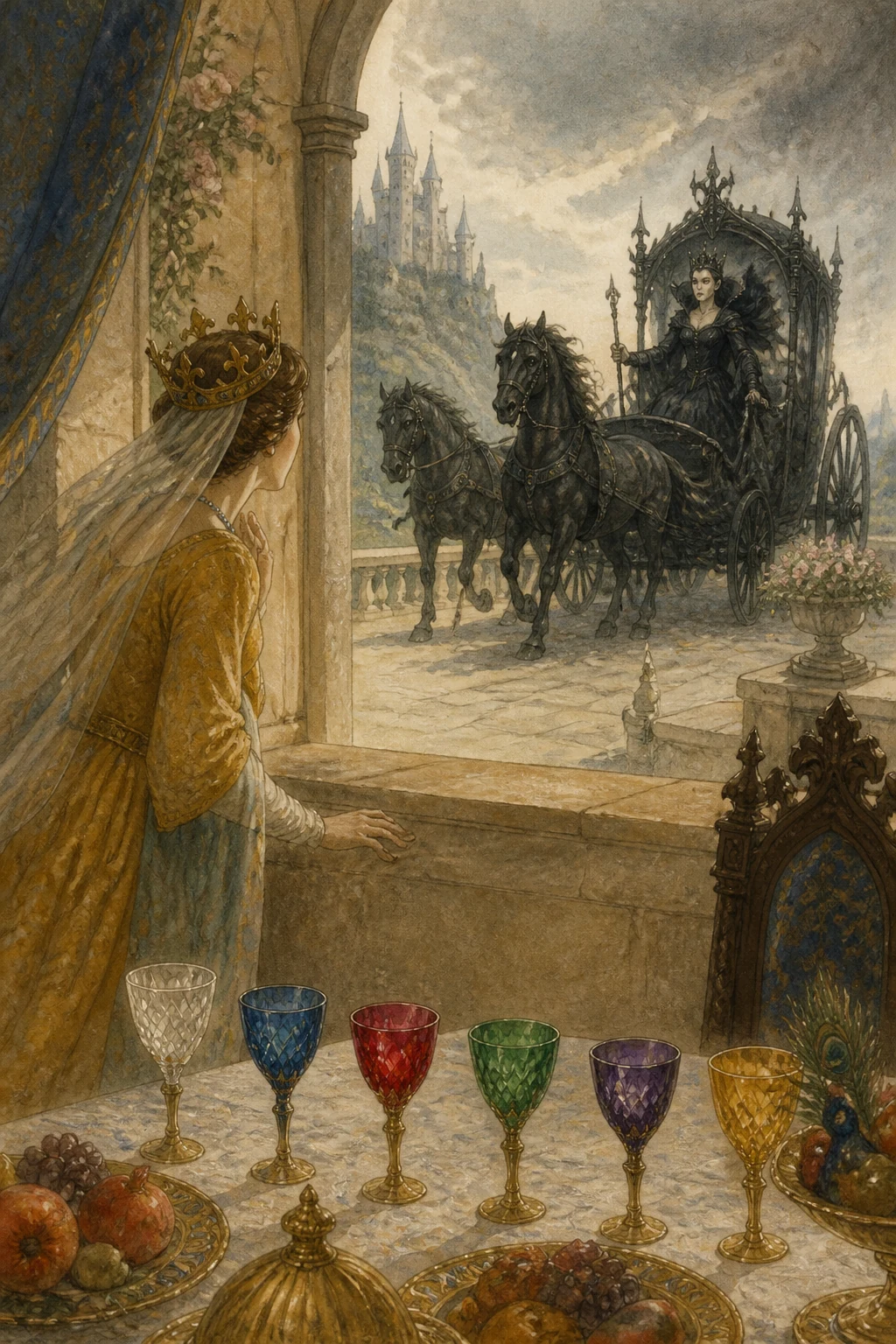
After the christening ceremony, the whole company returned to the King’s palace, where a great feast had been prepared for the fairies. Before each was set a magnificent place setting, with a case of solid gold containing a spoon, a fork, and a knife of fine gold, studded with diamonds and rubies. But just as everyone was taking a place at the table, an old fairy came in who had not been invited, because she had not left her tower for more than fifty years and was believed to be dead or enchanted. The King had a place laid for her, but there was no way to provide her with a solid-gold case like the others, since only seven had been made for the seven fairies. The old fairy thought she was being slighted and muttered a few threats between her teeth. One of the young fairies, who happened to be beside her, overheard her and, fearing that she might bestow some dreadful gift upon the little Princess, went to hide behind the tapestry as soon as they left the table, so that she could speak last and repair, as far as she could, whatever harm the old fairy might have done.
Meanwhile, the fairies began bestowing their gifts upon the Princess. The youngest gave her the gift of being the most beautiful person in the world; the next, of having the wit of an angel; the third, of showing an admirable grace in everything she did; the fourth, of dancing perfectly; the fifth, of singing like a nightingale; and the sixth, of playing every kind of instrument to the utmost perfection. When the old fairy’s turn came, she shook her head, more from spite than from age, and declared that the Princess would pierce her hand with a spindle and die of it.
This terrible gift made the whole company shudder, and there was not a soul who did not weep. At that moment the young fairy stepped out from behind the tapestry and said aloud, “Take heart, King and Queen: your daughter shall not die. It is true that I have not enough power to undo entirely what my elder has done. The Princess will pierce her hand with a spindle, but instead of dying, she will merely fall into a deep sleep that will last a hundred years, at the end of which a King’s son will come to awaken her.”
The King, hoping to avert the misfortune foretold by the old fairy, immediately issued an edict forbidding anyone, on pain of death, to spin with a spindle or to keep spindles in the house. Fifteen or sixteen years later, the King and Queen having gone to one of their country residences, it happened that the young Princess, running about the castle one day and climbing from room to room, came to a little garret at the top of a tower, where a good old woman sat alone, spinning from her distaff. This good woman had never heard of the King’s prohibition against spinning with a spindle.
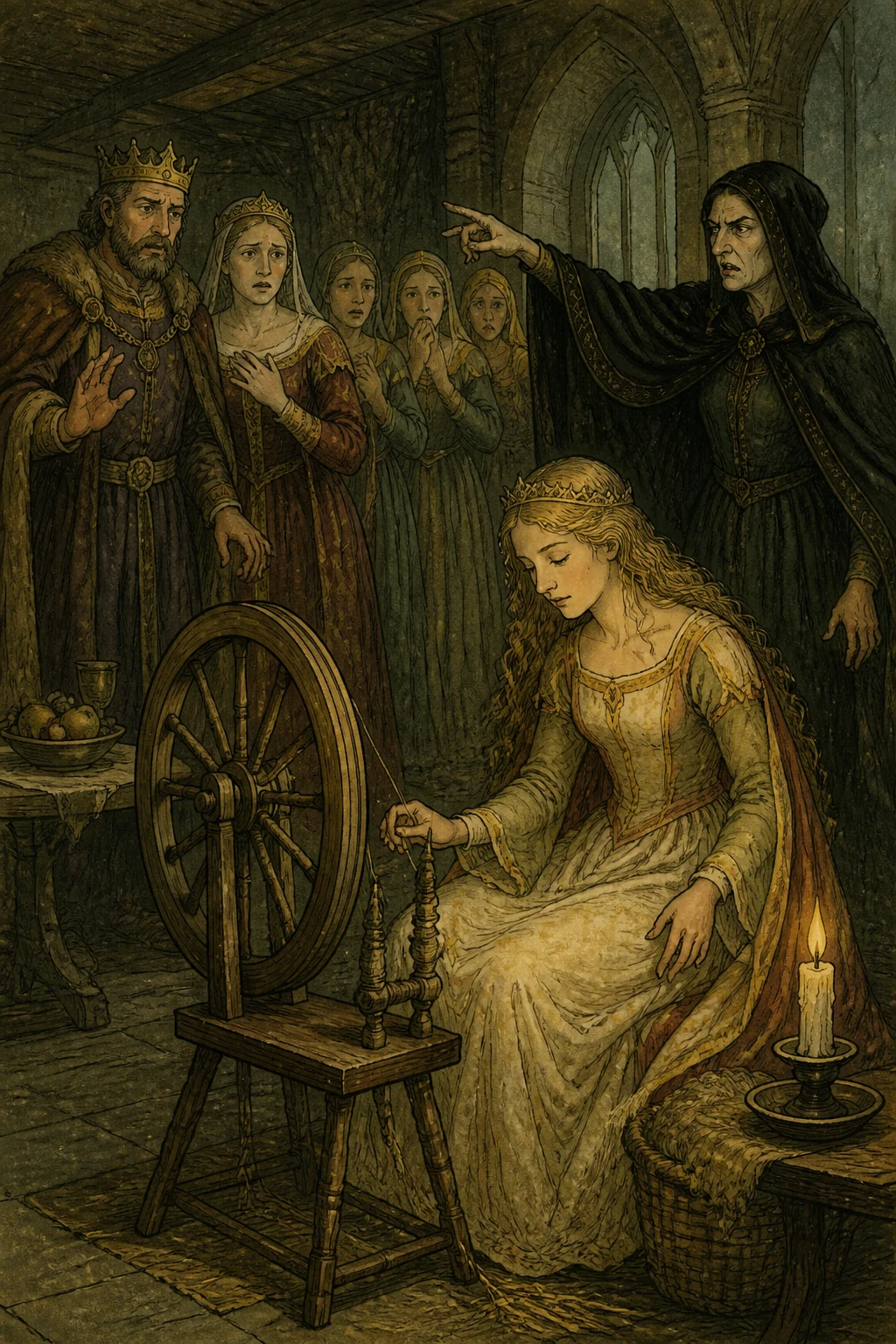
“What are you doing there, good woman?” asked the Princess. “I am spinning, my pretty child,” replied the old woman, who did not know her. “Oh, how pretty it is!” the Princess said. “How do you do it? Let me have it, so I can see whether I could do as well.” No sooner had she taken the spindle than, being very lively and rather heedless, and since the fairies’ decree had ordained it so, she pierced her hand with it and fell unconscious.
The good old woman, greatly alarmed, cried for help. People came running from every direction; they splashed water on the Princess’s face, loosened her clothes, slapped her hands, and rubbed her temples with Queen of Hungary’s water, but nothing would bring her round. Then the King, who had come upstairs at the commotion, remembered the fairies’ prediction and, realizing that this must happen since the fairies had foretold it, had the Princess laid in the finest apartment in the palace, upon a bed embroidered with gold and silver. She was so beautiful that one might have taken her for an angel, for her unconsciousness had not robbed her complexion of its vivid colours: her cheeks were rosy and her lips like coral. Her eyes alone were closed, but she could be heard breathing softly, which showed that she was not dead. The King ordered that she be left to sleep in peace until the hour of her awakening should come. The good fairy who had saved her life by condemning her to sleep for a hundred years was in the Kingdom of Mataquin, twelve thousand leagues away, when the Princess met with her accident; but she was told of it in an instant by a little dwarf who wore seven-league boots—boots in which one could travel seven leagues in a single stride. The fairy set off at once, and an hour later she was seen arriving in a chariot of fire drawn by dragons. The King went to offer her his hand as she stepped down from the chariot. She approved of everything he had done; but, being very far-sighted, she reflected that when the Princess awoke, she would find herself in great difficulty all alone in this old castle. Here is what she did. She touched with her wand everyone in the castle except the King and Queen: governesses, maids of honour, ladies’ maids, gentlemen, officers, stewards, cooks, kitchen boys, errand boys, guards, Swiss guards, pages, and footmen. She also touched all the horses in the stables, along with the grooms, the great mastiffs in the yard, and little Pouffe, the Princess’s little dog, who was lying beside her on the bed. As soon as she touched them, they all fell asleep, not to awaken until their mistress did, so that they would be quite ready to serve her when she needed them. Even the spits over the fire, laden with partridges and pheasants, fell asleep, and so did the fire itself. All this was done in a moment: fairies did not take long over their work. Then the King and Queen, having kissed their dear child without waking her, left the castle and issued orders forbidding anyone to approach it. These orders were unnecessary, for within a quarter of an hour so many trees, great and small, and so many brambles and thorns had grown up all around the park, interlacing with one another, that neither beast nor man could have passed through them. Nothing could be seen but the tops of the castle towers, and even those only from a great distance. No one doubted that the fairy had worked another of her spells, so that the Princess, while she slept, would have nothing to fear from the curious.
At the end of a hundred years, the son of the King then reigning, who belonged to a different family from the sleeping Princess, went hunting in that part of the country and asked what the towers were that he could see above a great, dense wood. Everyone answered according to what they had heard. Some said it was an old castle haunted by spirits; others, that all the witches and sorcerers of the district held their sabbath there. The most common belief was that an ogre lived there and carried off to it all the children he could catch, so that he could eat them at his leisure without anyone being able to follow him, since he alone had the power to make a passage through the wood. The Prince did not know what to believe, when an old peasant spoke up and said:
“My Prince, more than fifty years ago I heard my father say that in that castle there was a Princess, the most beautiful in the world; that she was to sleep there for a hundred years, and that she would be awakened by a King’s son, for whom she was destined.”
At these words the young Prince felt his heart catch fire. He believed without hesitation that he would bring so splendid an adventure to its conclusion, and, urged on by love and glory, he resolved to discover the truth of it at once. Scarcely had he advanced towards the wood when all the great trees, brambles, and thorns parted of their own accord to let him pass. He walked towards the castle, which he could see at the end of a broad avenue he had entered, and was somewhat surprised to find that none of his attendants had been able to follow him, because the trees had closed together again as soon as he had passed. Nevertheless, he continued on his way: a young Prince in love is always brave. He entered a great outer courtyard, where the first sight that met his eyes might well have chilled him with fear. A dreadful silence reigned; the image of death appeared everywhere, and there was nothing but the outstretched bodies of men and animals who seemed to be dead. Yet from the bulbous noses and ruddy faces of the Swiss guards, he could plainly see that they were only sleeping, and their cups, which still held a few drops of wine, showed clearly enough that they had fallen asleep while drinking.
He crossed a great courtyard paved with marble, climbed the stairs, and entered the guardroom, where the guards stood in two rows, carbines on their shoulders, snoring mightily. He passed through several rooms full of gentlemen and ladies, all sleeping, some standing and others sitting. He entered a room covered in gilding, and there, upon a bed with its curtains drawn back on every side, he saw the loveliest sight he had ever beheld: a Princess who seemed to be fifteen or sixteen years old, and whose radiant beauty had something luminous and divine about it. Trembling with admiration, he approached and knelt beside her.
Then, as the enchantment had reached its end, the Princess awoke and, looking at him with eyes more tender than a first meeting would seem to allow, said:
“Is it you, my Prince? You have kept me waiting a very long time.” The Prince, enchanted by these words, and still more by the way they were spoken, did not know how to express his joy and gratitude. He assured her that he loved her more than himself. His words were disordered, and pleased her all the more for it: little eloquence, much love. He was more at a loss than she was, which should come as no surprise; she had had time to think about what she would say to him, for it seems likely—though the story says nothing of it—that during so long a sleep the good fairy had granted her the pleasure of agreeable dreams. In short, they had been talking for four hours and had not yet said half the things they had to say.
Meanwhile, the whole palace had awakened with the Princess. Everyone was thinking of attending to their duties, and, as they were not all in love, they were dying of hunger. The lady-in-waiting, as hungry as the rest, grew impatient and told the Princess in a loud voice that dinner was served. The Prince helped the Princess to rise. She was fully dressed, and very magnificently too, but he took care not to tell her that she was dressed like his grandmother and wore a high, stiff collar; she was no less beautiful for it.
They went into a hall of mirrors and supped there, served by the Princess’s household officers. The violins and oboes played old but excellent pieces, though it was nearly a hundred years since anyone had played them. After supper, without losing any time, the chief chaplain married them in the castle chapel, and the lady-in-waiting drew their bed curtains. They slept little: the Princess had no great need of sleep, and early in the morning the Prince left her to return to the city, where his father must have been anxious about him. The Prince told him that he had lost his way in the forest while hunting and had spent the night in the hut of a charcoal burner, who had given him black bread and cheese to eat. His father the King, who was a good-natured man, believed him; but his mother was not so easily persuaded. Seeing that he went hunting almost every day and always had an excuse ready whenever he had spent two or three nights away, she no longer doubted that he had some love affair. For he lived with the Princess for more than two whole years and had two children by her. The first, a girl, was named Aurore, and the second, a boy, was named Jour, because he seemed even more beautiful than his sister.
The Queen told her son several times, hoping to make him speak, that one ought to enjoy oneself in life; but he never dared trust her with his secret. Though he loved her, he feared her, for she came of a race of ogres, and the King had married her only because of her great wealth. It was even whispered at court that she had the inclinations of an ogress and that, whenever she saw little children passing, she had the greatest difficulty restraining herself from pouncing on them. Thus the Prince would never say anything.
But when the King died, which happened after two years, and the Prince found himself his own master, he publicly declared his marriage and went in great ceremony to fetch the Queen his wife from her castle. She was given a magnificent welcome in the capital, which she entered with her two children beside her.
Some time later, the King went to war against his neighbour, the Emperor Cantalabutte. He left the regency of the kingdom to the Queen his mother, earnestly commending his wife and children to her care. He was to be away at war all summer, and as soon as he had gone, the Queen Mother sent her daughter-in-law and the children to a country house in the woods, where she could more easily satisfy her horrible craving. She went there herself a few days later, and one evening said to her steward, “Tomorrow at dinner I mean to eat little Aurore.”
“Ah, Madam!” said the steward. “I insist,” said the Queen, in the voice of an ogress longing to eat fresh flesh, “and I want her served with sauce Robert.”
The poor man, seeing plainly that an ogress was not to be trifled with, took his great knife and went up to little Aurore’s room. She was four years old at the time and came skipping and laughing to throw her arms about his neck and ask him for sweets. He began to weep, the knife fell from his hands, and he went into the yard to cut the throat of a little lamb. He prepared it with such a delicious sauce that his mistress assured him she had never eaten anything so good. Meanwhile, he had carried little Aurore away and given her to his wife to hide in their lodgings at the far end of the yard. Eight days later the wicked Queen said to her steward, “I mean to eat little Jour for supper.” He made no reply, having resolved to deceive her as before. He went to fetch little Jour and found him with a little foil in his hand, fencing with a large monkey, though he was only three years old. He carried him to his wife, who hid him with little Aurore, and in little Jour’s place he served a very tender young kid, which the ogress found wonderfully good.
So far everything had gone very well, but one evening the wicked Queen said to the steward, “I mean to eat the Queen with the same sauce as her children.” Then the poor steward despaired of being able to deceive her again. The young Queen was over twenty, not counting the hundred years she had slept; her skin was a little tough, though fair and beautiful, and how was he to find an animal in the menagerie as tough as that? To save his own life, he resolved to cut the Queen’s throat and went up to her room intending to do it in a single stroke. He worked himself into a fury and entered the young Queen’s chamber with his dagger in his hand. Yet he would not take her unawares, and with great respect he told her of the order he had received from the Queen Mother.
“Do it, do it,” she told him, offering him her neck. “Carry out the order you have been given. I shall see my children again, my poor children whom I loved so dearly.” She had believed them dead ever since they had been taken away without a word to her.
“No, no, Madam,” replied the poor steward, deeply moved. “You shall not die, and you shall still see your dear children again, but it will be in my lodgings, where I have hidden them. And I shall deceive the Queen once more by serving her a young doe in your place.”
He took her at once to his room and, leaving her to embrace her children and weep with them, went to prepare a doe, which the Queen ate for supper with as much appetite as if it had been the young Queen. She was well pleased with her cruelty and was preparing to tell the King on his return that ravening wolves had eaten his wife and both his children.
One evening, as she was prowling as usual about the castle’s courts and yards, sniffing out fresh flesh, she heard little Jour crying in a ground-floor room because the Queen his mother meant to have him whipped for being naughty. She also heard little Aurore pleading for her brother to be forgiven. The ogress recognized the voices of the Queen and her children, and, furious at having been deceived, gave orders the very next morning, in a dreadful voice that made everyone tremble, for a great vat to be brought into the middle of the courtyard. She had it filled with toads, vipers, adders, and snakes, intending to have the Queen and her children, the steward, his wife, and his maidservant thrown into it. She had ordered them brought out with their hands tied behind their backs. They were standing there, and the executioners were preparing to throw them into the vat, when the King, who was not expected so soon, rode into the courtyard. He had come by post horses and asked in astonishment what this horrible spectacle meant. No one dared tell him, when the ogress, enraged at what she saw, flung herself headfirst into the vat and was devoured in an instant by the loathsome creatures she had ordered put there. The King could not help grieving, for she was his mother, but he soon found comfort with his beautiful wife and his children.
MORAL To wait a while to find a husband Rich, handsome, gallant, gentle too, Is natural enough to do; But wait a hundred years, and sleeping all the while? No woman now could sleep so soundly Through so long a trial.
The tale would also seem to show That marriage’s delightful ties, Though long delayed, are no less sweet, And those who wait lose nothing by it.
But women yearn with such desire To pledge themselves in marriage That I have neither strength nor heart To preach to them this moral.
Izvirnik
LA BELLE
AU BOIS
DORMANT
CONTE
Il estoit une fois un Roi & une Reine qui estoient si faschez de n’avoir point d’enfans, si faschez qu’on ne sçauroit dire. Ils allerent à toutes les eaux du monde : vœux, pelerinages, menuës devotions, tout fut mis en œuvre, & rien n’y faisoit. Enfin, pourtant, la Reine devint grosse, & accoucha d’une fille ; on fit un beau Baptesme ; on donna pour Maraines à la petite Princesse toutes les Fées qu’on pust trouver dans le Païs (il s’en trouva sept), afin que, chacune d’elles luy faisant un don, comme c’estoit la coustume des Fées en ce temps-là, la Princesse eust, par ce moyen, toutes les perfections imaginables.
Aprés les ceremonies du Baptesme, toute la compagnie revint au Palais du Roi, où il y avoit un grand festin pour les Fées. On mit devant chacune d’elles un couvert magnifique, avec un estui d’or massif où il y avoit une cuillier, une fourchette, & un couteau de fin or, garnis de diamants & de rubis. Mais, comme chacun prenoit sa place à table, on vit entrer une vieille Fée, qu’on n’avait point priée, parce qu’il y avait plus de cinquante ans qu’elle n’estoit sortie d’une Tour, & qu’on la croyoit morte ou enchantée. Le Roi lui fit donner un couvert ; mais il n’y eut pas moyen de lui donner un estuy d’or massif, comme aux autres, parce que l’on n’en avoit fait faire que sept pour les sept Fées. La vieille crût qu’on la méprisait, & grommela quelques menaces entre ses dents. Une des jeunes Fées qui se trouva auprés d’elle, l’entendit, et, jugeant qu’elle pourroit donner quelque fâcheux don à la petite princesse, alla dés qu’on fut sorti de table, se cacher derriere la tapisserie, afin de parler la derniere, & de pouvoir réparer, autant qu’il luy seroit possible, le mal que la vieille aurait fait.
Cependant les Fées commencerent à faire leurs dons à la Princesse. La plus jeune luy donna pour don qu’elle seroit la plus belle personne du monde, celle d’aprés qu’elle auroit de l’esprit comme un Ange, la troisiéme qu’elle auroit une grace admirable à tout ce qu’elle feroit ; la quatriéme qu’elle danseroit parfaitement bien, la cinquiéme qu’elle chanteroit comme un Rossignol, & la sixiéme, qu’elle joüeroit
de toutes sortes d’instrumens dans la derniere perfection. Le rang de la vieille Fée estant venu, elle dit, en branlant la teste, encore plus de dépit que de vieillesse, que la Princesse se perceroit la main d’un fuseau & qu’elle en mourroit.
Ce terrible don fit fremir toute la compagnie, & il n’y eut personne qui ne pleurât. Dans ce moment, la jeune Fée sortit de derriere la tapisserie, dit tout haut ces paroles : Rassurez-vous, Roi & Reine, vostre fille n’en mourra pas. Il est vrai que je n’ay pas assez de puissance pour défaire entierement ce que mon ancienne a fait. La Princesse se percera la main d’un fuseau ; mais, au lieu d’en mourir, elle tombera seulement dans un profond sommeil qui durera cent ans, au bout desquels le fils d’un Roi viendra la réveiller.
Le Roi, pour tâcher d’éviter le malheur annoncé par la vieille, fit publier aussi tost un Edit par lequel il deffendoit à toutes personnes de filer au fuseau, ny d’avoir des fuseaux chez soy, sur peine de la vie. Au bout de quinze ou seize ans, le Roi & la Reine estant allez à une de leurs Maisons de plaisance, il arriva que la jeune Princesse, courant un jour dans le Château, & montant de chambre en chambre, alla jusqu’au haut d’un Donjon dans un petit galletas, où une bonne Vieille estoit seule à filer sa quenoüille. Cette bonne femme n’avoit point ouï parler des deffenses que le roi avoit faites de filer au fuseau.
Que faites-vous là, ma bonne femme ? dit la Princesse,
Je file, ma belle enfant, luy répondit la vieille, qui ne la connoissoit pas.
Ha ! que cela est joli, reprit la Princesse ; comment faites-vous ? donnez-moy que je voye si j’en ferois bien autant. Elle n’eust pas plutost pris le fuseau, que, comme elle estoit fort vive, un peu estourdie, & que d’ailleurs l’Arrest des Fées l’ordonnoit ainsi, elle s’en perça la main & tomba évanouie.
La bonne vieille, bien embarrassée, crie au secours : on vient de tous costez ; on jette de l’eau au visage de la princesse, on la délasse, on luy frappe dans les mains, on luy frotte les tempes avec de l’eau de la Reine de Hongrie ; mais rien ne la faisoit revenir. Alors le Roy, qui estoit monté au bruit, se souvint de la prédiction des fées, et, jugeant bien qu’il falloit que cela arrivast, puisque les Fées l’avoient dit, fit mettre la Princesse dans le plus bel appartement du Palais, sur un lit en broderie d’or & d’argent. On eût dit d’un Ange, tant elle estoit belle : car son évanouissement n’avoit pas osté les couleurs vives de son teint : ses joues estoient incarnates, & ses levres comme du corail ; elle avoit seulement les yeux fermez, mais on l’entendoit respirer doucement : ce qui faisoit voir qu’elle n’estoit pas morte. Le Roi ordonna qu’on la laissast dormir en repos, jusqu’à ce que son heure de se réveiller fust venue. La bonne Fée qui luy avoit sauvé la vie en la condamnant à dormir cent ans estoit dans le Royaume de Mataquin, à douze mille lieuës de là, lorsque l’accident arriva à la Princesse ; mais elle en fut avertie en un instant par un petit Nain qui avoit des bottes de sept lieues (c’estoit des bottes avec lesquelles on faisoit sept lieues d’une seule enjambée). La Fée partit aussi tost, & on la vit, au bout d’une heure, arriver dans un chariot tout de feu, traisné par des dragons. Le Roi luy alla presenter la main à la descente du chariot. Elle approuva tout ce qu’il avoit fait ; mais, comme elle estoit grandement prévoyante, elle pensa que, quand la Princesse viendrait à se réveiller, elle seroit bien embarassée toute seule dans ce vieux château : voicy ce qu’elle fit. Elle toucha de sa baguette tout ce qui estoit dans ce Chasteau (hors le Roi & la Reine) : Gouvernantes, Filles-d’Honneur, Femmes-de-Chambre, Gentils-Hommes, Officiers, Maistres d’Hostel, Cuisiniers, Marmitons, Galopins, Gardes, Suisses, Pages, Valets-de-pied ; elle toucha aussi tous les chevaux qui estoient dans les Ecuries, avec les Palfreniers, les gros mâtins de basse-cour, & la petite Pouffe, petite chienne de la Princesse, qui estoit auprés d’elle sur son lit. Dés qu’elle les eust touchez, ils s’endormirent tous, pour ne se réveiller qu’en mesme temps que leur Maistresse, afin d’estre tout prests à la servir quand elle en auroit besoin : les broches mêmes qui estoient au feu, toutes pleines de perdrix & de faysans, s’endormirent, & le feu aussi. Tout cela se fit en un moment : les Fées n’estoient pas longues à leur besogne. Alors le Roi & la Reine aprés avoir baisé leur chere enfant sans qu’elle s’éveillast, sortirent du chasteau, & firent publier des deffenses à qui que ce soit d’en approcher. Ces deffenses n’estoient pas necessaires, car il crut dans un quart d’heure tout au tour du parc une si grande quantité de grands arbres & de petits, de ronces & d’épines entrelassées les unes dans les autres, que beste ny homme n’y auroit pû passer : en sorte qu’on ne voyoit plus que le haut des Tours du Chasteau, encore n’estoit-ce que de bien loin. On ne douta point que la fée n’eust encore fait là un tour de son métier, afin que la Princesse, pendant qu’elle dormiroit, n’eust rien à craindre des Curieux.
Au bout de cent ans, le fils du roi qui regnoit alors, & qui estoit d’une autre famille que la princesse endormie, estant allé à la chasse de ce costé-là, demanda ce que c’estoit que des Tours qu’il voyoit au-dessus d’un grand bois fort épais, chacun luy répondit selon qu’il en avoit ouï parler. Les uns disoient que c’estoit un vieux Château où il revenoit des Esprits ; les autres, que tous les Sorciers de la Contrée y faisoient leur sabbat. La plus commune opinion estoit qu’un Ogre y demeuroit, & que là il emportoit tous les enfans qu’il pouvoit attraper, pour les pouvoir manger à son aise & sans qu’on le pust suivre, ayant seul le pouvoir de se faire un passage au travers du bois. Le prince ne sçavoit qu’en croire, lors qu’un vieux Paysan prit la parole & luy dit :
Mon Prince, il y a plus de cinquante ans que j’ay ouï dire à mon pere qu’il y avoit dans ce Chasteau une Princesse, la plus belle du monde ; qu’elle y devoit dormir cent ans, & qu’elle seroit réveillée par le fils d’un Roi, à qui elle estoit reservée.
Le jeune Prince à ce discours se sentit tout de feu ; il crut sans balancer qu’il mettroit fin à une si belle avanture, & poussé par l’amour & par la gloire, il résolut de voir sur le champ ce qui en estoit. À peine s’avança-t-il vers le bois que tous ces grands arbres, ces ronces, & ces épines s’écarterent d’elles-mesmes pour le laisser passer : il marche vers le Chasteau qu’il voyoit au bout d’une grande avenuë où il entra, & ce qui le surprit un peu, il vit que personne de ses gens ne l’avoit pû suivre, parce que les arbres s’estoient rapprochez dés qu’il avoit esté passé. Il ne laissa pas de continuer son chemin : un Prince jeune & amoureux est toûjours vaillant. Il entra dans une grande avancour, où tout ce qu’il vit d’abord estoit capable de le glacer de crainte : c’estoit un silence affreux, l’image de la mort s’y presentoit par tout, & ce n’estoit que des corps étendus d’hommes & d’animaux, qui paroissoient morts. Il reconnut pourtant bien au nez bourgeonnez & à la face vermeille des Suisses, qu’ils n’estoient qu’endormis, & leurs tasses où il y avoit encore quelques goutes de vin, montroient assez qu’ils s’estoient endormis en beuvant.
Il passe une grande cour pavée de marbre, il monte l’escalier, il entre dans la salle des Gardes qui estoient rangez en haye, la carabine sur l’épaule, & ronflans de leur mieux. Il traverse plusieurs chambres pleines de Gentilshommes & de Dames, dormans tous, les uns debout, les autres assis ; il entre dans une chambre toute dorée, & il vit sur un lit, dont les rideaux estoient ouverts de tous côtez, le plus beau spectacle qu’il eut jamais veu : Une Princesse qui paroissoit avoir quinze ou seize ans, & dont l’éclat resplendissant avoit quelque chose de lumineux & de divin. Il s’approcha en tremblant & en admirant, & se mit à genoux auprés d’elle.
Alors, comme la fin de l’enchantement estoit venuë, la Princesse s’éveilla ; & le regardant avec des yeux plus tendres qu’une premiere veuë ne sembloit le permettre ;
est ce vous, mon Prince, luy dit-elle ; vous vous estes bien fait attendre. Le Prince charmé de ces paroles, & plus encore de la maniere dont elles estoient dites, ne sçavoit comment luy témoigner sa joye & sa reconnoissance ; il l’assura qu’il l’aimoit plus que luy-mesme. Ses discours furent mal rangez, ils en plurent davantage, peu d’éloquence, beaucoup d’amour : il estoit plus embarassé qu’elle, & l’on ne doit pas s’en estonner ; elle avoit eu le temps de songer à ce qu’elle auroit à luy dire, car il y a apparence (l’Histoire n’en dit pourtant rien) que la bonne fée pendant un si long sommeil, lui avoit procuré le plaisir des songes agreables. Enfin il y avoit quatre heures qu’ils se parloient, & ils ne s’estoient pas encore dit la moitié des choses qu’ils avoient à se dire.
Cependant tout le Palais s’estoit réveillé avec la Princesse : chacun songeoit à faire sa charge, & comme ils n’estoient pas tous amoureux, ils mouroient de faim. La Dame d’honneur, pressée comme les autres, s’impatienta, & dit tout haut à la Princesse que la viande estoit servie. Le Prince aida la princesse à se lever : elle estoit tout habillée, & fort magnifiquement ; mais il garda bien de luy dire qu’elle estoit habillée comme ma mere grand, & qu’elle avoit un collet monté, elle n’en estoit pas moins belle.
Ils passerent dans un salon de miroirs, & y souperent, servis par les Officiers de la Princesse. Les Violons & les Hautbois joüerent de vieilles pieces, mais excellentes, quoyqu’il y eut prés de cent ans qu’on ne les joüast plus ; & aprés soupé, sans perdre de temps, le grand Aumonier les maria dans la Chapelle du Chasteau, & la Dame-d’honneur leur tira le rideau. Ils dormirent peu : la Princesse n’en avoit pas grand besoin, & le Prince la quitta dès le matin pour retourner à la Ville, où son pere devait estre en peine de luy : le Prince luy dit qu’en chassant il s’estait perdu dans la forest, & qu’il avait couché dans la hutte d’un Charbonnier, qui luy avoit fait manger du pain noir & du fromage. Le Roi son pere qui estoit bon-homme, le crut ; mais sa Mere n’en fut pas bien persuadée, & voyant qu’il alloit presque tous les jours à la chasse, & qu’il avoit toûjours une raison en main pour s’excuser quand il avoit couché deux ou trois nuits dehors, elle ne douta plus qu’il n’eut quelque amourette : car il vêcut avec la Princesse plus de deux ans entiers, & en eut deux enfans, dont le premier qui fut une fille, fut nommée l’Aurore, & le second un fils, qu’on nomma le Jour, parce qu’il paroissoit encore plus beau que sa sœur.
La Reine dit plusieurs fois à son fils, pour le faire expliquer, qu’il falloit se contenter dans la vie, mais il n’osa jamais se fier à elle de son secret ; il la craignoit quoy qu’il l’aimast, car elle estoit de race Ogresse, & le Roi ne l’avoit épousée qu’à cause de ses grands biens. On disoit même tout bas à la Cour qu’elle avoit les inclinations des Ogres, & qu’en voyant passer de petits enfans, elle avoit toutes les peines du monde à se retenir de se jeter sur eux ; ainsi le Prince ne voulut jamais rien dire.
Mais, quand le Roy fut mort, ce qui arriva au bout de deux ans, & qu’il se vit le maistre, il declara publiquement son Mariage, & alla en grande ceremonie querir la Reine sa femme dans son Chasteau. On luy fit une entrée magnifique dans la Ville Capitale, où elle entra au milieu de ses deux enfans.
Quelque temps aprés, le Roi alla faire la guerre à l’Empereur Cantalabutte, son voisin. Il laissa la Regence du royaume à la Reine sa mere, & luy recommanda fort sa femme & ses enfans : il devoit estre à la guerre tout l’Esté ; et, dés qu’il fut parti, la Reine-Mere envoya sa bru & ses enfans à une maison de campagne dans les bois, pour pouvoir plus aisément assouvir son horrible envie. Elle y alla quelques jours aprés, & dit un soir à son Maistre d’Hostel, je veux manger demain à mon dîner la petite Aurore.
Ah ! Madame, dit le Maistre-d’Hostel, je le veux, dit la Reine (& elle le dit d’un ton d’Ogresse qui a envie de manger de la chair fraische), & je la veux manger à la Sausse-robert.
Ce pauvre homme, voyant bien qu’il ne falloit pas se joüer à une Ogresse, prit son grand cousteau, & monta à la chambre de la petite Aurore : elle avoit pour lors quatre ans, & vint en sautant & en riant se jetter à son col, & luy demander du bon bon. Il se mit à pleurer, le couteau luy tomba des mains, & il alla dans la basse cour couper la gorge à un petit agneau, & luy fit une si bonne sausse que sa maistresse l’assura qu’elle n’avoit jamais rien mangé de si bon. Il avoit emporté en même temps la petite Aurore, & l’avoit donnée à sa femme, pour la cacher dans le logement qu’elle avoit au fond de la basse-cour. Huit jours après, la méchante Reine dit à son Maistre-d’Hostel, je veux manger à mon souper le petit Jour : il ne répliqua pas, résolu de la tromper comme l’autre fois ; il alla chercher le petit Jour, & le trouva avec un petit fleuret à la main, dont il faisoit des armes avec un gros Singe : il n’avoit pourtant que trois ans. Il le porta à sa femme, qui le cacha avec la petite Aurore, & donna à la place du petit Jour, un petit chevreau fort tendre, que l’Ogresse trouva admirablement bon.
Cela estoit fort bien allé jusque là, mais un soir cette méchante reine dit au Maistre-d’Hostel, je veux manger la Reine à la mesme sausse que ses enfans. Ce fut alors que le pauvre Maistre-d’Hostel desespera de la pouvoir encore tromper. La jeune reine avoit vingt ans passez, sans compter les cent ans qu’elle avoit dormi : sa peau estoit un peu dure, quoyque belle & blanche ; & le moyen de trouver dans la Menagerie une beste aussi dure que cela : il prit la resolution, pour sauver sa vie, de couper la gorge à la reine, & monta dans sa chambre, dans l’intention de n’en pas faire à deux fois ; il s’excitoit à la fureur, & entra le poignard à la main dans la chambre de la jeune Reine : il ne voulut pourtant point la surprendre, & il luy dit avec beaucoup de respect, l’ordre qu’il avoit receu de la Reine-Mere.
Faites, faites, luy dit-elle en luy tendant le col ; executez l’ordre qu’on vous a donné ; j’irai revoir mes enfans, mes pauvres enfans, que j’ay tant aimez : elle les croyoit morts depuis qu’on les avoit enlevez sans luy rien dire.
Non, non, Madame, lui répondit le pauvre Maistre d’Hostel tout attendri, vous ne mourrez point, & vous ne laisserez pas d’aller revoir vos chers enfans ; mais ce sera chez moy où je les ay cachez, & je tromperay encore la Reine, en luy faisant manger une jeune biche en vostre place.
Il la mena aussi-tost à sa chambre, où la laissant embrasser ses enfans & pleurer avec eux : il alla accommoder une biche, que la reine mangea à son soupé, avec le même appetit que si c’eut esté la jeune reine. Elle estoit bien contente de sa cruauté, & elle se préparoit à dire au Roi à son retour, que des loups enragez avoient mangez la Reine sa femme & ses deux enfans.
Un soir qu’elle rodoit à son ordinaire, dans les cours & basses-cours du chasteau pour y halener quelque viande fraische, elle entendit dans une salle basse le petit Jour qui pleuroit, parce que la Reine sa mere le vouloit faire foüetter, à cause qu’il avoit esté méchant, & elle entendit aussi la petite Aurore qui demandoit pardon pour son frere. L’Ogresse reconnut la voix de la Reine & de ses enfans, et, furieuse d’avoir esté trompée, elle commande, dés le lendemain matin, avec une voix épouvantable, qui faisoit trembler tout le monde, qu’on apportast au milieu de la cour une grande cuve, qu’elle fit remplir de crapaux, de viperes, de couleuvres & de serpens, pour y faire jetter la Reine & ses enfans, le Maistre d’Hostel, sa femme & sa servante ; elle avoit donné ordre de les amener les mains liées derriere le dos. Ils estoient là, & les bourreaux se preparoient à les jetter dans la cuve, lorsque le Roi qu’on n’attendoit pas sitost, entra dans la cour, à cheval ; il estoit venu en poste & demanda tout estonné ce que vouloit dire cet horrible spectacle. Personne n’osoit l’en instruire, quand l’Ogresse, enragée de voir ce qu’elle voyoit, se jeta elle-mesme la teste la premiere dans la cuve, & fut devorée en un instant par les vilaines bestes qu’elle y avoit fait mettre. Le roi ne laissa pas d’en estre fasché, elle estoit sa mere, mais il s’en consola bientost avec sa belle femme & ses enfans.
MORALITÉ
Attendre quelque temps pour avoir un Époux
Riche, bien-fait, galant & doux,
La chose est assez naturelle :
Mais l’attendre cent ans, & toûjours en dormant,
On ne trouve plus de femelle
Qui dormist si tranquillement.
La Fable semble encor vouloir nous faire entendre
Que souvent de l’Hymen les agreables nœuds,
Pour estre differez, n’en sont pas moins heureux,
Et qu’on ne perd rien pour attendre.
Mais le sexe avec tant d’ardeur
Aspire à la foy conjugale
Que je n’ay pas la force ny le cœur
De luy prescher cette morale.