Prevod
Once upon a time there lived a King and Queen who were so unhappy at having no children, so unhappy that words cannot tell. They visited every medicinal spring in the world; vows, pilgrimages, little acts of devotion—everything was tried, and nothing did any good. At last, however, the Queen became pregnant and gave birth to a daughter. A splendid christening was held, and all the fairies who could be found in the country were made godmothers to the little Princess—there were seven of them—so that, by each bestowing a gift upon her, as was the custom among fairies in those days, the Princess might possess every imaginable perfection.
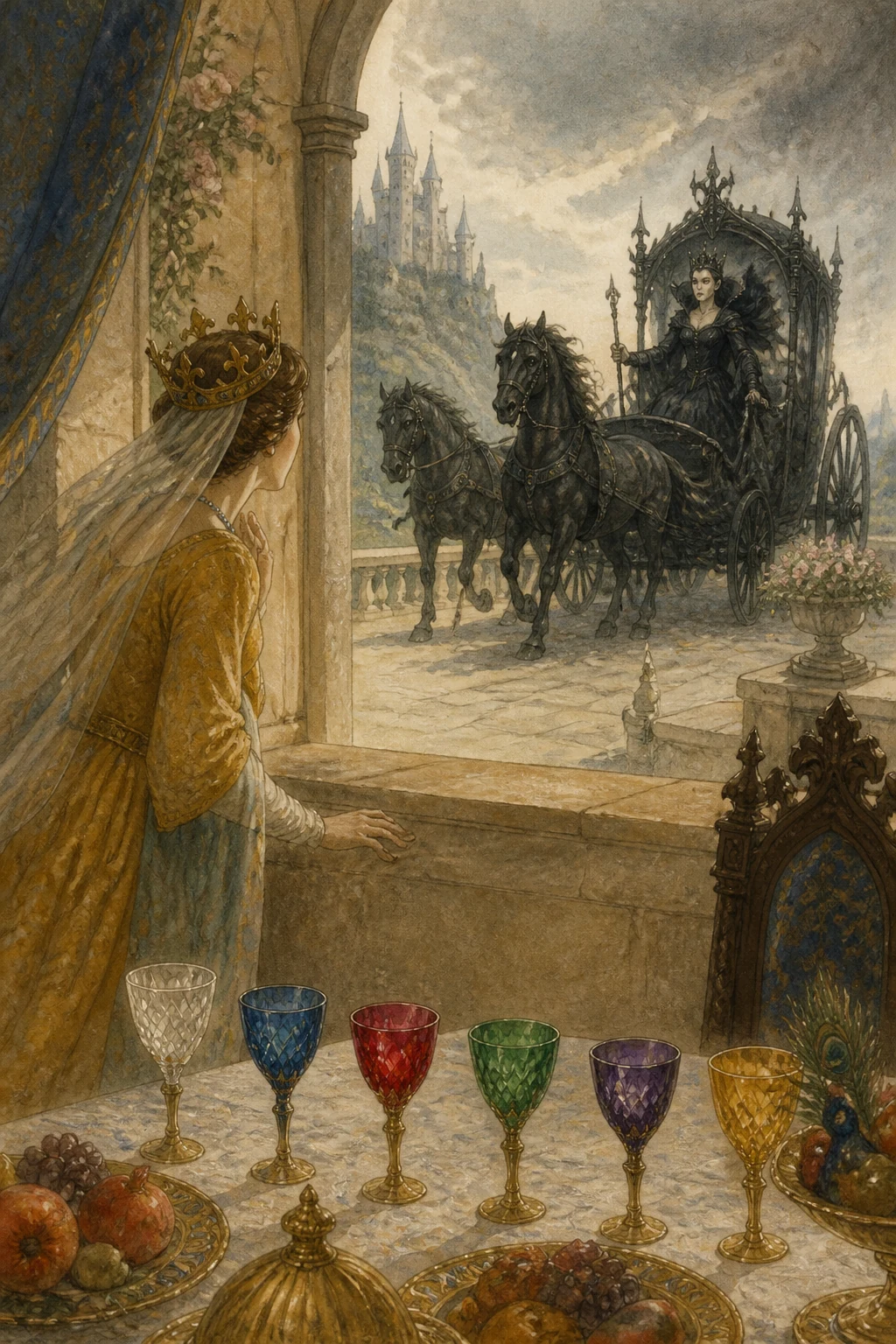
After the christening ceremony, the whole company returned to the King’s palace, where a great feast had been prepared for the fairies. Before each was set a magnificent place setting, with a case of solid gold containing a spoon, a fork, and a knife of fine gold, studded with diamonds and rubies. But just as everyone was taking a place at the table, an old fairy came in who had not been invited, because she had not left her tower for more than fifty years and was believed to be dead or enchanted. The King had a place laid for her, but there was no way to provide her with a solid-gold case like the others, since only seven had been made for the seven fairies. The old fairy thought she was being slighted and muttered a few threats between her teeth. One of the young fairies, who happened to be beside her, overheard her and, fearing that she might bestow some dreadful gift upon the little Princess, went to hide behind the tapestry as soon as they left the table, so that she could speak last and repair, as far as she could, whatever harm the old fairy might have done.
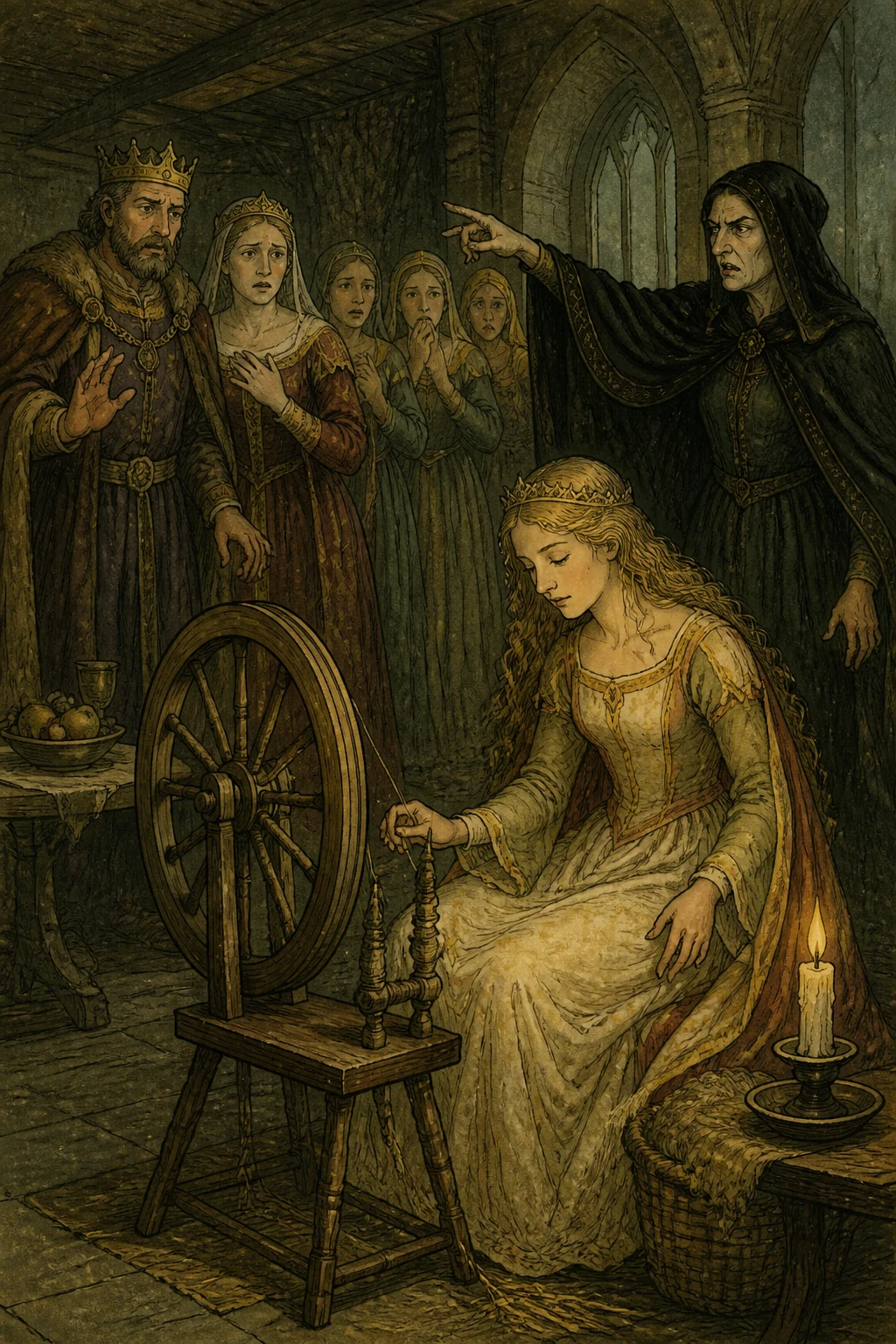
Meanwhile, the fairies began bestowing their gifts upon the Princess. The youngest gave her the gift of being the most beautiful person in the world; the next, of having the wit of an angel; the third, of showing an admirable grace in everything she did; the fourth, of dancing perfectly; the fifth, of singing like a nightingale; and the sixth, of playing every kind of instrument to the utmost perfection. When the old fairy’s turn came, she shook her head, more from spite than from age, and declared that the Princess would pierce her hand with a spindle and die of it.
This terrible gift made the whole company shudder, and there was not a soul who did not weep. At that moment the young fairy stepped out from behind the tapestry and said aloud, “Take heart, King and Queen: your daughter shall not die. It is true that I have not enough power to undo entirely what my elder has done. The Princess will pierce her hand with a spindle, but instead of dying, she will merely fall into a deep sleep that will last a hundred years, at the end of which a King’s son will come to awaken her.”
The King, hoping to avert the misfortune foretold by the old fairy, immediately issued an edict forbidding anyone, on pain of death, to spin with a spindle or to keep spindles in the house. Fifteen or sixteen years later, the King and Queen having gone to one of their country residences, it happened that the young Princess, running about the castle one day and climbing from room to room, came to a little garret at the top of a tower, where a good old woman sat alone, spinning from her distaff. This good woman had never heard of the King’s prohibition against spinning with a spindle.
“What are you doing there, good woman?” asked the Princess. “I am spinning, my pretty child,” replied the old woman, who did not know her. “Oh, how pretty it is!” the Princess said. “How do you do it? Let me have it, so I can see whether I could do as well.” No sooner had she taken the spindle than, being very lively and rather heedless, and since the fairies’ decree had ordained it so, she pierced her hand with it and fell unconscious.
The good old woman, greatly alarmed, cried for help. People came running from every direction; they splashed water on the Princess’s face, loosened her clothes, slapped her hands, and rubbed her temples with Queen of Hungary’s water, but nothing would bring her round. Then the King, who had come upstairs at the commotion, remembered the fairies’ prediction and, realizing that this must happen since the fairies had foretold it, had the Princess laid in the finest apartment in the palace, upon a bed embroidered with gold and silver. She was so beautiful that one might have taken her for an angel, for her unconsciousness had not robbed her complexion of its vivid colours: her cheeks were rosy and her lips like coral. Her eyes alone were closed, but she could be heard breathing softly, which showed that she was not dead. The King ordered that she be left to sleep in peace until the hour of her awakening should come. The good fairy who had saved her life by condemning her to sleep for a hundred years was in the Kingdom of Mataquin, twelve thousand leagues away, when the Princess met with her accident; but she was told of it in an instant by a little dwarf who wore seven-league boots—boots in which one could travel seven leagues in a single stride. The fairy set off at once, and an hour later she was seen arriving in a chariot of fire drawn by dragons. The King went to offer her his hand as she stepped down from the chariot. She approved of everything he had done; but, being very far-sighted, she reflected that when the Princess awoke, she would find herself in great difficulty all alone in this old castle. Here is what she did. She touched with her wand everyone in the castle except the King and Queen: governesses, maids of honour, ladies’ maids, gentlemen, officers, stewards, cooks, kitchen boys, errand boys, guards, Swiss guards, pages, and footmen. She also touched all the horses in the stables, along with the grooms, the great mastiffs in the yard, and little Pouffe, the Princess’s little dog, who was lying beside her on the bed. As soon as she touched them, they all fell asleep, not to awaken until their mistress did, so that they would be quite ready to serve her when she needed them. Even the spits over the fire, laden with partridges and pheasants, fell asleep, and so did the fire itself. All this was done in a moment: fairies did not take long over their work. Then the King and Queen, having kissed their dear child without waking her, left the castle and issued orders forbidding anyone to approach it. These orders were unnecessary, for within a quarter of an hour so many trees, great and small, and so many brambles and thorns had grown up all around the park, interlacing with one another, that neither beast nor man could have passed through them. Nothing could be seen but the tops of the castle towers, and even those only from a great distance. No one doubted that the fairy had worked another of her spells, so that the Princess, while she slept, would have nothing to fear from the curious.
At the end of a hundred years, the son of the King then reigning, who belonged to a different family from the sleeping Princess, went hunting in that part of the country and asked what the towers were that he could see above a great, dense wood. Everyone answered according to what they had heard. Some said it was an old castle haunted by spirits; others, that all the witches and sorcerers of the district held their sabbath there. The most common belief was that an ogre lived there and carried off to it all the children he could catch, so that he could eat them at his leisure without anyone being able to follow him, since he alone had the power to make a passage through the wood. The Prince did not know what to believe, when an old peasant spoke up and said:
“My Prince, more than fifty years ago I heard my father say that in that castle there was a Princess, the most beautiful in the world; that she was to sleep there for a hundred years, and that she would be awakened by a King’s son, for whom she was destined.”
At these words the young Prince felt his heart catch fire. He believed without hesitation that he would bring so splendid an adventure to its conclusion, and, urged on by love and glory, he resolved to discover the truth of it at once. Scarcely had he advanced towards the wood when all the great trees, brambles, and thorns parted of their own accord to let him pass. He walked towards the castle, which he could see at the end of a broad avenue he had entered, and was somewhat surprised to find that none of his attendants had been able to follow him, because the trees had closed together again as soon as he had passed. Nevertheless, he continued on his way: a young Prince in love is always brave. He entered a great outer courtyard, where the first sight that met his eyes might well have chilled him with fear. A dreadful silence reigned; the image of death appeared everywhere, and there was nothing but the outstretched bodies of men and animals who seemed to be dead. Yet from the bulbous noses and ruddy faces of the Swiss guards, he could plainly see that they were only sleeping, and their cups, which still held a few drops of wine, showed clearly enough that they had fallen asleep while drinking.
He crossed a great courtyard paved with marble, climbed the stairs, and entered the guardroom, where the guards stood in two rows, carbines on their shoulders, snoring mightily. He passed through several rooms full of gentlemen and ladies, all sleeping, some standing and others sitting. He entered a room covered in gilding, and there, upon a bed with its curtains drawn back on every side, he saw the loveliest sight he had ever beheld: a Princess who seemed to be fifteen or sixteen years old, and whose radiant beauty had something luminous and divine about it. Trembling with admiration, he approached and knelt beside her.
Then, as the enchantment had reached its end, the Princess awoke and, looking at him with eyes more tender than a first meeting would seem to allow, said:
“Is it you, my Prince? You have kept me waiting a very long time.” The Prince, enchanted by these words, and still more by the way they were spoken, did not know how to express his joy and gratitude. He assured her that he loved her more than himself. His words were disordered, and pleased her all the more for it: little eloquence, much love. He was more at a loss than she was, which should come as no surprise; she had had time to think about what she would say to him, for it seems likely—though the story says nothing of it—that during so long a sleep the good fairy had granted her the pleasure of agreeable dreams. In short, they had been talking for four hours and had not yet said half the things they had to say.
Meanwhile, the whole palace had awakened with the Princess. Everyone was thinking of attending to their duties, and, as they were not all in love, they were dying of hunger. The lady-in-waiting, as hungry as the rest, grew impatient and told the Princess in a loud voice that dinner was served. The Prince helped the Princess to rise. She was fully dressed, and very magnificently too, but he took care not to tell her that she was dressed like his grandmother and wore a high, stiff collar; she was no less beautiful for it.
They went into a hall of mirrors and supped there, served by the Princess’s household officers. The violins and oboes played old but excellent pieces, though it was nearly a hundred years since anyone had played them. After supper, without losing any time, the chief chaplain married them in the castle chapel, and the lady-in-waiting drew their bed curtains. They slept little: the Princess had no great need of sleep, and early in the morning the Prince left her to return to the city, where his father must have been anxious about him. The Prince told him that he had lost his way in the forest while hunting and had spent the night in the hut of a charcoal burner, who had given him black bread and cheese to eat. His father the King, who was a good-natured man, believed him; but his mother was not so easily persuaded. Seeing that he went hunting almost every day and always had an excuse ready whenever he had spent two or three nights away, she no longer doubted that he had some love affair. For he lived with the Princess for more than two whole years and had two children by her. The first, a girl, was named Aurore, and the second, a boy, was named Jour, because he seemed even more beautiful than his sister.
The Queen told her son several times, hoping to make him speak, that one ought to enjoy oneself in life; but he never dared trust her with his secret. Though he loved her, he feared her, for she came of a race of ogres, and the King had married her only because of her great wealth. It was even whispered at court that she had the inclinations of an ogress and that, whenever she saw little children passing, she had the greatest difficulty restraining herself from pouncing on them. Thus the Prince would never say anything.
But when the King died, which happened after two years, and the Prince found himself his own master, he publicly declared his marriage and went in great ceremony to fetch the Queen his wife from her castle. She was given a magnificent welcome in the capital, which she entered with her two children beside her.
Some time later, the King went to war against his neighbour, the Emperor Cantalabutte. He left the regency of the kingdom to the Queen his mother, earnestly commending his wife and children to her care. He was to be away at war all summer, and as soon as he had gone, the Queen Mother sent her daughter-in-law and the children to a country house in the woods, where she could more easily satisfy her horrible craving. She went there herself a few days later, and one evening said to her steward, “Tomorrow at dinner I mean to eat little Aurore.”
“Ah, Madam!” said the steward. “I insist,” said the Queen, in the voice of an ogress longing to eat fresh flesh, “and I want her served with sauce Robert.”
The poor man, seeing plainly that an ogress was not to be trifled with, took his great knife and went up to little Aurore’s room. She was four years old at the time and came skipping and laughing to throw her arms about his neck and ask him for sweets. He began to weep, the knife fell from his hands, and he went into the yard to cut the throat of a little lamb. He prepared it with such a delicious sauce that his mistress assured him she had never eaten anything so good. Meanwhile, he had carried little Aurore away and given her to his wife to hide in their lodgings at the far end of the yard. Eight days later the wicked Queen said to her steward, “I mean to eat little Jour for supper.” He made no reply, having resolved to deceive her as before. He went to fetch little Jour and found him with a little foil in his hand, fencing with a large monkey, though he was only three years old. He carried him to his wife, who hid him with little Aurore, and in little Jour’s place he served a very tender young kid, which the ogress found wonderfully good.
So far everything had gone very well, but one evening the wicked Queen said to the steward, “I mean to eat the Queen with the same sauce as her children.” Then the poor steward despaired of being able to deceive her again. The young Queen was over twenty, not counting the hundred years she had slept; her skin was a little tough, though fair and beautiful, and how was he to find an animal in the menagerie as tough as that? To save his own life, he resolved to cut the Queen’s throat and went up to her room intending to do it in a single stroke. He worked himself into a fury and entered the young Queen’s chamber with his dagger in his hand. Yet he would not take her unawares, and with great respect he told her of the order he had received from the Queen Mother.
“Do it, do it,” she told him, offering him her neck. “Carry out the order you have been given. I shall see my children again, my poor children whom I loved so dearly.” She had believed them dead ever since they had been taken away without a word to her.
“No, no, Madam,” replied the poor steward, deeply moved. “You shall not die, and you shall still see your dear children again, but it will be in my lodgings, where I have hidden them. And I shall deceive the Queen once more by serving her a young doe in your place.”
He took her at once to his room and, leaving her to embrace her children and weep with them, went to prepare a doe, which the Queen ate for supper with as much appetite as if it had been the young Queen. She was well pleased with her cruelty and was preparing to tell the King on his return that ravening wolves had eaten his wife and both his children.
One evening, as she was prowling as usual about the castle’s courts and yards, sniffing out fresh flesh, she heard little Jour crying in a ground-floor room because the Queen his mother meant to have him whipped for being naughty. She also heard little Aurore pleading for her brother to be forgiven. The ogress recognized the voices of the Queen and her children, and, furious at having been deceived, gave orders the very next morning, in a dreadful voice that made everyone tremble, for a great vat to be brought into the middle of the courtyard. She had it filled with toads, vipers, adders, and snakes, intending to have the Queen and her children, the steward, his wife, and his maidservant thrown into it. She had ordered them brought out with their hands tied behind their backs. They were standing there, and the executioners were preparing to throw them into the vat, when the King, who was not expected so soon, rode into the courtyard. He had come by post horses and asked in astonishment what this horrible spectacle meant. No one dared tell him, when the ogress, enraged at what she saw, flung herself headfirst into the vat and was devoured in an instant by the loathsome creatures she had ordered put there. The King could not help grieving, for she was his mother, but he soon found comfort with his beautiful wife and his children.
MORAL To wait a while to find a husband Rich, handsome, gallant, gentle too, Is natural enough to do; But wait a hundred years, and sleeping all the while? No woman now could sleep so soundly Through so long a trial.
The tale would also seem to show That marriage’s delightful ties, Though long delayed, are no less sweet, And those who wait lose nothing by it.
But women yearn with such desire To pledge themselves in marriage That I have neither strength nor heart To preach to them this moral.