O besedilu
Trije živalski kralji
- Vir
- Pentameron
- Avtor
- Giambattista Basile
- Jezik branja
- English
- Jezik izvirnika
- Neapolitan
- Čas branja
- 13 min branja
- Obseg
- 10 strani
- Naslov izvirnika
- Jornata IV III LI TRÈ RRI ANEMALE
O izvirniku
Pentameron
Baročna, divja starejša plast evropske pravljice, polna obratov in pretiravanj. Bralni jezik je English, izvirnik pa prihaja iz vira Pentameron v jeziku Neapolitan.
Besedilo
Trije živalski kralji
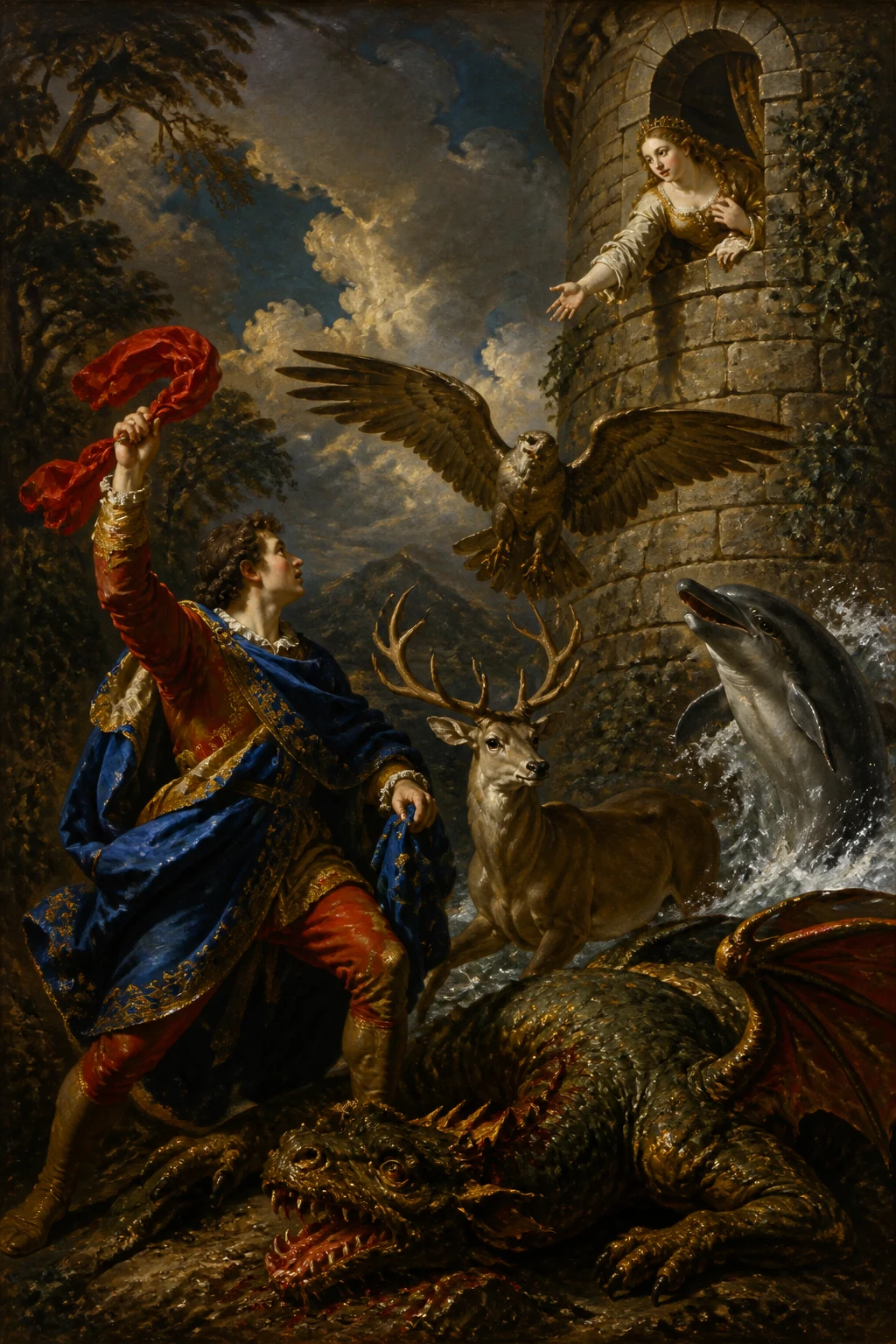
_Tittone, son of the King of Verde-colle, goes in search of his three sisters, who are married to a Falcon, a Stag, and a Dolphin. After a long journey he finds them, and on his way home discovers a king’s daughter held captive by a Dragon in a tower. By means of the tokens his three brothers-in-law have given him, he summons all three to her aid. With their help he kills the Dragon, frees the Princess, and takes her for his wife, then returns to his own kingdom with his brothers-in-law and sisters._ _More than a few were moved by the compassion Marcuccio had shown Parmiero, and all the women agreed that virtue bestows lasting riches, which neither time consumes, nor storms carry off, nor woodworm gnaws away; whereas the other blessings of this life come and go, and ill-gotten wealth never reaches the third generation. At last Meneca, taking her cue from the events just related, brought the following tale to their storytelling table._ Once upon a time there was a King of Verde-colle who had three daughters, three precious jewels. Three sons of the King of Bello-prato were burning with love for them, but because a fairy’s curse had turned all three into animals, the King of Verde-colle scorned to give them his daughters in marriage. So the eldest, who was a handsome Falcon and possessed magical powers, summoned all the birds to a parliament. Finches, wrens, golden orioles, greenfinches, flycatchers, kestrels, hoopoes, larks, cuckoos, magpies, and every other feathered tribe came at his call, and he sent them all to ravage the blossoms on the trees of Verde-colle, where they left neither flower nor leaf. The second, who was a Stag, called together all the goats, rabbits, hares, porcupines, and other animals of that country, and had them lay waste the crops, until not so much as a blade of grass remained.
The third, who was a Dolphin, conspired with a hundred sea monsters and raised such a storm along the coast that not one boat was left whole. Seeing that matters were going from bad to worse, and that he could do nothing to prevent the damage these three wild lovers were causing, the King resolved to free himself from his troubles and consented to give them his daughters in marriage. Without asking for festivities or music, they carried the girls out of the kingdom. As the brides were leaving, Queen Grazolla gave her daughters three identical rings, one apiece, telling them that if they should be parted and meet again after some time, or encounter anyone else of their blood, they would recognize one another by these rings. So they took their leave and departed. The Falcon carried Fabiella, the eldest sister, to a mountain so immensely high that it pierced the clouds and held its dry head where rain never falls. There he provided her with a magnificent palace and kept her like a queen.
The Stag carried Vasta, the second sister, into a forest so tangled that the shadows, when night called them out, could not find their way to attend her. There, in a splendid house with a garden whose beauty had no equal, he maintained her in a style worthy of himself. The Dolphin swam with Rita, the youngest, on his back, out into the open sea, where he provided her with a house on a lovely rock, spacious enough for three crowned kings. Meanwhile Grazolla gave birth to a handsome boy, whom she named Tittone. When he was fifteen, hearing his mother forever lamenting her three daughters, married to three animals and never heard of again, he took it into his head to travel the world until he found some trace of them. After much entreating of his father and mother, the Queen gave him another ring like those she had given her daughters, and they granted him leave to go, furnishing him with all the comforts and attendants necessary and fitting for a prince of his rank. He left no hole in Italy, no nook in France, no corner of Spain unsearched; he passed through England, roamed Slavonia, visited Poland, and, in short, journeyed east and west. At last, having left all his servants behind, some in taverns and some in hospitals, and finding himself without a penny, he reached the mountain where the Falcon and Fabiella lived. As he stood beside himself with wonder at the beauty of the palace, with its porphyry cornerstones, alabaster walls, golden windows, and silver roof tiles, his sister saw him. She had him called in and asked who he was, where he came from, and what chance had brought him to those parts. When Tittone told her his country, his father’s and mother’s names, and his own, Fabiella recognized him as her brother, all the more surely when she compared the ring he wore with the one her mother had given her. She embraced him with great joy, but, fearing her husband might resent his coming, she hid him away. When the Sparrowhawk returned, Fabiella began by saying that she had been longing for her family. The Sparrowhawk answered, “Let the feeling pass, my wife, for that cannot be until I am in the mood.” “At least,” said Fabiella, “let us send for some relation of mine to comfort me.” “And who would come so far to see you?” replied the Sparrowhawk. “But if someone did come,” Fabiella asked again, “would you be displeased?” “Why should I be displeased?” answered the Sparrowhawk. “So long as he is of your blood, I would cherish him like the apple of my eye.” Hearing this, Fabiella took courage, brought her brother out, and presented him to the Sparrowhawk, who said, “Five and five make ten; love gets through a glove, and water through a boot:
you are welcome here! You are master of this house: give your orders and make yourself at home.” And he commanded that Tittone should be honored and served as though he were himself. But after spending a fortnight on that mountain, Tittone began to think of searching for his other sisters. When he asked leave of his sister and brother-in-law, the Sparrowhawk gave him one of his feathers, saying, “Take this, my dear Tittone, and treasure it, for you may find yourself in such need that you will value it as a fortune. Only keep it safe, and if ever necessity presses you, throw it on the ground and say, ‘Come here, come here!’ You will have cause to thank me.” Tittone wrapped the feather in a piece of paper and put it in a little purse; then, after a thousand courtesies, he departed. After a prodigious stretch of traveling he reached the forest where the Stag lived with Vasta. Famished, he went into the garden to pick a little fruit, and his sister saw him. Recognizing him in the same way Fabiella had, she made him known to her husband, who welcomed him warmly and treated him truly like a prince. When, after another fortnight, he wished to leave in search of his remaining sister, the Stag gave him one of his hairs, with the same words the Sparrowhawk had spoken when giving him the feather. So he set off with a handful of crowns from the Sparrowhawk and as many more from the Stag, and traveled until he reached the end of the land. Unable to go farther because of the sea, he took ship, intending to search all the islands for news of her. Setting his sails to the wind, he voyaged about until he was brought to the island where the Dolphin lived with Rita. Scarcely had he landed when his sister saw him and recognized him in the same way as the others had done. His brother-in-law lavished a thousand kindnesses on him, and when he wished to leave to see his mother and father again after so long an absence, the Dolphin gave him one of his scales, with the same instructions. Then Tittone procured a horse and set out;
but he had not gone half a mile from the shore when he entered a forest that was a free port for fear and shadows, where darkness and terror made an everlasting twilight. There he found a great tower in the middle of a lake, which kissed the feet of the trees so that they would not show its ugliness to the sun. At one of the tower’s windows he saw a beautiful maiden at the feet of an ugly Dragon, who lay asleep;
and when she saw Tittone, she said in a low, piteous voice, “Oh, my handsome young man, perhaps Heaven has sent you to comfort me in my misery, to this place where no Christian face has ever been seen! Deliver me from this tyrant serpent, who stole me from my father, the King of Chiara-Valle, and carried me away to imprisonment in this wretched tower, where I have grown musty and moldy. Alas!” “What can I do to serve you, my fair lady?” said Tittone. “Who can cross this lake?
Who can climb this tower? Who can approach this hideous Dragon, whose very looks strike terror, sow fear, and set men trembling? But softly now, wait a little, and we shall see whether we can catch this serpent with someone else’s sleeve. ‘One step at a time,’ as Gradasso used to say. We shall soon see whether this is substance or wind.” With that he threw down together the feather, the hair, and the scale his brothers-in-law had given him, saying:
“Come here, come!” As they touched the earth, like summer raindrops that bring forth frogs, the Falcon, the Stag, and the Dolphin appeared, all crying together, “Here we are! What are your commands?” Overjoyed at the sight, Tittone said, “All I wish is to rescue that poor maiden from the claws of that Dragon, bring her out of the tower, pull the whole place down, and take this beautiful bride home with me.” “Say no more,” answered the Sparrowhawk. “Beans sprout where you least expect them. We shall make him turn on a farthing, and see that he has scarcely a scrap of ground to stand on.” “Let us waste no time,” replied the Stag. “Troubles and macaroni are best dealt with hot.” So saying, the Sparrowhawk summoned a flock of griffins, who flew to the tower window, plucked out the maiden, and carried her across the lake to where Tittone stood with his brothers-in-law. If from afar she had seemed a moon to him, close at hand he thought her a sun, so beautiful was she. But while he was embracing her and speaking tender words, the Dragon awoke, flung himself from the window, and came swimming over to devour Tittone. Then the Stag summoned a troop of lions, tigers, panthers, bears, and great apes, who fell upon the Dragon and shredded him with their claws. This done, Tittone was about to depart when the Dolphin said, “I too wish to do something in your service.” And so that no memory should remain of so accursed and dismal a place, he made the sea rise until it overflowed its bounds and battered the tower with such fury that it tore it up by the foundations. At the sight of these deeds, Tittone thanked his brothers-in-law as warmly and eloquently as he could, bidding his bride do the same, since it was through them that she had escaped such peril. But the animals answered, “Rather, it is we who must thank this lovely lady, for she is the means of restoring us to our own true selves. When we were born, a fairy whom our mother had offended laid a curse upon us, condemning us to remain in these animal shapes until we should rescue a king’s daughter from great distress. Now the time we longed for has come; now this cluster of sorb apples has ripened, and already we feel new life within our breasts, new blood within our veins.” As they spoke, they became three handsome young men, who one after another embraced their brother-in-law tightly and took the hand of their new kinswoman, who was beside herself with joy. At the sight, Tittone heaved so deep a sigh that he nearly fainted, and said:
“O Lord God, why are my dear mother and father not here to share this happiness? They would melt with delight to see such charming, handsome sons-in-law before them!” “The day is not over yet,” his brothers-in-law answered. “Shame at being seen so transformed drove us to shun the sight of men. But now that, by Heaven’s grace, we can appear among people again, we wish to gather beneath one roof with our dear wives and live happily. So let us make haste, for before the sun unpacks his merchandise of rays at the customhouse of the East tomorrow morning, our wives shall be with you.” Having said this, so that they need not travel on foot, since there was nothing but the broken-down nag Tittone had brought, they summoned a splendid coach drawn by six lions. All five got in, and after traveling all day they reached an inn that evening. While food was being prepared for them to tuck into, they passed the time reading the many testimonials to human ignorance scrawled upon the walls. At last, after they had eaten and retired, the three young men pretended to go to bed but busied themselves all night, so that by morning, when the stars, bashful as young brides, refuse to let the sun see them, they were back at the same inn with their wives. There was a great embracing and joy beyond all bounds; then all eight seated themselves in the same coach and, after a long journey, arrived at Verde-colle. There the King and Queen welcomed them with unspeakable tenderness, having recovered the principal of four children they had thought lost, with the bonus of three sons-in-law and a daughter-in-law who were four pillars of the temple of beauty. Word of their children’s adventures was sent to the Kings of Bel-prato and Chiara-valle, and both came to the festivities, adding the rich fat of their joy to the mingled stew of everyone’s happiness, and wiping away all their former sorrows, for _One hour of content_ _Makes a thousand years of torment forgotten._
Izvirnik
Jornata IV III LI TRÈ RRI ANEMALE
Naslednje strani prikazujejo izvirno besedilo za primerjavo.
_Tittone figlio de lo Rrè de Verde-colle và cercanno tre ssore carnale mmaritate co no Farcone, co no Ciervo, e co no Darfino; e dapò luongo viaggio le ttrova, e ttrovato a lo retuorno na figlia de no Rrè, che steva ’n mano de no Dragone drinto na Torre, co no segnale, ch’appe da li tre Cainate, l’ave tutte tre leste ad ajutarela; co li quale acciso lo Dragone, e liberata la Prencepessa, se la piglia pe mmogliere, e nsiemme co li Cainate, e co le ssore, se nne retorna a lo Regno sujo._ _Se ’ntennerero cchiù de quatto a la pietà mostrata da Marcuccio a Parmiero, e confermattero tutte, ca la vertù dona recchezza secura, che nè ttiempo la conzuma, nè ttempesta nne la porta, nè ccarola la roseca, comm’a lo ccontrario l’autre bene de sta vita vanno, e
beneno, e de lo mmale acquistato non gaude lo tierzo arede: a la fine Meneca pe connettura de lo socciesso contato, portaje a la tavola de le ffilastoccole lo cunto che ssecoteja._ Era na vota lo Rrè de Verde-colle, lo quale aveva tre ffiglie femmene, ch’erano tre gioje; pe le quale erano cuotte d’Ammore tre ffiglie de lo Rrè de Bello-prato, ch’essenno pe na mmardizzejone de na Fata tutte tre anemale, sdegnaje lo Rrè de Verde-colle de darecella pe mmogliere, pe la quale cosa lo primmo, ch’era no bello Farcone, avenno la fatazione, chiammaje tutte l’Aucielle a parlamiento, a dove venettero Froncille, Reille, Golane, lecore, pappamosche, cestarelle, paposce, covarelle, cucule, cajazze, e alia genera pennatorum, li quale essenno venute a
la chiammata soja, le mmannaje tutte a rroinare li sciure dell’arvole de Verdecolle, che non ce lassaro ne sciure, nè ffrunne. Lo secunno, ch’era no Ciervo, chiammanno tutte li Crapie, li coniglie, li liepare, li puorce spine, e tutte l’autre anemale de chillo pajese, face dare lo guasto a li semmenate, che non ce restaje manco no filo d’erva. Lo terzo, ch’era no Darfino confarfatose co ciento mostre de lo mare, fece venire tanta tempesta a chella marina, che non ce restaje varca sana. Pe la quale cosa lo Rrè vedenno ca le ccose jevano a la peo, e ca non poteva remmediare a li danne, che le facevano sti trè Nnammorate sarvateche, se resorvette scire da sti ’mmarazze, e se contentaje de darele pe mmogliere le ffiglie; li quale senza volere nè ffeste, nè
ssuono, se le pportaro fore de chillo regno, e a lo partire de le Zite, Grazolla la Regina dette tre anella simmele uno ped’una a le ffiglie decennele, che accorrenno spartirese, e dapò quarche tiempo de nuovo retrovarese, o vedere quarcuno autro de lo sango lloro, pe mmiezo de st’anielle se sarriano reconosciute. Cossì pigliato lecienzia, e partutose, lo Farcone portaje Fabiella, ch’era la primma de le Ssore, ncoppa na montagna cossì llonga-ciavana, che passato li confine de le nnuvole, arrivava co la capo asciutta dove maje non chiove, e llà fattole trovare no bellissimo palazzo, la teneva comm’a Rregina.
Lo Ciervo carriaje Vasta, ch’era la seconna drinto no vosco cossì ’ntricato, che l’ombre chiammate da la notte, non sapevano da dove scire a corteggiarela; dove drinto na casa de spante co giardino, che non vedive autra bellezza, la faceva stare da paro sujo. Lo Darfino nataje co Rrita, ch’era la terza, sopra le spalle ’n miezo maro, dove sopra no bello scuoglio le fece trovare na casa, che nce averriano potuto stare tre Rrì de corona. Fra chisto tiempo Grazolla fece no bello figlio mascolo, a lo quale mettette nomme Tittone, lo quale comme fu de quinnece anne, sentenno sempre gualiare la mamma de tre ffiglie mmaritate a tre anemale, che non se n’era saputo maje nova, le venne crapiccio de cammenare tanto lo munno, ficchè n’avesse quarche
ssentore, e dapò no luongo stimmolo, che fece a lo Patre, ed a la Mamma, la Regina datole n’autro aniello simmele a chillo, ch’aveva dato a le ffiglie, le dettero lecienzia, facennole portare tutta la commodetà, e compagnia, ch’era de necessità, e de repotazione a no Prencepe comm’ad isso; lo quale non ce lassaje pertuso a la Talia, no caracuoncolo a la Franza, nè parte a la Spagna, che non cercasse, e passato l’Angrise, e scorza la Schiavonia, e bisto la Polonia, e ’n somma cammenato lo Levante, e lo Ponente, all’utemo avenno lassato tutte li Serveture parte a le Ttaverne, parte a li Spetale, e rrestato senza na maglia, se trovaje ncoppa la montagna abitata da lo Farcone, e da Fabiella, dove stanno comme fora de se stisso a contemprare
la bellezza de chillo palazzo, ch’aveva, le ccantonere de porfeto, le mmura d’alavastro, le ffinestre d’oro, e l’irmece d’argiento, fu bisto da la sore, che fattolo chiammare, le demmannaje chi era, da dove veneva, e che ffortuna l’aveva portato a chille paise; Tittone dittole lo Pajese, lo Patre, e la Mamma, e lo nomme sujo, Fabiella lo recanoscette pe Ffrate, tanto cchiù confrontanno l’aniello, che portava a lo dito co cchillo, che le deze la mamma, e abbracciatolo co no priejo granne, perchè dubetava, che lo marito non sentesse desgusto de la venuta soja, lo fece nasconnere. E benuto lo Sproviero da fore, Fabiella commenzaje a dicere: ca l’era venuto sfiolo de li pariente suoje; e lo Sproviero le respose, lassatillo passare, mogliere mia,
ca chesto non pò essere, nfi ttanto che non me venga d’omore. A lo mmanco, disse Fabiella, mannammo a chiammare quarche parente mio pe cconzolareme; e lo Sproviero leprecaje; e chi vo venire tanto lontano a bederete? E si nce venesse quarcuno, tornaje a dire Fabiella, l’averrisse a desgusto? E perchè vorria averne desgusto, respose lo Sproviero, vasta che fosse de lo sango tujo pe mme lo mettere drinto all’uocchie. La quale cosa sentuto Fabiella, e pigliato core, fece scire lo Frate, e lo fece vedere a lo Sproviero; lo quale disse cinco e ccinco a dece, l’ammore passa lo guanto, e l’acqua lo stivale: singhe lo ben venuto; tu si lo padrone de sta casa; commanna, e fa tu stisso. E cossì dette ordene, che fosse nnorato, e sservuto comme la
perzona soja stessa. Ma stato a chella montagna quinnece juorne, le venne penziero de ire cercanno l’autre ssorelle, e ccercata lecienzia a la sore, ed a lo cainato, lo Sproviero le deze na penna de le soje, decennole: portate chesta Tittone mio, ed aggela cara, perchè a tale besuogno te puoje trovare, che la stimmaraje no tresoro: vasta, conservala buono, e si t’accorre cosa necessaria, jettala ’n terra, e di vienela, vienela, ca mme ne laudarraje. Tittone arravogliata la penna a na carta, e postasela a no vorzillo, dapò fatto mille zeremonie, se partette; e dapò no sfonnerio de cammino arrivaje a chillo vuosco, dove lo Ciervo se ne steva co Vasta, e mmentre allancato da la famme era trasuto a chillo ciardino a ccogliere quatto frutte,
fu bisto da la sore, e rreconosciutolo de la stessa manera, ch’aveva fatto Fabiella, lo fece canoscere a lo marito che le fece accoglienza assaje, trattannolo veramente da Prencepe, e bolenno dapò quinnece autre juorne partire pe ccercare l’autra sore, lo Ciervo le detto no pilo de li suoje co le stesse parole, ch’aveva fatto lo Sproviero de la penna; e puostose ’n cammino co na mano de scute, che l’aveva dato lo Sproviero, e co autre ttante, ch’appe da lo Ciervo, tanto cammenaje, che ghionze a l’estrema de la terra, dove non potenno passare cchiù nnante pe lo maro pigliaje na nave co ddesigno de cercare pe tutte l’Isole si n’avesse nova, e dato le bele a lo viento, tanto geraje, che fu portato all’isola, dove steva lo Darfino co Rrita; lo quale a ppena
smontato ’n terra, fu bisto da la Sore, e rrecanosciuto a lo medesimo muodo, ch’era socciesso coll’autre, e rrecevuto mille carizze da lo Cainato, comme voze partire pe rrevedere dapò tanto tiempo la Mamma, e lo Patre, lo Darfino le dette na scarda de le ssoje, parlannole de la stessa forma, dove pigliato no cavallo accommenzaje a cammenare; ma non se fu scostato miezo miglio da la marina, che trasuto drinto no vuosco, ch’era scala franca de la paura, e dell’ombre, dove se faceva na continua sera de scoretà, e de spaviento, trovaje na gran torre ’n miezo a no lago, che basava li piede dell’arvole, azzò non facessero vedere a lo Sole le bruttezze soje, a na fenestra de la quale vedde na bellissima Giovane a li piede de no brutto Dragone, che dormeva;
la quale vedenno Tittone co na voce sotto lengua pietosa disse: O bello Giovane mio, mannato fuorze da lo Cielo pe cconfuorto de le mmiserie meje a sto luoco, dove non se vedde maje facce de Cristejano, levame da mano de sto serpe tiranno, lo quale m’ha levato da lo Rrè de Chiara-Valle, che m’era Patre, e portatame confinata a sta negra torre, dove nce sò pperuta, e pigliata de granceto. Oimè, disse Tittone, che pozzo fare pe sservirete, bella femmena mia, chi pò passare sto lago?
chi pò saglire sta torre? chi pò accostarese a sto brutto Dragone, che t’atterrisce co la vista, che ssemmena paura, e fa sguigliare cacavesse? Ma chiano, aspetta no poco, ca vedarrimmo de cacciare sto serpe co la maneca d’autro: a passo a passo, deceva Gradasso: mò mò vedarrimmo s’è cucco, o viento; e ditto chesto, jettaje a no tiempo la penna, lo pilo, e la scarda, che l’avevano dato li Cajenate, decenno: Vienela, viene, che date ’n terra comme stizze d’acqua de state, che fa nascere le Ranonchie, se veddero comparere lo Farcone, lo Ciervo, e lo Darfino, che tutte ’nsiemme gridaro: eccoce, che commanne? Tittone, che bedde chesto, co n’allegrezza granne, disse: Autro non borria, che llevare chella povera Giovane da le granfe de chillo Dragone,
cacciarela da sta torre, sfravecare ogne cosa, e portareme sta bella mogliere a la casa. Zitto, respose lo Sproviero, ca dove manco te cride nasce la fava: mò te lo farrimmo votare ncoppa a no carrino, e bolimmo ch’aggia carestia de terreno: non perdimmo tiempo, leprecaje lo Ciervo, guaje, e mmaccarune se magnano caude, e cossì decenno, lo Sproviero fece venire na mano d’Aucielle Grifune, che bolanno a la fenestra de la torre, nne zeppoliaro la Giovane, portannola fore de lo lago, dove steva Tittone co li Cainate, che si da lontano le parze na Luna, da vicino la stimmaje no Sole, tanto era bella, ma ’ntanto, che isso l’abbracciava, e faceva belle parole, se scetaje lo Drago, e lanzatose da la fenestra, se nne veneva a nnatune pe devorare Tittone,
quanno lo Ciervo fece comparere na squatra de Liune, de tigre, de Pantere, d’Urze, e de Gatte maimune, li quale dato adduosso a lo Drago, nne fecero mesesca co l’ogne. La quale cosa fatta, mentre Tittone voleva partire, disse lo Darfino, e io puro voglio fare quarcosa pe te servire; ed azzò non restasse mammoria de no luogo cossì mmarditto, e nnegrecato, fece crescere tanto lo maro, che sciuto da li termene suoje, venne a ttozzare co ttanta furia la torre, che la spedamentaje da lo fonnamiento: le quale cose visto Tittone, rengraziaje quanto potte, e seppe li Cainate, decenno a la zita, che facesse lo mmedesemo, mentre pe ccausa lloro era sciuta da tanto pericolo. Ma l’anemale resposero, anze nuje devimmo rengraziare sta bella Segnora, pocca essa
è ccausa de farece tornare all’essere nuostro; perchè avenno avuto na mmardezzione da che nascettemo pe no desgusto dato da la mamma nostra a na Fata, che fossemo state sempre a sta forma d’anemale, nfi a ttanto, che non avessemo liberato na figlia de no Rrè da no gran travaglio, ecco arrevato lo tiempo da nuje desederato; ecco maturato sto spognile de sorva, e già sentimmo a sto pietto nuovo spireto, a ste bene nuovo sango. Accossì decenno, deventaro tre bellisseme Giuvene, che l’uno dapò l’autro abbracciaro strettamente lo Cajenato, e ttoccaro la mano a la Parente, che pe allegrezza era juta ’nn estrece. La quale cosa vedenno Tittone, co no gran sospiro, che s’appe a scevolire, decette: O Signore Dio, e perchè non ne ha parte de sto gusto la Mammarella,
e lo Tata mio? che se ne jarriano ’mbrodetto, si se vedessero ’nnante Jennere cossì graziuse, e cossì belle. Ancora non è nnotte resposero, e dissero li Cainate, ca la vregogna de vederece cossì straformate nce aveva arreddutte de foire la vista dell’uommene; ma mò che potimmo pe grazia de lo Cielo comparire fra le Gente, volimmo reterarece tutte sotto a no titto co le mmoglierelle nostre, e ccampare allegramente, perzò cammenammo priesto, ca nnante, che lo Sole crajemmatino sballe la mercanzia de li ragge a la Doana de l’Oriente, saranno nsieme co buje le mmogliere nostre. Ditto chesto, perchè non ghiessero a pede, già che non c’era autro, che na Jolla scortecata, che aveva portato Tittone, fecero comparere na bellissema carrozza tirata da seje liune,
drinto la quale se posero tutte cinco, e ccammenato tutto lo juorno, se trovaro la sera a na taverna, dove mentre s’apparecchiava da ’ngorfire, passattero lo tiempo, lejenno tante testemmonie de la ’ngnoranza de l’uommene che s’erano firmate pe le mmura. All’utemo magnato, e ccorcatese li tre Giuvane, facenno fenta de ire a lietto, trafecaro tutta la notte, de manera, che la matina quanno le stelle vregognose comm’a Zitelle zite non vonno essere viste da lo Sole, se trovaro a la stessa taverna co le mmogliere lloro, dove fattose n’abbracciatorio granne, e na prejezza fore de li fore, puostese tutte otto drinto la medesema carrozza, dapò luongo cammino arrivaro a Berde Colle, dove da lo Rrè, e da la Regina appero carizze ’ncredibele, avenno guadagnato
lo capitale de quatto figlie, che le tteneva perdute, e lo scuto de tre ghiennere, e na nora ch’erano quatto Colonne de lo tempio de la bellezza, e fatto ’ntennere a li Rrè de Bel-prato, e de Chiara-valle lo socciesso de li figlie, vennero tutte duje a le ffeste, che se fecero, refonnenno grasso d’allegrezza a lo pignato mmaritato de le contentizze loro, scompetanno tutte l’affanne passate, _Che n’ora de contiento_ _Fa scordare mill’anne de tormiente._
Nadaljuj z branjem