Prevod
A carpenter went away and married. He lived with his wife for many years, until they had a daughter. Then his wife fell ill and died, leaving him with his little girl. He said to himself, “Here I am, a man who must go out to work, and this child of mine is still small. I had better find a wife and marry, so that she can bring up my child. Without a wife, my child will suffer.”
His brother said to him, “You ought to marry. You are a grown man, and with such a little child you will not manage. Better marry a wife who can stay with your child while you go to work.” He replied, “Very well. Your advice is good. Since you are the one who has given it, help me make a good choice. Whichever woman you favour and consider worthy, I shall accept.” His brother said, “There is a woman who lives near me, the widow of the late Salih. I have found her good-hearted. She lived with her husband a long time, and I never heard of them quarrelling. Of course, I cannot tell what fortune awaits you, but to my mind she is a good woman. She also has a daughter, left to her by her late husband.” The carpenter said, “Then go and ask for her hand, and hear what answer she gives you. Come tomorrow and tell me when I return from work.” His brother went and told the woman, “A man has asked for your hand. Give me your answer, so that I can take it back to him.” She said, “I cannot refuse him. As things stand, I am a widow with a child, and if I find a husband, I shall be more comfortable.” He said, “Very well. I shall go and tell him.”
He went to his brother and said, “I have come with the answer to the errand you sent me on yesterday. I spoke to the woman, and she gave me no unfavourable answer. Her words were agreeable and proper.” The carpenter said, “Then I shall give you clothes and the marriage payment to take to her. When you go, tell her, ‘Here is your marriage payment, and here are your clothes. If there is anything else you wish to say, tell me, and I shall take him your answer.’” The woman said, “I have nothing more to say. Now that the marriage payment and the clothes have arrived, there is nothing further on my mind. Tell my husband to come on Wednesday.”
He went back and reported, “I took the woman the clothes and the marriage payment and gave them to her. I asked whether she had anything further to say. She told me, ‘There is nothing more on my mind.’ She had just one message: ‘Let my husband come on Wednesday.’ That was all.” The carpenter said, “Wednesday is not far off. God willing, today is Tuesday and tomorrow will be Wednesday.” His brother said, “Make all your arrangements.” He replied, “There is nothing more for me to arrange. Everything is settled. My daughter and I are ready. But you, my brother, go and ask whether the wife’s household is ready too. If she tells you they are, come and fetch me, and we shall go when the appointed time arrives.”
He went to the wife and said, “Your husband sends his greetings. Are you ready here? The bridegroom wishes to come.” She replied, “We are ready and waiting for him, and time is passing. Go and tell him to come quickly.”
He hurried back and found his brother standing at the door, ready to leave. “Your wife sends her greetings,” he said. “Well, what news?” asked the carpenter. “There is no news except that you are wanted at once. They are ready there, waiting for you to come. Hurry now, time is passing.” They left the house and went on until they reached the wife’s home, where the carpenter waited outside. His brother went in and said, “Now, women, the bridegroom has arrived and wishes to enter.” She said, “He has permission. Let him come in.” And he went in.
He stayed in her house with his wife, his daughter, and his wife’s daughter until seven days had passed. Then he said, “My wife.” “Yes, husband?” she answered. “Tomorrow is Thursday, and I shall go to work. Take good care of your daughter, for she is still a little child.” When morning came, he went off to work.
The woman, left at home, cooked the food and served the children their portions separately. To her own daughter she gave good rice, but to her husband’s daughter she gave the burnt crust from the bottom of the pot.
When the father came home at noon, he said, “Serve the food, my dear.” The woman went into the kitchen, dished up the food, and brought it to her husband, along with water for washing his hands. He said, “Call the children so that we may eat.” The woman replied, “Oh, husband! Must the children eat twice? I have already given them their portions. I have not taught them bad habits. Once little children have been given their food and have eaten, that is enough: they must wait for the evening meal.” He said, “Very well, my wife. I thought they had not eaten. That is why I told you to call them. If they have eaten, that is enough.”
He went back to work, and the woman cooked the evening meal. When it was ready, before her husband came home, she fed the children. She gave her own daughter good rice, and the other girl the crust, burnt again. The child ate, drank some water, and went outside to play.
That evening her husband returned home and called, “My wife.” “Yes, husband?” she answered. “Is the food ready?” “It is ready, husband.” “Serve it.” “Certainly, husband.” She went and dished it up, brought it in, and set it out, then gave her husband water to wash his hands. “My wife!” he said. “Yes, husband?” “Call the children to come and eat.” “Oh, husband! Was what I told you this morning not enough?” “What was that, my dear?” “Did I not tell you that children do not eat their meals twice? You will teach them bad habits.” He said, “I did not know, my wife. If the children have already eaten, am I to eat alone? Wash your hands too, and let us eat together.” “I am coming,” she said. She took some coconut husks and scrubbed her hands. Her husband said, “Why are you taking so long, my wife? I am waiting for you so that we can eat.” “My hands are sooty. I am scrubbing them hard with coconut husks to get them clean. Start eating; I shall come. Do not put gravy on my portion. I shall eat it with the relish.” The woman came, and they sat down to eat. When they had finished, they washed their hands and rose.
He said, “My wife, bring me some betel.” “Why, there is no tobacco.” “Look under the pillow,” he told her. “I remember putting some tobacco there yesterday. Look for it and bring it to me.” The woman went and lifted the pillow, but found no tobacco. “Husband,” she said. “Yes, my dear?” “I have looked under the pillow, but I cannot find the tobacco.” “Look carefully, and take your time. If you rush, you will not find anything.” “Yes, husband, I am looking carefully, but I cannot see it.” “Look down at the foot of the bed.” The woman lifted the bedding, but found no tobacco. He said, “Well, my dear, perhaps in your haste you knocked it off the bed onto the floor.” “Husband, it has not fallen on the floor. If you do not believe me, I shall take a lamp and shine it under the bed. If your tobacco is there, I shall see it.” “Then shine it there quickly. I have already prepared my betel, and I am waiting only for the tobacco. You have been searching for it all day as though it were a needle, and still you cannot find it. If it were a needle, would you ever see it? This is tobacco, after all—a whole plug, not some tiny scrap.” “Oh, husband, I cannot find it. Come and look for it yourself, with me.” “I am not coming. I am tired. Just find it and bring it to me. Lift all the mats and look. Where can that tobacco have gone? Ah, my wife! I remember now. It is inside the side rail of the little bed.” “Ah, so you meant to torment me! You knew all along where you had put your tobacco. You wanted to torment me, another woman’s daughter.” She took the tobacco from beneath the bed rail and brought it to him. “Take your tobacco. You have your own madness! Before a person’s rice has even settled in her stomach, you begin tormenting her.” “Ah, my wife, I am tired, and I had forgotten. It is night now. Call the children to bed, and go and shut the door.” The children went into their room to sleep, and their parents went to bed.
When morning came, he called, “My wife.” “Yes, husband?” she answered. “I am going to work. Watch the child. Do not let her go outside; let her play here in the courtyard with her sister.” “Certainly, husband,” she said. And he went off to work.
The woman cooked the food and called, “Children!” “Yes, Mother!” Both girls came running. Her husband’s daughter said, “Here I am, Mother.” “Ah! Who called me your mother? When did I give birth to you? Your mother is dead over there. I am calling my own daughter, the one I bore myself.” The girl went round to the back of the house, remembered her mother, and wept bitterly, until the other girl said to her, “Sister, why are you crying?”
She said, “I am not your sister. Your mother has told me, ‘Your mother is dead.’ I am not your sister. If I were your sister, would I be given the rice crust, and burnt at that? You get good rice and relish, while I get dry crust without any gravy, simply because I have no mother. That is all. I am not your sister.” The other girl went and called, “Mother!” “My child!” “Why has my sister gone round to the back to cry? Mother, what have you done to her?” “Oh, she is no child of mine. You are the only child I bore.” “But is she not Father’s child?” “And if she is your father’s child, what am I to do with her? Put her in the pupil of my eye, so you may know for certain that she is your sister? Hush, be quiet. Say no more. Go and call her, and eat your food.” She went and said, “Sister, you are being called.” “Who is calling me?” “Mother is calling you.” “You mock me. I have no mother.
“My mother is dead. You are the only one who has a mother. You are given good rice to eat. Go back to your mother.” “Oh, sister, do not be angry. Let us go and eat.” “I am not going there. Bring mine out here.”
The girl went back and called her mother. She answered, “My child, where is your sister?” “I called her, but she will not come. She told me to take her rice out to her.” “Where is she?” “Out at the back.” “Take this and bring it to her.” The girl took it and carried it out. “Sister, sister, here is the rice I was given to bring you.” She said, “Leave it here. I shall eat.” The girl set down the rice and went away.
“Well, did you give your sister the rice?” “I gave it to her. She has not eaten. She told me to put it down, and I did.” “Then sit down and eat your own rice.” She ate and finished. “Go and see whether your sister has finished hers.” She went and found her bent over, tears streaming from her eyes as she remembered what her father’s wife had done to her. She said, “My sister, do not cry so much. Your head will ache. You had better eat your rice.” “My heart is bitter. I am thinking of the ways of the world, and I cannot swallow the rice, though I am hungry.” “Why, my sister?” “That is how it is,” she answered. She took the rice and gave it to a goat.
Just then her father arrived and called at the door. His wife answered, “Come in! Welcome, husband!” She asked, “What news from the shore?” “All is well. The sun is fierce. Give me a little water to drink.” She gave him water, and he drank. Then he called, “My dear!” “Yes, husband!”
“Is the food ready?” “Oh, it has been ready a long time, husband. The rice has even gone cold.” “Serve it quickly. I want to sleep.” The woman went into the kitchen, quickly dished up the rice, and brought it to her husband. She brought water for washing, and her husband washed his hand. He said, “Call the children so that we can eat.”
“Oh, husband, have you no ears? The same words over and over, every day! Are the children to sit waiting, with the food ready, until you return from work at one in the afternoon? These children would die of hunger. I make a point of cooking early so that they can eat in good time and not go hungry. Yet every day, when you come home from work, you call the children to eat with you. Do you want to feed them twice or three times? What sort of conduct is that?”
“My dear, I did not know. If the children have already eaten, would I call them a second time if I knew? I thought they had not eaten; that is why I called them. If they have eaten, that is enough. Go and wash, and let us eat.”
The woman went to wash, returned, and they ate. She said, “You make a habit of it, husband. Whenever you come home, you insist on calling the children: ‘Children, come and eat!’ But the proper way in a household is to ask the wife first, for she is the one at home with them. She knows everything—what is cooked and what is still raw, who has eaten and who is hungry. The wife knows, because she is the cook and the one who serves the food. So when you come home now, husband, make a habit of asking me. I am the one you have left in charge of your house, and I understand that I am your wife.”
“Very well, my wife. Forgive me for what I said and for the mistake I made. What you have told me is the proper course: when a husband comes home, he should ask his wife, ‘My dear, have you cooked? My dear, have the children eaten? My dear, was the food you gave the children enough for them?’”
“Then I, your wife, can answer, ‘Yes, husband, the children have had enough to eat.’ That is how men live with their wives in their homes. That is precisely why men marry: when they return from outside, they need not question a slave or a child, but the wife who is in the house, the one responsible for the household. That is why men take wives—so that when they come home, they find everything ready. And if anything in the house is lacking, do not question the slave or the child. Ask me, your wife, who am here in the house. If you wish to beat me, bind me, or insult me, do as you please, husband, if I am at fault.”
“Then forgive me, my wife, for what I have done. I shall not do it again. Now let us go to bed.” When the night had passed and morning came, her husband rose and said, “My dear, I shall not go to work today. My whole body aches. But I shall go out for a little while to the neighbour’s to play bao. When the food is ready, send the child to fetch me.” “Very well, husband,” she replied.
The woman went into the kitchen and cracked a coconut. By the time she finished cooking the rice, it was the hour when the cattle are let out. Before anyone could be sent to fetch her husband, he came home on his own. “My wife, why have you taken so long to cook?” “Husband, I have finished cooking. I am only washing the plates. I was going to send the child to fetch you. Shall I serve, husband?” “If you are ready, serve.” The woman went into the kitchen and filled three plates: one for her husband, one for his daughter, and one for her own. Two plates held good rice—her husband’s and her daughter’s. On the plate for her husband’s daughter she put burnt rice crust and a fish head. That was what she gave her. The husband was brought his rice, her own daughter took her rice, and her husband’s daughter took the burnt crust. The man’s heart was troubled because he could not eat from the same plate as his daughter, yet he did not dare say anything to the woman.
He asked, “My dear, have the children eaten?” She said, “I have given them their portions. She and her sister have eaten.” He said, “Then give me water to wash.” He washed his hand and went out.
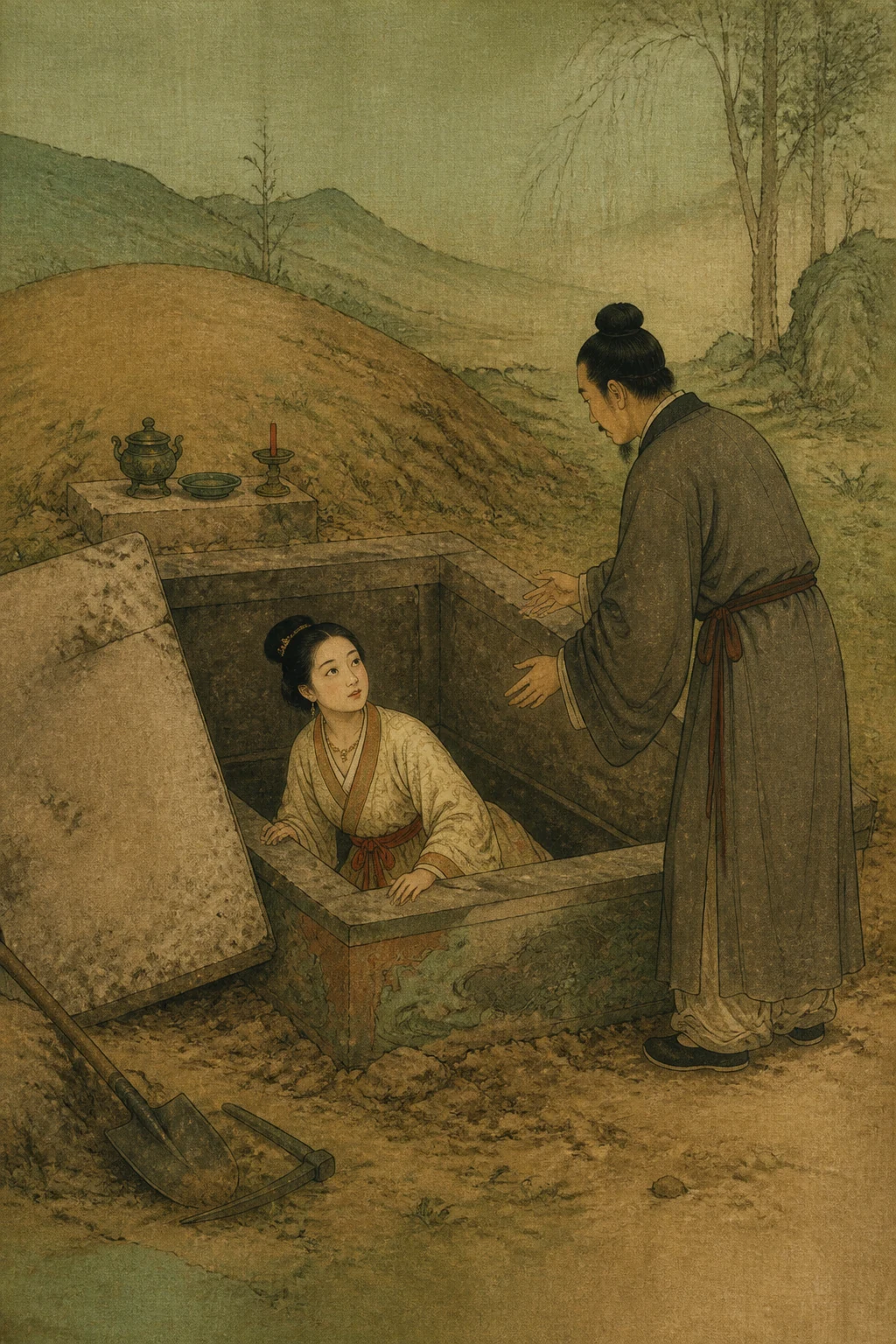
His daughter was out at the back, eating her rice and crying, grieving to see the other girl with good rice while she ate crust. She left the crust and went to her mother’s grave, full of sorrow and weeping bitterly.
Going round behind the grave, she saw a cucumber vine. She looked down and saw cucumbers. She picked two, ate one, and took the other to use as a doll. When she reached home, the woman asked, “Where did you get that cucumber?” She replied, “I picked it in someone’s field.” “Give me the cucumber.” She snatched it from her and gave it to her own daughter. The girl sat down and cried.
When her father came out, he found the girl crying. “Well, my little one, what are you crying about?” She said, “Nothing at all.” “Are you crying for nothing? There is something in your heart. Tell me what it is that makes you cry, so that I too may know.” “There is nothing, Father.” “Can you really be crying for no reason?” “I am just crying,” she said.
His wife came over. “What are you doing with the child?” “I am looking at this girl. I see her crying and ask what is making her cry, but she will not tell me.” She said, “What do you want with the girl? This child is a fool; she is mad. She went off and stole someone’s cucumber and brought it here. I saw it, took it from her, and gave it back to its owners. This girl wants to bring a quarrel upon us. She wants to get us insulted by people, to get us beaten. Look at my own child: she does not go taking other people’s things. When she has eaten, she sits and plaits her palm strips, and when she is tired of plaiting, she sleeps. But your child will not behave. As soon as she has eaten, she goes into other people’s fields and takes their things. She means to bring trouble upon us, poor creatures of God that we are. When the owners come, I shall have nothing to do with it. I wash my hands of it. I shall tell them, ‘Go to her father.’ If payment must be made, you will pay. If someone must be imprisoned, you will be imprisoned. If someone must be beaten, you will be beaten. All this will happen to you because of your daughter, for your daughter does not listen, cannot be corrected, and will not be told. What is one to do with such a child? I wash my hands of her, husband. I shall have nothing to do with this girl’s behaviour.”
Her father took the child by the hand and led her inside. He bound her hands and feet, drove a stake between them, and said, “I shall not untie you. You will die right here.”
She said, “Father, why are you binding me? Are you binding me unjustly because I am your child? Have I insulted someone, so that you bind me to teach me never to insult anyone again? Or have I stolen someone’s property, and they have come to complain, so that you bind me to teach me never to take other people’s property again?”
He said, “You went into someone’s field. Your mother told me. You picked their cucumbers, and the owners came here to complain about you. Your mother took the cucumber from you and gave it back to its owners.”
“My father, I have nothing to say. My mouth is full of water. And if I speak, I am afraid of you, Father—afraid that you will become very angry and quarrel with your wife over what she does to me.”
“My child, tell me. I am not angry, and I shall not tell my wife. I want to know it myself, in my own heart.” She said, “Father, do you see how thin I am growing?” “I see it, my child.” “I am never given rice, only crust, and burnt crust at that. I dare not speak. She gives her own daughter good rice, and puts more aside for her, hiding it away. In the morning, when you leave for work, she calls her daughter into the room and gives her the rice saved from the day before, and she eats it alone. I know, but I am given none. I am afraid to tell you, Father, for you elders have said that these women carry their love for their own children in their loins, and you men have said that a girl belongs with her mother. Father, you married this woman to look after me. How could I, your daughter, a girl as old as I am, come and say, ‘Father, I am hungry’? Should I come and say, ‘Father, I want millet’? As a daughter, I must go to that mother of mine. And perhaps she would not like me coming to you, Father. If she heard of it, she would cease to love me. She would say, ‘That child is worthless. Instead of asking me, her mother, she insists on asking her father. Then what am I here in the house for, as his wife?’”
He said, “That is true, my child. Now tell me about this cucumber.” She said, “That cucumber I brought home the other day—it was the day you were ill, when you went to the neighbour’s to play bao and came home early, before anyone had come to fetch you. You asked Mother why she was taking so long, when it was already the hour for letting out the cattle. Did she not tell you, ‘The food is ready. I was washing the plates so that I could send someone to fetch you’? You told her, ‘If the food is ready, serve it.’ She said it was ready, and went and filled three plates: one for you, Father, one for her daughter, and one for me. Your plate had rice, and her daughter’s had rice. Mine had burnt crust and a fish head. I took mine round to the back, looked at that rice, and could not eat it. I was very sad and cried bitterly. I said to myself, ‘If my mother were alive, I too would eat good rice, like the rice my companion is given by her mother.’ When you had finished eating, Father, and washed your hand and gone out, I too went out in the bitterness of my heart. I went to my mother’s grave and grieved and wept. Then I got up and went round behind the grave. I looked down and saw a cucumber vine. I picked two cucumbers, ate one, and took the other to use as a doll. When I came home, this mother asked, ‘Where have you brought that cucumber from?’ I did not tell her I had brought it from my mother’s grave. I said, ‘I brought it from someone’s field.’ She snatched the cucumber from me and gave it to her daughter. Then my heart grew bitter again, and I felt how unjustly I was treated. I bowed my head and remembered my mother, saying to myself, ‘If my mother were here, this woman could not snatch this cucumber from me and give it to her daughter.’ I was afraid to tell her that I pick the cucumbers at my mother’s grave. She would have gone there at once and picked them all for her daughter, and I would have had none left. I have deliberately left them there at the grave, so that when hunger hurts me I can find one to eat and soothe my heart, and another to make into a doll. So I did not steal those cucumbers, Father. If you do not believe me, go yourself to the foot of the grave. There are seven large cucumbers, and countless little ones and flowers. You have bound me unjustly, Father. I have done no wrong to you or to this wife of yours.”
He untied his daughter and said, “My little one, forgive me for what I have done to you. I did not know, had not heard, and had not understood.” “Oh, my father, I accept whatever you do to me.” “Tomorrow, my child, I shall buy you a woman slave and move you into your late mother’s house. You shall live there with your slave, and I shall provide your food.”
When the night had passed, he went to the market. By nine in the morning he had bid for a fine slave girl who pleased him, and he took her home. He said, “My child, this is your slave. She is your nurse, she is your mother. Stay here with her.” Then he called, “Slave girl!” “Yes, master.” “I have bought you for my daughter’s sake. Cook her good food, dress her in good clothes, make her a good bed, and speak kindly to her. She is your mother, your father, your husband, your closest friend, and your child. Please take very good care of her.”
The man then went to the home of his wife. His wife had heard the news that her husband had bought a concubine and installed her in his late wife’s house. She said, “When he comes, he shall not enter this house. He can go back to that concubine, where he has put her, or we shall go straight to the sheikh and he shall divorce me. I do not want this husband any longer. Ah! If my husband buys a concubine, what does he want with me?”
Just as the man was arriving, the woman planted one foot on either side of the doorway and spread herself across it, waiting for her husband so that he would find no way into the house. She stretched both arms across the doorway too.
When her husband appeared, she said, “Go back, go back! Stop! Do not come into my house. Do not come here. Go back to that concubine you have bought, to the house where you have put her, and stay there. You may look at the roof of this house, but do not come to my door.”
“Oh, woman, are you mad? Wait a moment and ask me first. Instead—just like that!—you fly at me. Call me aside into the house and question me in private. Here you sit in the doorway, one foot here, one foot there, one arm here, one arm there, stretched right across the entrance. Everyone passing can see you standing like that in the doorway. Have you no shame?”
“I do not want your words today. Go back there, go back there. Do not enter my house.” “My dear, please let me say just three words to you.”
“You liar! I do not want your words today. All I want is for you to divorce me and live with your concubine.” Just then a man came up and called, “Master craftsman!” He answered, “Yes?” The man said, “I have a few words to say to you.” “Certainly.” “Then come, and let us speak privately.” “Certainly.” He said, “There is a man who wishes to marry your daughter.” The carpenter said, “Good. I am very pleased. You see this quarrel here at home between my wife and me? It is because I bought a slave for this girl, and my wife says she is my concubine. Better that my daughter should marry, and I shall have some peace.” The man said, “Then I too agree.” He went to report to the suitor the answer he had received from the father of the girl he wished to marry.
When he went to call on the suitor, he found him asleep at home. He told the child who was there, “Wake him at once. He sent me on an errand, and I want to give him the answer I have brought back.” “Certainly,” said the child. The child went inside and woke him. “Father!” He answered, “Yes? Why are you waking me? What are you waking me for? I have not had my sleep out.” The child said, “Your messenger, the man you sent, has come back with an answer.” He said, “May it be good news.” He got up and went outside, welcoming him. “Welcome! Well, what news have you brought?” The messenger said, “All is well there. I do not know how you feel yourself.” He replied, “For my part, I made up my mind before I asked.” The messenger said, “I have been sent by your father-in-law. He sends many greetings, and after his greetings, he says there is no kindness you could have done him greater than this.
“He is ready, so make your own arrangements.” The suitor said, “I have no arrangements left to make. Everything is settled. I need only give you the clothes, the marriage payment, the mother’s sash, the turban, and the payment for carrying the bride as a baby.”
“Then give them to me quickly, so that I can deliver them before sunset.” He said, “They are all ready. I have already set them aside. I was waiting for you to take them, and now that you ask for them, they are ready.” “Go inside and give them to me quickly. I have things to do and must be on my way.”
The man went inside and fetched the marriage payment, then the turban, then the mother’s sash, then the payment for carrying the bride as a baby. When he had finished, he said, “Take the foot-washing payment too, and take the door-opening payment.” He told him, “I shall bring the hand-giving payment myself. Now go and take them my greetings as well. I am ready here and waiting for them to come and fetch me.”
The messenger left, carrying everything he had been given, and went to the bride’s father’s home. He was not there, so he asked his wife, “Where has your husband gone?” She said, “He told us he was going round the back to the neighbour’s to play a game. He left word that when you came, messenger, the child should go and fetch him.”
He said, “Then hurry and call him for me. I shall wait here.” The child got up and ran to the neighbour’s house, where he found his father playing a game, and beckoned to him. His father understood and told the others, “I must be off, friends. The child has come to fetch me; perhaps there is something to be done at home.” They said, “Very well, go.”
He went home and found his messenger waiting on the veranda. “So you have come?” He replied, “I have come, sir.” “What news from where you have been?” He told him, “Very good news indeed—joyful news, pleasing news. What was entrusted to me for you has arrived. First, here is the bride-price; second, these clothes; third, this sachet of perfume; fourth, this cloth for the bride’s mother; fifth, this baby sling; sixth, this gift for the washing of feet; seventh, this gift for opening the door. These are the things I was given to deliver to you. As for the gift placed in the hand, he says he will bring that himself. He also says that he is ready and waiting for you to send for him.” He replied, “I have nothing to delay me. Call him today, and by tomorrow he shall have his wife.”
He took the clothes inside to his wife and said, “Wife, call the girl and show her her clothes. Show her her bride-price too, so that she may do as she wishes.”
She called the girl. “Come, my dear. These clothes have come from your betrothed, and here is your bride-price. The other things are our customary dues, your father’s and mine.” The girl said, “Well, Mother, can I undo what you have settled? What pleases you pleases me. I cannot smear my father’s face with filth, so that wherever he goes he cannot lift his eyes. I wish to make my father happy, so that wherever he goes he may hold his head high, laugh as he always has, as other people laugh, speak as he always has, as other people speak, and walk as other people walk. I do not wish to incur my father’s anger. As others live with their fathers, so would I.”
Her mother said, “Well spoken, my child. Your words are pleasing. I thought, my child, that you would make me bow my head before others, but instead you have raised my head before them. May God grant you a long life, my child, and a heart as good as this answer you have given me, for these are wise words. Your father and I are pleased.”
So they remained at home, making their preparations until morning. The next day they sent word to the bridegroom: “The time has come. Come and be married, so that you may enter your home.” The messenger went to the house and found the gentleman sitting on the veranda, waiting for those who were to summon him. He said, “Sir, you are wanted. The time has come.” He replied, “I am ready indeed.”
He set off with his kinsmen, and when they reached his father-in-law’s house he called, “Hodi!” They answered, “Welcome, Sheikh! Welcome, gentlemen!” He said, “We are here.” They went onto the veranda, and someone went to call the religious teacher. He came and married the couple. Before the guests left, they were served rice and ate, and were treated with the greatest kindness. They were told, “You are welcome, gentlemen.” They said, “And you, bridegroom, farewell.” Then they left and went their ways.
He went inside to his wife, and they stayed in his father-in-law’s house for seven days. When the seven days were over, he called his father-in-law, who answered, “At your service.” He said, “There are three things I wish to tell you.” The older man replied, “Sir, my Sheikh, not merely three—even if there were thirteen, I should see no harm in your telling me.” He said, “I have no more than these three.” “Very well, tell me.” He said, “First, I want your permission for my wife and me to go to my own home. Second, do not be angry at what I am saying. Third, I want you to give me leave today, before tomorrow comes, for I consider today a good day for my wife and me to move. And do not say that we have run away. You shall see us morning and evening, until perhaps you yourself, who receive our visits, have had your fill of us.”
He replied, “I bear you no ill will. I would like you to come every day, at any time, and visit me. This is my only child, and I do not wish to miss her too much.” He answered, “God willing, sir.”
At sunset he and his wife moved away to his own home. They lived together a long time and loved each other dearly. The woman loved her husband with a love beyond compare, and the man loved his father-in-law beyond compare.
They lived for many years without a quarrel between husband and wife, or between him and his father-in-law. They lived in harmony, of one mind in all their affairs, until at last his father-in-law met his appointed death. He and his wife saw to his burial.
Many more years passed, and then his wife too met her appointed death, and he buried her. So he lived alone. After a long time he took to a life of debauchery, and through his excesses lost everything he possessed.
He became a beggar, going from house to house and receiving alms. In time, however, the houses where he begged would give him nothing more. He resorted to the rubbish heap, scratching like a chicken, picking out grains of millet and eating them. He lived this way for many days.
One day, as he was scratching through the rubbish, he found a coin worth an eighth of a dollar. He bent down again and searched the heap, but found not a single grain of millet. “Ah! I have found this eighth-dollar coin. I shall go home and sleep.” He went home, drank some water, and took some tobacco to chew. Those were all he had found that day: the eighth-dollar coin, water to drink, and tobacco to chew. He climbed into bed and went to sleep.
When morning came, he went back to the rubbish heap. Looking towards the main road, he saw a Hadimu man carrying a cage of gazelles. He called, “You there, Hadimu! What have you got in that cage?” The man answered, “Gazelles! Gazelles!” He said, “Bring them here! Bring them!”
Three men were standing nearby. They said, “You Hadimu, you are wasting your time.” “Why, gentlemen?” “That poor fellow has nothing at all. He is utterly destitute.” He replied, “Perhaps the gentleman has something.” “He has nothing. Can’t you see that he never leaves the rubbish heap? He scratches there like a chicken. Every day he finds two grains of millet and chews them. If he had anything, wouldn’t he buy millet to eat? Would he want to buy a gazelle? He cannot feed himself; will he be able to feed a gazelle?”
The Hadimu said to them, “Well, gentlemen, I do not know him. I am carrying goods for sale, and I answer anyone who calls me. If a man says, ‘Come,’ and I go to him, how am I to know whether he is a buyer or not? Am I to quarrel with people? Should I carry goods for sale and refuse to go when I am called? A trader goes to whoever calls him, whether young or old, whether a woman, a poor man, or a pauper. Those distinctions are no concern of mine. I am a trader, and I go to anyone who calls me.”
“Oh, so you will not listen to what we have told you? We have seen his circumstances, and we know he is no buyer.” The second man spoke up and said, “Oh, what sort of talk is that? Perhaps God has given him something. Or when God gives him something, will He tell you, ‘Today I have given so-and-so something; go and see him’?”
The third man spoke up. “Oh! Are clouds not the sign of rain? Well, we have seen not the slightest sign that this man has come into anything.” The Hadimu said, “Gentlemen, I shall go and listen to the man who is calling me. Since I left my home in the country and came this far, many people have called me—no fewer than fifty, perhaps more—and not one has bought anything. All of them have money; they are not poor, yet they have bought nothing. I showed them my goods, they looked them over, and when they had finished they went away, telling me, ‘Take them away.’ Wherever I go, it is the same business. ‘Bring the gazelles!’ I take the load off my head and they look. ‘Ah, too expensive. Take them away.’ So I lift them up again. I go a little farther. ‘You, Hadimu! Bring the gazelles here!’ I take them over, set them down, and they look. ‘Ah! Fine gazelles, but too expensive. Take them away.’ So I lift them up again, and I must not be angry. It is a trader’s lot to be called here and there, to put his load down and lift it up again. I must not be angry, for that is the way of trade. You never know who will buy. You say to yourself, ‘Perhaps this one will buy, perhaps that one will buy,’ until at last you find a buyer and make a sale.”
“So you will not heed our words. You have poured out a flood of talk and arguments. Go on, then, poor fellow.” Then the three men said, “Well! We shall follow him too and watch that pauper. Will he really buy?”
“Good sir, where would that fellow get anything? What are you saying? There is no sign that he has come into money. Since his wife died, he spent all his property on debauchery. It is nearly three years now since his belly knew hot food. A man who cannot get a hot meal even once in ten days—will he find the means to buy a gazelle? But let us go and watch him. Hadimu, let us go and see that wastrel, who wears himself out shouting and troubles you with that load on your head. Let us see whether he really buys. If he does not, each of us shall give him one stroke of a stick, to teach him a lesson, so that next time he sees a man carrying a load he will not call him.”
They went over to him. “Ah! Here are the gazelles. Buy one, then! ‘I want a gazelle, I want a gazelle!’ Well, words are not deeds. You may long for one with your eyes, but you will never hold it in your hands.”
He asked the Hadimu, “How much are your gazelles?” The three men sprang in. “You fraud! You know perfectly well that gazelles always sell at two for a quarter-dollar.” He said, “Then I want one for an eighth.” “You liar! Have you got an eighth? Where did you get it?” One of them gave him a shove.
“Why have you shoved me for nothing, sir? What have I done to you? Have I insulted you or hissed at you? Have I taken anything of yours? I called this owner of gazelles to buy one of his animals, and you have come to stand in my way. Do you want to ruin my bargain and prevent me from getting one?” He took hold of the corner of his cloth, untied the eighth-dollar coin, and said, “Take this, Hadimu, and give me a gazelle of my own to look at.” The Hadimu took out a gazelle. “Here, sir, take this one.” Then the Hadimu laughed. “Why, you wear robes and turbans, swords and daggers, and shoes on your feet. You are wealthy gentlemen who lack for nothing. You told me that this man was a destitute pauper, with nothing before him and nothing behind him. Yet he has been able to buy a gazelle from me for an eighth of a dollar, while you, fine gentlemen with wealth in abundance, could not buy even half an eighth’s worth. The man you called a penniless beggar, with nothing before him and nothing behind him, has been able to lighten my load, while you fine gentlemen could not manage even half an eighth.”
The poor man took his gazelle and went back to the rubbish heap, carrying it in his arms. He bent down and searched through the rubbish, finding grains of millet to put into his mouth, and a few more grains to give his gazelle. Then he took the road home, to the place where he had his little bed. He spread out his mat and lay down with his gazelle beside him. When morning came, he got up, took his gazelle, and returned to the same rubbish heap. Scratching there, he found a handful of millet, put some into his mouth, and gave the rest to his gazelle. Then he went home again. Five days passed in this way.
One night the gazelle spoke and called, “Master!” His master answered, “Here I am!” Then he said, “Why, I have witnessed a wonder!” The gazelle asked, “What is this wonder you have witnessed, that you should be startled, distressed, and so troubled in spirit?”
He replied, “What I have witnessed is no small thing: you, a gazelle, speaking.” The gazelle said, “Have you lost hope in the mercy of God?” He replied, “From the days of our fathers and grandmothers, among all the people in the world, I have never heard anyone tell me that gazelles knew how to speak.”
“Then do not marvel. Almighty God can do all things. He can give speech to me and to creatures other than me. There is no need for this now. Listen to what I have called you to hear.”
He said, “Very well, I shall listen. Explain it properly, so that I may understand.” The gazelle said, “First, I have accepted you as my master. You have spent on me what little you possessed, and I have seen your straitened circumstances. I cannot run away from you. But I shall give you a promise, and you must hold me to it.”
He replied, “God willing, even if the promise you give me is a bad one, to me it will be good; and if it is good, to me it will be better still.” The gazelle said, “First, master, I must tell you that you are poor. I know what food you eat. You yourself can endure it, and you endure it because you have nothing. But for me, your servant, the food you eat is a hardship and brings me no pleasure.”
He said, “Then what would you like?” The gazelle replied, “My master, before I tell you what I want, I ask your forgiveness, for I shall say something that may displease you, something that may anger you.”
He said, “You are no longer a gazelle to me; you have become my child, and a mother feels the pain of her child in her very loins. Say whatever you wish.”
The gazelle said, “I want you to give me leave—and forgive me—to go out and graze until evening, then return and sleep here. Let not your heart be troubled by what I am telling you. Your food is little, and I too am small; that is why I cannot keep following you and sharing your meals. So forgive me, and let your heart be assured that I shall return. Now, master, farewell. I take my leave and go.”
He said, “Very well, go.” The gazelle ran out, and the poor man hurried out of the house and stood in the yard. The gazelle ran farther and farther away. The poor man was overcome with dismay, and tears streamed down his face. He gave one cry, “Oh, my mother!” with his hands upon his head. He cried a second time, “Oh, my father!” Then a third time: “Oh, my gazelle has run away!”
The neighbours came and jeered at him. “You fool, you idiot, you wastrel! You spent day after day on the rubbish heap, scratching like a chicken, until God gave you that eighth-dollar coin. Instead of buying cassava to eat, you bought a gazelle. Now you have let it go. What are you crying for? The tears of a madman!”
He fell silent and resigned himself. The poor man went back to his rubbish heap, found some grains of millet, and returned home to sit in loneliness. But at sunset his gazelle came back. The poor man laughed with joy. “May God keep you safe! Ah, you have come, my child!”
The gazelle said, “Was that not the promise I gave you? I know that the eighth of a dollar you paid for me was a hundred thousand in your eyes. I should think it a great loss if you took your hundred thousand and gave it to someone else, only for me to run away from you. Suppose I went into the forest and someone trapped me, or someone came and shot me with a gun: then another man would have me. Whatever hardships may befall me, why should I bring such a loss upon you? I cannot do that. I shall go out to find my food, and in the evening I shall come back to sleep.”
“Ah! That is good, my child. May God give you compassion.” They got into bed and slept, the gazelle and his master. That day the gazelle’s belly was full of leaves. When morning came, he told his master, “I am going out to graze.” He replied, “Go in health and strength.” So the gazelle went away, and his master set out for the rubbish heap. His neighbours spoke about him. “Ah, the mad pauper! Perhaps he is a sorcerer. Wasn’t that the gazelle we said yesterday would never return? Yet it came back last night and slept right inside his house! This very morning the gazelle has run off down the road. After all the noise he made yesterday, crying over his gazelle, why has he let it go again today? There is something behind this. I think he is mad, but his madness is still hidden; it has not yet shown itself fully.” Then the neighbours went away, and the poor man returned home.
At sunset the gazelle came home and found his master lying down, chewing tobacco. He took his master’s hand, raised it, and laid it against his beard. Then he called to him.
“Ah! Was all well where you went?” The gazelle replied, “Ah, very well indeed. Today, master, I went to a place with lovely leaves, shade, and cool air. I ate those leaves until I was full. It is secluded, and there is a river. I would eat, lie down and enjoy the breeze, then go down to the river to drink. I would come back, lie down again, and enjoy the breeze. That was all I did until it was time to return: eat, sleep, enjoy the breeze, go down to the river for water, and return to the breeze. My heart is content today, for I have been very comfortable among those leaves, in that shade, with that lovely breeze. The river is close by, and the place is secluded. There is no road and no house nearby; even the river itself lies among thickets. Tomorrow when I wake, I shall go there again.”
He said, “When you wake, go, my friend.” They slept. When dawn broke, the gazelle ran off. He met some people on the way. “There he is! There he is! The poor man’s gazelle! Catch him! There he is! Catch the poor man’s gazelle! Catch him, catch him!” But they could not catch him. The gazelle ran faster and went on his way. Those who had chased him turned back.
After five days of going out to graze, the gazelle came to a great tree among thorn bushes in the forest. Weary of the sun, he said, “I shall hide beneath that great tree, where there is shade, and rest from this heat.” He went and lay down beneath the great tree, and slept there for a long time.
When he woke, he wandered about beneath the tree and noticed a place where leaves had gathered in a little heap. He lifted a hoof and scratched them aside, revealing an enormous diamond, shining brilliantly. “Oh!” The gazelle was astonished. “This is wealth! This is a kingdom! But if I take it to my master, he will be killed. He is poor, and they will ask him, ‘Where did you get it?’ If he says, ‘I found it,’ they will not believe him. Even if he says, ‘It was given to me,’ they will not believe him. Why should I bring my master into trouble? I shall seek out powerful people, for they are the ones who can enjoy such a thing.”
The gazelle set off at a run into the forest, holding the diamond in his mouth. He ran hard through the forest but reached no town that day, and slept in the wild. The next morning he rose before dawn and ran until late morning, when he rested. At noon he ran on again with the diamond in his mouth, and at sunset he slept beside the road. When dawn broke he set off once more, striving to run as fast as he could. In the early morning he rested, and saw signs of a town nearby. He hurried on, running hard, until just after noon, when he caught sight of houses and the town itself. He could no longer bear to stop, but ran faster until he reached the main road into the town. The road led straight towards the Sultan’s house. He went on until the Sultan’s house came clearly into view, and quickened his pace still more. Along the road, people stared in amazement at a gazelle running towards the Sultan’s house with something wrapped in leaves held in his mouth.
The townspeople marvelled as the gazelle reached the Sultan’s doorway, where the Sultan was sitting. The gazelle called, “Hodi! Hodi!” He had put the diamond down and was sitting in the road, panting. He called again, “Hodi! Hodi!” The Sultan said, “Listen to that caller at the door.” They told him, “Sir, it is a gazelle calling.” He said, “Welcome him in! Welcome him!” Three men hurried out and said, “Come, get up. You are invited in. Welcome.” The gazelle rose, picked up his diamond, and went to the Sultan, laying it at his feet.
He said, “Good evening, sir.” The Sultan answered, “May God grant you a good evening. Welcome.” “I am here, sir.” The Sultan ordered his guards, “Bring a mat, a carpet, and a cushion.” They were brought at once and spread out. He told the gazelle, “Sit there.” “Ah, sir, the place where I am sitting is enough. I am your servant; I am content to lie on bare earth, let alone here, where there is a mat.” The Sultan said, “You must get up and sit over there.” So he rose and went to sit there. The Sultan ordered milk and rice for the gazelle. They were brought, and he ate the rice and drank the milk. Then he was left to rest a little.
The Sultan asked, “Tell me what has brought you.” He replied, “Sir, I shall tell you what has brought me. I have been sent to insult you. I have been sent to seek trouble with you. I have come to quarrel with you. I have been sent to seek kinship and family ties with you.”
The Sultan said, “Ah, gazelle, you know how to speak!” He went on, “I too am looking for someone to insult me. I am looking for someone to speak ill of me. I am looking for someone with whom to seek kinship and family ties, and happily I have found him. Now tell me your business.”
The gazelle asked, “Do you consent, Sultan?” He answered, “A thousand times.” “Then, if you consent, unwrap this gift entrusted to me for you.” The Sultan bent down, picked it up, laid it on his lap, and unwrapped it with his own hands. When he saw the diamond, he marvelled at its beauty and the light it gave off. In his heart the Sultan felt that an incomparable kindness had been done him. He said, “I have seen my gift.”
The gazelle said, “I have brought that gift from my master, Sultan Darai. He has heard that you have a daughter, and so he has sent you this. Forgive him and bear with him, for he has brought you something unworthy of your rank, such a little thing.”
The Sultan said, “By God, I am well pleased, very well pleased. Even in my grave, when I am dead, I shall be pleased with what Sultan Darai has done for me. Tell him, ‘My thanks, my gratitude. I am well pleased. My daughter is his wife, my kinsmen his kinsmen, my servants his servants. Whenever Sultan Darai wishes, I shall give him my daughter in marriage. I ask not a pishi from him, not a kisaga, not a kibaba; not half a kibaba, not a quarter of a kibaba. Let him come empty-handed. After this, let him bring nothing more. What he has brought me is no small thing. Whatever else there is, let him leave it where it is.’ Those are my words. Give them to Sultan Darai.”
Then the gazelle rose and said, “Sir, farewell. Forgive me, your servant.” The Sultan replied, “I have already accepted your apology, and I ask you, gazelle, to forgive me for the answers I have given you.” He said, “You are forgiven, sir, for these and for anything else. I too am well pleased, sir. Now I shall return to our town. We shall not be long—perhaps eight days, or ten—and we shall arrive as your guests.” He answered, “Ah! Farewell.”
Meanwhile, in his own town, the gazelle’s master was being jeered at. People laughed at him; some scoffed, and others said, “This poor man is madder than ever now. He had his eighth of a dollar, went and bought a gazelle, then let it go. Now he wanders about the town weeping, ‘Oh, my poor gazelle! Oh, my poor gazelle!’” People laughed at him, and he had lost his wits over the gazelle.
That day he went home, and scarcely had he sat down when the gazelle appeared. The poor man sprang from his bed, embraced him, and wept. The gazelle said, “Be quiet, master. Do not cry. Let me tell you my news.” “Ah, my gazelle, you have been gone so long! I stayed here weeping and grieving. I thought you were dead.” He replied, “Ah, master, I am alive and well. Sit down, and let me tell you what I have to say.”
His master sat down and said, “Come, tell me.” The gazelle said, “Master, I shall tell you things, but you must be able to bear them.” He replied, “Whatever you tell me, I shall bear it, because my heart loves you so. If you tell me, ‘Master, lie down so that I may overturn a mountain upon you,’ I shall lie down.” The gazelle said, “Master, I have seen food in abundance, enough to eat your fill and leave some over. But that food is very sweet indeed, master.”
He replied, “Is there nothing but good in this world? There must be good and evil; that is the world. Food is both sweet and bitter; that is good food. If food is nothing but sweetness, may it not be poisoned?”
The gazelle said, “Then let us sleep now. In the morning, when I go, follow me.” They slept, and at dawn he and his gazelle set out into the forest. They travelled the first day, then the second, through the forest. On the fifth day the gazelle told his master, “Sit down.” They were near a river. He seized his master and beat him severely, until his master cried out, “I repent, my master!”
Leaving him there, the gazelle said, “Do not move from here. I am going away, and when I return I must find you in this very place.” The gazelle ran off and reached the Sultan’s house in the late morning. The guards stationed along the road to watch for Sultan Darai’s arrival hurried to the Sultan and said, “Sultan Darai is coming. I have seen the gazelle running this way.”
The Sultan set out with his people to meet him on the road. When they had gone halfway, they met the gazelle. The gazelle said, “Good morning, sir.” He answered, “Welcome, gazelle. Are you well?” The gazelle said, “Sir, do not ask me anything now. I can scarcely drag myself another step.”
The Sultan said, “What has happened, gazelle?” He replied, “I set out with Sultan Darai. We were travelling alone; he had no one with him but me. We came into the forest and met robbers. They seized my master and bound him. They beat him terribly and stripped him of everything he had, even the cloth he wore about his waist. There he lies, sir, just as he was on the day his mother bore him.”
The Sultan hurried out with the soldiers, and they ran all the way back to his house. He called his groom and said, “Saddle the finest horse in my stable, with the best trappings, the ones I use myself.” Then he called his maidservant. “Henzerani!” She answered, “At your service, master.” He told her, “Open the great inlaid chest and take out a bundle of clothes.” She went, opened it, and brought him a bundle. The Sultan unwrapped it and took out a splendid black robe, a fine striped kanzu, a beautiful Sayyidi kikoi, a lovely length of kariyati cloth, and a handsome shawl. Then he had a magnificent gold-mounted sword brought, followed by a fine gold-mounted Temsi dagger. A pair of shoes was brought as well, and a handsome walking stick of mtobwe wood.
He said to the gazelle, “Take these things and these soldiers to the Sultan. Give them to him so that he may come.” The gazelle replied, “Ah, master! How could I take these soldiers and expose my master to shame, when he is as naked as the day his mother bore him? I alone will do, master.”
“How can you manage alone, with this horse and all these clothes?” he asked. The gazelle replied, “Master, tie the horse’s rein here round my neck, and fasten these clothes securely on its back, for I shall run with the horse.” The Sultan said, “If you can do it, I shall have it done.” He answered, “Master, if I could not, I should not have told you that I could.”
So the horse’s rein was tied round his neck, and the clothes were fastened on the horse’s back. “Ah, master, farewell. I am going now,” he said. The Sultan asked, “Well, gazelle, when shall we expect you?” He replied, “In the late afternoon, before the prayer time has passed.” The Sultan said, “Inshallah.”
The gazelle set off at a run with his horse, the gazelle in front and the horse behind. The people of that town, the Sultan, the emirs, the viziers, the captains, the judges, and all the nobles and wealthy townspeople marvelled that this gazelle could speak, and express himself so elegantly. And now he had taken charge of a horse! What confidence that gazelle had in himself. A horse is much bigger than a gazelle: when that horse bent down to look at him, he saw him as we see an ant on the ground. That was how the horse saw the gazelle beneath him. But we do not know the measure of that gazelle’s wisdom.
The Sultan said, “Indeed! That gazelle has been reared by a nobleman, in a Sultan’s household. He has lived under the eyes of powerful people. That explains him.” And the gazelle rose greatly in this Sultan’s esteem.
So the gazelle went on until he reached his master, at the place where he had told him, “Do not leave here.” He found him in that very spot; he had not moved. When his master heard the approaching hoofbeats, he looked behind him and saw the gazelle with a horse, and laughed heartily. When the gazelle arrived, he called to his master, “May I come in? May I come in? Greetings, my master!” His master replied, “Welcome, my benefactor! Welcome, my spokesman! Welcome, my generous friend!” The gazelle said, “Here I am, my master, here I am, my lord. I have brought you these delicious foods.” His master answered, “How I love such food! Yet when food is nothing but sweetness, it turns to poison.”
The gazelle said, “Get up, master, and bathe.” His master stepped into the river. The gazelle told him, “The water is shallow here in the river. Go into that deep pool.” His master answered, “Why, that pool is what you should fear! It is full of deep water, and wherever there is a deep pool, there are sure to be dangerous creatures.”
“What creatures, master?” he asked. His master replied, “First, pools are never without pythons; second, there are monitor lizards; third, snakes; and fourth, at the very least, frogs—and they bite people. I am afraid of all these things.” “Then bathe here in the shallow river, master.”
His master went into the river and washed. The gazelle told him, “Scrub yourself well with earth.” Then he said, “Take some sand and scrub your teeth thoroughly, for your teeth are coated with grime.” He scrubbed himself well with earth and rubbed his teeth vigorously with sand. The gazelle said, “There, that will do. Come out. The sun is sinking; let us be off.”
He brought the clothes and said, “Unwrap them, master.” His master opened the bundle and dressed. He put on the Sayyidi kikoi and the striped kanzu, fastened on the gold-mounted Temsi dagger, and put on the splendid black robe. He wound the beautiful length of kariyati cloth into a turban. He put on the shoes, tucked the sword beneath his arm, and took the mtobwe walking stick in his hand.
The gazelle said, “Master!” He answered, “At your service, my child; at your service, my benefactor, my provider, my spokesman, my light. What is it?” The gazelle told him, “Where we are going, do not let a word pass your lips beyond greetings and asking after people’s health. Say nothing more. Leave all the talking to me; you have nothing to add.” He replied, “Very well.” The gazelle continued, “I have asked for a wife for you there. I have paid the marriage gift, and supplied the clothes, the mother’s cloths, the turbans, the carrying cloth, and all the customary gifts due to the bride, her mother, and her father.” His master said, “I shall say nothing.” “Then mount the horse, and let us go.”
The gazelle ran ahead, stopped some distance away, and called, “Master! Master!” “Yes?” his master answered. The gazelle said, “A wife needs clothes, a banana plant needs tending: that is how they flourish. My master, there you are in the distance, mounted on that horse and dressed in those fine clothes! No one would imagine that only yesterday you were scratching about in a rubbish heap. Never mind these strangers we are going to visit—even when we return to our own country, if people are told that you are the poor man who used to rummage in the rubbish, they will not believe it, so handsome have you become, so bright and clean is your face. To say the very least, even your teeth are so white today that one can only compare you to the full moon on its fourteenth night, shining with light.” His master replied, “All this is thanks to the kindness you have shown me.”
So they went on. On and on they travelled, until the gazelle looked up and saw the Sultan’s palace. “Master, do you see that house?” he asked. “I see it,” his master replied. “That is the house we are going to. Here you are no longer a poor man. Now, do you know your name?” “I know it.” “What is your name?” “I am called Hamdani.” “That is not your name.” “Then, father, what is my name?” “Your name is Sultan Darai.” “Very well,” he answered.
Presently they saw soldiers running towards them, while others ran back to tell the Sultan. Fourteen soldiers reached them, and after they had gone a little farther, they saw the Sultan coming with his viziers, emirs, judges, and the wealthy men of the town.
The gazelle told him, “Dismount, master. Your father-in-law is coming to meet you. He is the one in the middle, wearing the blue robe.” “Very well,” his master replied. He dismounted, and the soldiers were called to take charge of the horse.
They went forward until they met. Sultan Darai and his father-in-law shook hands and warmly kissed one another, then went together to the palace. When they reached it, the Sultan said, “Keep the girl apart in a room, where no one can see her, for her bridegroom has arrived.” Then he ordered food, and they came and ate and talked at length. When night fell, he lodged Sultan Darai and his gazelle in an inner room, with three soldiers guarding the door until morning.
When the night was over, the gazelle went to the Sultan and said, “Master, a man must attend to the business that brought him. So, master, we ask you to give us our wife in marriage, for Sultan Darai’s heart is overcome with longing.” The Sultan answered, “The bride is ready. Call the religious teacher.” They went to call him, and he came. “We wish you to marry this gentleman.” “Certainly, I am ready.” So he performed the marriage. The Sultan ordered the cannons to be fired, and a great cannonade rang out. He ordered the drums to be beaten, each community playing its own drums. Then Sultan Darai went into the bridal chamber.
On the second day, the gazelle told his master, “I am setting out on a journey. I shall return within seven days. If I have not returned in seven days, do not leave your rooms until I come.” His master replied, “Very well, inshallah.” The gazelle said, “Farewell, my master.”
Then he went to take leave of the Sultan who ruled that country. “Master,” he said. “Yes, gazelle?” the Sultan answered. “Sultan Darai has sent me to his town to prepare the house. He has told me to return within seven days, and if I do not return within seven days, he will not leave his rooms until I come.” The Sultan said, “Very well. Farewell.”
The Sultan asked him, “Do you not want people to accompany you?” He replied, “I was sent from home carrying great wealth, and I travelled through the wilderness. There is nothing good in the wilderness; every evil has its origin there. Yet I came here alone and was not afraid. How much less should I fear today, when I am carrying nothing? Farewell, master. I am going.”
He travelled on and on through forest and wilderness until he reached a town. It was a great town, with beautiful houses. Seeing it lying silent and still, he was astonished. He could neither go forward nor turn back. He lowered his head, reflected, pondered, and looked about, but could find no answer except to enter the town. So he went in. He followed the main street to its end, where there stood a great house, so beautiful that nothing else in the town could compare with it. He saw that it was built of rubies, turquoise, and lovely marble.
The gazelle stood amazed, pondering and considering. At last he said, “This is the house for my master. I shall take courage and go to see who lives here, whether there is anyone in it or not. Since I first entered this town, from its outskirts all the way to its centre, I have not seen a single person—not a man, not a woman, not an old person, not a child—until I have reached this place. So I shall take courage and enter this house as well.” He said, “If I must die, I shall die; if I am to live, I shall live. I have not come all this way for nothing. Whatever is destined to kill me, let it kill me.”
He knocked on the door and called, “May I come in?” He called again, but no one inside answered. “Ah, there is no one in this house. But why is the door not locked from outside? Perhaps the people are asleep, or perhaps they are far away and cannot hear me. Now I shall call very loudly, so that if they are far away they will hear, and if they are asleep they will wake.”
He called, “May I come iiiin! May I come iiiin!” An old woman answered from within, “Who is there? Who are you, calling at the door?” He replied, “It is I, grandmother, your grandchild.” She said, “If you are my grandchild, my dear, go back where you came from. Do not come here to die and bring death upon me as well.”
He said, “Grandmother, open the door. I have three things to tell you.” She answered, “My grandchild, I do not refuse to open it. I fear only that your life will be lost, and mine with it.” He replied, “Grandmother, neither my life nor yours will be lost. But please, grandmother, open the door and let me tell you my three things.”
The old woman opened the door. “I bow before you, grandmother,” he said. “My blessings, my grandchild,” she replied. “And how are things where you come from?” He answered, “All is well where I come from, grandmother, and may it be well here where I have arrived.” She said, “Ah, my child, this is no good place at all. If you are seeking the road to death, if you have never seen death, then today is the day you will see it, the day you will learn what death is.”
He replied, “Grandmother, for a fly to die in coconut cream is no loss.” She said, “Be that as it may, my child, I would grieve to lose you. Many have died here, men with swords and shields.” He answered, “Mother, that is past. Now see what I can do.” She said, “My dear, if those with two legs could not manage it, will you succeed with four?” He replied, “Mother, I have heard the praises, but seen no marvel. I have come to see for myself.”
She said, “Child, I wish you would go back where you came from.” He answered, “That cannot be, mother, this talk of turning back. What did I tell you at first? Did I not say that for a fly to die in coconut cream is no loss?” She replied, “Indeed you did, my child, but did I not answer you?” “What did you answer, mother?” “Did I not say I would grieve to lose you?” He said, “I am not so eager for you to suffer loss. But I must ask you something, whether or not you choose to answer: who owns this house?”
She answered, “Oh, my dear! This house contains vast wealth, many people, plentiful stores of food, and many horses. But the master of it, and of this whole town, is an enormous, fearsome serpent.”
“Well then, grandmother, tell me how to find this serpent, so that I may kill him.” She replied, “Oh, my child, do not say such things! You will bring trouble upon me. Wherever he is, he may hear you. I have been left here alone, an old woman, to cook his food. Do you see those cooking pots? When that great serpent approaches, a cold wind roars and the dust rises as though a tempest were coming. He arrives in that courtyard and eats until he is full, then comes inside here to drink water. When he has finished drinking,
“he goes away, and does not return until the next day, at the same hour, when the sun is overhead. How could you overcome this serpent, my dear? He has seven heads. Even mighty warriors, fierce as king bees, could not overcome him. Will you overcome him?”
He said, “Mother, look at what you have, not at what you lack. Does this serpent have a sword?” She replied, “He has a sword, a beautiful one, a splendid one—and it is a sword of thunder.” “Give it to me, mother,” he said. She went to the peg, took it down, and brought it to him. “Is this it, mother?” “That is it, my child. But be quick! He will be coming now. You have come to kill yourself and me as well.” “Why, mother?” he asked. “Have I not told you that you cannot overcome him?” He replied, “If it is death, we are already dead; only the rotting remains. Take courage, mother, and let me try today. If those mighty men, those king bees, could not overcome this serpent, then today I shall.” “Ah, my child!” she said.
Suddenly he heard a tempest roaring. The old woman told him, “Do you hear him? The mighty fellow is coming.” He replied, “And there is a mighty fellow in here too. Two bulls cannot live in one pen. Either he shall live in this house, or I shall.” The old woman laughed heartily at the gazelle’s words. She already counted herself dead, for she had seen men a thousand times stronger than this gazelle fail against the serpent; he had defeated them all. The gazelle said, “Mother, leave all that. Not every fruit is a mazu fruit, and the mazu is red. Have patience, mother.”
Presently the great brute arrived at his house and plunged into his cooking pots to eat. When he had finished, he came to the doorway and smelled something unfamiliar inside. He called, “You old woman! Why do I smell something different in there today?” She replied, “Master, I am here alone. I had gone many days without rubbing myself with perfume, and today I have done so. That is the scent you smell, and you say there is something else inside. Where could anything come from here, master?”
Meanwhile the gazelle had drawn the sword and stood ready. When the serpent thrust one head inside, the gazelle’s sword flashed out and cut it off. The serpent did not even know that a head had been severed. He pushed in a second, and again the gazelle’s sword flashed out and cut it off. The serpent raised another head and said, “Who has come into my house to scratch me?” As he pushed his third head inside, the gazelle’s sword flashed out and severed that one too.
By the time six heads had been cut off, the serpent was so enraged that he flung himself about in coils, raising such clouds of dust that the gazelle and the old woman could no longer see one another. When he thrust his seventh head into the doorway, the gazelle said, “Today is the day of your death. Of all the trees you have climbed, this one will tear you with its thorns.” The serpent raised his head to enter, the gazelle’s sword flashed out, and he cut off the seventh head. Then the gazelle fell down in a faint.
The old woman burst into ululations and cries of joy. In body and sight, in spirit and strength, she felt like a child of nine, though she was a woman of seventy-five. She hurried to the unconscious gazelle, lifted him, sprinkled him with water, fanned him, and laid him where the cool air could reach him. At last the gazelle gasped and sneezed—“Chhee!” The old woman was overjoyed to see him sneeze. She fanned him vigorously, sprinkled him with more water, and turned him from side to side until at last he rose.
The old woman said, “Ah, my grandchild! Well done, my child. I never thought you could overcome him.” He answered, “Mother, did I not tell you before: I have heard the praises, but seen no marvel; I have come to see for myself?” “Indeed, my child,” she replied. “Now I have seen.”
He said, “Now give me good news.” “What news, my child?” she asked. “There is no further obstacle before us?” She replied, “Neither before us nor behind us—though what God holds, I cannot know.” He said, “Then I want you to show me this house from beginning to end, from bottom to top, inside and out.” “Certainly, my dear,” she answered. “Let us go through the courtyard first,” he said. She replied, “I shall take you through, my dear, and show you all that has been stored away, both hidden and in plain sight.” He said, “Very well, my mother. Good things do not rot.” “True, my child,” she answered.
Then she showed him the treasure storerooms and the rooms filled with precious provisions. She showed him rooms containing beautiful people who had been held captive for many years. She took him upstairs and showed him everything within, living and lifeless alike. “All this wealth is yours, master,” she said. He replied, “Keep this wealth in your care until I fetch my master. He is the owner of it all.”
The gazelle was delighted. The house pleased him greatly. When his master came with his father-in-law, his wife, and all their attendants, everyone who saw it would say, “Now this is a house!” For in the town they came from, there was not a house half as fine. “Ah!” the gazelle said. “My master will be delighted with what I have done for him. With this house, he who was once so far from such things will feel as though he has been born anew, so splendid will he seem to himself.”
He stayed in the house talking with the old woman, and after the third day he set off. He travelled until he reached the town where his master was staying. When the Sultan heard that the gazelle had returned, he rejoiced as though good fortune had descended upon him. And when his master heard the news in his rooms, he felt like a man who had beheld Laylat al-Qadr, the Night of Destiny. He rose and kissed him affectionately. “My father, you have been so long away! You left me grieving. I have sat here thinking of you, unable to eat or drink or laugh. Nothing could bring a smile to my heart, because I was thinking of you.”
The gazelle replied, “I am well, and all is well where I have come from. I should like us to take your wife and set off for home in four days.” His master answered, “The choice is yours. Whatever you tell me, I shall do.” The gazelle said, “Then I shall go to your father-in-law and tell him the news.” “Go,” his master replied.
He went to the audience hall and said, “Master, I have come to you.” The Sultan replied, “May you bring good tidings. Tell me what has brought you.” He said, “My master has sent me to tell you that in four days he will depart with his wife. I have come to give you notice.” The Sultan replied, “I do not wish him to leave so soon. Sultan Darai and I have scarcely spent any time together or had a proper conversation. It is fourteen days since he arrived, yet we have not sat and talked, nor ridden out together, nor shared a meal in easy company. I would feel his departure as a loss.” The gazelle answered, “Master, it cannot be helped, for he is eager to return home. He has told me that he has already been away a long time.” “Very well,” said the Sultan. The gazelle went back and reported to his master. “I have told your father-in-law your plans, and he has agreed.” Then the Sultan gave orders: “Tell all the people that in four days the Sultan’s daughter is leaving for her husband’s home. Let everyone know.”
The Sultan told the townspeople, men and women, “On the day my daughter leaves, the noblewomen are to accompany her.” He also appointed men and told them, “You are to watch over my daughter along the road.”
When the fourth day came, all the leading noblewomen set out with their slaves and horses, joining the company that would escort the Sultan’s daughter to her husband, Sultan Darai. They left the town and took to the road, travelling until the sun stood overhead, when they halted to rest. The gazelle ordered good food to be prepared. Everyone ate, from the nobles to the slaves, until they were thoroughly satisfied, and their hearts rejoiced at the excellence of the food.
They travelled on until about five in the afternoon. He told them, “Noble ladies, let us stop here. This shall be our resting place for the night.” Fine food and delicious rice were prepared, and everyone ate, nobles and slaves alike. All were content, and they lay down to sleep. That night he went from one end of the camp to the other, from first to last, attending to nobles and slaves and even the animals they rode. Not a single person was denied the consideration due to them, from slave to noble, nor were their mounts neglected. Everyone was happy, for his greatest wish was to please his master. His master called him. “Father! I can see how tired you are. From sunrise to sunset, and now into the night, you have not rested once. Please, lie down. And do not be offended, father: a great man must be a place where all may cast their burdens. It is the bearer who truly bears; one who carries nothing is no bearer.” “True,” the gazelle answered. And they slept.
In the morning, before it was properly light, he woke the noblewomen. “Noble ladies! Noble ladies! Wake up! My companions, my companions, wake up! Noble ladies, wash your faces. My companions, wash your faces too.”
He told them, “Come, noble ladies, and break your fast. My companions, come and break your fast, so that we may escape the heat of the sun.” The noblewomen rose and ate the fine food, and their hearts were glad, as were those of the slaves. Everyone there, slave and noble alike, loved the gazelle more than Sultan Darai.
When they had finished, they rose to leave. “Well, noble ladies, have you eaten your fill?” he asked. “We have,” they replied. “We are women of noble birth, yet even had we not eaten this food, your courtesy and care alone would have satisfied us.” He said, “Thank you.” Then he asked, “And you, my friends, have you eaten your fill?” They answered, “We are so full that even our eyelids seem too heavy for our bellies to bear.”
He said, “Then let us travel on.” They went until the sun stood overhead, and halted. “Let us rest here, drink water, and eat.” Food was brought, and all ate, nobles and slaves alike; all were satisfied, nobles and slaves alike; all were happy, nobles and slaves alike.
The noblewomen came to love that gazelle with an extraordinary, matchless affection. Their slaves cherished him like the pupils of their own eyes, so dear had his kindness made him.
He asked, “Noble ladies, have you eaten your fill?” They replied, “We are so full that we scarcely have room to breathe.” He asked, “My companions, women and men, if anyone is hungry, do not hide it from me.” They answered, “None of us is hungry.” He said, “Then, noble ladies, let us go.” They rose and travelled on until five in the afternoon, when he told them, “Noble ladies, we shall not travel by night. Let us stop.” They sat down. Food was brought, and nobles and slaves ate; nobles and slaves were satisfied; nobles and slaves were happy. Such was the consideration the gazelle showed them that, though he was a gazelle, they thought him excellent, even finer than his master, Sultan Darai. Again he went from first to last, attending to each noble in her place and each slave in theirs, to the great and the humble alike. Then he returned and slept until the first cockcrow. He rose and spoke to his master. “Master!” His master answered, “Yes, father. Yes, my dearest friend, you who clothed me. Tell me what you have to say.” The gazelle told him, “Considering where we are and the house we are going to, I should like us to leave early.” “Very well,” his master replied. “Then I shall wake the noblewomen so that they may eat early and we can be off. Before the noon prayer we shall see the town.” His master answered, “Very well.”
He woke them. “Noble ladies! Noble ladies!” They answered, “Yes?” He told them, “Rise and wash your faces.” They rose. Then he called, “My companions! My companions!” They answered, “Yes, father?” “Rise and wash your faces.” “We are up, father,” they replied. Food was set before them, nobles and slaves, great and humble. “Come, noble ladies, break your fast.” Then he went to the others. “Come, my companions, break your fast.” Everyone ate until they were satisfied. When they had finished, dawn had not yet broken. “Now, noble ladies, let us go.”
They rose and set off. They travelled until the sun stood overhead, when the gazelle and the noblewomen accompanying them caught sight of a great house ahead. They called, “Gazelle!” He answered, “Yes, my ladies?” They said, “Ahead of us we seem to see the outline of a house.” He replied, “Oh, my ladies, why, is this not our town? That is Sultan Darai’s house.”
The women were overjoyed, and the slaves were overjoyed as well. They travelled on for another two hours and reached the town gate. The gazelle said, “Noble ladies, wait here, nobles and slaves, women and men. Let Sultan Darai and me go on to the house alone.” They answered, “Very well.” So the gazelle set off with his master, and they came to the house.
When the old woman in the house saw the gazelle coming, she leapt up with cries of joy and ululations, whirling about and running until she reached his feet. She took him in her arms and kissed him. The gazelle said to her, “Leave me be. It is this master of ours you should embrace, this master of ours you should kiss. Whenever I travel in my master’s company, the first honours must go to him, and only then to me.” She said, “Forgive me, father, forgive me.
“I did not recognize him as our master.” Then she said to the young man, “And you, master, forgive your servant. I did not know that you were our master.” He replied, “You are forgiven.”
They moved on, and the doors were opened from the lowest floor to the highest, all the rooms and all the storerooms, to the right and to the left. The young man went inside and said, “Release these people who are bound. Let some sweep, some make the beds, some cook, some fetch water, and some go out to bring the bride.”
Sultan Darai found the house exceedingly beautiful. He saw splendid beds and furnishings whose like he had neither seen nor heard of before. His soul rejoiced, and his heart felt as a man’s might feel if God sent him word that he was to enter Paradise, so great was his delight.
The people went and fetched the bride, together with the gentlefolk who had accompanied her and the servants they had brought. With their leader at their head, they came to the house. The gazelle said to them, “Welcome, gentlefolk, come in. Welcome, my friends, come inside, my kin. Let the women go upstairs.” When the gentlefolk had entered, he said, “And let the horses that came with them be taken into the courtyard and kept there.”
Then they prepared a great abundance of food, including the finest rice, and everyone ate their fill, gentlefolk and servants alike. The women who had come said to him, “Ah, gazelle! Ah, father! We have seen mansions, we have seen people, we have heard many things. But a house like this, and someone like you, we have never seen or heard of. Whoever wishes to see a house should see one like this; let him seek no finer house. Anyone who tells you there is a finer house is a liar. And anyone who tells you there is a person wiser and more discerning than you, who better understands the places of gentlefolk and servants and knows who is great and who is humble, know that person for a liar. If anyone comes first, it is this master of yours; the second is you. Anyone who tells you otherwise, call him a liar.”
They stayed many days in that house, until the women asked leave to depart. “We wish to go home.” He said to them, “Oh, my gentlefolk! Oh, my ladies! Oh, my honoured ones! You came only yesterday morning, and would you leave this evening?” They replied, “We have been here many days, father. We have brought the bride to her husband, and we have arrived safely. Now we wish to return and attend to our affairs at home.” He said, “Very well indeed, ladies, very well, my ladies, very well, my kin.”
He prepared many gifts for the gentlefolk and gave them lavishly, and he gave gifts to their servants too. The gentlefolk were delighted, and so were the servants, with the gifts they received. They thought the gazelle a thousand times better than his master, Sultan Darai. They set off for home, and he sent people to escort them.
The gazelle and his master lived in the house for a long time. One day the gazelle said to the old woman, “I have come with my master to this house, to this town, and I have done many things for him—good things, things that have raised his standing before others. Yet, from the time we arrived until today, he has never asked me, ‘Father,
“‘my gazelle, my servant, my shoe, how did you come by this house? Who owns this town? Who owns this house? Have you rented the house, or bought it? Were you given this town? Is there not so much as a single person in it?’ Tell me, mother, what am I to make of this? I do him every kindness, yet not once has he done a kindness for me. He knows that the companion he came with has never been here before, that this house is not his, nor is this land. From the day he was born until today, he has never seen such a house or such a town. Even if he felt no concern for me, he might at least have asked out of curiosity. But people have said there is no goodness in mankind: ‘Let him who does good beware.’ And the elders said, ‘If you wish to do a man good, do not give him kindness alone; do him some harm as well, and then the two of you will understand one another.’ Well, mother, I have finished. Now I wish to see whether my master will repay the kindness I have shown him.” She said, “Very well, father,” and they went to sleep.
When morning came, the gazelle fell ill with a stomach ache and fever, and pain in all his legs. “Mother!” he called. “Here I am, father,” she answered. He said, “Go and tell the master upstairs that the gazelle is very ill.” She replied, “Very well, father. And if he asks what ails you, what shall I say?” “Tell him every part of my body aches terribly; there is not one place that does not hurt.”
The old woman went upstairs. She found the husband and wife sitting on a marble bed, with a mattress covered in striped cloth and cushions on either side, chewing betel together.
They asked her, “Well, old woman, what have you come for?” She replied, “To tell the master that the gazelle is ill.” The wife started in alarm and asked, “What ails him?” She answered, “His whole body aches, my lady. There is not one place that does not hurt.”
“Ah, well, what am I to do? Find some of that poor-quality millet, make him gruel, and give it to him.” His wife was astonished. “My husband, are you telling her to make the gazelle gruel from that wretched millet which even the horses refuse when it is offered to them? Ah, husband, you are not a good man.”
He said to her, “Oh, leave off! Are you mad? People throw it away, do they? Is it such a small thing for him to get millet?” She replied, “My husband, that creature is no mere gazelle. He is the apple of your eye. If sand gets into it, trouble will get in with it.”
“Ah, you talk too much! What a woman!” The old woman went downstairs. When she saw the gazelle, she was overcome; tears streamed from her eyes, and she wept bitterly. “Ah, gazelle!”
He asked her, “What is it, mother? I sent you on an errand, and you come back doing nothing but weep. Will you not give me the answer? If it is good, tell me; if it is bad, tell me. That is the way of the world: do a man good, and he will do you harm. I am not the first to be treated so. Others long ago suffered the same. Come, tell me.”
She said, “My mouth is full of spittle, and my tongue fills my mouth. I cannot tell you what I was told, nor can I do to you what I was ordered to do.”
He said, “Mother, whatever you were ordered and told to do to me, do it. Whatever you were told to say to me, say it. Do not be afraid to tell me, or ashamed to speak. These words are not yours. I know who said them. Tell me, mother.”
She said, “I went upstairs and found the master and mistress sitting on a marble bed, with a mattress covered in striped cloth and cushions on either side, chewing betel together, husband and wife. The master stirred and asked me, ‘What have you come for, old woman?’ I said, ‘Your servant the gazelle sent me to tell you that he is ill.’ His wife sprang up in alarm and asked, ‘What ails the gazelle?’ I told her, ‘Every part of his body aches; there is not one place that does not hurt.’ The master said to me, ‘Fetch that poor millet, make him gruel, and give it to him.’ The mistress said, ‘Ah, husband, the gazelle is the apple of your eye. You have no child, and he is like a son to you. You have no clerk, and he acts as your clerk. You cannot manage your affairs, and he acts as your steward. Yet among ten things you do, not one good thing can be found. This gazelle, husband, does not deserve ill-treatment. He is a gazelle in shape, but not in heart. In heart and deeds he surpasses any gentleman, however noble.’
“He said to her, ‘You fool, you talk too much. I know what he is worth. I bought him for an eighth of a dollar. What loss could I suffer?’ She replied, ‘My husband, do not look at what is past; look at what lies before your eyes. This gazelle is worth more than an eighth of a dollar, more than a hundred thousand. His words and his courtesy, when he settles himself to speak and reason with you, are worth more than two hundred thousand.’
“‘Ah, you talk too much! What a woman! Will you never stop?’” Then the old woman said to the gazelle, “The master told me to fetch the poor millet and make gruel for you to drink.”
The gazelle said, “Ha! That is the gruel he would have made for me? The master himself told you?” “Would I lie to you, father? The master himself told me, with his wife there beside him. She even quarrelled with him over treating you so, and he insulted her for defending you.”
The gazelle said, “The elders said, ‘Let him who does good beware.’ I have done him good, and now I have met with the evil they spoke of.” He said to her, “Mother, go upstairs to the master again. Do not tire of these unhappy errands I give you. Tell him, ‘The gazelle is very ill, and he has not drunk the millet gruel you ordered made for him.’”
The old woman went and found the husband and wife sitting by the window, drinking coffee. When the master glanced behind him, he saw her. “What do you want, old woman?” he asked. She said, “Master, the gazelle sent me. He has not drunk the gruel you told me to make from that millet, and he is very ill.”
He said, “Enough! Hold your tongue, and restrain your feet. Shut your eyes and stop your ears with wax. If the gazelle tells you to come upstairs, tell him, ‘My legs cannot climb the stairs; they are crippled.’ If he tells you to listen, say, ‘My ears cannot hear your words; they are stopped with wax.’ If he tells you to look at him, say, ‘My eyes are covered with baskets, as a camel’s are.’ If he says, ‘Come, let us talk,’ tell him, ‘My tongue has a hook through it; it cannot speak to you.’”
The old woman was appalled by these words. She remembered how the gazelle had come to that town, ready to sell his life to gain wealth, yet had kept his life and gained the wealth as well. And now, seeing that his master held him in no honour, she pitied him for the misery that had befallen him. Such are the ways of the world.
When the Sultan’s wife heard her husband speak to the old woman in this way, the light faded from her face. Compassion filled her soul, and tears ran from her eyes. Seeing her tears and the brightness gone from her face, her husband asked, “What is the matter, daughter of a Sultan?” She replied, “In this world, whoever has not many troubles has a few; and a person’s madness is their wisdom.”
“Why do you say such things, my wife?” She answered, “I grieve for you, my husband, because of the way you treat the gazelle. Whenever I say a good word for him, you refuse to listen. You will have nothing but your own judgement. I pity you, my husband, for letting your judgement lead you astray.”
He said, “Why do you tell me this?” She replied, “Counsel is a blessing. When two people, husband and wife, share a house, if the wife has something on her mind, she should tell her husband, and if the husband has something on his mind, he should tell his wife. Counsel is a blessing.”
He said, “Woman, you are mad. Your madness is plain to see, and you ought to be put in chains.” She answered, “My husband, I am not mad. But if I am, then this madness is my wisdom.”
He said, “Old woman, do not listen to this lady. Tell her to go to the devil. Go and tell the gazelle not to trouble me. He must not sit down there playing the Sultan while I can get no sleep by night or day, no food to eat or water to drink, because of the nuisance he makes of himself. One moment someone comes saying the gazelle is ill; the next, someone comes saying the gazelle will not eat. Let him go to the devil! If he wants to eat, let him eat; if not, let him go to the devil. My mother died, and my father died, yet I still eat and drink. Is this one gazelle, whom I bought for an eighth of a dollar, to keep me running up and down? Go and tell him to behave himself.”
The old woman went downstairs as though bleeding blood and pus. When she reached the gazelle, she embraced him and cradled him in her lap. “My child,” she said, “all the good you have done has been thrown away. Bear patiently what remains.”
He said, “Mother, my belly is full, my tongue is heavy, and my eyes are clouded by the evil things I hear.” And the two of them wept bitterly, the gazelle and the old woman.
He said to her, “Mother, I shall die. My soul is filled with anger and bitterness, and my face burns with shame that I should have done my master good, only for him to repay me with evil.”
She said, “Ah, my child, I have nothing to say.” He replied, “Mother, of all the wealth in this house, how much do I, one gazelle, eat? If he had half a measure cooked for me each day, my master would lack nothing. I laboured to gain it all, and now that I am ill, he orders them to fetch wretched millet that even a horse will not eat and make me gruel from it! The elders said, ‘Let him who does good beware.’”
He said to her, “Go upstairs once more and tell the master that the gazelle is very ill. Tell him, ‘As we look at him, he seems nearer death than life.’” She went upstairs and found the master chewing a mouthful.
She addressed him through her tears. “Master, the gazelle is very ill. He seems to us nearer death than health.” He said, “I told you not to trouble me.”
His wife said, “My husband, will you not go down and see your gazelle? Will you not go down and see your shoe? Will you not go down and see the apple of your eye? Will you not go down and see your clerk, your steward? If you will not go yourself, let me go and see him. Of ten things you do, not one good thing can be found.”
He said, “Go and tell the gazelle that if other people die once, he may die eleven times.” His wife said, “Ah, husband, what has the gazelle done to you? How has he wronged you? A man says such things only to an enemy he cannot bear to see. What enmity is there between you and the gazelle, my husband? What you are doing is not good. It does not become you to do such things, or to do them to the gazelle. People will hear of it and laugh at you, for this gazelle is no insignificant creature. He is loved by gentlefolk and servants, by humble and great, by women and men. Why do you hate him, husband? This is not noble conduct. When a gentleman is shown kindness, he repays it with kindness. A gentleman does not repay kindness with evil; that is not nobility. Yet of ten things you do, not one good thing can be found. If you do not love this gazelle for his beauty, love him for his speech. If not for his speech, love him because he is your servant, whom you send here and there. If not for that, love him because he knows the respect due to others. If not for that, love him for being the steward of your household. And that gazelle, my lord, my husband, my sheikh—ah, Sultan Darai! I thought you very wise, yet it turns out you have not the least wisdom. Of ten things you do, not one good thing can be found. Greatness is not a pair of horns a man can simply grow. A great man must be patient. A great man is a rubbish heap upon which everyone throws their refuse, for that heap belongs to no single person: neither rich man nor Sultan, neither judge nor poor man, neither great nor humble, neither woman nor man.”
He said to her, “You are mad, my wife.” She replied, “All these words of yours are another cloth for me to wrap myself in. But, husband, the old woman is weeping. A mouthful seasoned with tears cannot be chewed.”
The old woman went downstairs and found the gazelle vomiting. She hurried to catch him and cradle him in her lap, and they both wept bitterly. The wife rose upstairs and secretly took some milk and a little rice. She called a maid and said, “Take these downstairs, cook them for the gazelle, and give them to him. Take this cloth too, for him to cover himself, and this pillow for him to rest his head on. Whatever he wants or longs for, let him send someone to me. He must not ask his master, for his master will give him nothing. If he wishes to leave here, I shall give him people to take him to my father, where he can be treated and well cared for. I shall send him there.”
The maid went downstairs and said to the gazelle, “The mistress sends you many greetings. This cruelty is not hers, but your master’s. She would gladly put you in her eyes and keep you safe there, but she dare not; as a woman, she has no authority. I have been sent to bring you this milk, this rice, this cloth to cover yourself, and this pillow. The mistress says that whatever you want, you must tell me and hide nothing. If you wish to go to her father, she will give you people to carry you there gently. There you will receive every treatment and every care, for you are greatly honoured there. Now give me your answer, so that I may tell the mistress.”
At that moment the gazelle died. When he was dead, the whole household wept, servants and gentlefolk, great and humble, women and men. Sultan Darai rose and said to them, “What are you crying for? What are you crying for? You weep for the gazelle as though it were I who had died. It is only a gazelle that is dead, worth an eighth of a dollar.”
His wife said, “My husband, we knew the gazelle before we knew you. It was the gazelle who came to ask my father for my hand. It was the gazelle who took me from my father’s house. It was to the gazelle that my father entrusted me.”
The others said to him, “We here had never seen you. It was the gazelle we saw. He came here and found hardship; he came here and found prosperity. Now that such a person has left this world, we weep for ourselves, not for the gazelle.”
They said, “The gazelle did you so much good. If there is goodness, let it be such as his; there can be none greater. Whoever claims there is greater goodness, rebuke him as a liar. What, then, will you do to us, who have done you no favours? The gazelle did you every kindness, yet you cared nothing for him, in good times or bad, until he died with anger and bitterness in his soul. And now you have ordered people to throw him into a well! Ah, leave us to weep.”
The gazelle was carried away and thrown into a well from which water was drawn. When the wife heard of it upstairs, she wrote a letter in great haste. “My father, I send you this letter. As soon as you have read it, set out upon the road.” She secretly took three donkeys and gave them to three slaves. “Mount and ride as fast as you can,” she told them. “When you have given my father the letter and he has read it, say to him, ‘Quickly, let us go.’ And you, I set you free; and you, the second, I set you free; and you, the third, I set you free, so that you may carry this letter swiftly.”
The three men rode their donkeys at speed, night and day, until they arrived and gave the Sultan the letter. When he read it, he bowed his head and wept bitterly, like a man whose mother had died. The Sultan was filled with grief. He ordered a horse to be saddled and summoned the governor, the judges, and all the wealthy men in the town. He said to them, “Come, follow me quickly. We have suffered a bereavement. Let us go and bury our dead.”
The Sultan set out and travelled night and day until he reached the well into which the gazelle had been thrown. The Sultan himself climbed down into the well, and the vizier himself went down, and the judges themselves went down, and the great merchants followed the Sultan into the well. When the Sultan saw the gazelle lying there, he wept bitterly, and all those with him wept bitterly for the suffering the gazelle had endured. The Sultan brought the gazelle out, and they carried him away.
The three messengers returned to report to the wife. They told her, “Your father came with the noblest gentlemen in the town. They have taken the gazelle and gone away with him. What weeping there was in that well! Everyone wept as they did on the day the Sultan’s mother died.”
She said to them, “Since the day that gazelle died, I have eaten no food and drunk no water. I have neither spoken nor laughed.” Her father went and buried the gazelle. He held a great mourning ceremony for him, and the whole town observed a solemn mourning.
After the mourning was over, the woman lay asleep beside her husband one night and dreamed that she was at her father’s house. While she was dreaming, morning came. She opened her eyes and found herself in her father’s town, in the very house she had lived in there.
The man dreamed that he was at the rubbish heap, rummaging through it. While he was dreaming, it became eight o’clock in the morning, the hour at which he used to go scavenging every day. When Sultan Darai opened his eyes, he saw his hand rummaging in the rubbish heap. He was astonished. “Ah! Who brought me here?” He looked to right and left and saw nothing. He looked ahead and saw darkness; he looked behind and saw dust. Just then some children passed. He had returned to his former state, and the children jeered at him. “Hoo! Hoo! Where has this fellow been? Where has he come from? We said he was dead, but is he still alive after all?”
The woman remained there with her wealth, her father, her brother, and her family, in peace and comfort. But that poor fellow of mine went back to his old work, rummaging on the ground and chewing whatever grains of millet he found.
If the tale is good, its goodness belongs to us all; if it is bad, the fault belongs to its teller alone.