Prevod
There was once a Sultan of Kiliindi who had an only son, whom he loved dearly. When he lay dying, he instructed his ministers, “Give the kingdom to my son, and love him dearly, as you have loved me.” Then he died.
When the days of mourning were over, the son took the throne. The vizier also had a son, and the two young men were devoted to one another. For many days they enjoyed their wealth and the pleasures of royal life.
One day the Sultan’s son said to the vizier’s son, “Let us travel and see other cities.” “Very well,” he replied. They fitted out a ship, loaded it with provisions and money, took soldiers aboard, and set sail.
But out at sea they were shipwrecked, and many people died. The vizier’s son was eaten by a shark, and one of his slaves was swept away by the water. Only the Sultan’s son and one of his slaves survived. They were washed ashore in a foreign land.
When they reached the town, they stayed in the fields outside it. The Sultan’s son said to his slave, “Go into town and find some food for us to eat.” When the slave reached the town, he found festivities in progress and a great crowd gathered. The Sultan of that town had died, and they were choosing another to take his place. Their custom was to throw a lime into the crowd: whoever it struck three times would be Sultan.
The lime was thrown for the first time, and it struck the slave. They looked at him and said, “This will not do. Throw it a second time.” They threw it, and it struck the very same slave. They moved him from where he stood and placed him far away. They threw it a third time, and again it struck him. “Very well,” they said, “this is our Sultan.”
The ministers took the slave and led him into the town amid rejoicing and festivities, with many cannon salutes. They enthroned him, and he settled into a life of ease.
In that town lived a Bedouin who slaughtered goats and sold their meat. He also slaughtered people and mixed their flesh with the goat meat. This was his trade, but the townspeople knew nothing of it.
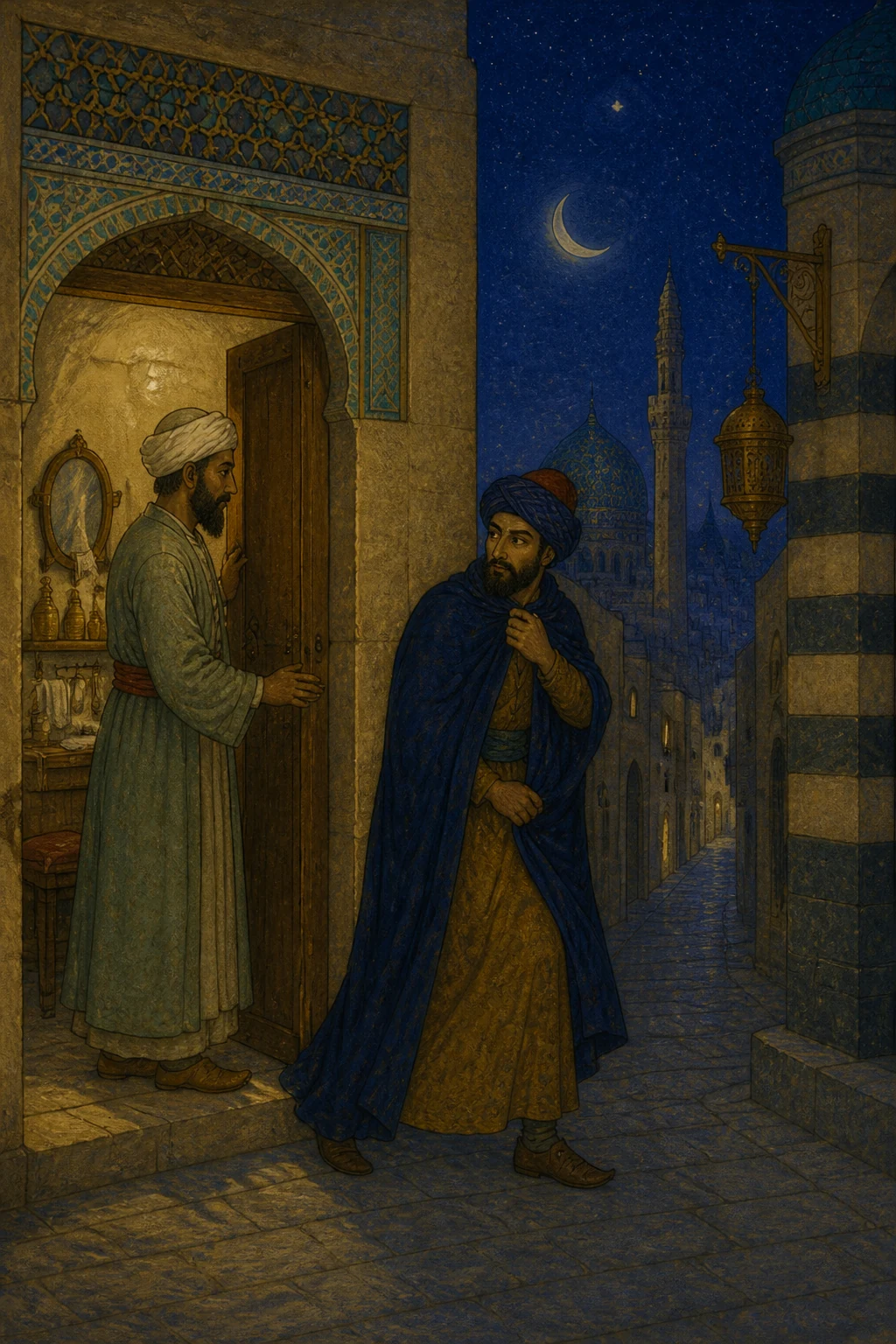
The Sultan’s son came into town and passed the Bedouin’s door. The man seized him, dragged him inside, and locked him up. There he saw many people imprisoned alongside goats. In the morning, a person and a goat were taken out and slaughtered. The Bedouin mixed their flesh together and went to sell it in the marketplace. This was what he did every day.
The Sultan’s son grew thin with distress. He called the Bedouin’s slave and gave him a coin, saying, “Go and buy me some thread and a piece of cloth.” The slave bought them and brought them to him. He embroidered a beautiful cap and stitched these verses inside it: “Ajabtu rangadida na kitun hiraja Illahi Eke kordenai, eke kordeshire, Kaja bondekana, gulam batashahi; Ajabtu rangadida kitun hiraja Illahi.”
He gave the cap to the Bedouin, who was delighted with it. “Go and sell this cap to the Sultan,” the young man told him. “Then you will get a good price for it.” The Bedouin went to sell it. When the Sultan saw it, he recognized his master’s handiwork. He read the verses too and understood their meaning, which was this:
“How wondrous are the ways of God! One was carried off by the water, one was carried off by a shark. I, a freeborn man, am imprisoned; my slave has become Sultan. How wondrous are the ways of God!” He asked the Bedouin, “Where did you get this cap?” “My wife made it,” the man replied. The Sultan gave him fifty reals and said, “Tell your wife to make me another.” Then the Bedouin went on his way.
The Sultan sent out soldiers, telling them, “Follow him. When you see which house he enters, come back and tell me.” They followed him all the way home. He went inside, and the soldiers returned to the Sultan and reported, “We have found his house.”
A hundred soldiers were sent to the house. The Sultan told them, “Seize him and bind him, and bring everyone you find in his house. Be sure to bring them all.” They went, seized and bound him, and brought him back with everyone who had been in the house. He was questioned: “So this is your trade—seizing people and keeping them prisoner in your house so that you can slaughter them and feed them to others?” He could not deny it. The captives were questioned, and they said, “That is indeed his trade.” He was thrown into prison.
The Sultan took his master in and ordered attendants to bathe him. He gave him clothes to put on, then food, and he ate his fill. He asked him what had happened, and his master told him everything. “As for me, I am Sultan here in this town,” he said, “but tomorrow I shall step down and give the throne to you, my master. I would not presume to be Sultan in your presence.” “Very well,” his master replied.
In the morning he summoned all the townspeople, and they came to the palace. He had his master splendidly arrayed in royal robes. When the young man appeared, the people were astonished. “What is the meaning of this?” they asked. The Sultan said to them, “I have called you here to ask you: did you bestow this sultanate upon me in earnest or in jest?” The ministers answered, “We bestowed it upon you in earnest.” He asked them, “And will you approve of what I wish?” “We will,” they replied.
He told them, “My wish is that this man, my master, should be Sultan.” They answered, “We agree.” Then they asked him, “Who is he?” He told them, “He is truly my master, and a Sultan in his own country. But all this has come about by the will of God.”
The townspeople rejoiced greatly. The Bedouin was taken away and drowned, and all his wealth was given to the poor. And they lived in peace and comfort to the end of their days.