Prevod
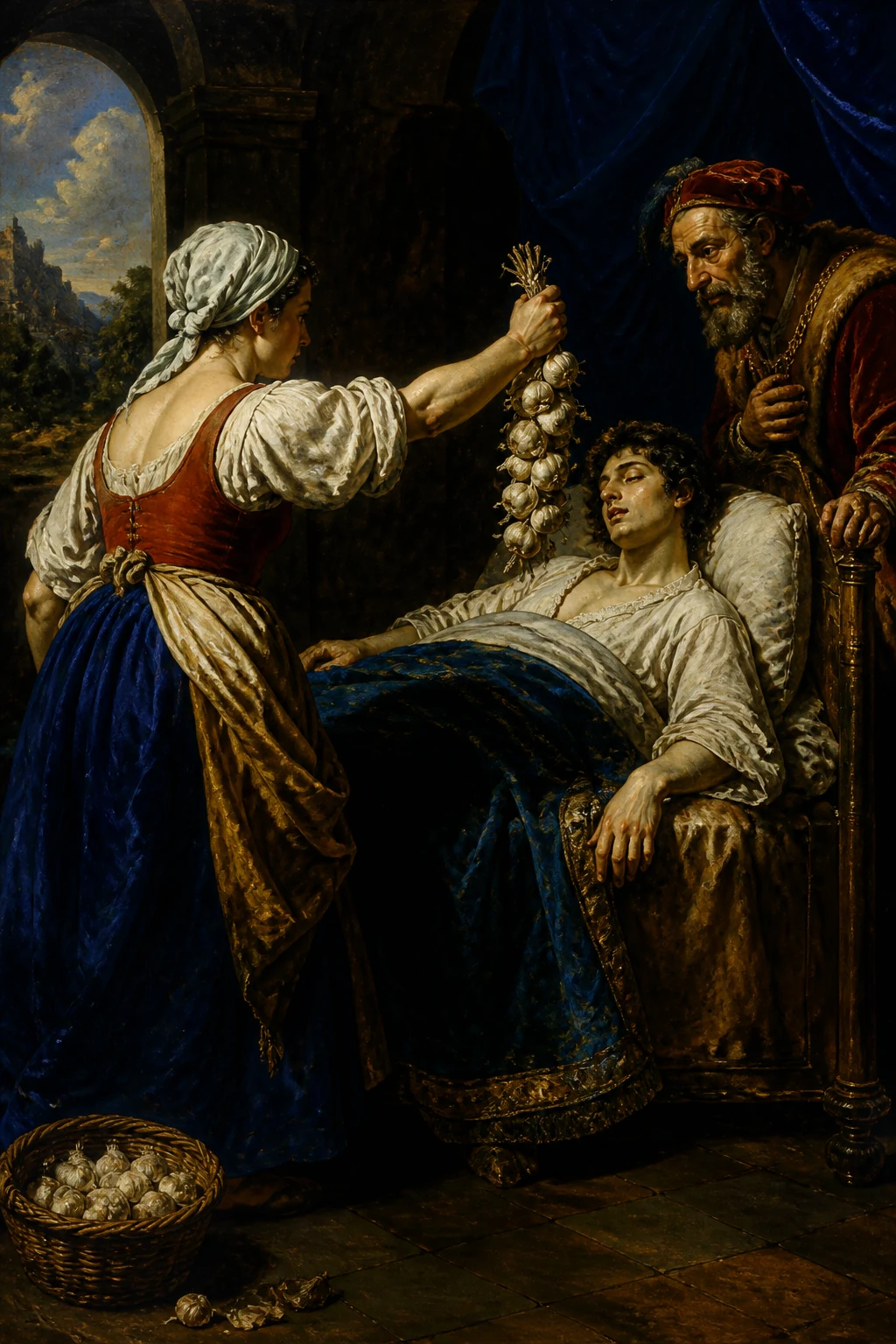
Once upon a time there were a farmer and his wife, and the village priest had taken a great fancy to the farmer’s wife. He was always wishing he could spend a whole day alone with her, enjoying himself, and the farmer’s wife would have been quite happy with that too. So one day he said to her, ‘Now, my dear farmer’s wife, I’ve thought of a way for us to spend a whole pleasant day together. Do you know what? On Wednesday, take to your bed and tell your husband you’re ill, and groan and moan as much as ever you can. Keep it up until Sunday, when I preach my sermon. Then I’ll preach that anyone who has a sick child, a sick husband, a sick wife, a sick father, a sick mother, a sick sister or brother, or whoever else it may be, at home, and makes a pilgrimage to Göcherliberg in Wälischland, where you can get a bushel of bay leaves for a kreuzer, will find that the sick child, the sick husband, the sick wife, the sick father, the sick mother, the sick sister, or whoever else it may be, gets well on the spot.’
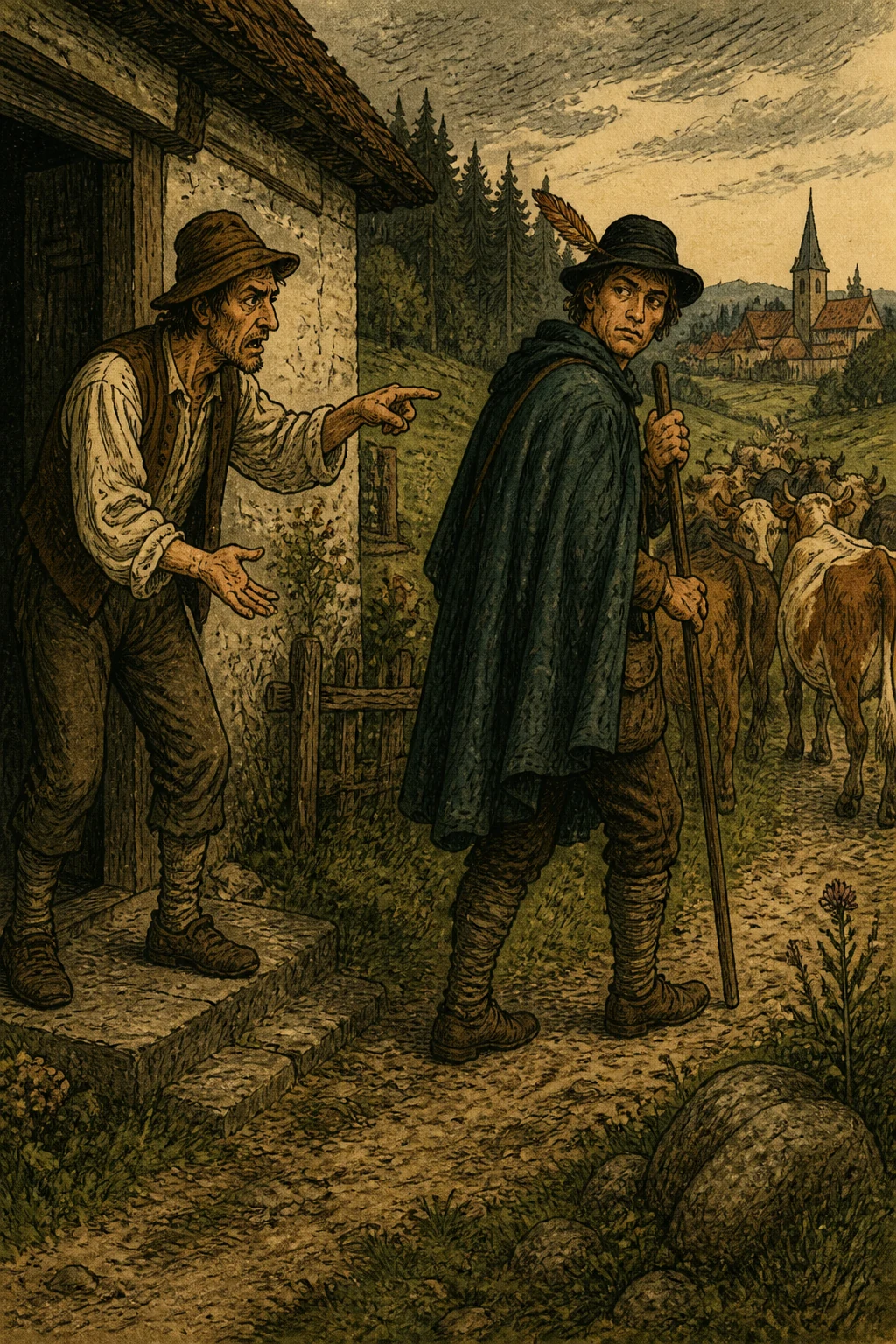
‘I can certainly do that,’ said the farmer’s wife. Well, on Wednesday she took to her bed and groaned and moaned something dreadful. Her husband brought her every remedy he could think of, but nothing did any good. When Sunday came, the farmer’s wife said, ‘I feel so wretched I could die this very minute, but there’s one thing I’d still like before my end: I’d like to hear the sermon the reverend father is going to preach today.’ ‘Ah, my dear,’ said the farmer, ‘don’t you do that. You might get worse if you got up. Look, I’ll go to the sermon and listen very carefully, and I’ll tell you everything the reverend father says.’ ‘Well,’ said the farmer’s wife, ‘go, then, and listen carefully, and tell me everything you hear.’ So the farmer went to the sermon, and the reverend father began to preach. He said that if anyone had a sick child, a sick husband, a sick wife, a sick father, a sick mother, a sick sister or brother, or whoever else it might be, at home, and wished to make a pilgrimage to Göckerliberg in Wälischland, where a bushel of bay leaves cost a kreuzer, then the sick child, the sick husband, the sick wife, the sick father, the sick mother, the sick sister or brother, or whoever else it might be, would get well on the spot. Anyone wishing to undertake the journey should come to him after Mass, and he would give him the sack for the bay leaves and the kreuzer. No one was more eager than the farmer, and straight after Mass he went to the priest, who gave him the sack for the bay leaves and the kreuzer. Then he went home, and was already shouting from the doorway, ‘Hurrah, dear wife! Now you’re as good as well again! The reverend father preached today that anyone who has a sick child, a sick husband, a sick wife, a sick father, a sick mother, a sick sister or brother, or whoever else it may be, at home, and makes a pilgrimage to Göckerliberg in Wälischland, where a bushel of bay leaves costs a kreuzer, will find that the sick child, the sick husband, the sick wife, the sick father, the sick mother, the sick sister or brother, or whoever else it may be, gets well on the spot. And I’ve already fetched the sack for the bay leaves and the kreuzer from the reverend father, and I’ll set off on my journey at once, so you’ll get well all the sooner.’ And off he went. But he had scarcely left before the farmer’s wife was up, and the priest soon arrived as well. Now we’ll leave those two alone for a while and go along with the farmer. He kept walking briskly ahead, so as to reach Göckerliberg all the sooner, and as he went along he happened to meet his child’s godfather. The godfather was an egg seller, and he was just coming back from market, where he had sold his eggs. ‘Praised be the Lord,’ said the godfather. ‘Where are you hurrying off to, old friend?’ ‘For ever and ever, old friend,’ said the farmer. ‘My wife has fallen ill, and today I heard the reverend father’s sermon. He preached that if anyone has a sick child, a sick husband, a sick wife, a sick father, a sick mother, a sick sister or brother, or whoever else it may be, at home, and makes a pilgrimage to Göckerliberg in Wälischland, where a bushel of bay leaves costs a kreuzer, then the sick child, the sick husband, the sick wife, the sick father, the sick mother, the sick sister or brother, or whoever else it may be, will get well on the spot. So I fetched the sack for the bay leaves and the kreuzer from the reverend father, and now I’m setting out on my journey.’ ‘But look here, old friend,’ said the godfather to the farmer, ‘are you really so simple that you can believe such a thing? Do you know what’s going on? The priest wants to spend a whole day alone with your wife, enjoying himself, and that’s why they’ve spun you this yarn—to get you out of the way.’ ‘Well,’ said the farmer, ‘I’d certainly like to know whether that’s true.’ ‘Well, then,’ said the godfather, ‘do you know what? Climb into my egg basket, and I’ll carry you home, and you’ll see for yourself.’ And so they did. The godfather put the farmer into his egg basket and carried him home. When they got there, goodness, the merrymaking was already in full swing! The farmer’s wife had slaughtered just about everything in the farmyard, and she had baked fritters, and the priest was there already, with his fiddle. The godfather knocked, and the farmer’s wife asked who was outside. ‘It’s me, my dear,’ said the godfather. ‘Please give me a night’s lodging. I didn’t sell my eggs at market, and now I have to carry them home again, but they’re far too heavy. I can’t go any farther, and it’s dark already.’ ‘Well, my friend,’ said the farmer’s wife, ‘you’ve come at a very awkward time. Still, since there’s nothing else for it, come in and sit over there on the bench by the stove.’ So the godfather sat down on the bench by the stove with the basket on his back. The priest and the farmer’s wife, meanwhile, were having a merry time. At last the priest said, ‘Now, my dear farmer’s wife, you sing so beautifully. Do sing me something.’ ‘Oh,’ said the farmer’s wife, ‘I can’t sing any more. Yes, when I was young I could, but those days are over.’ ‘Come now,’ said the priest, ‘just sing a little.’ So the farmer’s wife began to sing, ‘I’ve sent my husband off, you see, to Göckerliberg in Wälischland.’
Then the priest sang, ‘I wish he’d stay a whole long year; what do I care for his sack of bay leaves? Hallelujah!’ Now the godfather joined in from the back and sang—but I must tell you here that the farmer’s name was Hildebrand—so the godfather sang, ‘Oh, my dear Hildebrand, what are you doing on the bench by the stove?
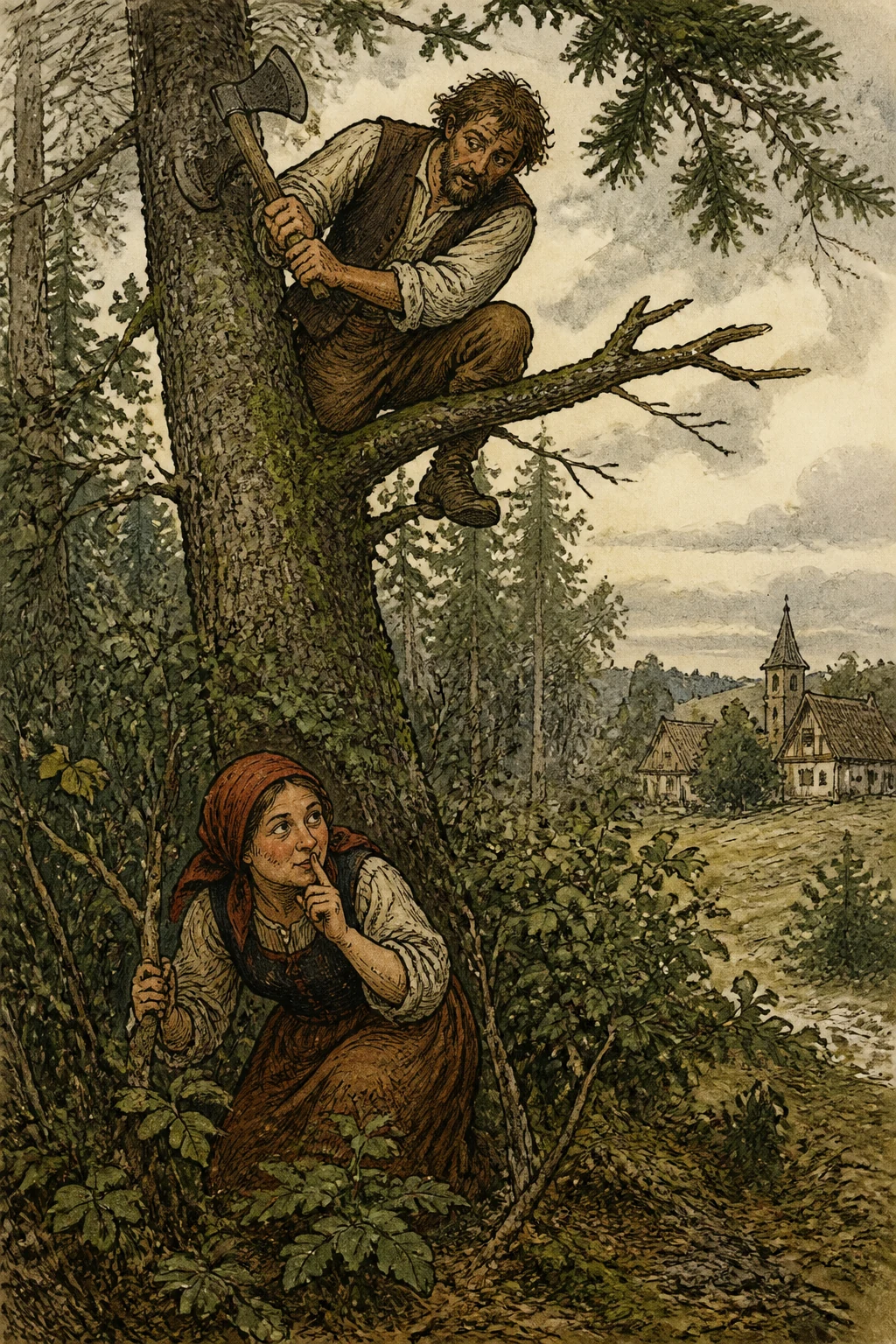
Hallelujah!’ And now the farmer sang from inside the basket, ‘I cannot bear this singing any more; out of my basket I must climb.’ And he climbed out of the basket and beat the priest out of the house.
Izvirnik
Ein Märchen der Brüder Grimm
Es war amahl a Baur und a Bäurin, und dö Bäurin, dö hat der Pfarra im Dorf gern gesegn, und da hat er alleweil gwunschen, wann er nur amahl an ganzen Tag mit der Bäurin allan recht vergnügt zubringa kunnt, und der Bäurin, der wars halt a recht gwesn. No, da hat er amahl zu der Bäurin gsagt 'hanz, mei liebi Bäurin, hietzt hab i was ausstudiert, wie wir halt amahl an ganzen Tag recht vergnügt mitanander zubringa kunnten. Wißts was, ös legts eng aufm Mittwoch ins Bett und sagts engern Mon, ös seits krang, und lamatierts und übelts nur recht, und das treibts fort bis aufm Sunta, wann i die Predi halt, und da wir (werde) i predigen, daß wer z' Haus a krangs Kind, an krangen Mon, a krangs Weib, an krangen Vader, a krange Muader, a krange Schwester, Bruader, oda wers sunst nacha is, hat, und der tut a Wollfart aufm Göcherliberg in Wälischland, wo ma um an Kreuzer an Metzen Lorberbladen kriegt, dem wirds krange Kind, der krange Mon, 's krange Weib, der krange Vader, d' krange Muader, d' krange Schwester, oda wers sunst nacha is, auf der Stell gsund.'
'Dös wir i schon machen,' hat die Bäurm drauf gsagt. No, drauf, aufm Mittwoch hat sie halt d' Bäurin ins Bett glegt und hat g,lamatiert und g'übelt als wie, und ihr Mon hat ihr alles braucht, was er nur gwißt hat, 's hat aber halt nix gholfn. Wie denn der Sunta kuma is, hat d' Bäurin gsagt 'mir is zwar so miserabel, als ob i glei verschaden sollt, aber ans möcht i do no vor mei End, i möcht halt in Herrn Pfarra sei Predi hörn, dö er heund halten wird.' 'A, mei Kind,' sagt der Baur drauf, 'tu du dös nit, du kunntst schlechter wern, wann aufstundst. Schau, es wir i in d' Predi gehn und wir recht acht gebe und wir dir alles wieder derzöhln, was der Herr Pfarra gsagt hat.' 'No,' hat d' Bäurin gsagt, 'so geh halt und gibt recht acht und derzöhl mir alles, was d' gehört hast.' No, und da is der Baur halt in d' Predi ganga, und da hat der Herr Pfarra also angfangt zun predigen und hat halt gsagt, wann ans a krangs Kind, an krangen Mon, a krangs Weib, an krangen Vader, a krange Muader, a krange Schwester, Bruader, oda wers sunst nacha war, z' Haus hät, und der wollt a Wollfart machen aufm Göckerliberg in Wälischland, wo der Metzen Lorberbladen an Kreuzer kost, dem wird 's krange Kind, der krange Mon, 's krange Weib, der krange Vater, d' krange Muader, d' krange Schwester, Bruader, oda wers sunst nacha war, auf der Stell gsund wern, und wer also dö Ras unternehma wollt, der soll nach der MeB zu ihm kuma, da wird er ihm den Lorbersack gebn und den Kreuzer. Da war niembd fröher als der Bauer, und nach der Meß is er gleich zum Pfarra ganga, und der hat ihm also den Lorbersack gebn und den Kreuzer. Drauf is er nach Haus kuma und hat schon bei der Haustür eini gschrien 'juchesha, liebes Weib, hietzt is so viel, als obs gsund warst. Der Herr Pfarra hat heunt predigt, daß, wer a krangs Kind, an krangen Mon, a kranges Weib, an krangen Vader, a krange Muader, a krange Schwester, Bruader, oda wers sunst nacha war, z' Haus hat, und der macht a Wollfart aufm Göckerliberg in Wälischland, wo der Metzen Lorberbladen an Kreuzer kost, dem wird 's krange Kind, der krange Mon, 's krange Weib, der krange Vader, d' krange Muader, d' krange Schwester, Bruader, oda wers sunst nacha war, auf der Stell gsund; und hietzt hab i mir schon den Lorbersack gholt vom Herrn Pfarra und den Kreuzer, und wir glei mein Wanderschaft antreten, daß d' desto ehender gsund wirst;, und drauf is er fort ganga. Er war aber kam fort, so is die Bäurin schon auf gwesn, und der Pfarra war a glei do. Hietzt lassen wir aber dö zwa indessen auf der Seiten und gänga mir mit,n Baur. Der is halt alleweil drauf los ganga, damit er desto ehender aufm Göckerliberg kummt, und wie halt so geht, begegnt ihm sein Gvatter. Sein Gvatter, dös war an Armon (Eiermann), und der is just von Mark kuma, wo er seine Ar verkauft hat. 'Globt seist,' sagt sein Gvatter, 'wo gehst denn so trabi hin, Gvatter?' 'In Ewigkeit, Gvatter,' sagt der Baur, 'mein Weib is krang worn, und da hab i heund in Herrn Pfarra sein Predi ghört, und da hat er predigt, daß, wann aner z' Haus an krangs Kind, an krangen Mon, a krangs Weib, an krangen Vader, a krange Muader, a krange Schwester, Bruader, oda wers sunst nacha war, hat, und er macht a Wollfart aufm Göckerliberg in Wälischland, wo der Metzen Lorberbladen an Kreuzer kost, dem wird's krange Kind, der krange Mon, 's krange Weib, der krange Vader, d' krange Muader, d' krange Schwester, Bruader, oda wers sunst nacha war, auf der Stell gsund, und da hab i mir von Herrn Pfarra den Lorbersack und den Kreuzer gholt, und hietzt trit i halt mein Wanderschaft an.' 'Aber hanz, Gvatter,' hat der Gvatter zum Baur gsagt, 'seits denn gar so dacket (einfältig), daß so was glauben könts? Wißts, was is? der Pfarra möcht gern mit engern Weib an ganzen Tag allan recht vergnügt zubringa, drum habn's eng den Bärn anbunden, daß ihr,en aus,n Füßen kumts.' 'Mein ,' hat der Baur gsagt, 'so möcht i do wissen, ob das wahr is.' 'No,' hat der Gvatter gsagt, 'wast was, setz di in mein Arkorb eini, so will i di nach Haus tragn, und da wirst es selber segn.' No, das is also geschegn, und den Baur hat sein Gvatter in sein Arkorb eini gsetzt, und der hat,n nach Haus tragn. Wie's nach Haus kuma san, holla, da is schon lusti zuganga. Da hat die Bäurin schon fast alles, was nur in ihren Hof war, abgstochen ghabt, und Krapfen hats bachen, und der Pfarra war a schon da und hat a sein Geige mitbracht ghabt. Und da hat halt der Gvatter anklopft, und d' Bäurin hat gfragt, wer draußen war. 'I bins, Gvatterin,' hat der Gvatter gsagt, 'mei, gebts mir heund nacht a Herberg, i hab meini Ar aufm Mark nit verkauft, und hietzt muß i's wieder nach Haus trage, und sö san gar z' schwar, i bring's nit fort, es is a schon finster.' 'Ja, mein Gvatter,' sagt d' Bäurin drauf, 'ös kumts mir recht zur unglegna Zeit. No, weils halt her nit anders is, so kömts eina und setzts eng dort auf d' Ofenbank.' No hat sie der Gvatter also mit sein Buckelkorb auf d' Ofenbank gsetzt. Der Pfarra aber und d' Bäurin, dö warn halt recht lusti. Endli fangt der Pfarra an und sagt 'hanz, mein liebi Bäurin, ös könnts ja so schön singa, singts mir do ans.' 'A,' sagt die Bäurin, 'hietzt kann i nix mehr singa, ja, in mein junge Jahren, da hab i's wohl könna, aber hietzt is schon vorbei.' 'Ei,' sagt wie der der Pfarra, 'singts do nur a bißl.' No, da fangt die Bäurin an und singt
'i hab mein Mon wohl ausgesandt
aufm Göckerliberg in Wälischland'
Drauf singt der Pfarra
'i wollt, er blieb da a ganzes Jahr,
was fragt i nach dem Lorbersack.
Halleluja!'
Hietzt fangt der Gvatter hinten an und singt (da muß i aber derzöhln, daß der Baur Hildebrand ghassen hat), singt also der Gvatter
'ei du, mein lieber Hildebrand,
was machst du auf der Ofenbank?
Halleluja!'
Und hietzt singt der Baur in Korb drinna
'hietzt kann i das Singa nimmermehr leiden,
hietzt muß i aus mein Buckelkorb steigen.'
Und steigt aus'n Korb und prügelt den Pfaffen beim Haus hinaus.