O besedilu
Lena predica
- Vir
- Grimmove pravljice
- Avtor
- Jacob in Wilhelm Grimm
- Jezik branja
- English
- Jezik izvirnika
- Deutsch
- Čas branja
- 4 min branja
- Obseg
- 4 strani
- Naslov izvirnika
- Die faule Spinnerin
O izvirniku
Grimmove pravljice
Gozdovi, čarobni predmeti in ljudska logika evropske pripovedne tradicije. Bralni jezik je English, izvirnik pa prihaja iz vira Grimmove pravljice v jeziku Deutsch.
Besedilo
Lena predica
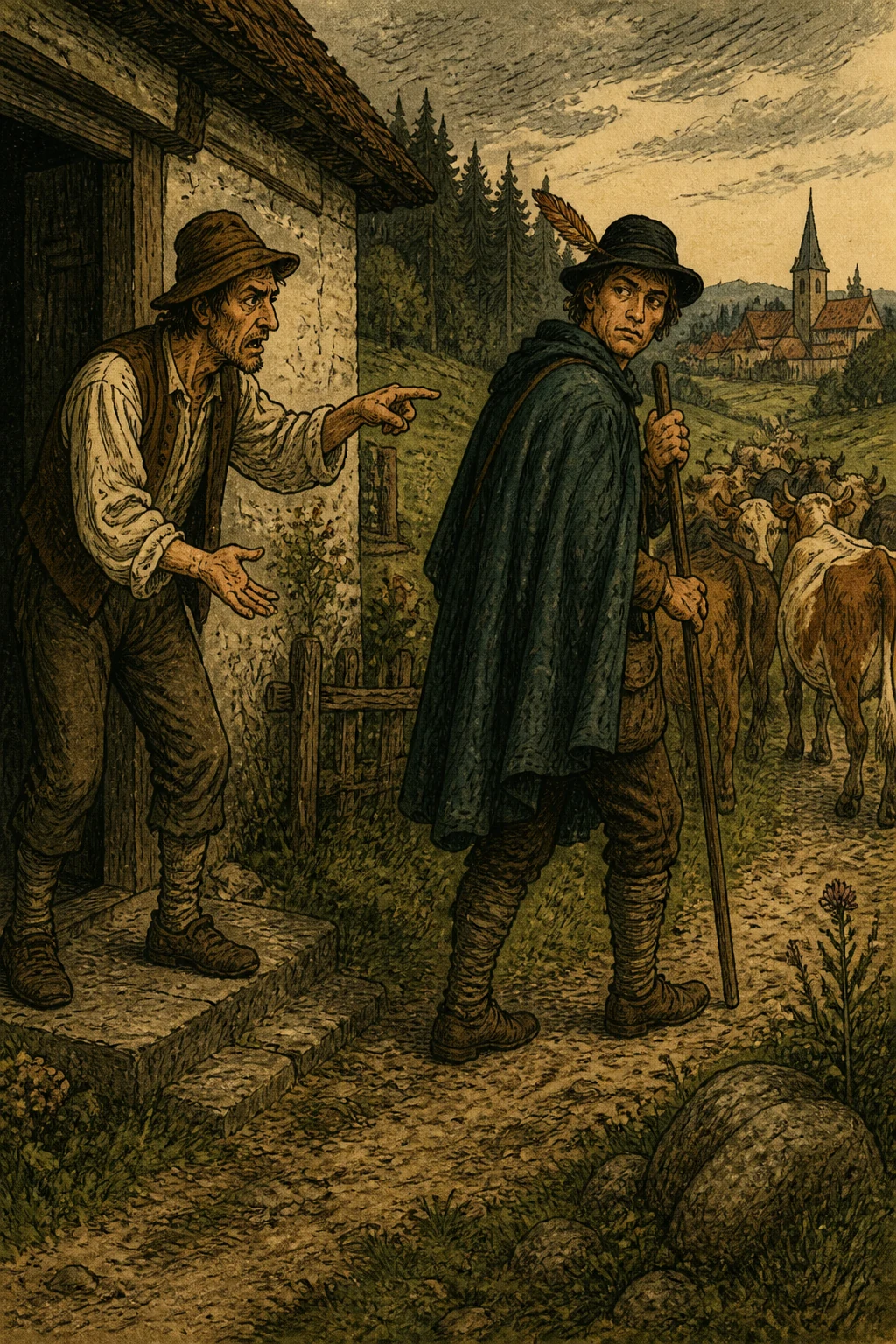
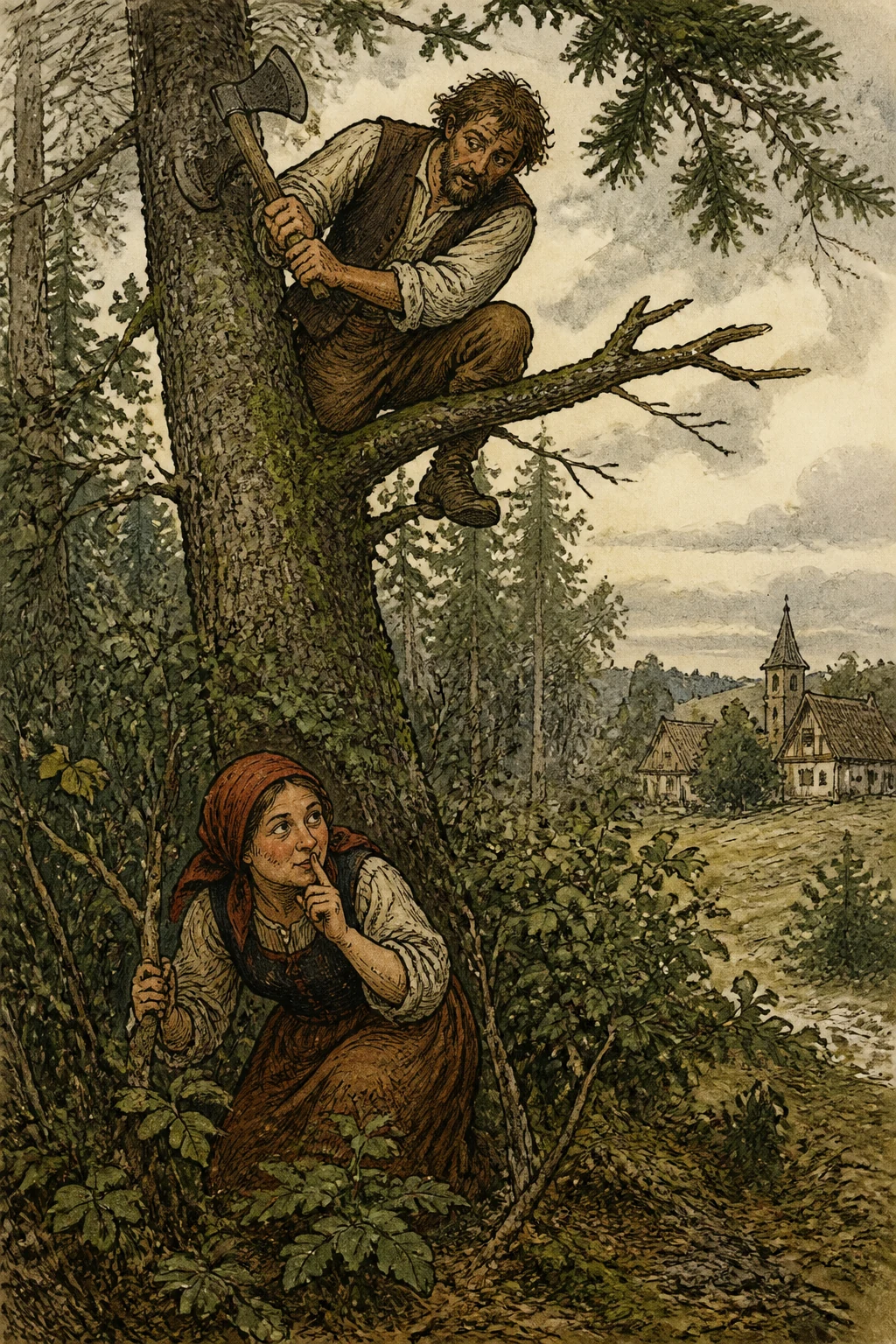
In a village there lived a man and his wife, and the wife was so lazy that she never wanted to do any work. Whatever her husband gave her to spin, she never finished, and what she did spin she never reeled, but left it all wound up in a ball. Whenever her husband scolded her, she was always ready with an answer. “Why, how am I to reel the yarn when I have no reel? Go into the forest first and get me one.” “If that is all,” said her husband, “I will go into the forest and fetch some wood for a reel.” Then the wife grew afraid that, once he had the wood, he would make a reel out of it, and she would have to reel off her yarn and then begin spinning again. She thought for a little while, and a good idea came to her, so she secretly followed her husband into the forest. When he had climbed a tree to choose and cut the wood, she crept into the bushes beneath it, where he could not see her, and called up, “Who cuts wood for a reel shall die; who reels the yarn meets ruin thereby.”
The man listened, laid down his axe for a while, and wondered what this could mean. “Oh, nonsense,” he said at last. “What could it have been? Your ears were ringing. Don’t frighten yourself for nothing.” So he took up his axe again and was about to strike, when the voice called up once more from below, “Who cuts wood for a reel shall die; who reels the yarn meets ruin thereby.”
He stopped, grew frightened and uneasy, and pondered the matter. But after a little while his courage returned, and for the third time he reached for his axe and was about to strike. But for the third time the voice cried out loudly, “Who cuts wood for a reel shall die;
who reels the yarn meets ruin thereby.” Then he had had enough, and all desire to cut the wood had left him. He climbed hastily down the tree and set off home. His wife ran as fast as she could along the side paths, so that she would get home before him. When he came into the room, she acted quite innocently, as though nothing had happened, and said, “Well, have you brought some good wood for a reel?” “No,” he said, “I can see that this reeling business will never do.” He told her what had happened to him in the forest, and from then on left her in peace about it.
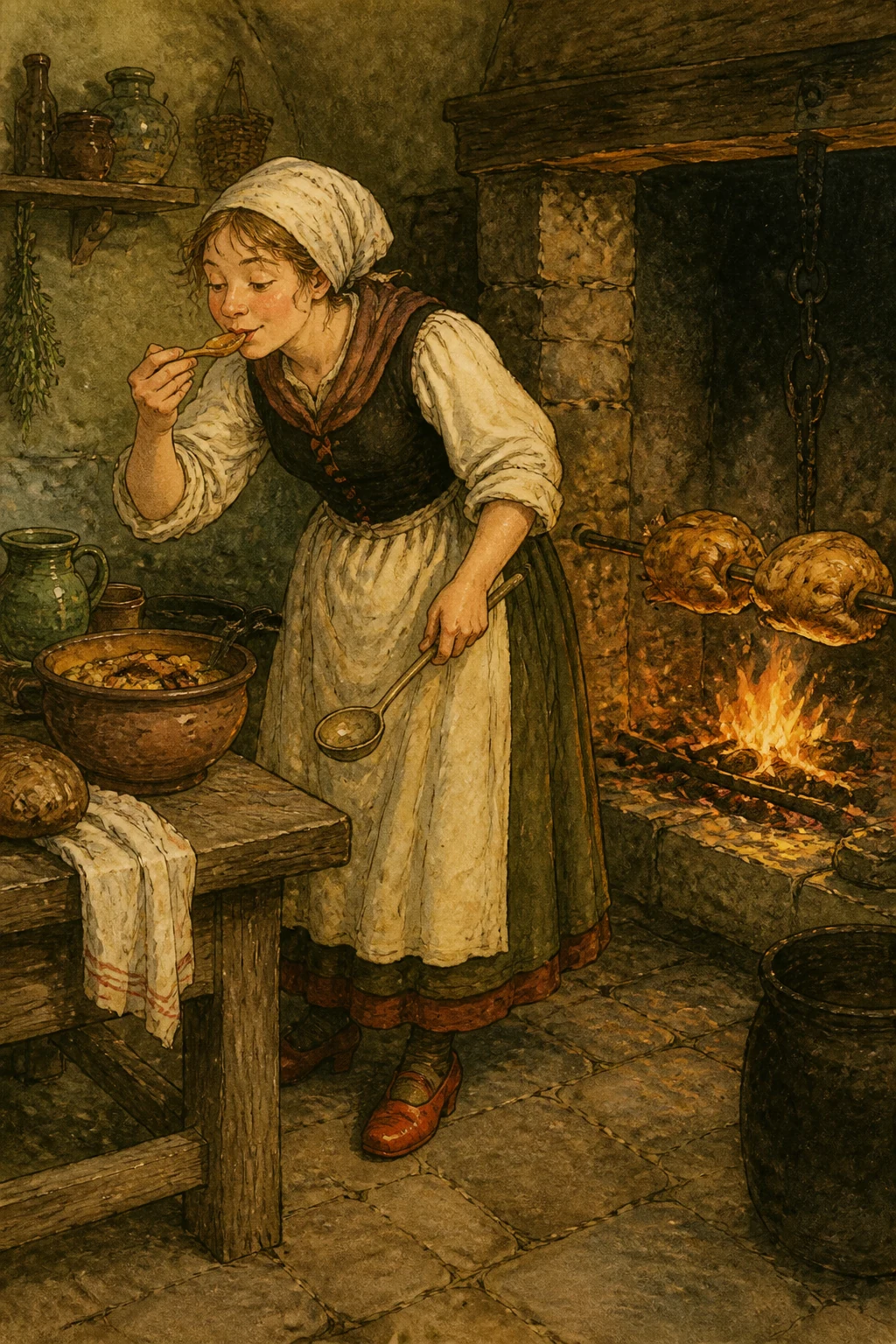
Before long, however, the man began to fret once more about the disorder in the house. “Wife,” he said, “it really is a disgrace that the spun yarn should be left lying there in a ball.” “Do you know what?” she said. “Since we cannot get a reel, you stand up in the loft and I will stand below. I will throw the ball up to you, and you can throw it down again, and at least we shall have a skein.” “Yes, that will work,” said her husband. So that was what they did, and when they had finished, he said, “Now that the yarn is in a skein, it must be boiled.” The wife grew afraid again, and although she said, “Yes, we will boil it first thing tomorrow morning,” she was already thinking up another trick. Early next morning she got up, lit the fire, and put the kettle on, but instead of the yarn she put in a lump of tow and let it boil away. Then she went to her husband, who was still in bed, and said, “I must go out for a while. Get up in the meantime and look after the yarn in the kettle over the fire. But you must do it in good time, mind you, for if the cock crows and you have not looked in on it, the yarn will turn to tow.” The man was eager to do his part and did not want to neglect anything, so he got up as quickly as he could and went into the kitchen. But when he reached the kettle and looked inside, he saw to his horror nothing but a lump of tow. The poor man kept as quiet as a mouse, thinking he had been careless and it was all his fault, and from that day on he never said another word about yarn or spinning. But you must admit, she was a nasty woman.
Izvirnik
Die faule Spinnerin
Naslednje strani prikazujejo izvirno besedilo za primerjavo.
Ein Märchen der Brüder Grimm
Auf einem Dorfe lebte ein Mann und eine Frau, und die Frau war so faul, daß sie immer nichts arbeiten wollte: und was ihr der Mann zu spinnen gab, das spann sie nicht fertig, und was sie auch spann, haspelte sie nicht, sondern ließ alles auf dem Klauel gewickelt liegen. Schalt sie nun der Mann, so war sie mit ihrem Maul doch vornen und sprach 'ei, wie sollt ich haspeln, da ich keinen Haspel habe, geh du erst in den Wald und schaff mir einen.' 'Wenns daran liegt,' sagte der Mann, 'so will ich in den Wald gehen und Haspelholz holen.' Da fürchtete sich die Frau, wenn er das Holz hätte, daß er daraus einen Haspel machte, und sie abhaspeln und dann wieder frisch spinnen müßte. Sie besann sich ein bißchen, da kam ihr ein guter Einfall, und sie lief dem Manne heimlich nach in den Wald. Wie er nun auf einen Baum gestiegen war, das Holz auszulesen und zu hauen, schlich sie darunter in das Gebüsch, wo er sie nicht sehen konnte und rief hinauf
'wer Haspelholz haut, der stirbt,
wer da haspelt, der verdirbt.'
Der Mann horchte, legte die Axt eine Weile nieder und dachte nach, was das wohl zu bedeuten hätte. 'Ei was,' sprach er endlich, 'was wirds gewesen sein! es hat dir in den Ohren geklungen, mache dir keine unnötige Furcht.' Also ergriff er die Axt von neuem und wollte zuhauen, da riefs wieder von unten herauf
'wer Haspelholz haut, der stirbt,
wer da haspelt, der verdirbt.'
Er hielt ein, kriegte angst und bang und sann dem Ding nach. Wie aber ein Weilchen vorbei war, kam ihm das Herz wieder, und er langte zum drittenmal nach der Axt und wollte zuhauen. Aber zum drittenmal riefs und sprachs laut
'wer Haspelholz haut, der stirbt'
wer da haspelt, der verdirbt.'
Da hatte ers genug, und alle Lust war ihm vergangen, so daß er eilends den Baum herunterstieg und sich auf den Heimweg machte. Die Frau lief, was sie konnte, auf Nebenwegen, damit sie eher nach Haus käme. Wie er nun in die Stube trat, tat sie unschuldig, als wäre nichts vorgefallen, und sagte 'nun, bringst du ein gutes Haspelholz?' 'Nein,' sprach er, 'ich sehe wohl, es geht mit dem Haspeln nicht,' erzählte ihr, was ihm im Walde begegnet war, und ließ sie von nun an damit in Ruhe.
Bald hernach fing der Mann doch wieder an, sich über die Unordnung im Hause zu ärgern. 'Frau,' sagte er, 'es ist doch eine Schande, daß das gesponnene Garn da auf dem Klauel liegen bleibt.' 'Weißt du was,' sprach sie, 'weil wir doch zu keinem Haspel kommen, so stell dich auf den Boden und ich steh unten, da will ich dir den Klauel hinaufwerfen, und du wirfst ihn herunter, so gibts doch einen Strang.' 'Ja, das geht,' sagte der Mann. Also taten sie das, und wie sie fertig waren, sprach er 'das Garn ist nun gesträngt, nun muß es auch gekocht werden.' Der Frau ward wieder angst, sie sprach zwar 'ja wir wollens gleich morgen früh kochen,' dachte aber bei sich auf einen neuen Streich. Frühmorgens stand sie auf, machte Feuer an und stellte den Kessel bei, allein statt des Garns legte sie einen Klumpen Werg hinein, und ließ es immerzu kochen. Darauf ging sie zum Manne, der noch zu Bette lag, und sprach zu ihm 'ich muß einmal ausgehen, steh derweil auf und sieh nach dem Garn, das im Kessel überm Feuer steht: aber du mußts beizeit tun, gib wohl acht, denn wo der Hahn kräht, und du sähest nicht nach, wird das Garn zu Werg.' Der Mann war bei der Hand und wollte nichts versäumen, stand eilends auf, so schnell er konnte, und ging in die Küche. Wie er aber zum Kessel kam und hineinsah, so erblickte er mit Schrecken nichts als einen Klumpen Werg. Da schwieg der arme Mann mäuschenstill, dachte, er hätts versehen und wäre schuld daran, und sprach in Zukunft gar nicht mehr von Garn und Spinnen. Aber das mußt du selbst sagen, es war eine garstige Frau.
Nadaljuj z branjem