O besedilu
Kmetič
- Vir
- Grimmove pravljice
- Avtor
- Jacob in Wilhelm Grimm
- Jezik branja
- English
- Jezik izvirnika
- Deutsch
- Čas branja
- 11 min branja
- Obseg
- 9 strani
- Naslov izvirnika
- Das Bürle
O izvirniku
Grimmove pravljice
Gozdovi, čarobni predmeti in ljudska logika evropske pripovedne tradicije. Bralni jezik je English, izvirnik pa prihaja iz vira Grimmove pravljice v jeziku Deutsch.
Besedilo
Kmetič
There was once a village where all the peasants were rich except one, whom they called the Little Peasant. He did not even have a cow, much less the money to buy one, though he and his wife would dearly have liked one. One day he said to her, “Listen, I have a good idea. Our friend the carpenter can make us a calf out of wood and paint it brown, so it looks like a real one. In time it may well grow into a cow.” His wife liked the idea too, and their friend the carpenter hammered and planed the calf into shape, painted it as he should, and made it with its head lowered as though it were grazing.
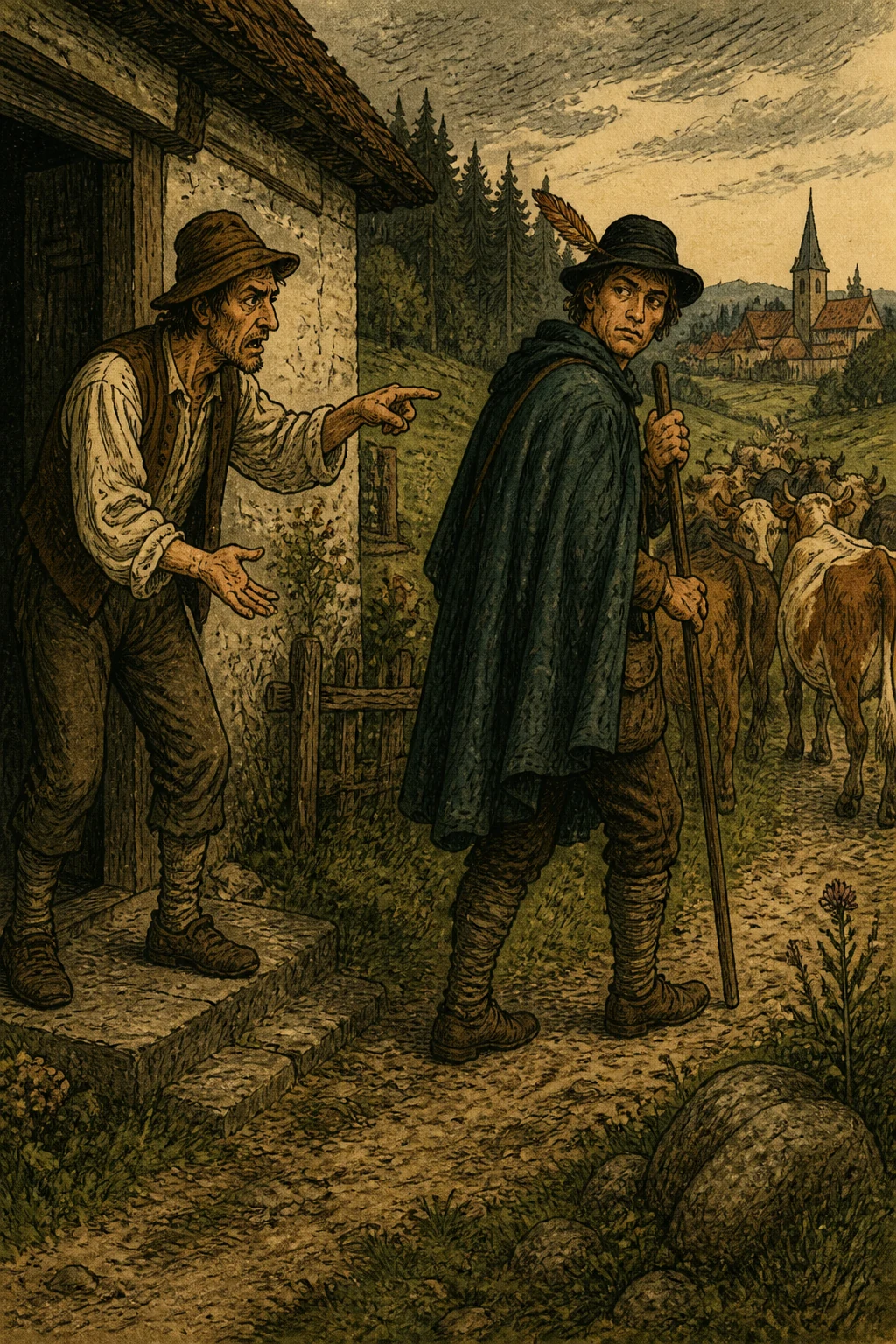
When the cows were driven out the next morning, the Little Peasant called the herdsman inside and said, “Look, I have a little calf here, but it is still small and must be carried.” The herdsman said, “Very well,” took it in his arms, carried it out to pasture, and set it in the grass. The little calf stood there all day as though it were grazing, and the herdsman said, “It will soon be walking on its own. Just look how much it eats already!” That evening, when he was ready to drive the herd home, he said to the calf, “If you can stand there and eat your fill, you can walk on your own four legs too. I am not going to lug you home in my arms again.” But the Little Peasant was standing at his door, waiting for his calf. When the herdsman drove the cows through the village and the calf was missing, he asked after it. The herdsman replied, “It is still out there eating. It would neither stop nor come along.” But the Little Peasant said, “Nonsense! I must have my animal back.” So they went back to the meadow together, but someone had stolen the calf, and it was gone. “It must have strayed,” said the herdsman. But the Little Peasant said, “That will not do for me!” and brought the herdsman before the village magistrate, who ruled that, for his negligence, he must give the Little Peasant a cow in place of the missing calf.
Now the Little Peasant and his wife had the cow they had long wished for. They were delighted, but they had no fodder and nothing to feed it, so before long it had to be slaughtered. They salted the meat, and the Little Peasant set off for town to sell the hide and use the money to buy another little calf. On the way he came to a mill, where a raven was sitting with broken wings. Out of pity he picked it up and wrapped it in the hide. But the weather grew so foul, with wind and driving rain, that he could go no farther. He went into the mill and asked for shelter. The miller’s wife was home alone and said to the Little Peasant, “Lie down there on the straw,” and gave him some bread and cheese. The Little Peasant ate and lay down with his hide beside him, and the woman thought, “He is tired and asleep.” Just then the priest arrived. The miller’s wife welcomed him warmly and said, “My husband is away, so let us have a feast.” The Little Peasant pricked up his ears, and when he heard about the feast, he was annoyed that he had been made to do with bread and cheese. The woman brought out four things and set them on the table: roast meat, salad, cake, and wine.
Just as they sat down to eat, there was a knock outside. “Oh, heavens!” said the woman. “That is my husband!” She quickly hid the roast in a compartment of the tiled stove, the wine under the pillow, the salad on the bed, the cake under the bed, and the priest in the cupboard out in the entrance hall. Then she opened the door to her husband and said, “Thank goodness you are home again! What weather! You would think the world was coming to an end!” The miller saw the Little Peasant lying on the straw and asked, “What is that fellow doing here?” “Oh,” said his wife, “the poor wretch came through the wind and rain and asked for shelter, so I gave him some bread and cheese and showed him where he could lie down on the straw.” “I have no objection,” said her husband, “but get me something to eat quickly.” His wife said, “I have nothing but bread and cheese.” “Anything will do for me,” her husband answered. “Bread and cheese, then.” He looked at the Little Peasant and called, “Come and have another bite with me.” The Little Peasant did not need to be asked twice. He got up and ate with him. Then the miller noticed the hide lying on the floor with the raven inside it and asked, “What have you got there?” The Little Peasant answered, “I have a soothsayer in there.” “Can he tell my fortune too?” asked the miller.
“Why not?” answered the Little Peasant. “But he will tell only four things, and the fifth he keeps to himself.” The miller was curious and said, “Let him make a prediction, then.” The Little Peasant pressed the raven’s head until it croaked, “Krr, krr.” “What did he say?” asked the miller. The Little Peasant answered, “First, he said there was wine under the pillow.” “Well, I’ll be damned!” cried the miller. He went to look and found the wine. “Now go on,” said the miller. The Little Peasant made the raven croak again and said, “Second, he said there was roast meat in the tiled stove.” “Well, I’ll be damned!” cried the miller. He went to look and found the roast. The Little Peasant made the raven prophesy again and said, “Third, he said there was salad on the bed.” “Well, I’ll be damned!” cried the miller. He went to look and found the salad. At last the Little Peasant squeezed the raven once more until it gave a growling croak, and said, “Fourth, he said there was cake under the bed.” “Well, I’ll be damned!” cried the miller. He went to look and found the cake.
Now the two sat down at the table together, but the miller’s wife was terrified. She took to her bed and kept all the keys with her. The miller was eager to hear the fifth thing too, but the Little Peasant said, “First let us eat the other four things in peace, for the fifth is something dreadful.” So they ate, and afterward they bargained over how much the miller should pay for the fifth prophecy, until they agreed on three hundred thalers. Then the Little Peasant pressed the raven’s head once more, making it croak loudly. “What did he say?” asked the miller. The Little Peasant answered, “He said the devil was hiding in the cupboard out in the entrance hall.” “The devil must be driven out!” said the miller, and he flung open the front door. His wife had to hand over the key, and the Little Peasant unlocked the cupboard. Out ran the priest as fast as his legs would carry him, and the miller said, “I saw the fellow in black with my own eyes. It was true!” The next morning, at first light, the Little Peasant slipped away with the three hundred thalers.
Back home, the Little Peasant gradually began to live in style and built himself a handsome house. The other peasants said, “The Little Peasant must have been to the place where golden snow falls and people carry money home by the bushel.” So the Little Peasant was summoned before the magistrate to explain where his wealth had come from. He answered, “I sold my cowhide in town for three hundred thalers.” When the peasants heard this, they wanted a share in such handsome profits. They ran home, killed all their cows, and stripped off the hides to sell in town for a great deal of money. The magistrate said, “My maid must go first.” But when she reached the merchant in town, he gave her no more than three thalers for a hide. When the others arrived, he would not give them even that much, and said, “What am I to do with all these hides?”
Now the peasants were furious that the Little Peasant had deceived them. They wanted revenge and brought a charge of fraud against him before the magistrate. The innocent Little Peasant was unanimously condemned to death: he was to be rolled into the water in a barrel riddled with holes. He was led out, and a priest was brought to say a mass for his soul. Everyone else had to withdraw, and when the Little Peasant looked at the priest, he recognized the man who had been with the miller’s wife. He said to him, “I freed you from the cupboard; now free me from the barrel.” Just then a shepherd came by with a flock of sheep. The Little Peasant knew that he had long wanted to become magistrate, so he shouted at the top of his voice, “No, I will not do it! Even if the whole world wanted me to, no, I will not do it!” Hearing this, the shepherd came over and asked, “What are you up to? What is it you will not do?” The Little Peasant said, “They want to make me magistrate if I get into this barrel, but I will not do it.” The shepherd said, “If that is all it takes to become magistrate, I would get into the barrel this very moment.” The Little Peasant said, “If you will get in, you will become magistrate too.” The shepherd was quite content with that and climbed inside, and the Little Peasant fastened the lid over him. Then he took the shepherd’s flock for himself and drove it away. Meanwhile, the priest went back to the villagers and told them the mass for the condemned man’s soul had been said. They came and rolled the barrel toward the water. As it began to roll, the shepherd cried, “I am quite willing to be magistrate!” They were certain it was the Little Peasant shouting, and said, “So we should think! But first you must have a look around down below.” And they rolled the barrel into the water.
Then the peasants went home, and as they came into the village, there was the Little Peasant, calmly driving in a flock of sheep and looking perfectly content. They were astonished and said, “Little Peasant, where have you come from? Have you come out of the water?” “Of course,” answered the Little Peasant. “I sank deep, deep down, until at last I reached the bottom. I knocked the bottom out of the barrel and crawled out, and there were lovely meadows with flocks of lambs grazing on them. That is where I got this flock.” “Are there any more?” asked the peasants. “Oh yes,” said the Little Peasant, “more than you could ever want.” Then the peasants agreed that they too would fetch some sheep, a flock apiece, but the magistrate said, “I shall go first.” So they all went down to the water. Little fleecy clouds, the kind people call lambs, were floating in the blue sky just then, and their reflections shone in the water. The peasants cried, “We can already see the sheep down on the bottom!” The magistrate pushed to the front and said, “Now I shall go down first and have a look. If all is well, I shall call you.” He jumped in, and the water went “Plump!” They took the sound for his calling “Come!” and the whole crowd plunged in after him in one great rush. So the village was left deserted, and the Little Peasant, as its sole heir, became a rich man.
Izvirnik
Das Bürle
Naslednje strani prikazujejo izvirno besedilo za primerjavo.
Ein Märchen der Brüder Grimm
Es war ein Dorf, darin saßen lauter reiche Bauern und nur ein armer, den nannten sie das Bürle (Bäuerlein). Er hatte nicht einmal eine Kuh und noch weniger Geld, eine zu kaufen und er und seine Frau hätten so gern eine gehabt. Einmal sprach er zu ihr: "Hör, ich habe einen guten Gedanken, da ist unser Gevatter Schreiner, der soll uns ein Kalb aus Holz machen und braun anstreichen, daß es wie ein anderes aussieht, mit der Zeit wirds wohl groß und gibt eine Kuh." Der Frau gefiel das auch, und der Gevatter Schreiner zimmerte und hobelte das Kalb zurecht, strich es an, wie sichs gehörte, und machte es so, daß es den Kopf herabsenkte, als fräße es.
Wie die Kühe des andern Morgens ausgetrieben wurden, rief das Bürle den Hirt herein und sprach: "Seht, da hab ich ein Kälbchen, aber es ist noch klein und muß noch getragen werden." Der Hirt sagte: "Schon gut," nahms in seinen Arm, trugs hinaus auf die Weide und stellte es ins Gras. Das Kälblein blieb da immer stehen wie eins, das frißt, und der Hirt sprach: "Das wird bald selber laufen, guck einer, was es schon frißt!" Abends, als er die Herde wieder heimtreiben wollte, sprach er zu dem Kalb: "Kannst du da stehen und dich satt fressen, so kannst du auch auf deinen vier Beinen gehen, ich mag dich nicht wieder auf dem Arm heimschleppen." Das Bürle stand aber vor der Haustüre und wartete auf sein Kälbchen. Als nun der Kuhhirt durchs Dorf trieb und das Kälbchen fehlte, fragte er danach. Der Hirt antwortete: "Das steht noch immer draußen und frißt, es wollte nicht aufhören und nicht mitgehen." Bürle aber sprach: "Ei was, ich muß mein Vieh wiederhaben." Da gingen sie zusammen nach der Wiese zurück, aber einer hatte das Kalb gestohlen, und es war fort. Sprach der Hirt: "Es wird sich wohl verlaufen haben." Das Bürle aber sagte: "Mir nicht so!" und führte den Hirten vor den Schultheiß, der verdammte ihn für seine Nachlässigkeit, daß er dem Bürle für das entkommene Kalb mußte eine Kuh geben.
Nun hatte das Bürle und seine Frau die lang gewünschte Kuh; sie freuten sich von Herzen, hatten aber kein Futter, und konnten ihr nichts zu fressen geben, also mußte sie bald geschlachtet werden. Das Fleisch salzten sie ein, und das Bürle ging in die Stadt und wollte das Fell dort verkaufen, um für den Erlös ein neues Kälbchen zu bestellen. Unterwegs kam er an eine Mühle, da saß ein Rabe mit gebrochenen Flügeln, den nahm er aus Erbarmen auf und wickelte ihn in das Fell. Weil aber das Wetter so schlecht ward, und Wind und Regen stürmte, konnte er nicht weiter, kehrte in die Mühle ein und bat um Herberge. Die Müllerin war allein zu Haus und sprach zu dem Bürle: "Da leg dich auf die Streu," und gab ihm ein Käsebrot. Das Bürle aß und legte sich nieder, sein Fell neben sich, und die Frau dachte: "Der ist müde und schläft." Indem kam der Pfaff, die Frau Müllerin empfing ihn wohl und sprach: "Mein Mann ist aus, da wollen wir uns traktieren." Bürle horchte auf, und wies von traktieren hörte, ärgerte es sich, daß es mit Käsebrot hätte vorlieb nehmen müssen. Da trug die Frau herbei und trug viererlei auf, Braten, Salat, Kuchen und Wein.
Wie sie sich nun setzten und essen wollten, klopfte es draußen. Sprach die Frau: "Ach Gott, das ist mein Mann!" Geschwind versteckte sie den Braten in die Ofenkachel, den Wein unters Kopfkissen, den Salat aufs Bett, den Kuchen unters Bett und den Pfaff in den Schrank auf dem Hausehrn. Danach machte sie dem Mann auf und sprach: "Gottlob, daß du wieder hier bist! Das ist ein Wetter, als wenn die Welt untergehen sollte!" Der Müller sahs Bürle auf dem Streu liegen und fragte: "Was will der Kerl da?" "Ach," sagte die Frau, "der arme Schelm kam in dem Sturm und Regen und bat um ein Obdach, da hab ich ihm ein Käsebrot gegeben und ihm die Streu angewiesen." Sprach der Mann: "Ich habe nichts dagegen, aber schaff mir bald etwas zu essen." Die Frau sagte: "Ich habe aber nichts als Käsebrot." "Ich bin mit allem zufrieden," antwortete der Mann, "meinetwegen mit Käsebrot," sah das Bürle an und rief: "komm und iß noch einmal mit." Bürle ließ sich das nicht zweimal sagen, stand auf und aß mit. Danach sah der Müller das Fell auf der Erde liegen, in dem der Rabe steckte, und fragte: "Was hast du da?" Antwortete das Bürle: "Da hab ich einen Wahrsager drin." "Kann der mir auch wahrsagen?" sprach der Müller.
"Warum nicht?" antwortete das Bürle, "er sagt aber nur vier Dinge, und das fünfte behält er bei sich." Der Müller war neugierig und sprach: "Laß ihn einmal wahrsagen." Da drückte Bürle dem Raben auf den Kopf, daß er quakte und "krr krr" machte. Sprach der Müller: "Was hat er gesagt?" Bürle antwortete: "Erstens hat er gesagt, es steckte Wein unterm Kopfkissen." "Das wäre des Kuckucks!" rief der Müller, ging hin und fand den Wein. "Nun weiter," sprach der Müller. Das Bürle ließ den Raben wieder quaksen und sprach: "Zweitens, hat er gesagt, wäre Braten in der Ofenkachel." "Das wäre des Kuckucks!" rief der Müller, ging hin und fand den Braten. Bürle ließ den Raben noch mehr weissagen und sprach: "Drittens, hat er gesagt, wäre Salat auf dem Bett." "Das wäre des Kuckucks!" rief der Müller, ging hin und fand den Salat. Endlich drückte das Bürle den Raben noch einmal, daß er knurrte, und sprach: "Viertens, hat er gesagt, wäre Kuchen unterm Bett." "Das wäre des Kuckucks!" rief der Müller, ging hin und fand den Kuchen.
Nun setzten sich die zwei zusammen an den Tisch, die Müllerin aber kriegte Todesängste, legte sich ins Bett und nahm alle Schlüssel zu sich. Der Müller hätte auch gern das fünfte gewußt, aber Bürle sprach: "Erst wollen wir die vier andern Dinge ruhig essen, denn das fünfte ist etwas Schlimmes." So aßen sie, und danach ward gehandelt, wieviel der Müller für die fünfte Wahrsagung geben sollte, bis sie um dreihundert Taler einig wurden. Da drückte das Bürle dem Raben noch einmal an den Kopf, daß er laut quakte. Fragte der Müller: "Was hat er gesagt?" Antwortete das Bürle: "Er hat gesagt, draußen im Schrank auf dem Hausehrn, da steckte der Teufel." Sprach der Müller: "Der Teufel muß hinaus," und sperrte die Haustür auf, die Frau aber mußte den Schlüssel hergeben, und Bürle schloß den Schrank auf. Da lief der Pfaff, was er konnte, hinaus, und der Müller sprach: "Ich habe den schwarzen Kerl mit meinen Augen gesehen: es war richtig." Bürle aber machte sich am andern Morgen in der Dämmerung mit den dreihundert Talern aus dem Staub.
Daheim tat sich das Bürle allgemach auf, baute ein hübsches Haus, und die Bauern sprachen: "Das Bürle ist gewiß gewesen, wo der goldene Schnee fällt und man das Geld mit Scheffeln heim trägt." Da ward Bürle vor den Schultheiß gefordert, es sollte sagen, woher sein Reichtum käme. Antwortete es: "Ich habe mein Kuhfell in der Stadt für dreihundert Taler verkauft." Als die Bauern das hörten, wollten sie auch den großen Vorteil genießen, liefen heim, schlugen all ihre Kühe tot und zogen die Felle ab, um sie in der Stadt mit dem großen Gewinn zu verkaufen. Der Schultheiß sprach: "Meine Magd muß aber vorangehen." Als diese zum Kaufmann in die Stadt kam, gab er ihr nicht mehr als drei Taler für ein Fell; und als die übrigen kamen, gab er ihnen nicht einmal soviel und sprach: "Was soll ich mit all den Häuten anfangen?'
Nun ärgerten sich die Bauern, daß sie vom Bürle hinters Licht geführt waren, wollten Rache an ihm nehmen und verklagten es wegen des Betrugs bei dem Schultheiß. Das unschuldige Bürle ward einstimmig zum Tod verurteilt, und sollte in einem durchlöcherten Faß ins Wasser gerollt werden. Bürle ward hinausgeführt und ein Geistlicher gebracht, der ihm eine Seelenmesse lesen sollte. Die andern mußten sich alle entfernen, und wie das Bürle den Geistlichen anblickte, so erkannte es den Pfaffen, der bei der Frau Müllerin gewesen war. Sprach es zu ihm: "Ich hab Euch aus dem Schrank befreit, befreit mich aus dem Faß." Nun trieb gerade der Schäfer mit einer Herde Schafe daher, von dem das Bürle wußte, daß er längst gerne Schultheiß geworden wäre, da schrie es aus allen Kräften: "Nein, ich tus nicht! Und wenns die ganze Welt haben wollte, nein, ich tus nicht!" Der Schäfer, der das hörte, kam herbei und fragte: "Was hast du vor? Was willst du nicht tun?" Bürle sprach: "Da wollen sie mich zum Schultheiß machen, wenn ich mich in das F aß setze, aber ich tus nicht." Der Schäfer sagte: "Wenns weiter nichts ist, um Schultheiß zu werden, wollte ich mich gleich in das Faß setzen." Bürle sprach: "Willst du dich hineinsetzen, so wirst du auch Schultheiß." Der Schäfer wars zufrieden, setzte sich hinein, und das Bürle schlug den Deckel drauf; dann nahm es die Herde des Schäfers für sich und trieb sie fort. Der Pfaff aber ging zur Gemeinde und sagte, die Seelenmesse wäre gelesen. Da kamen sie und rollten das Faß nach dem Wasser hin. Als das Faß zu rollen anfing, rief der Schäfer: "Ich will ja gerne Schultheiß werden." Sie glaubten nicht anders, als das Bürle schrie so, und sprachen: "Das meinen wir auch, aber erst sollst du dich da unten umsehen," und rollten das Faß ins Wasser hinein.
Darauf gingen die Bauern heim, und wie sie ins Dorf kamen, so kam auch das Bürle daher, trieb eine Herde Schafe ruhig ein und war ganz zufrieden. Da erstaunten die Bauern und sprachen: "Bürle, wo kommst du her? Kommst du aus dem Wasser?" "Freilich," antwortete das Bürle, "ich bin versunken tief, tief, bis ich endlich auf den Grund kam: ich stieß dem Faß den Boden aus und kroch hervor, da waren schöne Wiesen, auf denen viele Lämmer weideten, davon bracht ich mir die Herde mit." Sprachen die Bauern "sind noch mehr da?" "O ja," sagte das Bürle, "mehr, als ihr brauchen könnt." Da verabredeten sich die Bauern, daß sie sich auch Schafe holen wollten, jeder eine Herde; der Schultheiß aber sagte: "Ich komme zuerst." Nun gingen sie zusammen zum Wasser, da standen gerade am blauen Himmel kleine Flockwolken, die man Lämmerchen nennt, die spiegelten sich im Wasser ab, da riefen die Bauern: "Wir sehen schon die Schafe unten auf dem Grund." Der Schulz drängte sich hervor und sagte: "Nun will ich zuerst hinunter und mich umsehen; wenns gut ist, will ich euch rufen." Da sprang er hinein, "plump" klang es im Wasser. Sie meinten nicht anders, als er riefe ihnen zu "kommt!" und der ganze Haufe stürzte in einer Hast hinter ihm drein. Da war das Dorf ausgestorben, und Bürle als der einzige Erbe ward ein reicher Mann.
Nadaljuj z branjem