O besedilu
Skila in Minos
- Vir
- Ovidove preobrazbe
- Avtor
- Ovid
- Jezik branja
- English
- Jezik izvirnika
- Latin
- Čas branja
- 9 min branja
- Obseg
- 7 strani
- Naslov izvirnika
- Scylla and Minos
O izvirniku
Ovidove preobrazbe
Pesniški tok antičnih preobrazb, kjer bogovi, ljudje in narava stalno menjavajo obliko. Bralni jezik je English, izvirnik pa prihaja iz vira Ovidove preobrazbe v jeziku Latin.
Besedilo
Skila in Minos
Now, as the Morning Star unveiled the shining day and drove away the hours of night, the east wind fell, and moist clouds rose: gentle southerlies sped the returning sons of Aeacus and Cephalus, and, borne along so happily, they reached their destined harbor sooner than expected. Meanwhile Minos ravaged the shores of the Leleges and tested his strength in war against the city of Alcathous, ruled by Nisus, whose head, amid its venerable gray hairs, bore one lock gleaming purple at the crown, the safeguard of his mighty kingdom.
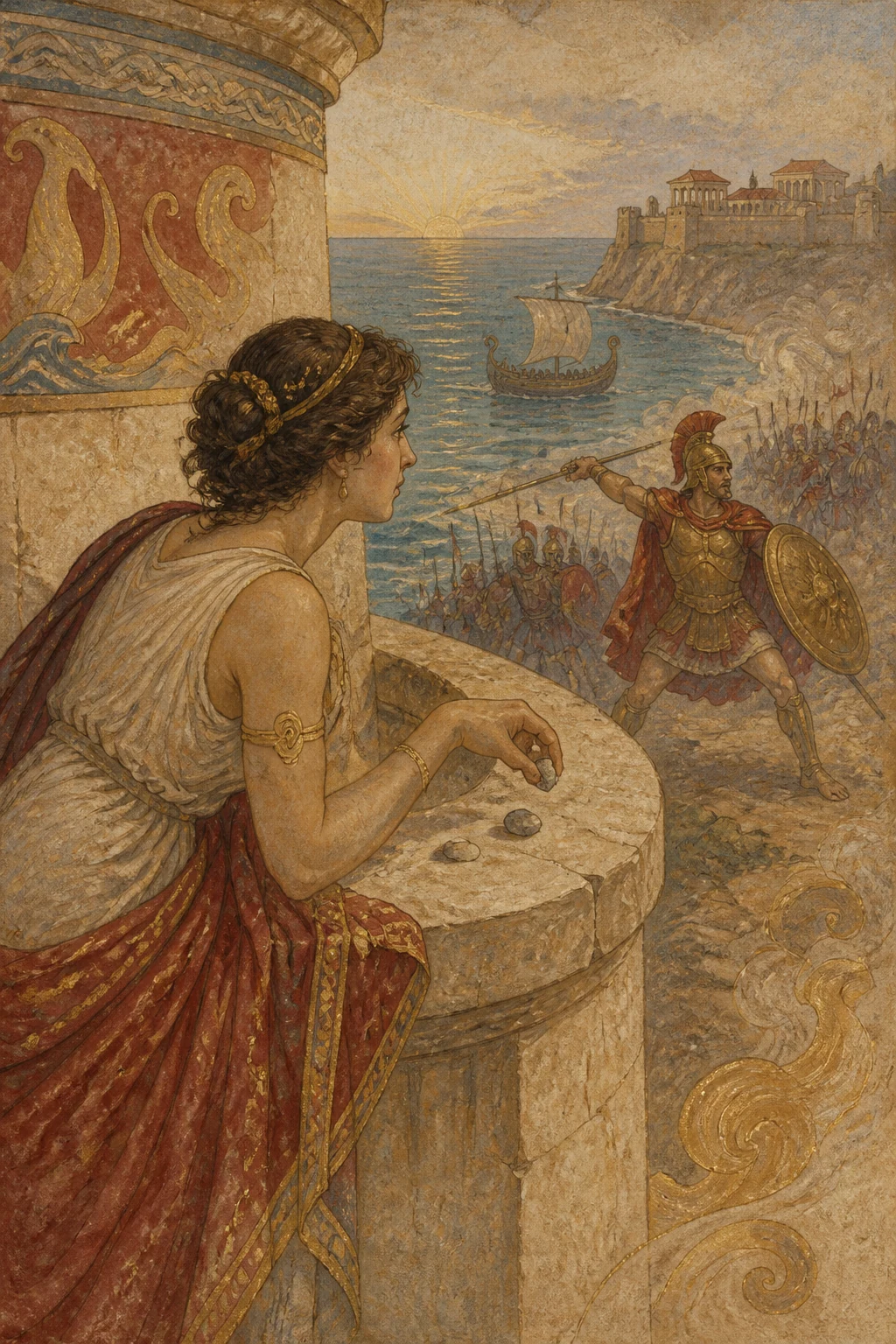
For the sixth time the horns of the rising moon were appearing, and the outcome of the war still hung in doubt: long did Victory hover between the two on wavering wings. A royal tower stood upon the sounding walls, where Leto’s son is said to have laid down his golden lyre: its music lingered in the stone. Often the daughter of Nisus used to climb there and strike the ringing stones with a little pebble, when peace prevailed; in wartime too she often watched from there the battles of relentless Mars.
And now, as the war dragged on, she had learned the chiefs’ names, their arms, their horses, their dress, their Cydonian quivers. Above all others she knew the face of Europa’s son, knew it more than she should. In her eyes, Minos, whether he hid his head beneath a helmet crested with plumes, was handsome in that helmet; or, if he took up a shield of gleaming bronze, the shield became him.
When he drew back his arm and hurled a supple spear, the maiden praised his skill allied with strength. When he set an arrow to the string and bent his broad bow, she swore that Phoebus stood just so when he took up his arrows. But when he took off his bronze helmet and bared his face, and, clad in purple, sat upon the back of a white horse splendid with embroidered cloths, and reined its foaming mouth, the daughter of Nisus could scarcely master herself, scarcely keep her senses. Happy the spear he touched, she said, and happy the reins his hand held fast.
She longed, if only she might, to carry her maiden steps through the hostile ranks; she longed to fling herself from the tower’s summit into the Cretan camp, or open the bronze gates to the enemy, or do whatever else Minos wished. And as she sat gazing at the white tents of the Dictaean king, “Should I rejoice,” she said, “or grieve that this sorrowful war is being fought? I cannot tell. I grieve that Minos is the enemy of one who loves him; yet, but for the war, I should never have known him.
Still, he could end the war by accepting me as hostage, keeping me as his companion, as a pledge of peace. If she who bore you, loveliest of all beings, was as beautiful as you, no wonder a god burned for her. Oh, three times happy I, if I could glide on wings through the air and alight in the Cretan king’s camp, confess myself and my passion, and ask what dowry would purchase him! Only let him not demand my country’s citadel.
For let my hoped-for marriage perish rather than let me win my desire through treachery!—And yet the mercy of a gentle conqueror has often made defeat a blessing: surely he wages a just war for his murdered son; he is strong both in his cause and in the arms that uphold it, and I think we shall be conquered. For what fate awaits our city, when his own prowess in war will open these walls to him, and not my love? Better that he should triumph without slaughter, without delay, without the cost of shedding his own blood.
At least I should not fear that someone might unwittingly wound your breast, Minos. For who could be so cruel as to dare knowingly to aim a ruthless spear at you? I welcome this venture: my mind is fixed on giving myself with my country as my dowry, and putting an end to the war. But wishing is not enough! Guards watch the approaches, and my father holds the keys to the gates: he alone, unhappy that I am, is what I fear; he alone delays my hopes.
Would the gods might leave me fatherless!—Yet surely each of us is a god to ourselves: Fortune resists idle prayers. Another woman, fired by such desire, would long since have gladly destroyed whatever stood in the way of love. And why should any woman be braver than I? Through fire and swords I would dare to go. Yet here there is no need of fire or swords: I need only my father’s lock of hair.
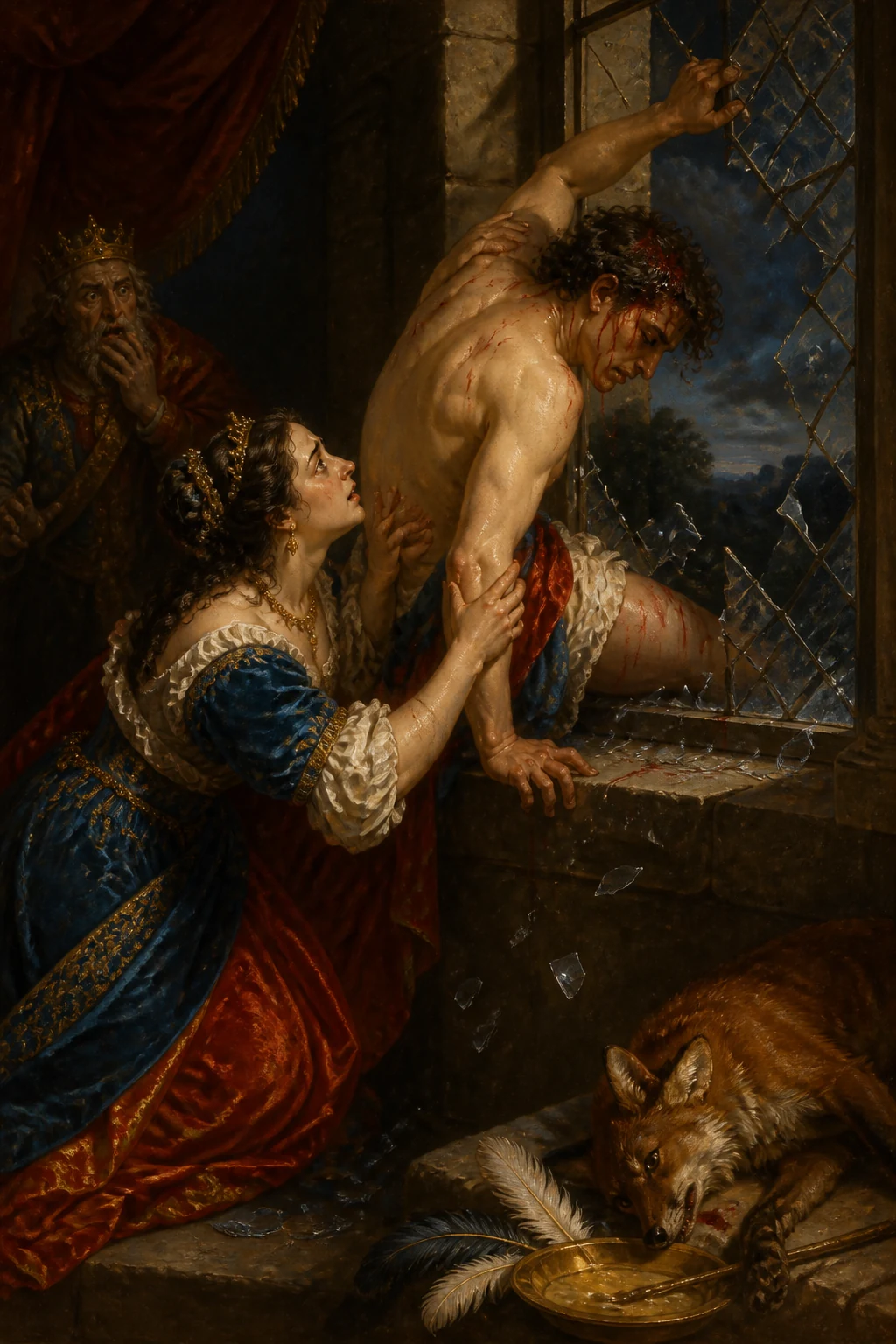
That purple lock is worth more to me than gold; it will make me happy and give me all I long for.” As she spoke, night, the greatest nurse of troubled thoughts, came on, and darkness fed her daring. It was the hour of first repose, when sleep takes hold of hearts worn out by the day’s cares: silently she entered her father’s chamber, and—what a crime!—the daughter robbed her own father of his fateful lock. Possessing that wicked prize, she carried her spoil away, slipped swiftly through the gate, and passed through the enemy’s midst—so great was her faith in her service— until she reached the king. He shrank in alarm as she addressed him: “Love urged this deed. I am Scylla, the royal daughter
of Nisus, and I surrender to you my country and my home. I ask no reward but you. Take this pledge of my love, this purple lock, and believe that what I give you now is not a lock of hair, but my father’s head.” And in her guilty hand she held out the gift. Minos recoiled from what she offered, and, horrified at the thought of this unheard-of deed, replied: “May the gods banish you, disgrace of our age, from their world, and may both land and sea deny you refuge.
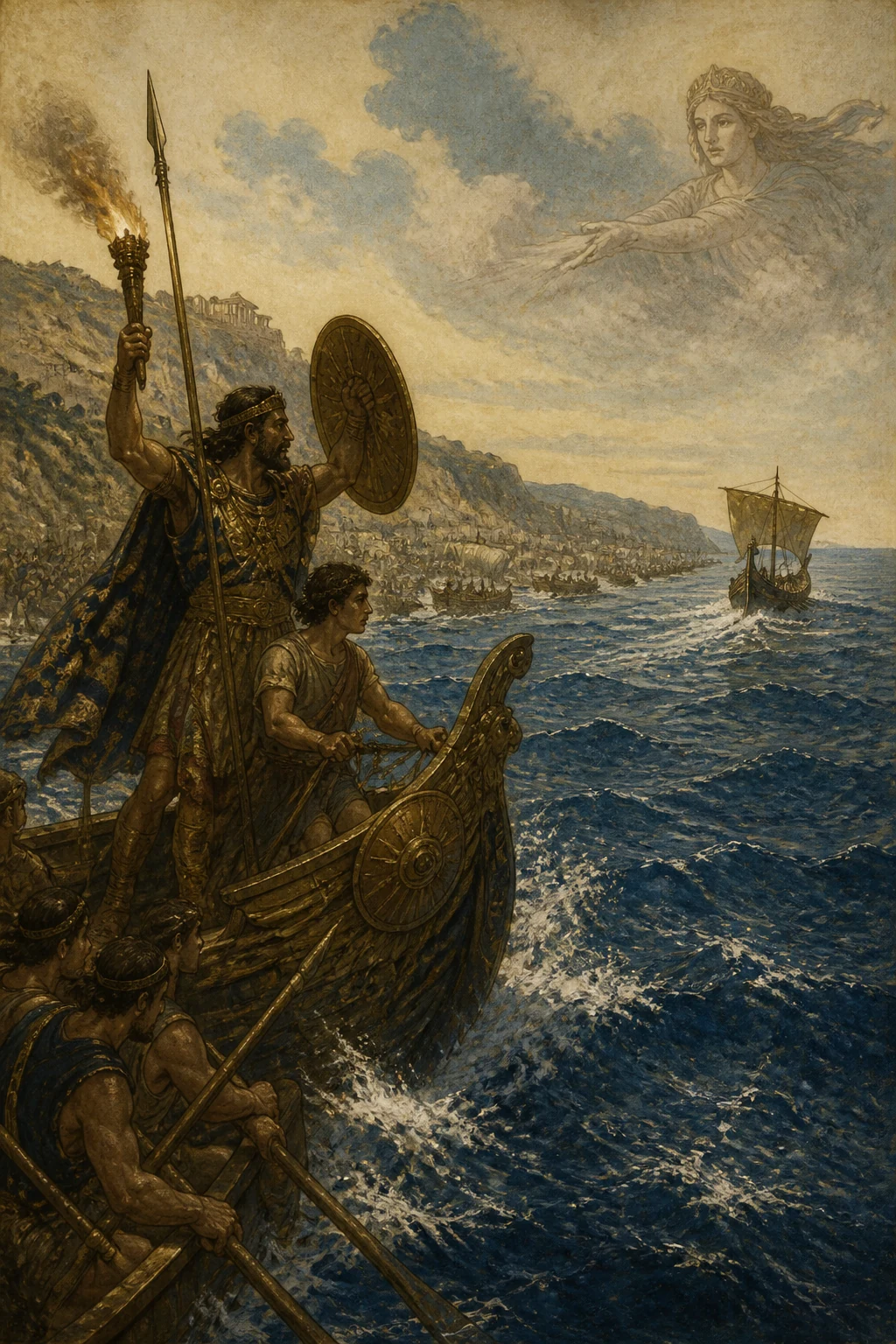
I, at least, will never allow so foul a monster to touch Crete, the cradle of Jove, which is my own realm.” He spoke, and, after imposing laws upon his conquered enemies as a most just ruler, he ordered the fleet’s moorings cast off and the bronze-beaked ships driven forward by the oars. When Scylla saw the ships launched and sailing over the sea, and saw that the king would give her no reward for her crime, her pleading spent, she turned to violent anger.
Stretching out her hands, frantic, with her hair streaming loose, “Where are you fleeing,” she cried, “abandoning the woman who won you this, you whom I chose above my country, above my father? Where are you fleeing, cruel man, whose victory is both my crime and my service? Have neither my gifts nor my love moved you, nor the thought that all my hopes are fixed on you alone? For where can I turn, forsaken?
To my country? It lies conquered. But suppose it still stood: my treachery has closed it to me. Into my father’s presence? I gave him to you! My countrymen hate me, as I deserve; my neighbors fear my example. I am cast out, bereft, with Crete alone in all the world left open to me. If you deny me even that and abandon me, ungrateful man, then Europa was not your mother, but the inhospitable Syrtes, Armenian tigresses, and Charybdis lashed by the south wind.
You were not born of Jove, nor was your mother beguiled by the semblance of a bull—that tale of your descent is false! The bull that fathered you was real and savage, and never swayed by love for any heifer. Take your vengeance, Nisus, my father! Rejoice in my misery, walls I have just betrayed! I confess it: I have earned death and deserve to die. Yet let someone among those I wickedly wronged destroy me. Why do you, who triumphed through my crime, condemn that crime? An outrage against my country and my father, let it count as service to you. Truly worthy to be your wife is the adulteress who deceived a savage bull with a wooden cow and bore in her womb a monstrous hybrid. Do any of my words
reach your ears? Or do the winds carry off my empty words, and your ships with them, ungrateful man? Now, now it is no wonder Pasiphae preferred a bull to you: you had more savagery than he. Wretched me! He orders them to hurry, and the water cries out beneath the cleaving oars; with me, my own land slips away. It is no use: in vain you forget what I have done for you.
I shall follow you against your will, clasp your curving stern, and be dragged over the endless seas.” Scarcely had she spoken when she leaped into the waves and caught up with the ships, desire lending her strength, and clung, an unwelcome companion, to the Cretan vessel. When her father saw her—for already he hung in the air, just transformed into a sea eagle with tawny wings— he swooped to tear her with his hooked beak as she clung there.
In fear she let go of the stern, and as she fell, the light air seemed to hold her up, keeping her from touching the sea. It was feathers that held her: transformed into a feathered bird, she is called ciris, a name she took from the lock she had shorn.
Izvirnik
Scylla and Minos
Naslednje strani prikazujejo izvirno besedilo za primerjavo.
Source ID: ovid_metamorphoses_story_053 Citation: Ovid, Metamorphoses 8.1-8.151 Original language: Latin Source: PerseusDL canonical-latinLit Source URL: https://github.com/PerseusDL/canonical-latinLit/blob/master/data/phi0959/phi006/phi0959.phi006.perseus-lat2.xml Segmentation certainty: medium 1: Iam nitidum retegente diem noctisque fugante 2: tempora Lucifero cadit eurus, et umida surgunt 3: nubila: dant placidi cursum redeuntibus austri 4: Aeacidis Cephaloque, quibus feliciter acti 5: ante exspectatum portus tenuere petitos.
6: Interea Minos Lelegeia litora vastat 7: praetemptatque sui vires Mavortis in urbe 8: Alcathoi, quam Nisus habet, cui splendidus ostro 9: inter honoratos medioque in vertice canos 10: crinis inhaerebat, magni fiducia regni. 11: Sexta resurgebant orientis cornua lunae, 12: et pendebat adhuc belli fortuna: diuque 13: inter utrumque volat dubiis Victoria pennis. 14: Regia turris erat vocalibus addita muris, 15: in quibus auratam proles Letoia fertur 16: deposuisse lyram: saxo sonus eius inhaesit.
17: Saepe illuc solita est ascendere filia Nisi 18: et petere exiguo resonantia saxa lapillo, 19: tum cum pax esset: bello quoque saepe solebat 20: spectare ex illa rigidi certamina Martis. 21: Iamque mora belli procerum quoque nomina norat 22: armaque equosque habitusque Cydonaeasque pharetras. 23: Noverat ante alios faciem ducis Europaei, 24: plus etiam, quam nosse sat est. Hac iudice Minos, 25: seu caput abdiderat cristata casside pennis, 26: in galea formosus erat; seu sumpserat aere 27: fulgentem clipeum, clipeum sumpsisse decebat.
28: Torserat adductis hastilia lenta lacertis: 29: laudabat virgo iunctam cum viribus artem. 30: Imposito calamo patulos sinuaverat arcus: 31: sic Phoebum sumptis iurabat stare sagittis. 32: Cum vero faciem dempto nudaverat aere 33: purpureusque albi stratis insignia pictis 34: terga premebat equi spumantiaque ora regebat, 35: vix sua, vix sanae virgo Niseia compos 36: mentis erat. Felix iaculum, quod tangeret ille, 37: quaeque manu premeret, felicia frena vocabat.
38: Impetus est illi, liceat modo, ferre per agmen 39: virgineos hostile gradus, est impetus illi 40: turribus e summis in Gnosia mittere corpus 41: castra, vel aeratas hosti recludere portas, 42: vel siquid Minos aliud velit. Utque sedebat 43: candida Dictaei spectans tentoria regis, 44: “laeter,” ait “doleamne geri lacrimabile bellum, 45: in dubio est. Doleo, quod Minos hostis amanti est: 46: sed nisi bella forent, numquam mihi cognitus esset.
47: Me tamen accepta poterat deponere bellum 48: obside, me comitem, me pacis pignus haberet. 49: Si quae te peperit, talis, pulcherrime rerum, 50: qualis es ipsa fuit, merito deus arsit in illa. 51: O ego ter felix, si pennis lapsa per auras 52: Gnosiaci possem castris insistere regis 53: fassaque me flammasque meas, qua dote, rogarem, 54: vellet emi! tantum patrias ne posceret arces.
55: Nam pereant potius sperata cubilia, quam sim 56: proditione potens! — Quamvis saepe utile vinci 57: victoris placidi fecit clementia multis: 58: iusta gerit certe pro nato bella perempto 59: et causaque valet causamque tenentibus armis, 60: et, puto, vincemur. Quis enim manet exitus urbem, 61: cum suus haec illi reserabit moenia Mavors 62: et non noster amor? Melius sine caede moraque 63: impensaque sui poterit superare cruoris.
64: Non metuam certe, ne quis tua pectora, Minos, 65: vulneret imprudens. Quis enim tam durus, ut in te 66: dirigere inmitem non inscius audeat hastam? 67: Coepta placent, et stat sententia tradere mecum 68: dotalem patriam finemque imponere bello. 69: Verum velle parum est! Aditus custodia servat 70: claustraque portarum genitor tenet: hunc ego solum 71: infelix timeo, solus mea vota moratur.
72: Di facerent, sine patre forem! — Sibi quisque profecto 73: est deus: ignavis precibus Fortuna repugnat. 74: Altera iamdudum succensa cupidine tanto 75: perdere gauderet quodcumque obstaret amori. 76: Et cur ulla foret me fortior? Ire per ignes 77: et gladios ausim. Nec in hoc tamen ignibus ullis 78: aut gladiis opus est: opus est mihi crine paterno. 79: Illa mihi est auro pretiosior, illa beatam 80: purpura me votique mei factura potentem.”
81: Talia dicenti curarum maxima nutrix 82: nox intervenit, tenebrisque audacia crevit. 83: Prima quies aderat, qua curis fessa diurnis 84: pectora somnus habet: thalamos taciturna paternos 85: intrat et (heu facinus!) fatali nata parentem 86: crine suum spoliat praedaque potita nefanda 87: fert secum spolium celeris progressaque porta 88: per medios hostes (meriti fiducia tanta est) 89: pervenit ad regem. Quem sic adfata paventem est: 90: “Suasit amor facinus. Proles ego regia Nisi 91: Scylla tibi trado patriaeque meosque penates.
92: Praemia nulla peto nisi te. Cape pignus amoris 93: purpureum crinem, nec me nunc tradere crinem, 94: sed patrium tibi crede caput.” Scelerataque dextra 95: munera porrexit. Minos porrecta refugit 96: turbatusque novi respondit imagine facti: 97: “Di te summoveant, o nostri infamia saecli, 98: orbe suo, tellusque tibi pontusque negetur. 99: Certe ego non patiar Iovis incunabula, Creten, 100: qui meus est orbis, tantum contingere monstrum.”
101: Dixit, et ut leges captis iustissimus auctor 102: hostibus imposuit, classis retinacula solvi 103: iussit et aeratas impelli remige puppes. 104: Scylla freto postquam deductas nare carinas 105: nec praestare ducem sceleris sibi praemia vidit, 106: consumptis precibus violentam transit in iram, 107: intendensque manus, passis furibunda capillis, 108: “quo fugis” exclamat, “meritorum auctore relicta, 109: o patriae praelate meae, praelate parenti?
110: Quo fugis, inmitis? cuius victoria nostrum 111: et scelus et meritum est. Nec te data munera, nec te 112: noster amor movit, nec quod spes omnis in unum 113: te mea congesta est? Nam quo deserta revertar? 114: In patriam? Superata iacet. Sed finge manere: 115: proditione mea clausa est mihi. Patris ad ora? 116: Quem tibi donavi! Cives odere merentem, 117: finitimi exemplum metuunt: exponimur orbae, 118: terrarum nobis ut Crete sola pateret.
119: Hac quoque si prohibes et nos, ingrate, relinquis, 120: non genetrix Europa tibi ea, sed inhospita Syrtis, 121: Armeniae tigres austroque agitata Charybdis. 122: Nec Iove tu natus, nec mater imagine tauri 123: ducta tua est (generis falsa est ea fabula !): verus 124: et ferus et captus nullius amore iuvencae, 125: qui te progenuit, taurus fuit. Exige poenas, 126: Nise pater! gaudete malis, modo prodita, nostris 127: moenia! nam fateor, merui et sum digna perire.
128: Sed tamen ex illis aliquis, quos impia laesi, 129: me perimat. Cur, qui vicisti crimine nostro, 130: insequeris crimen? Scelus hoc patriaeque patrique, 131: officium tibi sit. Te vere coniuge digna est, 132: quae torvum ligno decepit adultera taurum 133: discordemque utero fetum tulit. Ecquid ad aures 134: perveniunt mea dicta tuas? An inania venti 135: verba ferunt idemque tuas, ingrate, carinas?
136: Iam iam Pasiphaen non est mirabile taurum 137: praeposuisse tibi: tu plus feritatis habebas. 138: Me miseram! properare iubet, divulsaque remis 139: unda sonat; mecumque simul mea terra recedit. 140: Nil agis, o frustra meritorum oblite meorum: 141: insequar invitum, puppimque amplexa recurvam 142: per freta longa trahar.” Vix dixerat, insilit undis 143: consequiturque rates, faciente cupidine vires, 144: Gnosiacaeque haeret comes invidiosa carinae.
145: Quam pater ut vidit (nam iam pendebat in aura 146: et modo factus erat fulvis haliaeetus alis), 147: ibat, ut haerentem rostro laceraret adunco. 148: Illa metu puppim dimisit, et aura cadentem 149: sustinuisse levis, ne tangeret aequora, visa est. 150: Pluma fuit: plumis in avem mutata vocatur 151: ciris, et a tonso est hoc nomen adepta capillo.
Nadaljuj z branjem