Prevod
Now, as the Morning Star unveiled the shining day and drove away the hours of night, the east wind fell, and moist clouds rose: gentle southerlies sped the returning sons of Aeacus and Cephalus, and, borne along so happily, they reached their destined harbor sooner than expected. Meanwhile Minos ravaged the shores of the Leleges and tested his strength in war against the city of Alcathous, ruled by Nisus, whose head, amid its venerable gray hairs, bore one lock gleaming purple at the crown, the safeguard of his mighty kingdom.
For the sixth time the horns of the rising moon were appearing, and the outcome of the war still hung in doubt: long did Victory hover between the two on wavering wings. A royal tower stood upon the sounding walls, where Leto’s son is said to have laid down his golden lyre: its music lingered in the stone. Often the daughter of Nisus used to climb there and strike the ringing stones with a little pebble, when peace prevailed; in wartime too she often watched from there the battles of relentless Mars.
And now, as the war dragged on, she had learned the chiefs’ names, their arms, their horses, their dress, their Cydonian quivers. Above all others she knew the face of Europa’s son, knew it more than she should. In her eyes, Minos, whether he hid his head beneath a helmet crested with plumes, was handsome in that helmet; or, if he took up a shield of gleaming bronze, the shield became him.
When he drew back his arm and hurled a supple spear, the maiden praised his skill allied with strength. When he set an arrow to the string and bent his broad bow, she swore that Phoebus stood just so when he took up his arrows. But when he took off his bronze helmet and bared his face, and, clad in purple, sat upon the back of a white horse splendid with embroidered cloths, and reined its foaming mouth, the daughter of Nisus could scarcely master herself, scarcely keep her senses. Happy the spear he touched, she said, and happy the reins his hand held fast.
She longed, if only she might, to carry her maiden steps through the hostile ranks; she longed to fling herself from the tower’s summit into the Cretan camp, or open the bronze gates to the enemy, or do whatever else Minos wished. And as she sat gazing at the white tents of the Dictaean king, “Should I rejoice,” she said, “or grieve that this sorrowful war is being fought? I cannot tell. I grieve that Minos is the enemy of one who loves him; yet, but for the war, I should never have known him.
Still, he could end the war by accepting me as hostage, keeping me as his companion, as a pledge of peace. If she who bore you, loveliest of all beings, was as beautiful as you, no wonder a god burned for her. Oh, three times happy I, if I could glide on wings through the air and alight in the Cretan king’s camp, confess myself and my passion, and ask what dowry would purchase him! Only let him not demand my country’s citadel.
For let my hoped-for marriage perish rather than let me win my desire through treachery!—And yet the mercy of a gentle conqueror has often made defeat a blessing: surely he wages a just war for his murdered son; he is strong both in his cause and in the arms that uphold it, and I think we shall be conquered. For what fate awaits our city, when his own prowess in war will open these walls to him, and not my love? Better that he should triumph without slaughter, without delay, without the cost of shedding his own blood.
At least I should not fear that someone might unwittingly wound your breast, Minos. For who could be so cruel as to dare knowingly to aim a ruthless spear at you? I welcome this venture: my mind is fixed on giving myself with my country as my dowry, and putting an end to the war. But wishing is not enough! Guards watch the approaches, and my father holds the keys to the gates: he alone, unhappy that I am, is what I fear; he alone delays my hopes.
Would the gods might leave me fatherless!—Yet surely each of us is a god to ourselves: Fortune resists idle prayers. Another woman, fired by such desire, would long since have gladly destroyed whatever stood in the way of love. And why should any woman be braver than I? Through fire and swords I would dare to go. Yet here there is no need of fire or swords: I need only my father’s lock of hair.
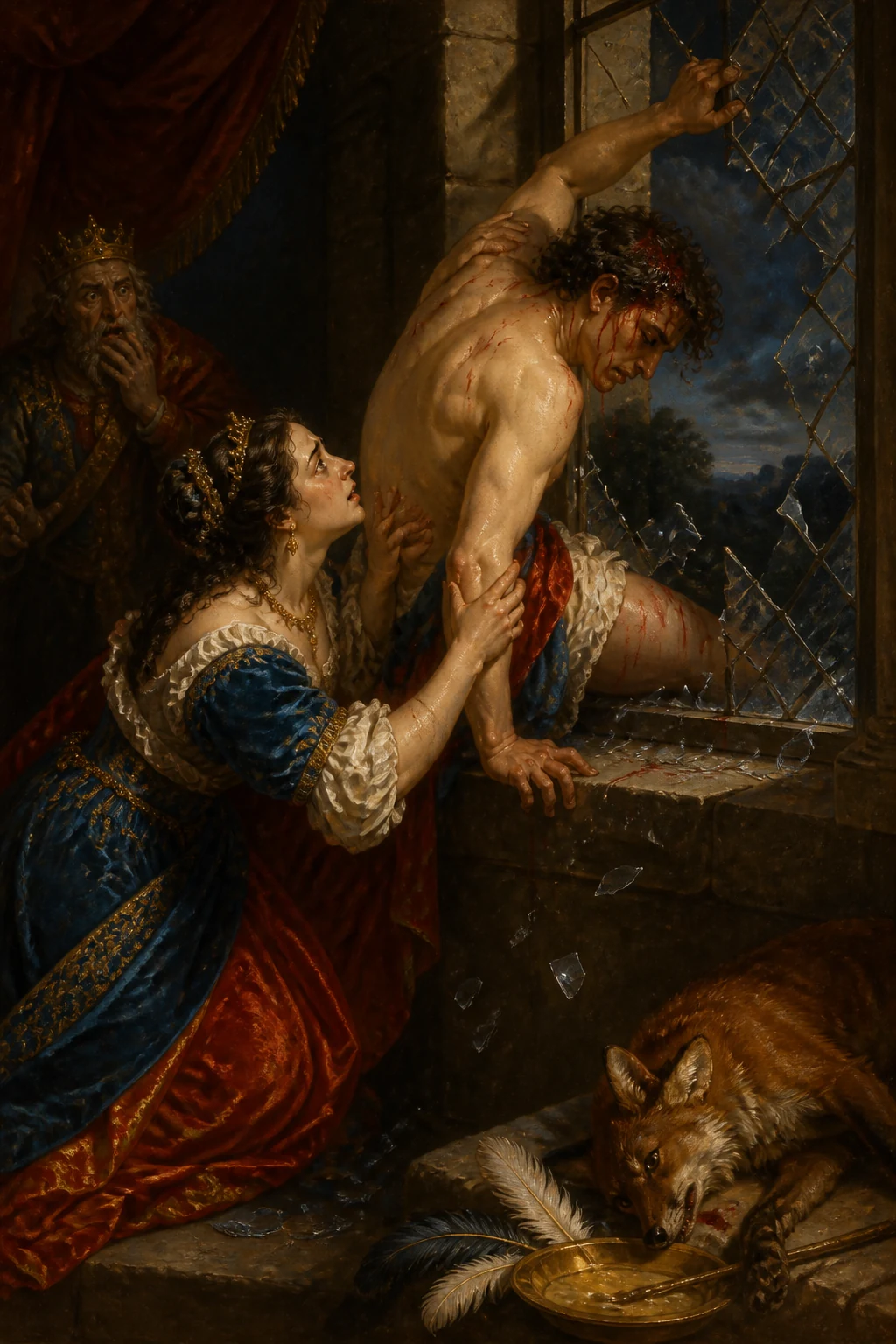
That purple lock is worth more to me than gold; it will make me happy and give me all I long for.” As she spoke, night, the greatest nurse of troubled thoughts, came on, and darkness fed her daring. It was the hour of first repose, when sleep takes hold of hearts worn out by the day’s cares: silently she entered her father’s chamber, and—what a crime!—the daughter robbed her own father of his fateful lock. Possessing that wicked prize, she carried her spoil away, slipped swiftly through the gate, and passed through the enemy’s midst—so great was her faith in her service— until she reached the king. He shrank in alarm as she addressed him: “Love urged this deed. I am Scylla, the royal daughter
of Nisus, and I surrender to you my country and my home. I ask no reward but you. Take this pledge of my love, this purple lock, and believe that what I give you now is not a lock of hair, but my father’s head.” And in her guilty hand she held out the gift. Minos recoiled from what she offered, and, horrified at the thought of this unheard-of deed, replied: “May the gods banish you, disgrace of our age, from their world, and may both land and sea deny you refuge.
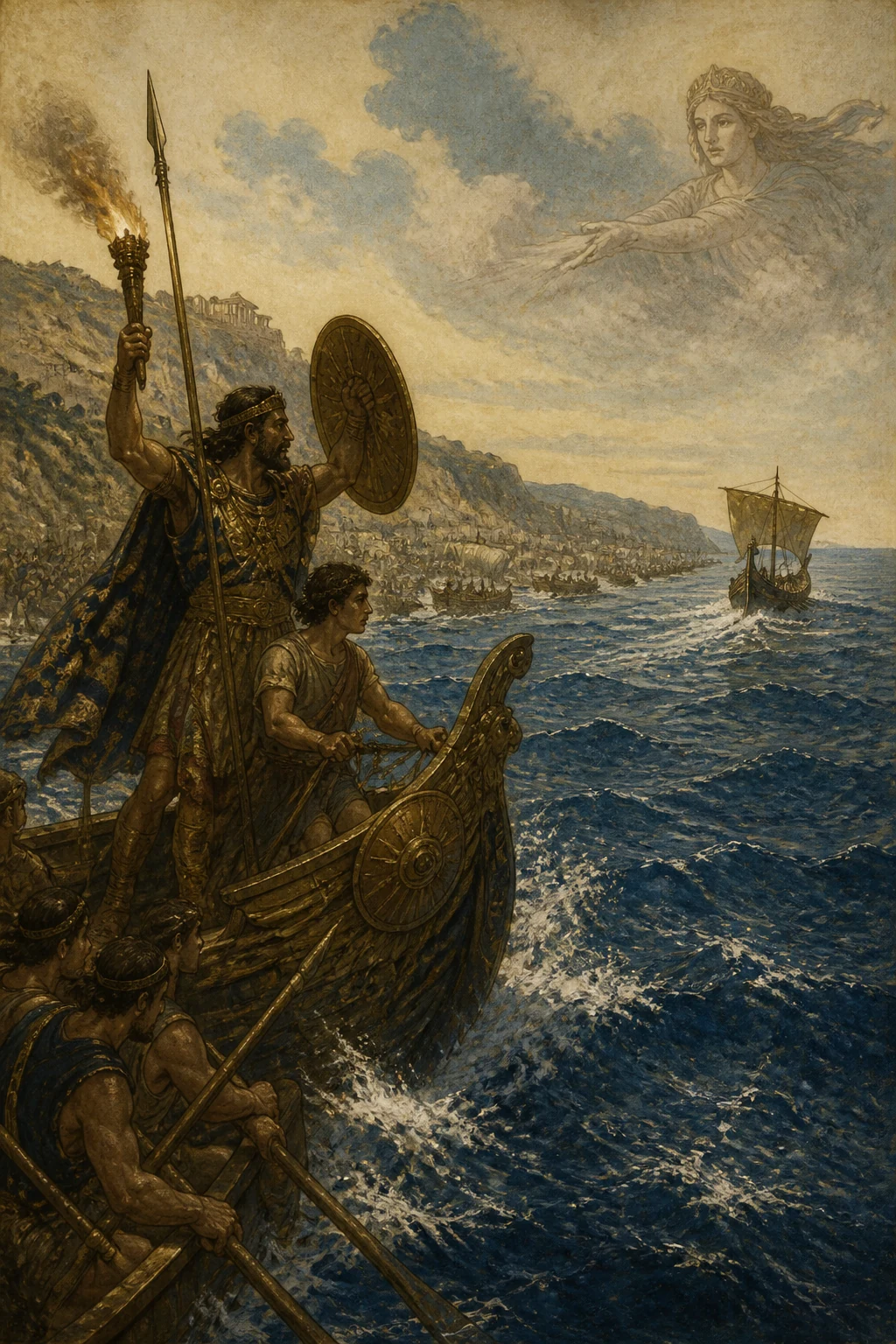
I, at least, will never allow so foul a monster to touch Crete, the cradle of Jove, which is my own realm.” He spoke, and, after imposing laws upon his conquered enemies as a most just ruler, he ordered the fleet’s moorings cast off and the bronze-beaked ships driven forward by the oars. When Scylla saw the ships launched and sailing over the sea, and saw that the king would give her no reward for her crime, her pleading spent, she turned to violent anger.
Stretching out her hands, frantic, with her hair streaming loose, “Where are you fleeing,” she cried, “abandoning the woman who won you this, you whom I chose above my country, above my father? Where are you fleeing, cruel man, whose victory is both my crime and my service? Have neither my gifts nor my love moved you, nor the thought that all my hopes are fixed on you alone? For where can I turn, forsaken?
To my country? It lies conquered. But suppose it still stood: my treachery has closed it to me. Into my father’s presence? I gave him to you! My countrymen hate me, as I deserve; my neighbors fear my example. I am cast out, bereft, with Crete alone in all the world left open to me. If you deny me even that and abandon me, ungrateful man, then Europa was not your mother, but the inhospitable Syrtes, Armenian tigresses, and Charybdis lashed by the south wind.
You were not born of Jove, nor was your mother beguiled by the semblance of a bull—that tale of your descent is false! The bull that fathered you was real and savage, and never swayed by love for any heifer. Take your vengeance, Nisus, my father! Rejoice in my misery, walls I have just betrayed! I confess it: I have earned death and deserve to die. Yet let someone among those I wickedly wronged destroy me. Why do you, who triumphed through my crime, condemn that crime? An outrage against my country and my father, let it count as service to you. Truly worthy to be your wife is the adulteress who deceived a savage bull with a wooden cow and bore in her womb a monstrous hybrid. Do any of my words
reach your ears? Or do the winds carry off my empty words, and your ships with them, ungrateful man? Now, now it is no wonder Pasiphae preferred a bull to you: you had more savagery than he. Wretched me! He orders them to hurry, and the water cries out beneath the cleaving oars; with me, my own land slips away. It is no use: in vain you forget what I have done for you.
I shall follow you against your will, clasp your curving stern, and be dragged over the endless seas.” Scarcely had she spoken when she leaped into the waves and caught up with the ships, desire lending her strength, and clung, an unwelcome companion, to the Cretan vessel. When her father saw her—for already he hung in the air, just transformed into a sea eagle with tawny wings— he swooped to tear her with his hooked beak as she clung there.
In fear she let go of the stern, and as she fell, the light air seemed to hold her up, keeping her from touching the sea. It was feathers that held her: transformed into a feathered bird, she is called ciris, a name she took from the lock she had shorn.