Prevod
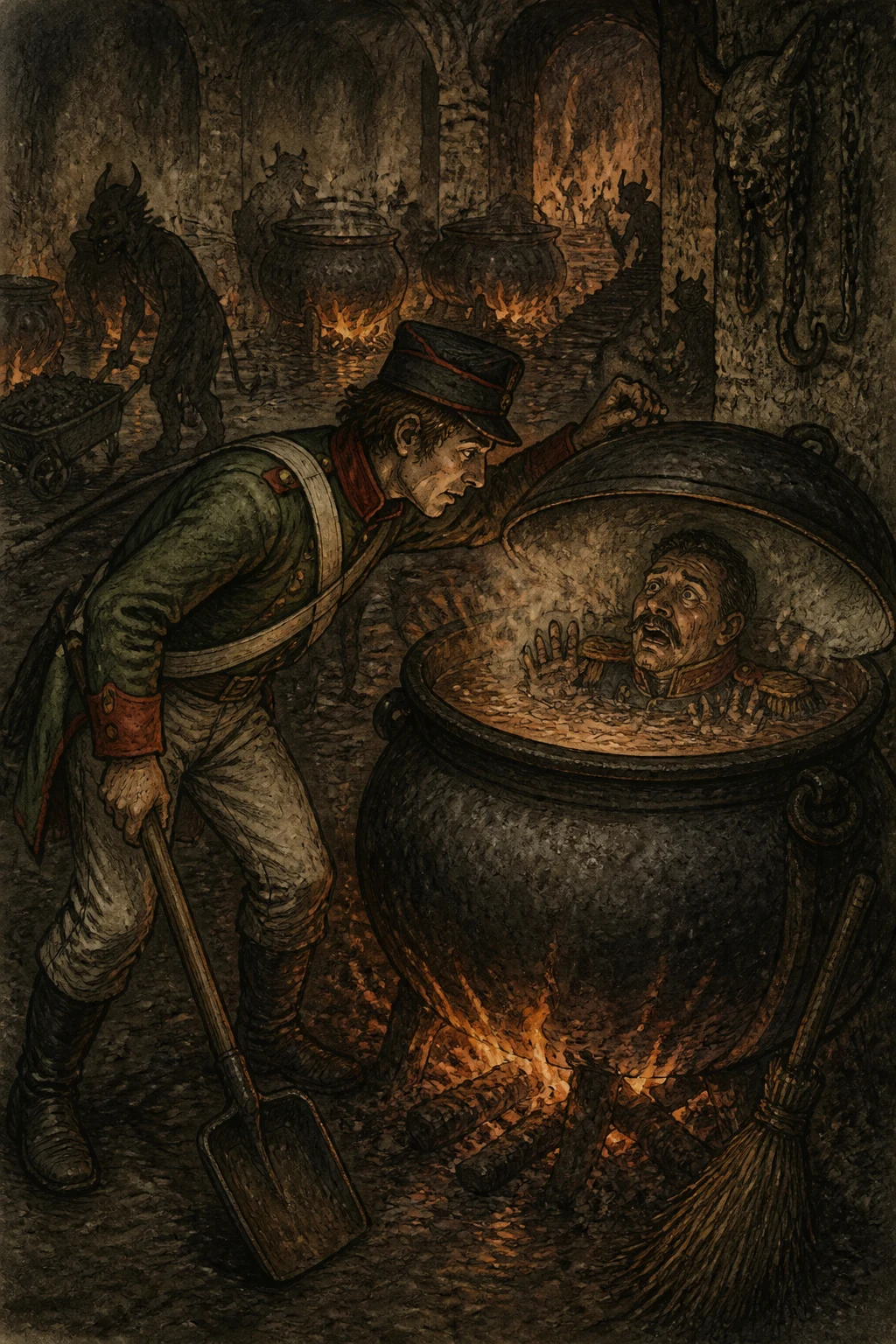
Once upon a time there was a young fellow who enlisted as a soldier. He fought bravely and was always at the front when bullets rained down. As long as the war lasted, all went well, but when peace was made, he was discharged, and the captain told him he could go wherever he pleased. His parents were dead, and he no longer had a home, so he went to his brothers and asked them to support him until war broke out again. But his brothers were hard-hearted and said, "What are we to do with you? We have no use for you. See how you can fend for yourself." The soldier had nothing left but his gun, which he slung over his shoulder, meaning to go out into the world. He came to a great heath where there was nothing to be seen but a ring of trees. He sat down beneath them in deep sorrow and pondered his fate. 'I have no money,' he thought, 'and I have learned no trade but soldiering. Now that peace has been made, they have no more use for me. I can see I shall starve.' All at once he heard a rushing sound, and when he looked round, a stranger stood before him, wearing a green coat. He was a fine-looking gentleman, except that he had a hideous horse's hoof for a foot. "I know well enough what you lack," said the man. "You shall have money and possessions—as much as you can possibly squander—but first I must find out whether you are afraid, so that I do not spend my money for nothing." "A soldier and fear—how do those go together?" he answered. "You may put me to the test." "Very well," replied the man. "Look behind you." The soldier turned and saw a great bear trotting towards him with a growl. "Oho!" cried the soldier. "I'll tickle your nose so thoroughly that you'll lose your taste for growling." He took aim and shot the bear in the muzzle, so that it fell to the ground and never moved again. "I can see," said the stranger, "that you are not lacking in courage, but there is another condition you must fulfil." "So long as it does not endanger my salvation," replied the soldier, who had a good idea whom he was dealing with. "Otherwise I will have nothing to do with it." "You shall see for yourself," answered the man in green. "For the next seven years you must not wash, comb your beard or hair, cut your nails, or say the Lord's Prayer. I shall give you a coat and a cloak, and you must wear them all that time. If you die during those seven years, you are mine; but if you live, you shall be free, and rich for the rest of your days." The soldier thought of the desperate plight he was in, and since he had so often faced death, he resolved to take the risk this time too, and agreed. The devil took off his green coat, handed it to the soldier, and said, "Whenever you are wearing this coat and reach into its pocket, you will find your hand full of money." Then he skinned the bear and said, "This shall be your cloak, and your bed as well, for you must sleep on it and may lie in no other bed. And because of this garb, you shall be called Bearskin." With that, the devil vanished.
The soldier put on the coat, reached into the pocket at once, and found that it was just as the devil had said. Then he threw the bearskin about his shoulders and went out into the world in high spirits, sparing himself no pleasure that money could buy. During the first year his appearance was still tolerable, but by the second he already looked like a monster. His hair covered almost his entire face, his beard resembled a piece of coarse felt, his fingers had claws, and his face was so thick with dirt that cress would have sprouted if anyone had sown it there. Whoever saw him ran away, but because he gave money to the poor wherever he went, asking them to pray that he would not die during the seven years, and because he paid handsomely for everything, he could still always find lodging. In the fourth year he came to an inn where the innkeeper refused to take him in, and would not even give him a place in the stable, for fear that his horses would shy. But when Bearskin reached into his pocket and drew out a handful of ducats, the innkeeper relented and gave him a room in an outbuilding. He had to promise, however, to keep out of sight, lest the inn fall into disrepute.
That evening, as Bearskin sat alone, wishing with all his heart that the seven years were over, he heard loud lamentations in the next room. He had a compassionate heart, so he opened the door and saw an old man weeping bitterly and wringing his hands above his head. Bearskin went closer, but the man sprang up and tried to flee. At last, when he heard a human voice, he allowed himself to be persuaded to stay, and with kindly words Bearskin induced him to reveal the cause of his grief. His fortune had dwindled little by little; he and his daughters were going hungry, and he was so poor that he could not even pay the innkeeper and was to be sent to prison. "If that is all that troubles you," said Bearskin, "I have money enough." He sent for the innkeeper, paid the bill, and slipped a purse full of gold into the unfortunate man's pocket besides.
When the old man found himself freed from his troubles, he did not know how to show his gratitude. "Come home with me," he said. "My daughters are marvels of beauty. Choose one of them for your wife. When she hears what you have done for me, she will not refuse you. You do look a little strange, to be sure, but she will soon put you to rights." Bearskin was well pleased with this and went along. When the eldest daughter saw him, she was so horrified by his face that she screamed and ran away. The second stood her ground and looked him over from head to foot, but then said, "How can I marry a man who no longer looks human? I liked that shaved bear they once exhibited here, pretending it was a man, much better than this fellow. At least it wore a hussar's fur-trimmed jacket and white gloves. If he were merely ugly, I could grow used to him." But the youngest said, "Dear Father, a man who helped you in your distress must be a good man. If you promised him a bride in return, your word must be kept." It was a pity that Bearskin's face was covered with dirt and hair, or they would have seen how his heart rejoiced when he heard these words. He took a ring from his finger, broke it in two, and gave her one half, keeping the other for himself. On her half he engraved his name, and on his own he engraved hers, and he asked her to keep her piece safe. Then he took his leave, saying, "I must wander for three more years. But if I do not return, you are free, for then I shall be dead. Only pray to God that he may preserve my life."
The poor bride dressed all in black, and whenever she thought of her bridegroom, tears came to her eyes. From her sisters she received nothing but mockery and scorn. "Take care," said the eldest. "When you offer him your hand, he'll strike it with his paw." "Beware," said the second. "Bears love sweet things, and if he takes a fancy to you, he'll eat you up." "You must always do as he wishes," the eldest began again, "or he'll start to growl." And the second went on, "But the wedding will be merry—bears are such good dancers." The bride said nothing and would not let them shake her resolve. Meanwhile, Bearskin wandered through the world from place to place, doing good wherever he could and giving generously to the poor so that they would pray for him. At last, when the final day of the seven years dawned, he went back to the heath and sat down beneath the ring of trees. Before long the wind came rushing, and the devil stood before him, looking thoroughly displeased. He threw the soldier's old coat at him and demanded his green one back. "We have not got that far yet," answered Bearskin. "First you must clean me." Whether the devil liked it or not, he had to fetch water, wash Bearskin, comb his hair, and cut his nails. Afterwards he looked like a gallant soldier and was far handsomer than he had ever been before.
Once the devil had gone at last, Bearskin's heart felt light. He went into town, put on a splendid velvet coat, and took a carriage drawn by four white horses to his bride's house. No one recognized him. The father took him for a distinguished colonel and led him into the room where his daughters were sitting. He was obliged to sit between the two eldest. They poured him wine, served him the choicest morsels, and thought they had never seen a handsomer man in all the world. His bride, however, sat opposite him in her black dress, never raising her eyes or speaking a word. When at last he asked the father whether he would give him one of his daughters in marriage, the two eldest sprang up and ran to their room to put on their finest clothes, for each imagined she was the chosen one. As soon as the stranger was alone with his bride, he took out his half of the ring and dropped it into a cup of wine, which he passed to her across the table. She accepted it, but when she had drunk and found the half-ring lying at the bottom, her heart began to beat fast. She brought out the other half, which she wore on a ribbon round her neck, and held it against his, and the two pieces fitted perfectly. Then he said, "I am your betrothed, whom you saw as Bearskin, but by God's grace I have regained my human form and am clean once more." He went to her, embraced her, and kissed her. Just then the two sisters came in, dressed in all their finery. When they saw that the handsome man had fallen to their youngest sister, and heard that he was Bearskin, they rushed out in fury. One drowned herself in the well, and the other hanged herself from a tree. That evening someone knocked at the door, and when the bridegroom opened it, there stood the devil in his green coat, who said, "You see, now I have two souls in place of your one."