O besedilu
Smešne želje
- Vir
- Perraultove pravljice
- Avtor
- Charles Perrault
- Jezik branja
- English
- Jezik izvirnika
- Français
- Čas branja
- 5 min branja
- Obseg
- 4 strani
- Naslov izvirnika
- Les Souhaits ridicules
O izvirniku
Perraultove pravljice
Francoske dvorne pravljice, kjer eleganca pogosto skrije ostro svarilo. Bralni jezik je English, izvirnik pa prihaja iz vira Perraultove pravljice v jeziku Français.
Besedilo
Smešne želje
The Ridiculous Wishes A TALE. Once upon a time there was a poor woodcutter who, weary of his wretched life, longed, so he said, to go and rest upon the banks of Acheron:
In his deep sorrow, he lamented that, ever since he had come into the world, cruel heaven had never seen fit to grant a single one of his wishes.
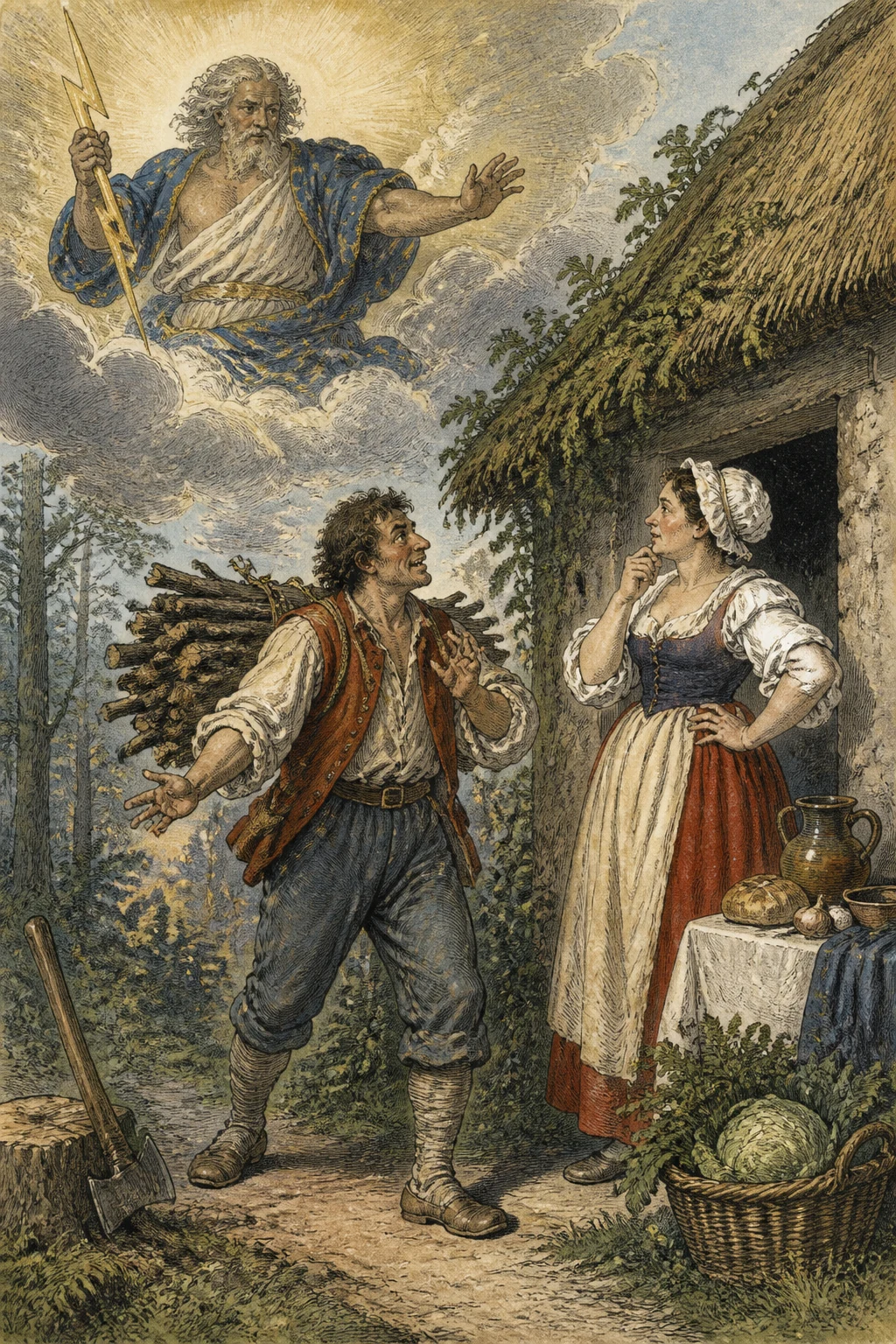
One day, as he stood complaining in the woods, Jupiter appeared before him, thunderbolt in hand; it would be hard to describe just how frightened the good fellow was.
“I want nothing!” he cried, flinging himself to the ground. “No wishes, no thunder, my lord—let us call it quits.” “Have no fear.
“Touched by your complaints,” said Jupiter, “I have come to show you how unjustly you accuse me. Listen, then: I, the sovereign master of the whole world, promise to grant in full the first three wishes you choose to make, whatever they may be.
“Consider what would make you happy, consider what would satisfy you; and since your happiness depends entirely on your wishes, think carefully before you make them.”
With these words, Jupiter rose back into the heavens; and the delighted woodcutter gathered up his bundle of firewood and hoisted it onto his back to carry home. Never had that burden seemed so light.
“I must do nothing rashly in all this,” he said as he trotted along. “This is an important matter: I must ask my good wife’s advice.
“Come, Fanchon,” he said, entering their fern-thatched cottage, “let us have a roaring fire and a splendid supper. We are rich for evermore, and all we need do is make our wishes.”
Then he told her the whole story at length. At his account, his lively, quick-witted wife conceived a thousand grand designs; but, considering how important it was to proceed with caution:
“Blaise, my dear,” she said to her husband, “let us not spoil everything through impatience. Let us carefully discuss what we ought to do in such circumstances;
“Let us put off our first wish until tomorrow, and sleep on it.” “That is just what I think,” said good old Blaise. “But go and draw some wine from behind those bundles of sticks.”
When she returned, he drank; and as he savoured the pleasure of resting at his ease beside a great fire, he leaned back in his chair and said, “With such fine embers glowing here, an ell of black pudding would be just the thing!”
Scarcely had he finished speaking when his wife, to her great astonishment, caught sight of a very long black pudding, which, emerging from a corner of the hearth,
Came wriggling towards her. She cried out at once; but, deciding that this marvel must have been caused by the wish her thoughtless husband had made out of sheer stupidity,
There was no abuse or insult that she did not heap upon the poor man in her anger and vexation. “When you can have an empire,” she said, “gold, pearls, rubies, diamonds, fine clothes,
“Is black pudding what you ought to wish for?” “Well, I was wrong,” he said. “I chose badly. I have made a dreadful mistake. I shall do better next time.”
“Oh, certainly,” she said, “and pigs will fly! You must be a prize ox to make a wish like that!” More than once, carried away by anger, her husband thought of silently wishing himself a widower.
And perhaps, between ourselves, he could have done no better. “Men are surely born to suffer!” he said. “A plague on this black pudding, and all this talk of black pudding!
“Would to God, you wretched fool, that it were hanging from the end of your nose!” Heaven heard his prayer at once; and the moment the words escaped her husband’s lips, the ell of black pudding fastened itself to the angry wife’s nose.
This unexpected marvel distressed him greatly. Fanchon was not ugly; she had a pleasing manner, and, to tell the plain and simple truth, this ornament in such a place was far from becoming—except that, dangling over the lower part of her face, it made it difficult for her to speak;
A wonderful advantage for a husband, and so great a one that, in that happy moment, he almost wished for nothing more! “After so grievous a misfortune,” he said to himself, “I could certainly use my remaining wish to make myself a king in a single bound.
“Nothing, it is true, can equal sovereign grandeur; but I must still consider what the queen would look like, and how miserable it would make her to be set upon a throne with a nose more than an ell long.
“I must hear what she has to say about it, and let her choose for herself whether to become a great princess and keep her dreadful nose, or remain a woodcutter’s wife with a nose like anyone else’s, just as hers was before this mishap.”
When she had considered the matter carefully, although she knew the power and influence of a sceptre, and that a crowned head’s nose is always thought handsome,
Since everything yields to the desire to please, she preferred to keep her humble bonnet rather than be a queen and ugly. And so the woodcutter’s station did not change.
He became no mighty potentate, nor filled his purse with crowns; he was only too glad to spend his one remaining wish—small comfort, a sorry remedy!—
On restoring his wife to what she had been before. It is true, then, that wretched mortals, blind, rash, restless and fickle, are not fit to make wishes;
And that few among them know how to use wisely the gifts heaven has bestowed upon them. THE END.
Izvirnik
Les Souhaits ridicules
Naslednje strani prikazujejo izvirno besedilo za primerjavo.
Les souhaits ridicules CONTE. Il était une fois un pauvre bûcheron Qui, las de sa pénible vie, Avait, disait-il, grand envie De s’aller reposer aux bords de l’Achéron : Représentant, dans sa douleur profonde, Que, depuis qu’il était au monde, Le ciel cruel n’avait jamais Voulu remplir un seul de ses souhaits. Un jour que, dans le bois, il se mit à se plaindre, A lui, la foudre en main, Jupiter apparut ;
On aurait peine à bien dépeindre La peur que le bonhomme en eut. Je ne veux rien, dit-il, en se jetant par terre ; Point de souhaits, point de tonnerre, Seigneur, demeurons but à but. — Cesse d’avoir aucune crainte ; Je viens, dit Jupiter, touché de ta complainte, Te faire voir le tort que tu me fais. Écoute donc : je te promets, Moi qui du monde entier suis le souverain maître, D’exaucer pleinement les trois premiers souhaits Que tu voudras former sur quoi que ce puisse être ;
Vois ce qui peut te rendre heureux, Vois ce qui peut te satisfaire ; Et, comme ton bonheur dépend tout de tes vœux, Songes-y bien avant que de les faire. » À ces mots, Jupiter dans les cieux remonta ; Et le gai bûcheron, embrassant sa falourde. Pour retourner chez lui sur son dos la jeta. Cette charge jamais ne lui parut moins lourde. « Il ne faut pas, disait-il en trottant, Dans tout ceci rien faire à la légère ; Il faut, le cas est important, En prendre avis de notre ménagère.
Çà, dit-il, en entrant sous son toit de fougère, Faisons, Fanchon, grand feu, grand chère, Nous sommes riches à jamais. Et nous n’avons qu’à faire des souhaits. » Là-dessus, tout au long, le fait il lui raconte. A ce récit, l’épouse, vive et prompte, Forma dans son esprit mille vastes projets ; Mais, considérant l’importance De s’y conduire avec prudence : « Blaise, mon cher ami, dit-elle à son époux, Ne gâtons rien par notre impatience, Examinons bien entre nous
Ce qu’il faut faire en pareille occurrence ; Remettons à demain notre premier souhait. Et consultons notre chevet. — Je l’entends bien ainsi, dit le bonhomme Blaise ; Mais, va tirer du vin derrière ces fagots. » À son retour, il but ; et, goûtant à son aise, Près d’un grand feu, la douceur du repos, Il dit, en s’appuyant sur le dos de sa chaise : « Pendant que nous avons une si bonne braise, Qu’une aune de boudin viendrait bien à propos ! » À peine acheva-t-il de prononcer ces mots.
Que sa femme aperçut, grandement étonnée, Un boudin fort long, qui, partant D’un des coins de la cheminée. S’approchait d’elle en serpentant. Elle fit un cri dans l’instant ; Mais, jugeant que cette aventure Avait pour cause le souhait Que, par bêtise toute pure, Son homme imprudent avait fait. Il n’est point de pouille et d’injure Que, de dépit et de courroux, Elle ne dit au pauvre époux.
« Quand on peut, disait-elle, obtenir un empire, De l’or, des perles, des rubis, Des diamants, de beaux habits. Est-ce alors du boudin qu’il faut que l’on désire ? — Eh bien ! j’ai tort, dit-il ; j’ai mal placé mon choix, J’ai commis une faute énorme, Je ferai mieux une autre fois. — Bon, bon, dit-elle, attendez-moi sous l’orme. Pour faire un tel souhait, il faut être bien bœuf ! » L’époux, plus d’une fois, emporté de colère, Pensa faire tout bas le souhait d’être veuf.
Et peut-être, entre nous, ne pouvait-il mieux faire. « Les hommes, disait-il, pour souffrir sont bien nés ! Peste soit du boudin, et du boudin encore ! Plût à Dieu, maudite pécore, Qu’il te pendît au bout du nez » ! La prière aussitôt du ciel fut écoutée ; Et, dès que le mari la parole lâcha, Au nez de l’épouse irritée L’aune de boudin s’attacha. Ce prodige imprévu grandement le fâcha.
Fanchon n’était pas laide ; elle avait bonne grâce, Et, pour dire sans fard la vérité du fait, Cet ornement en cette place Ne faisait pas un bon effet, Si ce n’est qu’en pendant sur le bas du visage, Il l’empêchait de parler aisément ; Pour un époux, merveilleux avantage, Et si grand, qu’il pensa, dans cet heureux moment, Ne souhaiter rien davantage ! « Je pourrais bien, disait-il à part soi, Après un malheur si funeste, Avec le souhait qui me reste,
Tout d’un plein saut me faire roi. Rien n’égale, il est vrai, la grandeur souveraine ; Mais encore faut il songer Comment serait faite la reine, Et dans quelle douleur ce serait la plonger, De l’aller placer sur un trône Avec un nez plus long qu’une aune. Il faut l’écouter sur cela, Et qu’elle-même elle soit la maîtresse De devenir une grande princesse, En conservant l’horrible nez qu’elle a, Ou de demeurer bûcheronne
Avec un nez comme une autre personne, Et tel qu’elle l’avait avant ce malheur-là. » La chose bien examinée, Quoiqu’elle sût d’un sceptre et la force et l’effet, Et que, quand on est couronnée, On a toujours le nez bien fait ; Comme au désir de plaire il n’est rien qui ne cède, Elle aima mieux garder son bavolet Que d’être reine et d’être laide. Ainsi le bûcheron ne changea point d’état.
Ne devint point grand potentat, D’écus ne remplit point sa bourse ; Trop heureux d’employer son souhait qui restait, Faible bonheur, pauvre ressource ! À remettre sa femme en l’état qu’elle était. Bien est donc vrai qu’aux hommes misérables, Aveugles, imprudents, inquiets, variables, Pas n’appartient de faire des souhaits ; Et que peu d’entre eux sont capables De bien user des dons que le ciel leur a faits.
FIN.
Nadaljuj z branjem