Prevod
Long ago, the King of Ireland had a son who went out one day with his gun and his dog. There was snow on the ground. He killed a black raven, and the raven fell upon the snow. He had never seen anything whiter than the snow, blacker than the raven’s head, or redder than the blood that flowed from it.
He bound himself under solemn enchantments and the hardships of the year: he would not eat two meals at the same table, nor sleep two nights in the same house, until he found a woman whose hair was as black as the raven, whose skin was as white as the snow, and whose two cheeks were as red as blood.
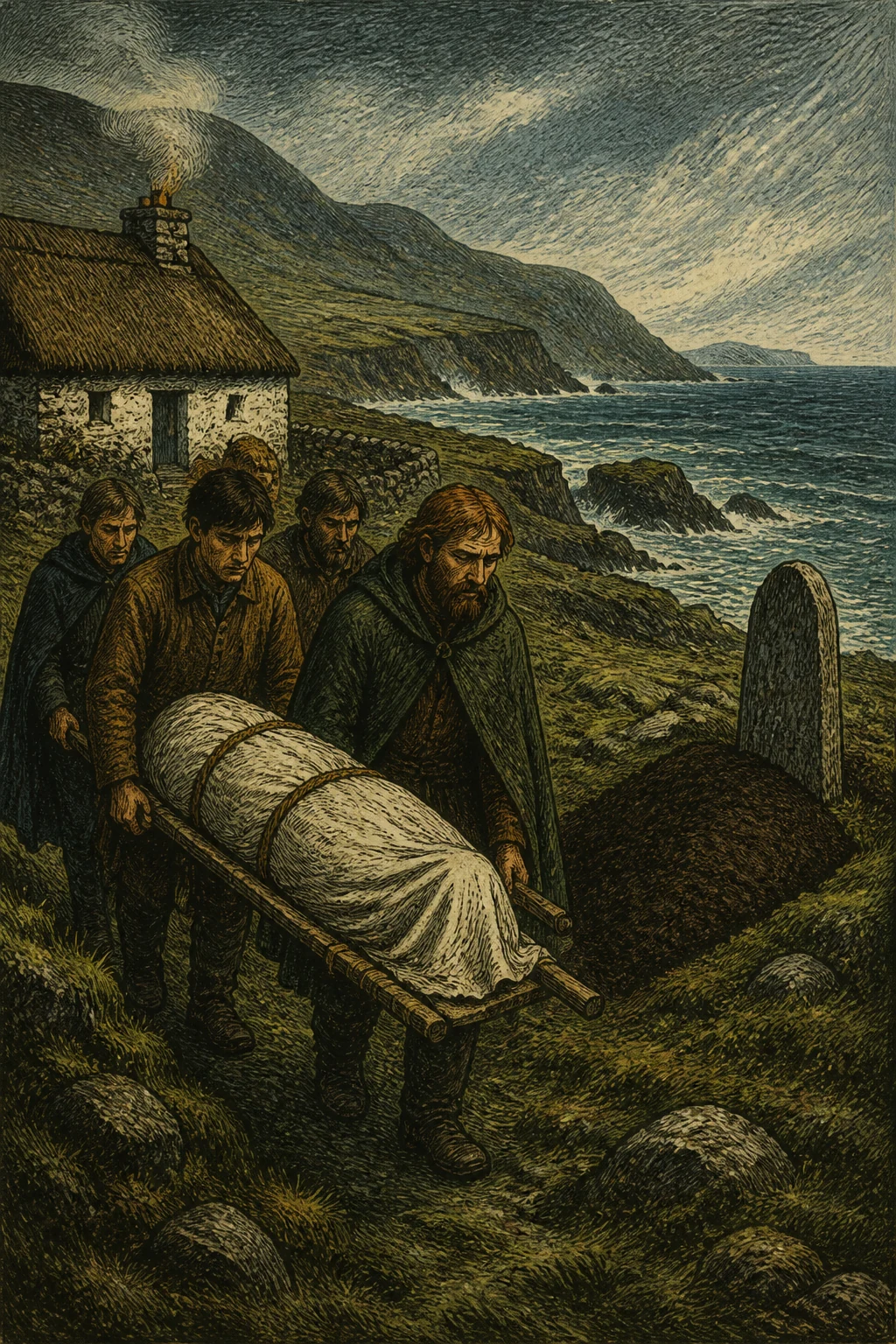
There was no woman like that in the whole world except one, who lived in the eastern world. The next morning he set out. He had little money, but he took twenty pounds with him. He had not gone far when he met a funeral, and he said he might as well walk three steps with the coffin. Before he had taken the three steps, a man came and laid a claim of five pounds upon the corpse. There was a law in Ireland at that time that, if one man owed another money, the debtor’s family could not bury him when he died without either paying the debt or obtaining the creditor’s permission. When the King of Ireland’s son saw the dead man’s sons and daughters weeping, with no money to give the man, he said to himself, “It is a great pity these poor people have not the money.” He put his hand into his pocket and paid the five pounds himself on behalf of the dead man. Then he said he would go on to the churchyard and see him buried. Another man came and laid a claim of another five pounds upon the corpse. “Since I gave the first five pounds,” said the King of Ireland’s son to himself, “I may as well give another five now and let the poor man go into his grave.” He paid the other five pounds. Then he had only ten pounds left.
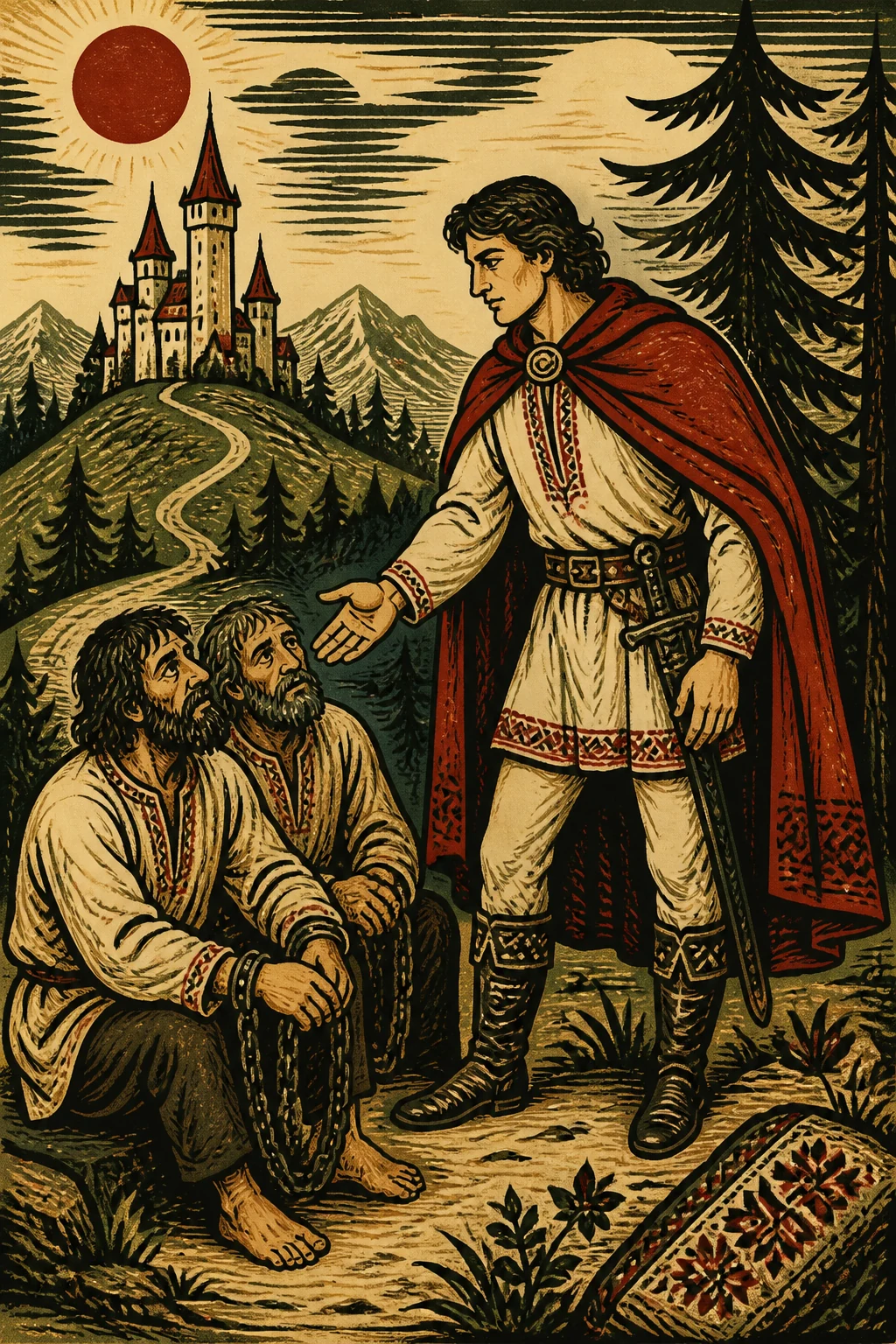
He had not gone far when he met a little grey man, who asked him where he was going. He told him. The little grey man asked whether he needed a servant, and he said that he did, and asked what wages he would want. “Two little kisses from your wife, if you win her,” he answered. The King of Ireland’s son agreed. They had not gone far before they met another man with a gun in his hand, taking aim at a blackbird far away in the eastern world, so that he might have it for his dinner. The little grey man told the King of Ireland’s son that he might as well hire this man too, if he would enter his service. The King of Ireland’s son asked whether he would come into his service. “I will,” said the man, “if I get my wages.”
“And what wages will you want?” “A house-site and a garden.” “You shall have them from me, if my journey succeeds.” The King of Ireland’s son went on with the grey man and the gunman, and they had not gone far before they met
a man with his ear to the ground, listening to the grass growing. “You may as well hire that man,” said the little grey man. The King of Ireland’s son asked the man whether he would enter his service.
“I will, if I get a house-site and a garden.” “You shall have them from me, if I succeed in what I have set my heart upon.” The King of Ireland’s son, the little grey man, the gunman, and the listener went on, and before long they met another man with one leg over his shoulder, guarding a field of hares and allowing none of them either in or out. The King of Ireland’s son was astonished, and asked him why he carried one leg over his shoulder like that.
“Oh,” said he, “if I had both feet on the ground, I would be so swift that I would run out of sight.” “Will you enter my service?” said the king’s son.
“I will, if I get a house-site and a garden.” “You shall have them from me,” said the King of Ireland’s son, “if I succeed in what I have set my heart upon.”
The King of Ireland’s son, the little grey man, the gunman, the listener, and the runner went on, and before long they came to a man who was turning a windmill with one nostril, while he held a finger against his nose to close the other.
“Why have you your finger against your nose?” the King of Ireland’s son asked him. “Oh,” said he, “if I blew through both nostrils, I would sweep the mill away up into the air.”
“Will you enter my service?” “I will, if I get a house-site and a garden.” “You shall have them, if I succeed in what I have set my heart upon.”
The King of Ireland’s son, the little grey man, the gunman, the listener, the runner, and the blower went on until they came to a man sitting beside the road, breaking stones with the side of his foot, without a hammer or anything else. The king’s son asked him why he was breaking the stones with the side of his foot.
“Oh,” said he, “if I struck them with the full sole of my foot, I would turn them to powder.” “Will you enter my service?” “I will, if I get a house-site and a garden.” Then they all went on together: the King of Ireland’s son, the little grey man, the gunman, the listener, the runner, the blower, and the man who broke stones with the side of his foot. They would overtake the March wind before them, and the March wind behind them would not overtake them, until evening came and the close of day.
The King of Ireland’s son looked about him and saw no house where he might spend the night. The little grey man looked about him and saw a house with neither the butt of a rafter jutting out nor the tip of a rafter showing within, except for one single rafter that held it sheltered and secure. The King of Ireland’s son said he did not know where they would spend the night, and the little grey man said they would spend it in the giant’s house over there.
They came to the house, and the little grey man shook the challenge-post. Such a din did he raise from it that he left no child in a woman, no foal in a mare, no piglet in a sow, and no badger in a glen that he did not turn three times over. The giant came out and said, “I smell the sweet-tongued, lying Irishman beneath my native sod.”
“I am no sweet-tongued, lying Irishman,” said the little grey man, “but my master is outside there at the end of the road, and if he comes he will take your head off.” The little grey man began to grow and grow, until at last he was as big as the castle. The giant grew frightened and said, “Is your master as big as yourself?”
“He is,” said the little grey man, “and bigger.” “Hide me until morning, until your master has gone.” He hid the giant, then brought the King of Ireland’s son, the little grey man, the gunman, the listener, the blower, the runner, and the man who broke stones with the side of his foot into the castle. They spent that night, a third in reciting verses, a third in telling stories, and a third in the gentle repose of slumber and
sound sleep. When day broke next morning, he took his master, the gunman, the listener, the runner, the blower, and the man who broke stones with the side of his foot outside, and left them at the end of the road. Then he came back himself and released the giant. He told the giant that his master had sent him back for the little black cap beneath the side of his bed. The giant said he would give him a hat that he had never worn himself, but he would be ashamed to give him the old cap. The little grey man said that, unless he gave him the cap, his master would come back and take his head off.
“I had better give it to you,” said the giant, “and whenever you put it on your head, you will see everyone, and no one will see you.” Then he gave him the cap, and the little grey man went and gave it to the King of Ireland’s son.
Then they set off again. They would overtake the March wind before them, and the March wind behind them would not overtake them, as they travelled towards the eastern world. When evening came and the close
of day, the King of Ireland’s son looked for a place to spend the night. The little grey man looked about him and saw a castle, and said, “The giant in that castle is the brother of the giant we stayed with last night, and we shall stay in that castle tonight.” They went on, and he left the King of Ireland’s son and his people at the end of the road, went up to the castle, and shook the challenge-post. Such a din did he raise from it that, within seven miles of him, he left no child in a woman, no foal in a mare, no piglet in a sow, and no badger in a glen that he did not turn three times over.
The giant came out and said, “I smell the sweet-tongued, lying Irishman beneath my native sod.” “I am no sweet-tongued, lying Irishman,” said the little grey man, “but my master is outside there at the end of the road, and if he comes he will take your head off.”
“You are too much for one bite, and too little for two,” said the giant. “You will not get me for any bite at all,” said the little grey man, and he began to grow until he was as big as the castle.
The giant grew frightened and said, “Is your master as big as you?” “He is, and bigger,” said the little grey man. “Hide me until morning, until your master has gone,” said the giant, “and whatever you ask for, you shall have.”
He took the giant and put him under an upturned tub. Then he went out and brought in the King of Ireland’s son, the gunman, the listener, the blower, the runner, and the man who broke stones with the side of his foot. They spent the night there, a third in reciting verses, a third in telling stories, and a third in the gentle repose of slumber and sound sleep, until morning.
In the morning he took the King of Ireland’s son and his people out of the castle and left them at the end of the road. Then he came back himself and asked the giant for the old slippers beneath the side of the bed. The giant said he would give his master as good a pair of boots as he had ever worn, and what use were those old slippers? The little grey man said that, unless he got the slippers, he would fetch his master to take the giant’s head off. Then the giant said he would give them to him, and did so. “Whenever,” said he, “you put on those slippers and say, ‘Away with you,’ wherever you wish to go, you will be there.”
The King of Ireland’s son, the little grey man, the gunman, the listener, the runner, the blower, and the man who broke stones with the side of his foot went on until evening came and the close of day, until the horse was seeking shelter beneath the dock leaf, and the dock leaf would not wait for him. Then the King of Ireland’s son asked the little grey man where they would spend the night, and the little grey man said they would stay at the house of the brother of the giant they had stayed with the night before. The King of Ireland’s son looked about him and saw nothing. The little grey man looked about him and saw a great castle. He left the King of Ireland’s son and his people there and went up to the castle alone. He shook the challenge-post, and such a din did he raise from it that he left no child in a woman, no foal in a mare, no piglet in a sow, and no badger in a glen that he did not turn three times over. The giant came out and said, “I smell the sweet-tongued, lying Irishman beneath my native sod.”
“I am no sweet-tongued, lying Irishman,” said the little grey man, “but my master is standing there at the end of the road, and if he comes he will take your head off.”
With that the little grey man began to grow, until at last he was as big as the castle. The giant grew frightened and said, “Is your master as big as yourself?”
“He is,” said the little grey man, “and bigger.” “Oh, hide me, hide me,” said the giant, “until your master has gone, and whatever you ask for, you shall have.”
He took the giant and put him under an upturned tub. Then he came back and brought in the King of Ireland’s son, the gunman, the listener, the runner, the blower, and the man who broke stones with the side of his foot. They spent that night merrily, a third in reciting verses, a third in telling stories, and a third in the gentle repose of slumber and sound sleep.
The next morning he took the King of Ireland’s son and his people outside and left them at the end of the road. Then he came back himself, let out the giant, and told him to give him the rusty sword beneath the side of his bed.
The giant said he would not give that old sword to anyone, but he would give him a sword two or three fathoms long, which had never needed a second blow, and, if it did, would surely finish the work with that second blow.
“I will not take that,” said the little grey man. “I must have the rusty sword, and unless I get it, I will fetch my master, and he will take your head off.”
“I had better give it to you,” said the giant, “and wherever you strike a blow with that sword, it will cut down to the sand, even if all before it is iron.” Then he gave him the rusty sword.
The King of Ireland’s son, the little grey man, the gunman, the listener, the runner, the blower, and the man who broke stones with the side of his foot went on until evening came and the close of day, until the horse was seeking shelter beneath the dock leaf, and the dock leaf would not wait for him. They would overtake the March wind before them, and the March wind behind them would not overtake them. That night they were in the eastern world, where the lady lived.
The woman asked the King of Ireland’s son what he wanted, and he said he wanted her for his wife. “You shall have me,” said she, “if you release me from my enchantments.”
He and his servants were given lodging in the castle that night. During the night she came and said to him, “Here is a pair of scissors, and unless you have those scissors tomorrow morning, I shall take your head off.” She put him to sleep, and as soon as he fell asleep she took the scissors from him and left. She gave the scissors to the King of Poison and told him to have them ready for her in the morning. Then she went away. When she had gone, the King of Poison fell asleep, and while he slept the little grey man came to him with the rusty sword in his hand. Wherever the king had left the scissors, he found them. He gave them to the King of Ireland’s son, and when she came in the morning she asked, “Son of the King of Ireland, have you the scissors?”
“I have,” said he. There were sixty heads of men who had come to seek her set upon stakes around the castle, and she had thought she would have his head upon a stake among them.
The following night she came and gave him a comb, and told him that, unless he had the comb in the morning when she came, his head would be taken off. She put a sleep-pin beneath his head, and he fell asleep as he had the night before, and she stole away with the comb. She gave the comb to the King of Poison and told him not to lose it as he had lost the scissors. The little grey man came with the old slippers on his feet, the old cap on his head, and the rusty sword in his hand. The king did not see him as he came up behind him and took the comb
away. When morning came, the King of Ireland’s son awoke and began lamenting the comb he had lost. “Never mind that,” said the little grey man, “I have it.” When she came, he gave her the comb, and she was astonished.
She came on the third night and told the King of Ireland’s son that he must have for her next morning the head that had been combed with that comb. “Now,” said she, “you were in no danger until tonight, but if you fail this time, your head is gone.”
The sleep-pin was beneath his head, and he fell asleep. She came and stole the comb from him. She gave it to the King of Poison and told him that the comb must not leave him unless his head were taken off. The King of Poison took the comb and put it inside a rock, with sixty locks upon it. The king remained outside all the locks, at the entrance to the rock, guarding it. The little grey man came, wearing the slippers and the cap, with the rusty sword in his hand. He struck the rock a blow and split it open, and struck a second blow at the King of Poison and took his head off. Then he brought the comb to the King of Ireland’s son and found him awake, lamenting its loss. “Here is your comb,” said he. “She will come presently and ask whether you have it. Tell her that you have, and the head that was combed with it, and throw the head to her.”
When she came and asked whether he had the comb, he said he had, and the head that had been combed with it, and he threw the King of Poison’s head to her.
When she saw the head, she was furious. She told him that he would not have her in marriage until he found a runner to race against her own runner for three bottles of healing water from the well of the eastern world. If her runner returned sooner than his, his head would be forfeit.
Three bottles were brought for her. The little grey man told them to give three bottles to the man who had been guarding the field of hares, and they were given to him. The hag and the man set off, each with three bottles, and the King of Ireland’s son’s runner was halfway home before the hag was halfway there. “Sit down a while,” said the hag to the runner, “and rest yourself. The two of them are married by now, and do not break your heart running.” She brought a horse’s skull and put it beneath his head, with a sleep-pin in it, and as soon as he laid his head upon it, he fell asleep.
She poured out the water he had and went on her way. The little grey man thought them long in coming, and said to the listener, “Put your ear to the ground and see whether they are coming.” “I hear the hag coming,” said he, “and the runner is asleep and snoring.”
“Look about you,” said the little grey man to the gunman, “and see where the runner is.” The gunman said he was in such and such a place, asleep, with a horse’s skull beneath his head.
“Put your gun to your eye,” said the little grey man, “and knock the skull from beneath his head.” He put the gun to his eye and shot the skull from beneath the runner’s head. The runner awoke and found his bottles empty, and he had to return to the well. The hag was coming by then, and there was no sign of the runner. Then the little grey man said to the man who had been turning the windmill with his nostril, “Get up and see whether you can drive the hag back.” He put his finger against his nose, and as the hag drew near he sent a puff of wind beneath her that swept her backwards. She came on again, and he did the same to her. Every time she came near them he drove her back again with the wind he blew from his nostril. At last he blew through both nostrils and swept the hag back to the eastern world. Then the King of Ireland’s son’s runner arrived, and that day was won.
The woman was furious when she saw that her own runner had not returned first, and she said to the King of Ireland’s son, “You shall not have me now until you walk three miles without shoes or stockings over hard spikes.”
She had a road three miles long, strewn with sharp, hard spikes as thick as grass. The little grey man said to the man who broke stones with the side of his foot, “Go and trample those down.” That man went over them with the side of his foot and turned them into stumps. The little grey man told him to go over them with the full sole of his foot. Then he went over them with the full sole of his foot and made powder and pulp of them. The King of Ireland’s son came and walked the three miles, and he had won his wife.
Then the two were married, and the little grey man was to have the first kiss. The little grey man took the woman into a room alone and began to work upon her. She was full of venomous snakes, and they would have killed the King of Ireland’s son when he fell asleep, had the little grey man not driven them out of her.
Then he came to the King of Ireland’s son and said, “You may go to your wife now. I am the man who lay in the coffin that day, for whom you paid the ten pounds, and these people who were with you are servants whom God sent to you.”
Then the little grey man and his people departed, and the King of Ireland’s son never saw him again. He took his wife home with him, and they lived happily together.