Prevod
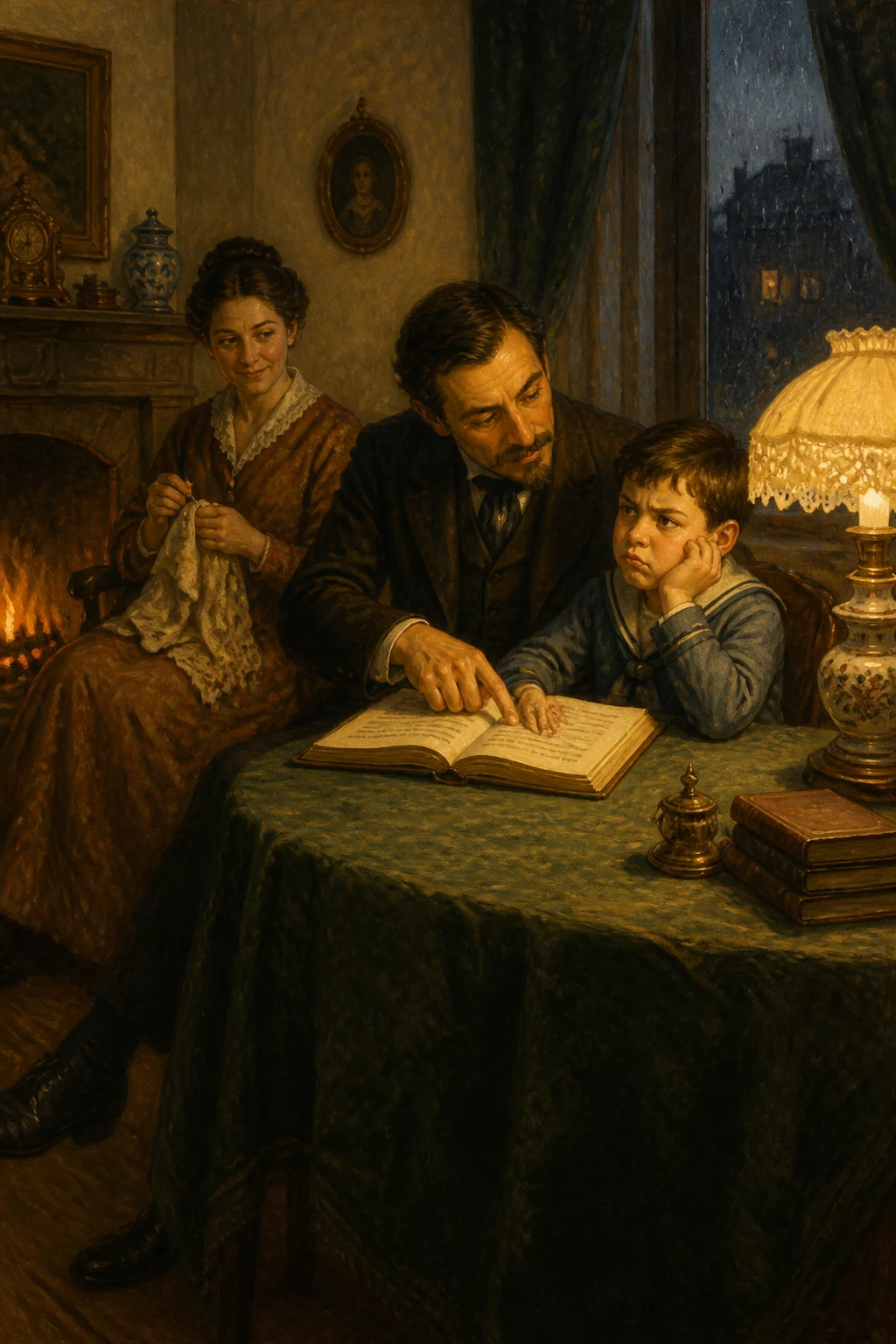
The boy is one of those delicate, precociously clever creatures who grow up in large cities, deprived of air, light, exercise, and sound, wholesome food, victims of the straitened circumstances of the middle class, sometimes needier than the poor. Always neat and clean, his hair carefully smoothed, solemn, docile, and restrained by nature, Eloy gives no trouble at home. Indeed, if he did, how would his poor mother manage to keep him in line—a widow, alone, and suffering from a chronic heart complaint? The true cause of Eloy’s good manners and conduct is precisely that ardent, early-awakened sensitivity which fear so often stirs in children: fear of making someone dearly loved suffer, of saddening a mother’s eyes, of adding to a sorrow whose depth they sense but cannot fathom.
Eloy learned his lessons word for word because his mother smiled a wan smile when she heard him recite them from memory; Eloy took great care of his clothes and shoes because he realized that his mother had no money to replace anything stained or torn; Eloy came straight home from school instead of lingering to play the rascal and get up to mischief with his companions because his mother was glad to see him return, and the little boy, with the intuition of his loving heart, sensed that Mama’s melancholy eased in his presence, and that in sending him off to learn, parting with him for long hours, she was making a sacrifice.
Yet Eloy remembered, both hazily and in minute detail, as children do, a recent time when his mother had not complained, when her life had been happy. In those days, to be sure, a young man had lived in the house, vigorous and lively, with a firm tread and black mustaches.—Papa!—Eloy associated his memory with rides on his knees or on the tip of his foot, fierce kisses on the cheeks, a pleasant smell of fine cigars, laughter and games and pranks as though he were another boy... Then... Papa disappeared, and Mama’s eyelids were always swollen and red. The house grew quiet and mournful, and Eloy felt uneasy, afraid to play or call loudly for his afternoon snack, because he felt as though he were inside a dark church or a tomb. Acquaintances he met spoke to him in pitying voices when they asked “whether there was any news of Papa, who was away at the war.” At the war! From the tone in which his mother and their friends spoke those words, Eloy understood that war was something very dreadful, atrocious, wicked. Could Papa perhaps die in the war? Ah, indeed he could! For one afternoon, on coming home from school, Eloy found his mother in a faint, the maid sobbing, and the women from the second floor taking him away and stuffing him with sweets “so he wouldn’t be upset, poor little thing...” The next day Mama sent for him, embraced him silently, without shedding a tear, and dressed him in black, all in black, from his stockings to his beret... The boy could not have defined death or explained what it was, but he was certain that it was something terrible, and that this something would forever prevent them from living happily again. He wept in secret so as not to distress his mother further, and said the prayers he knew, over and over, “for Papa’s soul.” From then on he began to study his lessons diligently, to do nothing naughty, to fold his little jacket before going to bed, to come home from school “like clockwork,” with his books strapped together under his arm. Papa’s soul surely approved of such conduct.
Still, even the most sensible boy is a boy after all, and when, in the first days of the year, Eloy heard his schoolmates guessing what the Three Kings would bring them, and making plans to leave their shoes by the window or the fireplace, he could not help letting his imagination run free. He, too, wanted the Kings to bring him something... And why shouldn’t they, pray? Hadn’t he been good the whole year long? If he put his shoe on the windowsill, would it be fair for him to find it in the morning as empty as an old hazelnut?
Fortunately, the same notion of fairness had found its way into his mother’s mind. She, who never went out, who felt herself dying on the stairs, ventured into the street on the afternoon of the fifth, wrapped in her modest, old-fashioned cloth jacket, and stopped at the toy shop. When she returned home she had a small, flat cardboard box hidden away. By forcing us to calculate, poverty destroys many a budding fancy. What would that mother not have given to bring her boy the spirited mechanical horse, the gleaming bicycle, the marvelous cinematograph, the steam locomotive with its tender and carriage, real rails, and copper boiler! But alas! Such fancies cost half an ounce of gold, ten duros, fifteen, and her purse shrank back in terror... No, no; the gift from the holy Magi, those wise and learned Kings, ought not to be something useless, but something that would help the boy’s education... And so, for a modest sum, his mother bought a geographical puzzle, nothing less than a map of Spain... In this way Eloy, as he played, would learn still better what he had already proved he knew, for he was top of his class in geography.
Rising at midnight, the fatherless boy left his shoe among the cold ashes in the sitting-room fireplace, the only one in the house, and very seldom lit. In the morning he leaped out of bed, barefoot and shivering, to see whether the Kings... An unforgettable surprise! Their Majesties had deigned to come: there lay their gift, their offering... What could be inside that little flat box, so pretty with its gilt edging?... Eloy seized it eagerly and went back to his soft, warm bed, where, with his arms out and his body snugly covered, he untied the ribbon and looked... Well, goodness! The Kings had brought him a map... Since they knew how well Eloy behaved, how he always knew his lessons... Still, a map! Pshaw!... Wouldn’t an Ariston organ have been better, or a magic lantern like Pepito Ponzano’s, which he was forever showing off under the other boys’ noses?... Eloy began to forgive the Kings when he discovered that the little map was made of pieces and could be taken apart and put together again... And once he was up and had drunk his hot coffee, while Mama was getting ready to go to Mass, Eloy amused himself assembling and dismantling the country, shuffling Spain a hundred times, mixing Zaragoza up with Valladolid and Salamanca with Vigo...
Suddenly, lost in thought, he broke off his task and anxiously questioned his mother:—Mama, they’ve cheated you... The toy isn’t complete. There’s a lot of Spain missing here. I can’t find the island of Cuba. Or Puerto Rico... There’s some of Spain missing!
His mother’s eyes filled with tears, and she stood motionless, her little veil half fastened. At last she shrugged her shoulders.—Those lands were so far away!—she said.—And they don’t belong to Spain anymore, you see... The puzzle is right, because... they don’t anymore. Your father died there...!
Eloy fell silent: a sorrow greater than his usual sorrows, immeasurable, too vast for a child’s soul to contain, weighed upon his thoughts for an instant. And with an eloquent gesture he pushed away, rejected, the gift of the Kings.