Waltey
Katekizem
Cuentos de la Patria
Cuentos de Navidad, de la patria y antiguos · Emilia Pardo BazánO besedilu
Katekizem
- Vir
- Cuentos de Navidad, de la patria y antiguos
- Avtor
- Emilia Pardo Bazán
- Jezik branja
- English
- Jezik izvirnika
- Español
- Čas branja
- 6 min branja
- Obseg
- 5 strani
- Naslov izvirnika
- 020 El catecismo
O izvirniku
Cuentos de Navidad, de la patria y antiguos
Sedemintrideset avtorskih zgodb v treh zgodovinskih knjižnih skupinah. Bralni jezik je English, izvirnik pa prihaja iz vira Cuentos de Navidad, de la patria y antiguos v jeziku Español.
Besedilo
Katekizem
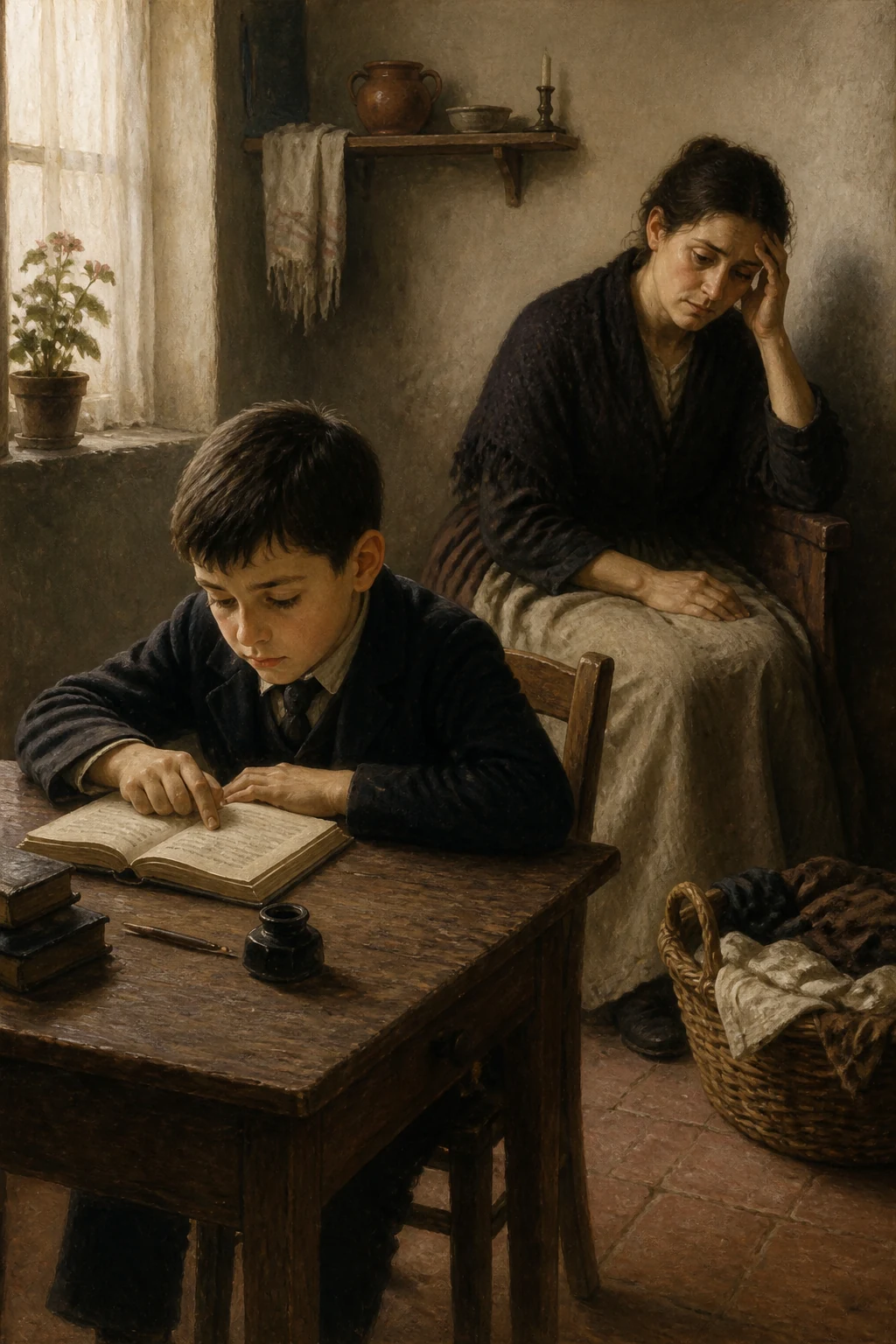
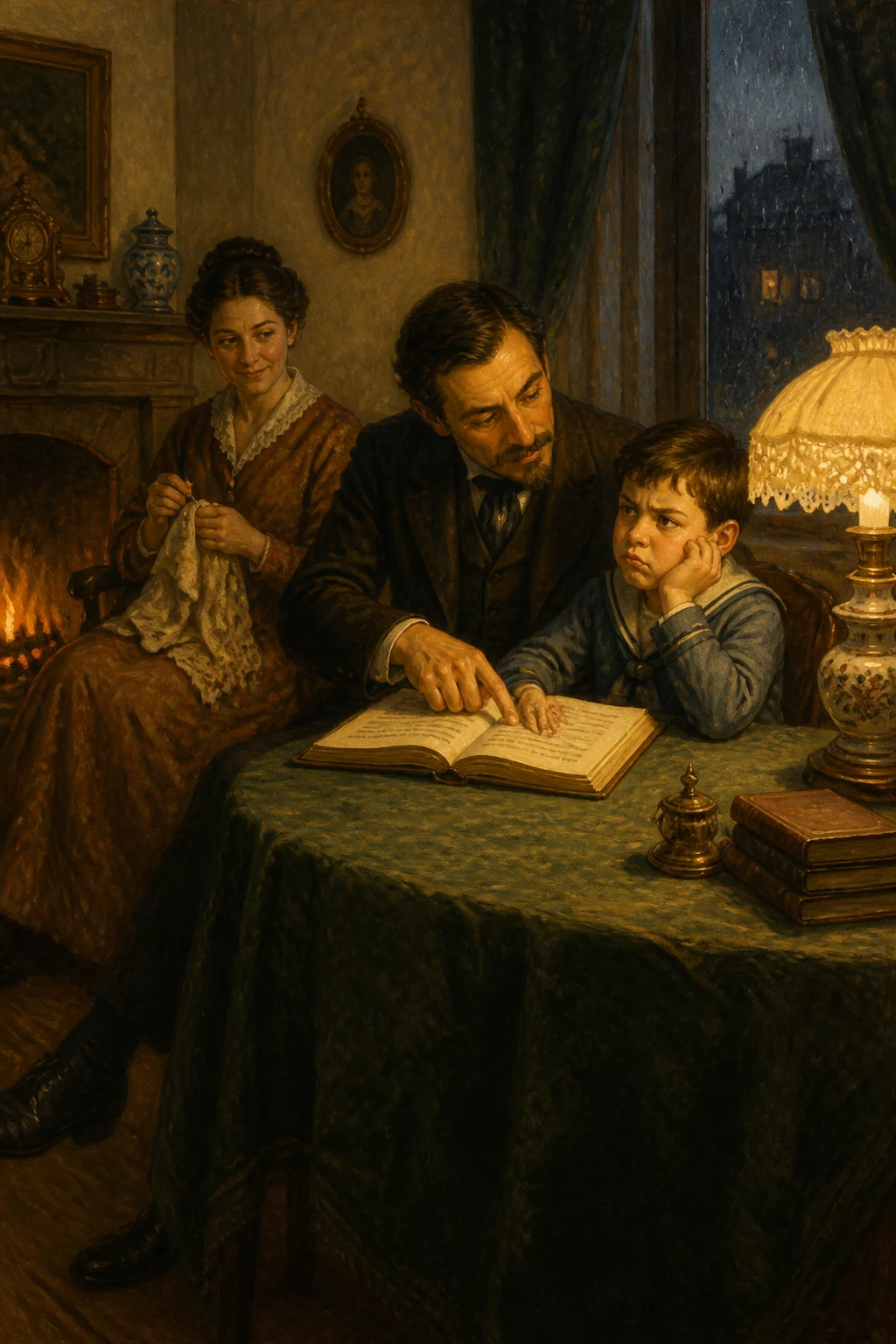
The family evening lasted until ten, and Angelito always bargained for another five minutes or quarter of an hour, resisting bedtime like all children of six or seven, when reason first begins to dawn. While Rosario, his mother, sewed unhurriedly, now and then raising her neatly coiffed head and smiling face, which motherhood had, so to speak, rounded and softened, Carlos, his father, gave the boy his lesson. “Rather than waste my time at the café...” he would reply, almost apologetically, when his friends teased him in the street, coming out point-blank with: “We hear you’ve taken to teaching the ABC...”
The truth was that Carlos had grown accustomed to the lesson, to the sweet intimacy of evenings spent like this, between his loving, contented wife and the precocious, intelligent child, so eager to learn. Outside, the rain fell relentlessly, the wind whistled, or frost hardened the paving stones; inside, the lamp shone affectionately through the old lace of its shade, the fire burned gently, and the warm, peaceful atmosphere of the sitting room spread into the adjoining bedroom, a nest of peace and tenderness, so different from the gloomy, foul-smelling dens where Carlos’s cronies used to lurk—the very men who fancied themselves such rakes and slyly mocked the father who taught his own son.
That night Angelito was rebellious, distracted, inattentive to his lesson. While reading he had swallowed half the words, and, obliged to go back and repeat what he had skipped, his little voice took on those shrill, irritable tones that betray a child’s anger. When he wrote, he pursed his little mouth into a trumpet, gripped the penholder stiffly, made more than a dozen great inkblots on the paper, and finally dashed down the pen with a sudden movement, splashing ink as far as his mother’s white needlework. She gave a cry of surprise and annoyance. Carlos looked at his wife, shook his head, and touched his forehead as if to say, “I don’t know what’s got into this child today.” Rosario rose, took the boy into her lap, and began a mother’s anxious questioning. “What is it, darling? Does something hurt? Are you sleepy? Does it hurt here, or here?” And she stroked his cheeks and temples, feeling for the heat of a fever. A child can fall ill so suddenly!
Finding no heat or other alarming symptom, Rosario made her voice deeper and sterner. “Now you’re going to be good... You know I don’t like naughty little boys... Poor Papa will fall ill if you torment him; then you’ll have to look after him and bring his medicine to bed... Come, Angel, let’s finish your lessons; you still have your Catechism to do...”
Without answering, Angel stared into a dark corner of the room. His tense little face and the fixed gaze of his eyes, a clear, limpid blue, betrayed one of those struggles with ideas beyond their years that ravage and ripen children’s tender minds at once.
“Mama,” he answered at last, very slowly, as though speaking in his sleep, “is Uncle Alejandro never coming?” His mother shuddered. The thought of her brother, away at war with his regiment, often assailed Rosario too amid her domestic happiness, poisoning it with the fear that at the very hour when she lay resting between clean sheets, close to loving arms, Alejandro might be lying face-up to the sun, his chest pierced and his eyes glazed for ever.
“Is Uncle Alejandro never coming, Mama?” the boy repeated in that childish tone that foretells tears. “He’ll come if God wills it, my son,” his mother answered in a broken voice, pressing the child to her breast.
“When will he come? Papa, when? Will he come this week? Tell me.” “I don’t know, darling,” his father exclaimed. “Come, let’s have your primer. It’s late, little fellow.” “But when, Papa? Why don’t you know?”
“Because until the war is over, sweetheart... until it’s over, Uncle Alejandro can’t come.” The child’s turquoise eyes darkened with concentration and the immense effort to understand.
“What is war like?” he exclaimed at last. “People fighting one another, to see who wins.” “The good people against the bad, Papa?” “Yes, the good against the bad.”
“Uncle Alejandro is good,” Angel declared. “And how do they fight?” “With rifles, with swords, with cannons.” The child clapped his hands. “You must take me, Papa. You must take me.”
“Poor little fellow!” Carlos sighed. “War is no place for children.” “Is it for grown men?” “Yes.” “Then why aren’t you at war? You’re big, very big.”
“Because I’m not a soldier,” his father said, vexed and somewhat mortified—as though those words had not been spoken by a six-year-old—and trying to sound persuasive. “Uncle Alejandro is a soldier; you know he came to show you his uniform. Soldiers study for that, to defend their country...”
“Their country...” the child repeated, impressed by the grave emphasis Carlos had given the word. “Our country... is it here?” “Here... where?”
“In our little house.” “No... that is, yes... Our house is in our country, but our country is much more... it’s all the houses you see in this town and in other towns, so many, many of them! And it’s the land as well, and the forests, and the villages, and Madrid, and everything...”
“And the churches too?” Angel murmured in the tone he used for his bedtime prayers. “Those too.” “And the Virgin? Our Mama in heaven?” “The Virgin too; yes, our Mama in heaven is our country.”
“And does Uncle Alejandro love our country?” “You see,” Rosario interrupted, making no attempt to hide the emotion that misted her eyes, “your poor uncle loves it very much. Why, he risks being shot and dying just like that, all of a sudden—only think. Pray, my son, pray that they don’t kill your uncle.”
The child fell silent, thinking hard, almost painfully. “And do people who don’t go to war never die?” he asked at last, following the thread of his budding logic.
“They die too.” “Then I want to go to war when I’m big,” the little boy declared firmly. “And I want you to go, Papa. We have to die in the end, don’t we? Then let’s die for that... for that... For our Mama in heaven, for our country!”
A silence followed the child’s words. His parents looked at one another, speechless, filled with a strange reverence, as though the innocent’s voice had come from other realms, from somewhere higher. And after a few moments Carlos said to his wife:
“Put him to bed. It’s well past ten.” “And his Catechism lesson?” “He’s given it today already,” his father answered, kissing Angel fervently where his fair hair began.
Izvirnik
020 El catecismo
Naslednje strani prikazujejo izvirno besedilo za primerjavo.
Hasta las diez duraba la velada de familia, y Angelito regateaba siempre cinco minutos ó un cuarto de hora, refractario á acostarse, como todos los niños en la edad de seis á siete años, cuando empieza á alborear la razón. Mientras Rosario, la madre, cosía sin prisa, levantando de tiempo en tiempo su cabeza bien peinada, su cara sonriente, que la maternidad había redondeado y dulcificado por decirlo así, Carlos, el padre, daba lección al muchacho. «Si había de perder el tiempo en el café...» solía responder como excusándose, cuando los amigos, en la calle, le embromaban, soltándole á quemarropa: «Ya sabemos que te dedicas á maestro de primeras letras...»
La verdad era que Carlos se había acostumbrado á la lección, á la intimidad dulce de las noches pasadas así, entre la mujer enamorada y contenta y el niño precoz, inteligente, deseoso de aprender. Fuera, la lluvia caía tenaz, el viento silbaba, ó la helada endurecía las losas de la calle; dentro, la lámpara alumbraba cariñosa al través de los rancios encajes de la pantalla, la chimenea ardía mansamente, y la atmósfera regalada y tranquila del gabinete se comunicaba á la alcoba contigua, nido de paz y de ternura, tan diferente de las sombrías y hediondas madrigueras donde solían agazaparse los amigotes de Carlos,--los mismos que se creían unos calaverones y se burlaban solapadamente del padre profesor de su hijo.
Aquella noche Angelito estaba rebelde, distraído, desatento á la enseñanza. Al leer se había comido la mitad de las palabras, y obligado á volver atrás y repetir lo saltado, su vocecilla adquirió esos tonos irritados y chillones que delatan la cólera pueril. Al escribir hizo la trompeta con el hociquito, engarrotó el portaplumas, echó más de una docena de calamares en el papel, y por último estrelló la pluma en un movimiento precipitado, y la tinta saltó hasta la blanca labor de la madre, que exhaló un grito de sorpresa y enojo. Carlos miró á su mujer, y meneó la cabeza y se tocó la frente como significando: «No sé qué le pasa hoy á esta criatura.» Y Rosario, levantándose, cogió al rapaz en el regazo y le dirigió las inquietas interrogaciones maternales. «¿Qué tienes, vida? ¿Te duele algo? ¿Es sueño? ¿Es pupa aquí, aquí?» Y le acariciaba las mejillas y las sienes, tentando por si sorprendía el fuego de la calentura. ¡Enferma tan pronto un niño!
No encontrando calor ni ningún síntoma alarmante, Rosario engrosó y endureció la voz.
--Vas á ser bueno... Ya sabes que no me gustan los nenes caprichosos... El pobre papá se pondrá malito si le haces rabiar; después tienes tú que cuidarle á él y que llevarle las medicinas á la cama... Vamos, Angel, á concluir las lecciones; aún te falta por dar el Catecismo...
Angel, sin responder, miraba fijamente á un rincón obscuro del cuarto. La contracción de su carita, la inmovilidad de sus ojos de un azul fluído y transparente, delataban una de esas luchas con ideas superiores á la edad, que devastan y maduran á la vez el tierno cerebro de los niños.
--Mamá--respondió por fin muy despacio, como si hablase en sueños:--¿y el tío Alejandro, no viene nunca?
La madre se estremeció. El recuerdo del hermano que estaba en la guerra con su regimiento la asaltaba también á Rosario muchas veces en medio de su ventura doméstica, y se la envenenaba con el temor de que á la misma hora en que ella descansaba entre limpias sábanas, cerca de unos brazos amantes, pudiese Alejandro yacer cara al sol, con el pecho taladrado y las pupilas vidriadas para siempre.
--¿No viene nunca tío Alejandro, mamá?--repitió el chico con ese acento infantil que anuncia llanto.
--Vendrá si Dios quiere, hijo mío--respondió la madre con rota voz, apretando contra el seno á la criatura.
--¿Cuándo vendrá? Papá, ¿cuándo? ¿Vendrá esta semana, di?
--No sé, querido--exclamó el padre.--A ver, la cartilla. Que es tarde, muñeco.
--¿Pero cuándo? papá. ¿Por qué no lo sabes tú?
--Porque hasta que se acabe la guerra, mi cielo... hasta que se acabe, tío Alejandro no puede venir.
Los ojos de turquesa del niño se obscurecieron á fuerza de concentración y de ímprobo trabajo para entender.
--¿Cómo es la guerra?--exclamó por último.
--Pelear unos contra otros, á ver quién gana.
--¿Los buenos con los malos, papá?
--Sí; los buenos con los malos.
--Tío Alejandro es bueno--declaró Angel.--¿Y cómo pelean?
--Con fusiles, con espadas, con cañones.
El niño batió palmas.
--Me has de llevar, papá. Me has de llevar.
--¡Pobretín!--suspiró Carlos.--La guerra no es para chiquillos.
--¿Es para hombres grandes?
--Sí.
--Y entonces, ¿por qué no estás tú en la guerra? Tú eres grande, grande.
--Porque no soy militar--dijo el padre contrariado, algo mortificado, (como si aquellas palabras no las hubiese articulado una lengua de seis años,) y hablando para convencer.--Tío Alejandro es militar; ya sabes que vino á enseñarte el uniforme. Los militares estudian para eso, para defender á la patria...
--La patria...--repitió el niño, impresionado por el tono enfático y grave con que Carlos pronunció la palabra.--La patria... ¿es aquí?
--Aquí... ¿dónde?
--En nuestra casita.
--No... es decir, sí... Nuestra casa está en la patria, pero la patria es mucho más... son todas las casas que ves en el pueblo y en otros pueblos, ¡tantos, tantos! Y es además la tierra, y los bosques, y las aldeas, y Madrid, y todo...
--¿Y las iglesias también?--murmuró Angel con el tono con que decía sus oraciones al acostarse.
--También.
--¿Y la Virgen? ¿Mamá del cielo?
--También la Virgen; sí, mamá del cielo es la patria.
--¿Y tío Alejandro quiere á la patria?
--Ya ves--interrumpió Rosario sin ocultar la emoción que empañaba sus ojos.--El pobre tío la quiere mucho. Como que se expone á que le den un tiro y á morirse así, de pronto, figúrate tú. Reza, hijo mío, reza, para que no maten al tío.
El niño calló, reflexionando laboriosa, casi dolorosamente.
--¿Y los que no van á la guerra no mueren nunca?--preguntó al fin, siguiendo el hilo de su temprana lógica.
--También mueren.
--Entonces quiero ir á la guerra cuando sea grande--declaró con energía el pequeñuelo.--Y quiero que tú vayas, papá. Al fin hemos de morir, ¿no? Pues morir por eso... por eso... Por mamá del cielo, ¡por la patria!
Un silencio siguió á las palabras del niño. Los padres se miraban, mudos, penetrados de un respeto extraño, como si la voz del inocente viniese de otras regiones, de más arriba. Y al cabo de unos instantes, Carlos dijo á su mujer:
--Acuéstale. Son las diez largas.
--¿Y la lección del Catecismo?
--Hoy ya la ha dado--respondió el padre, besando á Angel con ardor sobre el nacimiento de la rubia melena.
Nadaljuj z branjem