O besedilu
Sedem svinjskih kožic
- Vir
- Pentameron
- Avtor
- Giambattista Basile
- Jezik branja
- English
- Jezik izvirnika
- Neapolitan
- Čas branja
- 12 min branja
- Obseg
- 9 strani
- Naslov izvirnika
- Jornata IV IV LE SSETTE COTENELLE
O izvirniku
Pentameron
Baročna, divja starejša plast evropske pravljice, polna obratov in pretiravanj. Bralni jezik je English, izvirnik pa prihaja iz vira Pentameron v jeziku Neapolitan.
Besedilo
Sedem svinjskih kožic
_An old beggar woman beats her greedy daughter for eating seven pork rinds, and they persuade a merchant that she is doing it because the girl has worked too hard at filling seven spindles. He takes her for his wife; but, having no wish to work, she receives a fairy’s help, so that when her husband returns from his travels he finds the linen woven. By a fresh trick of his wife’s, he resolves never to make her work again, lest she fall ill._ _They all blessed Meneca’s lips, for she had told her tale with such relish that she brought events that had happened so far away before her listeners’ very eyes. This stirred Tolla’s envy and put such a fierce desire into her bones to outstrip Meneca at a single bound that, after first clearing her throat, she began as follows._ No saying is ever half or wholly false, and so whoever said:
“A crooked face and a straight run of luck” knew something of the ways of the world; or perhaps he had read the story of Antuono and Parmiero: “Lucky Antuono, with no need of snares, catches his birds without birdlime.” Experience shows that this world is the very image of Cockaigne, where those who work hardest earn least, and where the one who fares best takes his time as it comes and cries, “Macaroni, fall into my mouth!”
Indeed, you can see for yourselves that fortune’s prizes and spoils are won with little skiffs, not with fully fitted galleys, as I shall now let you hear.
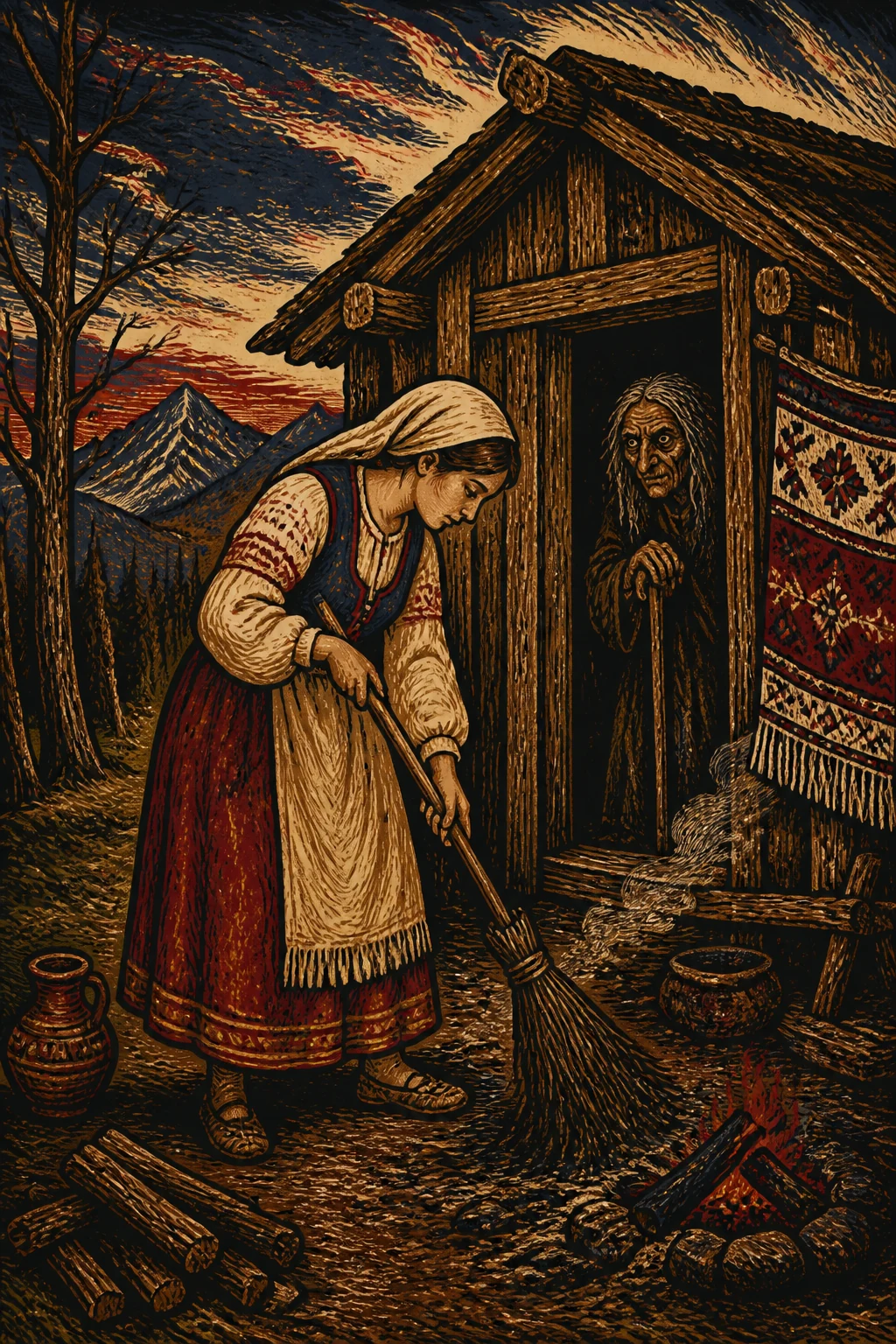
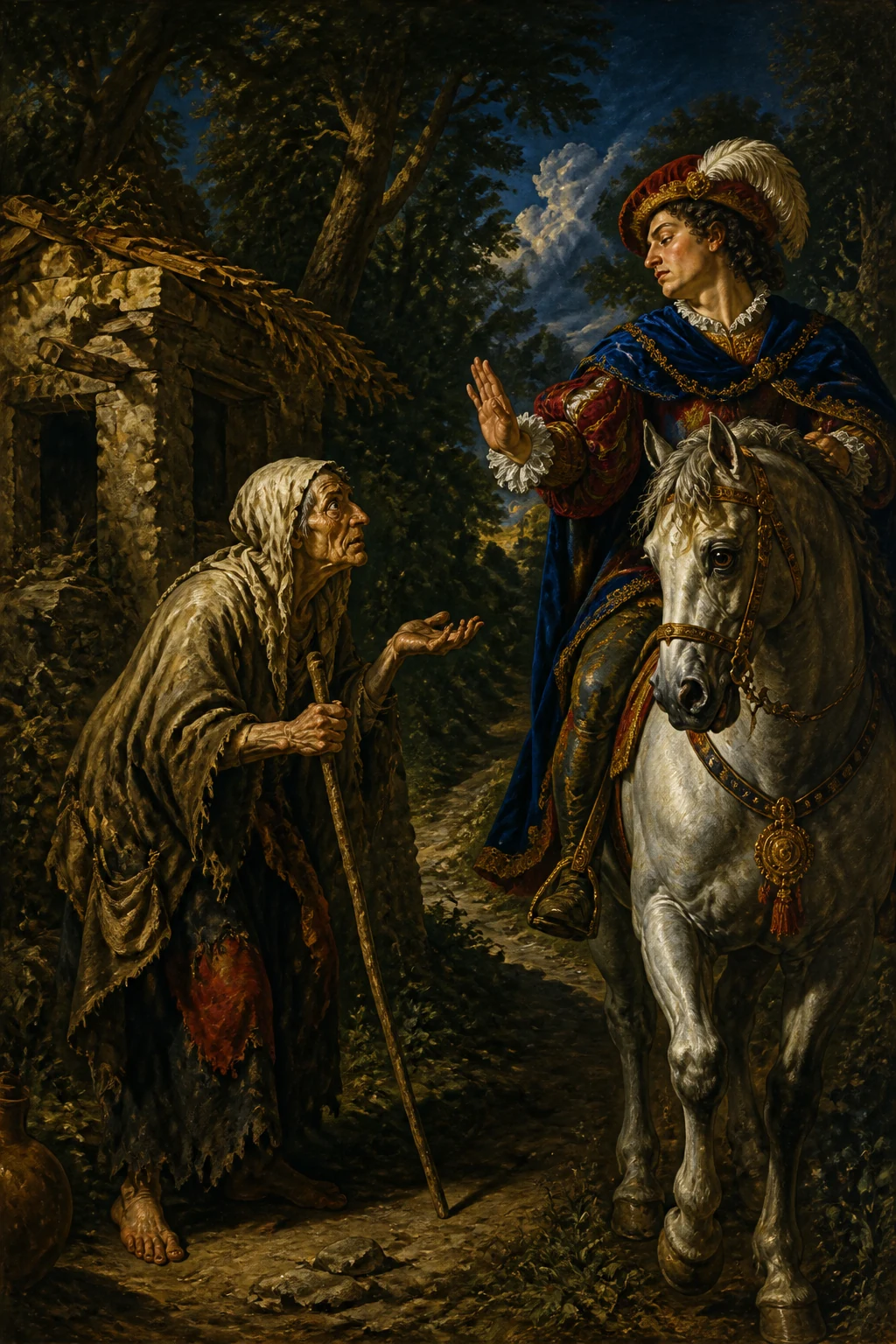
Once upon a time there was an old beggar woman who, with a distaff in her hand, went from door to door asking for alms, spattering the people in the street with her spittle. And since cunning and deceit will keep you half the year, she persuaded some softhearted, credulous women that she wanted to make some sort of rich dish for her skinny daughter, and wheedled seven little pork rinds out of them. These she took home, together with a good apronful of twigs she had gathered from the ground, and gave them to her daughter, telling her to put them on to cook while she went back out to beg a few greens from some market gardeners, so that they could make a tasty little soup. The daughter took the rinds, singed off the bristles, put them in a little pot, and began to cook them. But they were not bubbling in the pot half so fiercely as they were bubbling in her throat, for the smell that rose from them was a challenge to mortal combat on the field of appetite and a summons to appear before the tribunal of gluttony. She held out and held out, but at last, provoked by the pot’s fragrance and driven by a hunger that gnawed at her, she let herself taste just a tiny piece. It tasted so good that she said to herself, “Let anyone who is afraid become a constable! Here’s my chance for once: let’s eat, and let the sky come down in clay and rain! After all, what is it but a pork rind?
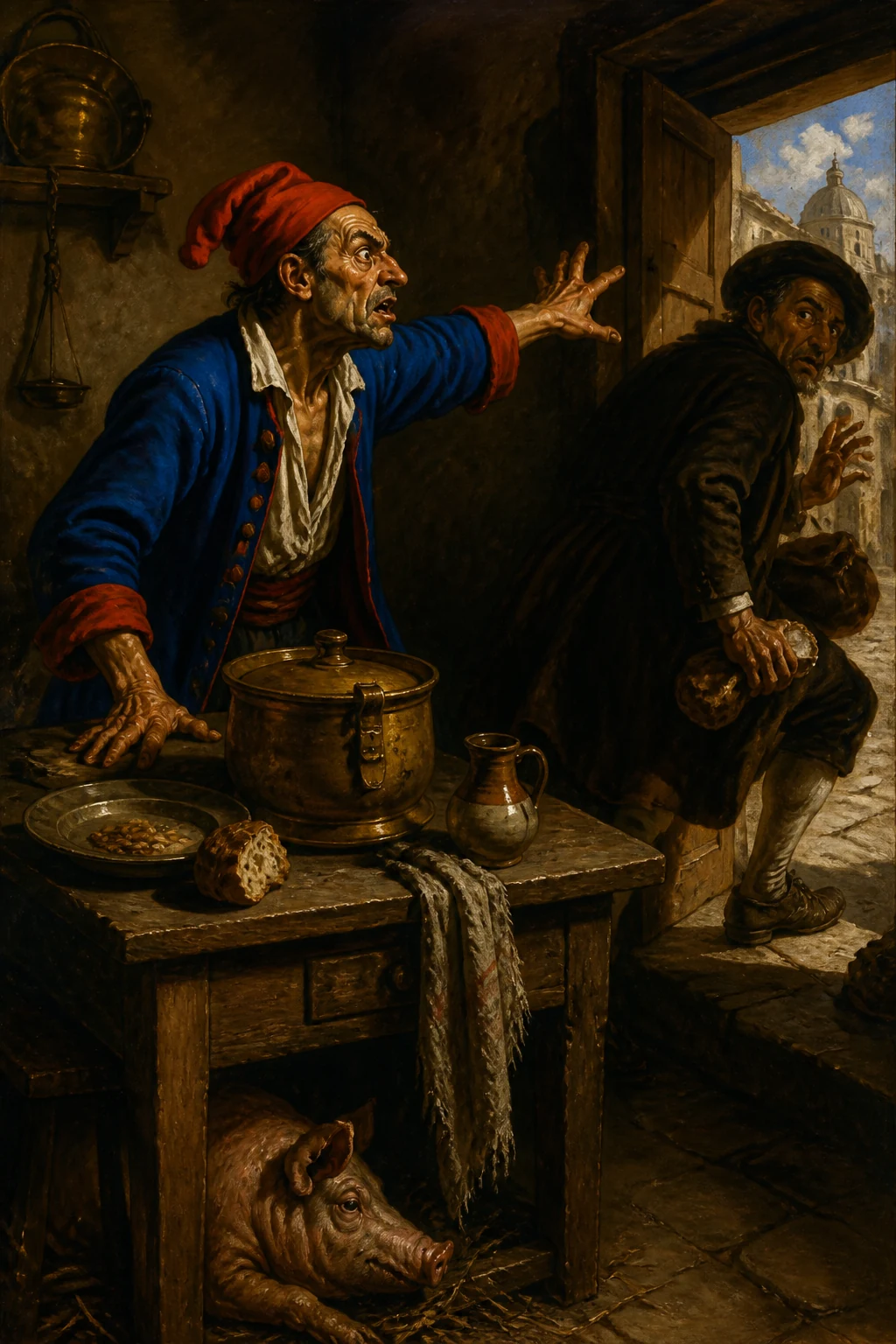
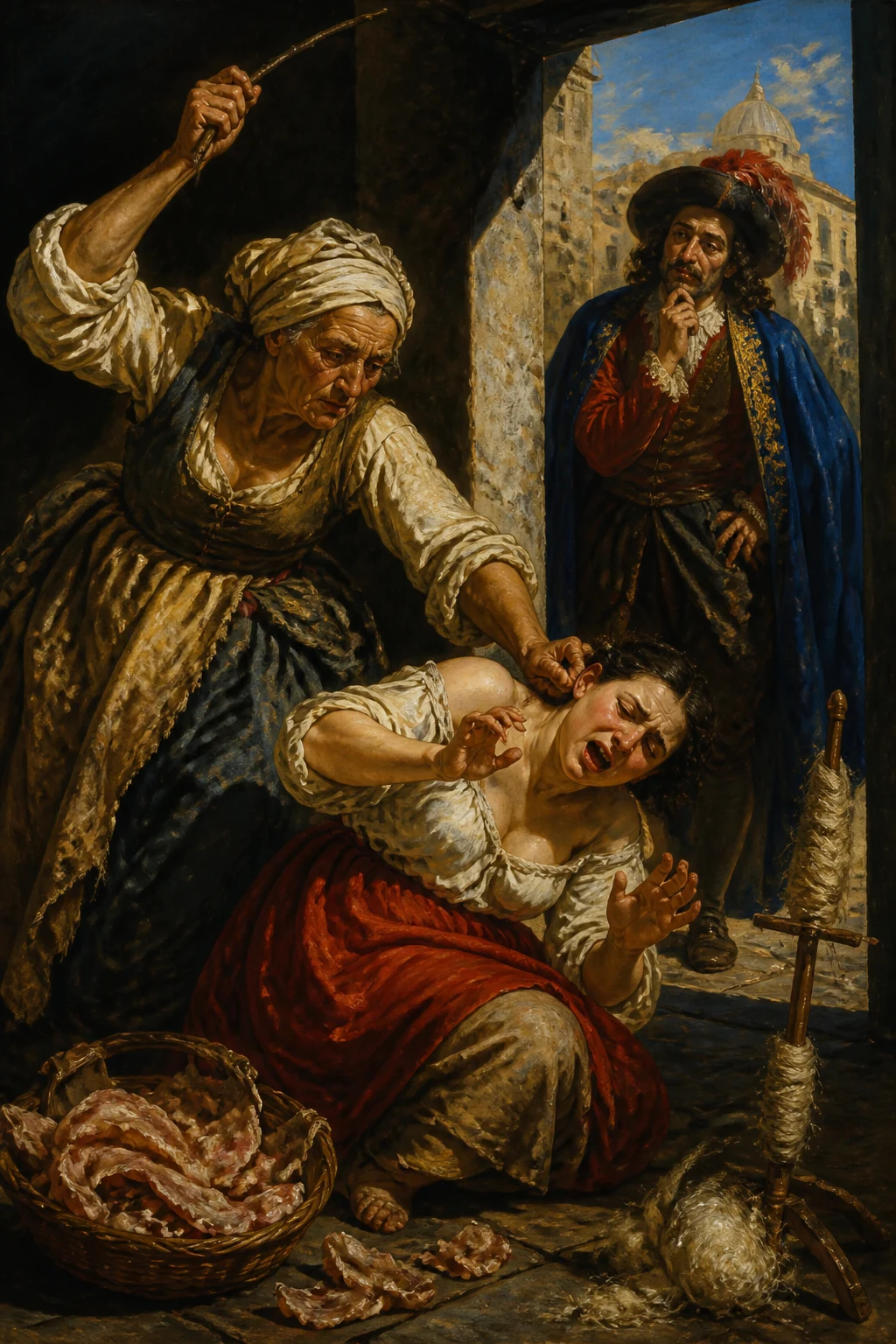
“What can come of it? I have hide enough on my back to pay for these rinds.” And so saying, down went the first; then, feeling her stomach claw at her still more fiercely, she laid hands on the second. Next she nibbled away the third, and so, one after another, she gulped down all seven. But once the mischief was done, she considered her mistake, and, imagining that those rinds would yet stick in her throat, she thought of a way to hoodwink her mother. Taking an old shoe, she sliced its sole into seven pieces and put them into the pot. Meanwhile her mother came home with a small bunch of cabbage leaves, and chopped them up, stalks and all, so as not to waste a scrap. Seeing that the pot was at a rolling boil, she threw in the greens and added a little grease that a coachman had given her as alms, left over from greasing a carriage. Then she had a cloth spread over an old poplarwood chest, took two chunks of stale bread out of her bag, fetched a wooden bowl from a rack, broke the bread into it, and ladled the greens and the patches of leather over the top. But as soon as she began to eat, she realized that her teeth were not a cobbler’s tools, and that, by some new transformation of Ovid’s, the pork rinds had turned into buffalo bellies. Turning to her daughter, she said, “You’ve played a fine trick on me, you accursed sow! What filth have you put in this soup? Has my belly become an old boot, that you should furnish it with patches? Quick, confess what has happened, or you’ll wish you had never been hatched, for I won’t leave a sound bone in your body!” Saporita began by denying it, but as the old woman pressed her more and more fiercely, she blamed the steam from the pot, which had blinded her eyes and led her into this wretched blunder. The old woman, finding her meal ruined, seized a broomstick and began plying it so briskly that more than seven times she dropped it and picked it up again, thrashing away wherever the blows might land. At the girl’s shrieks, a merchant who happened to be passing came inside. Seeing the old woman’s savagery, he took the stick out of her hand and said, “What has this poor girl done that you want to kill her? Is this a way to punish her, or to put an end to her days?
“Have you caught her tilting with lances, perhaps, or smashing pots at the games? Aren’t you ashamed to treat a poor little girl like this?” “You don’t know what she has done to me,” replied the old woman. “The shameless creature sees that I’m a beggar and has no consideration for me. She wants to see me ruined by doctors and apothecaries. Now that the weather is hot, I told her to stop working so hard, lest she fall ill, for I have no means of nursing her. But the headstrong thing has gone against my wishes and filled seven spindles this very morning, at the risk of bringing on some fever about her heart and lying bedridden for a couple of months.” When the merchant heard this, he thought that such an industrious girl might prove the good fairy of his house, and said to the old woman, “Put your anger aside, for I mean to rid your house of this danger by taking your daughter for my wife and bringing her home with me, where I shall keep her like a princess. For, by Heaven’s grace, I rear my own chickens, I fatten my own pig, I have pigeons, and my house is so full I can scarcely turn around in it. Heaven bless me and keep the evil eye away! I have barrels of grain, chests of flour, jars of oil, pots and bladders of lard, sides of bacon hanging overhead, racks of crockery, stacks of firewood, heaps of charcoal, a chest of linen, a bridal bed; and above all, rents and revenues enough to let me live like a lord. Besides, I turn an honest penny at the fairs—a few dozen ducats—and if things go my way I shall make myself rich.” The old woman, seeing this good fortune rain down upon her when she least expected it, took Saporita by the hand and gave her to him according to the use and custom of Naples, saying:
“Here she is: may she be yours for many happy years, with good health and fine children.” The merchant put his arms about her neck and took her home, scarcely able to wait for market day. When Monday came, he got out of bed bright and early and went to where the countrywomen sold their wares. There he bought twenty ten-pound bundles of flax, brought them to Saporita, and said, “Now spin to your heart’s content! You needn’t fear finding another raving madwoman like your mother, who broke your bones for filling a spindle. For every ten spindles I’ll give you ten kisses, and for every skein you make me, I’ll give you this heart of mine.
“So work away cheerfully, and when I come back from the fair, which will be in twenty days, let me find these twenty bundles of flax spun, and I’ll have a fine pair of red cloth sleeves made for you, trimmed with green velvet.” “Well, aren’t you in a hurry!” Saporita muttered under her breath. “You’ve filled your spindle now, haven’t you? Keep running, and see what you catch! If you’re waiting for a shirt from my hands, you may as well lay in a supply of wastepaper this minute. You’ve certainly found the right woman! Do you think spinning twenty bundles of flax in twenty days is as easy as milking a black goat? A curse on the boat that brought you to this country! Go on, you’ve plenty of time: you’ll find the flax spun when livers grow hair and monkeys lose their tails.” Once her husband had left, she, being as greedy as she was lazy, did nothing but take apronfuls of flour and jugfuls of oil and make fritters and fried cakes, which she nibbled from morning till night like a mouse and gobbled like a pig. But when the time drew near for her husband’s return, she began spinning fine schemes, thinking of the uproar and commotion there would be when the merchant found the flax untouched and the chests and jars empty. So she took a long pole and wound a ten-pound bundle of flax around it, tow and coarse ends and all; then she stuck an Indian gourd on a great forked stick and began lowering this lord abbot of spindles from the roof terrace to the street below. For her little bowl of water she had a great cauldron of macaroni broth, and as she spun her delicate thread, as fine as a ship’s cable, every dip of her finger gave the passersby a carnival sprinkling. Some fairies came along and were so delighted by this grotesque spectacle that they nearly burst with laughter. They therefore bestowed a charm on her, so that all the flax she had in the house should at once be not merely spun but woven into cloth and bleached. This was done in the twinkling of an eye, and Saporita swam in a sea of delight to see such good fortune rain down upon her from Heaven. But to prevent her husband from ever plaguing her this way again, she arranged to be found in bed with a measure of hazelnuts beneath her. When the merchant arrived, she began to moan, and, turning first to one side and then to the other, made the nuts crack as though her bones were coming apart. When her husband asked how she felt, she answered in the most woebegone little voice, “I couldn’t be worse, my husband: I haven’t a sound bone left in my body.
“Do you think it’s a mere mouthful of grass for a sheep to spin twenty bundles of flax in twenty days, and weave the cloth as well? Ah, husband, you never paid the midwife for your good sense: the donkey must have eaten it! Once I’m dead, my mother won’t make another like me, so you won’t catch me at this dog’s work again. I’ve no wish to fill so many spindles only to empty the spindle of my life.” Her husband caressed her and said, “Only get well, my wife, for I care more for this lovely loom of love than for all the linen in the world. Now I see that your mother was right to punish you for working so hard, since it costs you your health. But take heart: I’ll spend an eye out of my head to cure you. Wait here while I fetch the doctor.” And with that he ran off to summon Master Catruppolo. Meanwhile Saporita gobbled up the hazelnuts and threw the shells out of the window. When the doctor arrived, he felt her pulse, examined her face, inspected her urine, and sniffed her chamber pot, then concluded, with Hippocrates and Galen, that her trouble was too much blood and too little work. The merchant, who thought this the greatest nonsense he had ever heard, put a carlino into his hand and sent him packing without ceremony. He was about to go for another physician when Saporita told him there was no need, for the mere sight of him had cured her. So her husband embraced her and told her that from that day forward she was to take care of herself and do no work, for one could not have both Greek wine and cabbages, _The barrel full and the slave girl drunk._
Izvirnik
Jornata IV IV LE SSETTE COTENELLE
Naslednje strani prikazujejo izvirno besedilo za primerjavo.
_Na vecchia pezzente mazzeja la Figlia cannaruta, che s’ha manciato sette cotene, e danno a rrentennere a no mercante, ca lo ffaceva, perchè aveva fatecato sopierchio a nchire sette fuse, chillo se la piglia pe mmogliere, ma non volenno fatecare, pe beneficio de na Fata trova lo marito venenno da fora fatta la tela, e co nnova rasa de la mogliere se resorve de non farela cchiù ffatecare, azzò non cada malata._ _Benedecettero tutte la vocca de Meneca, la quale co ttanto gusto contaje sto cunto, che portaje nnanze all’uocchie de chi senteva, le ccose, ch’erano soccesse tanto lontano; de manera, che mmoppero ’nvidia a Tolla, e le fecero venire la voglia dall’ossa pezzella de passare a ppiede chiuppe Meneca; pe la quale cosa sporgato primmo
la voce, cossì decette._ Non se dice mutto, che non sia miezo, o tutto, e perzò chi disse; faccie storta, e bentura deritta, sapeva de le ccose de lo munno; o fuorze aveva lietto la storia de Antuono, e Parmiero; ventura Antuono, e non avè parpetole, ca senza visco piglie le ffocetole; vedennose pe sperienzia, ca sto munno è no retratto spiccecato de coccagna, dove chi cchiù fatica manco guadagna: dove chillo n’ave la meglio, che se piglia lo tiempo comme vene, ed è no maccarone cascame ’n canna; toccannose veramente co mmano, ca le pprede, e le spoglie de la fortuna se guadagnano co le ppermonare, e non co le galere sparmate, comme ve farraggio sentire.
Era na vota na vecchia pezzente, che co na conocchia ’n mano, sputazzianno le gente pe la via, jeva de porta ’n porta cercanno lemmosena, e perchè con arte, e co ’nganno se vive miezo l’anno, dette a rrentennere a ccerte femmenelle tennere de pormone, e ffacile de credenza, ca voleva fare non saccio, che grassa pe na figliola secca, s’abboscaje sette cotenelle de lardo, le quale portate a la casa, co na bona mappata de sproccole, che ghieze adonanno pe terra, le dette a la figlia, decennole, che l’avesse poste a ccocenare, mentre essa tornava a pezzire no poco de foglia a ccierte ortolane pe fare na menestrella saporita; la figlia pigliate le ccotene, e abbroscatone li pile, le mmese a na pignatella, e commenzaje a ffarele ccocere. Ma
non tanto vollevano drinto a lo pignato, quanto le vollevano ’n canna, perchè l’addore, che ne sceva l’era na desfida mortale a lo campo de l’appetito, e na zitazione ad informanno a la banca de la gola, tanto, che resiste e rresiste, all’utemo provocata da lo sciauro de lo pignato, tirata da na famma, che la rosecava, se lassaje correre a pprovarene no pocorillo, la quale le sappe tanto bona, che disse fra se stessa, chi ha paura se faccia sbirro: mme nne trovo sta vota: magnammo, e benga de creta, e chiova, è autro, che na cotena?
che sarà maje? aggio cuoiro de spalle da pagare ste ccotene; e cossì decenno, nne scese la primma, e sentennose granciare co cchiù fforza lo stommaco, dette de mano a la seconna; appriesso nne pezolejaje la terza, e cossì de mano ’n mano l’una appriesso l’autra ne le vrocioliaje tutte sette. Ma dopò fatto lo male servizio, penzanno a l’arrore, e nzonnannose che le ccutene l’avevano da ntorzare ’n canna, penzaje de cecare la mamma, e pigliato na scarpa vecchia, fellejaje ’n sette parte la sola, e la pose drinto a lo pignato. Fra sto miezo venne la mamma co no fascetiello de torza, e mmenozzatele co ttutte li streppune, pe non ne perdere mollica, comme vedde che lo pignato volleva a tutto revuoto, nce sciaffaje le foglia, e puostoce
no pocorillo de nzogna, che l’avea dato pe llemmosena no cocchiero, avanzato dall’onzione de na carrozza, fece stennere no cannavaccio ’n coppa na cascetella de chiuppo viecchio, e cacciato da na vertola doje tozze de pane sedeticcio, e pigliato da na rastellera no nappo de ligno, nce menozzaje lo ppane, e nce menestraje sopra le ffoglie co li taccune, e commenzanno a mmagnare, s’addonaje subeto, ca li diente suoje non erano de cauzolare, e ca le cutene de puorco co nova trasformazione d’Avidio erano deventate ventresche de vufaro. Pe la quale cosa votatase a la figlia le disse: Me l’aje fatta, scrofa mmardetta, e che schefienzia aje puosto drinto sta menestra, e che era fatto scarpone viecchio la panza mia, che m’aje provisto de
taccune? Priesto confessa mò comme passa sto fatto, o meglio non ce fusse schiusa, ca non te voglio lassare piezzo d’uosso sano. Saporita ccommenzaje a nnegare, ma ncauzannole le ddoglie de la vecchia; dette la corpa a lo fummo de lo pignato, che l’aveva cecato l’uocchie a fare sto male scuoppo. La vecchia, che se vedde ntossecato lo mmagnare, dato de mano a na mazza de scopa, accommenzaje de manera a llavorare de tuorno, che cchiù de sette vote la lassaje, e pigliaje, zollanno dove coglieva coglieva. A li strille de la quale trasette no mercante, che se trovaje passanno, e bisto la canetate de la vecchia, levatale la mazza da mano, le disse: Che ha fatto sta povera figliola, che la vuoje accidere? è mmuodo de castecare chisto, o de levare li juorne?
l’aje fuorze trovato a ccorrere lanze, o a rrompere carosielle? non te vreguogne a trattare de sta manera na scura peccerella? non saje tu, che m’ha fatto, respose la vecchia: la sbregognata mme vede pezzente, e non me conzidera, volennome vedere arroinata co mmiedece, e co speziale, pocca avennole ordenato mò, che face caudo, che lasse de fatecare tanto, pe non cadere malata, ca n’aggio comme covernarela, la presentosa a despietto mio ha voluto stammatina nchire sette fusa, a rriseco de le venire quarche rosala a lo core, e stare no paro de mise nfunno a no lietto. Lo mercante, che ssentette sta cosa, penzaje ca la massaria de sta fegliola poteva essere la fata de la casa soja, e disse a la vecchia, lassa la collera da na banna, ca io te voglio levare
sto pericolo da la casa, pigliannome sta figlia toja pe mmogliere, e portarela a la casa mia, dove la farraggio stare da prencepessa, ca pe grazia de lo cielo mme allevo le galline, me cresco lo puorco, aggio li palumma, no mme pozzo votare pe la casa, tanto sto cchino; lo cielo mme benedica, e li mal’uocchie non me pozzano, ca mme trovo le butte de grano, le ccasce de farina; le llancelle d’uoglio, le ppignate, e le bessiche de nzogna, l’appese de lardo, le rrastellere de roagne, le ccataste de legna, li montune de cravune, no scrigno de jancaria, no lietto de zito, e sopratutto de pesune, e de cienze pozzo campare da signore: otra, che mme nnustrio quarche decina de docate pe ste ffere, che si mme vene ’n chino mme faccio ricco. La vecchia, che se vedde
chiovere sta bona fortuna quanno manco lo ppenzava, pigliata Saporita pe la mano nce la conzegnaje ad uso, e ccostumanza de Napole, decenno: eccotella, sia la toja da ccà a biell’anne co ssanetate, e bella rede. Lo mercante puostele le braccia sopra lo cuollo, se la portaje a la casa, e non vedde maje l’ora, che fosse juorno de fare spesa; venuto lo lunedì se auzaje ben-matino da lo lietto, e ghiuto dove venevano le fforetane, accattaje vinte decine de lino, e portatele a Saporita, le disse: Or agge voglia de filare, ca n’aje paura de trovare n’autra pazza arraggiata comm’a mmammata, che te rompeva ll’ossa, perchè nchive lo fuso, ca io ped’ogne decina de fuse te voglio dare na decina de vase, e ped’ogne corinola, che mme farraje, te darraggio sto core;
lavora addonca de bona voglia, e comme torno da la fera, che sarrà fra vinte juorne, famme trovare ste binte decine de lino filato, ca te voglio fare no bello paro de maneche de panno russo fasciate de velluto verde: và ca staje lesto, respose sotto lengua Saporita, mo aje chino lo fuso, si, quanto curre, e mpizze. Si aspiette cammisa da le mmano meje, da mò te puoje provedere de carta straccia; ajela trovata, e ch’era latte de crapa negra a ffilare ’n vinte juorne vinte decine de lino? che malannaggia la varca, che te portaje a sto pajese. Va ch’aje tiempo, e trovarraje filato lo llino quanno lo fecato ha pile, e la scigna coda. Fra tanto partuto lo marito, essa ch’era cossì cannaruta, comme potrona, non attese ad autro, ch’a pigliare mappate de farina, ed
agliare d’uoglio, ed a ffare zeppole, e pizze fritte, che da la matina a la sera rosecava comm’a ssorece, e delloviava comm’a puorco. Ma arrivato lo termene, che lo marito doveva tornare, commenzaje a ffilare sottile, conzideranno lo remmore, e lo fracasso, ch’aveva da soccedere, quanno lo mercante avesse trovato lo llino sano, e le ccasce, e le llancelle vacante; e perzò pigliato na perteca longa, nce arravogliaje na decina de lino co tutta la stoppa, e le rreste, e ’mpizzato a na grossa forcina na cocozza d’innia, commenzaje a ccalare sto patre-abbate de le ffusa pe l’astreco a bascio, tenenno na gran caudara de vruodo de maccarune pe ssauzariello d’acqua, e mentre filava sottile comm’a nzarte de nave, e ad ogn’nfosa de dito jocava a ccarnevale co
cchille, che ppassavano: Vennero passanno certe Ffate, le quale appero tanto gusto de sta brutta visione, ch’appero a crepare de riso: pe la quale cosa le dezero fatazione, che quanto lino aveva a la casa se fosse trovato subeto, non sulo filato, ma fatto tela, e ghianchiato, la quale cosa fu fatto ped’ajero, tanto che Saporita natava drinto a lo grasso de la prejezza, vedennose chioppeta da lo Cielo sta bona ventura. Ma perchè non l’avesse a ssoccedere cchiù sto frosciamiento de lo marito, se fece trovare a lo lietto, e ’n miezo na mesura de nocelle; e arrivato lo Mercante commenzaje a gualiarese, e botannose mo da na parte, e mo da n’autra faceva scoccolare le nnocelle, che pareva che se scatenassero l’ossa; e demmannata da lo marito comme se
senteva, respose co na vocella affritta affritta: Non pozzo stare peo de chello, che stongo, marito mio, che non m’è remasto uosso sano; e che te pare no poco d’erva pe lo piecoro a ffilare vinte decine de lino ’n vinte juorne, e ffare la tela perzì. Va marito mio ca non n’aje pagato la mammana, e la descrezzione se l’ha manciata l’aseno: comme io so mmorta, non ne fa cchiù mamma mia, e perzò non me ce cuoglie cchiù a ste ffatiche de cane, ca non voglio pe nchire tante fusa, devacare lo fuso de la vita mia. Lo marito facennole carezzielle, le disse stamme sana mogliere mia, ca voglio cchiù pe sto bello Telaro ammoruso, che pe tutte le ttele de sto munno; e mmo canosco, ch’aveva raggione mammata de te castecare pe ttanta fatica, mentre nce pierde la sanetate. Ma fa
buon anemo, ca nce voglio spennere n’uocchio a ssanarete, ed aspetta ca vao mo pe lo miedeco; e cossì decenno jette a la ncorza a chiammare messere Catruppolo. Fra tanto Saporita, se cannarejaje le nnocelle, e ghiettaje pe la fenestra le scorze, e benuto lo Miedeco, toccato lo puzo, osservata la facce, visto l’aurinale, e addorato lo cantaro, concrose co Ippocrate, e Galeno, ca lo mmale sujo era de sopierchio sango, e de poca fatica; lo mercante che le parze de sentire no sproposeto granne, puostole no carrino ’n mano nne lo mannaje caudo, e ffetente, e bolenno ire pe n’autro Gerugeco, Saporita le disse che non faceva abbesuogno, perchè la vista soja schitto l’aveva sanata; e cossì lo marito abbracciannola, le disse, che se fosse dall’ora nne nante
covernata senza fatica, perchè non era possibele ad avere grieco, e ccappuccie, _La votte chiena, e la schiava mbriaca._
Nadaljuj z branjem