O besedilu
Boter
- Vir
- Pentameron
- Avtor
- Giambattista Basile
- Jezik branja
- English
- Jezik izvirnika
- Neapolitan
- Čas branja
- 24 min branja
- Obseg
- 19 strani
- Naslov izvirnika
- Jornata II X LO COMPARE
O izvirniku
Pentameron
Baročna, divja starejša plast evropske pravljice, polna obratov in pretiravanj. Bralni jezik je English, izvirnik pa prihaja iz vira Pentameron v jeziku Neapolitan.
Besedilo
Boter
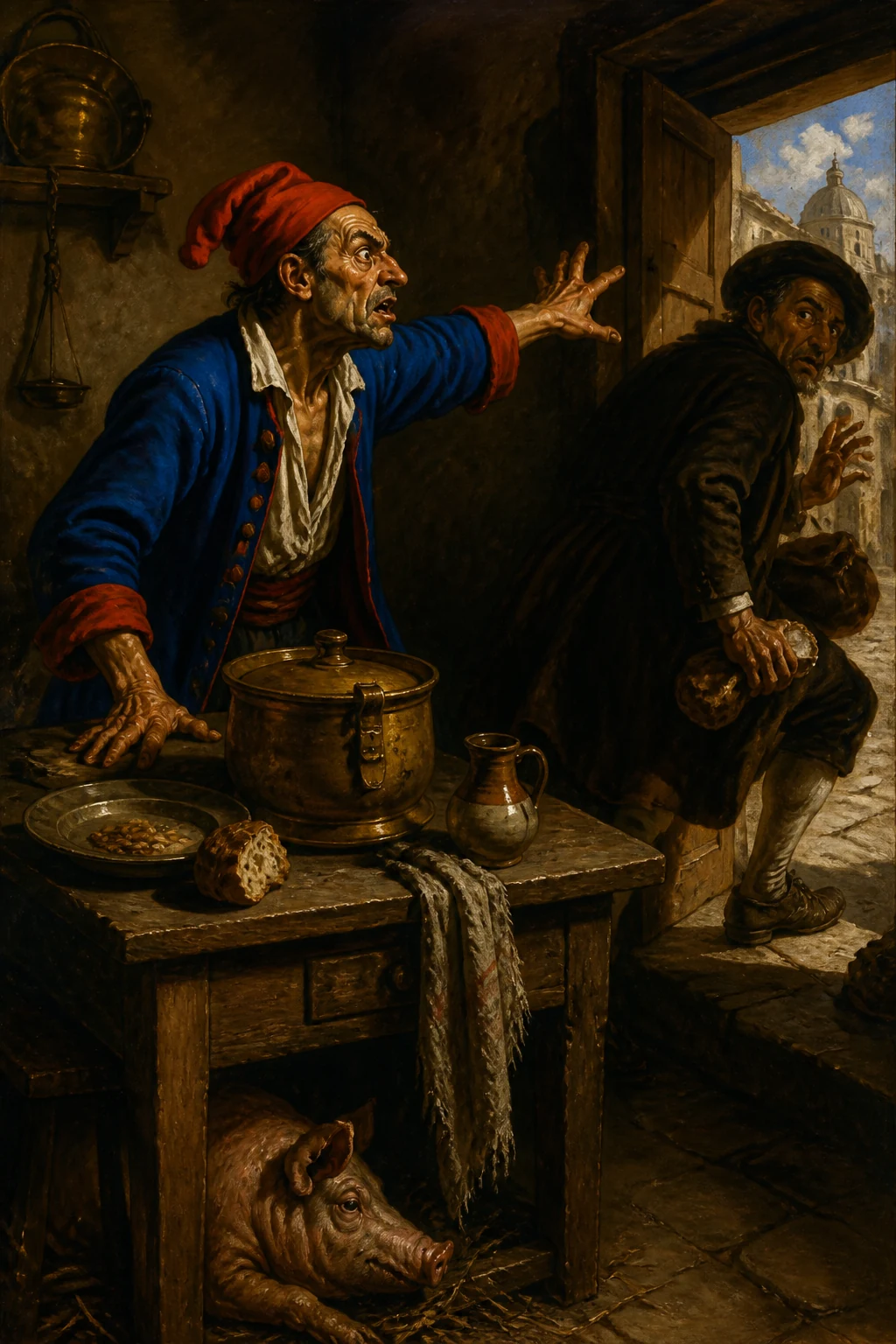
_Cola Jacovo, a miser, has a sponging friend who sucks him dry. Unable to shake him off by tricks or stratagems, he sticks his head out of the sack at last and drives him from the house with a torrent of abuse._ _The tale was truly delightful, gracefully told and attentively heard, so that a thousand things combined to season it and make it pleasing. But every scrap of time that slipped between one tale and the next kept the slave-woman on the rack and dealt her another blow; so Jacova was urged to take her turn. She tapped the barrel of her stories to refresh her listeners’ thirst, and began in this fashion._ A lack of discretion, my lords, makes the yardstick drop from the hand of the merchant of judgment, sends the compass astray in the hand of the architect of good breeding, and robs the mariner of reason of his bearings. Taking root in the soil of ignorance, it bears no fruit but shame and disgrace, as we see happen every day. This befell, in particular, a certain brazen-faced fellow, as I shall tell you.
There was once a certain Cola Jacovo, a miser from Pomegliano, married to Masella Cernecchia of Resina, a man as rich as the sea, who had so much he did not know what he owned: his pigs were safely penned, and he had straw enough to last till Judgment Day. Yet although he had neither children nor any other encumbrances, and measured his money by the bushel, he could have run a hundred miles without letting slip a coin worth a hundred and twentieth of a carlino. Denying himself everything, he led a wretched dog’s life, all to put something by and heap up his hoard. Nevertheless, whenever he sat down to keep body and soul together, along came that curse of a friend of his, never an ounce short, never a step behind him. As though he had a clock in his belly and an hourglass between his teeth, he always reported for duty at feeding time, to join them at table; and with a forehead as hard as a pestle, he fastened himself upon them so firmly that they could not have driven him off with kicks.
He counted every mouthful that went down their throats, dropping hints and casting out feelers, until someone said, “If you would care to join us”—whereupon, without much pressing, he thrust himself squarely between husband and wife. Then, as though starved, famished, sharpened to a razor’s edge, ravenous as a hunting dog, with a wolf in his belly, he set to at a flying pace, like a man racing home from the mill. His hands worked like a piper’s, his eyes rolled like a stray cat’s, his teeth ground like millstones. Swallowing everything whole, with one mouthful overtaking the next, he stuffed his cheeks, loaded his gullet, and made himself a belly like a drum. When he could see the bare glaze of the dishes, and had swept the whole country clean, without so much as a “God keep you,” he seized a jug and puffed at it, gulped it, emptied it, swilled it, drained it at a single breath until the bottom showed. Then off he went about his own affairs, leaving Cola Jacovo and Masella with their noses a foot long. Seeing how little discretion their friend possessed, how, like a sack split at the seams, he gobbled, guzzled, chomped, crammed, gulped, drained, stripped, picked, bundled away, wolfed, flattened, combed, battered, mangled, and demolished everything on the table, they did not know what to do to rid themselves of this bloodsucker, this plaster over the heart, this plague in their breeches, this August purge, this persistent fly, this burrowing tick, this torment, this bony growth, this burden, this perpetual tax, this octopus, this weasel, this weight, this headache. They longed for the hour when they might eat at their ease for once, without this helping hand, this fattening piece of cork. So one morning, having learned that their friend had gone out of town as an official’s assistant, Cola Jacovo said, “Oh, praise the sun in Leo! Once in a hundred years we’ve been granted the chance to work our jaws, set our grinders trotting, and put something under our noses without all this fretting of our backsides! Well, if the court means to ruin me, I’ll ruin myself: in this shitty world, you get only what you can snatch with your teeth. Quick, light the fire! Now that we’ve a free hand to give ourselves a proper combing, let’s satisfy our longing for something tasty, some dainty morsel.” So saying, he ran to buy a fine eel from Pantano, a rotolo of sifted flour, and a good flask of Mangiaguerra wine. Returning home, he fried the eel while his wife busied herself making a splendid pie. When everything was ready, they sat down at table; but scarcely were they seated when, lo and behold, their great glutton of a friend was knocking at the door. Masella looked out, saw this spoilsport come to wreck their pleasure, and said to her husband, “My dear Cola Jacovo, never was a pound of meat sold at the butcher’s shop of human pleasures without the makeweight bone of sorrow! Never did anyone sleep between the white sheets of contentment without some bedbug of trouble!
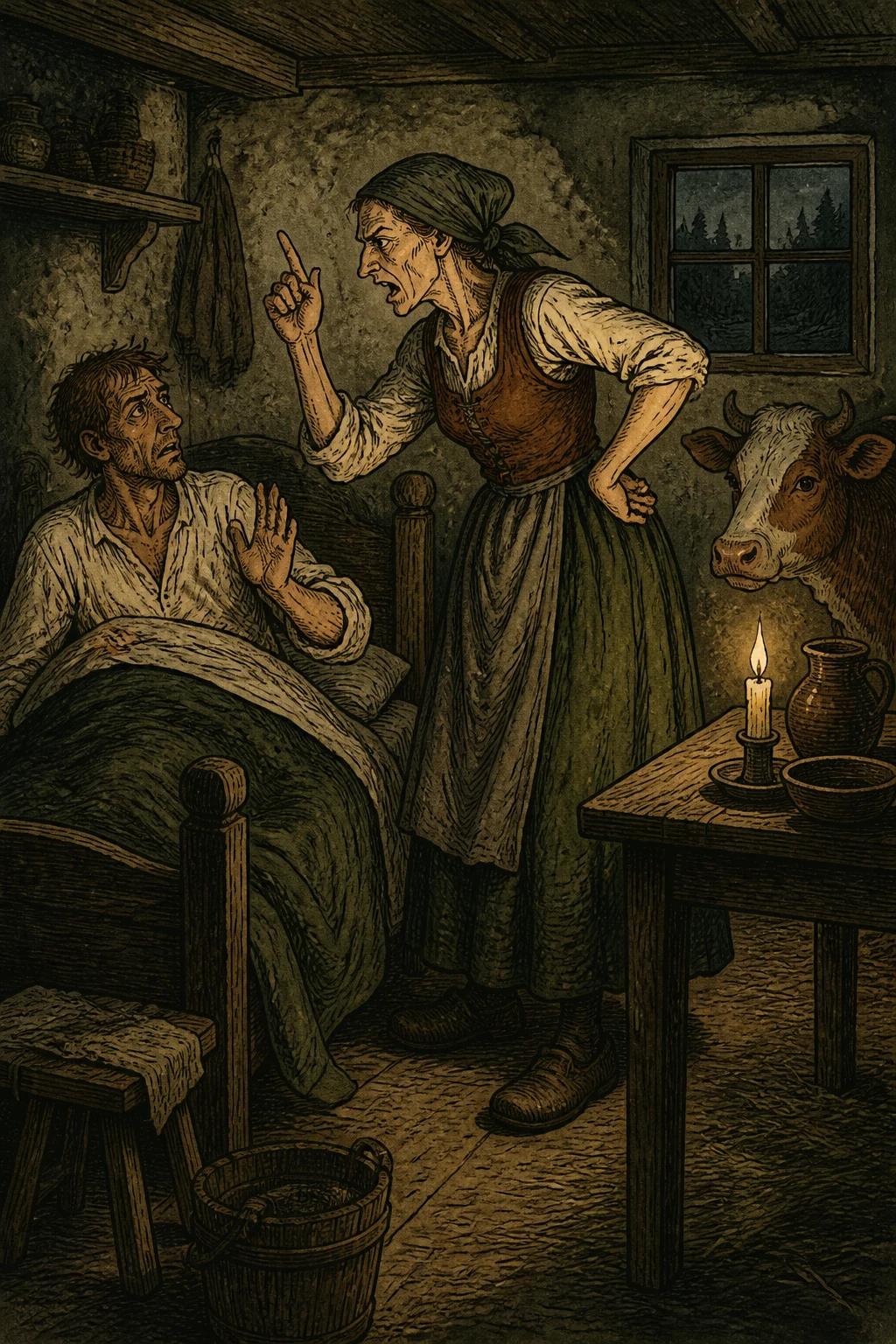
“Never was a wash of pleasure hung out without a shower of disappointment falling on it! Here’s our bitter mouthful tied in a knot; here’s this damned dinner stuck in our throats!” To which Cola Jacovo replied, “Put away what’s on the table: spirit it off, hide it, shove it into holes where it won’t show; then open the door. Finding the village already plundered, perhaps he’ll have the decency to leave soon and give us room to choke down this little bit of poison.” While their friend was sounding the alarm and ringing a triumphant peal, Masella thrust the eel behind a cupboard, the flask beneath the bed, and the pie between the mattresses; and Cola Jacovo ducked under the table, peering through a hole in the cloth, which hung down to the floor. Their friend saw all these manoeuvres through the keyhole. When the door was opened, he came in with a fine tale ready, looking utterly flustered and terrified. Masella asked what had happened to him. “While you left me wasting away outside,” he said, “in such torment and anxiety, waiting for the crow to come home before you would open the door, a snake slithered round my feet. Oh, mother of mercy, what a monstrous, hideous creature! Just imagine: it was as big as the eel you put in the cupboard. Finding myself cornered and in danger, trembling like a reed, with my innards spinning from fright, my guts crawling with fear, and my limbs shaking with terror, I picked up a stone as big as the flask beneath the bed, and—whack!—caught it on the head and flattened it into a pie like the one between the mattresses. And as it lay dying and writhing, I could see it looking at me just as my friend is looking from under the table. There isn’t a drop of blood left in my body, I’m so frightened and appalled!” At these words Cola Jacovo, who could no longer sit still or swallow this sweet talk, poked his head out of the tablecloth like a puppet appearing onstage and said, “So that’s how it is! A pretty pie indeed! Now we’ve filled the spindle, eh? Now we’ve baked our bread, eh? Now we’ve won our lawsuit, eh? If we owe you anything, summon us before the bailiff; if we’ve offended you, lodge a complaint at the Mint; if you feel injured, put me on a short tether; if you’ve an itch, give yourself an enema with a funnel; if you’ve a claim, press it with a fox’s tail, and go stick that nose of yours in Naples! What manners are these? What way is this to behave? Anyone would think you were a soldier billeted on us, demanding our goods as your due! You should have been content with a finger, not taken the whole hand: with all this commotion you’ll soon drive us from our own house! To a man without discretion, the whole world belongs; but whoever won’t measure himself will be measured by others, and if you have no yardstick, we have augers and rolling pins! In short, you know the saying: a stout pestle for a stout forehead. So let every hedgehog go back to his own pallet, and leave us with our own troubles. If you think you’ll keep playing this tune from now on, you’re wasting your breath: you won’t bring it off. If you imagine you’ll always lie soaking in this gravy, wait on, wait on—March has shaved you bare, and you can take your toothpick elsewhere! If you think this is an open tavern for that rotten gullet of yours, however fast you run to cram it, forget it! Get it out of your head! It’s wasted effort, a thing of wind; there’s no more bait here, no more curds for you! You’d scented the gulls and pigeons, you’d spotted the helpless wards, you’d sounded out the asses, you’d found the land of plenty! Now go back where you came from: you won’t have your way again. You may call this house a feather, for it has flown beyond your reach; you’ll draw no more water at my expense! You’re a dinner-sniffer, a bread-evictor, a table-wrecker, a kitchen-sweeper, a pot-licker, a bowl-cleaner, a great gullet, a sewer-pipe, with a craving, a wolf, a deluge, a bottomless pit inside you! You’d eat an ass’s packsaddle and the bottom out of a ship; you’d swallow the Prince’s bear and wear out a blood-drain. Neither the Tiber nor the Garigliano would suffice you, and you’d eat Mariaccio’s breeches! Go round the other churches, go cast your dragnet, go gather rags from rubbish heaps, go hunt nails for coffins, go beg wax for funerals, go unblock privy drains to fill that crop of yours—and let this house be fire to you! Everyone has troubles of his own; everyone knows what he carries beneath his clothes; everyone knows what sits upon his stomach. We have no need of bankrupt firms, broken-down connections, and shattered lances like you! Save himself who can: you must be weaned from this little teat! You bird that wastes the daylight, you idler, you lazybones—work, work! Take up a trade! Find yourself a master!”
The wretched friend, hearing this plain-spoken harangue, this bursting of an abscess, this carding without a comb, stood cold and frozen as a thief caught in the act, a pilgrim who has lost his way, a sailor whose boat has broken up, a whore who has lost her customer, a little girl who has fouled the bed. Tongue between his teeth, head lowered, beard thrust into his chest, eyes streaming, nose drooping, teeth chilled, hands empty, heart dwindling, tail between his legs, thoroughly roasted, silent and speechless, he gathered up his traps and went, never once looking back. And well did that worthy saying fit his case: _A dog unasked to wedding feasts_ _Had best stay home, or taste the sticks._ They laughed so much at the shameless friend’s disgrace that they did not notice how the Sun, having been too prodigal with his light, had gone bankrupt, slipped his golden keys beneath the door, and made his escape. But Cola Ambruoso and Marchionno came out in chamois breeches and slashed serge doublets to perform the second interlude, and pricked up every ear to hear the rigmarole of the eclogue that follows.
THE DYE. AN ECLOGUE. _Cola Ambruoso and Marchionno._ _Col._ Of all the trades, Marchionno, dyeing deserves—as someone said, I cannot remember whether a scullion or a cook—the highest praise and foremost place.
_M._ I deny your conclusion, Cola Ambruoso, for that is a filthy trade: your hands are always stained with gallnuts, vitriol, and alum, just like the bottom of a cooking pot.
_C._ On the contrary, it is the cleanest of all occupations, just the thing for a man who wishes to look spotless when he is foul with grease. _M._ Next you’ll persuade me it’s a perfumer’s trade, or an embroiderer’s! Away with you, away: you’ve made a blunder.
_C._ I mean to prove to you, and maintain it even inside an oven, that the dyer’s trade is a gentleman’s business. Nowadays it is practised above all others; by it a man makes his living and wins esteem.
Though his belly be full of fraud and his breast full of vice, dye covers every flaw. _M._ What have a man’s vices to do with dyeing wool and silk braid?
_C._ How plain it is you know nothing of the matter! You think I mean dyeing stockings or old rags. The dye I speak of is something other than indigo or brazilwood: a dye that makes a mulberry colour look like flesh.
_M._ I’m all in the dark; I don’t understand a scrap. This talk of yours muddles and clouds everything. _C._ Listen: if you understand me, you’ll learn to be a dyer—or at least to recognize those who dye.
And you’ll take great pleasure in learning this new art, an art much practised among the craftiest folk; an art that undertakes to make a cockroach look like a cat.
Listen: suppose there’s a triple-distilled gallows-bird who sweeps up everything he comes across or sets eyes on, who lifts whatever he sees and clips whatever he finds. Now someone who knows this dye will not give him the infamous name of thief or robber, swindler or rogue, but will say he uses his judgment, digs money out of the earth, knows how to earn, and could make a living even in a wood.
He makes the most of things, he’s a fine fellow, a hook, a dragnet, a go-getter, a corsair of the purest metal, who never loses his cap in a crowd. In short, with this dye so fine and elegant,
a scoundrel wins the name of shrewd. _M._ Ah, now you’re filling my hand! This is a marvellous art—but not one that works for poor folk, only for certain high-and-mighty fellows who are allowed, without so much as blinking, to call their thefts gifts and their stolen goods fruits brought from afar.
_C._ Then there’s a coward, a turncoat, a Judas, a breeches-fouler, a hen, a poor-spirited creature with the heart of a chick, terrified, appalled, frozen, frightened, trembling like a reed, always spinning the thinnest thread, always with worms crawling through him and his innards in a whirl, afraid of his own shadow. If anyone looks at him askance, he turns into a heap of worms;
if someone threatens him, you see him like a plucked quail, deathly and pale. His words fail him, he gets the runs on the spot; if the fellow reaches for his sword, he takes to his heels and bolts. Yet with this noble dye people consider him prudent, steady, a worthy man who proceeds by plumb line and compass, who does not catch turds on the wing or buy quarrels for ready money. He is no bait for the law courts; he minds his own business and keeps quiet and still. Thus, my son, a rabbit comes to be taken for a fox.
_M._ It seems to me a man who saves his skin knows what he’s about. I once read in a history—I cannot say whether handwritten or printed—that a fine retreat saves a whole life.
_C._ But then, on the other hand, you see a man of honour, a daring fellow, a man of heart who would not yield an inch to Rodomonte, who could stand toe to toe with Orlando and butt heads with Hector, who will not let a fly brush past his nose, whose deeds come before his words, who keeps every swaggering bully and faction-leader on short rations and makes him put both feet into one shoe. He knows how to wield his weapons, has the spirit of a lion, would fight death itself, never takes a backward step, and always charges like a ram.
But once he is treated with this dye, everyone takes him for an impudent daredevil, rash, insolent, touchy, mad, all vitriol, a firebrand, a house-wrecking blaze, a fellow who sets his foot against every stone, who fishes for quarrels with a stick, an unreasonable man, a dissolute, unbridled creature who never lets a day pass without making trouble, who keeps the neighbours in turmoil and provokes the very stones in the street. In short, he is thought a man worthy of rhymes—and of an oar in the galleys.
_M._ Hush, they’re right: a wise, well-balanced man is one who wins respect without a sword. _C._ Here’s a skinflint, a starveling, a tight-belt, a pitch-lined purse, a brazier’s pair of pincers, a dry-shitter, a constipated wretch, a nail-gnawer, a Sienese horse, a squeezed orange, a corkwood pig, a plum stone, a niggardly ant out of a sorb-apple, the very mother of poverty and want, who, like a kicking horse, would sooner give you a pair of kicks than a hair from his tail.
A sour, grasping miser who could run a hundred miles without dropping a farthing, who would take a hundred bites at a bean and tie a hundred knots round half a fivepenny piece, who never shits so that he need not eat. But apply this dye at once and he is called a thrifty man,
one who does not throw away or squander what he owns, who does not let his property go floating downstream, who is a good householder and lets not a crumb fall to the floor. In the end he is called—though only by certain scoundrels—
a man as exact as a compass, as firm as pincers. _M._ Oh, what a filthy breed, with their hearts lodged in their pennies! He keeps fasts no doctor ordered, wears a hundred patches, always looks miserable, treats himself like a beggar and a scullion, and dies lean in the midst of plenty.
_C._ But the reverse of that medal is the man who scatters and spends, who would sink a ship and saddle a mint with debt, a sack split at the seams, spilling all he has, who takes no account of his possessions.
You see a hundred round him, spongers and parasites without a single virtue, and he showers money on them wholesale. He squanders without judgment, flings away without reason, gives to dogs and pigs, and goes up in smoke.
Yet with this dye he acquires the reputation of a generous soul, courteous, magnanimous, and noble, who would give you the eyes out of his head, a friend to his friends, with a royal air about him, never refusing anyone who asks. And with this fine excuse he empties his coffers and strips his house bare.
_M._ Whoever calls such a man generous lies in his throat. A generous man gives at the right time and place; he does not throw good coins at worthless people and buffoons, but bestows his crowns upon the honourable, deserving poor.
_C._ Look at a great guzzler, a well-filled pot, a woolly ram, a horned Martin, a leap-and-butt, a house with two doors, a pair of shoes made of horn, a fellow whose home stands at the fork in the road;
a “Yes, sir, as you please,” a little bull, the original painting of infamy and the very image of its copy. Dye even him, and they call him quiet, a worthy man, a gentleman who minds his own business, gets on with everyone, and is courteous to all. His house is open to his friends; he stands on neither ceremony nor points of honour; he is soft as bread, sweet as honey, you may do what you please with him. And meanwhile, without so much as blushing, he trades in flesh and saves his bones.
_M._ Such men live off the fat these days. Just look at one of them going to the tavern at night: the lantern shines through his horns. _C._ A man lives in retirement, does not mix with rogues and scoundrels, shuns disturbances, wants no headaches, has no wish to answer to every Tom, Dick, and Harry. He lives quietly, his own master, with no one to wake him when he sleeps or count his mouthfuls when he eats.
Yet someone will dye him too, calling him unsociable and savage, a turd of a sparrowhawk, with neither scent nor stink, a sour, insipid creature, crusty, hard-hearted, a man without savour or affection, wretched, brutish, a lump, macaroni without salt.
_M._ Oh, happy the man who lives in a desert, who neither sees others nor has his fill of them! Let people say what they please; I find one saying well proved: better alone than in bad company.
_C._ But then, on the other side, they find a sociable man, flesh and nail with his friend, a good, affable companion who treats everyone informally. And with this dye—who would believe it?—he finds people to cut and snip at him, stitch and unpick him, work against the nap, and plead his case behind his back,
calling him shameless, a pushy fellow, a fart in breeches, a forehead hard as an awl, a broken lace among a dozen, a brazen wretch, parsley in every sauce, who wants to salt everything he sees and poke his nose into everything he hears, a meddler, an arrogant busybody. Add that to your account and spend it, poor fellow!
_M._ He deserves that and worse. The Spaniard understood it when he said long ago, “Too much familiarity breeds contempt.” _C._ If a man happens to speak wittily, chat, discourse, and display his ingenuity and eloquence, if wherever you touch or turn him you find him lively and ready with an apt reply,
this dye reduces him to such a state that he gains nothing but the title of prattler and loudmouth, a sewer-pipe, a fellow who could outdo the cicadas, with more words than a magpie, who deafens you and addles your brains with so much nonsense and rigmarole, so many ogre’s tales, so much droning and fuss, that when he sets his tongue in motion, with a mouth like a hen’s backside, he poisons, stuns, and plagues you.
_M._ In this age of great asses, do what you will, you’ll always be wrong. _C._ But if another man stays quiet and mute, holds his peace, seals his lips, and saves his mouth for figs, so that you never hear him utter a peep, this dye changes his colour too: he is called Anthony the Simpleton, a limp fool, a lump of a dolt, a blockhead, a stump from hell, always cold and frozen, like a bride who has come to a bad match.
And so I see no North Star to steer through this gulf: speaking is bad, and silence worse. _M._ Truly, nowadays you don’t know how to deal with people, you don’t know how to fish; there’s no beaten path for the traveller. Blessed is he who guesses right in this world.
_C._ But who could ever tell to the last drop all the effects of this dye? It would take a thousand years, certainly, and a tongue of metal would not suffice. Let a man do what he will, behave as he pleases, his colour is changed all the same: the buffoon is called a wit who provides entertainment;
the spy, a man who knows the workings of this topsy-turvy world; the scoundrel, ingenious and enterprising; the lazy man, of a phlegmatic temper; the glutton, a lover of good living;
the flatterer, an accomplished courtier who understands his master’s humour and knows how to please him; the whore, courteous and obliging; the ignorant man, simple and good-hearted.
And so it goes, from one to the next; but enough. It is no wonder, then, that at court the wicked flourish and the good lament, for their lords are fooled by this colouring dye, and keep swapping and exchanging, as we have always seen, leaving the worthy man for the rogue.
_M._ Wretched is he who serves! Oh, better had his mother borne him dead: he runs through storms and never hopes for port. _C._ The court is made solely for vicious folk; it always keeps the good man at a distance, gets him out of the way, pushes him off, and flings him aside.
But let us leave these matters: once I begin scratching where it itches, I should not finish tomorrow or the day after. So let us put a full stop here and go our way, now that the sun is playing hide-and-seek; we’ll do the rest another evening.
_Colambruoso closed his mouth and the Sun closed the day at the very same moment. So, having agreed to return the following morning with a fresh supply of tales, they went home, sated with words and laden with appetite._ _End of the Second Day._ THIRD DAY OF THE ENTERTAINMENT FOR LITTLE ONES.
No sooner had the Sun’s visit set free all the shadows imprisoned by the tribunal of night than the Prince and his wife returned with the women to the same place, to pass pleasantly the hours that lay between morning and mealtime. They sent for the musicians and began to dance with great delight, performing the Roggiero, the Villanella, the Ogre’s Tale, the Sfessania, the Beaten Peasant, All Day Long with That Little Dove, the Tordiglione, the Dance of the Nymphs, the Gypsy Girl, the Capricious Girl, My Bright Star, My Sweet Loving Fire, She Whom I Go Seeking, the Chatterbox and Little Chatterbox, Yes, Sir, As You Please, Low and High, the Chiaranzana with its pointed toe, See Whom I Fell in Love With, Snatch It, It Will Do You Good, the Clouds That Drift Through the Air, the Devil in His Shirt, Living on Hope, Change Hands, the Cascarda, and the Spagnoletta, ending the dances with Lucia the Bitch to please the slave-woman. Thus the time flew by without their noticing, and the hour for eating arrived, when all the good things under heaven were served up—indeed, they are eating still. When the tables had been cleared away, Zeza, who was sharpened to a razor’s edge and eager to tell her tale, began as follows.
Izvirnik
Jornata II X LO COMPARE
Naslednje strani prikazujejo izvirno besedilo za primerjavo.
_Cola Jacovo aggrancato ha no Compare aleviento, che se le zuca tutto, nè potenno co arteficie, e stratagemme scrastaresillo da cuollo, caccia lo capo da lo sacco, e co mmale parole lo caccia da la casa._ _Fu bello veramente lo cunto ditto co grazia, e ssentuto co attenzione, de manera, che concorzero mille cose a darele zuco perchè piacesse; ma perchè ogne picca de tiempo, che se metteva ’n miezo da canto a canto teneva la schiava a la corda, e le deva li butte, però se sollecetaje Jacova de ire a lo tuorno, la quale mese mano a la votte de le filastroccole, per refrescare lo desederio de l’audeture, de chesta manera._ La poca descrezzione, Segnure, fa cadere la meza-canna da mano a lo
mercante de lo jodizio, e sgarrare lo compasso all’architetto de la crianza, e perdere la vusciola a lo marinaro de la ragione, la quale piglianno radeca ne lo terreno de la gnoranza, non produce autro frutto, che de vergogna, e de scuorno, comme se vede soccedere ogne ghiuorno; particolaremente accorze a no cierto facce-tosta de Compare, comme dirraggio. Era no cierto Cola Jacovo aggrancato de Pomegliano, marito de Masella Cernecchia de Resina, ommo ricco comme a lo maro, che non sapeva chello, che se trovava, tanto ch’aveva ’nchiuso li puorce, e tteneva paglia fi a ghiuorno. Co ttutto chesso, si bè n’aveva nè figlie, nè sfittiglie, e mmesurava li de quibus a ttommola, se correva ciento milia, non le scappava uno de ciento vinte a ccarrino, e ffacennose
male a patere, faceva na vita stentata da cane pe mettere da simmeto, e fare stipa; tutta vota sempre, che se metteva a ttavola pe mmantenere la vita, nc’arrevava pe rruotolo scarzo no male-juorno de Compare, che non lo lassava pedata, e comme s’avesse l’alluorgio ncuorpo, e l’ampolletta a li diente, sempre se consigniava all’ora de lo mazzeco, pe rremescarese co lloro, e co na fronte de pesaturo se l’azzeccoliava de manera ’ntuorno, che non ne lo poteva cacciare, co li pecune; e tanto le contava li muorze ’n canna, e tanto deceva mottete, e ghiettava mazze, si che l’era ditto; se te piacesse, dove senza farese troppo pregare, schiaffannose da miezo a mmiezo fra lo marito, e la mogliere, e comme se fosse abbramato, allancato, ammolato a rrasulo,
assajato, comme cane de presa, e co la lopa ncuorpo, co na carrera, che bolava, da dove viene da lo molino, menava le mmano comme a sonatore de Pifero, votava l’uocchie comme a gatta forastera, ed operava li diente comme a ppreta de macena, e gliottenno sano, e l’uno voccone non aspettanno l’autro, comme s’aveva buono chino li vuoffole, carrecato lo stefano, e fattone na panza comme a ttammurro, dapò visto la petena de li piatte, e scopato lo paese senza dicere, covernamette; dato de mano a n’arciulo, e sciosciatolo, zorlatolo, devacatolo, trincatolo, e scolatolo tutto a no sciato fi che ne vedeva lo funno, se ne pigliava la strata a fare li fatte suoje, lassanno Cola Jacovo, e Masella co no parmo de naso; lo quale vedenno la poca descrezzione de lo Compare,
che comme a ssacco scosuto se ’nnorcava, cannariava, ciancolava, ’ngorfeva, gliotteva, devacava, scervecchiava, piuziava, arravogliava, scrofoniava, schianava, pettenava, sbatteva, sformava, e arresediava quanto nc’era a la tavola, non sapevano, che fare pe scrastarese da tuorno sta sango-zuca, sta pittema cordiale, sto ’nfettamiento de vrache, sta cura d’Agusto, sta mosca ’nsista, sta zecca fresa, sta susta, sto sopr’uosso, sto pesone, sto cienzo perpetuo, sto purpo, sta fasina, sto pisemo, sta doglia de capo; e non vedevano maje chell’ora de na vota magnare sciamprate, senza st’ajuto de costa, senza sta grassa de suvaro, tanto che na matina avenno saputo ca lo Compare era juto pe spalla de no commissario fora la terra, Cola Jacovo disse, o
che ssia laudato lo Sole Lione, ca na vota ’n capo de cient’anne nc’è toccato de menare le mmasche, de dare lo portante a le Ganasse, e de mettere sotta lo naso senza tanto frusciamiento de tafanario; perzò la corte mme vò sfare, io sfare mme voglio: Da sto munno de ’mmerda tanto n’aje, quanto scippe co li diente, pristo allumma lo ffuoco, che mo, che avimmo mazza franca de farece na bona pettenata nce volimmo sgoliare de quarche cosa de gusto, e de quarche muorzo gliutto: cossì decenno corze ad accattare na bona Anguilla de Pantano, no ruotolo de farina asciorata, e no buono fiasco de manciaguerra, e tornato a la casa; mentre la mogliere tutta affannata fece na bella pizza, isso frejette l’anguilla, ed essenno ogne cosa all’ordine, se sedettero a
ttavola; ma non foro accossì priesto sedute, che beccote lo pascone de lo compare a ttozzolare la porta, e affacciatose Masella, e bisto lo sconceca-juoco de li contiente lloro, disse a lo marito; Cola Jacovo mio, male s’appe ruotolo de carne a la chianca de li guste omane, che non nce fosse la jonta dell’uosso de lo dispiacere; maje se dormette a llenzola janche de sfazione, senza quarche pimmece de travaglio; maje se fece colata de gusto, se non ce ’mmattesse chioppeta de mala sfazione: eccote nzocato st’amaro muorzo, eccote annozzato ncanna sto mmagnare cacato: a quale Cola Jacovo respose, stipa ste ccose, che stanno ’ntavola, squagliale, sporchiale, ’ncaforchiale, che non parano, e po apre la porta, ca trovanno sacchejato lo Casale, fuorze averrà
descrezzione de partirese priesto, e nce darrà luoco da strafocarence sto ppoco de tuosseco. Masella, mentre lo Compare sonava ad arme, e scampaniava a grolia, ’mpizzaje l’anguilla dereto a no respuosto, lo fiasco sotta lo lietto, e la pizza fra matarazze, e Ccola Jacovo se schiaffaje sotta la tavola, tenenno mente pe no pertuso de lo trappito, che pennoliava fi ’nterra, lo Compare pe la chiavatura de la porta vedde tutto sto trafeco. Comme fu apierto, co na bella rasa, tutto sbagottuto, e sorriesseto trasette dinto, e demannato da Masella, che l’era socciesso; disse, mentre m’aje fatto stennerire co tanto spromiento e penzamiento fore la porta aspettanno lo stimmolo, e la venuta de lo cuorvo, che avisse apierto, m’è benuto pe li piede no
serpe, uh mamma mia, che cosa spotestata, e brutta; fa cunto, ch’era quanto l’Anguilla, ch’aje posta dinto lo stipo; io che mme vidde curto, e male parato, tremmanno comm’a ghiunco, avenno lo filatorio ncuorpo pe lo jajo, la vermenara pe la paura, lo tremmoliccio pe lo schianto, auzo la preta da terra quanto lo fiasco, ch’è sotta lo lietto, e ttuffete ’ncapo nne faccio na pizza comme chella ch’è fra li matarazze; e mentre moreva, e sparpetejava vedeva; ca mme teneva mente, comme fa lo Compare da sotta la tavola, non mm’è restato sango adduosso, tanto sto schiantuso, e atterruto. A ste pparole non potenno cchiù stare saudo Cola Jacovo, che non ne poteva scennere lo zuccaro, cacciato la capo fora de lo trappito comm’a ttrastullo, che s’affaccia a la scena, le
disse s’è accossì, è ppasticcio, mo si ch’avimmo chino lo fuso vi, mo avimmo fatto lo ppane vi, mò avimmo vinto lo chiaito, vi, se t’avimmo da dare, accusace a la Vagliva, si te avimmo fatto despiacere, fance na quarera a la Zecca, se te siente affiso, legame a curto, si aje quarche crapiccio, fance na cura co lo mutillo, se pretienne quarcosa, fance na secotata co na coda de vorpa, e schiaffance sso naso a Napole. Che termene, che muodo de procedere è lo tujo? pare che singhe sordato de descrizione, e che buoglie la rrobba nostra pe ffilatiello; te doveva vastare lo dito, e non pigliarete tutta la mano, ch’oramaje nce vuoje cacciare de sta casa co ttant’ammoinamiento: chi ha poca descrezzione tutto lo munno è lo sujo; ma chi non se mesura è mmesurato, e se tu
non aje meza-canna, nuje avimmo trapanature, e laganature, all’utemo saje ca se dice a buono fronte buono pesaturo, perzò ogne Rriccio a suo pagliariccio, lassannoce co li malanne nuostre; se cride d’oje nnante continuare sta museca nce pierde la paratura, ca non te resce a pilo, se te ’mmagene de corcarete sempre a sto mmuollo, aje tiempo, va ca l’aje, marzo te n’ha rraso, e te puoje pigliare lo palicco: se pienze ca chessa è taverna aperta a ssa canna fraceta, quanto curre, e ’mpizze; scordatenne, levatello da chiocca, è opera perza, è cosa de viento, e non c’è cchiù esca; ne ccaglio pe tene; avive abbestato li corrive, e li pecciune, avive allomato li pupille, avive scanagliate l’asene, avive trovato la coccagna; ora va tornatenne, ca non te vene
cchiù ffatta, e a sta casa puoje mettere nomme penna, ca non lieve cchiù acqua co lo fatto mio, ca si no spia pranzo, no sfratta-panelle, no arresidia tavole, no scopa-cocine, no licca-pignata, no annetta scotelle, no cannarone, na canna de chiaveca, ch’aje lo ciancolo, la lopa, lo delluvio, e lo sfonnerio ’ncuorpo, che darrisse ’mmasto a n’aseno funno a na nave, che te ’norcarisse l’urzo de lo Prencepe, nne frusciarrisse lo sangradale, ne te vastarria lo Tevere, ne l’angravio, e te mangiarrisse le brache de Mariaccio; va pe ss’autre Accresie, va a tirare la sciaveca, va adonanno pezze pe li monnezzare, va trovanno chiuove pe le llave, va abboscanno cera pe l’assequie, va spilanno connutte de latrine pe ’nchire ssa vozza, e sta casa te para fuoco,
ch’ogne uno ha li guaje suoje, ogn’uno sà, che porta sotto, ogn’uno sà, che le và pe lo stommaco: ca n’avimmo abbesuogno de ste ditte spallate, ne d’accunte fallute, e de ste lanze spezzate: chi se pò sarvare se sarva; besogna smammarete da sta zizzenella. Auciello pierde jornata, dessutele, mantrone, fatica fatica, miettete a l’arte, trovate patrone. Lo negrecato Compare, sentennose fare sta parlata fore de li diente, sta sbottata de posteoma, sta cardata senza pettenarulo; tutto friddo, e ghielato comme a mmariuolo trovato ’nfragante, comme a Pellegrino, c’ha sperduto la strata, comme a mmarinaro c’ha rotta la varca, comme a pottana, c’ha perduto l’accunto, comme a ppeccerella ch’ave allurdato lo lietto, co llengua ’nfra li diente, la capo vascia, la
varva ’mpizzata ’mpietto, l’uocchie a ppisciarielle, lo naso peruto, li diente jelate, le mmano vacante, lo core assotigliato, la coda fra le ccoscie, cuotto cuotto, zitto e mmutto, se nne pigliaje le zaravattole, senza votarese maje capo dereto, venennole a ssiesto chella nnorata settenza, _Cane no ’nvittato a nnozze_ _Non ce vaa ca coglie zzotte._ Risero tanto de lo scuorno de lo sbregognato Compare, che non s’addonavano ca lo Sole pe d’essere stato troppo prodeco de luce, era falluto lo banco, e puosto le chiave d’oro sotto la porta, s’era misso ’nsarvo, ma Cola Ambruoso, e Marchionno sciute co ccosciale de cammuscio, e ccasacche de saja frappata, a fare lo secunno motivo,
scetarono l’aurecchie tutte a ssentire lo spetaffio de st’Egroca, che ssecota. LA TENTA. EGROCA _Cola Ambruoso, e Marchionno._ _Col._ Fra tutte quante l’arte, o Marchionno, A la Tenta se deve, comme disse, Non saccio si fu guattaro, o si cuoco, Dare lo primmo vanto, e primmo luoco. _M._ Io nego conseguenzia, o Cola Ambruoso, Perchè chessa arte è llorda, Ca vaje co le mmanzolle
Sempre de galla, vetrejuolo, e alumma, Comm’a ppetena justo de gargiumma. _C._ Anze è la cchiù ppolita Fra tutte l’esercizie; Cosa de n’ommo appunto, Che vo parere nietto, ed è ssedunto. _M._ Mme darraje a rrentennere, Che sia de Sproffomiero, O de Ragammatore, Và tornatenne, và, ch’aje fatto arrore. _C._ Io te voglio provare, E mmantenere dinto de no furno,
Ca l’arte de Tentore È ccosa de Segnore; Chesta a lo juorno d’oje s’usa fra tutte, Co chessa l’ommo campa, Ed è tenuto ’ncunto; Aggia mbroglie a lo cuorpo, Aggia vizie a lo pietto, Ca co la Tenta cuopre ogne ddefietto. _M._ Comme nc’entra lo vizio de la vita, Co la tenta de lana, e ccapisciola? _C._ Comme se vede ca non saje de cola: Tu te cride ca parlo
De tegnere cauzette, o pezze vecchie, La Tenta, che dic’io, E d’autra cosa, ch’inneco, o verzino, Tenta, che fa parere a le pperzone Lo colore moriello ’ncarnascione. _M._ Io sto dinto no sacco, Non te ’ntenno spagliosca, Ca sto pparlare tujo ’mpapochia, e ’nfosca. _C._ Vi ca si tu mme ’ntienne, Te ’mmezzarraje Tentore, O pure de canoscere chi tegne; E averraje gran gusto
Mparare st’arte nova, arte, che corre Fra le gente cchiù scautra; Arte che piglia a ppatto No scarrafone, che te para gatto. Siente, sarà na forca de tre cotte, Che scopa quanto ’mmatte, e quanto allumma, Che n’auza quanto vede, Ch’azzimma quanto trova. Ora chi sà sta Tenta, No le da nomme ’nfamme De latro marejuolo, De furbo marranchino,
Ma dirrà, ca se serve De lo jodizio, e caccia li denare Da sotta terra, abbusca, e ssarria buono A ccampare fi dinto de no vosco. Che s’approveccia, ed è no buono fante, Saraco, tartarone, e precacciuolo, Corzaro de coppella, Che non perde la coppola a la folla. E ’n somma co sta tenta Cossì bella, e galante: Piglia nomme d’accuorto no forfante. _M._ Aglie, tu mme vaje ’nchienno pe la mano:
Chesta è n’arte de spanto, Ma n’arte, che non resce a poverielle, Si non a cierte masaute, A li quale è cconciesso de chiammare Venenno da lontano asciutte, asciutte, Gagie li grancie suoje, li furte frutte. _C._ Nce sarrà no potrone, vota facce, No jodìo, caca-vrache, na gallina, No poveriello d’armo, Core de pollecino, Sorriesseto, atterruto, Agghiajato, schiantuso,
Che tremma comm’a ghiunco, Sempre fila sottile, Sempre ha la vermenara, Lo filatorio ’ncuorpo, E le face paura l’ombra soja, S’uno lo mmira stuorto Fa na quatra de vierme; Si n’autro l’ammenaccia, tu lo vide Comm’a cquaglia pelata, Deventa muorto, e spalleto, Le manca la parola, E ssubeto le veneno li curze
Si chillo caccia mano assarpa, e sbigna, Ma co sta tenta nobbele Lo teneno le gente Pe perzona prodente, Posata, ommo da bene, Che bace co lo chiummo, e lo compasso, Nè ppiglia strunze ’n vuolo, Ne a denare contante Compra le ccostiune, Non eje esca de corte, Se fa lo fatto sujo, E cquieto, e ccagliato,
De sta manera, o figlio, È tenuto pe Vorpa no coniglio. _M._ Me pare, che la ’ntenne Chi se sarva la pelle, Ca na vota lejette A na storia, non saccio Si fatta a mmano, o a stampa, Ch’un bel fuir tutta la vita scampa. _C._ Ma po dall’autra parte Vide n’ommo de punto, Un ommo arresecato, ommo de core, Che non cede mollica a Rotamonte,
Che sta da toccia a toccia co n’Orlanno, Che sta da tuzzo a tuzzo co n’Attorre, Che non se fa passare La mosca pe lo naso, ed ha li fatte Nnante, che le parole, Che fa stare a sticchetto, e fa che mmetta Duje piede into na scarpa Ogne taglia cantone, e capo parte, Votta buono le ’mmescole, Ave armo de Leone, S’accide co la morte, Nè dà maje passo arreto, e sempre ’nveste
Comm’a no caperrone; Ma s’è misso a sta tenta È ttenuto da tutte Pe no scapizza cuollo ’mpertenente, Temerario, ’nsolente, No toccuso, no pazzo, vetrejuolo, No tentillo, no fuoco scasa case, Che te mette lo pede ad ogne preta, Che te cerca l’arrisse co lo spruoccolo, N’ommo senza raggione, Una perzona rotta e senza vriglia, Che non è ghiuorno, che non fa sgarriglia,
Che fa stare ’nquiete li vecine, Che provoca le pprete de la via, Nsomma è stimato n’ommo, che bedimmo Digno de rimme, digno de no rimmo. _M._ Zitto, c’hanno raggione, Perchè perzona sapia, ed agghiustata È chi se fa stimare senza spata. _C._ Ecco nc’è no spizeca, Uno muorto de famme, Uno stritto ’ncentura, Una vorza picosa, una tanaglia De caudararo, cacasicco, e stiteco,
Uno roseca chiuove, No cavallo senese, No cetrangolo asciutto, No suvaro suino, uosso de pruno, Na formica de suorvo speluorcio, Mamma de la meseria poveriello, Che comme a no cavallo caucetaro Nnanze darrà no paro de panelle, Che no pilo de coda. No grimmo, ed aggrancato, Che corre ciento miglia, Nè le scappa no picciolo,
Che darrà ciento muorze a no fasulo, Che farrà ciento nodeca A na meza decinco, E che non caca maje pe no mmagnare, Ma se remmedia subeto sta tenta, E se dice, ch’è n’ommo de sparagno; Che non ghietta, o sbaraglia chello ch’ave, Che non face la rrobba Ire pe l’acqua abascio, Ch’è buon’ommo de casa, E ghire non ne fa mollica ’nterra, All’utemo è chiammato
(Ma da certe ccanaglia) Ommo, ch’è no compasso, ed è trenaglia. _M._ O che sporchia sta razza C’hanno lo core dinto a li tornise, Fa diete non dette da lo miedeco, Porta ciento pezzolle, Sempre lo vide affritto Se tratta da Guidone, e da Vajasso, E mmore sicco ’n miezo de lo grasso. _C._ Ma lo revierzo po de ssa medaglia È di chi spanne, e spenne Darria funno a na nave,
Darria ’mmasto a na zecca Sacco scosuto, jetta quanto tene, Che non fa cunte de la rrobba, ch’ave. Le vide ciento attuorno Scorcogliune, aliviente; Senza nulla vertute, Ed isso a botta fascio le rrefonne: Sfragne senza jodizio, Votta senza raggione, Dace a cane, ed a ppuorce, E se nne vace ’nfummo: Ma co sta tenta acquista openione
De n’armo liberale, De cortese, magnannemo, e gentile, Che te darria le bisciole, Ammico de l’ammice, Puzza de Rrè, maje nega a chi le cerca, E co sta bella rasa Sfratta le ccasce, e sfronnola la casa. _M._ Nne mente pe la canna Chi chiamma liberale uno de chisse. Liberale è chi dace a ttiempo, e lluoco, Nè ghietta pataccune A gente senza bore, ed a boffune,
Ma refonne li scute, A povero nnorato, e c’ha bertute. _C._ Vide no magna magna Pignato chino, piecoro lanuto, Martino cervenara, sauta, e ttozza, Una casa a doje porte, cauzature, Che bene da cornito, Ed ha casa a fforcella; Uno accorda messere, uno tauriello; Ch’è quatro oregenale De la ’nfamia, e retratto de la copia; E tinto isso perzine
Lo chiammano quieto, ommo da bene, Galant’ommo, che fa lo fatto sujo, E se la fa co tutte, E co ttutte cortese, Tene la casa aperta pe l’ammice, Non va co zeremonie, ne co ppunte, Cuotto comm’a lo ppane, Doce comm’a lo mmele, Nne faje chello che buoje, E ’n tanto senza fare Niente la faccia rossa, Fa mercato de carne, e ssarva l’ossa.
_M._ Chisse oje campano a grassa, Uno de chisse schitto Vede, se và de notte a la taverna, Pocca pe l’ossa luce la lanterna. _C._ N’ommo sta reterato, Ne ppratteca co guitte, e co berrille, Fuje le scommerziune, Non bò doglie de capo, Non vole dare cunto A lo tierzo e lo quarto, Vive sempre cojeto, Patrone de se stisso,
Non ave chi lo sceta quanno dorme, Ne le conta li muorze quanno magna; Puro nc’è chi lo tegne, E lo chiamma foriesteco, e ssarvaggio, Na ’mmerda de sproviero, Che n’addora, no ffete, No spurceto, no nzipeto, Custeco, corecone, N’ommo senza sapore, e senz’ammore, Sciaurato, bestiale, Catarchio, maccarone senza sale. _M._ O felice chi stace a no desierto,
Ca non vede, nè abbotta; Dica chi vole, io trovo No mutto assaje provato, Meglio sulo, che mmale accompagnato. _C._ Ma po dall’autra banna Trovano commerzevole, Che se fa carne, ed ogna co l’ammico. No buon compagno affabele, Che ttratta a la carlona, E co sta Tenta, chi lo ccredarria, Trova chi lo retaglia, e fforfecheja, Cose, e scose, e llavora a ppilo ’mmierzo,
E le facce la causa da dereto; Chiammannolo, sfrontato, miette ’nnante, Pideto ’nvraca, fronte a ppontarulo, Strenga rotta ’ndozzana, Sfacciato, petrosino d’ogne ssauza, Che bo mettere sale a cquanto vede Che bo dare de naso a cquanto sente, Ntramettiero, arrogante, mpacciariello, Auzane chesso, e spienne, o poveriello. _M._ Nce vole chesto, e ppeo; Lo Spagnuolo la ’ntese, Che disse, ha no gran piezzo,
La muccia chella es causa de despriezzo. _C._ Si n’ommo pe bentura Parla sperlito, chiacchiara, e ttrascorre, E fa pompa de ’nciegno, e de loquela, E dovonca lo tuoche, e lo revuote Lo truove spierto; e te responne a ssiesto; Sta Tenta l’arreduce de manera, Che n’auza no cappiello De no parabbolano cannarone, De na canna de chiaveca, D’uno, che darria nvasto a le ccecale, C’ha cchiù parole, che non ha na pica,
Che te ’ntrona la capo, e te scervelleca, Co tante paparacchie, e ffilastoccole, Tanta cunte dell’uorco E co tanta taluorne, e bisse visse, Che quanno mette chella lengua ’nvota, Co na vocca de culo de gallina Te ’nfetta, te stordisce, e t’ammoina. _M._ A sta età de sommarre, Fa quanto vuoje, ca sempre tu la sgarre. _C._ Ma s’un autro se stace zitto, e mmutto, Caglia, appila, ed ammafera, E se stipa la vocca pe le ffico,
Ne lo siente na vota pipitare, Sta tenta te lo muta de colore, Ca nn’è chiammato Antuono babbione, Muscio, piezzo d’Anchione, mammalucco, Comm’a cippo de ’nfierno, Sempre friddo, e ghielato, Comme la Zita, che male nce venne; Tanto che pe sto Guorfo Trammontana io non veo; Si parle è tristo, e si non parle è ppeo. _M._ Veramente oje lo juorno Non saje comme trattare,
Non saje comme pescare, Non c’è strata vattuta a chi cammina, Viato chi a sto munno la ’nnevina. _C._ Ma chi porria maje dire fi a lo rummo L’affette de sta Tenta? Ca nce vorria mill’anne senza fallo, Nè vastarria na lengua de mitallo: Facciase, che se voglia, Tratta comme te piace, ad ogne muodo Se le cagna colore, ed è chiammato Lo Boffone faceto, Che dà trattenemiento;
Lo spione, che ssape lo ccostrutto D’Agebilebo munno; Lo forfante ’ncegnuso, e ssaracone; Lo pigro ommo fremmateco; Lo cannaruto ommo de bona vita; L’adulatore bravo cortesciano, Che canosce l’omore De lo patrone, e che le vace a bierzo, La pottana cortese, e de buon tratto; Lo gnorante ch’è ssemprece, e da bene: Cossì de mano ’n mano, Va descorrenno, e ssuffece,
Perzò n’è mmaraveglia s’a la corte Lo tristo pampaneja Lo buono se gualeja, Perchè so li signure Gabbate da sta Tenta a li colure, E fanno cagno, e scagno, Comme sempre s’è bisto, Lassanno l’ommo buono pe lo tristo. _M._ Negrecato chi serve, O che meglio la mamma L’avesse fatto muorto, Corre borrasca, e mmaje no spera puorto.
_C._ La corte è fatta sulo Pe gente viziosa, Che nne tene lo buono sempre arrasso, E lo leva de pede, e botta, e sbauza; Ma lassammo sti cunte, Ca mentre mme se raspa a dove prode, No scomparria pe ccraje, ne pe ppescrigno; Perzò facimmo punto, e ’nsoperammo, Mo che lo sole joqua a ccovalera, Che farrimmo lo riesto n’autra sera. _Chiusero tutte a no stisso tiempo la vocca Colambruoso, e lo juorno lo Sole, pe la quale cosa appontato de tornare la matina
appriesso co nnova monizione de Cunte, se ne jettero a le ccase lloro sazie de parole, e ccarreche d’appetito._ _Scompetura de la Jornata seconna._ TERZA JORNATA DE LI TRATTENEMIENTE DE LI PECCERILLE. Non cossì priesto foro liberate pe la visita de lo Sole tutte l’ombre, che erano carcerate da lo Tribunale de la notte, che ttornate a lo medesemo luoco lo Prencepe, e la mogliere ’nsiemme co le ffemmene, pe ppassare allegramente chell’ore, che s’erano poste ’n miezo fra la matina, e l’ora de mangiare: fecero venire li votta fuoche, e commenzaro co gusto granne ad abballare, facenno Roggiero, Villanella, lo Cunto dell’Uorco, Sfessania, lo Villano vattuto, tutto lo juorno
co chella Palommella, Tordiglione, Ballo de le Ninfe, la Zingara, la Crapicciosa, la mia chiara stella, lo mio doce ammoroso fuoco: Chella, che bao cercanno, la Cianciosa, e cianciosella, l’Accorda messere, Vascia, ed auta, la Chiaranzana co lo sponta pede. Guarda de chi me jette a ’nnammorare, Rape, ca t’è utele, le Nnuvole che pe l’aria vanno, lo Diavolo ’ncammisa, Campare de speranza, Cagna mano, Cascarda, Spagnoletta, chiodenno li balle co Lucia canazza, pe dare gusto a la schiava. E cossì se ne corze lo tiempo, che non se n’addonaro, e benne l’ora de lo mazzeco, dove venne tutto lo bene de lo Cielo, che ancora magnano; e llevato le tavole, Zeza, che stava ammolata a rrasulo pe contare lo cunto sujo, decette de chesta manera.
Nadaljuj z branjem