Prevod
I have also heard a tale of the wiles of men and women more astonishing than all these.” The king said to her, “Tell me what you have.” She said, “Know, O King, that there was a princess who had no equal in her time for beauty and loveliness, grace and symmetry, splendor and charm, or power to steal men’s wits. She used to say, ‘There is none to equal me in my time.’ All the sons of kings sought her hand, but she would consent to marry none of them. Her name was al-Datma, and she would say, ‘No man shall marry me unless he overcomes me in the lists, with sword and spear. If he defeats me, I shall marry him with a willing heart; but if I defeat him, I shall take his horse, his weapons, and his clothes, and write upon his forehead: “This man is the freed slave of al-Datma.”’ Princes came to her from far and near, but she vanquished and disgraced them, took their weapons, and branded them with a hot iron. Now a prince named Bahram, the son of one of the kings of Persia, heard of her and set out from a distant land to seek her, taking with him wealth, horses, men, and treasures fit for kings. When he arrived, he sent her father a magnificent gift, and the king welcomed him and treated him with the utmost honor. Then the prince sent his ministers to tell the king that he wished to ask for his daughter’s hand. Her father sent for him and said, ‘My son, as for my daughter al-Datma, I have no authority over her, for she has sworn to marry no one unless he overcomes her in the lists.’ The prince replied, ‘It was on those very terms that I left my city.’ The king said, ‘Tomorrow you shall meet her.’
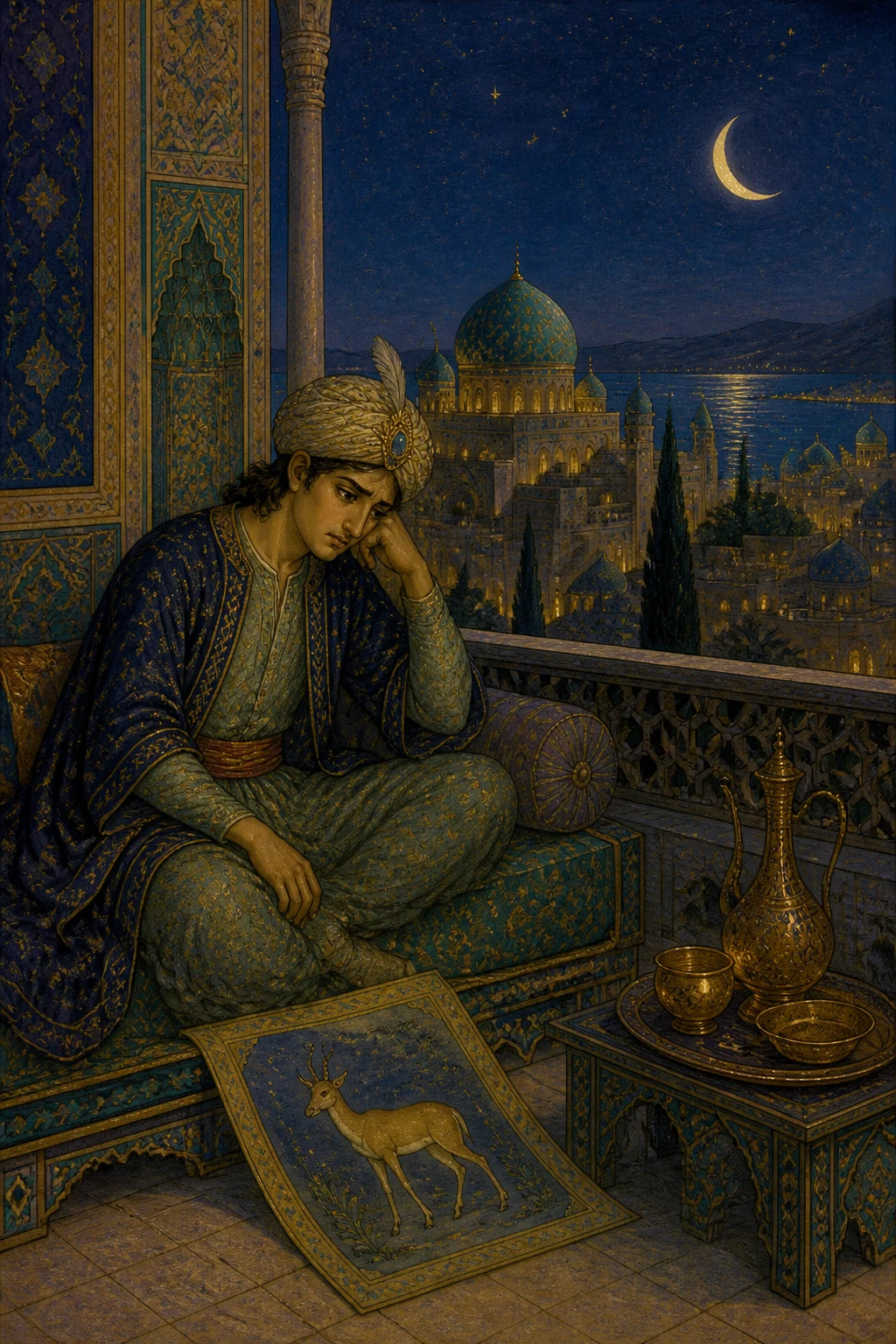
“When the next day came, her father sent to ask her consent. On hearing the news, she made ready for battle, put on her armor, and rode out to the lists. The prince went out to meet her, resolved to fight her. Word spread among the people, who flocked from every quarter to watch that day. Al-Datma appeared fully armed, with her sword belted about her and her face veiled, while the prince rode forth against her in splendid array, bearing the finest weapons and armor. They charged at one another, wheeling and fighting for a long while. She saw in him such courage and horsemanship as she had never seen in anyone else, and feared that he would shame her before the spectators. Knowing that he would surely defeat her, she resolved to trick him and devised a stratagem: she uncovered her face, and behold, it shone like the full moon. When the prince saw her, he was so dazzled that his strength failed and his resolve deserted him. Seeing this, she charged and plucked him from his saddle. He was in her grasp like a sparrow in an eagle’s talons, so entranced by her beauty that he knew nothing of what was being done to him. She took his horse, his weapons, and his clothes, branded him with a hot iron, and let him go. When he recovered from his stupor, he spent days unable to eat, drink, or sleep for humiliation, while love for the maiden took firm root in his heart. He sent his slaves back to his father with a letter saying that he could not return home until he had won his desire or died in the attempt. When the letter reached his father, he grieved for his son and wished to send armies and troops to him, but his ministers restrained him and counseled patience.
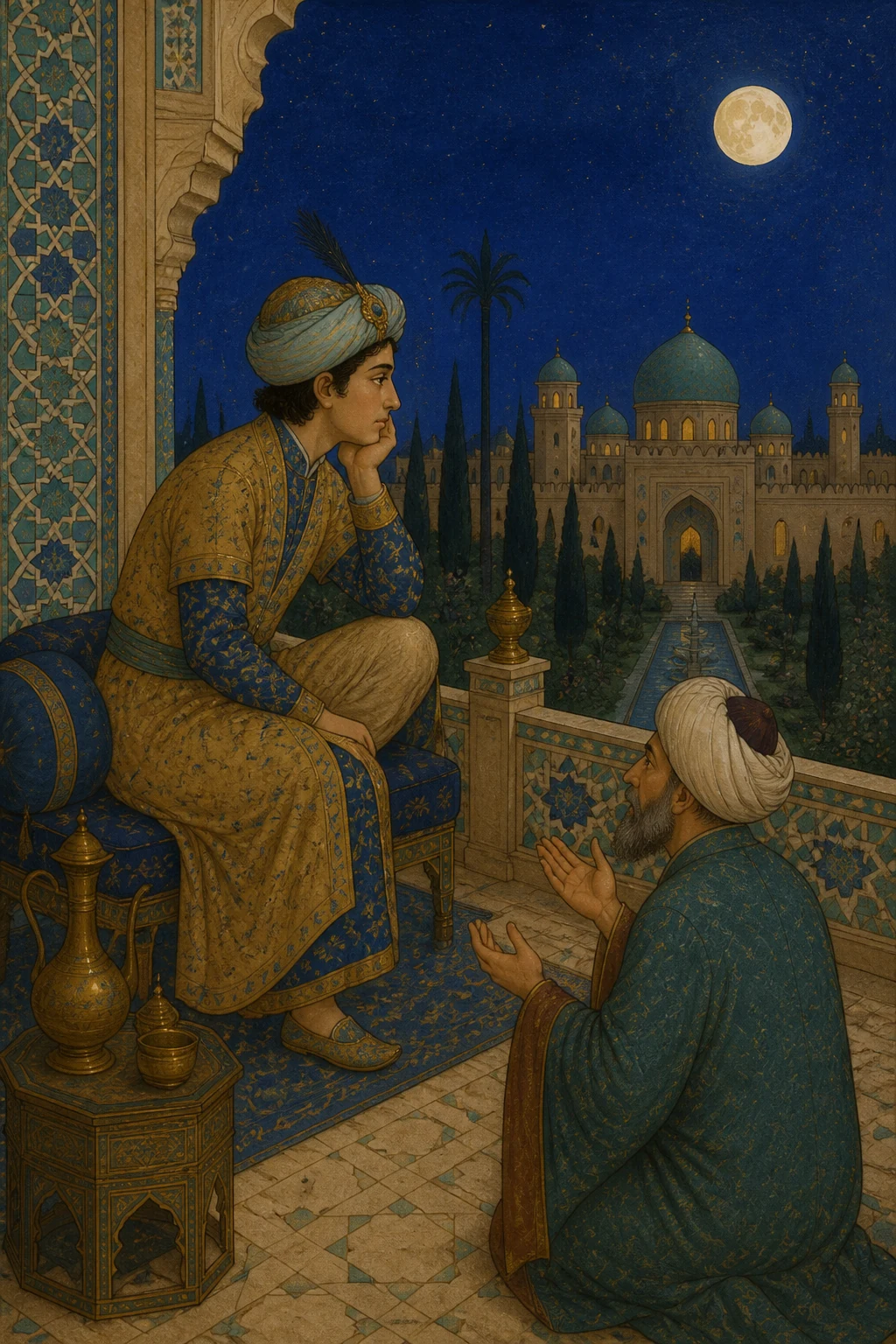
“Then the prince resorted to guile to gain his end. He disguised himself as a decrepit old man and went to the princess’s garden, which she visited most days. There he met the head gardener and said, ‘I am a stranger from a distant land. In my youth I was a gardener, and even now no one can equal my skill in tilling the soil and tending plants and fragrant flowers.’ The gardener was delighted to hear this, brought him into the garden, and commended him to the others there. So the prince set to work tending the trees and seeing to everything their fruit required. One day, while he was thus occupied, slaves entered the garden with mules laden with carpets, cushions, and vessels. He asked what this meant, and they told him, ‘The princess wishes to come and enjoy the garden.’ He went and fetched the jewels and robes he had brought from his own country, carried them into the garden, and sat down with some of these treasures laid out before him, trembling and pretending that it was from old age.” But morning overtook Shahrazad, and she ceased her permitted tale.
When it was the five hundred and ninety-eighth night
She said, “It has reached me, O fortunate King, that when the Persian prince had disguised himself as an old man and seated himself in the garden, he laid the jewels and robes before him and pretended to tremble with age, infirmity, and weakness. An hour later, the maids and servants arrived, with the princess in their midst like the moon among the stars. They wandered about the garden, gathering fruit and taking their pleasure, until they saw a man seated beneath a tree. They approached him—it was the prince—and found a very old man whose hands and feet were shaking, with jewels and royal treasures spread before him. Astonished at the sight, they asked him what he intended to do with these jewels. He replied, ‘I wish to marry one of you with them.’ They laughed at him and said, ‘And if you marry her, what will you do with her?’ He answered, ‘I would kiss her once and divorce her.’ The princess said, ‘Then I marry you to this maid.’ He rose and approached the girl, leaning on a stick, trembling and stumbling. He kissed her and gave her the jewels and robes. The maid rejoiced, and they all laughed at him before returning to their quarters.
“On the second day they entered the garden and came over to him. They found him sitting in the same place, with even more jewels and robes before him than the day before. They sat down beside him and said, ‘Old man, what will you do with these jewels?’ He replied, ‘Marry one of you with them, as I did yesterday.’ The princess said, ‘Then I marry you to this maid.’ He rose, kissed her, and gave her the jewels and robes, and they returned to their quarters. When the princess saw the jewels and robes he had given the maids, she said to herself, ‘I had a better right to those, and there would be no harm in it for me.’ The next morning she left her quarters alone, disguised as one of the maids, and slipped unseen through the grounds until she reached the old man. Standing before him, she said, ‘Old man, I am the princess. Would you like to marry me?’ He replied, ‘Most gladly, and with all honor.’ He brought out jewels and robes of greater worth and higher price than the others, gave them to her, and rose to kiss her, while she stood there at ease, suspecting nothing. But when he reached her, he seized her tightly, threw her to the ground, and took her virginity. Then he said, ‘Do you not know me?’ She asked, ‘Who are you?’ He replied, ‘I am Bahram, son of the king of Persia. For your sake I have changed my appearance and exiled myself from my family and my kingdom.’ She rose from beneath him in silence, neither answering nor speaking to him because of what had befallen her. She said to herself, ‘If I kill him, what good will his death do?’ Then she considered her plight and thought, ‘There is nothing for me now but to flee with him to his own country.’ So she gathered her wealth and treasures and sent him word of her decision, telling him to make his own preparations and collect his possessions. They agreed upon a night for their departure, mounted swift horses, and rode away under cover of darkness. By morning they had crossed a great stretch of country, and they continued on their way until they reached Persia and drew near his father’s city. When his father heard the news, he came out to meet him with his soldiers and troops, rejoicing beyond measure. A few days later, he sent a magnificent gift to al-Datma’s father, together with a letter informing him that his daughter was with them and asking him to send her bridal trousseau. When the gifts reached her father, he accepted them and treated their bearers with the utmost honor, overjoyed at the news. He held feasts, summoned the judge and witnesses, and had her marriage contract with the prince drawn up. He bestowed robes of honor upon the messengers who had brought the Persian prince’s letter and sent his daughter her trousseau. Thereafter the Persian prince lived with her until death parted them. See, then, O King, the wiles of men and women! As for me, I shall not relinquish my right until I die.” The king ordered his son to be put to death. Then the seventh vizier entered, kissed the ground before him, and said, “O King, grant me a little time to offer you this counsel: he who is patient and deliberate attains his hopes and gains his desires, but he who acts in haste earns regret. You have seen the shameless lengths to which this slave girl has gone to drive the king into peril. This servant, whom you have showered with favor and kindness, is your faithful counselor. O King, I know more of women’s wiles than any other man, and among the tales that have reached me is that of the old woman and the merchant’s son.” The king said, “And how was that, O Vizier?”