Prevod
When the story became known, it brought the seer well-earned renown throughout the cities of Achaea, and his fame as a prophet was great. Yet one man alone scorned him: Echion’s son, Pentheus, who despised the gods. He mocked the old man’s prophetic words and taunted him with his darkness, the calamity of his lost sight. Shaking his head, white-haired at the temples, the seer said, “How fortunate you would be if you too were robbed of this light, so that you could not see the rites of Bacchus!
For a day will come—and I foresee it is not far away— when a new god, Liber, Semele’s son, arrives here. Unless you deem him worthy of temples and their honors, you will be torn apart and scattered in a thousand places, and with your blood you will defile the woods, your mother, and your mother’s sisters. These things will happen, for you will not grant the god his honors, and you will lament that in this darkness I saw all too clearly.”
As he spoke, Echion’s son drove him away. His words proved true; the prophet’s answer was fulfilled: Liber came, and the countryside rang with festive cries. The crowds rushed out: mothers and young wives mingled with men, commoners with nobles, all swept toward the unfamiliar rites. “What madness, you serpent-born, you offspring of Mars, has stunned your minds?” cried Pentheus. “Can bronze clashing on bronze, the curved horn of a pipe, and magical deceptions have such power that men whom neither the sword nor the war trumpet frightened, nor ranks of soldiers with weapons drawn, are conquered by women’s voices, wine-driven frenzy, obscene mobs, and hollow drums?
Should I marvel at you, old men, who sailed across vast seas and established here a new Tyre, a home for your exiled household gods, and now allow yourselves to be taken without a battle? Or at you, whose years are fiercer, young men nearer my own age, who ought to carry weapons, not thyrsi, and cover your heads with helmets, not leaves? Remember, I beg you, the stock from which you sprang, and take on the courage of that serpent who, single-handed, destroyed so many! He died defending his springs and pool; but you must conquer to defend your fame!
He slew brave men; drive out these weaklings and preserve your fathers’ glory. If fate forbade Thebes to stand for long, would that siege engines and warriors were battering down its walls, and sword and fire were roaring! We would be wretched without disgrace, our fate something to mourn, not hide, and our tears would carry no shame. But now Thebes will be captured by an unarmed boy, who takes no pleasure in warfare, weapons, or horsemanship, but in hair dripping with myrrh, soft garlands, purple robes, and gold woven into embroidered clothes.
I shall soon force him—only stand aside— to confess that his father is falsely claimed and his rites invented. Has Acrisius courage enough to scorn this empty godhead and shut the gates of Argos against his coming, while a stranger frightens Pentheus and all Thebes? Go quickly,” he ordered his servants, “go and drag their leader here in chains! Let no sluggish delay hinder my command.”
His grandfather, Athamas, and all the rest of his family rebuked him and struggled in vain to restrain him. Their warnings only made him fiercer; checked, his rage was roused and swelled, and the very restraints made matters worse. So I have seen a torrent, where nothing blocked its course, flow down more gently, with only a muted roar; but wherever logs and piled-up rocks held it back, it surged on foaming, seething, fiercer for the barrier.
Now his servants returned, bloodstained; when their master asked where Bacchus was, they said they had not seen him. “But we have captured this man, his companion and an attendant at his rites,” they said, handing over a prisoner, his hands bound behind him, a man of the Tyrrhenian people who had joined the god’s worship. Pentheus looked at him with eyes made terrible by anger, and though he could scarcely wait to punish him, he said, “You who are doomed to die and by your death teach others a lesson, tell me your name, your parents’ names, your country, and why you celebrate these rites of a new religion.”
Without fear, the man replied, “My name is Acoetes; Maeonia is my country, and my parents were humble folk. My father left me no fields for sturdy oxen to till, no flocks of woolly sheep, no herds at all. He too was poor, and with line and hooks he used to trick the leaping fish and draw them out with his rod. His skill was all his wealth. When he taught me his craft, he said, ‘Take the riches I possess, successor and heir to my calling.’ At his death he left me nothing but the waters: that alone I can call my inheritance.
Soon, so as not to cling forever to the same rocks, I learned as well to guide a ship’s rudder with a steady hand, and watched the rainy star of the Olenian goat, Taygete, the Hyades, and the Bear, learning the quarters of the winds and harbors safe for ships. Once, bound for Delos, I came to the shores of Chios and made land with the starboard oars, then leaped lightly down onto the wet sand.
When night was over and the first dawn had begun to redden, I rose and told the men to bring fresh water aboard, showing them the path to the spring. I myself climbed a high hill to see what the breeze promised, then called my companions and returned to the ship. ‘Here we are!’ said Opheltes, the first of the crew to arrive. He had found what he thought was a prize in the deserted fields and was leading along the shore a boy as beautiful as a girl.
Heavy with wine and sleep, the boy seemed to stagger and could scarcely follow. I studied his dress, his face, his bearing: I could see nothing there that could be thought mortal. I felt it and told my companions: ‘What god is in that body, I cannot say, but a god is in that body. Whoever you are, favor us and help us in our labors. Grant these men your forgiveness too.’ ‘Stop praying for us,’ said Dictys, than whom no one was quicker to climb to the highest yardarms and slide back down a rope.
Libys agreed, and fair-haired Melanthus, the lookout at the bow, and Alcimedon, and Epopeus, who with his voice set the rhythm and pauses for the oars and urged the rowers on; all the others agreed as well, so blind was their greed for plunder. ‘Yet I will not allow this ship to be defiled by taking on so sacred a burden,’ I said. ‘Here my authority is greatest.’ I stood blocking the gangway. Lycabas, the boldest of them all, flew into a rage. Banished from a Tuscan city, he was paying in exile for a brutal murder.
As I resisted, he struck my throat with his powerful young fist and would have knocked me overboard had I not, half-stunned, caught hold of a rope and clung there. The godless crew applauded his deed. Only then did Bacchus— for Bacchus it was—as though the shouting had shaken off his sleep and his senses were returning after the wine, say, ‘What are you doing? What is this shouting? Tell me, sailors, how did I get here? Where do you mean to take me?’ ‘Put aside your fear,’ Proreus said, ‘and tell us what port you wish to reach. You shall be set ashore where you ask.’ ‘Then steer your course for Naxos,’ said Liber.
‘That is my home, and you will find a welcome there.’ The treacherous men swore by the sea and all the gods that it would be so, and ordered me to set the painted ship’s sails. Naxos lay to starboard. As I set sail to starboard, Opheltes cried, ‘What are you doing, fool? What madness—?’ Each feared for his share: most signaled to me to steer to port, while others whispered their wishes in my ear.
I was appalled. ‘Let someone else take the helm,’ I said, and withdrew from serving either their crime or my craft. They all abused me, and the whole crew muttered. Then Aethalion said, ‘So all our safety depends on you alone, does it?’ He took my place and did my work, leaving Naxos behind and steering the other way. Then the god, playing with them as though he had only just discovered their deceit, looked out to sea from the curving stern and said, as if in tears, ‘These are not the shores you promised me, sailors; this is not the land I asked for.
What have I done to deserve this punishment? What glory is yours if grown men deceive a boy, if many deceive one?’ I had long been weeping. The impious band laughed at my tears and drove the ship onward with quickening oars. Now I swear to you by the god himself—for no god is more truly present than he—that what I tell you is true, though the truth surpasses belief: the ship stood still on the sea as though she rested in a dry dock.
Amazed, the men persisted in beating the water with their oars, lowered the sails, and tried to make headway by both means. Ivy entangled the oars, crept upward in curling tendrils, and studded the sails with heavy clusters of berries. The god himself, his brow encircled with bunches of grapes, brandished a spear clothed in vine leaves. Around him lay tigers, phantom forms of lynxes, and the savage bodies of spotted panthers.
The men leaped overboard, whether driven by madness or by fear. Medon was the first whose body began to darken and bend, his spine arching in a pronounced curve. Lycabas began to ask him, ‘What monstrous thing are you turning into?’ But as he spoke his jaws spread wide, his nostrils flared, and his hardening skin took on scales. Libys, trying to turn the obstructed oars, saw his hands shrink to a little space and become hands no longer: now they could be called fins.
Another, reaching to grasp the twisted ropes, found he had no arms, and with arched, limbless body plunged into the waves. His tail curved at its tip like the bending horns of a half-moon. On every side they leaped, scattering showers of spray, rising to the surface and sinking beneath the sea again, playing like dancers in a chorus, tossing their bodies in delight and blowing seawater from their open nostrils.
Of the twenty men aboard that ship I alone remained. Frightened, cold, my body trembling, scarcely myself, I was reassured by the god, who said, ‘Cast fear from your heart and steer for Dia.’ Once carried there, I joined his worship and have celebrated the rites of Bacchus ever since.” “We have lent our ears to this long, rambling tale,” said Pentheus, “so that the delay might drain our anger’s strength.
Servants, drag this man away at once, torment his body with savage tortures, and send him down to Stygian night.” At once the Tyrrhenian Acoetes was dragged away and locked in a strongly built prison. But while they prepared the cruel instruments of his appointed death, the iron and the fires, the doors, they say, opened of their own accord, and the chains fell from his arms, untouched by anyone.
Echion’s son persisted. Now he no longer sent others, but went himself to Cithaeron, chosen for the sacred rites, where the mountain rang with the songs and piercing cries of Bacchus’s worshippers. As a spirited horse neighs when the trumpeter sounds the battle signal on ringing bronze, and is seized with eagerness to fight, so the air, struck by long, shrill cries, stirred Pentheus, and at the sound his anger flared anew.
About halfway up the mountain lies a clearing, free of trees and visible on every side, with woods around its edges. Here, as he watched the rites with profaning eyes, his mother was the first to see him, the first to rush upon him in a frenzy, the first to strike her own Pentheus with a hurled thyrsus. “Come, my two sisters!” she cried. “Come here! That boar, the greatest that roams our fields, that boar is mine to strike.” The whole frenzied crowd rushed upon him alone; all gathered and pursued him in his terror, already terrified, already speaking less fiercely, already condemning himself, already confessing his wrong.
Wounded, he cried, “Help me, my aunt Autonoe! Let Actaeon’s shade move your heart.” She no longer knew who Actaeon was, and tore away his pleading right arm; the other was ripped off by Ino’s wrenching grasp. The wretched man had no arms left to stretch toward his mother, but showed the torn wounds where his limbs had been and cried, “Look, Mother!” At the sight Agave howled, tossed her neck and shook her hair upon the air, then clasped his severed head in bloodstained fingers and shouted, “Come, companions! This victory is ours!”
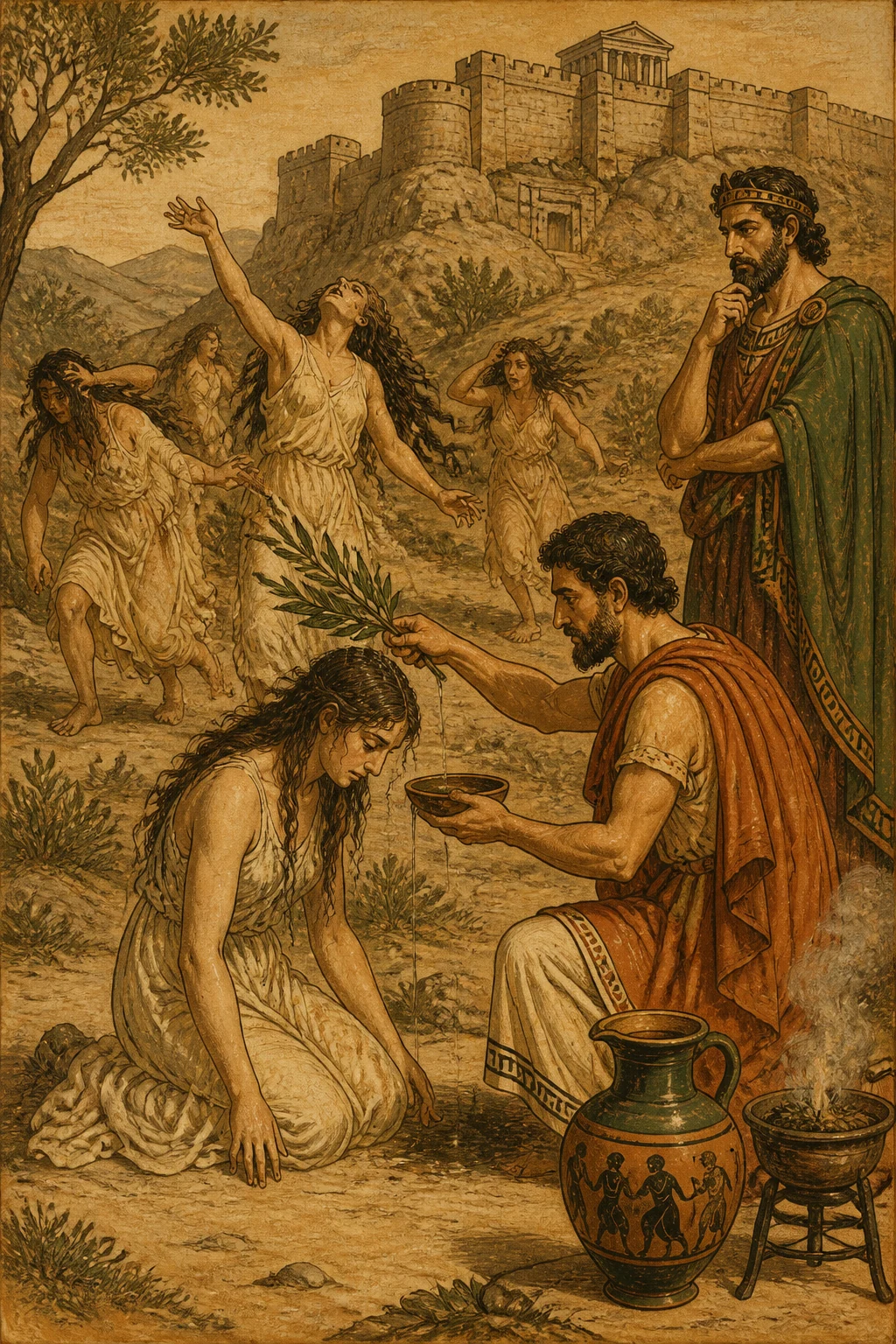
No more swiftly does the wind strip from a lofty tree the leaves touched by autumn’s chill and barely clinging still than those unhallowed hands tore the man’s limbs apart. Warned by such examples, the women of Thebes celebrated the new rites, offered incense, and worshipped at the sacred altars.