Prevod
But Alcithoe, daughter of Minyas, will not accept the god’s rites; still recklessly she denies that Bacchus is the son of Jove, and her sisters share her impiety. The priest had ordered them to celebrate the festival, mistresses and maids alike released from work, to cover their breasts with animal skins, untie their hairbands, wreathe their hair, and take leafy thyrsi in their hands; and he had foretold the savage wrath of the god if slighted. Mothers and young wives obey: they put aside their weaving, baskets, and unfinished wool, offer incense, and invoke Bacchus, Bromius, Lyaeus, the Fire-born, the Twice-born, the only god with two mothers.
To these they add Nyseus and long-haired Thyoneus, Lenaeus, the joyful planter of the grape, Nyctelius, Father Eleleus, Iacchus, Euhan, and all the countless other names you bear among the peoples of Greece, O Liber. For your youth never fades: you are the eternal boy, the fairest to be seen in the heights of heaven; when you stand without your horns, your face is a maiden’s. The East is conquered by you, as far as dusky India, washed by the remotest Ganges.
You, revered god, slay the sacrilegious Pentheus and axe-wielding Lycurgus, and hurl the Tyrrhenians into the sea. You harness a pair of lynxes, their necks adorned with bright reins; Bacchants and satyrs follow, and the drunken old man who props his swaying limbs on a staff and clings unsteadily to his swaybacked ass. Wherever you go, the cries of young men mingle with women’s voices, tambourines beaten by palms, the clang of hollow bronze, and the long-bored boxwood flute.
“Be gracious and gentle among us,” the women of Ismenus pray, and perform the appointed rites. Only the daughters of Minyas remain indoors, profaning the festival with Minerva’s untimely tasks: drawing out wool, twisting thread beneath their thumbs, or intent upon the loom, urging their maids to work. One of them, drawing out a thread with a light touch, said, “While the others leave their work to attend these invented rites, let us, whom Pallas, a better goddess, keeps at our tasks, lighten the useful labour of our hands with varied talk.
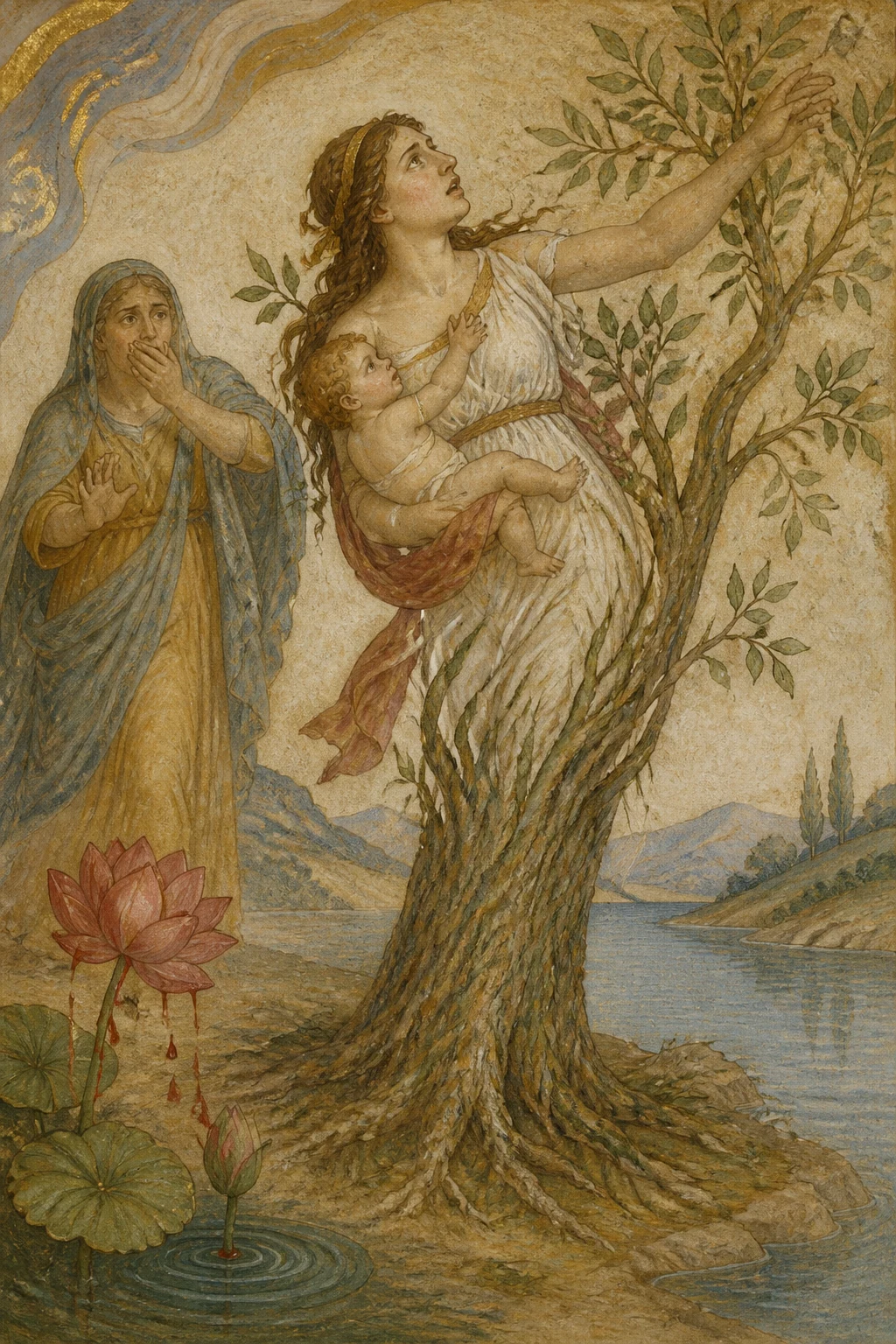
Let each in turn tell something for the others’ listening ears, so that the hours will not seem long.” Her sisters approve and ask her to tell the first tale. She considers which of the many she knows to tell, uncertain whether to speak of you, Babylonian Dercetis, whose limbs, the Palestinians believe, were clothed in scales as you changed shape and swam through their pools; or rather how your daughter took wing and spent her final years in white towers; or how a naiad, with spells and all-too-potent herbs, changed young men’s bodies into silent fish, until she suffered the same fate; or how a tree that once
bore white fruit now bears it black, stained by blood. This pleases her; and since the tale is not widely known, she begins it in these words, spinning the wool into thread: