Prevod
Now begins the fourth book, called “The Loss of What Has Been Gained.” Its opening verse is this:
He whose wits do not desert him when troubles arise
Will overcome danger, like the monkey in the water.
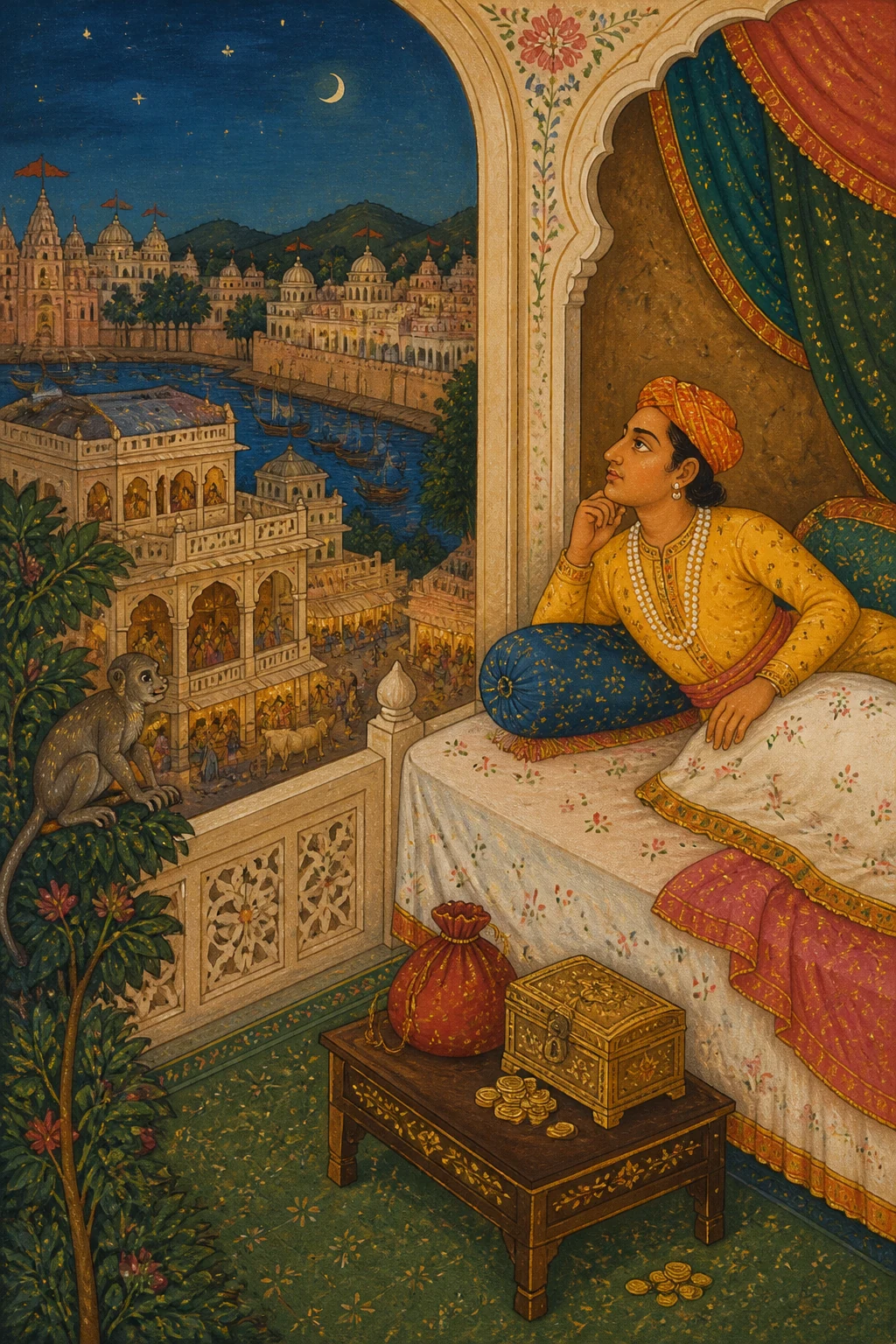
The tale is told as follows. The introductory story: The Monkey and the Crocodile. Beside a certain sea stood a great rose-apple tree that bore fruit all year round. In it lived a monkey named Raktamukha. One day a crocodile named Karalamukha came out of the sea and settled on the shore beneath that tree, where the sand was wonderfully soft. Raktamukha said to him, “Sir, you have come here as my guest. Please eat these rose-apples I offer you; they are sweet as nectar. For it is said:
Whether dear or disliked, whether foolish or learned,
A guest who arrives at the close of the offering to all the gods is a bridge to heaven.
Do not ask a guest his school of sacred learning, his lineage, his knowledge, or his family,
At the close of the offering to all the gods, or at the ancestral rites: so Manu declared.
Whoever honors a guest worn out by a long journey,
Arriving at the close of the offering to all the gods, attains the highest state.
When a guest leaves a man’s house unhonored, sighing in disappointment,
His ancestors turn their faces from him and depart, together with the gods.”
With these words he gave the crocodile some rose-apples. The crocodile ate them, spent a long while enjoying pleasant conversation with him, and then returned home. From then on, the monkey and the crocodile passed their days happily in the shade of the rose-apple tree, discussing all kinds of learning. The crocodile would take home whatever fruit remained after he had eaten and give it to his wife. One day she asked him, “My lord, where do you get such nectar-sweet fruit?”
He replied, “My dear, I have a very close friend, a monkey named Raktamukha. He gives me these fruits out of affection.”
Then she said, “If he is always eating fruit as sweet as nectar, his heart must be made of nectar. If you care anything for your wife, bring me his heart. Once I have eaten it, I shall be free from old age and death, and we can enjoy life together.” He replied, “My dear, do not say such a thing! He is our sworn brother, and besides, he supplies us with fruit. I cannot kill him. Give up this unreasonable insistence. For it is said:
One brother is born of the mother; another is born of a pledge.
The brother born of a pledge is held dearer even than a brother of the same womb.”
The crocodile’s wife said, “You have never refused me anything before. It must really be a female monkey, and you spend the whole day there because you are in love with her. Now I understand you perfectly. For:
You give me no tender words, nothing that I desire;
At night you often sigh, your breath hot as a blazing fire.
Your arms are slack when you embrace me; you no longer kiss me fondly.
You rogue, some other darling has taken my place in your heart!”
He took his wife’s feet in his hands and laid them in his lap. Seeing her in such a fury, he pleaded pitifully:
“Here I am, fallen at your feet, ready to be your servant.
Dearest love, why are you angry with me, my angry one?”
Hearing this, she answered him, her face streaming with tears: “You rogue, that darling of yours, so charming with her feigned affection,
Lives in your heart amid a hundred longing fancies.
There is no room at all for me in it.
Enough of this farce of falling at my feet!
“Besides, if she is not your sweetheart, why will you not kill her when I ask you to? And if it really is a male monkey, why are you so fond of him? But enough words! Unless I eat his heart, know that I shall fast to death.” When he saw how firmly she had made up her mind, his heart grew troubled with anxiety, and he said, “Well, the saying is true:
Adamantine cement, a fool, a woman, a crab,
A fish, indigo dye, liquor, and milk all cling fast once they take hold.
“What am I to do? How can I bring myself to kill him?” Turning this over in his mind, he went to the monkey. Seeing him arrive so late and looking so distressed, the monkey said, “My friend, why have you come so late today? Why do you not talk cheerfully, or recite wise sayings?” The crocodile replied, “My friend, your sister-in-law has spoken to me most harshly. ‘You ungrateful creature!’ she said. ‘Do not show your face to me! Every day you live on your friend’s bounty, yet you never repay him, not even by inviting him to visit our home. There is no atonement for such behavior. For it is said:
For the murderer of a Brahmin, the drinker of liquor, the thief, the breaker of vows, and the cheat,
The good have prescribed atonement; but for the ungrateful there is none.
“‘So bring my brother-in-law home today, to repay his kindness. If you do not, you will see me only in the next world.’ That is what she said, and so I have come to you. I am late today because I spent so long arguing with her about you. Come home with me. Your sister-in-law has decorated the courtyard, laid out fine clothes, jewels, rubies, and suitable ornaments, and hung a welcoming garland over the doorway. She is eagerly awaiting you.” The monkey replied, “My friend, my sister-in-law is quite right. For it is said:
A wise man should shun a friend who acts like a weaver,
Greedily drawing everything toward himself.
And again:
Giving and receiving, revealing secrets and asking about them,
Eating at another’s table and inviting him to eat: these are the six signs of friendship.
“But we are creatures of the forest, while your home is in the water. How can I get there? Better bring my sister-in-law here, so that I may bow to her and receive her blessing.”
The crocodile said, “My friend, our home is on a lovely sandy island in the sea. Climb onto my back and travel there comfortably, without fear.”
Hearing this, the monkey said joyfully, “My good fellow, if that is so, why delay? Hurry! Here I am on your back.”
And so it was done. But as the crocodile carried him into the deep sea, the monkey grew frightened and said, “Brother, go slowly, slowly! The waves are washing over my body.”
Hearing this, the crocodile thought, “Now that he is in deep water, he is in my power. Sitting on my back, he cannot move so much as a sesame seed’s width. I may as well tell him what I intend, so that he can call to mind his chosen deity.” He said, “My friend, at my wife’s bidding I have won your trust and brought you here to kill you. Call upon your chosen deity.” The monkey said, “Brother, what wrong have I done her, or you, that you should plan my death?”
The crocodile replied, “She has conceived a craving to eat your heart, made delicious by the nectar-sweet juice of the fruit you eat. That is why I have done this.”
The quick-witted monkey said, “My good fellow, if that is so, why did you not tell me while we were still there? I always keep my heart safely hidden in a hollow of the rose-apple tree. I would gladly give it to my sister-in-law. Why have you brought me here without my heart?”
Hearing this, the crocodile said happily, “My good fellow, then give me your heart, so that my wretched wife may eat it and end her fast. I shall take you back to that very rose-apple tree.” With these words he turned around and went back to the foot of the tree. The monkey somehow reached the shore, muttering promises of all kinds of offerings and worship to the gods. Then, with a great leap, he climbed into his rose-apple tree and thought, “Ah, at least I have saved my life! Well is it said:
Do not trust the untrustworthy; do not trust even the trustworthy.
Danger born of trust cuts away the very roots of life.
“Today is like the day of my second birth.”
While he was thinking this, the crocodile said, “My friend, give me that heart, so that your sister-in-law may eat it and end her fast.”
The monkey laughed and rebuked him. “Shame on you, you fool, you betrayer of trust! Does anyone have two hearts? Leave the foot of this rose-apple tree at once, and never come here again. For it is said:
He who seeks to renew friendship with a friend who has once betrayed him
Embraces his own death, as a she-mule does when she conceives.”
Hearing this, the crocodile thought in embarrassment, “Ah, what a fool I was to tell him what was in my mind! If I can somehow win his confidence again, I shall deceive him once more.” He said, “My friend, I was only joking, to see what you would say. My wife has no use for your heart. Come to our home as our guest.” The monkey replied, “Be off, you scoundrel! I shall not come now. For it is said: What wickedness will a starving creature not commit?
The destitute become merciless.
Tell Priyadarshana, my good lady,
That Gangadatta will not return to the well.”
The crocodile asked, “How did that happen?” The monkey replied: Story 1: Gangadatta and Priyadarshana. In a certain well there lived a king of frogs named Gangadatta. One day, harassed by his kinsmen, he climbed into a bucket of the waterwheel and escaped. Then he thought, “How can I pay those kinsmen back? For it is said:
When a man has repaid both the one who harmed him in adversity and the one who laughed at him in distress,
Only then, I think, has he truly been born a man.
As he was thinking this, he saw a black snake entering a hole. At the sight he thought again, “I shall take him into the well and wipe out all my kinsmen. For it is said:
Set an enemy against enemies, a stronger foe against a strong one,
To serve your own ends; their destruction need cause you no pain.
And again:
A wise man should uproot a dangerous enemy by means of another dangerous enemy,
As one removes a painful thorn with a thorn, to gain relief.
Having considered this, he went to the mouth of the hole and called, “Come out, Priyadarshana! Come out!” Hearing him, the snake thought, “Who is calling me like that? He is not one of my own kind, for that is no snake’s voice. And I have no alliance with any other creature in this mortal world. I shall stay here in my stronghold until I find out who he is. For it is said:
‘Do not associate with one whose character, family,
And place of refuge are unknown to you,’ said Brihaspati.
“Perhaps some snake-charmer, or someone skilled in herbs, is calling me out to capture me. Or perhaps someone with a grudge is summoning me to devour an enemy.” He called out, “Who are you, sir?”
The other replied, “I am Gangadatta, king of the frogs. I have come to seek your friendship.”
Hearing this, the snake said, “Sir, that is as incredible as an alliance between grass and fire. For it is said:
A creature that is another’s natural prey will never approach it,
Not even in a dream. Why do you talk such nonsense?”
Gangadatta replied, “Sir, that is true. You are our natural enemy. But I have come to you because others have treated me with contempt. For it is said:
When everything is being lost and life itself is in danger,
A man should save his life and wealth even by bowing to an enemy.”
The snake said, “Tell me, who has treated you with contempt?”
“My kinsmen,” he replied.
The snake asked, “And where do you live—in a reservoir, a well, a pond, or a lake? Tell me where your home is.”
He replied, “In a well lined with stone.”
The snake said, “But I have no feet. How am I to enter it? And once inside, there would be nowhere for me to stay while I killed your kinsmen. Go your way. For it is said:
One who desires to prosper should eat only what he can swallow,
What he can digest once swallowed, and what will benefit him when digested.”
Gangadatta said, “Sir, just come with me. I shall find an easy way to get you in. There is a very pleasant hollow inside, close to the water. From there you can kill my kinsmen with ease.” Hearing this, the snake thought, “I am getting old. It is only now and then, and with difficulty, that I catch even a single mouse. This disgrace to his family has shown me a comfortable way to make a living. I shall go and eat those frogs. Well is it said:
A wise man whose strength is failing and who has no one to help him
Should find a livelihood that affords him every ease.”
After considering this, he said, “Gangadatta, if that is so, lead the way, and let us go there.”
Gangadatta said, “Priyadarshana, I shall take you there by an easy route and show you where to stay. You must eat only those I point out.”
The snake replied, “You are now my friend. Have no fear. I shall eat your kinsmen as you direct.”
With these words he came out of his hole, embraced Gangadatta, and set off with him. When they reached the well, Gangadatta himself brought the snake down into his home by way of the waterwheel’s buckets.
Gangadatta said, “My good friend, you have fulfilled the duty of a friend. Now please leave by the same route, using the waterwheel’s buckets.”
The snake replied, “Gangadatta, that is not a proper thing to say. How can I go back there? Someone else will have occupied my fortified hole. So give me one frog from your own circle each day while I stay here. Otherwise I shall eat them all.” Hearing this, Gangadatta thought in distress, “Ah, what have I done by bringing this snake here? If I refuse him, he will eat everyone. Well is it said:
He who makes a friend of an enemy stronger than himself
Is surely swallowing poison of his own accord.
“Then I shall give him one of my friends each day. For it is said:
Wise men appease an enemy bent on taking everything by giving him a little,
As the ocean feeds the submarine fire.
And again: A weak man who will not peacefully yield even a little
When a stronger man demands it,
Who will not give even the small amount he is shown,
Will later have to give a whole measure of grain.
And again:
When total ruin threatens, a wise man gives up half.
With the remaining half he carries on, for total ruin is hard to overcome.
A sensible man should not destroy much for the sake of a little.
True wisdom lies in saving much at the cost of a little.”
Having made up his mind, he designated one frog each day. But the snake, after eating that one, ate others as well behind his back. Well is it said:
Just as a man in dirty clothes will sit down anywhere,
So one whose wealth has dwindled no longer guards what remains.
Then one day, after eating some other frogs, the snake ate Gangadatta’s son, Yamunadatta. When Gangadatta realized that his son had been eaten, he cried out loudly, “Alas! Alas!” and could not stop lamenting. Then his wife said to him:
“Why do you wail, you wretched wailer, you destroyer of your own kin?
Now that our own people are destroyed, who will protect us?
“Even now, think of a way to escape and a means of killing him.” As time passed, the whole community of frogs was devoured. Only Gangadatta remained. Then Priyadarshana said, “Gangadatta, I am hungry. All the frogs are gone. Give me something to eat, for it was you who brought me here.”
Gangadatta replied, “My friend, you need have no anxiety about that while I am here. If you let me go, I shall win the confidence of frogs in other wells and bring them here.”
The snake said, “You are like a brother to me, and I would never eat you. If you do this, you will be like a father to me. Do so, then.”