Waltey
Brahman in nezvesta žena
Pančatantra · indijska zbirka pripovediO besedilu
Brahman in nezvesta žena
- Vir
- Pančatantra
- Avtor
- indijska zbirka pripovedi
- Jezik branja
- English
- Jezik izvirnika
- Sanskrit
- Čas branja
- 17 min branja
- Obseg
- 13 strani
- Naslov izvirnika
- Tantra 04 labdha-pranasa chunk 3
O izvirniku
Pančatantra
Indijske zgodbe o zvijači, prijateljstvu in modrosti v svetu živali in vladarjev. Bralni jezik je English, izvirnik pa prihaja iz vira Pančatantra v jeziku Sanskrit.
Besedilo
Brahman in nezvesta žena
When this had been done, the Brahmin’s wife said, “Brahmin, whenever you go to another village without a companion, I have no one even to talk to. Let us take this lame man along.”
He replied, “I can scarcely carry myself. How could I carry this lame man as well?”
She said, “I shall put him in a basket and carry him myself.”
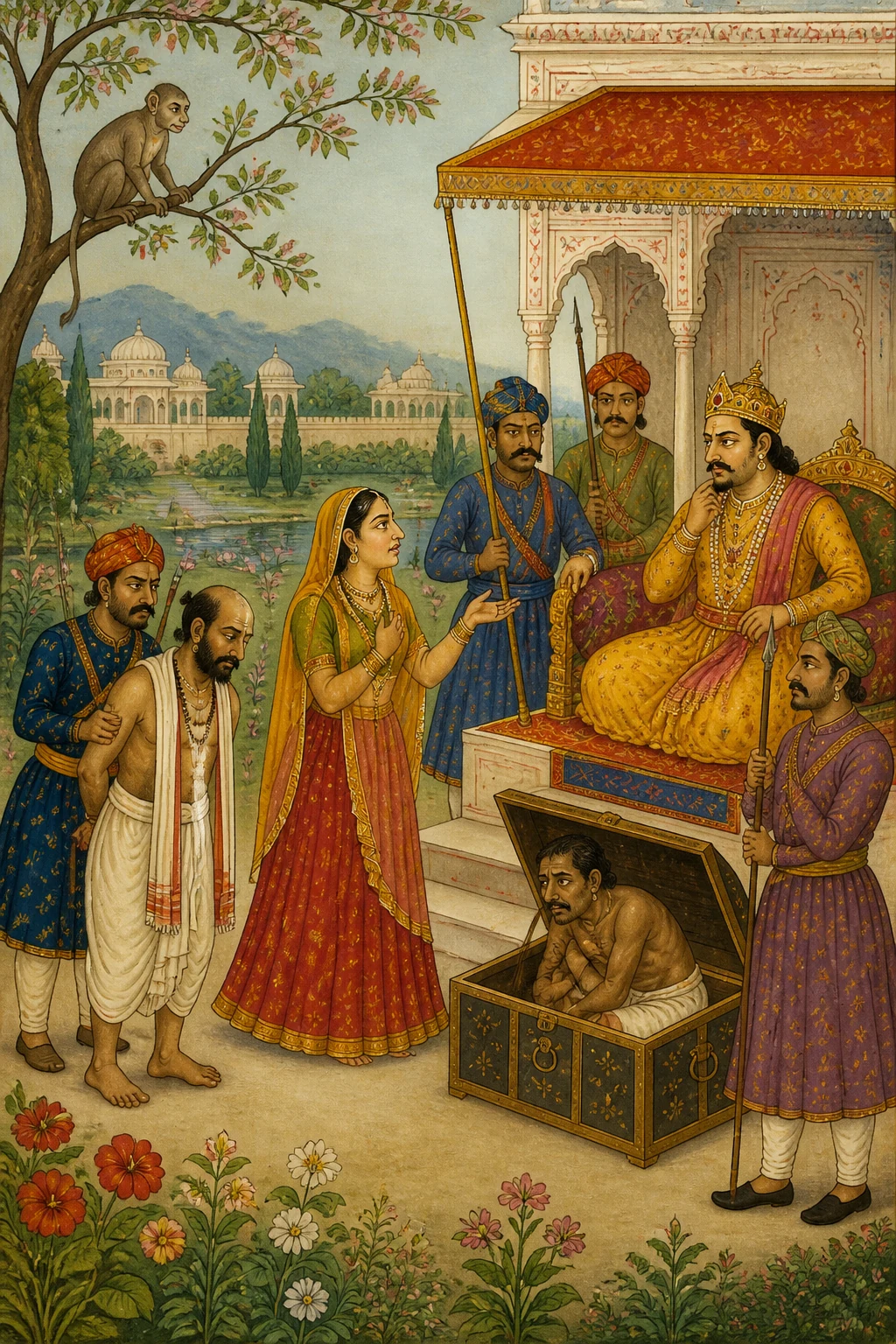
His mind beguiled by her deceitful words, he agreed. Some days later, while the Brahmin was resting beside a well, his wife, who was enamored of the lame man, pushed him in. Taking the lame man with her, she entered a certain city. There, some royal officers patrolling to prevent the evasion of tolls saw the basket on her head, seized it by force, and brought it before the king. When the king opened it, he saw the lame man inside. Meanwhile, the Brahmin’s wife arrived, wailing, close on the officers’ heels. The king asked her, “What is the meaning of this?”
She replied, “This is my husband. Afflicted by illness and harassed by his kinsmen, he had nowhere to turn. My heart overwhelmed with love, I carried him on my head and brought him to your city.”
Hearing this, the king said, “Brahmin lady, you shall be my sister. Take two villages, and live happily with your husband, enjoying their revenues.”
Now, by good fortune, a kindly man rescued the Brahmin from the well. In the course of his wanderings he came to that very city. His wicked wife saw him and reported to the king, “Your Majesty, an enemy of my husband has arrived.”
The king ordered his execution. The Brahmin said, “Your Majesty, this woman has taken something that belongs to me. If you cherish justice, have her return it.”
The king said, “Good woman, return whatever you have taken from this man.”
She replied, “Your Majesty, I have taken nothing.”
The Brahmin said, “Return the half of my life that I gave you with a threefold declaration.”
Afraid of the king, she declared three times, then and there, “The half of his life that he gave me is returned,” and fell dead. Astonished, the king asked, “What is this?” The Brahmin then told him the whole story from the beginning. ***********************************************************************
“That is why I say, ‘For whose sake I forsook my own family’ (44).”
The monkey continued, “There is another fine tale told in illustration of this:
What will a man not give, what will he not do, when women ask it of him?
Those who are not horses neigh, and heads are shaved when no holy day calls for it.
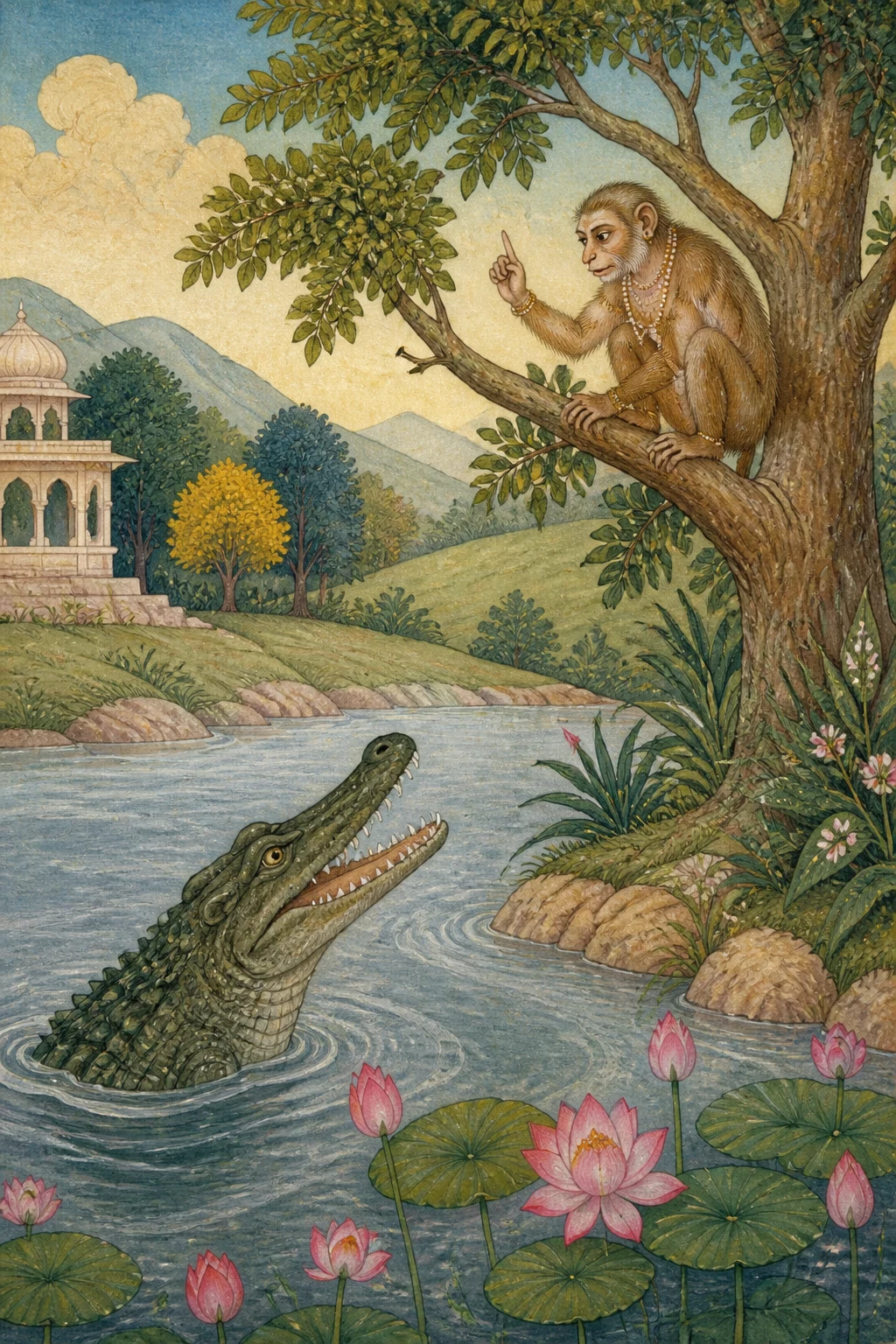
The crocodile asked, “How did that happen?” The monkey told the story: Story 6. There was once a king named Nanda, lord of the earth as far as the encircling sea. His strength and valor were renowned; his footstool was thickly woven with the rays from the crowns of countless kings who bowed before him; and his fame was as pure as the light of the autumn moon. His minister, named Vararuci, had mastered the essential truths of every branch of learning. One day, Vararuci’s wife became angry with him in a lovers’ quarrel. Though he tried every means of pleasing her, for she was exceedingly dear to him, she would not relent. At last he said, “My dear, tell me what would please you. I shall certainly do it.”
After some persuasion, she said, “If you shave your head and fall at my feet, I may be willing to forgive you.”
He did so, and she was appeased. Meanwhile, Nanda’s wife too had grown angry, and all his efforts to soothe her were in vain. He said, “My dear, I cannot live a moment without you. I fall at your feet and beg you to forgive me.”
She replied, “If you put a bridle in your mouth and let me mount your back and ride you about, and if, when I drive you, you neigh like a horse, then I shall be pleased.”
The king did exactly as she asked. The next morning, while he was seated in court, Vararuci approached him. Seeing him, the king asked, “Why, Vararuci, what holy day is this, that you have shaved your head?”
He replied, “What will a man not give…” (45), and recited the rest of the verse. “So, wicked crocodile, you too are ruled by a woman, just like Nanda and Vararuci. That is why, my good fellow, you came here and set about devising my death. But your own foolish words exposed you. Well indeed is it said:
Parrots and mynas are caught through the fault of their own mouths;
Herons are not caught that way. Silence accomplishes every purpose.
And again:
Though well concealed and carefully protected, displaying a fearsome shape,
An ass clad in a tiger’s skin was killed because he spoke.
The crocodile asked, “How did that happen?” The monkey told the story: Story 8. The Tale of the Washerman Named Shuddhapata. In a certain town lived a washerman named Shuddhapata. He owned an ass, which had grown very weak for lack of fodder. One day, while wandering in the forest, the washerman found a dead tiger. He thought, “Ah, what a stroke of luck! I shall cover the ass with this tiger’s skin and turn him loose in the barley fields at night. The field guards nearby will take him for a tiger and will not drive him away.” He did so, and the ass ate barley to his heart’s content. At dawn the washerman brought him home again. As time passed, the ass grew so fat that it was difficult even to lead him back to his stall. Then one day, full of high spirits, he heard a she-ass calling in the distance. The instant he heard her, he began to bray.
The field guards realized that this was an ass disguised in a tiger’s skin, and killed him with blows from clubs, arrows, and stones.
***********************************************************************
“That is why I say, ‘Though well concealed and carefully protected’ (47). Will you then endure insult after insult like Shyamalaka, and leave only when you are seized by the neck and thrown out?”
The crocodile asked, “How did that happen?” The monkey replied: Story 9. The Tale of the Wealthy Merchant Ishvara. There is a city on this earth named Vikantaka. In it lived a very wealthy merchant named Ishvara. His four sons-in-law came from the region of Avanti to visit him in Vikantaka. He received them with great honor, providing food, clothing, and everything else they needed. In this way they stayed for six months. At last Ishvara said to his wife, “These sons-in-law of ours have been treated with such respect that they will not go home. What can be done? They will not leave without an insult. So today, at mealtime, do not give them water to wash their feet. Once they realize they are being slighted, they will leave.” This was done, and Garga departed because of the insult of being given no water for his feet; Soma left because he was offered an inferior seat; and Datta went away because the food was poor. Thus three of them left. But the fourth, Shyamalaka, still would not go, and had to be seized by the neck and thrust out. *********************************************************************** That is why I say:
Garga left for want of water to wash his feet; Soma, because his seat was low;
Datta, because the food was poor; and Shyamalaka, with a hand around his neck.
“Do you think I am as foolish as the wheelwright, that I should trust you after seeing your treachery with my own eyes? For it is said:
Even when wickedness is committed before his eyes, a fool is soothed by flattering words.
The wheelwright carried his wife and her lover on his head.
The crocodile asked, “How did that happen?” The monkey told the story: Story 10. The Tale of the Wheelwright. In a certain town lived a wheelwright whose wife was widely rumored to be unfaithful. He thought of putting her to the test. “How shall I test her?” he wondered. “Yet it is not proper to do so, for:
The origins of rivers, of noble families, and of great sages
Should not be investigated, nor should the misconduct of women.
A sage lay with the fisherman’s daughter, born of Vasu’s seed;
Thus Vyasa was born, the dwelling place of a hundred virtues. What more need be said?
He himself divided the Vedas and fathered those through whom the stricken Kuru line continued.
Such was that illustrious man! Ah, how strange are the ways of fate!
“As for noble families, even the origins of the great-souled Pandavas should not be investigated, for they were begotten by others upon their fathers’ wives. And probing women’s misconduct only brings many faults to light. For it is also said:
If fire should become cold, or the hare-marked moon grow hot,
If a wicked man should wish one well, then women too might be faithful.
“Still, I can learn from what people say whether she is faithful or not. For it is said:
What is not found in the Vedas or the learned treatises, what has never been seen or heard,
The world knows it all—whatever lies within the cosmic egg.
Having considered the matter, he said to her, “My dear, tomorrow morning I must go to another village, and I shall be away for a few days. Please prepare suitable provisions for my journey.”
Delighted to hear this, she eagerly dropped all her other work and prepared food rich in clarified butter and sugar. Well indeed is it said:
On a stormy day, in the deepest darkness, when the city streets are hard to travel,
And when her husband has gone abroad, a lustful woman is happiest.
At dawn he rose and left the house. Once she knew he had gone, she spent the day as best she could, smiling and attending to her appearance. Then she went to the house of a lover she already knew and invited him, saying, “That wretch of a husband of mine has gone to another village. Come to our house tonight when everyone is asleep.” Meanwhile, the wheelwright spent the day in the forest, returned home at dusk by a back door, and hid quietly beneath the bed. Presently Devadatta, the lover, arrived and sat on the bed. At the sight of him, the wheelwright’s heart blazed with anger. “Shall I get up and kill him?” he thought. “Or shall I wait until they are both asleep and kill them easily? No, first I shall watch what she does and listen to what she says to him.” Just then she quietly shut the door and climbed onto the bed. As she did so, her foot touched the wheelwright’s body. She thought, “That wretch of a wheelwright must be hiding here to test me. I must show him something of a woman’s cunning.” While she was thinking this over, Devadatta grew eager to touch her. But she joined her palms and said, “O
noble sir! You must not touch my body, for I am a faithful wife, utterly devoted to my husband. If you do, I shall curse you and reduce you to ashes.”
He said, “If that is so, why did you invite me?” She replied, “Listen carefully. At dawn today I went to Chandika’s shrine to worship the goddess. Suddenly a voice spoke from the sky: ‘Daughter, what can I do? You are devoted to me, but by the decree of fate you will become a widow within six months.’ I said, ‘Goddess, just as you know the coming calamity, surely you know its remedy. Is there any means by which my husband may live a hundred years?’ She replied, ‘Child, there is a remedy, yet there is none, for it rests entirely with you.’ Hearing this, I said, ‘Goddess, even if it costs my life, tell me what to do, and I shall do it.’ Then the goddess said, ‘If today you lie on the same bed with another man and embrace him, the untimely death that threatens your husband will pass to that man, and your husband will live another hundred years.’ That is why I invited you. So
do whatever you wish to do. I am certain that the goddess’s words cannot prove false.” His face brightening with a secret smile, he did what the occasion invited.
The foolish wheelwright, hearing her words, felt his whole body thrill with joy. He crawled out from beneath the bed and said to her, “Well done, faithful wife! Well done, pride of your family! Well done! My heart was troubled by the words of malicious people, so I pretended to go to another village and hid here beneath the bed to test you. Come, embrace me! You are foremost among women devoted to their husbands, for even in another man’s company you have kept this sacred vow. You have done this to prolong my life and avert my untimely death.” With these words he embraced her lovingly. Then he lifted her onto his shoulder and said to Devadatta, “Noble sir, it is through the merit of my past deeds that you have come here. By your favor I have today gained a lifespan of a hundred years. Come, embrace me too, and mount my shoulder.” As he spoke, though Devadatta was unwilling,
he forcibly embraced him and hoisted him onto his shoulder. Then, dancing to the rhythm of music, he went about to the doors of all the houses.
*********************************************************************** “That is why I say, ‘Even when wickedness is committed before his eyes’ (49). Fool! I have seen your treachery. How can I go to your home? Still, it is not your fault that you try to win back my trust. Your kind is naturally wicked, and even the company of good people cannot make you gentle. Such indeed is the nature of the wicked. For it is said:
Though instructed by the good, an evil-hearted man of wicked deeds
Never becomes pure, any more than charcoal becomes clean by scrubbing.
“Fool! Slave to desire! Ruled by a woman! Others like you abandon their work, their wealth, and their friends for a woman’s sake. For it is said:
She who always shrinks from me embraces me today!
Good luck to you, my benefactor! Take whatever I possess.
The crocodile asked, “How did that happen?” The monkey replied: Story 11. The Tale of Kamatura. In a certain town lived a very wealthy old merchant named Kamatura. His wife had died, and, his mind overcome by desire, he paid a great sum to marry the daughter of an impoverished merchant. But the girl was so unhappy that she could not bear even to look at her aged husband. Well indeed is it said: When the hair upon a man’s head turns white,
It becomes the very seat of humiliation.
Young women shun him from afar, as they shun a Chandala’s well
Marked with a piece of bone.
And again: His body is shriveled, his gait unsteady, his teeth are gone;
His sight wanders, his beauty fades, and his mouth dribbles.
His kinsmen ignore his words, his wife no longer tends him.
Alas, how wretched! A man overcome by age is despised even by his sons.
One night, as she lay beside him on their bed with her face turned away, a thief entered the house. At the sight of him she was so frightened that she clasped even her old husband tightly in her arms. Astonished, his whole body thrilling with delight, the merchant thought, “Why, what is this? She is embracing me today! How extraordinary!” Looking carefully around, he saw the thief standing in a corner. Then he thought, “Surely she is embracing me because she is afraid of that thief.” Realizing this, he addressed the thief: “She who always shrinks from me embraces me today!” (55), and recited the rest of the verse. As the thief was leaving, he added, “Thief, you must come here every night. All this wealth of mine is yours.” ***********************************************************************
“That is why I say, ‘She who always shrinks from me,’ and so on. What more need be said? So besotted was he with a woman that he handed all he owned over to a thief. You have behaved in just the same way.”
While the crocodile was talking with the monkey, another water creature came up and said, “Crocodile, your wife had refused to eat, and when you delayed so long, she died, overcome by her wounded love.” Hearing these words, which struck him like a thunderbolt, the crocodile was utterly distraught and began to lament: “Alas, what has happened to me, unfortunate creature that I am! For it is said:
A house is not what they call a home; it is the wife who makes the home.
A house without a wife is no better than the wilderness.
And again:
Even beneath a tree, wherever one’s beloved dwells, there is home;
Without her, even a palace is like a forest.
A man whose home holds neither a mother nor a sweet-spoken wife
Might as well go to the forest: his house is a wilderness already.
“So, my friend, forgive me. I have wronged you. Now, parted from my wife, I shall enter the fire.” “Fool!” said the monkey. “You grieve when you have cause to rejoice! The death of such a wife calls for a celebration. For it is said:
A wife of wicked conduct, forever delighting in quarrels,
Should be recognized by the wise as dreadful old age in a wife’s disguise.
Therefore, a man who wishes for his own happiness
Should make every effort to avoid even the mention of women.
What is in their hearts is not on their tongues; what is on their tongues is not expressed in deeds;
What they outwardly profess, they do not do. Strange are the ways of women!
Who does not come to ruin through delusion over a shapely woman?
Men approach her beauty as moths approach a flame.
Poison within, yet lovely to behold—
Who fashioned women like the bright seeds of the gunja vine?
Though beaten with sticks or cut with weapons,
Women cannot be brought under control, nor by gifts or praise.
But enough—what need is there to speak of women’s other cruelties?
They kill even their own sons, whom they have carried in their wombs.
A fool imagines affection in a girl who is cold, tenderness in one who is hard,
And passion in one who has no feeling for him.
The crocodile said, “My friend, let that be. But what am I to do? Two misfortunes have befallen me: first, the ruin of my home, and second, estrangement from a friend like you. Yet such things happen through the workings of fate. For it is said:
Izvirnik
Tantra 04 labdha-pranasa chunk 3
Naslednje strani prikazujejo izvirno besedilo za primerjavo.
Source ID: panchatantra_gretil_tantra_04_chunk_03
Source URL: https://gretil.sub.uni-goettingen.de/gretil/1_sanskr/5_poetry/4_narr/vispancu.htm
tathānuṣṭhite brāhmaṇyābhihitaṃ-brāhmaṇa, sahāya-hīnas tvaṃ yadā grāmāntaraṃ gacchasi, tadā mama vacana-sahāyo 'pi nāsti | tad enaṃ paṅguṃ gṛhītvā gacchāvaḥ |
so 'bravīt-na śaknomy ātmānam apy ātmanāṃ voḍhum | kiṃ punar enaṃ paṅgum ?
sābravīt-peṭābhyantara-stham enam ahaṃ neṣyāmi |
atha tat-kṛtaka-vacana-vyāmohita-cittena tena pratipannam | tathānuṣṭhite'nyasmin dine kūpopakaṇṭhe viśrānto brāhmaṇas tayā ca paṅgu-puruṣāsaktayā samprerya kūpāntaḥ pātitaḥ | sāpi paṅguṃ gṛhītvā kasmiṃścin nagare praviṣṭā | tatra śulka-caurya-rakṣā-nimittaṃ rāja-puruṣair itas tato bhramadbhis tan-mastaka-sthā peṭī dṛṣṭā balād ācchidya rājāgre nītā | rājā ca yāvat tām udghāṭayati tāvat taṃ paṅguṃ dadarśa | tataḥ sā brāhmaṇī vilāpaṃ kurvatī rāja-puruṣānupadam eva tatrāgatā | rājñā pṛṣṭā-ko vṛttāntaḥ ? iti |
sābravīt-mamaiṣa bhartā vyādhi-bādhito dāyāda-samūhair udvejito mayā sneha-vyākulita-mānasayā śirasi kṛtvā bhavadīya-nagara ānītaḥ |
tac chrutvā rājābravīt-brāhmaṇi ! tvaṃ me bhaginī | grāma-dvayaṃ gṛhītvā bhartā saha bhogān bhuñjānā sukhena tiṣṭha |
atha sa brāhmaṇo daiva-vaśāt kenāpi sādhunā kūpād uttāritaḥ paribhramaṃs tad eva nagaram āyātaḥ | tayā duṣṭa-bhāryayā dṛṣṭā rājñe niveditaḥ-rājan ! ayaṃ mama bhartur vairī samāyātaḥ |
rājñāpi vadha ādiṣṭaḥ | sābravīt-deva, anayā mama saktaṃ kiñcit gṛhītam asti | yadi tvaṃ dharma-vatsalaḥ, tad dāpaya |
rājābravīt-bhadre ! yat tvayāsya saktaṃ kiñcit gṛhītam asti tat samarpaya |
sā prāha-deva, mayā na kiñcid gṛhītam |
brāhmaṇa āha-yan mayā trivācikaṃ sva-jīvitārdhaṃ dattam, tad dehi |
atha sā rāja-bhayāt tatraiva trivācikam eva jīvitārdham anena dattam iti jalpantī prāṇair vimuktā | tataḥ sa-vismayaṃ rājābravīt-kim etat iti | brāhmaṇenāpi pūrva-vṛttāntaḥ sakalo 'pi tasmai niveditaḥ |
***********************************************************************
ato 'haṃ bravīmi-yad-arthe sva-kulaṃ tyaktam (44) iti |
vānaraḥ punar āha-sādhu cedam upākhyānakaṃ śrūyate-
na kiṃ dadyān na kiṃ kuryāt strībhir abhyarthito naraḥ |
anaśvā yatra hreṣante śiraḥ parvaṇi muṇḍitam
makara āha-katham etat ?
vānaraḥ kathayati-
kathā 6
atiprakhyāta-bala-pauruṣo 'neka-narendra-mukuṭa-marīci-jāla-jaṭilī-kṛta-pāda-pīṭhaḥ śarac-chaśāṅka-kiraṇa-nirmala-yaśāḥ samudra-paryantāyāḥ pṛthivyā bhartā nando nāma rājā | yasya sarva-śāstrādhigata-samasta-tattvaḥ sacivo vararucir nāma | tasya ca praṇaya-kalahena jāyā kupitā | sā cātīva vallabhāneka-prakāraṃ paritoṣyamāṇāpi na prasīdati | bravīti ca bhartā-bhadre ! yena prakāreṇa tuṣyati taṃ vada | niścitaṃ karomi |
tataḥ kathañcit tayoktaṃ-yadi śiro muṇḍayitvā mama pādayor nipatasi, tadā prasādābhimukhī bhavāmi |
tathānuṣṭhite prasannāsīt | atha nandasya bhāryāpi tathaiva ruṣṭā prasādyamānāpi na tuṣyati | tenoktam-bhadre ! tvayā vinā muhūrtam api na jīvāmi | pādayoḥ patitvā tvāṃ prasādayāmi |
sābravīt-yadi khalīnaṃ mukhe prakṣityāhaṃ tava pṛṣṭhe samāruhya tvāṃ dhāvayāmi | dhāvitas tu yady aśvavad dhreṣase, tadā prasannā bhavāmi |
rājñāpi tathaivānuṣṭhitam | atha prabhāta-samaye sabhāyām upaviṣṭasya rājñaḥ samīpe vararucir āyātaḥ | taṃ ca dṛṣṭvā rājā papraccha-bho vararuce ! kiṃ parvaṇi muṇḍitaṃ śiras tvayā ?
so 'bravīt-na kiṃ dadyāt (45) ity ādi | tad bho dusṭa makara ! tvam api nanda-vararuci-vat strī-vaśyaḥ | tato bhadra āgatena tvayā māṃ prati vadhopāya-prayāsaḥ prārabdhaḥ | paraṃ sva-vāg-doṣeṇaiva prakaṭībhūtaḥ | athavā sādhv idam ucyate-
ātmano mukha-doṣeṇa badhyante śuka-sārikāḥ |
bakās tatra na badhyante maunaṃ sarvārtha-sādhanam
tathā ca-
suguptaṃ rakṣyamāṇo 'pi darśayan dāruṇaṃ vapuḥ |
vyāghra-carma-praticchanno vāk-kṛte rāsabho hataḥ
makara āha-katham etat ?
vānaraḥ kathayati-
kathā 8
śuddhapaṭa-nāma-rajaka-kathā
kasmiṃścid adhiṣṭhāne śuddhapaṭo nāma rajakaḥ prativasati sma | tasya ca gardabha eko 'sti | so 'pi ghāsābhāvād atidurbalatāṃ gataḥ | atha tena rajakenāṭavyāṃ paribhramatā mṛta-vyāghro dṛṣṭaḥ | cintitaṃ ca-aho ! śobhanam āpatitam | anena vyāghra-carmaṇā praticchādya rāsabhaṃ rātrau yava-kṣetreṣūtsrakṣyāmi | yena vyāghraṃ matvā samīpa-vartinaḥ kṣetra-pālā enaṃ na niṣkāsayiṣyanti |
tathānuṣṭhite rāsabho yathecchayā yava-bhakṣaṇaṃ karoti | pratyūṣe bhūyo 'pi rajakaḥ svāśrayaṃ nayati | evaṃ gacchatā kālena sa rāsabhaḥ pīvara-tanur jātaḥ | kṛcchrād bandhana-sthānam api nīyate | athānyasminn ahani sa madhoddhato dūrād rāsabhī-śabdam aśṛṇot | tac-chravaṇa-mātreṇaiva svayaṃ śabdayitum ārabdhaḥ |
atha te kṣetra-pālā rāsabho 'yaṃ vyāghra-carma-praticchanna iti jñātvā laguḍa-śara-pāṣāṇa-prahārais taṃ vyāpāditavantaḥ |
***********************************************************************
ato 'haṃ bravīmi-suguptaṃ rakṣyamāṇo 'pi (47) iti | tat kiṃ śyāmalakavad atyapamāna-sahanād ardha-candra-dānena yāsyasi |
makara āha-katham etat ?
vānara āha-
kathā 9
mahādhana-īśvara-nāma-bhāṇḍapati-kathā
asty atra dharā-pīṭhe vikaṇṭakaṃ nāma puram | tatra mahā-dhana īśvaro nāma bhāṇḍa-patiḥ | tasya catvāro jāmātṛkā avantī-pīṭhāt prāghūrṇikā vikaṇṭaka-pure samāyātāḥ | te ca yena mahatā gauraveṇābhyarcitā bhojānācchādanādibhiḥ | evaṃ teṣāṃ tatra vasatāṃ māsa-ṣaṭkaṃ sañjātam | tata īśvareṇa svabhāryoktā yad ete jāmātaraḥ parama-gauraveṇāvarjitāḥ svāmi gṛhāṇi na gacchanti, tat kiṃ kathyate ? vināpamānaṃ na yāsyanti | tad adya bhojana-velāyāṃ pāda-prakṣālanārthaṃ jalaṃ na deyaṃ yenāpamānaṃ jñātvā parityajya gacchantīti |
tathānuṣṭhite gargaḥ pāda-prakṣālanāpamānāt, somo laghv-āsana-dānāt, dattaḥ kadaśanato yātaḥ | evaṃ te trayo 'pi parityajya gatāḥ | caturthaḥ śyāmalako yāvan na yāti tāvad ardha-candra-pradānena niṣkāsitaḥ |
***********************************************************************
ato 'haṃ bravīmi-
gargo hi pāda-śaucāl laghv-āsana-dānato gataḥ somaḥ |
dattaḥ kadaśana-bhojyāc chyāmalakaś cārdha-candreṇa
tat kim ahaṃ rathakāravan mūrkho yataḥ svayam api dṛṣṭvā te vikāra-paścād viśvasimi | uktaṃ ca-
pratyakṣe'pi kṛte pāpe mūrkhaḥ sāmnā praśāmyati |
rathakāraḥ svakāṃ bhāryāṃ sajārāṃ śirasāvahat
makara āha-katham etat ?
vānaraḥ kathayati-
kathā 10
rathakāra-kathā
kasmiṃścid adhiṣṭhāne kaścid rathakāraḥ prativasati sma | tasya bhāryā puṃśalīti janāpavāda-saṃyuktā | so 'pi tasyāḥ parīkṣārthaṃ vyacintayat-kathaṃ mayāsyāḥ parīkṣaṇaṃ kartavyam | na caitad yujyate kartuṃ, yataḥ-
nadīnāṃ ca kulānāṃ ca munīnāṃ ca mahātmanām |
parīkṣā na prakartavyā strīṇāṃ duścaritasya ca
vasor vīryotpannām abhajata munir matsya-tanayāṃ
tathā jāto vyāso śata-guṇa-nivāsaḥ kim aparam |
svayaṃ vedān vyasyan śamita-kuru-vaṃśa-prasavitā
sa evābhā̆c chrīmān ahaha viṣamā karma-gatayaḥ
kulānām iti pāṇḍavānām api mahātmanāṃ notpattir adhigantavyā yataḥ te kṣetrajā iti | strī-duścaritaṃ sandhukṣyamāṇam aneka-doṣān prakaṭayati strīṇām iti | tathā ca-
yadi syāt pāvakaḥ śītaḥ proṣṇo vā śaśa-lāñchanaḥ |
strīṇāṃ tadā satītvaṃ syād yadi syād durjano hitaḥ
yathāpi śuddhām aśuddhāṃ vāpi jānāmi loka-vacanāt | uktaṃ ca-
yan na vedeṣu śāstreṣu na dṛṣṭaṃ na ca saṃśrutam |
tat sarvaṃ vetti loko 'yaṃ yat syād brahmāṇḍa-madhyagam
evaṃ sampradhārya tām avocata-priye, ahaṃ prātar grāmāntaraṃ yāsyāmi tatra dināni katicil lagiṣyanti | tat tvayā kiñcit pātheyaṃ mama yogyaṃ kāryam |
sāpi tad ākarṇya harṣita-cittautsukyena sarva-kāryāṇi santyajya siddham annaṃ ghṛta-śarkarā-prāyam akarot | athavā sādhv idam ucyate-
durdivase ghana-timire duḥkha-cārāsu nagara-vīthīṣu |
patyau videśa-yāte parama-sukhaṃ jaghana-capalāyāḥ
athāsau pratyūṣe utthāya sva-gṛhān nirgataḥ | sāpi taṃ prasthitaṃ vijñāya prahasita-vadanāṅga-satkāraṃ kurvāṇā kathañcit taṃ divasam atyavāhayat | tataś ca pūrva-paricitaṃ viṭa-gṛhaṃ gatvā tam abhyarthoktavatī yad-grāmāntaraṃ gataḥ sa durātmā me patiḥ | tad adya tvayāsmad-gṛhe prasupte jane samāgantavyam |
tathānuṣṭhite sa rathakāro 'py araṇye dinam ativāhya pradoṣe sva-gṛham apara-dvāreṇa praviṣṭaḥ śayyā-tale nibhṛto bhūtvā sthitaḥ | atrāntare sa devadattaḥ śayana āgatyopaviṣṭaḥ | taṃ dṛṣṭvā rathakāro roṣāviṣṭa-citto vyacintayat-kim enam utthāya vināśayāmy athavā dvāv apy etau suptau helayā hanmi | paraṃ paśyāmi tāvac ceṣṭitam asyāḥ śṛṇomi cānena sahālāpān | atrāntare sā gṛha-dvāraṃ nibhṛtaṃ pidhāya śayana-talam ārūḍhā | tasyās tac-chayanam ārohantyā rathakāra-śarīre pādo lagnaḥ | tato vyacintayat-nūnam etena durātmanā rathakāreṇa mat-parīkṣārthaṃ bhāvyam | tat-strī-carita-vijñānaṃ kim api karomi | evaṃ tasyāś cintayantyāḥ sa devadattaḥ sparśotsukyo babhūva | tataś ca tayākṛtāūjali-puṭayābhihitaṃ-bho
mahānubhava ! na me gātraṃ tvayā spraṣṭavyam, yato 'haṃ pativratā mahā-satī ca | no cec chāpaṃ dattvā tvāṃ bhasmasāt kariṣyāmi |
sa āha-yady evaṃ tarhi kim arthaṃ tvayāhūtaḥ ?
sā prāha-bhoḥ ! śṛṇuṣvaikāgra-manāḥ | aham adya pratyūṣe devatā-darśanārthaṃ caṇḍikāyatanaṃ gatā | tatrākasmāt khe vāṇī sañjātā-putri, kiṃ karomi | bhaktāsi me tvam | paraṃ ṣaṇmāsābhyantare vidhi-niyogād vidhavā bhaviṣyasi | tato mayābhihitaṃ-bhagavati ! yayā tvam āpadaṃ vetsi tathā tat-partīkāram api jānāsi | tad asti kaścid upāyo yena me patiḥ śata-saṃvatsara-jīvī bhavati | tatas tayābhihitaṃ-vatse, sann api nāsti yatas tavāyattaḥ sa pratīkāraḥ | tac chrutvā mayābhihitaṃ-devi ! yan mat-prāṇair bhavati tad ādeśaya yena karomi | tato devyābhihitaṃ-yady adya dine para-puruṣeṇa sahaikasmiñ chayane samāruhyāliṅganaṃ karoṣi, tadā tava bhartṛ-sakto 'pamṛtyus tasya sañcarita, tvad-bhartā punar varṣa-śataṃ jīvati | tena mayā tvam abhyarthitaḥ | tayo
yat kiñcit kartum anās tat kuruṣva, nahi devatā-vacanam anyathā bhaviṣyatīti niścayaḥ | tato 'ntarhāsa-vikāsa-mukhaḥ sa tad-ucitam ācacāra |
so 'pi rathakāro mūrkhas tasyās tad-vacanam ākarṇya pulakāṅkita-tanuḥ śayyā-talān niṣkramya tām uvāca-sādhu pativrate ! sādhu kula-nandini ! sādhu ! ahaṃ durjana-vacana-śaṅkita-hṛdayas tvat-parīkṣārthaṃ grāmāntara-vyājaṃ kṛtvātra nibhṛtaṃ khaṭvā-tale līnaḥ sthitaḥ | tad ehi, āliṅgaya mām | tvaṃ sva-bhartṛ-bhaktānāṃ mukhyā nārīṇāṃ, yad evaṃ brahma-vrataṃ para-saṅge'pi pālitavatī | mad-āyur-vṛddhi-kṛte'pamṛtyu-vināśārthaṃ ca tvam evaṃ kṛtavatī | tām evam uktvā sa-sneham āliṅgitavān | sva-skandhe tām āropya tam api devadattam uvāca-bhoḥ mahānubhāva ! mat-puṇyais tvam ihāgataḥ | tvat-prasādāt prāptām adya mayā varṣa-śata-pramāṇam āyuḥ | tatas tvam api māṃ samāliṅgaya skandhaṃ me samāroha | iti jalpann anicchantam
api devadattaṃ balād āliṅgya skandhe samāropitavān | tataś ca tūrya-dhvani-cchandena nṛtyan sakala-gṛha-dvāreṣu babhrāma |
***********************************************************************
ato 'haṃ bravīmi-pratyakṣe'pi kṛte pāpe (49) | tan mūḍha ! dṛṣṭa-vikāras tvam, tat kathaṃ tatra gṛhaṃ gacchāmi | athavā yan māṃ tvaṃ viśvāsayasi tat te doṣo nāsti, yat īdṛśī svabhāva-duṣṭā yuṣmaj-jātir yā śiṣṭa-saṅgād api saumyatvaṃ na yāti | athavā svabhāvo 'yaṃ duṣṭānām | uktaṃ ca-
sadbhiḥ sambodhyamāno 'pi durātmā pāpa-pauruṣaḥ |
ghṛṣyamāṇa ivāṅgāro nirmalatvaṃ na gacchati
tan mūrkha ! strī-lubdha ! strī-jita ! anye'pi ye tvad-vidhā bhavanti te sva-kāryaṃ vibhavaṃ mitraṃ ca parityajanti tat-kṛte | uktaṃ ca-
yā mamodvijate nityaṃ sādya mām avagūhate |
priya-kāraka bhadraṃ te yan mamāsti harasva tat
makara āha-katham etat ?
vānaro 'bravīt-
kathā 11
kāmātura-kathā
asti kasmiṃścid adhiṣṭhāne kāmāturo nāma mahādhano vṛddha-vaṇik | tena mṛta-bhāryeṇa kāmopahata-cetasā kācin nirdhana-vaṇik-sutā prabhūtaṃ vittaṃ dattvodvāhitā | atha sā duḥkhābhibhūtā taṃ vṛddha-vaṇijaṃ draṣṭum api na śaśāka | athavā sādhv idam ucyate-
śvetaṃ padaṃ śirasi yat tu śiroruhāṇāṃ
sthānaṃ paraṃ paribhavasya tad eva puṃsām |
āropitāsthi-śakalaṃ parihṛtya yānti
cāṇḍāla-kūpam iva dūrataraṃ taruṇyaḥ
tathā ca-
gātraṃ saṅkucitaṃ gati-vigalitā dantāś ca nāśaṃ gatāh
dṛṣṭir bhrāmyati rūpam eva hrasate vaktraṃ ca lālāyate |
vākyaṃ naiva karoti bāndhava-janaḥ patnī na śuśrūṣate
hā kaṣṭaṃ jarayābhibhūta-puruṣaḥ putrair avajñāyate
atha kadācit sā tena sahaika-śayane parāṅ-mukhī yāvat tiṣṭhati tāvat tasya gṛhe cauraḥ praviṣṭaḥ | sāpi taṃ cauram avalokya bhaya-vyākulā vṛddham api patiṃ gāḍhaṃ samāliliṅga | so 'pi vismayāt pulakāṅkita-sarva-gātraś cintayāmāsa-aho ! kim eṣā mām adyāvagūhate | aho citram etat ! tataś ca yāvan nipuṇatayāvalokayati tāvat cauraḥ praviṣṭaḥ koṇaika-deśe tiṣṭhati | punar apy acintayat-nūnam eṣā caurasya bhayān mām āliṅgati | taj jñātvā cauram āha-yā mamodvijate nityaṃ sādya (55) iti | bhūyo 'pi nirgacchantam avādīt-bho cora ! nityam eva tvayā rātrāv āgantavyaṃ madīyo 'yaṃ vibhavas tvadīya iti |
***********************************************************************
ato 'haṃ bravīmi-yā mamodvijate ity ādi | kiṃ bahunā, tena ca strī-lubdhena svaṃ sarvaṃ caurasya samarpitam | tvayāpi tathānuṣṭhitam |
athaiva tena saha vadato makarasya jalacareṇaikenāgatyābhihitam-bho makara ! tvadīyā bhāryānaśanopaviṣṭā tvayi cirayati praṇayābhibhavād vipannā | evaṃ tad-vajra-pāta-sadṛśa-vacanam ākarṇyātīvra-vyākulita-hṛdayaḥ pralapitam evaṃ cakāra-aho kim idaṃ sañjātaṃ me manda-bhāgasya | uktaṃ ca-
na gṛhaṃ gṛham ity āhur gṛhiṇī gṛham ucyate |
gṛhaṃ tu gṛhiṇī-hīnaṃ kāntārān nātiricyate
anyac ca-
vṛkṣa-mūle'pi dayitā yatra tiṣṭhati tad gṛham |
prāsādo 'pi tayā hīno 'raṇya-sadṛśaḥ smṛtaḥ
mātā yasya gṛhe nāsti bhāryā ca priya-vādinī |
araṇyaṃ tena gantavyaṃ yathāraṇyaṃ tathā gṛham
tan mitra ! kṣamyatām | mayā te'parādhaḥ kṛtaḥ | sampraty ahaṃ tu strī-viyogād vaiśvānara-praveśaṃ kariṣyāmi | tan mūḍha ! ānande'pi jāte tvaṃ viṣādaṃ gataḥ | tādṛg-bhāryāyāṃ mṛtāyām utsavaḥ kartuṃ yujyate | uktaṃ ca yataḥ-
yā bhāryā duṣṭa-caritrā satataṃ kalaha-priyā |
bhāryā-rūpeṇa sā jñeyā vidagdhair dāruṇā jarā
tasmāt sarva-prayatnena nāmāpi parivarjayet |
strīṇām iha hi sarvāsāṃ ya icchet sukham ātmanaḥ
yad-antas tan na jihvāyāṃ yaj jihvāyāṃ na tad-bahiḥ |
yad-bahis tan na kurvanti vicitra-caritāḥ striyaḥ
ke nāma na vinaśyanti mithyā-jñānān nitambinīm |
ramyāṃ te upasarpanti dīpābhāṃ śalabhā yathā
antar-viṣa-mayā hy etā bahiś caiva manoramāḥ |
guñjā-phala-samākārā yoṣitaḥ kena nirmitāḥ
tāḍitā api daṇḍena śastrair api vikhaṇḍitāḥ |
na vaśaṃ yoṣito yānti na dānair na ca saṃstavaiḥ
āstāṃ tāvat kim anyena daurātmyeneha yoṣitām |
vidhṛtaṃ svodareṇāpi ghnanti putram api svakam
rūkṣāyāṃ sneha-sad-bhāvaṃ kaṭhorāyāṃ sumārdavam |
nīrasāyāṃ rasaṃ bālo bālikāyāṃ vikalpayet
makara āha-bho mitra ! astv etat | paraṃ kiṃ karomi ? mamānartha-dvayam etat sañjātam | ekas tāvad gṛha-bhaṅgaḥ | aparas tvad-vidhena mitreṇa saha citta-viśleṣaḥ | athavā bhavaty evaṃ daiva-yogāt | uktaṃ ca yataḥ-
Nadaljuj z branjem