Prevod
On hearing this, he climbed into a bucket of the waterwheel and came out of the well, vowing offerings and prayers to various deities. Priyadarśana remained there, eagerly awaiting his return. When a long time had passed and Gaṅgadatta still had not come, Priyadarśana said to a monitor lizard living in another hollow, “Good lady, do me a small kindness. You have known Gaṅgadatta for a long time. Go and look for him in some pond, and give him this message from me: ‘If the other frogs will not come, then come quickly by yourself. I cannot live here without you. If I do you any harm, I pledge all the merit I have earned as surety.’”
At his request, the monitor lizard quickly sought out Gaṅgadatta and said, “Good Gaṅgadatta, your friend Priyadarśana is watching the road for your return. Come back at once.
“Moreover, he has pledged his accumulated merit as surety against doing you any harm. So come with an easy mind.” Hearing this, Gaṅgadatta said, “What evil will a hungry creature not commit?
Those reduced to want become merciless.
Tell Priyadarśana, good lady,
That Gaṅgadatta will never return to the well.”
With these words, he sent her away.
***********************************************************************
“And so, you wicked water-dweller, like Gaṅgadatta, I will never, under any circumstances, go to your home.”
Hearing this, the crocodile said, “My friend, then I shall starve myself to death here on your account.”
The monkey replied, “Fool! Do you take me for that simpleton Lambakarṇa? Having seen the danger, would I go back there of my own accord and bring about my own death?
He came, he went, and then returned;
The fool, who had neither ears nor heart, met his death in that very place.”
The crocodile said, “My good friend, who was this Lambakarṇa? How did he die after seeing the danger? Tell me.”
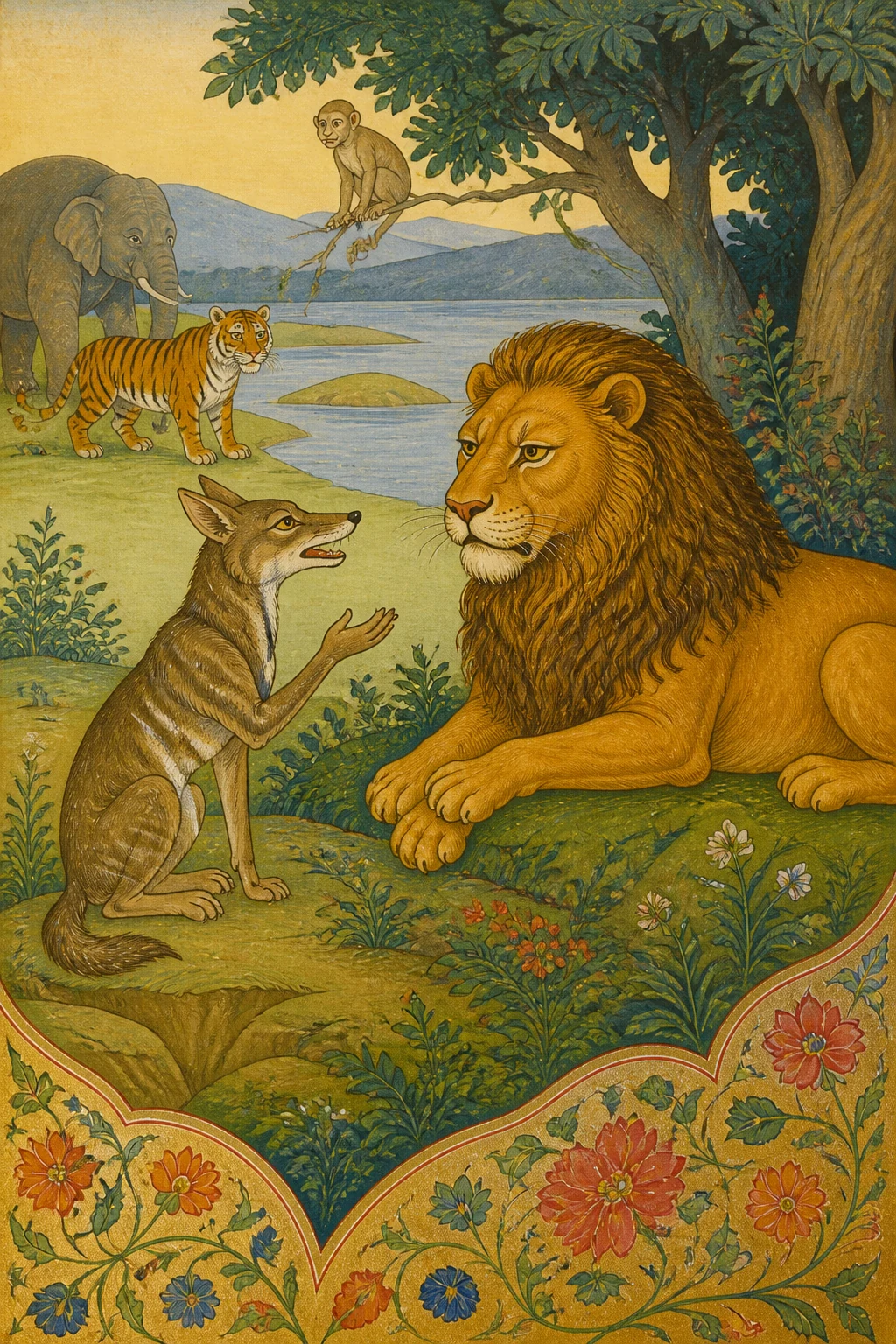
The monkey said: “Tale 2: The Tale of Karālakesara. In a certain part of a forest lived a lion named Karālakesara. A jackal named Dhūsaraka was his constant follower and attendant. One day, while fighting an elephant, the lion received such severe wounds that he could not move a single step. Since he could no longer hunt, Dhūsaraka too grew weak, his throat parched with hunger. One day he said to the lion, ‘Master, I am tormented by hunger. I can scarcely put one foot before the other. How am I to serve you?’
“The lion said, ‘Go and find some animal. Even in this condition, I can kill it.’
“Hearing this, the jackal went in search of prey and reached a nearby village. There he saw a donkey named Lambakarṇa beside a pond, struggling to graze on a few scattered shoots of grass. He approached him and said, ‘Uncle, please accept my greetings. It has been a long time since I saw you. Tell me, why have you grown so thin?’ The donkey replied, ‘Ah, nephew, what can I say? The washerman is utterly heartless. He torments me with excessive loads and does not give me so much as a handful of fodder. I eat nothing but grass shoots mixed with dust. How can I possibly grow strong?’
“The jackal said, ‘Uncle, if that is so, there is a lovely place beside a river, covered in grass as green as emeralds. Come and live there with me, enjoying the pleasure of good conversation.’
“Lambakarṇa said, ‘Nephew, what you say is very appealing. But we domestic animals are prey to the beasts of the forest. What use is such a lovely place to me?’
“The jackal replied, ‘Uncle, do not say that. That place is protected by the strength of my own arms. No outsider can enter it. Indeed, there are three she-donkeys living there without a protector, driven away by the very same trouble—cruel treatment by washermen. They are well fed and in the full bloom of youth. They said to me, “If you are truly our uncle, go to another village and bring us a suitable husband.” It is for their sake that I am taking you there.’ Hearing the jackal’s words, the donkey was overcome with desire and said, ‘My good fellow, if that is so, lead the way and I will follow. Indeed, it is well said:
“‘There is no nectar and no poison save a shapely woman:
Union with her gives life, and separation brings death.
“‘And again:
“‘When even the mention of women’s names awakens desire, without sight or union,
What wonder if a man’s heart melts when their eyes meet?’
“So he went with the jackal to the lion. The lion, racked with pain, began to rise as soon as he saw him, but the donkey immediately turned to flee. As he ran, the lion struck at him with his paw. The blow, however, proved as fruitless as the efforts of an unlucky man. The jackal flew into a rage and said, ‘What sort of a blow was that? Even a donkey can force his way past you! How will you ever fight an elephant? Now I have seen the measure of your strength!’
“With an embarrassed smile, the lion replied, ‘What could I do? I had not braced myself to spring. Otherwise, even an elephant cannot escape once I pounce on it.’
“The jackal said, ‘I will bring him to you once more. Only be ready to spring this time.’
“The lion replied, ‘My good fellow, he has seen me with his own eyes and escaped. How will he ever come back? Find some other animal.’
“The jackal said, ‘Why concern yourself with that? Just stand ready to spring.’
“When this was agreed, the jackal followed the donkey’s trail and found him grazing in the very same place as before. At the sight of the jackal, the donkey said, ‘Nephew, what a splendid place you took me to! I nearly met my death there. Tell me, what was that creature whose dreadful, thunderbolt-like paw I barely escaped?’ The jackal laughed and replied, ‘My good fellow, it was a she-donkey! When she saw you coming, she rose eagerly to embrace you, but you ran away in fright. She cannot bear to live without you. She only stretched out her hand to hold you back as you fled; there was no other reason. Come along. She has vowed to fast to death for your sake. She says, “If Lambakarṇa will not be my husband, I shall enter fire or drown myself. I cannot endure another separation from him.” So be kind and come back. Otherwise, you will bear the guilt of killing a woman. Moreover, the blessed god of love will turn his anger upon you. For it is said:
“‘Those foolish, misguided men who reject woman, the triumphant seal of the love-god, bestowing every earthly blessing, and pursue false rewards—
Those very men he strikes down without mercy:
Some he strips naked, some he shaves bald,
Some he clothes in red robes, and others he makes wear matted locks or carry skulls.’
“The donkey believed his words and set off with him once again. Indeed, it is well said:
“‘Though he knows better, a man is driven by fate to do what is shameful.
For who in this world would otherwise take pleasure in a shameful deed?’
“This time the lion was ready to spring, and he killed Lambakarṇa. Then, leaving the jackal to guard the body, he went to bathe in the river. But the jackal, overcome by greed, ate the donkey’s ears and heart. When the lion returned after bathing, worshipping the gods, and offering water to his ancestors, he found the donkey lying there without ears or heart. Furious at the sight, he said to the jackal, ‘Wretch! What is this disgraceful thing you have done? By eating his ears and heart, you have left me nothing but your leavings!’
“The jackal replied humbly, ‘Master, please do not say that. This donkey had neither ears nor heart to begin with. Otherwise, after coming here and seeing you, would he ever have returned?’
“The lion accepted his explanation and, his suspicions dispelled, shared the carcass with him and ate it.
*********************************************************************** “That is why I say, ‘He came, he went, and then returned.’ You fool, you laid a cunning plot, but ruined it by telling the truth, just as Yudhiṣṭhira did. Indeed, it is well said:
“‘The dull-witted pretender who forgets his own interest and tells the truth
Surely brings his prospects to ruin, like another Yudhiṣṭhira.’”
The crocodile asked, “How was that?” The monkey said: “Tale 3: The Tale of the Potter Named Yudhiṣṭhira. In a certain town lived a potter. One day, as he was running at great speed, he carelessly stumbled and fell upon the sharp edge of a potsherd half buried in the ground. It split his forehead, and he struggled to his feet, his body drenched in blood, and made his way home. Because he neglected the proper regimen, the wound became serious and healed only with difficulty. Later, when famine struck the country, the potter, his throat parched with hunger, went to another land with some royal retainers and entered the service of a king. Seeing the terrible scar on his forehead, the king thought, ‘This must be a brave man. Surely he received that blow upon his brow while facing the enemy.’ He therefore singled him out for special favor among all the princes, treating him with great honor. The princes, seeing the extraordinary favor shown him, burned with jealousy, but said nothing for fear of the king. One day, when war was imminent and the king was reviewing his warriors, the elephants were being made ready, the horses harnessed, and the soldiers equipped. Taking the opportunity, the king asked the potter in private, ‘Prince, what is your name? What is your lineage? In what battle did you receive that wound on your forehead?’
“He replied, ‘Your Majesty, this is not a wound from a weapon. I am a potter by birth, and my name is Yudhiṣṭhira. There were many broken pots in my house. One day I went out after drinking liquor, and as I ran, I fell on a potsherd. The wound it made has left this ugly scar on my forehead.’
“Hearing this, the king said in embarrassment, ‘Ah, I have been deceived by this potter posing as a prince! Seize him by the neck and throw him out at once!’
“As the order was carried out, the potter said, ‘No, do not do this! See how skillfully I fight in battle.’
“The king replied, ‘You may possess every virtue. Even so, you must go. For it is said:
“‘You are brave, accomplished, and handsome, my child;
But in the family into which you were born, elephants are not slain.’”
The potter asked, “How was that?” The king told him: “Tale 4: The Tale of the Lion and His Mate. In a certain place lived a lion and a lioness. In time, the lioness gave birth to two sons. Each day the lion killed wild animals and brought them to her. One day, however, he found nothing, though he roamed about until sunset. As he was returning home, he came upon a jackal cub. Thinking, ‘He is only a baby,’ he carefully carried him between his teeth and delivered him alive to the lioness. She asked, ‘My dear, have you brought us anything to eat?’
“The lion replied, ‘Beloved, today I found no creature except this little jackal. I did not kill him because he is only a baby, and, besides, he is of our own kind. For it is said:
“‘Never strike a woman, a Brahmin, a religious mendicant, or a child,
Even when your own life is at stake—above all, never strike those who trust you.
“‘Now eat him and restore your strength. Tomorrow morning I shall find something else.’ She replied, ‘My dear, you spared him because he is a baby. How, then, can I kill him merely to fill my belly? For it is said:
“‘What is wrong must never be done, even in the face of death;
Nor must one abandon what is right: this is the eternal law.
“‘Therefore he shall be my third son.’ With these words, she nourished him on her own milk until he grew strong. Thus the three youngsters passed their childhood together, sharing the same habits and games, unaware of any difference in their birth. One day a wild elephant wandered into that part of the forest. At the sight of it, the two lion cubs grew fierce and started toward it. But the young jackal cried, ‘Look! That is an elephant, the enemy of your family! Do not go near it!’ With these words, he ran home. Seeing their elder brother flee, the other two also lost heart. Indeed, it is well said:
“‘A single steadfast warrior, eager for battle,
Can fill an army with courage; if he breaks, the army breaks with him.
“And again:
“‘That is why kings seek warriors of mighty strength,
Bold, valiant, and eager, and keep cowards far away.
“When the two cubs reached home, they told their parents how their elder brother had behaved—how he had run away at the mere sight of an elephant in the distance.
“Hearing this, the young jackal flew into a rage. His tender lips quivered, his eyes reddened, and his brow drew into a threefold frown as he scolded them harshly. The lioness took him aside and gently admonished him: ‘My child, never speak like that. These are your younger brothers.’
“Still furious, he said to her, ‘Am I inferior to them in courage, looks, learning, or skill, that they should mock me? I shall certainly kill them both!’
“Hearing this, the lioness smiled to herself and, wishing to save his life, said, ‘Listen carefully. You are a jackal’s son. Out of kindness, I reared you on my own milk. While these two sons of mine are still too young to recognize you as a jackal, leave quickly and join your own kind. Otherwise, they will kill you and send you down the road to death.’ At her words, he was filled with fear. He slipped quietly away and joined his own kind. ‘So you too must leave quickly, before these princes discover that you are a potter. Otherwise, they will humiliate you and put you to death.’ Hearing this, the potter fled at once. ***********************************************************************
“That is why I say, ‘The dull-witted pretender who forgets his own interest’ (38).
“Shame on you, fool, for undertaking such a deed for a woman’s sake! One should never put one’s trust in women. For it is said:
“‘For her I forsook my family and gave up half my life;
Yet she abandons me without affection. What man would trust a woman?’”
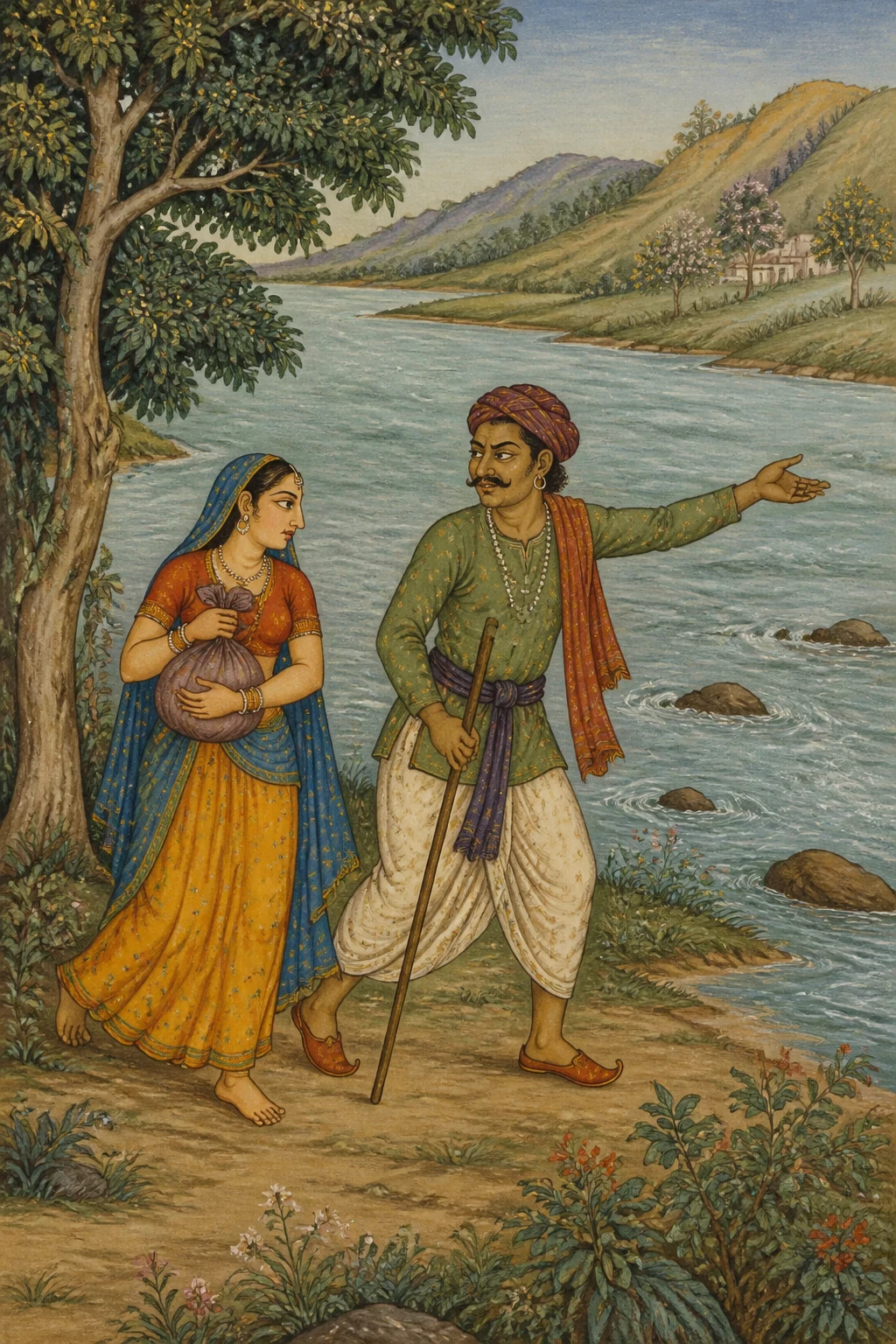
The crocodile asked, “How was that?” The monkey said: “Tale 5: The Tale of the Brahmin. In a certain town lived a Brahmin whose wife was dearer to him than life itself. Every day she quarreled with his family and never let the matter rest. Unable to endure the quarrels, and deeply attached to his wife, the Brahmin abandoned his family and set out with her for a distant land. In the middle of a great forest, his wife said, ‘My dear husband, I am tormented by thirst. Find me some water.’ He went at once, but when he returned with water, he found her dead. Because he loved her so dearly, he was overcome with grief and began to lament. As he wept, he heard a voice from the sky: ‘Brahmin, if you give her half of your own allotted life, your wife will live.’ Hearing this, he purified himself and, repeating his declaration three times, gave her half his life. The moment he spoke, she came back to life. They drank the water, ate some forest fruits, and resumed their journey. In time they reached the outskirts of a town and entered a flower garden. The Brahmin said to his wife, ‘My dear, stay here while I go and fetch some food.’ With these words, he went into the town. Now in that garden there was a lame man working a waterwheel and singing in a heavenly voice. Hearing him, the Brahmin’s wife was pierced by the flower-arrows of the god of love. She approached him and said, ‘Good sir, if you will not make love to me, you will bear the guilt of a woman’s death on my account.’ The lame man replied, ‘What would you do with an afflicted man like me?’
“She said, ‘Why speak of that? I must be united with you.’
“Hearing this, he did as she wished. After they had made love, she said, ‘From this moment, I give myself to you for as long as I live. Knowing this, come with us.’
“He replied, ‘So be it.’
“Then the Brahmin returned with food and began to eat with his wife. She said, ‘This lame man is hungry. Give him a little food as well.’”