Prevod
So he spoke, and they all fell silent, held spellbound throughout the shadowy halls. Then Alcinous answered him: “Odysseus, now that you have come to my high-roofed house with its threshold of bronze, I believe you will reach home without being driven astray again, though you have suffered greatly.
“And to each of you I give this charge, all who regularly drink the elders’ glowing wine in my halls and listen to the bard. Clothing for our guest already lies in a polished chest, with finely wrought gold and all the other gifts the Phaeacian counsellors have brought here. But come, let each of us give him a great tripod and a cauldron as well. Afterwards we will levy contributions from the people to repay ourselves, for it is hard for one man to give so much without return.”
So Alcinous spoke, and his proposal pleased them. Each went home to sleep; but when early-born, rosy-fingered Dawn appeared, they hurried to the ship, bringing their sturdy bronze vessels.
Alcinous, the sacred king, went aboard himself and stowed them carefully beneath the benches, so that nothing would hamper the crew as they rowed, whenever they bent eagerly to their oars. Then the others went to Alcinous’ house and set about preparing a feast.
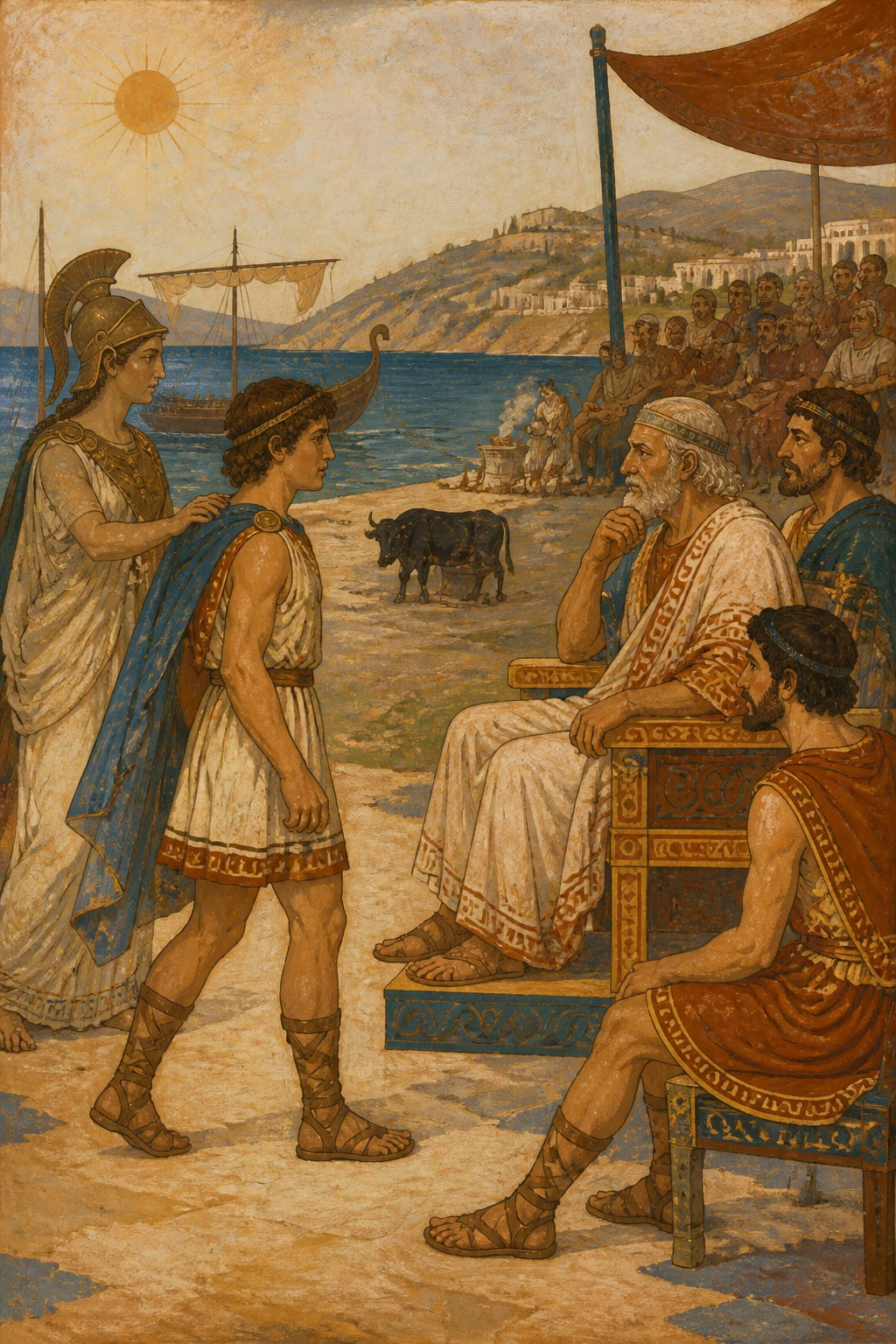
For them Alcinous, the sacred king, sacrificed an ox to Zeus of the dark clouds, the son of Cronus, who rules over all. They burned the thighbones and delighted in a glorious feast, while the inspired bard Demodocus, honoured by the people, sang among them. But Odysseus kept turning his head towards the radiant sun, longing for it to set, for his heart was eager to be home.
As a man longs for supper when all day long his wine-dark oxen have drawn the sturdy plough through a fallow field, and gladly sees the sunlight fade so that he may go to his meal, though his knees falter as he walks, so gladly did Odysseus see the sunlight sink.
At once he addressed the oar-loving Phaeacians, speaking chiefly to Alcinous: “Lord Alcinous, most renowned of all your people, pour the libations and send me safely on my way; and may happiness remain with you. Everything my heart desired has now been fulfilled: an escort home and loving gifts. May the gods of heaven make them a blessing to me, and may I find my faithful wife at home on my return, with all my loved ones safe.
“And may you who stay here bring joy to your wedded wives and children. May the gods grant you every kind of prosperity, and may no evil fall upon your people.” So he spoke, and all approved and urged that the stranger be sent on his way, for he had spoken fittingly.
Then mighty Alcinous addressed the herald: “Pontonous, mix a bowl of wine and serve everyone throughout the hall, so that we may pray to Father Zeus and send our guest back to his native land.”
So he spoke, and Pontonous mixed the honey-sweet wine and went from man to man, serving them all. From their seats they poured libations to the blessed gods who hold the broad heavens. Then noble Odysseus rose and placed a two-handled cup in Arete’s hands, addressing her with winged words: “May happiness be yours, my queen, through all the years until old age and death come, as they come to all mankind.
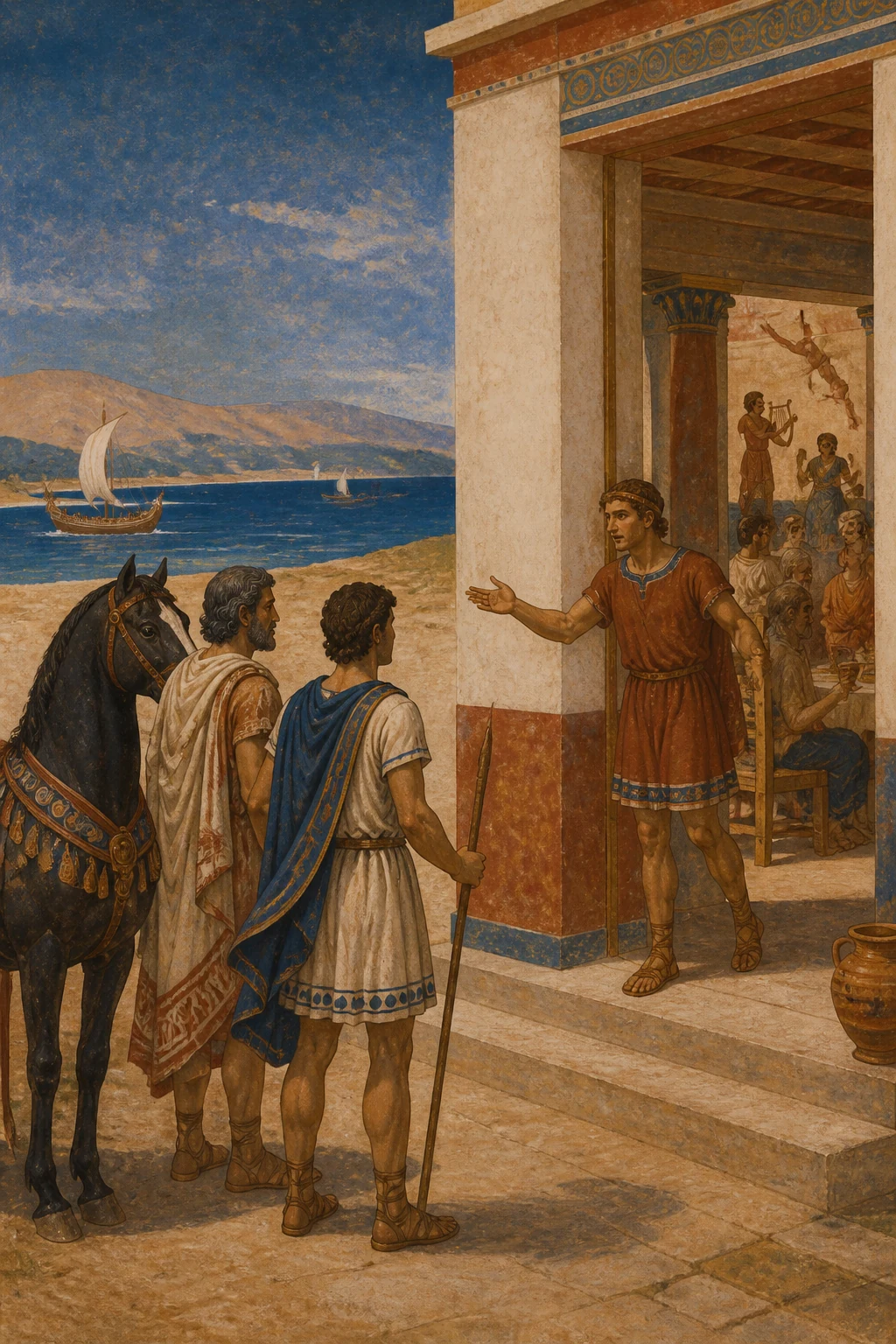
“Now I am going home. May you rejoice in this house with your children, your people, and King Alcinous.” With these words noble Odysseus crossed the threshold. Mighty Alcinous sent a herald with him to lead him to the swift ship and the seashore. Arete too sent serving women along: one carried a freshly washed cloak and tunic; another she charged with carrying the stout chest; and a third brought bread and red wine.
When they came down to the ship and the sea, his noble escorts at once took all the food and drink and stowed it in the hollow ship. For Odysseus they spread a rug and linen sheet on the stern deck, where he might sleep undisturbed. He too went aboard and lay down in silence. The men took their places in order on the rowing benches and untied the cable from the pierced stone.
As they leaned back and tossed the brine with their oar blades, sweet sleep fell upon his eyelids, deep and unbroken, most like death. As four stallions yoked together on a plain spring forward at the lash, lifting their feet high and swiftly covering the course, so the ship’s stern lifted, while behind her a great dark wave of the roaring sea surged up.
Surely and steadily she sped along; not even a hawk, the swiftest of winged creatures, could have kept pace with her. So swiftly she cut through the waves of the sea, carrying a man whose wisdom rivalled that of the gods. Before this he had suffered many sorrows in his heart, passing through men’s wars and the grievous waves; but now he slept in peace, forgetful of all he had endured.
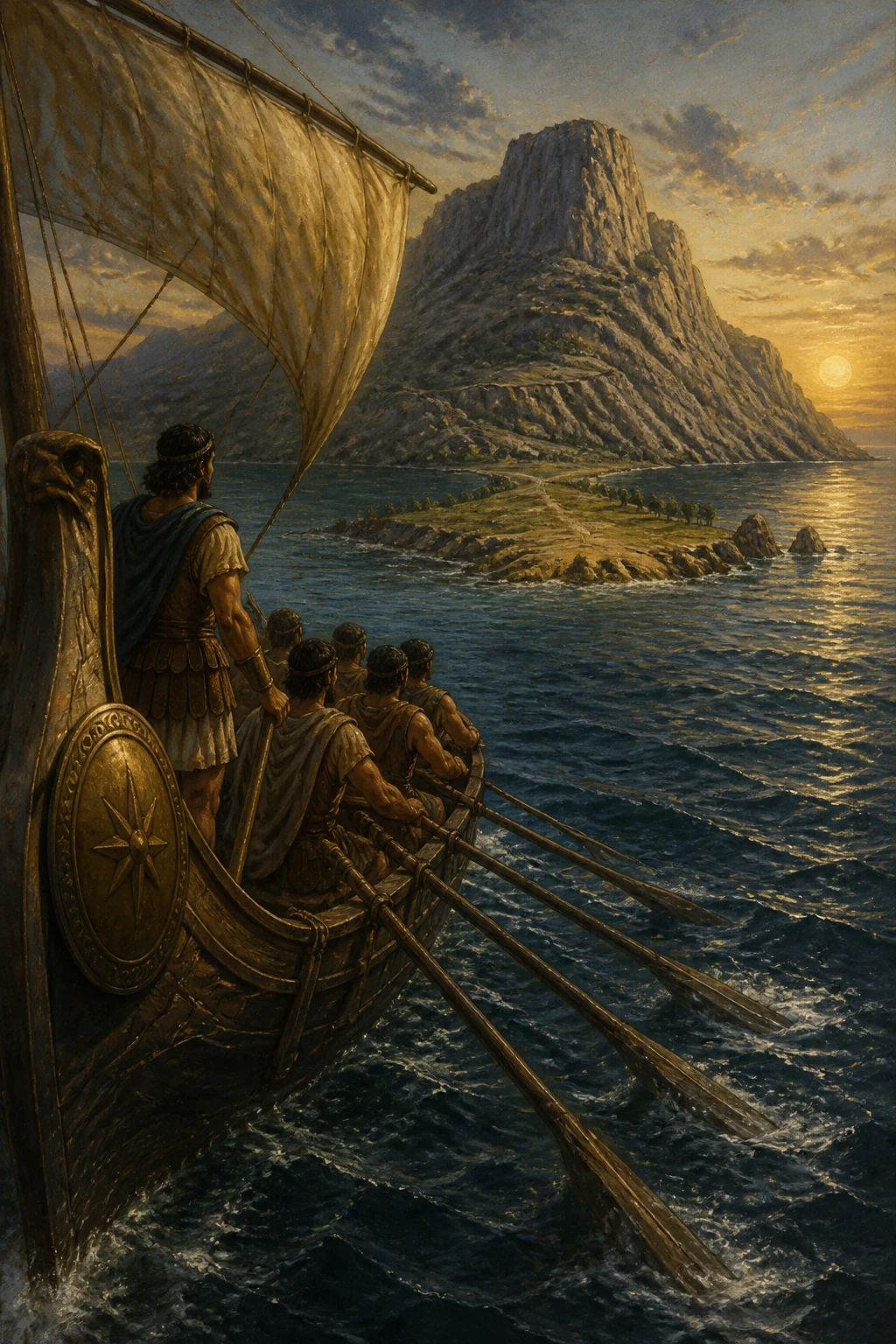
When the brightest star rose, the star that comes to herald the light of early-born Dawn, the seagoing ship drew near the island. There is a harbour in the land of Ithaca sacred to Phorcys, the old man of the sea. Two jutting headlands, steep and sheer, bend towards the harbour and shelter it from the great waves raised outside by raging winds. Within, well-benched ships lie without moorings once they have reached the anchorage.
At the head of the harbour stands a long-leaved olive tree, and near it is a lovely, shadowy cave, sacred to the nymphs called Naiads. Within are mixing bowls and two-handled jars of stone, and there bees store their honey.
There too are tall stone looms, where the nymphs weave sea-purple cloth, a wonder to behold, and springs whose waters never fail. The cave has two entrances: the one facing north is a way down for men; the other, facing south, belongs to the gods. No mortal enters there: it is the immortals’ way.
Into this harbour they rowed, knowing it well. The ship drove up onto the beach for half her length, such was the force of the rowers’ hands. They stepped ashore from the well-benched vessel and first lifted Odysseus from the hollow ship, linen sheet, gleaming rug and all, and laid him on the sand, still overcome by sleep. Then they brought out the treasures the noble Phaeacians had given him for his homeward journey, through the favour of great-hearted Athena.
They piled them all at the foot of the olive tree, away from the road, lest some passing traveller should come upon them and steal them before Odysseus woke. Then they set off home again. But the Earth-shaker had not forgotten the threats he had first made against godlike Odysseus, and he sought out Zeus’s will: “Father Zeus, I shall no longer be honoured among the immortal gods, now that mortals show me no respect—the Phaeacians, who spring from my own blood.
“For I said that Odysseus would come home only after suffering many hardships. I never deprived him of his homecoming altogether, since you had promised it and confirmed it with your nod. Yet they have carried him sleeping over the sea in their swift ship and set him down in Ithaca, giving him countless gifts, bronze and gold in abundance and woven clothing—more than Odysseus could ever have brought from Troy, even if he had returned unharmed with his full share of the spoils.”
Zeus, the gatherer of clouds, answered him: “Ah, mighty Earth-shaker, what a thing to say! The gods do not dishonour you. It would be hard indeed to heap dishonour on one so senior and so great.
“But if any mortal, yielding to your power and might, yet fails to honour you, you always have the means of taking vengeance afterwards. Do as you wish, as your heart desires.” Then Poseidon the Earth-shaker answered him: “I would gladly do at once as you say, lord of the dark clouds, but I always respect your wishes and shrink from crossing them.
“Now I want to wreck that splendid Phaeacian ship on the misty sea as she returns from her escort, so that they may hold back at last and cease conveying men, and I would throw a great mountain around their city.”
Zeus, the gatherer of clouds, answered him: “My friend, this seems best to me: when all the people look out from the city and see her being rowed towards them, turn her into stone close to shore, still in the likeness of a swift ship, so that everyone may marvel; then throw a great mountain around their city.”
When Poseidon the Earth-shaker heard this, he went to Scheria, where the Phaeacians live. There he waited. The seagoing ship came swiftly on and was already close at hand. The Earth-shaker drew near her, struck her with the flat of his hand, turned her to stone and rooted her to the seabed. Then he went away.
The long-oared Phaeacians, famed for their ships, spoke winged words to one another. One man would turn to his neighbour and say: “Ah, who has stopped our swift ship out at sea as she was coming home? We could already see her plainly!”
So they spoke, but they did not know what had happened. Then Alcinous addressed them: “Alas, the ancient prophecies my father told me have indeed come upon me. He used to say that Poseidon was angry with us because we safely convey all men.
“He said that one day he would wreck a splendid ship of the Phaeacians on the misty sea as she returned from an escort, and throw a great mountain around our city. So the old man spoke, and now it is all coming true.
“Come, then, let us all do as I say. Give up conveying mortals whenever anyone comes to our city, and let us sacrifice twelve chosen bulls to Poseidon, in the hope that he will take pity on us and not throw a towering mountain around our city.”
So he spoke, and in fear they made ready the bulls. Thus the leaders and rulers of the Phaeacian people stood around the altar and prayed to Lord Poseidon. Meanwhile noble Odysseus awoke from sleep in his native land, but did not recognize it after so long away. For Pallas Athena, daughter of Zeus, had poured a mist around him, to make him unrecognizable and to explain everything to him, so that neither his wife nor his townspeople and friends should know him before the suitors had paid for all their outrages.
That was why everything looked strange to its king: the long paths, the sheltered harbours, the sheer cliffs and the flourishing trees. He sprang up and stood gazing at his native land. Then he groaned and struck his thighs with the flat of his hands, crying out in grief: “Alas for me! To whose country have I come this time?
“Are they violent and savage, with no regard for justice, or do they welcome strangers and fear the gods? Where shall I take all these treasures? Where shall I wander now myself? If only I had stayed there among the Phaeacians! I might have gone to some other powerful king who would have welcomed me and sent me home.
“Now I do not know where to put these things, yet I cannot leave them here, lest they become someone else’s plunder. Ah, the leaders and rulers of the Phaeacians were not so wise or just after all! They have brought me to another country, though they said they would take me to clear-seen Ithaca. They have not kept their word.
“May Zeus, protector of suppliants, punish them—he who watches over all mankind and exacts payment from whoever does wrong. But come, let me count my treasures and see whether they have sailed off with anything in their hollow ship.”
So saying, he counted the splendid tripods and cauldrons, the gold and the fine woven clothing. Nothing was missing. But he mourned for his native land as he paced along the shore of the resounding sea, lamenting bitterly. Then Athena came near him in the shape of a young shepherd, delicate-featured as the sons of kings are, with a finely made cloak folded double over her shoulders, sandals on her graceful feet, and a spear in her hands.
Odysseus rejoiced to see her and went to meet her, speaking winged words: “Friend, since you are the first person I have met in this country, greetings to you, and may you meet me with no ill intent. Save these possessions, and save me too. I pray to you as to a god and clasp your knees in supplication.
“And tell me truly, so that I may know: what country is this? What people live here? Is it some clearly visible island, or a headland of the fertile mainland sloping down to the sea?”
The bright-eyed goddess Athena answered him: “You must be a simpleton, stranger, or have come from far away, if you ask about this country. It is certainly not so little known. Many know it, both those who live towards the dawn and the rising sun and those who dwell behind us towards the misty darkness.
“It is rugged and no place for driving horses, yet it is not a barren land, though it is not broad. Grain grows here in abundance, and wine is produced; rain and nourishing dew are always with it. It is good pasture for goats and cattle, has timber of every kind, and watering places that never fail.
“So, stranger, the name of Ithaca has reached even Troy, which they say lies far from the land of Achaea.” So she spoke, and long-enduring, noble Odysseus rejoiced, glad to be in his native land, as Pallas Athena, daughter of aegis-bearing Zeus, had told him. He addressed her with winged words, yet spoke no truth, holding back the story, always turning crafty thoughts over in his heart: “I heard of Ithaca even in broad Crete, far across the sea. And now I have come here myself with these possessions, leaving as much again to my children. I am a fugitive, for I killed Idomeneus’ dear son, swift-footed Orsilochus, who surpassed all men in broad Crete in speed of foot. He wanted to rob me of all the spoils I had won at Troy, for which I had suffered anguish in my heart, passing through men’s wars and the grievous waves, because I had not served under his father in the land of Troy, but commanded my own company.
“With a companion I lay in wait beside the road and struck him with a bronze-tipped spear as he came back from the fields. A very dark night covered the heavens, and no one saw us; unseen, I took his life.
“When I had killed him with the sharp bronze, I went straight to a ship and appealed to some noble Phoenicians, giving them a handsome share of spoil. I asked them to take me to Pylos and set me ashore there, or in holy Elis, where the Epeians rule.
“But the force of the wind drove them off course, much against their will; they had no wish to deceive me. Wandering from there, we reached this place by night. We rowed hard into the harbour and gave no thought to supper, much though we needed food, but all stepped out of the ship and lay down just as we were.
“There sweet sleep came over me in my weariness. They took my possessions from the hollow ship and set them beside me where I lay on the sand. Then they went aboard and sailed away for well-peopled Sidon, leaving me behind with a grieving heart.”
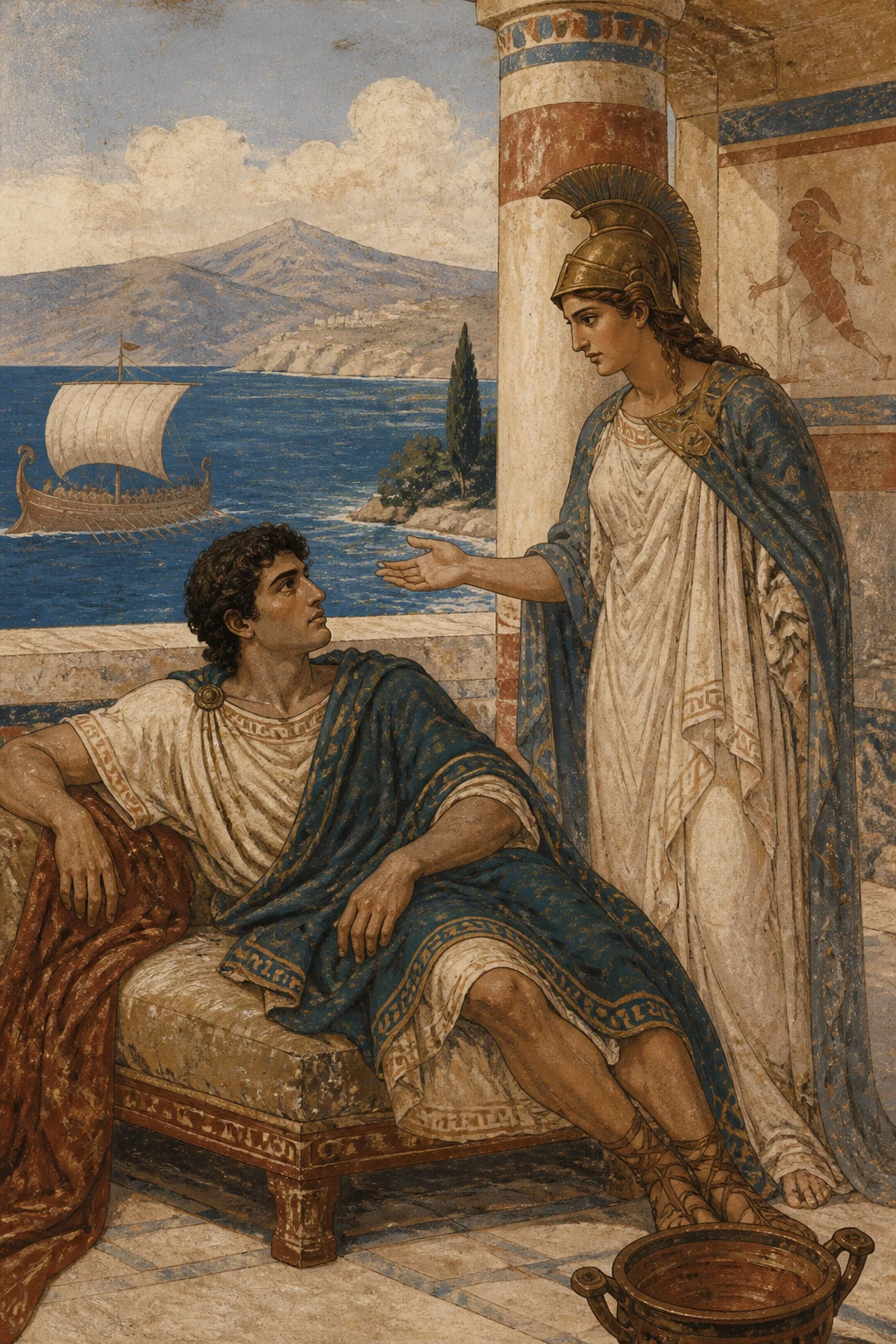
So he spoke, and the bright-eyed goddess Athena smiled and stroked him with her hand. Now she took the form of a woman, beautiful and tall, skilled in splendid handiwork, and addressed him with winged words: “Cunning indeed, and a cheat, would anyone have to be to outdo you in every kind of trickery—even if a god came against you.
“Incorrigible man, subtle schemer, never sated with deceit! Even in your own country you were not going to give up your tricks and lying tales, so dear to you from your earliest days. But come, let us speak no more of this, for we both know cunning: you are far the best of all mortals in counsel and in speech, while I am renowned among all the gods for wisdom and craft. Yet you did not recognize Pallas Athena, daughter of Zeus, who always stands beside you and guards you in all your troubles. It was I who made all the Phaeacians love you. And now I have come here to weave a plan with you and hide the treasures the noble Phaeacians gave you for your homeward journey through my counsel and design. I shall tell you too what sorrows fate requires you to endure in your well-built house. You must bear them, however hard it is, and tell no one, man or woman, that you have returned from your wanderings. Suffer your many sorrows in silence and submit to men’s violence.”
Resourceful Odysseus answered her: “Goddess, it is hard for a mortal who meets you to recognize you, however wise he may be, for you take on every shape. This I know well: you were kind to me in former days, when we sons of the Achaeans fought at Troy.
“But after we sacked Priam’s lofty city and sailed away in our ships, and a god scattered the Achaeans, I never saw you again, daughter of Zeus, nor knew of your coming aboard my ship to ward off any suffering.
“With a heart torn by sorrow I wandered on until the gods released me from my misery. Not until I reached the rich land of the Phaeacians did you encourage me with words and lead me yourself into their city.
“Now I beseech you by your father—for I do not think I have reached clear-seen Ithaca, but am wandering in some other country, and I think you say these things in mockery, to deceive my mind—tell me whether I have truly come to my beloved native land.”
The bright-eyed goddess Athena answered him: “Always the same thoughts in your heart! That is why I cannot abandon you in your misfortune: you are shrewd, quick-witted and self-controlled.
“Any other man returning from his wanderings would hurry joyfully to see his wife and children in his house. But you are not yet eager even to learn or inquire about them until you have tested your wife—though she sits in your halls just as before, and her sorrowful nights and days pass always in tears.
“For my part, I never doubted; I knew in my heart that you would come home, though all your companions would be lost. But I did not wish to contend with Poseidon, my father’s brother, who laid up anger against you in his heart, enraged because you blinded his dear son.
“Come, I will show you the land of Ithaca, so that you may believe. This is the harbour of Phorcys, the old man of the sea, and here at the harbour’s head is the long-leaved olive tree. Near it is the lovely, shadowy cave sacred to the nymphs called Naiads. This is the vaulted cavern where you often offered the nymphs perfect hecatombs. And there is Mount Neriton, clothed in forest.”
With these words the goddess scattered the mist, and the land appeared. Then long-enduring, noble Odysseus rejoiced in his own country and kissed the life-giving earth. At once he raised his hands and prayed to the nymphs: “Naiad nymphs, daughters of Zeus, I never thought to see you again. Now I greet you with loving prayers. We shall give you gifts too, as in former days, if the daughter of Zeus, who brings the spoils of war, graciously allows me to live and brings my dear son to full strength.”
The bright-eyed goddess Athena answered him: “Take courage; do not let these things trouble your heart. Let us put your treasures away at once in the depths of this holy cave, where they will remain safe. Then we ourselves will consider how best to act.”
So saying, the goddess entered the shadowy cavern, searching through it for hiding places, while Odysseus carried everything nearer: the gold, the enduring bronze and the finely made clothing the Phaeacians had given him.
He stowed it all carefully, and Pallas Athena, daughter of aegis-bearing Zeus, set a stone across the entrance. Then the two sat down at the foot of the sacred olive tree and planned destruction for the arrogant suitors.
The bright-eyed goddess Athena began: “Son of Laertes, sprung from Zeus, resourceful Odysseus, consider how you will lay hands on the shameless suitors. For three years now they have lorded it in your hall, courting your godlike wife and offering bridal gifts. But she, grieving in her heart for your return, gives hope to all and promises to each, sending messages, while her mind intends something else.”
Resourceful Odysseus answered her: “Ah, I too was surely destined to perish in my own halls by the same wretched fate as Agamemnon, son of Atreus, if you, goddess, had not told me everything as it stands.
“Come, weave a plan so that I may repay them. Stand beside me yourself and put bold courage into me, as when we loosened Troy’s gleaming crown of towers. If you would stand beside me with such zeal, bright-eyed goddess, I would fight three hundred men with you, sovereign goddess, if you would willingly come to my aid.”
The bright-eyed goddess Athena answered him: “Indeed I shall be with you, and you will not escape my notice when we set about this work. I think that more than one of the suitors who devour your substance will spatter the broad floor with his blood and brains.
“But come, I will make you unrecognizable to every mortal. I shall shrivel the fair skin on your supple limbs, strip the golden hair from your head, and clothe you in rags that will disgust anyone who sees a man wearing them. I shall dim your eyes, so beautiful before, so that you seem loathsome to all the suitors, and to your wife and the son you left in your halls.
“Go first to the swineherd who tends your pigs. His heart is still loyal to you, and he loves your son and prudent Penelope. You will find him sitting with the swine, which feed by Raven’s Rock and the spring of Arethusa, eating wholesome acorns and drinking the dark water that nourishes rich fat in pigs.
“Stay there, sit beside him and question him about everything, while I go to Sparta, land of beautiful women, to summon Telemachus, your dear son, Odysseus. He has gone to Menelaus in spacious Lacedaemon to seek news of you and learn whether you are still alive.”
Resourceful Odysseus answered her: “Why did you not tell him, since you know everything in your heart? Was it so that he too should wander the barren sea and suffer hardships, while others devour his livelihood?”
The bright-eyed goddess Athena answered him: “Do not let him weigh too heavily on your mind. I guided him myself, so that by going there he might win a noble name. He is suffering no hardship, but sits at ease in the house of Atreus’ son, with abundance spread before him.
“Young men are indeed lying in wait for him in a black ship, eager to kill him before he reaches his native land. But I do not think they will succeed; sooner will the earth cover some of those suitors who devour your substance.”
With these words Athena touched him with her wand. She shrivelled the fair skin on his supple limbs, stripped the golden hair from his head and covered all his body with the skin of an aged man. She dimmed his eyes, so beautiful before, and dressed him in a wretched cloak and tunic, torn and filthy, begrimed with foul smoke. Over these she threw the great skin of a swift deer, worn bare of hair. She gave him a staff and a shabby bag, full of holes, with a twisted cord for its strap.
So, their plans laid, the two parted. She went to holy Lacedaemon to fetch Odysseus’ son.