Prevod
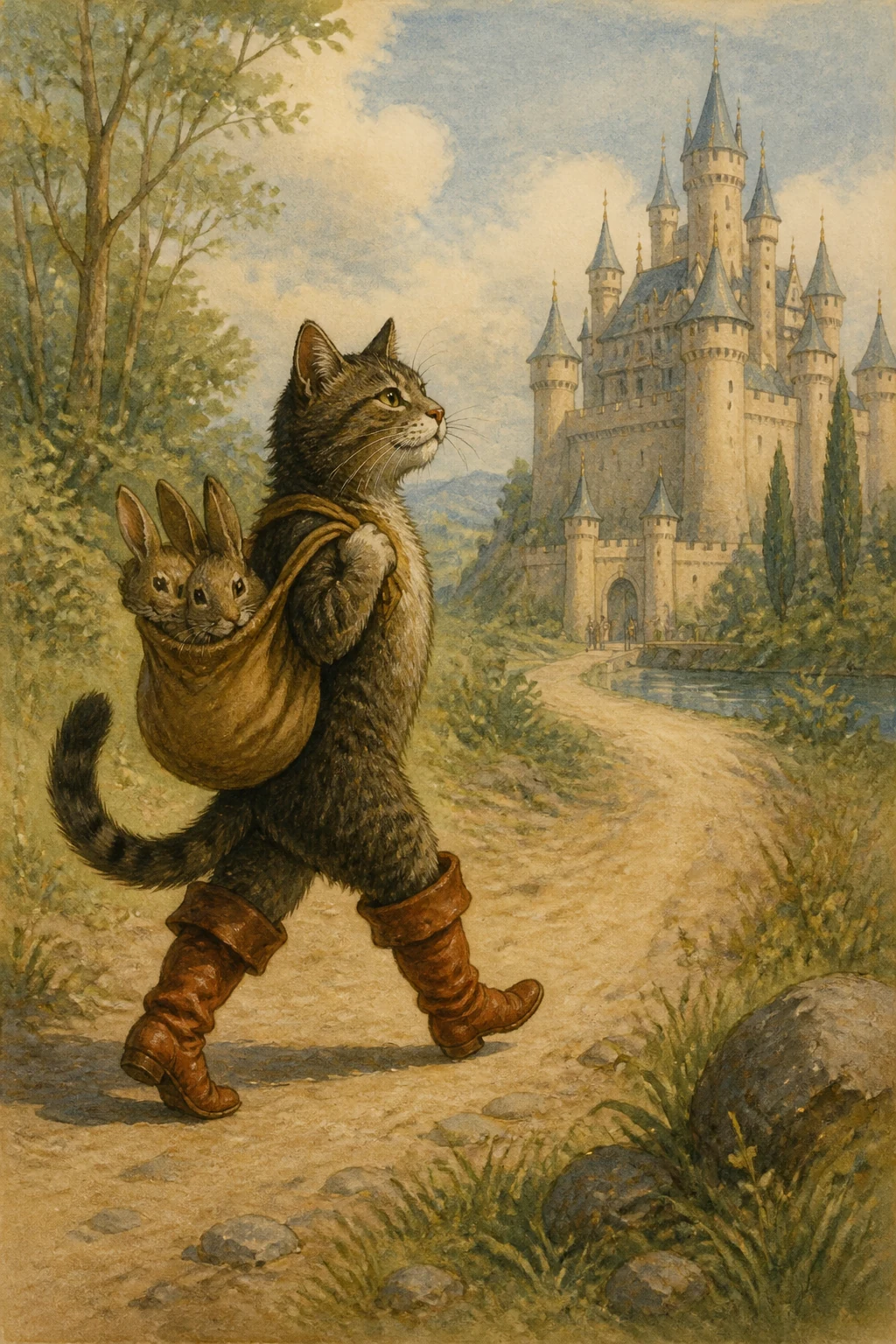
A miller left his three children nothing but his mill, his donkey, and his cat. The estate was soon divided, with neither notary nor lawyer called in: they would soon have swallowed up the whole poor inheritance. The eldest took the mill, the second the donkey, and the youngest got only the cat. This last could not console himself over so poor a share. “My brothers,” he said, “can earn an honest living by working together; but as for me, once I have eaten my cat and made a muff out of his skin, I shall have to starve.” The cat, who heard these words but pretended not to, said to him in a calm and serious manner, “Do not grieve, master. You need only give me a sack and have a pair of boots made for me, so that I can go among the brambles, and you will see that your share is not so poor as you think.” Though the cat’s master put little faith in this, he had seen him perform so many nimble tricks to catch rats and mice—hanging by his hind feet, for instance, or hiding in the flour and pretending to be dead—that he did not despair of finding help in his distress. Once the cat had what he had asked for, he boldly pulled on his boots, slung the sack about his neck, took its drawstrings in his forepaws, and set off for a warren where there were a great many rabbits. He put some bran and sow-thistle into his sack, then stretched himself out as though dead and waited for some young rabbit, still little acquainted with the wiles of the world, to creep into the sack and eat what he had put there. Hardly had he lain down when his wish was granted: a scatterbrained young rabbit entered the sack, and Master Cat at once pulled the strings, caught it, and killed it without mercy. Very proud of his prey, he went to the King’s palace and asked to speak to him. He was shown up to His Majesty’s apartments, where he made a deep bow to the King and said, “Here, Sire, is a wild rabbit that the Marquis of Carabas”—the name he had taken it into his head to give his master—“has charged me to present to you on his behalf.” “Tell your master,” replied the King, “that I thank him, and that his gift gives me pleasure.” Another time, the cat hid in a field of wheat, again holding his sack open, and when two partridges had gone inside, he pulled the strings and caught them both. He then went to present them to the King, as he had done with the wild rabbit. The King again received the two partridges with pleasure and ordered that the cat be given something to drink his health. For two or three months the cat continued in this way, bringing the King game from his master’s hunting from time to time. One day, learning that the King was to take a drive along the river with his daughter, the most beautiful princess in the world, he said to his master, “If you will follow my advice, your fortune is made. You need only bathe in the river at the spot I show you, and then leave the rest to me.” The Marquis of Carabas did as his cat advised, without knowing what good it would do. While he was bathing, the King came past, and the cat began shouting at the top of his voice, “Help! Help! The Marquis of Carabas is drowning!” At this cry, the King put his head out of the carriage window, and, recognizing the cat who had so often brought him game, ordered his guards to hurry to the Marquis of Carabas’s rescue. While they were pulling the poor Marquis from the river, the cat approached the carriage and told the King that, while his master was bathing, thieves had come and carried off his clothes, though he had shouted “Thieves!” as loudly as he could. The rogue had hidden them under a large stone. The King immediately ordered the officers of his wardrobe to fetch one of his finest suits for the Marquis of Carabas. He showered him with kindness, and as the fine clothes he had just been given set off his good looks—for he was handsome and well built—the King’s daughter found him very much to her liking. The Count of Carabas had scarcely cast two or three deeply respectful and slightly tender glances her way before she fell madly in love with him. The King insisted that he get into the carriage and join them on their drive. The cat, delighted to see his plan beginning to succeed, hurried on ahead, and, coming upon some peasants mowing a meadow, said to them, “Good people mowing here, unless you tell the King that this meadow belongs to the Marquis of Carabas, you will all be chopped as fine as meat for a pie.” The King duly asked the mowers whose meadow they were mowing. “It belongs to the Marquis of Carabas,” they all said together, for the cat’s threat had frightened them. “You have a fine estate there,” said the King to the Marquis of Carabas. “As you see, Sire,” replied the Marquis, “it is a meadow that never fails to yield abundantly every year.” Master Cat, still going on ahead, met some reapers and said to them, “Good people reaping here, unless you say that all this wheat belongs to the Marquis of Carabas, you will all be chopped as fine as meat for a pie.” The King, who passed a moment later, wished to know who owned all the wheat he could see. “It belongs to the Marquis of Carabas,” replied the reapers, and the King once again congratulated the Marquis. The cat, going ahead of the carriage, said the same thing to everyone he met, and the King was astonished at the great wealth of the Marquis of Carabas. At last Master Cat reached a splendid castle whose master was an ogre, the richest ever seen, for all the land through which the King had passed belonged to this castle. The cat, who had taken care to find out who this ogre was and what he could do, asked to speak to him, saying that he had not wished to pass so near his castle without having the honour of paying his respects. The ogre received him as courteously as an ogre can and invited him to sit down. “I have been assured,” said the cat, “that you have the gift of changing yourself into all kinds of animals; that you can turn yourself, for instance, into a lion or an elephant.” “That is true,” replied the ogre brusquely, “and to prove it, you shall see me become a lion.” The cat was so terrified to see a lion before him that he scrambled up to the gutters, not without difficulty and danger, for his boots were no use at all for walking on roof tiles. Some time later, seeing that the ogre had ceased to be a lion, the cat came down and admitted that he had been very frightened. “I have also been assured,” said the cat, “though I cannot believe it, that you have the power to take the shape of the very smallest animals—for example, to change yourself into a rat or a mouse. I confess I consider that quite impossible.” “Impossible?” retorted the ogre. “You shall see!” And at that very moment he changed himself into a mouse, which began running about the floor. No sooner had the cat caught sight of it than he pounced on it and ate it. Meanwhile, the King, seeing the ogre’s splendid castle as he passed, wished to go inside. The cat heard the rumble of the carriage crossing the drawbridge, ran out to meet it, and said to the King, “Your Majesty is welcome to the castle of the Marquis of Carabas.” “What, Marquis!” cried the King. “Does this castle belong to you as well? Nothing could be finer than this courtyard and all the buildings surrounding it. Let us see the inside, if you please.” The Marquis offered his hand to the young Princess, and, following the King, who went up first, they entered a great hall, where they found a magnificent feast that the ogre had ordered to be prepared for friends who were to visit him that very day, but who had not dared come in, knowing that the King was there. The King, charmed by the fine qualities of the Marquis of Carabas, as was his daughter, who was quite besotted with him, and seeing the great wealth he possessed, said to him after five or six glasses, “It rests entirely with you, Marquis, whether you become my son-in-law.” The Marquis, bowing low, accepted the honour the King bestowed on him, and married the Princess that very day. The cat became a great lord, and never chased mice again except for his own amusement.
MORAL. However great the boon may be, To gain a rich estate That passes down from sire to son, For young folk, as a rule, Resourcefulness and skill Are worth more than inherited wealth.
Another Moral. If a miller’s son so swiftly wins A princess’s heart, And makes her gaze at him with languishing eyes, It is because fine clothes, good looks, and youth Are not always without their power To stir tender feelings.
Izvirnik
LE MAISTRE CHAT
OU
LE CHAT BOTTÉ.
CONTE.
Vn Meusnier ne laissa pour tout biens à trois enfans qu’il avoit, que son Moulin, son Asne, & son Chat. Les partages furent bien tôt faits, ny le Notaire, ny le Procureur n’y furent point appellés. Ils auroient eu bien-tost mangé tout le pauvre patrimoine. L’aisné eut le Moulin, le second eut l’Asne, & le plus jeune n’eut que le Chat. Ce dernier ne pouvoit se consoler d’avoir un si pauvre lot : Mes freres, disoit-il, pourront gagner leur vie honnestement en se mettant ensemble ; pour moi, lors que j’aurai mangé mon chat, & que je me seray fait un manchon de sa peau, il faudra que je meure de faim. Le Chat qui entendoit ce discours, mais qui n’en fit pas semblant, luy dit d’un air posé & serieux, ne vous affligés point, mon maistre, vous n’avez qu’à me donner un Sac, & me faire faire une paire de Bottes pour aller dans les brousailles, & vous verez que vous n’êtes pas si mal partagé que vous croyez. Quoique le maistre du chat ne fit pas grand fond là-dessus, il lui avoit veu faire tant de tours de souplesse, pour prendre des Rats & des Souris ; comme quand il se pendoit par les pieds, ou qu’il se cachoit dans la farine pour faire le mort, qu’il ne desespera pas d’en estre secouru dans sa misere. Lors que le chat eut ce qu’il avoit demandé, il se botta bravement ; & mettant son sac à son cou, il en prit les cordons avec ses deux pattes de devant, & s’en alla dans une garenne où il y avoit grand nombre de lapins. Il mit du son & des lasserons dans son sac, & s’estendant comme s’il eut esté mort, il attendit que quelque jeune lapin, peu instruit encore des ruses de ce monde, vint se fourer dans son sac pour manger ce qu’il y avoit mis. À peine fut-il couché, qu’il eut contentement ; un jeune étourdi de lapin entra dans son sac, & le maistre chat tirant aussitost les cordons le prit & le tua sans misericorde. Tout glorieux de sa proye, il s’en alla chez le Roy & demanda à luy parler. On le fit monter à l’Appartement de sa Majesté, où estant entré il fit une grande reverence au Roy, & luy dit, voylà, Sire, un Lapin de Garenne que Monsieur le Marquis de Carabas (c’estoit le nom qu’il lui prit en gré de donner à son Maistre,) m’a chargé de vous presenter de sa part. Dis, à ton Maistre, répondit le Roy, que je le remercie, & qu’il me fait plaisir. Une autre fois il alla se cacher dans un blé tenant toûjours son sac ouvert, & lors que deux Perdrix y furent entrées, il tira les cordons, & les prit toutes deux. Il alla ensuite les presenter au Roy, comme il avoit fait le Lapin de garenne. Le Roy receut encore avec plaisir les deux Perdrix, & luy fit donner pour boire. Le chat continua ainsi pendant deux ou trois moi à porter de temps-en-temps au Roy du Gibier de la chasse de son Maistre. Un jour qu’il sçeut que le Roy devoit aller à la promenade sur le bord de la riviere avec sa fille ; la plus belle Princesse du monde, il dit à son Maistre, si vous voulez suivre mon conseil, vostre fortune est faite : vous n’avez qu’à vous baigner dans la riviere à l’endroit que je vous montreray, & ensuite me laisser faire. Le Marquis de Carabas fit ce que son chat luy conseilloit, sans sçavoir à quoy cela seroit bon. Dans le temps qu’il se baignoit, le Roy vint à passer, & le Chat se mit à crier de toute sa force : au secours, au secours, voilà Monsieur le Marquis de Carabas qui se noye. À ce cry le Roy mit la teste à la portiere, & reconnoissant le Chat qui luy avoit apporté tant de fois du Gibier, il ordonna à ses Gardes qu’on allast viste au secours de Monsieur le Marquis de Carabas. Pendant qu’on retiroit le pauvre Marquis de la riviere, le Chat s’approcha du Carosse, & dit au Roy que dans le temps que son Maistre se baignoit, il estoit venu des Voleurs qui avoient emporté ses habits, quoyqu’il eût crié au voleur de toute sa force ; le drosle les avoit cachez sous une grosse pierre. Le Roy ordonna aussi-tost aux Officiers de sa Garde robe d’aller querir un de ses plus beaux habits pour Monsieur le Marquis de Carabas. Le Roy luy fit mille caresses, & comme les beaux habits qu’on venoit de luy donner relevoient sa bonne mine (car il estoit beau, & bien fait de sa personne) la fille du Roy le trouva fort à son gré, & le Comte de Carabas ne luy eut pas jetté deux ou trois regards fort respectueux, & un peu tendres, qu’elle en devint amoureuse à la folie. Le Roi voulut qu’il montast dans son Carosse & qu’il fust de la promenade : Le Chat ravi de voir que son dessein commençoit à réussir, prit les devants, & ayant rencontré des Paysans qui fauchoient un Pré, il leur dit, bonnes gens qui fauchez, si vous ne dites au Roy que le pré que vous fauchez appartient à Monsieur le Marquis de Carabas, vous serez tous hachez menu comme chair à pasté. Le Roy ne manqua pas à demander aux Faucheux à qui estoit ce Pré qu’ils fauchoient. C’est à Monsieur le Marquis de Carabas, dirent-ils tous ensemble, car la menace du Chat leur avoit fait peur. Vous avez là un bel heritage, dit le Roy, au Marquis de Carabas. Vous voyez, Sire, repondit le Marquis, c’est un pré qui ne manque point de rapporter abondament toutes les années. Le maistre Chat qui alloit toûjours devant, rencontra des Moissonneurs, & leur dit, Bonnes gens qui moissonnez, si vous ne dites que tous ces blez appartiennent à Monsieur le Marquis de Carabas, vous serez tous hachez menu comme chair à pasté. Le Roy qui passa un moment aprés, voulut sçavoir à qui appartenoient tous les blés qu’il voyoit. C’est à Monsieur le Marquis de Carabas, répondirent les Moissonneurs, & le Roy s’en réjoüit encore avec le Marquis. Le Chat qui alloit devant le Carosse, disoit toûjours la même chose à tous ceux qu’il rencontroit ; & le Roy estoit estonné des grands biens de Monsieur le Marquis de Carabas. Le maistre Chat arriva enfin dans un beau Château dont le Maistre estoit un Ogre, le plus riche qu’on ait jamais veu, car toutes les terres par où le Roy avoit passé estoient de la dépendance de ce Chasteau : le Chat qui eut soin de s’informer qui estoit cet Ogre, & ce qu’il sçavoit faire, demanda à luy parler, disant qu’il n’avoit pas voulu passer si prés de son Chasteau, sans avoir l’honneur de luy faire la réverence. L’Ogre le receut aussi civilement que le peut un Ogre, & le fit reposer. On m’a assuré, dit le Chat, que vous aviez le don de vous changer en toute sorte d’Animaux, que vous pouviez par exemple vous transformer en Lyon, en Elephant ; cela est vray, répondit l’Ogre brusquement, & pour vous le montrer, vous m’alez voir devenir Lyon. Le Chat fut si éfrayé de voir un Lyon devant luy, qu’il gagna aussi-tost les goûtieres, non sans peine & sans peril, à cause de ses bottes qui ne valoient rien pour marcher sur les tuiles. Quelque temps aprés le Chat ayant veu que l’Ogre avoit quitté sa premiere forme, descendit, & avoüa qu’il avoit eu bien peur. On m’a assuré encore, dit le Chat, mais je ne sçaurois le croire, que vous aviez aussi le pouvoir de prendre la forme des plus petits Animaux, par exemple, de vous changer en un rat, en une souris ; je vous avoüe que je tiens cela tout à fait impossible. Impossible ? réprit l’Ogre, vous allez voir, & en même temps il se changea en une souris qui se mit à courir sur le plancher. Le chat ne l’eut pas plustost aperçuë, qu’il se jetta dessus, & la mangea. Cependant le Roy qui vit en passant le beau Chasteau de l’Ogre, voulut entrer dedans. Le Chat qui entendit le bruit du Carosse qui passoit sur le pont levis, courut au-devant, & dit au Roy : Vostre Majesté soit la bien venuë dans le Chasteau de Monsieur le Marquis de Carabas. Comment Monsieur le Marquis, s’écria le Roy, ce Chasteau est encore à vous, il ne se peut rien de plus beau que cette cour & que tous ces Bastimens qui l’environent ; voyons les dedans s’il vous plait. Le Marquis donna la main à la jeune Princesse, & suivant le Roy qui montoit le premier, ils entrerent dans une grande Sale où ils trouverent une magnifique colation que l’Ogre avoit fait preparer pour ses amis qui le devoient venir voir ce même jour-là, mais qui n’avoient pas osé entrer, sçachant que le Roy y estoit. Le Roy charmé des bonnes qualitez de Monsieur le Marquis de Carabas, de même que sa fille qui en estoit folle ; & voyant les grands biens qu’il possedoit, luy dit, aprés avoir beu cinq ou six coups, il ne tiendra qu’à vous Monsieur le Marquis que vous ne soyez mon gendre. Le Marquis faisant de grandes réverences accepta l’honneur que luy faisoit le Roy ; & dés le même jour épousa la princesse. Le Chat devint grand Seigneur, & ne courut plus aprés les souris, que pour se divertir.
MORALITÉ.
QVelque grand que soit l’avantage,
De jouir d’un riche heritage
Venant à nous de pere en fils,
Aux jeunes gens pour l’ordinaire,
L’industrie & le sçavoir faire,
Vallent mieux que des biens acquis.
Autre Moralité.
SI le fils d’un Meûnier tant de vitesse,
Gagne le cœur d’une Princesse
Et s’en fait regarder avec des yeux mourans,
C’est que l’habit, la mine & la jeunesse,
Pour inspirer de la tendresse,
N’en sont pas des moyens toûjours indifferens.