Prevod
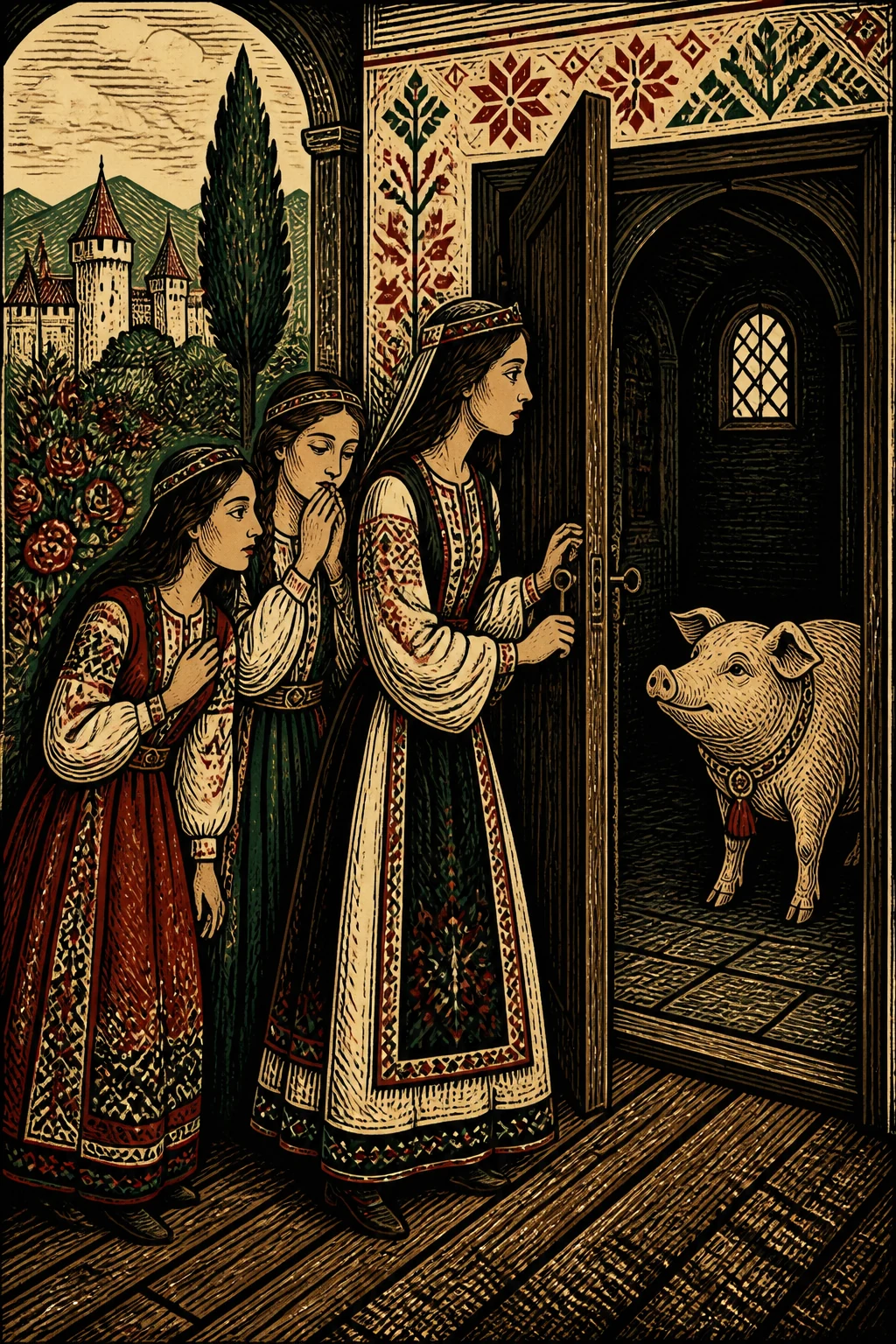
Once upon a time there was a man who had fine houses in town and country, gold and silver plate, embroidered furnishings, and gilded coaches. But unfortunately this man had a blue beard, which made him so ugly and so terrifying that every woman and girl fled at the sight of him. One of his neighbors, a lady of high birth, had two daughters who were both perfectly beautiful. He asked for one of them in marriage, leaving the mother to choose which she would give him. Neither daughter would have him, and each tried to pass him off on the other, for they could not bring themselves to marry a man with a blue beard. What put them off still more was that he had already married several wives, and no one knew what had become of them. To make their acquaintance, Bluebeard took them, with their mother, three or four of their closest friends, and a few young people from the neighborhood, to one of his country houses, where they stayed for eight whole days. There was nothing but outings, hunting and fishing parties, dancing, feasting, and fine refreshments. They never slept, but spent the whole night playing tricks on one another. In short, everything went so well that the younger daughter began to think the master of the house no longer had such a very blue beard, and that he was a thoroughly decent man. As soon as they returned to town, the marriage was settled. A month later, Bluebeard told his wife that an important matter obliged him to travel to the provinces for at least six weeks. He begged her to enjoy herself in his absence, to invite her close friends, to take them into the country if she wished, and to entertain them lavishly wherever she went. “Here,” he said, “are the keys to the two great storerooms; here are those to the gold and silver plate that is not used every day; here are those to my strongboxes, where I keep my gold and silver, and those to the caskets containing my jewels; and here is the master key to all the rooms. As for this little key, it opens the small room at the end of the long gallery on the ground floor. Open everything, go everywhere, but I forbid you to enter that little room. And I forbid it so strictly that, should you happen to open it, there is nothing you may not expect from my anger.” She promised to obey precisely everything he had commanded. Then, after embracing her, he climbed into his coach and set off on his journey. The neighbors and her close friends did not wait to be sent for before visiting the young bride, so eager were they to see all the riches of her house. They had not dared come while her husband was there, because his blue beard frightened them. At once they began exploring the bedrooms, private rooms, and dressing rooms, each more beautiful and splendid than the last. Then they went up to the storerooms, where they could not admire enough the number and beauty of the tapestries, beds, sofas, cabinets, small stands, tables, and mirrors in which one could see oneself from head to foot. The frames of these mirrors, some of glass, others of silver or silver gilt, were the finest and most magnificent ever seen. They never ceased praising and envying their friend’s good fortune. She, meanwhile, took no pleasure in the sight of all these riches, so impatient was she to open the little room on the ground floor. Her curiosity pressed her so hard that, without considering how rude it was to leave her guests, she went down a narrow back staircase in such haste that she nearly broke her neck two or three times. When she reached the door of the little room, she paused for a while, thinking of her husband’s prohibition and of the misfortune that might befall her if she disobeyed. But the temptation was too strong to resist. She took the little key and, trembling, opened the door. At first she could see nothing, because the shutters were closed. After a few moments she began to make out that the floor was covered with clotted blood, in which were reflected the bodies of several dead women fastened along the walls. (These were all the wives Bluebeard had married and whose throats he had cut, one after another.) She nearly died of fright, and the key, which she had just drawn from the lock, fell from her hand. When she had recovered her senses a little, she picked up the key, shut the door, and went upstairs to her room to compose herself. But she was so shaken that she could not manage it. Noticing that the key to the little room was stained with blood, she wiped it two or three times, but the blood would not come off. In vain she washed it and even scoured it with sand and sandstone: some blood always remained, for the key was enchanted, and there was no way to clean it completely. When the blood was removed from one side, it reappeared on the other. Bluebeard returned from his journey that very evening, saying that he had received letters on the road informing him that the business for which he had set out had just been settled in his favor. His wife did everything she could to show him how delighted she was at his speedy return.
The next day he asked her for the keys, and she gave them to him, but with such a trembling hand that he easily guessed all that had happened. “Why,” he asked, “is the key to the little room not with the others?” “I must have left it upstairs on my table,” she said. “Be sure to give it to me shortly,” said Bluebeard. After putting him off several times, she had to bring him the key. Bluebeard examined it and said to his wife, “Why is there blood on this key?” “I do not know,” replied the poor woman, paler than death. “You do not know?” Bluebeard repeated. “Well, I know. You chose to enter the little room? Very well, madam, you shall enter it and take your place beside the ladies you saw there.” She threw herself at her husband’s feet, weeping and begging his forgiveness, showing every sign of true repentance for having disobeyed him. So beautiful and sorrowful was she that she would have softened a stone, but Bluebeard’s heart was harder than stone. “You must die, madam,” he said, “and at once.” “Since I must die,” she replied, looking at him with eyes bathed in tears, “give me a little time to pray to God.” “I give you seven and a half minutes,” said Bluebeard, “but not a moment more.”
When she was alone, she called her sister and said to her, “Anne, my sister”—for that was her name—“please climb to the top of the tower and see whether my brothers are coming. They promised to visit me today, and if you see them, signal to them to hurry.” Sister Anne climbed to the top of the tower, and the poor, distressed woman called to her from time to time, “Anne, Sister Anne, do you see anyone coming?” And Sister Anne answered, “I see nothing but the sun shining on the dust, and the grass growing green.”
Meanwhile Bluebeard, holding a great cutlass in his hand, shouted to his wife at the top of his voice, “Come down at once, or I shall come up there!” “Just one moment more, please,” his wife replied, and immediately called in a low voice, “Anne, Sister Anne, do you see anyone coming?” And Sister Anne answered, “I see nothing but the sun shining on the dust, and the grass growing green.” “Come down at once!” shouted Bluebeard, “or I shall come up there!” “I am coming,” his wife replied, and then she called, “Anne, Sister Anne, do you see anyone coming?” “I see,” Sister Anne answered, “a great cloud of dust coming this way.” “Is it my brothers?” “Alas, no, sister, it is a flock of sheep.” “Will you not come down?” shouted Bluebeard. “Just one moment more,” his wife replied, and then she called, “Anne, Sister Anne, do you see anyone coming?” “I see,” she answered, “two horsemen coming this way, but they are still very far off. God be praised!” she cried a moment later. “They are our brothers! I am signaling as hard as I can for them to hurry.” Bluebeard began to shout so loudly that the whole house shook. The poor woman came down and threw herself at his feet, weeping bitterly, her hair disheveled. “That is no use,” said Bluebeard. “You must die.” Then, seizing her by the hair with one hand and raising his cutlass with the other, he was about to strike off her head. The poor woman turned toward him and, looking at him with dying eyes, begged him to give her one brief moment to compose her soul. “No, no,” he said, “commend yourself to God!” And he raised his arm… At that moment there came such a loud knocking at the door that Bluebeard stopped short. The door was opened, and at once two horsemen came in, drew their swords, and rushed straight at Bluebeard. He recognized his wife’s brothers, one a dragoon and the other a musketeer, and immediately fled to save himself. But the two brothers pursued him so closely that they caught him before he could reach the front steps. They ran their swords through his body and left him dead. The poor woman was almost as lifeless as her husband and had not the strength to rise and embrace her brothers. It turned out that Bluebeard had no heirs, and so his wife became mistress of all his possessions. She used part of her wealth to marry her sister Anne to a young gentleman who had long loved her, another part to buy captains’ commissions for her two brothers, and the rest to marry a thoroughly good man, who made her forget the unhappy days she had spent with Bluebeard.
MORAL. Curiosity, for all its charms, Often brings bitter regrets; A thousand examples appear every day. With all due respect to the ladies, its pleasure is slight: The moment it is satisfied, it dies, And always it costs far too dear.
ANOTHER MORAL. Anyone with a little sense, Who knows the ways of the world, Will soon see that this story Is a tale of bygone days;
No husband now is so fearsome, Nor demands the impossible; However discontented or jealous he may be, Beside his wife he meekly toes the line. And whatever the color of his beard, It is hard to tell which of the two is master.