Prevod
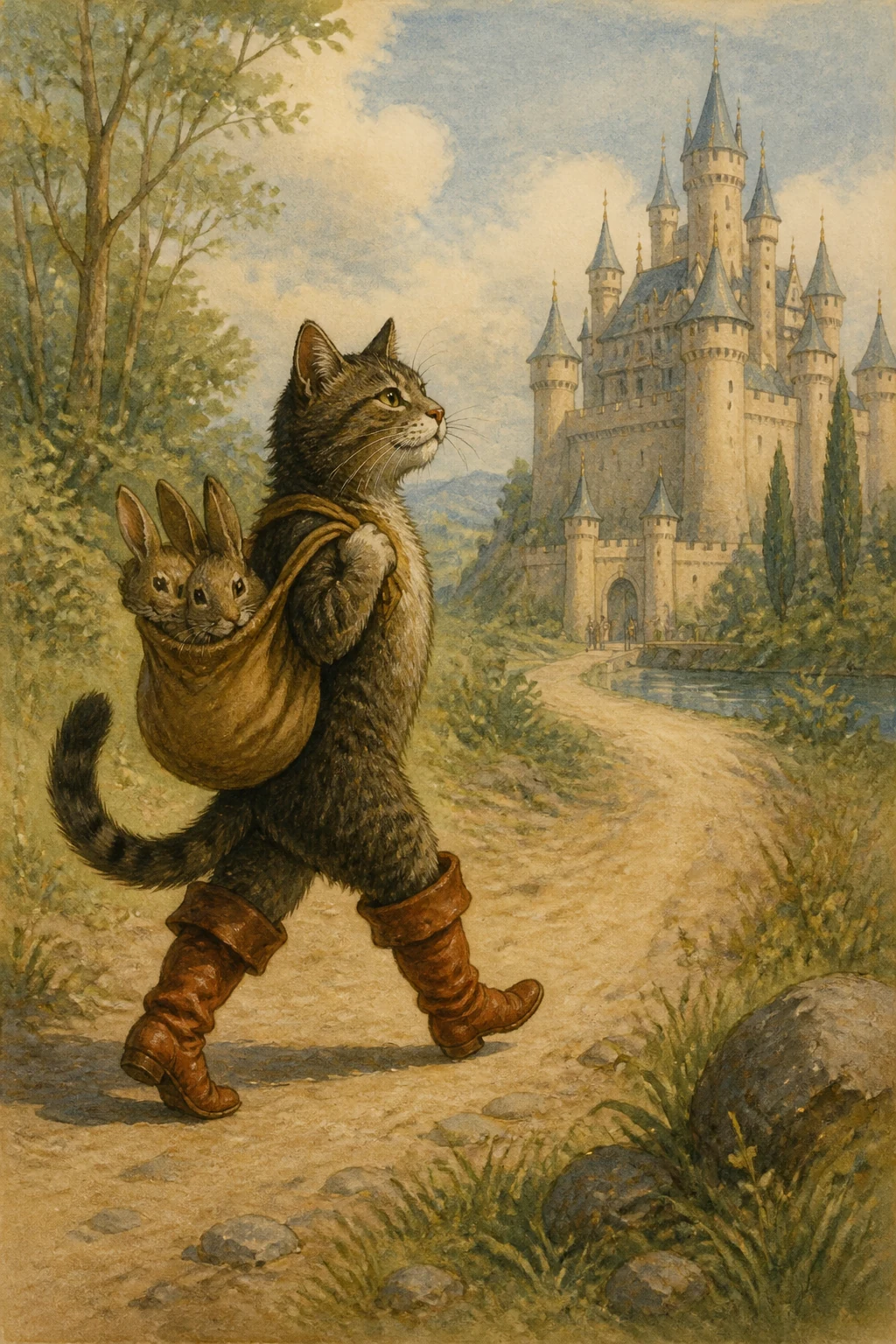
A miller left his three children nothing but his mill, his donkey, and his cat. The estate was soon divided, with neither notary nor lawyer called in: they would soon have swallowed up the whole poor inheritance. The eldest took the mill, the second the donkey, and the youngest got only the cat. This last could not console himself over so poor a share. “My brothers,” he said, “can earn an honest living by working together; but as for me, once I have eaten my cat and made a muff out of his skin, I shall have to starve.” The cat, who heard these words but pretended not to, said to him in a calm and serious manner, “Do not grieve, master. You need only give me a sack and have a pair of boots made for me, so that I can go among the brambles, and you will see that your share is not so poor as you think.” Though the cat’s master put little faith in this, he had seen him perform so many nimble tricks to catch rats and mice—hanging by his hind feet, for instance, or hiding in the flour and pretending to be dead—that he did not despair of finding help in his distress. Once the cat had what he had asked for, he boldly pulled on his boots, slung the sack about his neck, took its drawstrings in his forepaws, and set off for a warren where there were a great many rabbits. He put some bran and sow-thistle into his sack, then stretched himself out as though dead and waited for some young rabbit, still little acquainted with the wiles of the world, to creep into the sack and eat what he had put there. Hardly had he lain down when his wish was granted: a scatterbrained young rabbit entered the sack, and Master Cat at once pulled the strings, caught it, and killed it without mercy. Very proud of his prey, he went to the King’s palace and asked to speak to him. He was shown up to His Majesty’s apartments, where he made a deep bow to the King and said, “Here, Sire, is a wild rabbit that the Marquis of Carabas”—the name he had taken it into his head to give his master—“has charged me to present to you on his behalf.” “Tell your master,” replied the King, “that I thank him, and that his gift gives me pleasure.” Another time, the cat hid in a field of wheat, again holding his sack open, and when two partridges had gone inside, he pulled the strings and caught them both. He then went to present them to the King, as he had done with the wild rabbit. The King again received the two partridges with pleasure and ordered that the cat be given something to drink his health. For two or three months the cat continued in this way, bringing the King game from his master’s hunting from time to time. One day, learning that the King was to take a drive along the river with his daughter, the most beautiful princess in the world, he said to his master, “If you will follow my advice, your fortune is made. You need only bathe in the river at the spot I show you, and then leave the rest to me.” The Marquis of Carabas did as his cat advised, without knowing what good it would do. While he was bathing, the King came past, and the cat began shouting at the top of his voice, “Help! Help! The Marquis of Carabas is drowning!” At this cry, the King put his head out of the carriage window, and, recognizing the cat who had so often brought him game, ordered his guards to hurry to the Marquis of Carabas’s rescue. While they were pulling the poor Marquis from the river, the cat approached the carriage and told the King that, while his master was bathing, thieves had come and carried off his clothes, though he had shouted “Thieves!” as loudly as he could. The rogue had hidden them under a large stone. The King immediately ordered the officers of his wardrobe to fetch one of his finest suits for the Marquis of Carabas. He showered him with kindness, and as the fine clothes he had just been given set off his good looks—for he was handsome and well built—the King’s daughter found him very much to her liking. The Count of Carabas had scarcely cast two or three deeply respectful and slightly tender glances her way before she fell madly in love with him. The King insisted that he get into the carriage and join them on their drive. The cat, delighted to see his plan beginning to succeed, hurried on ahead, and, coming upon some peasants mowing a meadow, said to them, “Good people mowing here, unless you tell the King that this meadow belongs to the Marquis of Carabas, you will all be chopped as fine as meat for a pie.” The King duly asked the mowers whose meadow they were mowing. “It belongs to the Marquis of Carabas,” they all said together, for the cat’s threat had frightened them. “You have a fine estate there,” said the King to the Marquis of Carabas. “As you see, Sire,” replied the Marquis, “it is a meadow that never fails to yield abundantly every year.” Master Cat, still going on ahead, met some reapers and said to them, “Good people reaping here, unless you say that all this wheat belongs to the Marquis of Carabas, you will all be chopped as fine as meat for a pie.” The King, who passed a moment later, wished to know who owned all the wheat he could see. “It belongs to the Marquis of Carabas,” replied the reapers, and the King once again congratulated the Marquis. The cat, going ahead of the carriage, said the same thing to everyone he met, and the King was astonished at the great wealth of the Marquis of Carabas. At last Master Cat reached a splendid castle whose master was an ogre, the richest ever seen, for all the land through which the King had passed belonged to this castle. The cat, who had taken care to find out who this ogre was and what he could do, asked to speak to him, saying that he had not wished to pass so near his castle without having the honour of paying his respects. The ogre received him as courteously as an ogre can and invited him to sit down. “I have been assured,” said the cat, “that you have the gift of changing yourself into all kinds of animals; that you can turn yourself, for instance, into a lion or an elephant.” “That is true,” replied the ogre brusquely, “and to prove it, you shall see me become a lion.” The cat was so terrified to see a lion before him that he scrambled up to the gutters, not without difficulty and danger, for his boots were no use at all for walking on roof tiles. Some time later, seeing that the ogre had ceased to be a lion, the cat came down and admitted that he had been very frightened. “I have also been assured,” said the cat, “though I cannot believe it, that you have the power to take the shape of the very smallest animals—for example, to change yourself into a rat or a mouse. I confess I consider that quite impossible.” “Impossible?” retorted the ogre. “You shall see!” And at that very moment he changed himself into a mouse, which began running about the floor. No sooner had the cat caught sight of it than he pounced on it and ate it. Meanwhile, the King, seeing the ogre’s splendid castle as he passed, wished to go inside. The cat heard the rumble of the carriage crossing the drawbridge, ran out to meet it, and said to the King, “Your Majesty is welcome to the castle of the Marquis of Carabas.” “What, Marquis!” cried the King. “Does this castle belong to you as well? Nothing could be finer than this courtyard and all the buildings surrounding it. Let us see the inside, if you please.” The Marquis offered his hand to the young Princess, and, following the King, who went up first, they entered a great hall, where they found a magnificent feast that the ogre had ordered to be prepared for friends who were to visit him that very day, but who had not dared come in, knowing that the King was there. The King, charmed by the fine qualities of the Marquis of Carabas, as was his daughter, who was quite besotted with him, and seeing the great wealth he possessed, said to him after five or six glasses, “It rests entirely with you, Marquis, whether you become my son-in-law.” The Marquis, bowing low, accepted the honour the King bestowed on him, and married the Princess that very day. The cat became a great lord, and never chased mice again except for his own amusement.
MORAL. However great the boon may be, To gain a rich estate That passes down from sire to son, For young folk, as a rule, Resourcefulness and skill Are worth more than inherited wealth.
Another Moral. If a miller’s son so swiftly wins A princess’s heart, And makes her gaze at him with languishing eyes, It is because fine clothes, good looks, and youth Are not always without their power To stir tender feelings.