Prevod
_Renza, shut up in a tower by her father because it has been foretold that she will die through a great bone, falls in love with a prince. With a bone brought to her by a dog, she makes a hole in the wall and escapes. But when she sees her lover, now married, kiss his bride, she dies of heartbreak, and the prince kills himself in his grief._ _While Cecca told this tale with great feeling, there arose a veritable stew of pleasure and displeasure, consolation and distress, laughter and tears. They wept over Penta’s misfortune and laughed at the happy end of her troubles; they agonized to see her in so many dangers and rejoiced that she had been delivered with such honor; they were disgusted at the treachery practiced upon her and delighted by the vengeance that followed. Meanwhile Meneca, who had her match ready at the touchhole of conversation, took up her weapons and began as follows._ It often happens that just when a man thinks he is fleeing some dreadful misfortune, he runs straight into it. A wise man should therefore put all his affairs into Heaven’s hands, rather than seek out witches’ circles and astrologers’ mumbo jumbo; for in trying to foresee danger like a prudent man, he tumbles into ruin like a fool. And to prove it true, listen.
Once upon a time there was a king of Fuosso-stritto who had a beautiful daughter. Wishing to know what fate was written for her in the book of the stars, he summoned all the necromancers, astrologers, and Gypsy women in that country. They came to the royal court, and after examining, some the lines of her hands, some the features of her face, and some the moles upon the body of Renza—for that was the daughter’s name—each delivered an opinion. But most agreed that she was in danger of having the main sewer of her life unblocked by a great bone. When the king heard this, he resolved to throw himself forward rather than fall, and had a fine tower built, in which he shut up his daughter with twelve young ladies and a governess to attend her. On pain of death, he ordered that she should always be served meat without bones, to ward off this evil influence of the stars. Renza grew as lovely as the moon, and one day, as she stood at a window fitted with iron bars, Cecio, the son of the queen of Vigna-larga, happened to pass the tower. Seeing so beautiful a creature, he was instantly set aflame; and when she returned his greeting and gave him a charming little smile, he took courage, came closer beneath the window, and said, “Greetings, register of all Nature’s privileges, archive of all Heaven’s grants! Greetings, universal table of every title to beauty!” Hearing herself praised in this way, Renza blushed and became still lovelier, adding wood to Cecio’s fire—or, as the saying goes, pouring boiling water on a scald. Unwilling to let Cecio outdo her in courtesy, she replied:
“Welcome, pantry stocked with the savory morsels of grace, warehouse filled with the merchandise of virtue, customhouse of Love’s commerce!” But Cecio answered, “How comes the stronghold of Cupid’s forces to be shut up in a tower? How comes the captor of souls to be held a prisoner? How comes this golden apple to be behind iron bars?”
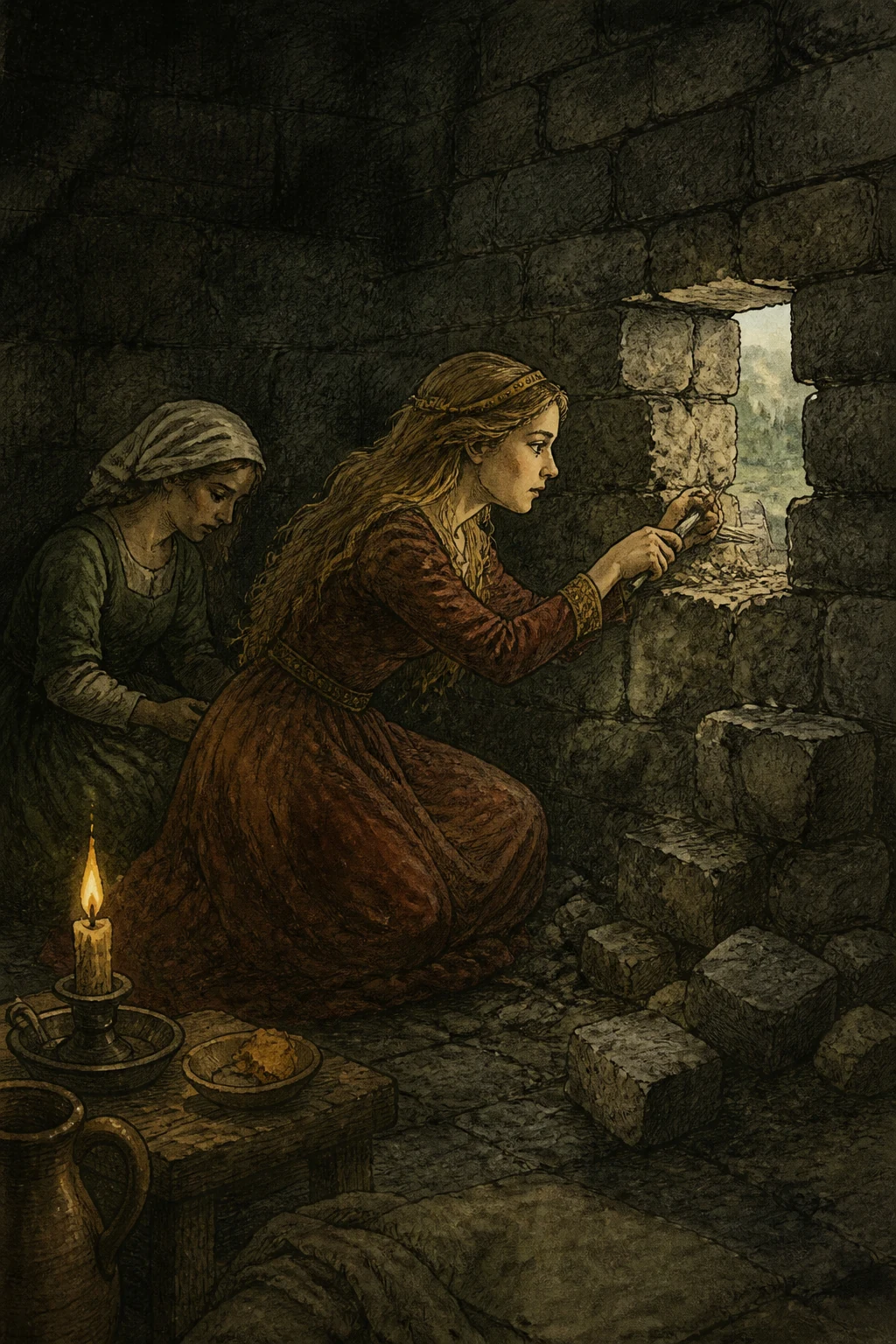
When Renza explained how matters stood, Cecio told her that he was a queen’s son but a vassal of her beauty, and that if she would agree to flee with him to his kingdom, he would set a crown upon her head. Renza, who was sick of being cooped up within four walls and could hardly wait to give her life an airing, accepted his proposal. She told him to return in the morning, when daybreak calls the birds to witness the taunt Aurora has flung at her, and they would slip away together. Then, blowing him a kiss from the window, she went inside, and the prince returned to his lodgings. Meanwhile Renza was thinking how she might steal away and outwit her attendants, when a certain mastiff that the king kept to guard the tower came into her room with a great bone in its mouth. As it gnawed the bone beneath her bed, Renza bent her head and caught sight of the friendly fellow. Thinking that Fortune had sent it to meet her need, she put the dog outside and took the bone. Then, telling her attendants that her head ached and they must let her rest without disturbing her, she barred the door and set to work with the bone like a day laborer. Chipping away at a stone in the wall, she worked until she had dug it out and broken an opening large enough to pass through easily. She tore up a pair of sheets and twisted them into a rope; and when the curtain of shadows was lifted from the stage of heaven for Aurora to come forth and speak the prologue to the tragedy of Night, she heard Cecio whistle. Fastening one end of the sheets to an upright, she let herself down to the street below, where Cecio caught her in his arms. He set her on an ass with a saddlecloth and started off toward Vigna-larga.
That evening they reached a place called Viso, where they found a most beautiful palace, and there Cecio planted his boundary stake in this lovely estate as a sign of his possession in love. But Fortune, whose constant vice is to spoil the spinning, upset the games, and butt her nose against every sound foundation lovers lay, chose the very height of their pleasures to bring a courier with a letter from Cecio’s mother. She wrote that unless he hurried to her that very instant, he would not find her alive, for she was on the verge of reaching the last letters of life’s alphabet. At this bad news Cecio said to Renza, “My heart, this is a matter of great importance, and I must ride posthaste if I am to arrive in time. Stay here in this palace for five or six days, and I will return or send for you at once.” Hearing this bitter news, Renza burst into tears and answered, “Oh, what a wretched fate is mine! How soon the barrel of my pleasures has run down to the dregs! How quickly the pot of my delights has boiled down to the scrapings! How soon the feast of my contentment has come to its last leftovers! Alas for me, my hopes are all going downstream, my plans turn out to be bran, and every satisfaction of mine has vanished into smoke.
“Scarcely have I touched this royal sauce to my lips before the mouthful sticks in my throat; scarcely have I put my mouth to this fountain of sweetness before its taste is muddied; scarcely have I seen the sun rise before I must say, ‘Good night, Uncle Straw-bed!’” These and other words flew from the Turkish bows of her lips to pierce Cecio’s soul, until he said, “Hush, lovely prop of my life, bright lantern of these eyes, healing hyacinth of this heart! I shall return very soon. No distance of miles can draw me a hand’s breadth away from your lovely person, nor can the power of time knock your memory out of this head.
“Be calm, set your poor brain at rest, dry your eyes, and keep me in your heart.” With these words he mounted his horse and began galloping toward his kingdom. Renza, finding herself left planted like a cucumber, set off at once in Cecio’s footsteps. She untethered a horse she found grazing in a meadow and rode after him. On the road she met a hermit’s young servant, dismounted, and gave him her clothes, which were all trimmed with gold, in exchange for the sackcloth robe and rope he wore. She put on the robe and girded herself with that rope, she who bound souls with the noose of love, then mounted again and dug her heels into the horse until she soon overtook Cecio. “Well met, sir,” she said. Cecio answered, “Welcome, my little friar! Where do you come from, and where are you bound?” And Renza replied:
_I come from where a woman weeps all day,_ _And cries, “O face so fair and pale,_ _Who stole you from my side away?”_ Hearing this, Cecio said to the person he took for a young man:
“My handsome lad, how dear your company is to me! Do me a kindness, then—and I kiss your hands for it—never leave my side, and repeat those verses to me from time to time, for they truly tickle my heart.” And so, fanning themselves against the heat of the journey with the fan of conversation, they reached Vigna-larga. There they found that the queen had arranged a marriage for Cecio and had used this trick to summon him home; his wife was already prepared and waiting for him. Upon arriving, Cecio asked his mother to keep the young man who had accompanied him in the house and treat him like a brother of his own. His mother agreed, and he kept the lad always beside him and had him eat at his table with the bride. Consider now what was passing in poor Renza’s heart, and what bitter poison she had to swallow! Nevertheless, from time to time she repeated the verses that pleased Cecio so much. But when the table was cleared and the bride and bridegroom withdrew to a private room to talk alone, Renza had a chance to give vent to the anguish in her heart. She went into a garden on the same level as the hall and, retiring beneath a mulberry tree, began to lament as follows.
“Alas, cruel Cecio! Is this your thousand thanks for the love I bear you? Is this your great reward for the affection I feel? Is this the gratuity I deserve for the devotion I show? Here I have abandoned my father, left my home, trampled on my honor, and put myself in the power of a vile cur, only to find my way barred, the door slammed in my face, and the drawbridge raised just when I thought I was taking possession of that lovely fortress! Only to find myself entered in the tax rolls of your ingratitude, when I thought I would dwell in peace in the ducal palace of your favor! Only to find myself playing the children’s game of ‘Ban and proclamation by order of Master Clement,’ when I thought I would be playing at tumble-and-tickle with you! Have I sown hopes, only to harvest horse-cheeses? Have I cast nets of desire, only to drag the sand of ingratitude ashore? Have I built castles in the air, only to come crashing headlong to the ground? This is the exchange I receive, this is how I am repaid, this is the payment I carry away! I have lowered my bucket into the well of amorous longing and been left with the handle in my hand; I have spread the washing of my plans in the sun, only to have rain fall on it from a cloudless sky; I have set the pot of my thoughts to cook over the fire of desire, only to have the soot of misfortune fall into it. But who would have thought, you turncoat dog, that the copper beneath the plating of your faith would show through?
“That the barrel of your promises would run down to the dregs? That the bread of your goodness would grow moldy? A fine deed for a good man, a fine display from an honorable person, a fine way for a king’s son to behave—to mock me, hoodwink me, and stuff me with rubbish; to cut me a generous cloak only to leave me short of a doublet; to promise me seas and mountains only to fling me into a dark ditch; to show me a bright face only to leave me with a black heart! O promises of wind, words of bran, oaths of fried spleen! Here I have counted four before they were in the sack; here I find myself a hundred miles away when I thought I had reached the baron’s house! Plainly enough, words spoken at night are carried off by the wind. Alas, where I thought this cruel man and I would be flesh and fingernail, we shall be like cat and dog; where I imagined that this vile cur and I would be pot and spoon, we shall be like snake and toad! For I cannot endure another woman’s lucky fifty-five snatching the winning prime of my hopes out of my hand; I cannot bear to be checkmated! O Renza, who set out so badly, go on, trust them! Go on, let yourself be filled with the words of lawless, faithless men! Wretched is she who has dealings with them, miserable she who clings to them, unfortunate she who lies down in the broad bed they know so well how to spread! But do not be too pleased with yourself: you know that he who cheats children dies like the crickets. You know there are no crooked clerks at Heaven’s countinghouse to falsify the books. When you least expect it, your day will come, for playing this sleight of hand on one who gave herself to you on credit, only to receive such bitter payment in ready cash. But do I not see that I am pleading my case to the wind, sighing into emptiness, sighing to no purpose, and lamenting all alone? Tonight he settles accounts with his bride and pays off his bond;
“while I settle accounts with death and pay my debt to Nature. He will lie in a white bed smelling sweetly of fresh washing; I in a dark bier reeking of death. He will play at empty-the-barrel with that fortunate bride, while I shall play at ‘Comrade, I am wounded’;
“and thrust a pointed stick into my temples to put a packsaddle on my life.” After these and other words of anguish, it was time to set their teeth to work, and she was called to table. But the gratins and stews were arsenic and spurge to her; she had something other than chewing on her mind, something other than a wish to fill her stomach churning in her belly. Seeing her so thoughtful and pale, Cecio said, “Why aren’t you doing justice to these dishes? What is wrong? What are you thinking of? How do you feel?” “I do not feel at all well,” Renza answered, “and I cannot tell whether it is indigestion or dizziness.” “You would do well to miss a meal,” Cecio replied, “for fasting is the best tobacco for every illness. But if you need a physician, let us send for a water doctor who can recognize people’s ailments just by looking at their faces, without even taking their pulse.” “It is no illness for prescriptions,” Renza answered, “for no one knows the pot’s troubles but the spoon.” “Go out and take a little air,” said Cecio. And Renza answered, “The more I see, the more my heart bursts.” With this talk the meal came to an end, and bedtime arrived. Since Cecio wanted to keep hearing Renza’s song, he insisted that she lie on a daybed in the very chamber where he was to sleep with his bride. From time to time he called on her to repeat those same words, which were dagger thrusts to Renza’s heart and a drumming in the bride’s ears. At last, after putting up with it for some time, the bride burst out, “You have worn out my backside with that fair, pale face! What damned music is this? To keep it up so long is enough to give anyone dysentery! Enough of it! Good heavens, have you caught a head cold that makes you repeat the same thing over and over? I thought I was coming to bed with you to hear instrumental music, not vocal laments. Look how you have settled on that same old tune, always striking the one note! For pity’s sake, let there be no more of it, husband of mine. And you, be quiet, you stink of garlic, and let us have a little rest.” “Hush, my wife,” Cecio answered, “we shall break off the thread of talk now.”
And with that he gave her so hearty a kiss that its smack could be heard a mile away. The sound of their lips was a thunderclap in Renza’s breast. So great was her anguish that all her vital spirits rushed to aid her heart and fulfilled the saying, “Too much breaks both pot and lid”: for such was the rush and gathering of blood that she suffocated and stretched out her feet in death. After Cecio had bestowed a few caresses on his bride, he called softly to Renza to repeat those words he liked so well. Receiving no answer to satisfy him, he begged her again to give him that little pleasure. But seeing that she did not utter a word, he rose quietly and tugged her by one arm. Still she did not answer, so he touched her face; and feeling her nose cold as ice, he realized that the fire of natural warmth had gone out in that body. Stunned and terrified, he had a candle brought, uncovered Renza, and recognized her by a lovely mole in the middle of her breast. Raising his voice in cries, he began to say, “What do you see, wretched Cecio? What has happened to you, unfortunate man? What spectacle lies before your eyes?
“What ruin has fallen upon your joints? O flower of mine, who has plucked you? O lamp of mine, who has put you out? O pot of love’s delights, how have you boiled over? Who has pulled you down, lovely house of all my joys? Who has torn you, charter of all my pleasures? Who has sunk you, lovely ship of this heart’s delights? O my beloved, with the closing of your lovely eyes the shop of beauty has gone bankrupt, the business of grace has shut down, and Love has gone to the bridge to beg for scraps. With the departure of your lovely soul, the seed of beautiful women has been lost, the mold of charming women has been broken, and there is no compass left upon the sea of love’s sweetness. O loss beyond repair, disaster beyond compare, ruin beyond measure! Go on, mother, stretch out your arm and congratulate yourself: what a fine deed you have done, choking me like this and making me lose so lovely a treasure! What shall I do, wretched as I am, destitute of pleasure, stripped of consolation, empty of delight, bankrupt of satisfaction, bare of enjoyment, shorn of contentment? Do not think, my life, that I mean to remain without you as a laughingstock for the world. I shall follow you and lay siege to you wherever you go; despite the jaws of death, we shall be joined together. If I had taken you for a partner in the tenancy of my bed, I shall share possession of your grave, and one epitaph shall tell the misfortune of us both.” With these words he seized a nail and gave himself a comfortless remedy beneath his left breast, opening a passage through which his life drained away in a single rush. He left his bride cold and frozen, and as soon as she could loosen her tongue and set her voice free, she called the queen. The queen came running at the noise with the whole court, and when she saw the dreadful fate of her son and Renza and heard the cause of the disaster, she did not leave a single hair on her head unplucked. Thrashing like a fish out of water, she called the stars cruel for raining so many misfortunes upon her house and cursed the wretched old age that had preserved her for such ruin. After a great outpouring of cries, she had the two laid in a single grave and the whole bitter history of their fortunes inscribed upon it. Meanwhile Renza’s father, the king, arrived. Traveling through the world in search of his runaway daughter, he had met the hermit’s servant, who was selling her clothes, and the lad had told him what had happened. He reached the prince of Vigna-larga’s court just as they were about to bury Renza, the ears of her years having been reaped. Seeing her and recognizing her, weeping and sighing over her, he cursed the great bone that had enriched the broth of his ruin. For he had found it in his daughter’s room and recognized it as the instrument of this bitter calamity, confirming, not merely in general but in particular, the dismal prophecy of those soothsayers who had said that she would die through a great bone. Thus it was plainly seen _That when misfortune means to come,_ _It enters through the cracks in the door._