Prevod
They tell of a friar with a touch of the rogue and the philosopher who, while administering the sacrament of marriage, said to the man: There, I give you this woman: treat her like a hired mule—plenty of stick and little to eat.
The man who married the silversmith Román in Lima must have been another of the same stripe, except that he changed tack and said to the woman: There is your husband: treat him like an ox yoked to the plough, and see that he hangs himself out of sheer misery.
There are people still living who knew and dealt with the silversmith, whom we shall call Román, for there is good reason not to set his real name down in print. This tale is exceedingly well known in Lima, and the first octogenarian you happen upon in those streets, dear reader, will tell it to you, down to the last jot and tittle.
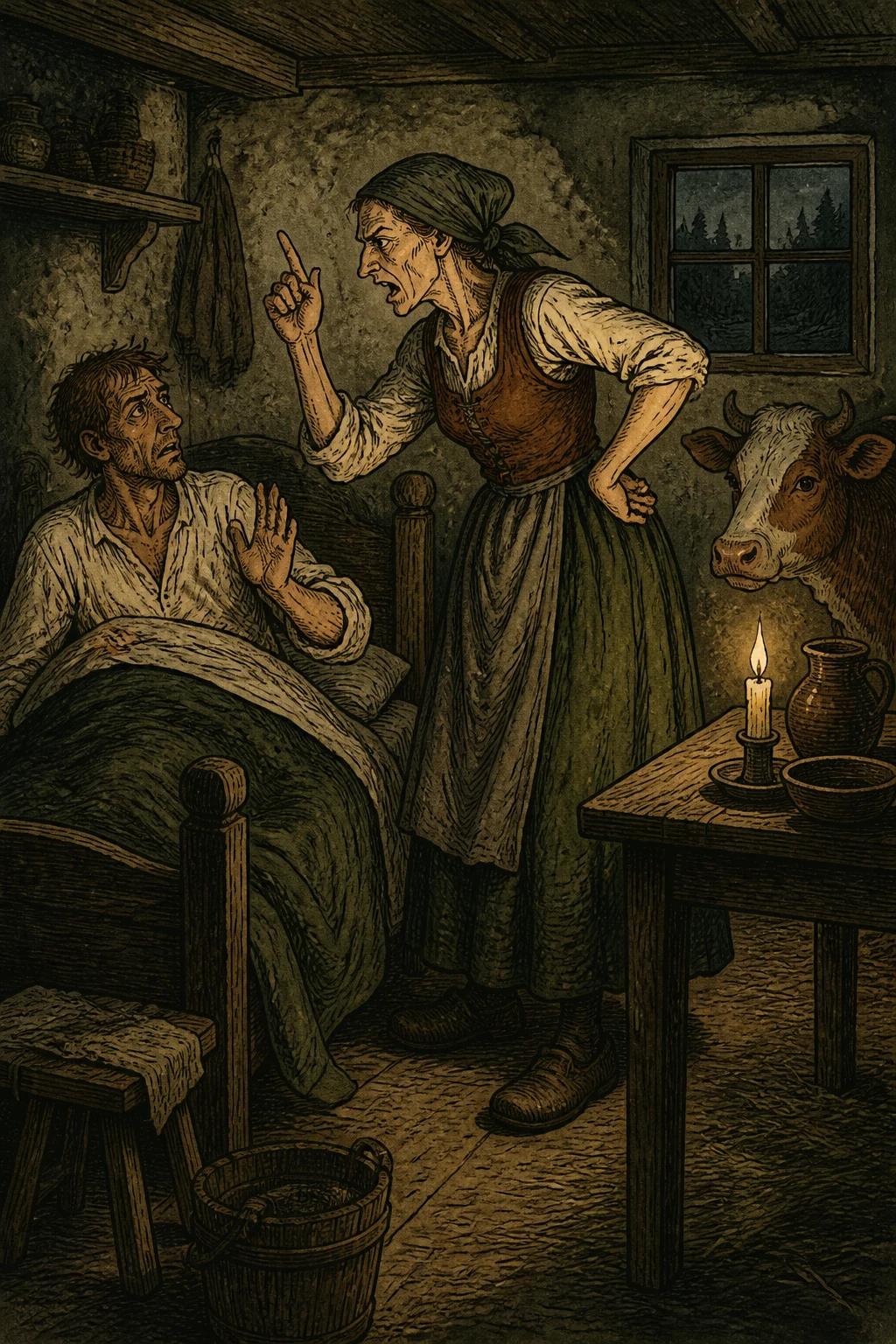
Román’s wife, though a woman of the strictest virtue where marital fidelity was concerned, possessed all the worst qualities one could wish upon a daughter of Eve. Fond of show, extravagant, stubborn, and shrewish, she plagued her poor husband with demands for money; and theirs was neither a house nor a home nor anything Christ ever founded, but a living image of hell. Not a floor was swept, not a sock darned for the poor fellow who paid the bills, not a thought given to the cooking; in short, everything went to rack and ruin. Madam thought of nothing but trinkets and fripperies, drinking parties and outings.
At that rate, the husband’s shop and property vanished in less time than it takes a mad priest to cross himself, and with poverty came civil war in that practical republic known as marriage. The couple were forever at each other’s throats. Over the merest trifle they would hurl crockery at one another’s heads, at the risk of cracking them open, and not a chair had a sound stick left in it. At best, the good-natured husband emerged bearing on his face mementoes of his better half’s fingernails.
This marriage brings to mind a sonnet we wrote in the merry days of our youth; and since the temptation to foist it upon you is irresistible, here it comes, like the knight of cups:
I wed, to my undoing, a shameless little thing, fresh as a bergamot pear; she brought a mother-in-law and a great sprawling clan, with her lovely face for dowry. At a brisk trot my fortune hastens to founder on an unknown shoal; soon she will bankrupt me, unless I find a thriving mine. A begging devil walks beside me; “Give me!” is her endless refrain, and so I am reduced to skin and bone, dear friend. What say you? Does my plight distress you? —I tell you, Don Peruétano, and I mean what I say: that creature is no woman… she is a leech.
I cannot remember whom I heard say that a married woman’s commandments, like those of God’s law, are ten: The first, to love her husband above all things.
The second, not to swear love to him in vain. The third, to lavish affection on him. The fourth, to love him more than father and mother. The fifth, not to torment him with jealousy and grumbling.
The sixth, not to betray him. The seventh, not to spend his money on finery. The eighth, not to feign fits of nerves or flirt with her cousins.
The ninth, to desire no neighbour but her husband. The tenth, not to covet the luxuries of others. These ten commandments are to be kept in the rice-powder box and read each day until learned by heart.
The trick is not to break any of them, as we Christians do with several of those in the Decalogue. Let us return to the silversmith. One morning, after one of those daily battles of Moors and Christians, with all their hurly-burly and hullabaloo, Román said to himself:
—Well, sir, this cannot go on any longer, for His Divine Majesty cannot have worse torments in store for me in the next world than those I suffer with my rib of a wife. Whoever said that if the sea married it would lose its fury and turn into a halfwit spoke truly. It is settled: today I shall hang myself.
And with the one pillar-stamped peseta remaining in his pocket, he went to the little corner shop and bought four yards of strong new rope—a very pardonable luxury in a man who intended never to indulge in another.
II —And which viceroy was ruling then?—I fancy I hear this question, so customary when people listen to a story whose accuracy they doubt.
Well, my readers, the ruler was His Excellency Don Gabriel de Avilés y Fierro, Marquis of Avilés, lieutenant general of the royal armies, who, after serving as president of Chile and viceroy of Buenos Aires, came in November 1801 to take command of this blessed land.
Avilés had arrived in Peru in the time of Viceroy Amat; and when the famous revolt of Tupac-Amaru broke out in 1780, he was sent with troops to suppress it. Excessive was the severity Avilés employed in that campaign.
During his government the bishopric of Maynas was established and Guayaquil was incorporated into the viceroyalty. The Refugio hospital for women was founded in Lima at the expense of Avilés and his wife, the Lima-born Doña Mercedes Risco, and work began on the fort of Santa Catalina as an artillery barracks, under the direction of Don Joaquín de la Pezuela, then a colonel and later viceroy.
The arrival of the smallpox vaccine was celebrated with great festivities. Peru received a visit from the learned Humboldt, and one night Lima experienced the alarming phenomenon of many clearly audible peals of thunder. It was in this period that the trees of the Alameda de Acho were planted.
Since Spain and France had made common cause against England, and the disaster of Trafalgar had just occurred, two English brigs attacked the Spanish war frigate Astrea at Arica, severely damaging her and forcing her to seek shelter in the bay.
In attempting to carry out a royal order for the sale of Church property, Avilés encountered serious resistance, which the prudent viceroy calmed by dragging the matter out and sending inquiries and memorials to the Crown. This was not the first time the viceroy had resorted to letting time take its course to extricate himself from a difficult position. In 1804 the city was pressing him to issue a certain decree; but believing either that it was impracticable or that it lay beyond his authority, he decided to consult the monarch. The people, unaware of this, began to grumble openly, and the following lampoon appeared on the palace door:
Avilés! Avilés! What are you doing, that you cannot see what goes on in the city? The viceroy took no offence, and ordered this reply to be written beneath it: To satisfy your wishes, I have sent all the way to Spain for spectacles.
This answer soothed their spirits, for the townspeople saw that their request awaited the king’s decision. Avilés devoted much of his time to religious observances. The people summed him up in this phrase: Able at prayer, unable at government.
In July 1806 he handed over command to Abascal. Old, ill, and downcast by the recent death of his wife, Avilés wished to return to Spain. The ship carrying him put in at Valparaíso, and a few days later the devout viceroy, as the mischievous ladies of Lima called him, died in that port.
III Equipped with his rope, and without troubling to write farewell notes beforehand, as has been the fashion since the invention of nerves and romanticism, our man made his way to the pond at Santa Beatriz, then a most delightful spot, surrounded by orange trees and other trees that seemed positively to invite a fellow to hang himself from them and make an end of misery and sorrow.
Román began by inspecting the trees, and found some fault with every one. This one was not tall enough; that one lacked the strength to bear as its fruit the body of a great lout like himself; another had too little foliage, and the one beyond leaned a little. When a man hangs himself, he ought at least to have the consolation of doing it entirely to his own liking. At last he found a tree that met the requirements of the case and, climbing into it, tied the rope to one of its sturdiest branches.
While making these preparations, he reflected that, to avoid being interrupted and left half dead, perhaps obliged to begin the job all over again, he had best wait until the road was deserted. Indigenous fisherwomen coming from Chorrillos, herb sellers from Surco, yanacona tenant labourers from Miraflores, runaway slaves from San Juan, and labourers from the estates were passing at that hour a short distance from the pond. There was simply no way for a man to kill himself in peace.
—It would be a fine business if, just at the best part of the performance, some ill-timed passer-by were to cut me down! Since it must come to this in the end, there is no harm in waiting a little: he who arrives is never too late.
Román was hidden among the tree’s thick branches, occupied with these and other reflections, when he saw a little man approaching at a slow pace, glancing suspiciously in every direction and wrapped in a cloak covered with patches.
This was an old Spaniard who lived on public charity and was known in Lima by the nickname of Ovillitos. The nickname came from his having once gone from house to house selling little balls of thread, until one day he decided to change trades and enlist in the ranks of the beggars.
After casting searching glances at the walls and the road, Ovillitos sat down beneath the tree that sheltered Román and, taking out a pair of scissors, unstitched two of the countless patches that adorned his filthy cloak of coarse wool.
Imagine the surprise of Román, perched above, when he saw Ovillitos take a gold ounce from each patch and, after spending a long while gazing lovingly at the coins, bury them at the foot of the tree!
—Suicide, my foot!—exclaimed Román, scrambling down from his tree as soon as the beggar had gone.—Since God has come to visit me, let us make the most of the occasion and seize bald Opportunity by her one remaining hair. Happy the tree that has such fertiliser!
And he set to work and dug up a little over a hundred peluconas, those gold coins bearing, beneath the words Indiae et Hispaniarum Rex, the bewigged bust of Charles III or Charles IV.
IV Román stocked his shop again, and his silversmith’s business sailed along with a fair wind. Taught by the days of hardship, he curbed his wife’s extravagance, and her disposition improved remarkably, doubtless through a miracle of Divine Providence, to whom nothing is impossible.
Ovillitos fell gravely ill when he discovered that his treasure had turned into a bird and flown its cage. The unfortunate fellow did not know that money is no Carthusian monk, content to remain shut away and gather mould, but a libertine who longs to be out in the open, passing from hand to hand. There have been beggars in every age who left a respectable fortune at their death.
Román died after the republic had been established, leaving his heirs a fortune estimated at more than fifty thousand pesos. One clause of his will, which we have read, sets aside thirty pesos a month for twenty-five years for Masses for the repose of Ovillitos’s soul.