Prevod
Around the year 1752, a peddler or hawker roamed the streets of Lima: a stout man of middling height, with coarse hands and features, fair hair, an almost alabaster complexion, and the appearance of being scarcely more than twenty. He was Irish, the son of poor farmers, and, according to his biographer Lavalle, spent his early years carrying bundles of firewood to the kitchen of Dungán Castle, the residence of the Countess of Bective, until an uncle of his, a Jesuit priest in a monastery in Cádiz, sent for him, gave him a modest education, and, seeing that he was more inclined toward trade than the holy habit, dispatched him to America with a small stock of merchandise.
Ño Ambrosio the Englishman, as the women of Lima called the hawker, became convinced that selling ribbons, needles, lace, thimbles, and other trifles would never bring him a comfortable living. He resolved to go to Chile, where, through the influence of an Irish physician with excellent connections in Santiago, he obtained employment as an engineering draftsman, building shelters or little houses for the couriers who carried the mail across the mountains between Chile and Buenos Aires.
He was conscientiously fulfilling his duties when a formidable invasion by the Araucanians took place. To repel it, the captain general organized, among other forces, a company of foreign volunteers, whose command was entrusted to our newly minted engineer. The campaign brought him honor and advancement; the king successively conferred on him the ranks of captain of dragoons, lieutenant colonel, colonel, and brigadier; and in 1785, upon promoting him to field marshal, appointed him president of the Audiencia, governor, and captain general of the kingdom of Chile.
We neither possess sufficient information nor does the light manner of our traditions permit us to chronicle the ten years of don Ambrosio O'Higgins's memorable government. The Barón fortress in Valparaíso and a multitude of public works have made his name imperishable in Chile.
After he had recaptured the city of Osorno from the Araucanians, the monarch named him Marquis of Osorno, promoted him to lieutenant general, and transferred him to Peru as viceroy, replacing the bailiff don Francisco Gil y Lemus de Toledo y Villamarín, a professed knight of the Order of Saint John, commander of Puente Orgivo, and lieutenant general of the royal navy.
O'Higgins assumed command on June 5, 1796. During his brief government, the streets were paved and the towers of Lima Cathedral completed, the Benevolent Society was founded, and textile factories were established. The gateway, tree-lined promenade, and carriage road of Callao were also the work of his administration.
During his tenure, the intendancy of Puno, which had been subject to the viceroyalty of Buenos Aires, was incorporated into Peru, while Chile was removed from the jurisdiction of the viceroyalty of Peru.
The alliance that the minister don Manuel Godoy, Duke of Acudía and Prince of the Peace, concluded with France through the Treaty of San Ildefonso, following the Roussillon campaign, resulted in war between Spain and England. O'Higgins sent the crown seven million pesos, with which Peru contributed less to the needs of the war than to the luxury of the courtiers and the pleasures of Godoy and his royal mistress, María Luisa.
Brief, but rich in benefits, was the administration of O'Higgins, whom Lima called the English viceroy. He died on March 18, 1800, and was buried in the vaults of the church of San Pedro.
II Great was the moral decay in Lima when O'Higgins assumed command. According to the census ordered by the viceroy-bailiff Gil y Lemus, the city numbered 52,627 inhabitants within its walls; yet for so small a population, more than seven hundred private carriages, with rich harnesses and magnificent teams, paraded along the Alameda. Such excessive luxury is enough to tell us that public morality could hardly have stood very high.
Robberies, murders, and other nighttime outrages were multiplying, and to remedy them His Excellency thought it advisable to issue proclamations warning that anyone found in the streets by the patrols after ten at night would be lodged in jail. The companies of cloaked watchmen, or police officers, established by Viceroy Amat were enlarged and their personnel improved by the appointment of prominent men as captains.
But the proclamations remained mere writing on street corners, and the disorders did not diminish. The young men of the colonial nobility, indeed, prided themselves on being the first to break the rules. The common people followed their example, and the viceroy, seeing no way to root out the evil, one day summoned the five captains of the companies of cloaked watchmen.
“I am informed, gentlemen,” he told them, “that you take to jail only those poor devils who have no patron to protect them; but when it comes to one of those little marquises or counts who scandalize the neighborhood with their climbing over walls, serenades, swordplay, and revels, you become accommodating and turn a blind eye. I will not have justice use two sets of weights and measures: it must be the same for high and low. Let that be clearly understood, and after ten at night . . . to jail with every last Christ!”
Before proceeding, let us relate, since it fits our subject, the origin of the popular saying “To jail with every last Christ.” They say that in a little Andalusian town a penitential procession was held, in which many of the faithful appeared in Nazarene robes, carrying heavy wooden crosses on their shoulders. It seems that one of these imitators of Christ maliciously shoved a companion who had no dishwater in his veins and who, forgetting the meekness his role required, drew his knife. The other penitents joined the fray, and fists and knives were flying freely until the mayor appeared and said, “To jail with every last Christ!”
Don Ambrosio O'Higgins probably remembered the story when, in lecturing the captains, he ended his reprimand with the words of the Andalusian mayor.
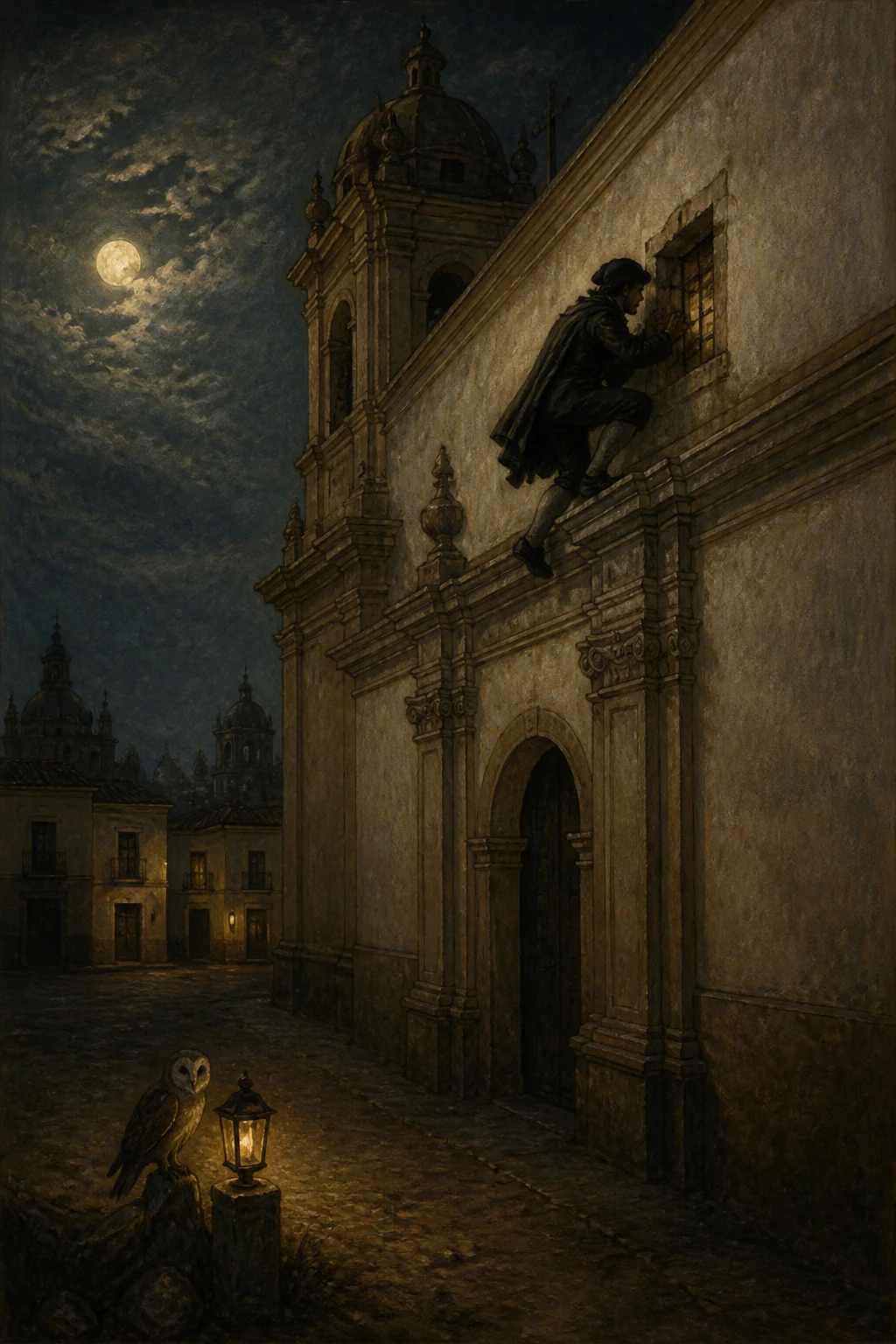
That night His Excellency wished to see for himself how his orders were being obeyed. After eleven, when the city was in utter darkness, the viceroy wrapped himself in his cloak and left the palace.
He had not gone far when he came upon a patrol; but the captain, recognizing him, let him proceed unmolested, muttering, “Well, now the truth is out! His Excellency is out courting too, and that is why he does not want anyone else to have a little affair and enjoy himself. Plainly, the office of viceroy offers more windfalls than the Moquegua man's will.”
This phrase cries out for an explanation. In Moquegua there lived a rich man named don Cristóbal Cugate, whose wife, a veritable she-devil, made his life a misery. As the poor fellow lay dying, he reflected that nowhere in the world could there be another man with so meek a disposition as his own, and that anyone else, for a tenth of what he had endured, would have given his spouse ten sound beatings.
“Someone must avenge me,” the dying man said to himself; and, sending for a notary, he dictated his will, leaving that harpy his fortune on condition that she marry again within six months of his death. Should she fail to do so, it was his wish that the inheritance pass to a hospital.
“A young woman, not badly put together, rich, and authorized to find a prompt replacement for the deceased,” the people of Moquegua would say. “What a windfall of a will!” And the saying became a proverb.
And the viceroy met three more patrols, and the captains wished him good evening, and asked whether he would like an escort, and melted into courtesies, and let him pass freely.
Two o'clock struck, and the viceroy, tired from his exertions, was already heading home to bed when the light of the fifth patrol's lantern fell upon his face. Its captain was don Juan Pedro Lostaunau.
“Halt! Who goes there?” “It is I, don Juan Pedro—the viceroy.” “I recognize no viceroy in the streets after ten at night. Take this vagabond into custody!”
“But, captain—” “Not a word! An order is an order, and to jail with every last Christ!” The next day the four captains who, out of respect, had failed to arrest the viceroy were dismissed from their posts; and their replacements proved sufficiently resolute to show no favoritism, soon putting an end to the disorders.
The fact remains that he spent the night in a cell in the Pescadería jail, like any common scoundrel—none other than don Ambrosio O'Higgins, Marquis of Osorno, Baron of Ballenari, lieutenant general of the royal armies, and thirty-sixth viceroy of Peru under His Majesty don Carlos IV.